What constitutes a ‘document’ and how does it function?
According to the Oxford English Dictionary, the etymological origin is the Latin ‘documentum’, meaning ‘lesson, proof, instance, specimen’. As a verb, it is ‘to prove or support (something) by documentary evidence’, and ‘to provide with documents’. The online version of the OED includes a draft addition, whereby a document (as a noun) is ‘a collection of data in digital form that is considered a single item and typically has a unique filename by which it can be stored, retrieved, or transmitted (as a file, a spreadsheet, or a graphic)’. The current use of the noun ‘document’ is defined as ‘something written, inscribed, etc., which furnishes evidence or information upon any subject, as a manuscript, title-deed, tomb-stone, coin, picture, etc.’ (emphasis added).
Both ‘something’ and that first ‘etc.’ leave ample room for discussion. A document doubts whether it functions as something unique, or as something reproducible. A passport is a document, but a flyer equally so. Moreover, there is a circular reasoning: to document is ‘to provide with documents’. Defining (the functioning of) a document most likely involves ideas of communication, information, evidence, inscriptions, and implies notions of objectivity and neutrality – but the document is neither reducible to one of them, nor is it equal to their sum. It is hard to pinpoint it, as it disperses into and is affected by other fields: it is intrinsically tied to the history of media and to important currents in literature, photography and art; it is linked to epistemic and power structures. However ubiquitous it is, as an often tangible thing in our environment, and as a concept, a document deranges.
the-documents.org continuously gathers documents and provides them with a short textual description, explanation,
or digression, written by multiple authors. In Paper Knowledge, Lisa Gitelman paraphrases ‘documentalist’ Suzanne Briet, stating that ‘an antelope running wild would not be a document, but an antelope taken into a zoo would be one, presumably because it would then be framed – or reframed – as an example, specimen, or instance’. The gathered files are all documents – if they weren’t before publication, they now are. That is what the-documents.org, irreversibly, does. It is a zoo turning an antelope into an ‘antelope’.
As you made your way through the collection,
the-documents.org tracked the entries you viewed.
It documented your path through the website.
As such, the time spent on the-documents.org turned
into this – a new document.
This document was compiled by ____ on 30.09.2026 13:36, printed on ____ and contains 15 documents on _ pages.
(https://the-documents.org/log/30-09-2026-6907/)
the-documents.org is a project created and edited by De Cleene De Cleene; design & development by atelier Haegeman Temmerman.
the-documents.org has been online since 23.05.2021.
- De Cleene De Cleene is Michiel De Cleene and Arnout De Cleene. Together they form a research group that focusses on novel ways of approaching the everyday, by artistic means and from a cultural and critical perspective.
www.decleenedecleene.be / info@decleenedecleene.be - This project was made possible with the support of the Flemish Government and KASK & Conservatorium, the school of arts of HOGENT and Howest. It is part of the research project Documenting Objects, financed by the HOGENT Arts Research Fund.
- Briet, S. Qu’est-ce que la documentation? Paris: Edit, 1951.
- Gitelman, L. Paper Knowledge. Toward a Media History of Documents.
Durham/ London: Duke University Press, 2014. - Oxford English Dictionary Online. Accessed on 13.05.2021.

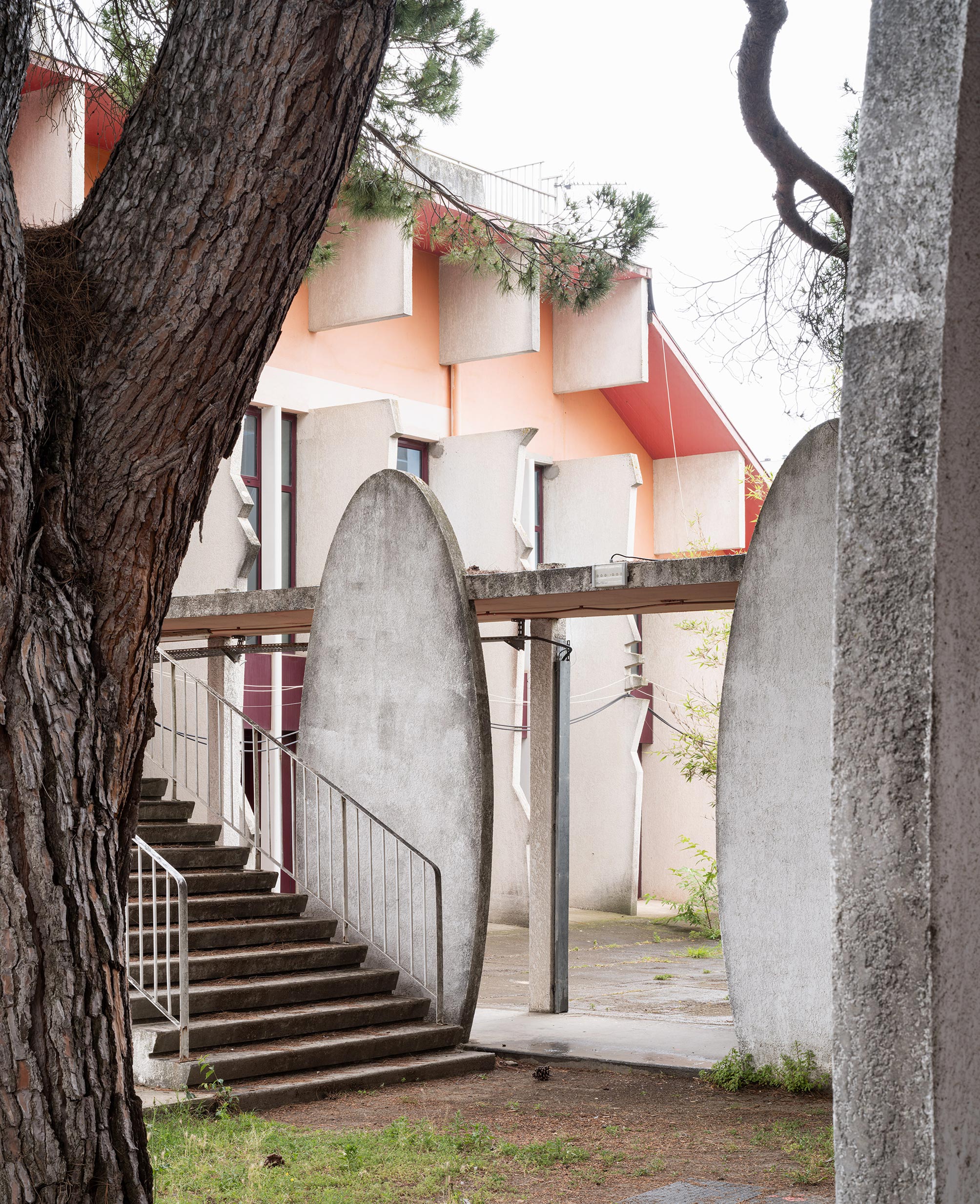
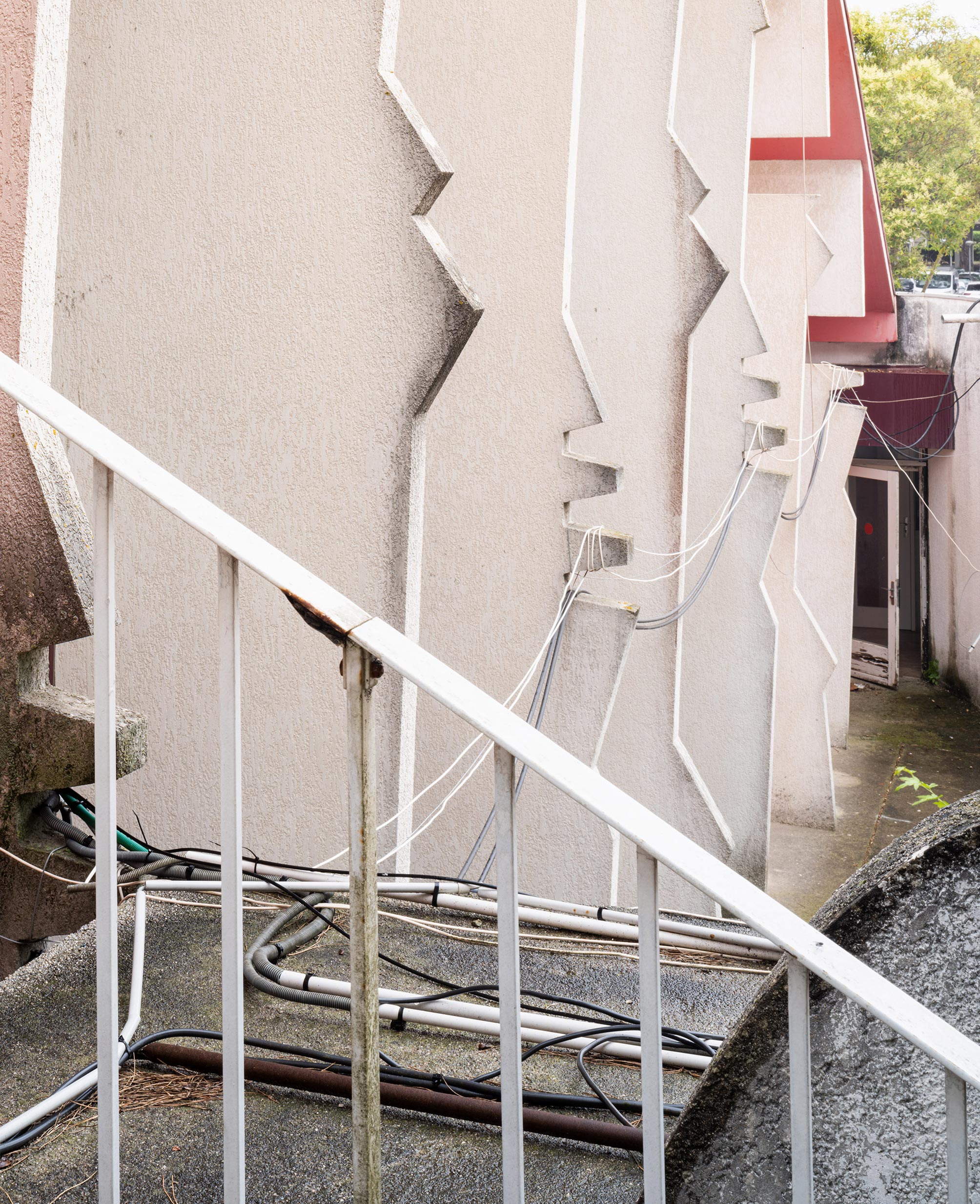
Built in 1969, the salle polyvalente1 in La Grande-Motte2 was the first venue where the residents – back when there were only 700 of them – could gather. Jean Balladur had envisioned an open-air theatre covered by a removable stretched canvas, adjacent to a single-storey multipurpose hall. The load-bearing structure, Balladur explained, consists of anthropomorphic columns sculpted by Albert Marchais: “My friend the sculptor, painter, poet and man of the theatre, Albert Marchais, devised the design for a sliding formwork that made it possible to cast the columns… they line up on either side of the hall in patterns that free them from the strict constraints of matter. This freedom is the joy of all sculpture.”3
The geometric forms that make up the hands and arms of these figures are today strung with cables carrying electricity and data.
Jean Balladur was never fond of the term ‘salle polyvalente’, he preferred ‘salle commune, dédié à la fête’ – a communal hall, dedicated to parties. Since 2019 it is officially the Centre Culturel Henri Dunoyer, after a former mayor.
La Grande-Motte is a seaside resort created by the Mission Racine, the state programme for the development of the Languedoc coastline in southern France. Intended as a holiday destination for the middle class in the 1970s, it is the work of architect Jean Balladur (1924–2002), who was tasked with designing the entire urban layout and architecture of the new town. He drew inspiration from pre-Columbian pyramids and from modernist architecture in Brazil, especially the work of Oscar Niemeyer. At a time when large housing complexes were going up all over France in the form of tower blocks and slabs, Balladur’s solutions were different enough that La Grande-Motte was a success from the very beginning.
« Mon ami le sculpteur, peintre, poète, homme de théâtre, Albert Marchais, a imaginé le dessin d’un coffrage glissant qui a permis de couler les poteaux… ils s’alignent de chaque côté de la salle dans des figures qui les affranchissent des strictes contraintes de la matière. Cette liberté fait le bonheur de toute sculpture. »
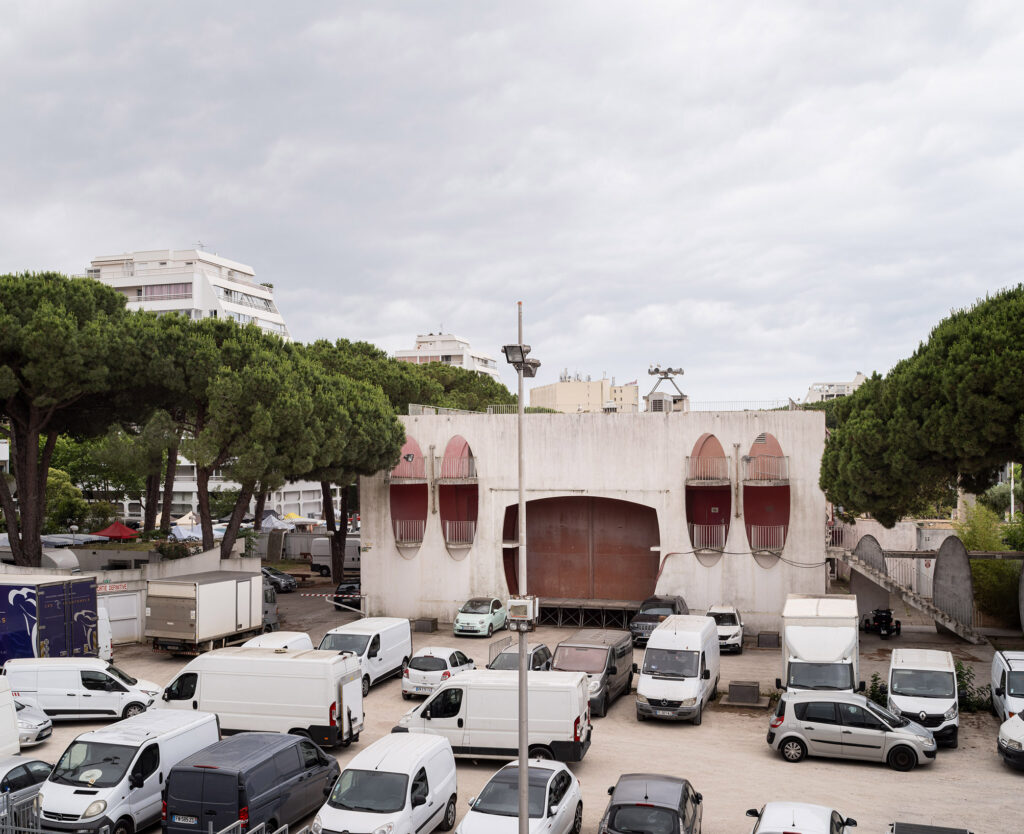
On market days, the parterre of the open-air theatre serves a a car park for the vendors’ vans and cars.
François, Michèle. Jean Balladur et la Grande-Motte: l’architecte d’une ville. Duo. Monuments historiques et objets d’art du Languedoc-Roussillon, Direction régionale des affaires culturelles, 2010, p. 41-42.
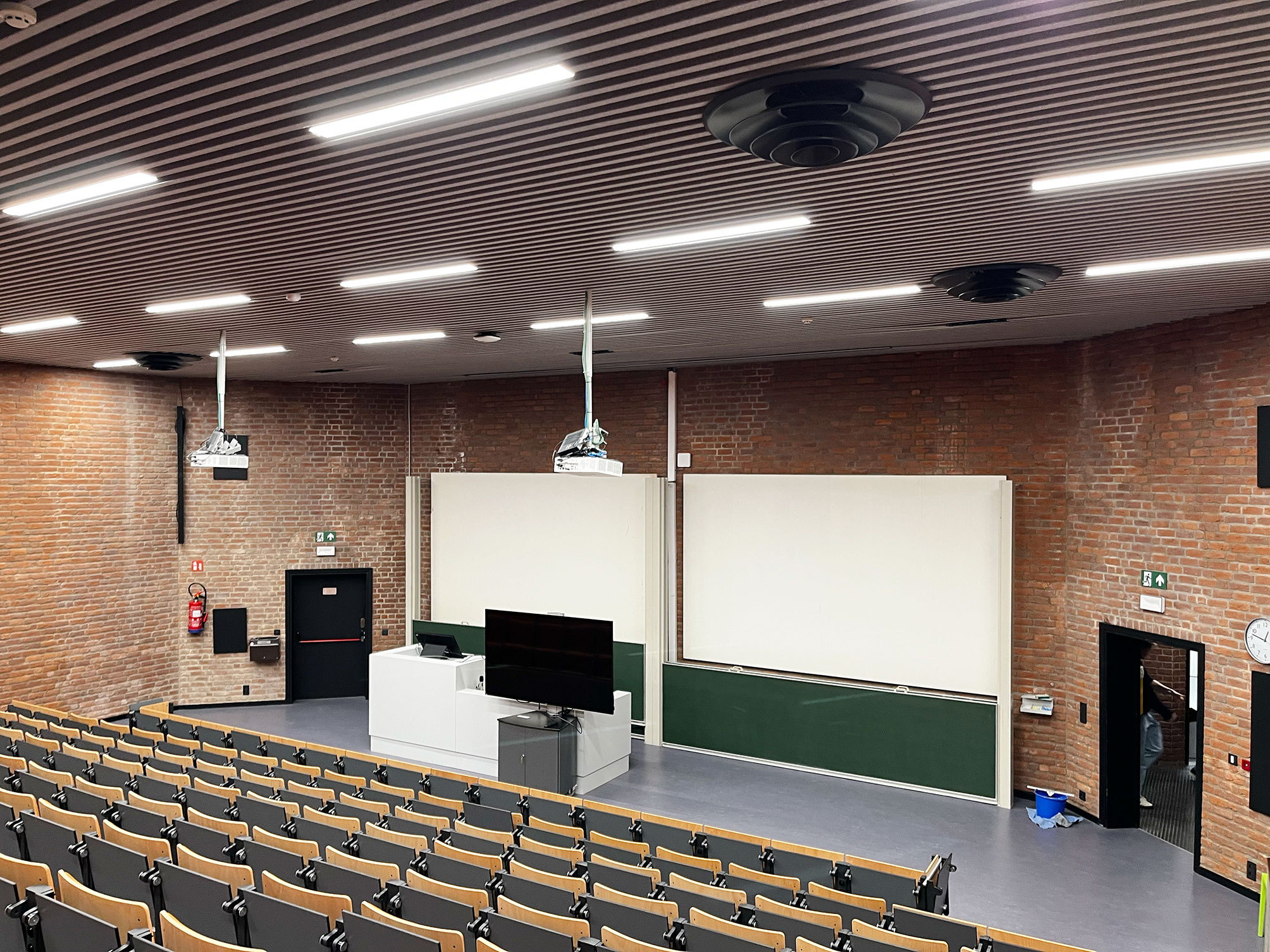
Today I was supposed to give an introduction to architectural photography. I had listed several approaches I would briefly touch on, showing work by Joel Sternfeld, Stephanie Kiwitt, Lynne Cohen, Thomas Ruff, Jeff Wall and Candida Höfer. I wanted to stress that the essence of architectural photography – and of photography as a whole – is to make the space outside the picture larger than the space within it.
The students never showed up. The secretary had forgotten to put my introduction on their timetable. While I was waiting in the empty auditorium, a colleague’s introduction to epidemiology in the auditorium next door suddenly boomed from my speakers.
‘Exit at the dock and kill some rats. Go around the building to the left, killing the guard and his rats before flipping the switch. Another guard arrives kill him too, taking the medkits from both your victims. Enter the now open front door and kill the guard on the balcony and his friend who appears on the ground floor. Grab the shells from your second kill then shoot out the window and kill the Dobermans who jump through when you get too close.’
Tomb Raider II. The Complete Guide to the Dagger of Xian. Downloaded from http://www.the-spoiler.com on 4 August, 1999, at 15:03.

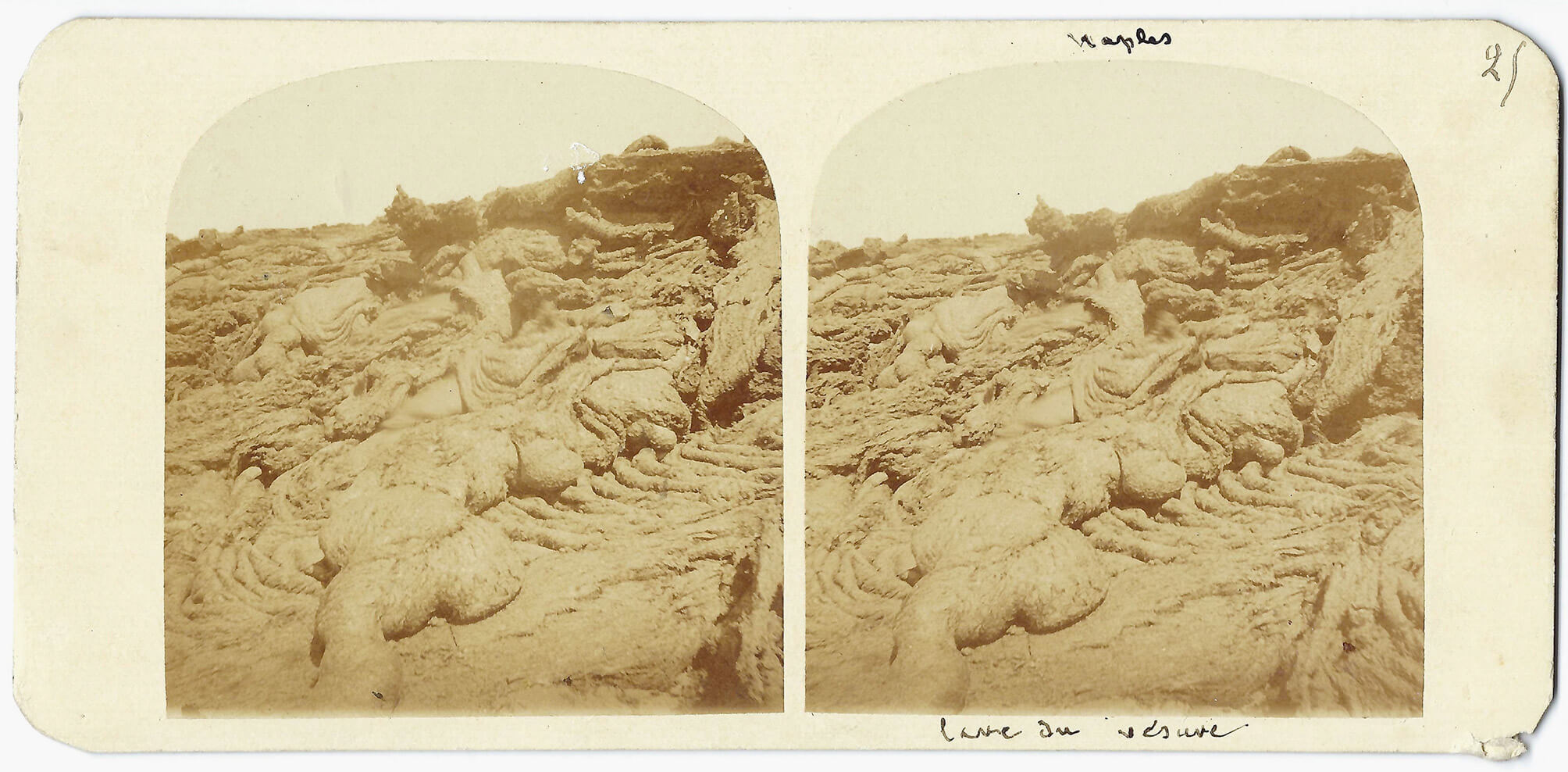
According to art critic Rosalind Krauss, nineteenth-century stereographic images presented ‘views’, not ‘landscapes’. Looking at a stereographic image through a stereoscope involves a particular experience that is altogether different from looking at other types of photographs, or paintings, as it is defined by ‘the isolation of the viewer with an image from which surrounding interference is masked out‘.1 An image of a violent and sudden eruption, higher up on the mountain, hanging next to a stereographic image of a petrified lava flow, would not be perceived.
Krauss, R. The Originality of the Avant-Garde and Other Modernist Myths. Cambridge, Mass./London: The MIT Press, 1986, 139.
The previous owners of the house we moved into, left us a piece of a newspaper that was used to clad the wall at the time the building was built, and which they found when they renovated the house. The sport-section of the socialist newspaper Vooruit is dated 18 November 1931. It features articles on cycling and soccer. Recently, we noticed the plaster is coming off the wall in one corner of the living room. With sufficient rain, it might reveal other events that happened on that 1931 November Wednesday.

Photographing the house and the clearing it stood in proved difficult. During summer, the nettles and brambles slowed down the pace. Some plants stung the elbows. The clearing only became visible when the sun fell through the opening in the canopy. On cloudy days the clearing disappeared.
‘As the order of institutions follows its course, or as huts give way to villages and then to cities and finally to cosmopolitan academies, the forests move further and further away from the center of the clearing. At the center one eventually forgets that one is dwelling in a clearing. […] Yet however wide the circle may get through the inertia of civic expansion, it presumably retains an edge of opacity where history meets the earth, where the human abode reaches its limits.’
Pogue Harrison, R. ‘The Ecology of Finitude’, in: id., Forests. Chicago, 1992, 245.

Depending on the language one chooses, the Wikipedia entry for ‘document’ shows a different picture. The French-language page shows what appears to be a Slovenian thesis written in 1984. The caption states it is a ‘book of Czechoslovak computer science author Květoslav Šoustal about computer networks’. The image was uploaded by Kelovy, a Slovakian mushroom-picker.
The anonymous hand rests on a lemon-yellow tablecloth, on which a yellow book and a blue binded file lie. The top left corner is the most intriguing, however: the tablecloth seems to be draped over a lemon, alongside a drinking glass. The cloth, however, does not get shaped by the lemon. Nor does the shadow-side of the lemon coincide with the shadow the other documents throw on the tablecloth. A closer look seems to indicate that the lemon is in fact an image of a lemon, printed on a plastic napkin.
The Russian wikipedia shows the image of a lease agreement. The German wikipedia for ‘document’ is text only.
https://fr.wikipedia.org/wiki/Document#/media/Fichier:KVETOSLAV_SOUSTAL_BOOK.JPG, created October 3, 2006 / original in original: paper, 1984

The planet Uranus should have followed a course as predicted by Newton’s laws. It didn’t. There were ‘residuals’, the 19th-century observers said: irregular data, which had to be interpreted as Uranus deviating from the projected trajectory. They could think of three possibilities. A) The planet Uranus was too far away from the Sun, which might render the Law of Gravitation invalid. B) The observations were incorrect. C) There was another planet, still further and yet unknown, with its own gravitational field and pull, causing Uranus to deviate from its course.
Following hypothesis C, astronomers predicted the position of a planet with a gravitational field, influencing Uranus, by means of mathematical calculations. Telescopes were directed to that calculated spot. There was a luminous point, with a touch of bright azure blue.

Gu Eryi’s Shanghainese opera film A Single Spark (1959) dramatises a violent confrontation between indentured labourers and their managers at the Japanese-owned Naigaiwata Company No. 7 Cotton Mill in 1925. The film’s protagonist is Yang Guiying, a peasant who moves to Shanghai to join her daughter only to find her at her last breath on the factory floor after being brutally beaten by her supervisor. The incident sparks protests among the workers at the factory, eventually resulting in one of them, Gu Zhenghong, being killed by a gunshot fired by a guard in the heat of the moment. This further escalates the unrest to a citywide scale, catalysing the May Thirtieth Movement.
The scenes of workers striking were filmed at Shenxin No. 9 Cotton Mill, also the location for another worker-themed film, United Until Tomorrow (1951). Those of Yang Guiying taking to the streets in support of anti-imperialism and patriotism were filmed at the Bund and the area surrounding Waibaidu Bridge. As for Naigaiwata Company No. 7 Cotton Mill where the events depicted in the film actually took place, the enterprise was merged with No. 5 and No. 8 Cotton Mills after the war and nationalised as Shanghai No. 2 Cotton Mill. Today, the site once occupied by the mill is a residential area where a statue of martyr Gu Zhenghong, first erected in 1959, stands before a memorial hall that was established in 2008.
Ho Rui An is an artist and writer working in the intersections of contemporary art, cinema, performance and theory. Through lectures, essays and films, his research examines the relations between labour, technology and capital across different systems of governance in a global age.
In spring 2024 the-documents.org and Trigger co-publish a series of online articles with a focus on the meeting ground between photography and the document.

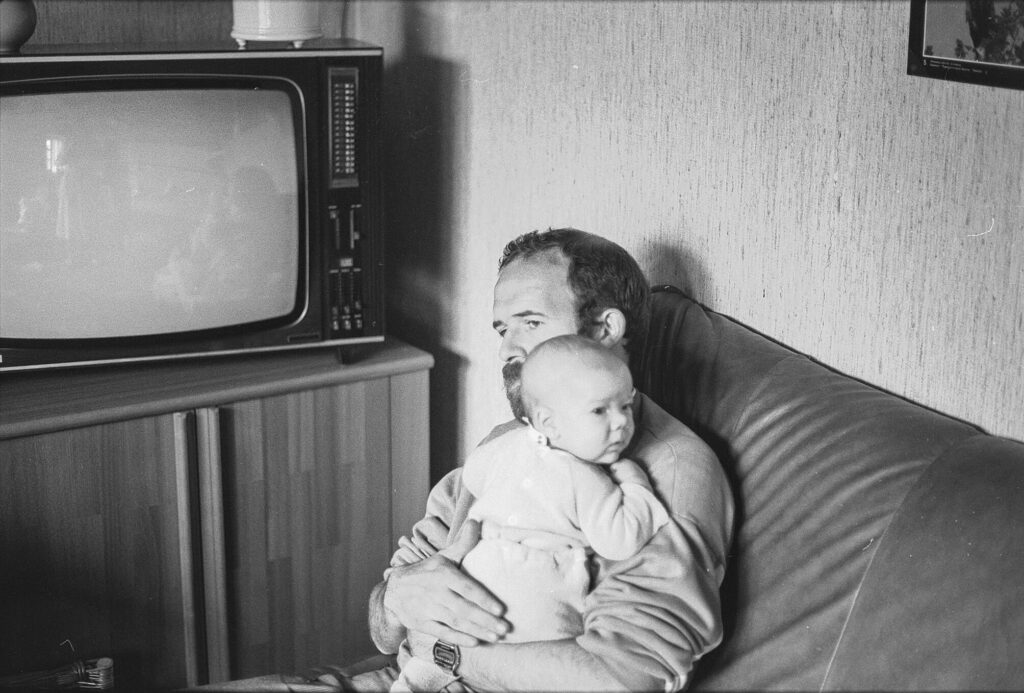
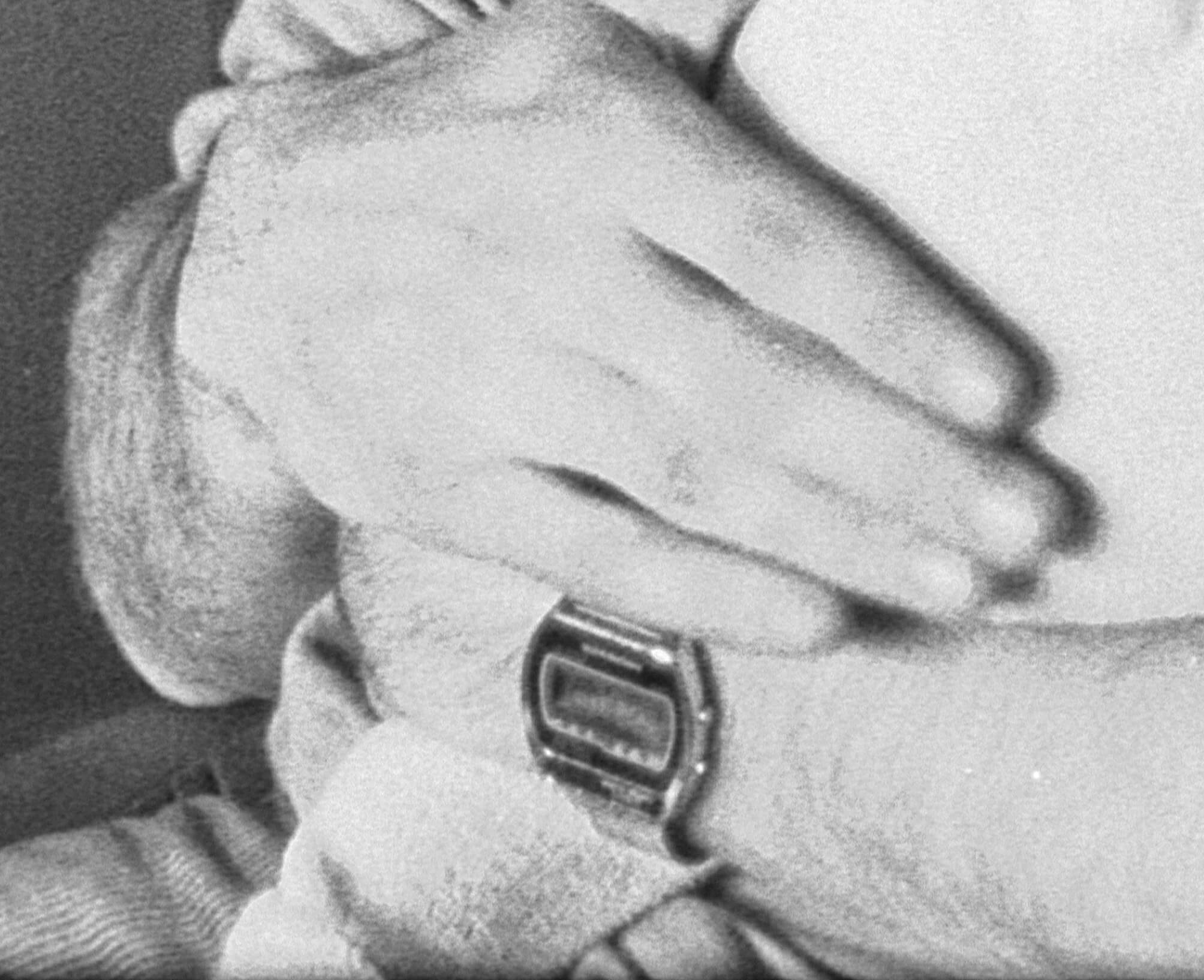
He’s wearing a digital watch. It looks like a Casio. It’s impossible to read the time, no matter whether you are studying the high-resolution scan of the negative or the negative itself, with the aid of a loupe and lightbox.
The device had a stopwatch function. When we were around eight and ten, we used to compete in trying to start and stop the stopwatch in the shortest possible interval. The smaller the gap, the closer to zero. Sometimes he would also have a try. We once managed to get it down to 00:00:00:03. Neither of us dared to press ‘reset’ and try again.
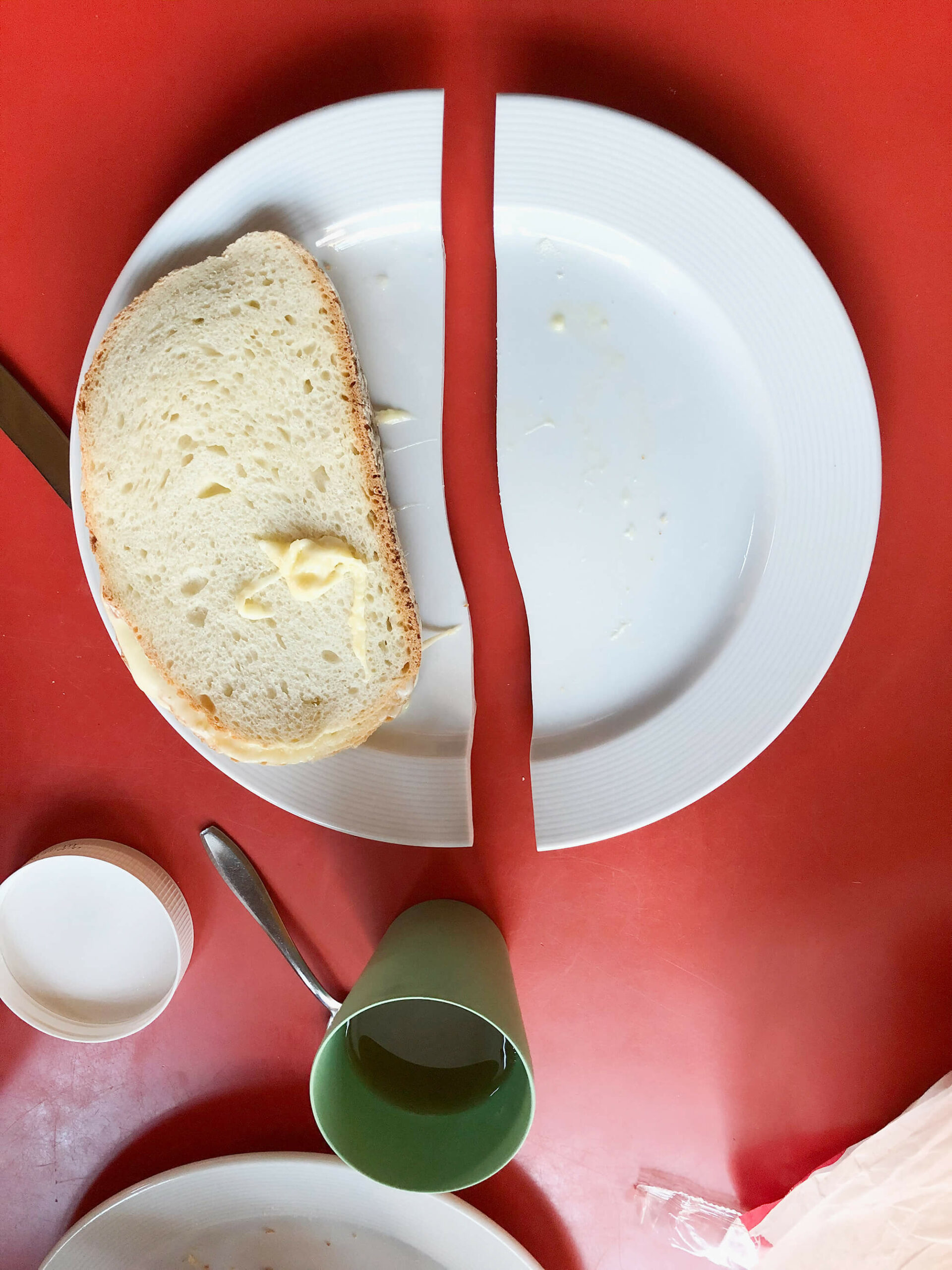
Most mornings I eat three slices of bread. I stack them. Between the highest slice and the one in the middle I put a slice of cheese (young Gouda). I put the whole in the microwave1 for 1 minute and 50 seconds. The result is what I like to call a smelteram2.
On the morning of my thirty-second birthday the plate broke in half during heating.
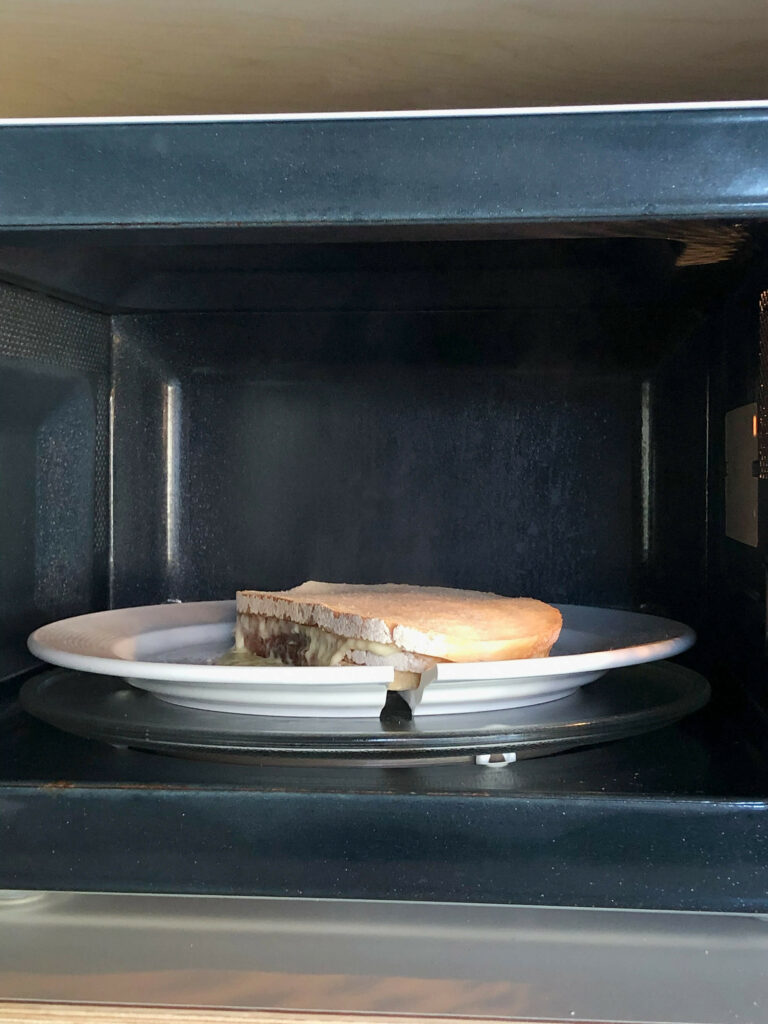
A contraction of smelten (Dutch for melting) and boterham (Dutch for a slice of bread).
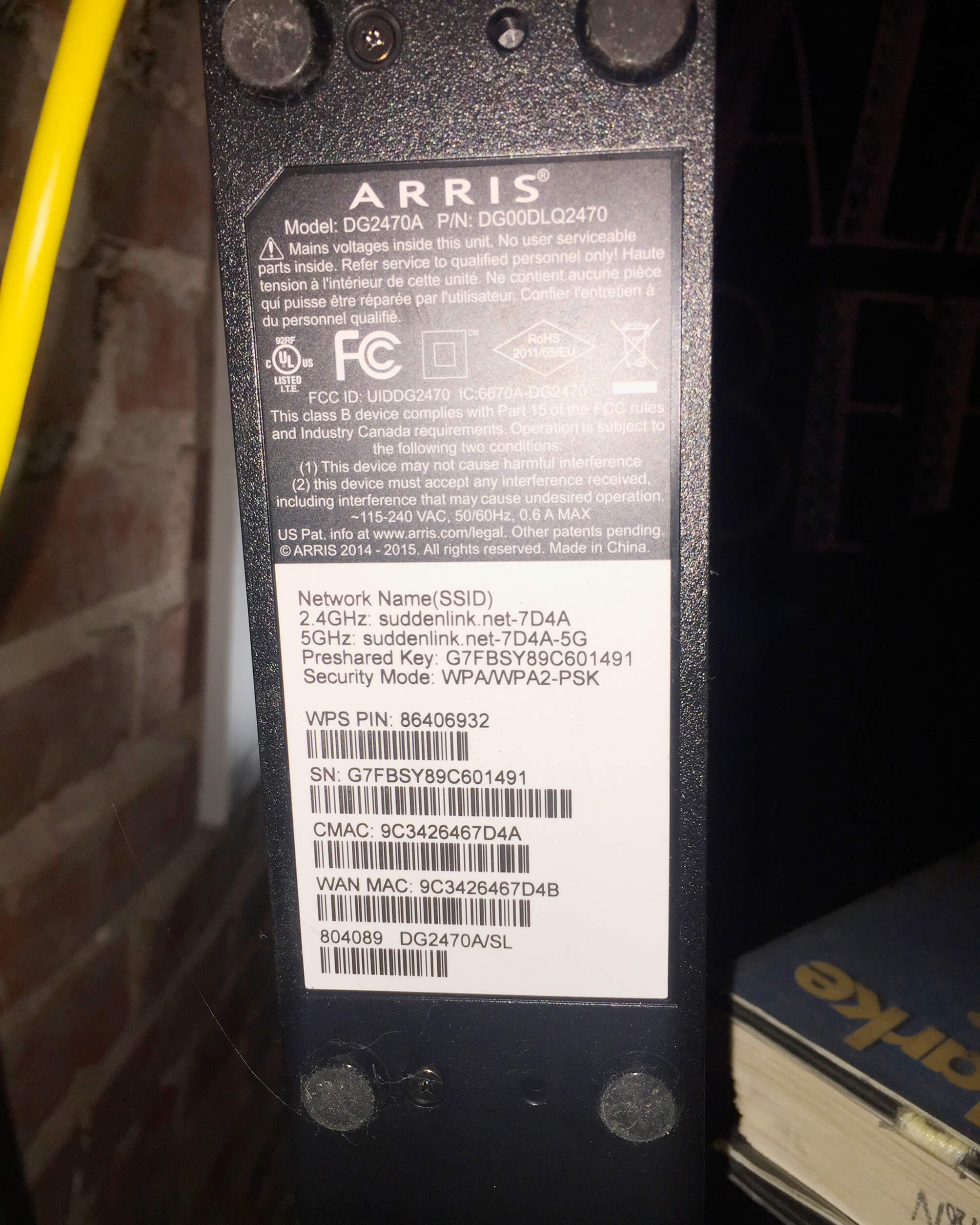
The bartender didn’t remember the passcode, so he pointed out where I could find it: on the bottom of the router box. Instead of trying to read the tiny numbers on the router label in the dark, while at the same time awkwardly typing it into my small, cumbersome smartphone keyboard, I decided to photograph the label. This allowed me to retreat back to my seat, zoom into the image and easily enter the code into my phone. The photograph immediately lost its value the moment this action was completed.
Max Pinckers (°1988, BE) and Victoria Gonzalez-Figueras (°1988, CA) are based in Brussels, Belgium. They have been working together for the past ten years on documentary photography projects. Victoria works in the cultural field as a researcher and producer. Max is a speculative documentarian, teacher and occasional writer on photography. They are married, in love, and have a son. Victoria has consistently assisted Max in his projects as a production manager, but they have recently been making new work together as co-authors. “Double Reward” is the first such project.
In spring 2024 the-documents.org and Trigger co-publish a series of online articles with a focus on the meeting ground between photography and the document.
A visit to the Royal Observatory of Belgium, in Ukkel. Most of the domes are damaged and need repairing. Only a few telescopes are in use. It is difficult to find a good spot from which to film the site. When we asked the people at the Royal Meteorological Institute – the Observatory’s neighbouring institution – if we could access their building’s roof to film the observatory, the answer was ‘no’.
I (M.D.C.) remember there was a fire nearby. We couldn’t see the flames, but a tall dark plume of smoke rose above the trees lining the site. We didn’t insist any longer and ceased our attempt to access the roof, hoping we might find a good spot to film the smoke with a dome in the foreground.
Kesteloot, J. Leerboek van Cosmografie voor Middelbaar en Lager Normaal Onderwijs (derde vermeerderde uitgave). Brugge: Firma Karel Beyaert, 1948.

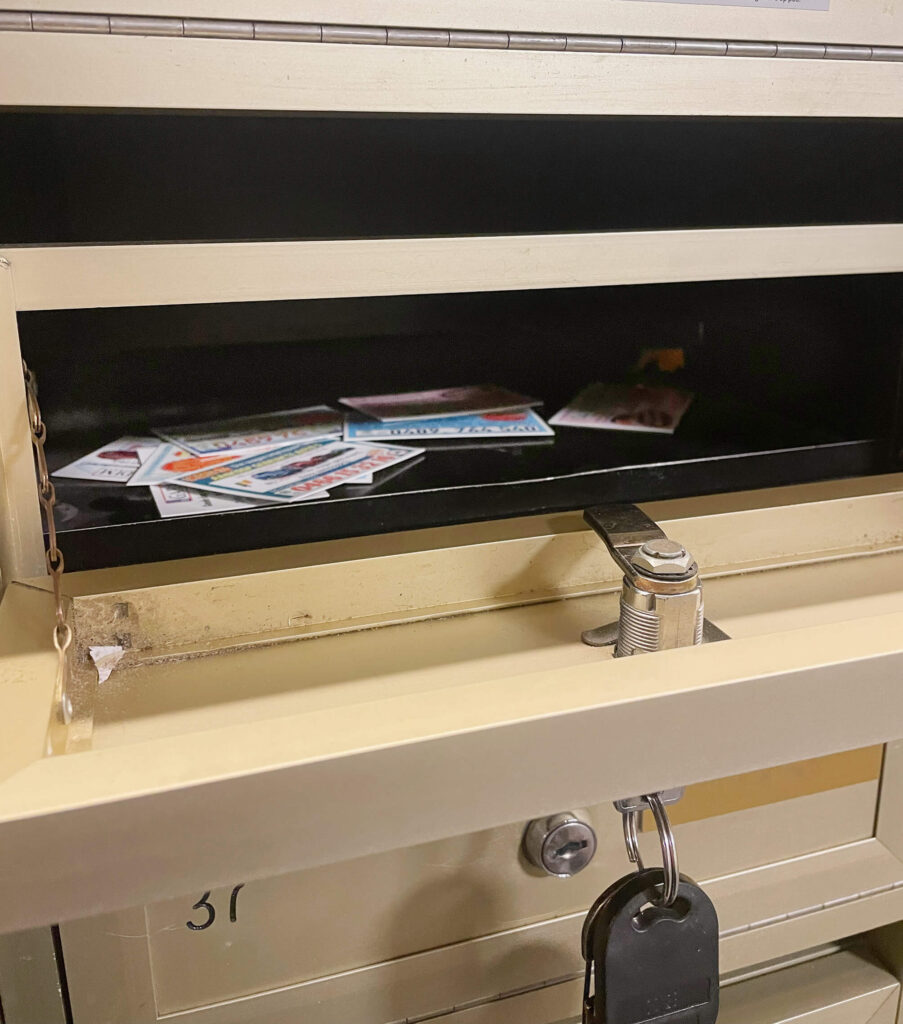
A year ago I moved into Solange’s appartement. From the balcony, I see half the parking lot and the adjacent high rise. On the mailbox, I haven’t replaced her name for mine.
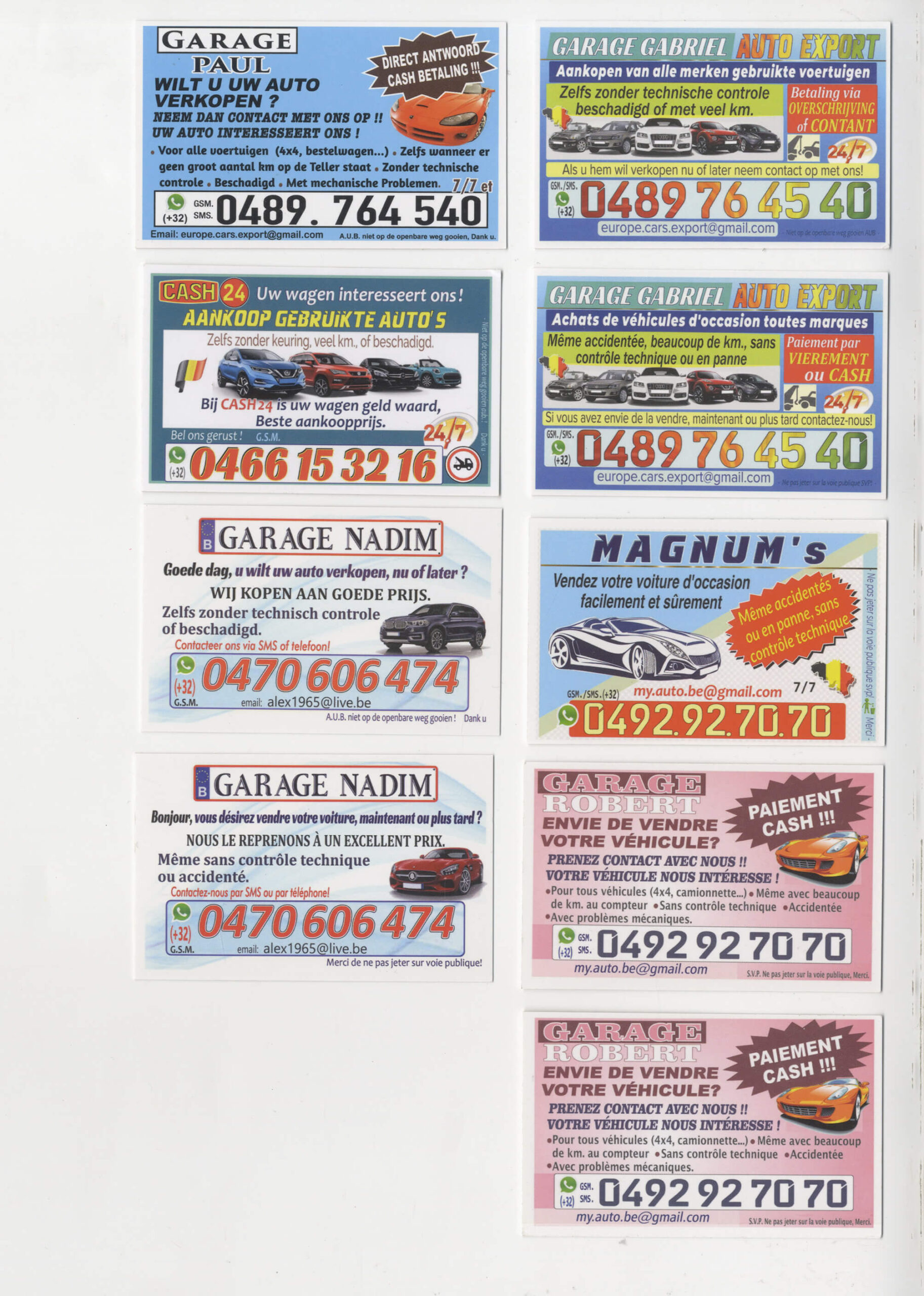
1. GARAGE PAUL, (+32) 0489. 764 540 / recto-verso NL/FR
2. CASH 24, (+32) 0466 15 32 16 / recto-verso NL/FR
3. GARAGE NADIM (+32) 0470 606 474 / recto-verso NL (1)
4. GARAGE NADIM (+32) 0470 606 474 / recto-verso FR (2)
5. GARAGE GABRIEL (+32) 0489 76 45 40 / recto-verso NL (1)
6. GARAGE GABRIEL (+32) 0489 76 45 40 / recto-verso FR (2)
7. MAGNUM’s (+32) 0492 92 70 70 / recto-verso FR
8. GARAGE ROBERT (+32) 0492 92 70 70 / recto-verso FR (1)
9. GARAGE ROBERT (+32) 0492 92 70 70 / recto-verso FR (2)
I don’t know whether Solange owned a car.
Bieke Criel, lives and works in Gent (BE). Intrigued by landscape, movement, light and the poetics of what lies in between. Does not own a car, loves to drive one. Part of 019.
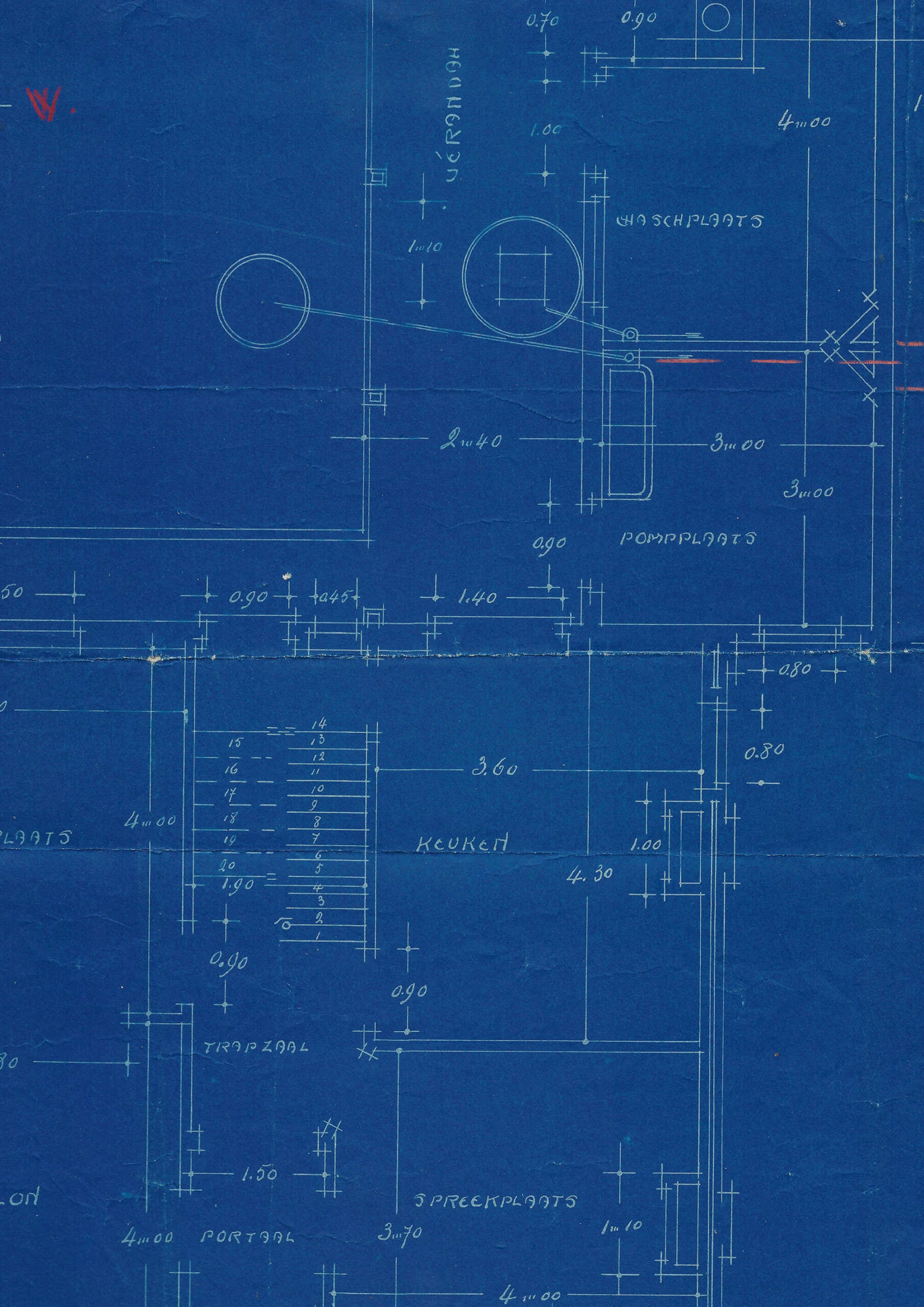
In the archive of the architect O. Clemminck, there is a piece of a plan of a building in a suburb in Gent. It presents the ground floor. There is a kitchen, a salon, an eating place, a meeting place. The missing part would have stated the exact address, the name, and maybe the profession of the owners. The plan of the first floor might have given an indication of the number of (anticipated) family members, based on the number and size of sleeping rooms.
At the southern edge of (the plan of) the lot, O. Clemminck has drawn a laundry room that gives out to a vérandah. The spelling of the Dutch word – nowadays written as veranda – is remarkable, as is its etymology, which is unclear and a matter of debate among scholars. The word might have Portuguese (varanda: railing) and Catalan roots (baranda: barrier), maybe also origins in the Lithuanian Žemaitan dialect (varanda: loop plaited from flexible wings) and might also be traced back to a Sanskrit root (varandaka: rampart separating two fighting elephants).
The vérandah O. Clemminck proposes is 2,40 meters by, at least, 2,80 meters.