What constitutes a ‘document’ and how does it function?
According to the Oxford English Dictionary, the etymological origin is the Latin ‘documentum’, meaning ‘lesson, proof, instance, specimen’. As a verb, it is ‘to prove or support (something) by documentary evidence’, and ‘to provide with documents’. The online version of the OED includes a draft addition, whereby a document (as a noun) is ‘a collection of data in digital form that is considered a single item and typically has a unique filename by which it can be stored, retrieved, or transmitted (as a file, a spreadsheet, or a graphic)’. The current use of the noun ‘document’ is defined as ‘something written, inscribed, etc., which furnishes evidence or information upon any subject, as a manuscript, title-deed, tomb-stone, coin, picture, etc.’ (emphasis added).
Both ‘something’ and that first ‘etc.’ leave ample room for discussion. A document doubts whether it functions as something unique, or as something reproducible. A passport is a document, but a flyer equally so. Moreover, there is a circular reasoning: to document is ‘to provide with documents’. Defining (the functioning of) a document most likely involves ideas of communication, information, evidence, inscriptions, and implies notions of objectivity and neutrality – but the document is neither reducible to one of them, nor is it equal to their sum. It is hard to pinpoint it, as it disperses into and is affected by other fields: it is intrinsically tied to the history of media and to important currents in literature, photography and art; it is linked to epistemic and power structures. However ubiquitous it is, as an often tangible thing in our environment, and as a concept, a document deranges.
the-documents.org continuously gathers documents and provides them with a short textual description, explanation,
or digression, written by multiple authors. In Paper Knowledge, Lisa Gitelman paraphrases ‘documentalist’ Suzanne Briet, stating that ‘an antelope running wild would not be a document, but an antelope taken into a zoo would be one, presumably because it would then be framed – or reframed – as an example, specimen, or instance’. The gathered files are all documents – if they weren’t before publication, they now are. That is what the-documents.org, irreversibly, does. It is a zoo turning an antelope into an ‘antelope’.
As you made your way through the collection,
the-documents.org tracked the entries you viewed.
It documented your path through the website.
As such, the time spent on the-documents.org turned
into this – a new document.
This document was compiled by ____ on 28.10.2026 16:26, printed on ____ and contains 24 documents on _ pages.
(https://the-documents.org/log/28-10-2026-6935/)
the-documents.org is a project created and edited by De Cleene De Cleene; design & development by atelier Haegeman Temmerman.
the-documents.org has been online since 23.05.2021.
- De Cleene De Cleene is Michiel De Cleene and Arnout De Cleene. Together they form a research group that focusses on novel ways of approaching the everyday, by artistic means and from a cultural and critical perspective.
www.decleenedecleene.be / info@decleenedecleene.be - This project was made possible with the support of the Flemish Government and KASK & Conservatorium, the school of arts of HOGENT and Howest. It is part of the research project Documenting Objects, financed by the HOGENT Arts Research Fund.
- Briet, S. Qu’est-ce que la documentation? Paris: Edit, 1951.
- Gitelman, L. Paper Knowledge. Toward a Media History of Documents.
Durham/ London: Duke University Press, 2014. - Oxford English Dictionary Online. Accessed on 13.05.2021.

Built in 1969, the salle polyvalente1 in La Grande-Motte2 was the first venue where the residents – back when there were only 700 of them – could gather. Jean Balladur had envisioned an open-air theatre covered by a removable stretched canvas, adjacent to a single-storey multipurpose hall. The load-bearing structure, Balladur explained, consists of anthropomorphic columns sculpted by Albert Marchais: “My friend the sculptor, painter, poet and man of the theatre, Albert Marchais, devised the design for a sliding formwork that made it possible to cast the columns… they line up on either side of the hall in patterns that free them from the strict constraints of matter. This freedom is the joy of all sculpture.”3
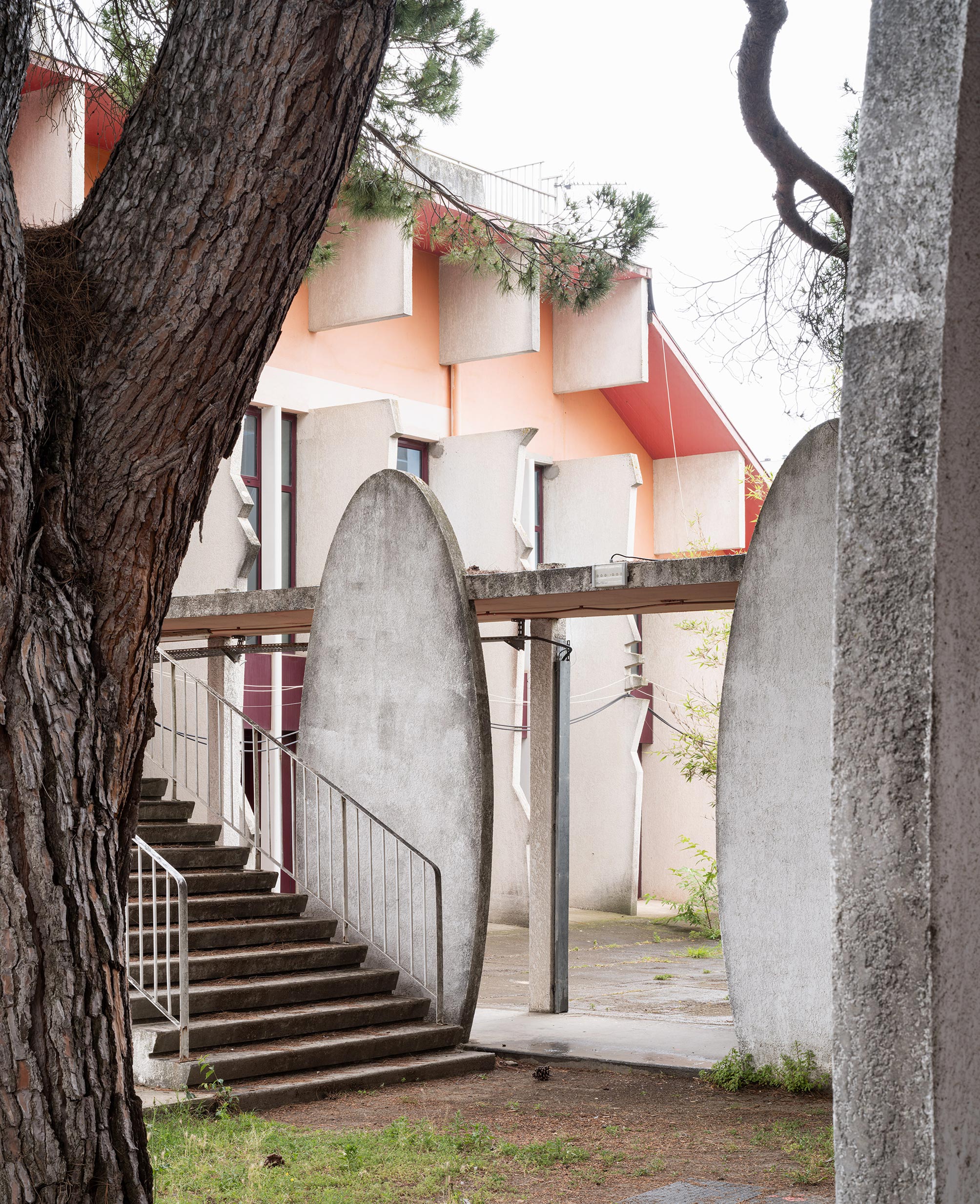
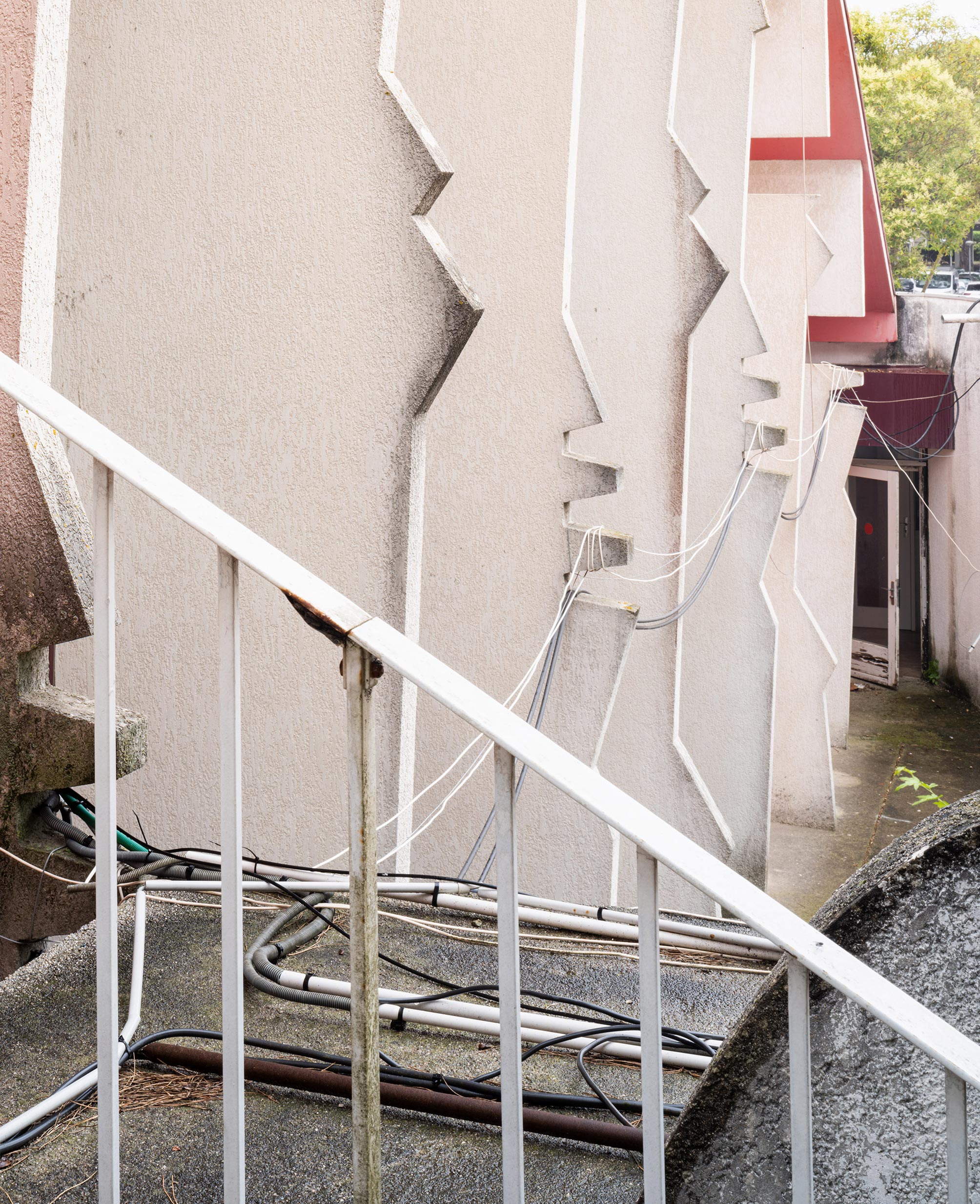
The geometric forms that make up the hands and arms of these figures are today strung with cables carrying electricity and data.
Jean Balladur was never fond of the term ‘salle polyvalente’, he preferred ‘salle commune, dédié à la fête’ – a communal hall, dedicated to parties. Since 2019 it is officially the Centre Culturel Henri Dunoyer, after a former mayor.
La Grande-Motte is a seaside resort created by the Mission Racine, the state programme for the development of the Languedoc coastline in southern France. Intended as a holiday destination for the middle class in the 1970s, it is the work of architect Jean Balladur (1924–2002), who was tasked with designing the entire urban layout and architecture of the new town. He drew inspiration from pre-Columbian pyramids and from modernist architecture in Brazil, especially the work of Oscar Niemeyer. At a time when large housing complexes were going up all over France in the form of tower blocks and slabs, Balladur’s solutions were different enough that La Grande-Motte was a success from the very beginning.
« Mon ami le sculpteur, peintre, poète, homme de théâtre, Albert Marchais, a imaginé le dessin d’un coffrage glissant qui a permis de couler les poteaux… ils s’alignent de chaque côté de la salle dans des figures qui les affranchissent des strictes contraintes de la matière. Cette liberté fait le bonheur de toute sculpture. »
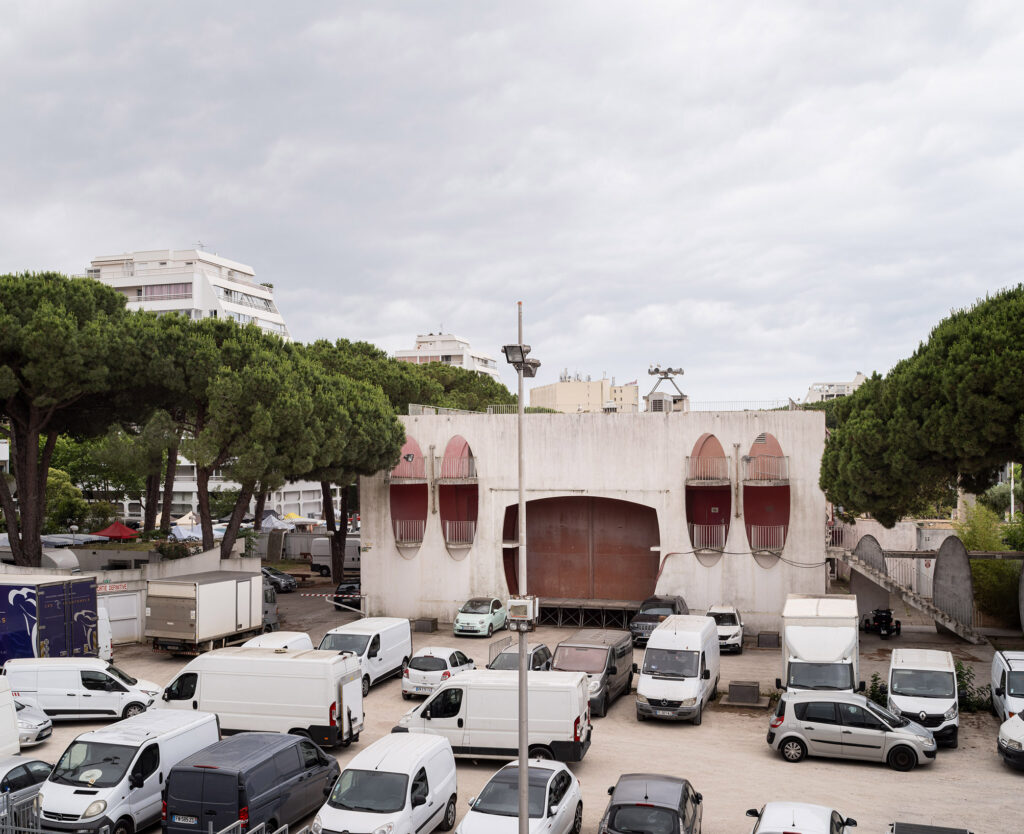
On market days, the parterre of the open-air theatre serves a a car park for the vendors’ vans and cars.
François, Michèle. Jean Balladur et la Grande-Motte: l’architecte d’une ville. Duo. Monuments historiques et objets d’art du Languedoc-Roussillon, Direction régionale des affaires culturelles, 2010, p. 41-42.
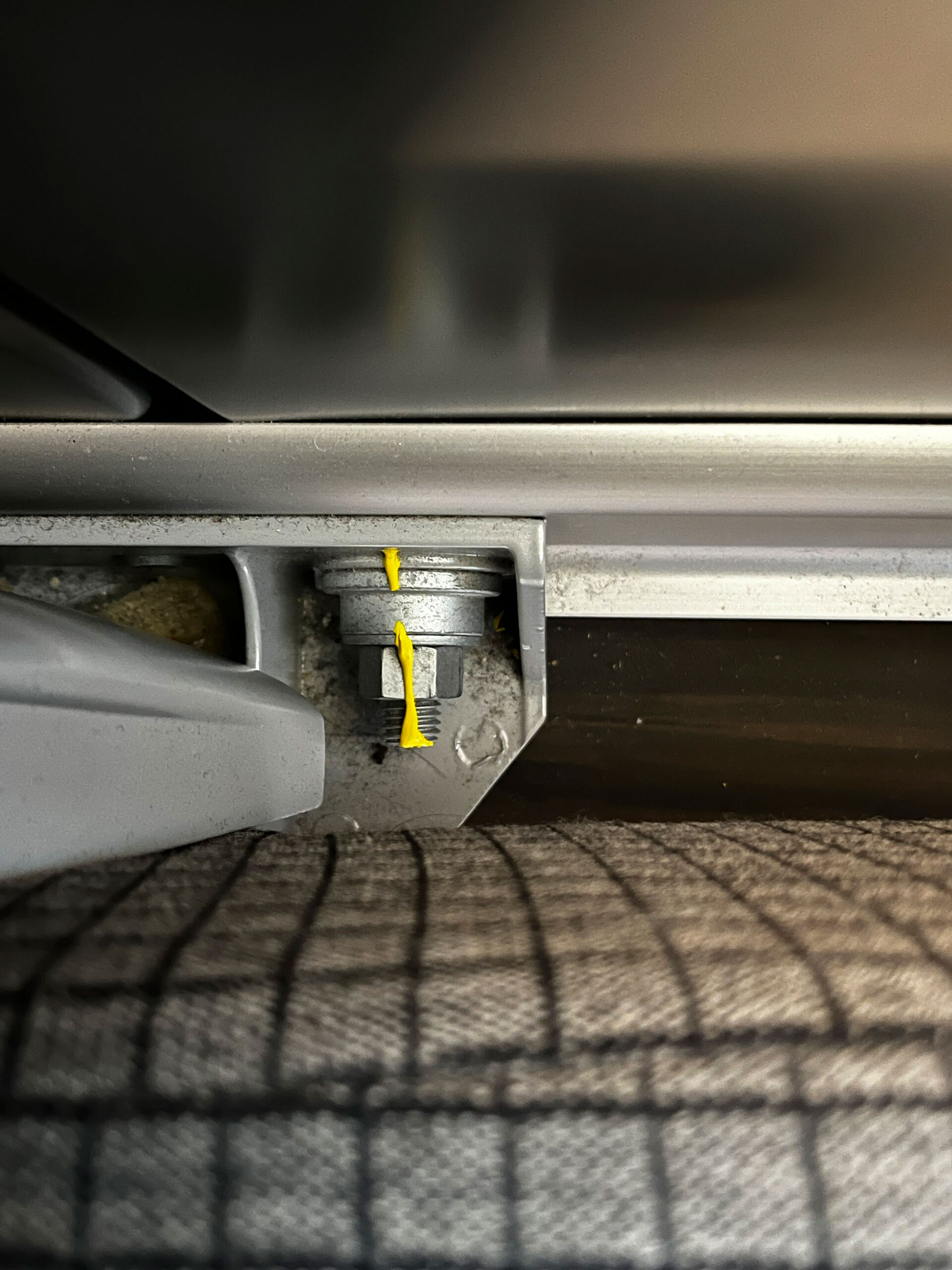
On the train between Brussels and Leuven someone appears to have spilled bright yellow mustard in a straight line onto the bolt, washer and nut that attach my seat to the structure of the carriage.
Hours later, on the train home, a similar bead. The mustard is hard and somewhat brittle1 beneath my index finger.
I search the internet for ‘lijntje verf op bout en moer’. Torque seal is a brightly colored paste applied across a tightened nut and bolt to provide a quick visual check of whether the fastener has moved or loosened due to shock, vibration or tampering. According to the same search, DIY enthusiasts often use nail polish.

The last couple of days have been dry. Rain is expected for the weekend. The office buckets are in place and are empty, except for some residue. Dirt, sand, a few hairs. Some particles must have come along with the drops when they made their way through the roof.

On May 7th, 1992, an anonymous photographer records the ice cellar, a stone’s throw from my parents’ house. It’s a beautiful day in spring. Quite a bit of wind, it seems. A Thursday. Surely, I am at school. Third grade kindergarten. It houses bats.
The photograph is part of an online heritage inventory, maintained by a government department. On the same day, the photographer took a photograph of the orangery, the entrance gate to the allotment, and the castle.
https://id.erfgoed.net/afbeeldingen/264680

“… the late-Gothic St Mary’s Church in Sandersleben … was consecrated in 1519, just two years after Martin Luther published his Ninety-five Theses. After extensive renovation, part of it is still home to Sandersleben’s Protestant community. The building spans the historical period encountered throughout this region, the various stages of which continue to resonate today. Parts of the church predate the Reformation and the Peasants’ War; its tower, for instance, was initially a city tower before its subsequent role as a watchtower. The contemporary folding glass barrier inside the church is a nod to the future. Since 2013, this feature has enabled the church to host secular events, as it separates the choir from the nave. The significance of a structure or place is derived from its function. If it ceases to serve a purpose or meet a need, it loses its societal relevance. This lack of societal meaning becomes evident in its dilapidation and, ultimately, in its decay, removal or demolition. Lesser-known structures that haven’t been captured in photographs or documented can thus vanish completely, leaving no archaeological footprint, especially when replaced by new constructions. They leave no vestiges behind, not even a trace, which is usually an indicator of the presence of nothingness …”1
Sequence of images from Flächenland/Sprawling Region
Stephanie Kiwitt (1972) is an artist based in Halle (Saale), Germany. Utilizing a large number of images, various perspectives and also textual elements, she is known for her insightful photography that explores spaces emblematic of contemporary phenomena. Over the past three years, she has focused on evolving habitats in rural areas, photographing traces of transformation and conducting interviews in Saxony-Anhalt, the region she moved to in 2020. From 2018 to 2020, Kiwitt was a guest lecturer at the LUCA School of Arts in Brussels.
In spring 2024 the-documents.org and Trigger co-publish a series of online articles with a focus on the meeting ground between photography and the document.
Jonathan Everts, ‘A Long Farewell to the Present’, Flächenland (2020–22), Stephanie Kiwitt, Spector Books, Leipzig, 2023

Gu Eryi’s Shanghainese opera film A Single Spark (1959) dramatises a violent confrontation between indentured labourers and their managers at the Japanese-owned Naigaiwata Company No. 7 Cotton Mill in 1925. The film’s protagonist is Yang Guiying, a peasant who moves to Shanghai to join her daughter only to find her at her last breath on the factory floor after being brutally beaten by her supervisor. The incident sparks protests among the workers at the factory, eventually resulting in one of them, Gu Zhenghong, being killed by a gunshot fired by a guard in the heat of the moment. This further escalates the unrest to a citywide scale, catalysing the May Thirtieth Movement.
The scenes of workers striking were filmed at Shenxin No. 9 Cotton Mill, also the location for another worker-themed film, United Until Tomorrow (1951). Those of Yang Guiying taking to the streets in support of anti-imperialism and patriotism were filmed at the Bund and the area surrounding Waibaidu Bridge. As for Naigaiwata Company No. 7 Cotton Mill where the events depicted in the film actually took place, the enterprise was merged with No. 5 and No. 8 Cotton Mills after the war and nationalised as Shanghai No. 2 Cotton Mill. Today, the site once occupied by the mill is a residential area where a statue of martyr Gu Zhenghong, first erected in 1959, stands before a memorial hall that was established in 2008.
Ho Rui An is an artist and writer working in the intersections of contemporary art, cinema, performance and theory. Through lectures, essays and films, his research examines the relations between labour, technology and capital across different systems of governance in a global age.
In spring 2024 the-documents.org and Trigger co-publish a series of online articles with a focus on the meeting ground between photography and the document.

United Until Tomorrow (1951) is based on the real-life events that took place at Shanghai’s Shenxin No. 9 Cotton Mill where workers led a factory-wide strike in 1948 to protest salary arrears against the background of escalating inflation. Shot at the original location of the strike, the film shows the entrance of the cotton mill transformed into a literal and ideological battlefield where workers gain class consciousness and fight to reclaim their rightful place as owners of the factory. In one climactic scene, the workers even seal the factory gate from the outside to prevent the products of their labour from being expropriated by Kuomintang forces.
Located at No. 128, Aomen Road, Shanghai, Shenxin No. 9 Cotton Mill belonged to the system of mills managed by Shenxin Textile Company, a private enterprise founded in 1915 by Wuxi-bred industrialist brothers Rong Zongjing and Rong Desheng. Following the Communist takeover of Shanghai, the cotton mill was nationalised in the 1950s and placed under the management of the Shanghai Textile Industry Bureau. With the subsequent launch of the economic reforms, the bureau was restructured into a holding company in 1998 amidst the deindustrialisation of the city. While many iconic buildings in the Shanghai Bund area today can be seen in the film, little remains of the original architecture of No. 9 Cotton Mill where the Shanghai Textile Museum is now located.
Ho Rui An is an artist and writer working in the intersections of contemporary art, cinema, performance and theory. Through lectures, essays and films, his research examines the relations between labour, technology and capital across different systems of governance in a global age.
In spring 2024 the-documents.org and Trigger co-publish a series of online articles with a focus on the meeting ground between photography and the document.

In the world of National Geographic, white people overlooking a landscape are not uncommon. “The Red Shirt School of Photography” was a label used to describe National Geographic photographers who allegedly brought red clothing and props with them on assignment to put on their subjects in order to make better photographs when working with Kodachrome film, which is famous for its capability of rendering rich colors. Overlooking a landscape wearing red, the observer asserts dominance over the land. They glorify it, seeing a country that is beautiful, rich in resources, and therefore “worth taking”.
Max Pinckers (°1988, BE) and Victoria Gonzalez-Figueras (°1988, CA) are based in Brussels, Belgium. They have been working together for the past ten years on documentary photography projects. Victoria works in the cultural field as a researcher and producer. Max is a speculative documentarian, teacher and occasional writer on photography. They are married, in love, and have a son. Victoria has consistently assisted Max in his projects as a production manager, but they have recently been making new work together as co-authors. “Double Reward” is the first such project.
In spring 2024 the-documents.org and Trigger co-publish a series of online articles with a focus on the meeting ground between photography and the document.

Getty Images charges a fee for the use of a 1953 image depicting Mau Mau detainees building a wall. Working together with the Bristol Archives in the case of this collection, Getty claims to sell services such as “image search tools” and “research support”. These images are public domain and in fact available for free but as long as Getty does not charge the fee as a copyright claim, there is no legal obstacle to charging money for images to which they hold no copyright.
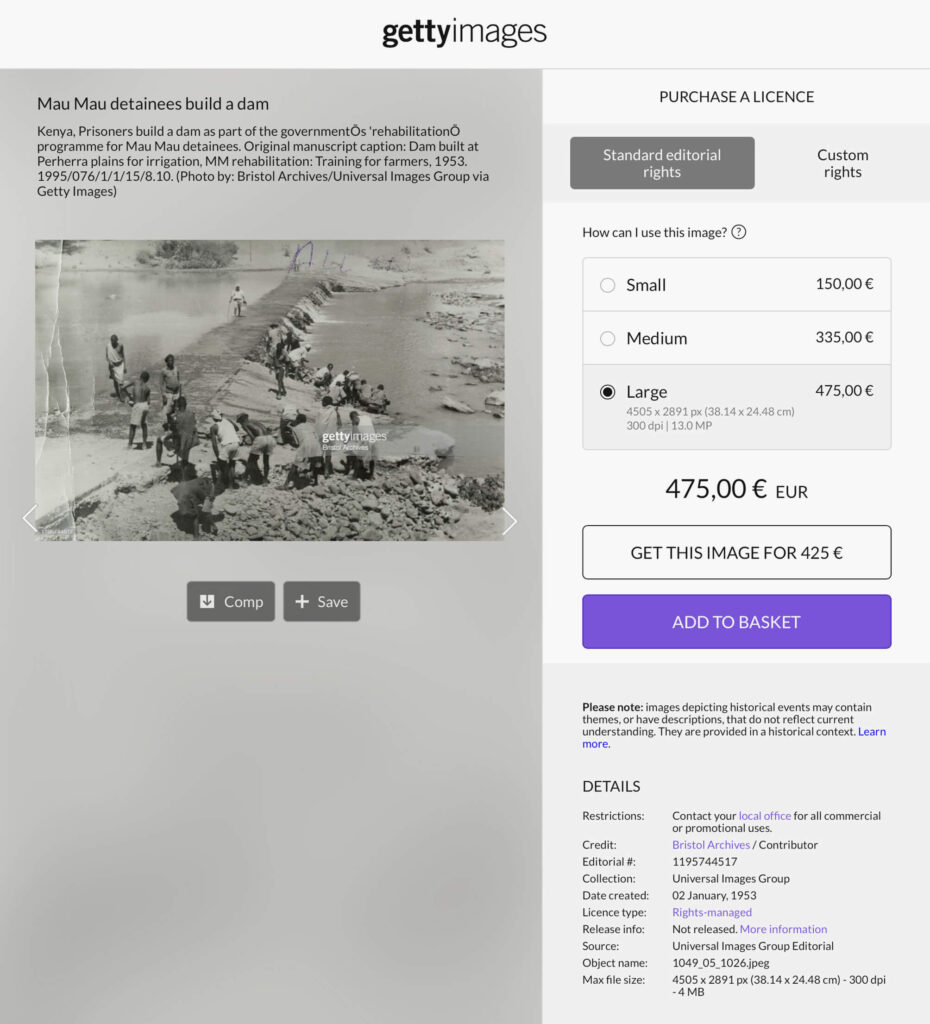
Mau Mau detainees build a dam, 1953, Elspeth Huxley (1995/076/1/1/15/8.10). British Empire & Commonwealth Collection, Bristol Archives, UK Public domain
Max Pinckers (°1988, BE) and Victoria Gonzalez-Figueras (°1988, CA) are based in Brussels, Belgium. They have been working together for the past ten years on documentary photography projects. Victoria works in the cultural field as a researcher and producer. Max is a speculative documentarian, teacher and occasional writer on photography. They are married, in love, and have a son. Victoria has consistently assisted Max in his projects as a production manager, but they have recently been making new work together as co-authors. “Double Reward” is the first such project.
In spring 2024 the-documents.org and Trigger co-publish a series of online articles with a focus on the meeting ground between photography and the document.


‘No consent was given for the photograph to be taken. The capture of my body in this way is a form of torture.
The photograph is evidence of the entitled authority and fundamental corruptions of the male soldiers and the occupying military forces.’
Screenshot from film chapter In Her View which engages an archival document revealing the sexual exploitation of an anonymous woman by occupying Australian soldiers fighting for the Allied forces in Lebanon in 1941. The film moves through the archival evidence to sense, trace and position her encounter as a formation of poetic testimony. The image shows extracted noise, levels, focal length and balance from the archive image to generate a 3D model of its violent points of interaction, this is without showing the image itself. A technique developed with Anabel Garcia-Kurland on human/non-human modelling in the making of the film.
Frame of Accountability, 01:00:00, Helene Kazan, 2024.
Helene Kazan is an artist, writer and educator. Her work investigates ‘risk’ as a lived condition produced through the conjoined violent effects of capitalism and conflict. This is observed in the colonial roots of international law and its material formation of the lived-built environment. In response, she uses decolonial, feminist, poetic and critical-legal approaches in her work, which explores ways of dismantling the ongoing effects of neo-colonial violence towards wider frameworks of accountability and justice.
In spring 2024 the-documents.org and Trigger co-publish a series of online articles with a focus on the meeting ground between photography and the document.

‘Dust particles flew off the box, disturbed by my opening. Adding to the sense that this archival material was vibrating under the weight of its unknown importance. Amidst the boxes of ‘Top Secret’ British governments documents, I find a map labelled ‘Syria’ 3.6.41.’
Screenshot from film chapter (Un)Touching Ground. A decolonial audio visual translation of an archival map reveals the effects of the Allied military campaign into Lebanon and Syria in 1941.
Frame of Accountability, 01:00:00, Helene Kazan, 2024.
Through film, installation, writing and public engagement Frame of Accountability investigates ‘risk’ as a lived condition, produced through the co-evolution of capitalist systems and violent conflict. The project focuses on the effects across Lebanon and Syria, with a view to understanding the wider regional and global consequences. Using poetic and critical-legal methods, the work explores ways of dismantling violence perpetrated through colonial mechanisms of governance, towards wider frameworks of accountability and justice. The work is produced in multi-part, non-linear formation.
Helene Kazan is an artist, writer and educator. Her work investigates ‘risk’ as a lived condition produced through the conjoined violent effects of capitalism and conflict. This is observed in the colonial roots of international law and its material formation of the lived-built environment. In response, she uses decolonial, feminist, poetic and critical-legal approaches in her work, which explores ways of dismantling the ongoing effects of neo-colonial violence towards wider frameworks of accountability and justice.
In spring 2024 the-documents.org and Trigger co-publish a series of online articles with a focus on the meeting ground between photography and the document.

When we bought our house more than a decade ago, we were told it was listed as architectural heritage.1 The house used to be part of the Heynderyckx Foundry, in part designed by architect F. Dierkens. When submitting the planning application in the run-up to the renovation, it was therefore mandatory to include a report from the city’s heritage conservation department. They asked for plans of the proposed changes, as well as plans and photographs of the situation as it is.
The department’s advice came a few weeks later. ‘With the exception of the fireplace with its marble mantelpiece in the room at the street side on the ground floor, this building has lost many of its architectural features. The façade rendering with faux joints, the vertical pilasters with their capitals, the central curved façade finish and the joinery are elements that defined the façade and have been removed. The new design is therefore acceptable subject to the following comments:
– preservation of the marble fireplace on the ground floor.’
We replied: ‘Unfortunately, the marble mantelpiece on the ground floor is not original either. We suspect that the original fireplace disappeared along with the façade, sometime in the seventies. The mantelpiece you can see in the image is an approximation of, and a reference to, what we imagine it might once have looked like. This replica is made of sheets of MDF with a layer of Formica F3460 – Calacatta Marble.’
Formica still produces these sheets.2 They measure 3,05 x 1,3m. Similar to wallpaper, the same marble pattern appears twice on every sheet, seamlessly.


https://inventaris.onroerenderfgoed.be/erfgoedobjecten/18442
https://www.formica.com/nl-be/products/laminate/F3460

July. Our eight-month-old son has a fever. We have a hard time getting him to drink enough. The tally marks on the back of a tortellini-box keep track of the diapers he wets and the millilitres of milk and electrolytes he’s able to hold down.
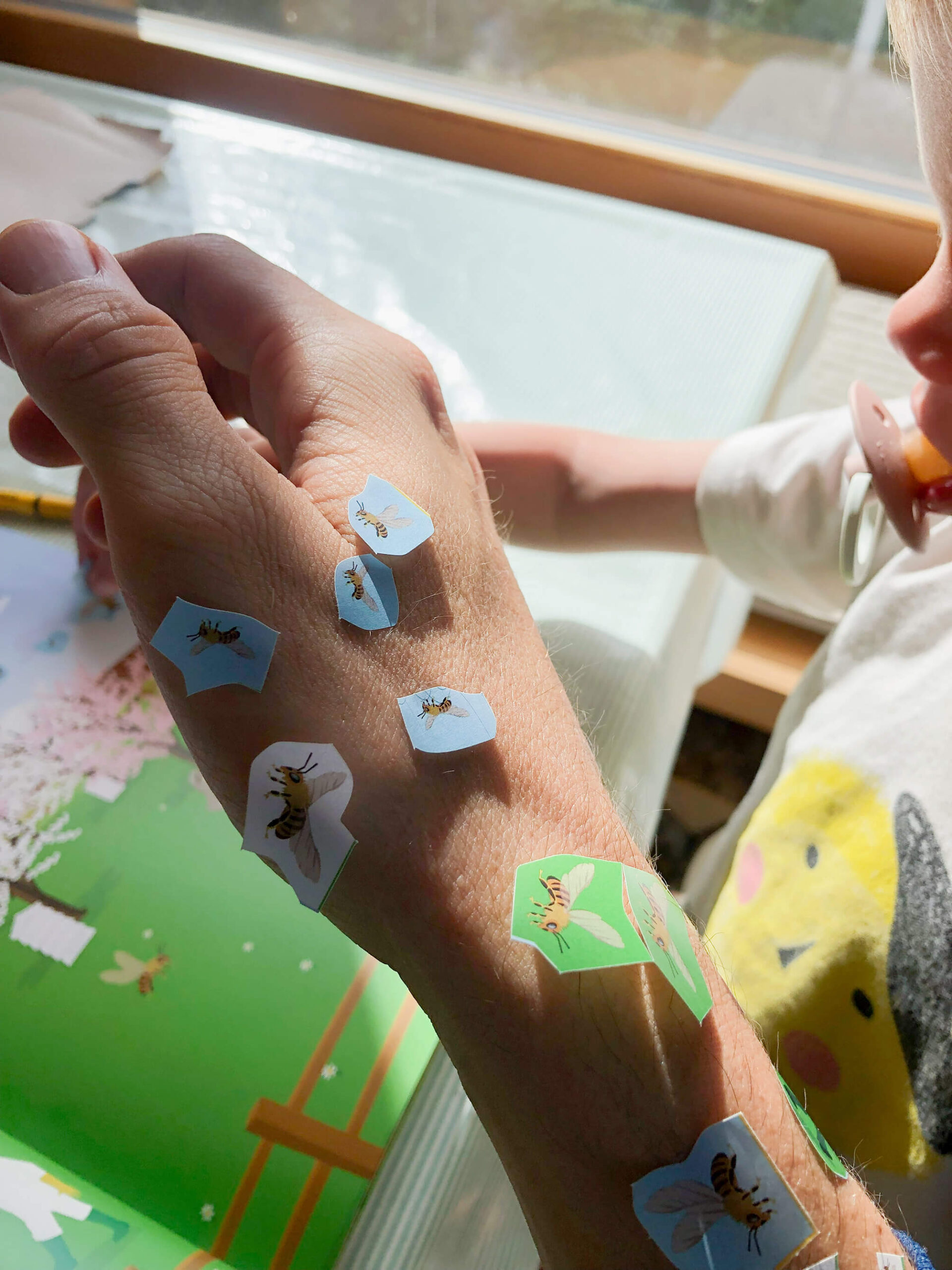
Stuck inside with worrying parents, a sticker-book about a farm is his brother’s favourite pass-time. Tired of having to go back and forth between the pastures and the sticker-filled sheets we decide to use my arm as a repository for animals that share a habitat.
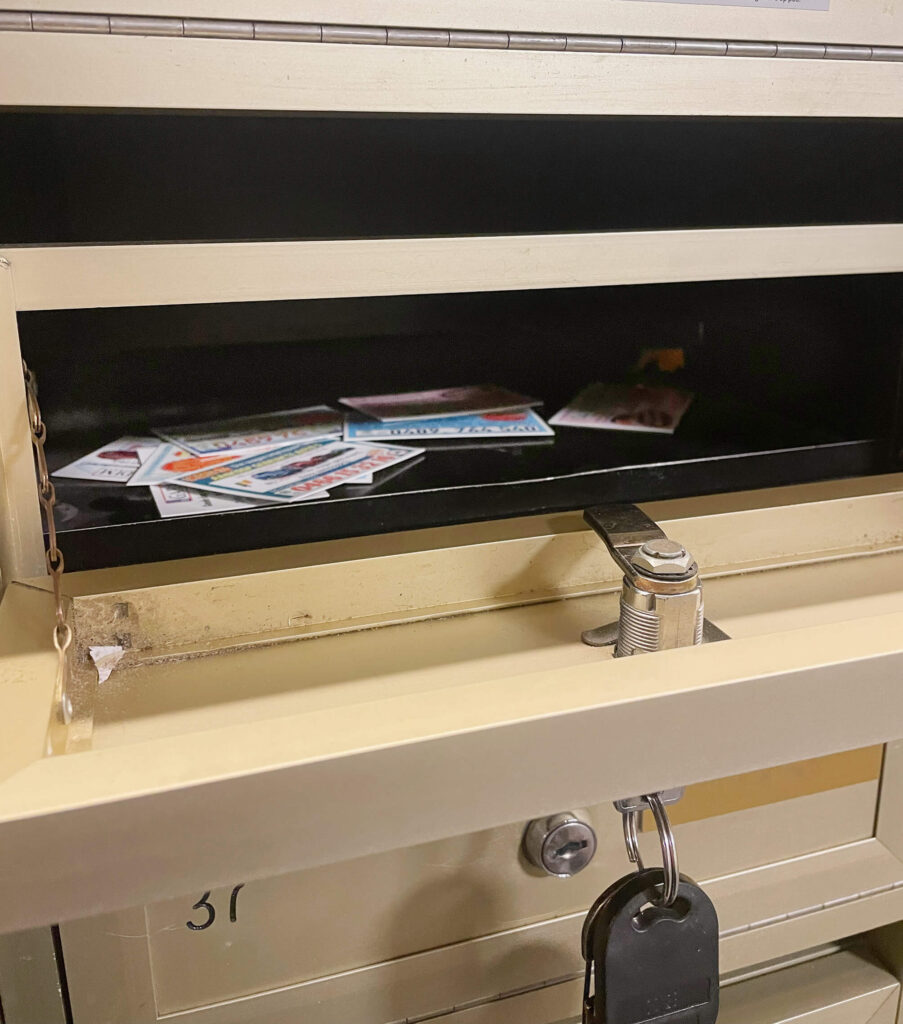
A year ago I moved into Solange’s appartement. From the balcony, I see half the parking lot and the adjacent high rise. On the mailbox, I haven’t replaced her name for mine.
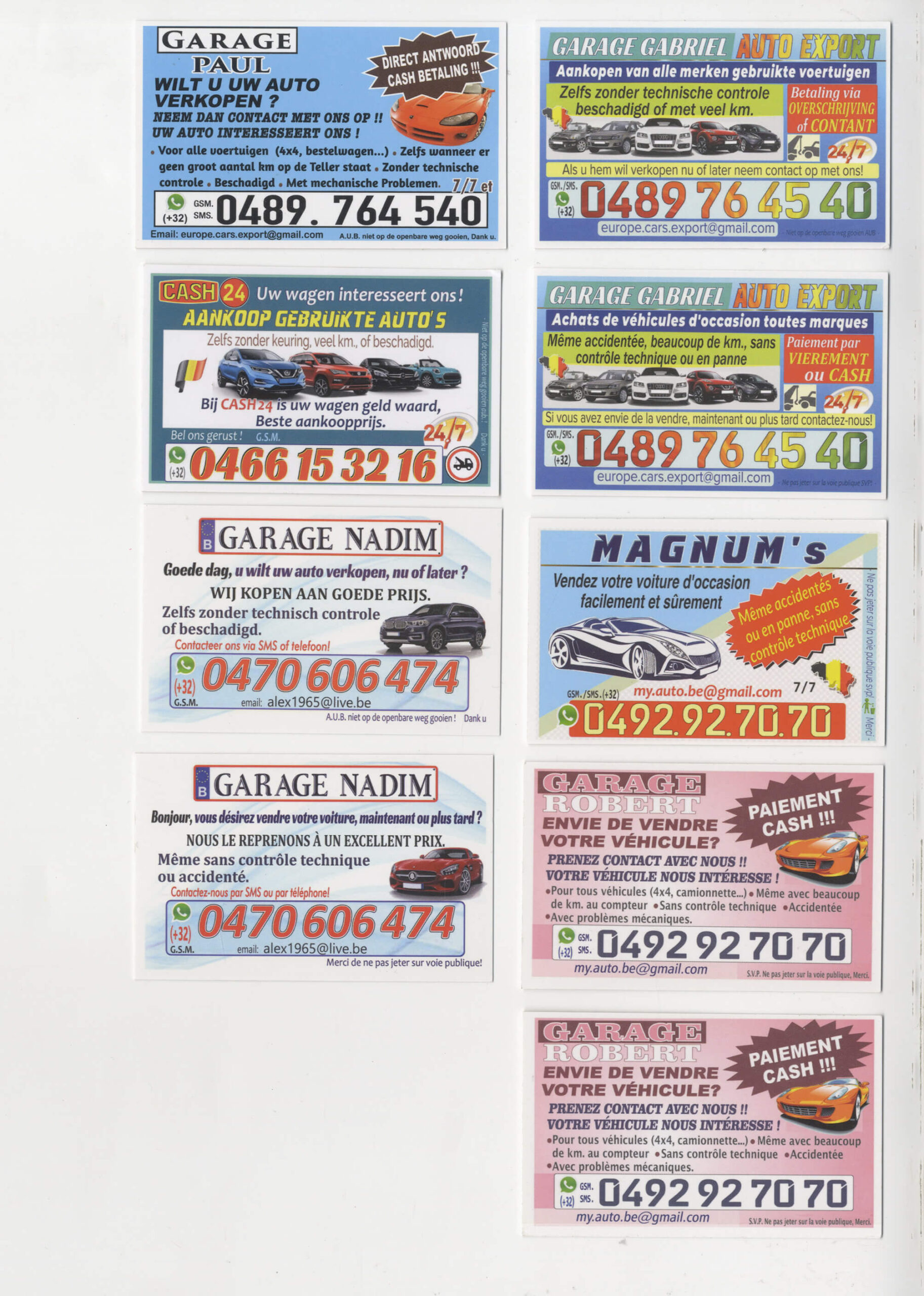
1. GARAGE PAUL, (+32) 0489. 764 540 / recto-verso NL/FR
2. CASH 24, (+32) 0466 15 32 16 / recto-verso NL/FR
3. GARAGE NADIM (+32) 0470 606 474 / recto-verso NL (1)
4. GARAGE NADIM (+32) 0470 606 474 / recto-verso FR (2)
5. GARAGE GABRIEL (+32) 0489 76 45 40 / recto-verso NL (1)
6. GARAGE GABRIEL (+32) 0489 76 45 40 / recto-verso FR (2)
7. MAGNUM’s (+32) 0492 92 70 70 / recto-verso FR
8. GARAGE ROBERT (+32) 0492 92 70 70 / recto-verso FR (1)
9. GARAGE ROBERT (+32) 0492 92 70 70 / recto-verso FR (2)
I don’t know whether Solange owned a car.
Bieke Criel, lives and works in Gent (BE). Intrigued by landscape, movement, light and the poetics of what lies in between. Does not own a car, loves to drive one. Part of 019.
A malfunctioning of the camera leading to a double-exposed negative. The car is decisive in establishing the relationship between the superimposed photographs. In the middle of the image, we see it parked in front of the house. Slightly less visible is the same car, repeated but further away. This makes it possible to deduce that the dark outline of the house, with the roof and the chimney, is also the same house as in the other photograph. This time, the house is photographed relatively frontally (the slightly angled point of view allows to bring the shed at the back of the house in the line of sight), and from nearby. At the bottom left, the lines that make up the street help to see the continuity of the one photograph, while the electric wires at the top right aid to comprehend the other one.
The camera malfunction speculates on a future addition to the plot. The dark, outlined shed’s scale is realistic with regards to the scale of the house and itself (the shed) in the other photograph. Its position with regards to the other buildings seems logical. It imposes itself as a possible second shed for the owner to build in the next few years. In that future shed, the car, now standing in front of the house, could be comfortably parked.

Photographing the house and the clearing it stood in proved difficult. During summer, the nettles and brambles slowed down the pace. Some plants stung the elbows. The clearing only became visible when the sun fell through the opening in the canopy. On cloudy days the clearing disappeared.
‘As the order of institutions follows its course, or as huts give way to villages and then to cities and finally to cosmopolitan academies, the forests move further and further away from the center of the clearing. At the center one eventually forgets that one is dwelling in a clearing. […] Yet however wide the circle may get through the inertia of civic expansion, it presumably retains an edge of opacity where history meets the earth, where the human abode reaches its limits.’
Pogue Harrison, R. ‘The Ecology of Finitude’, in: id., Forests. Chicago, 1992, 245.

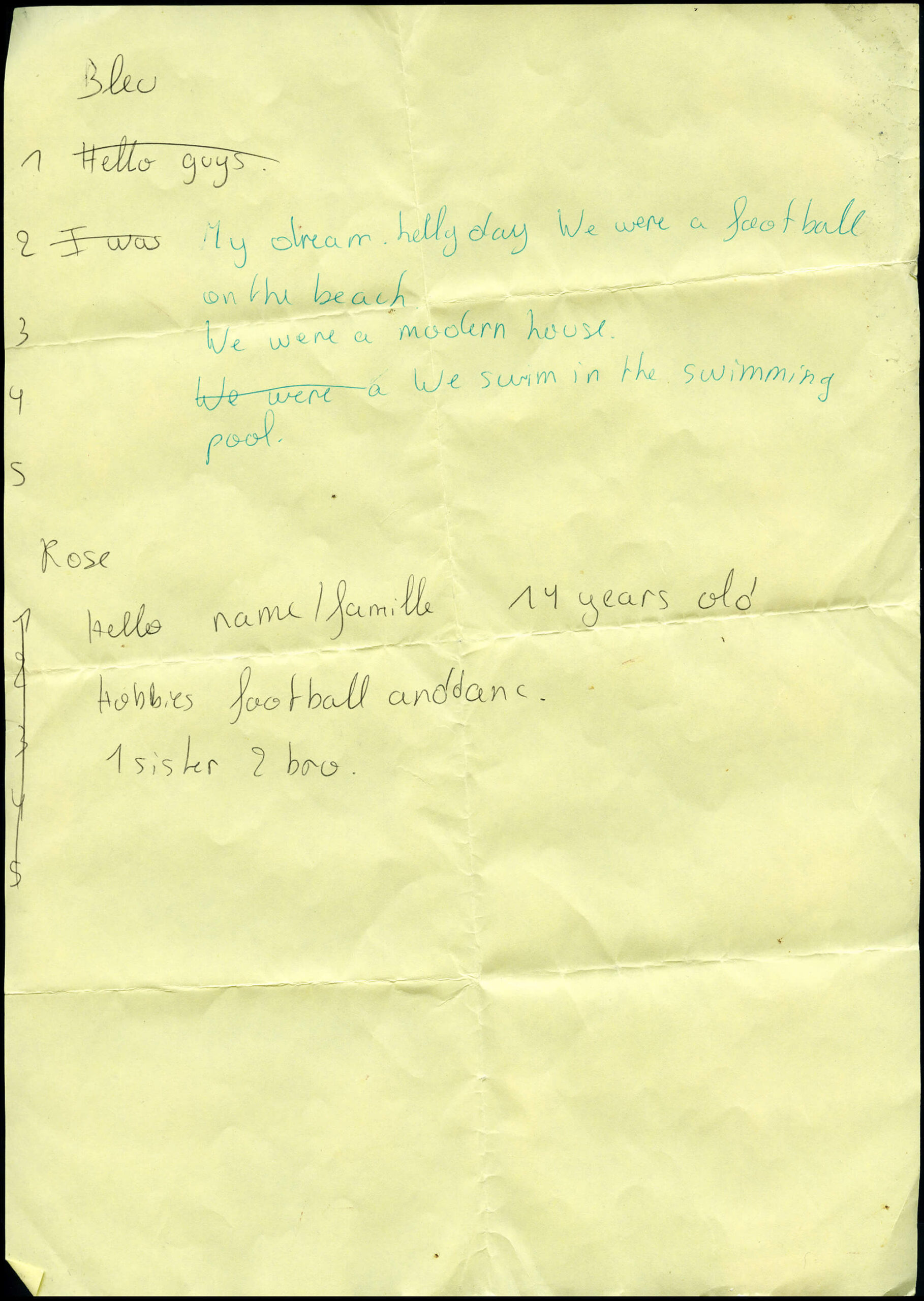
My dream hollyday We were a football
on the beach
We were a modern house.
We were a We swim in the swimming
pool.
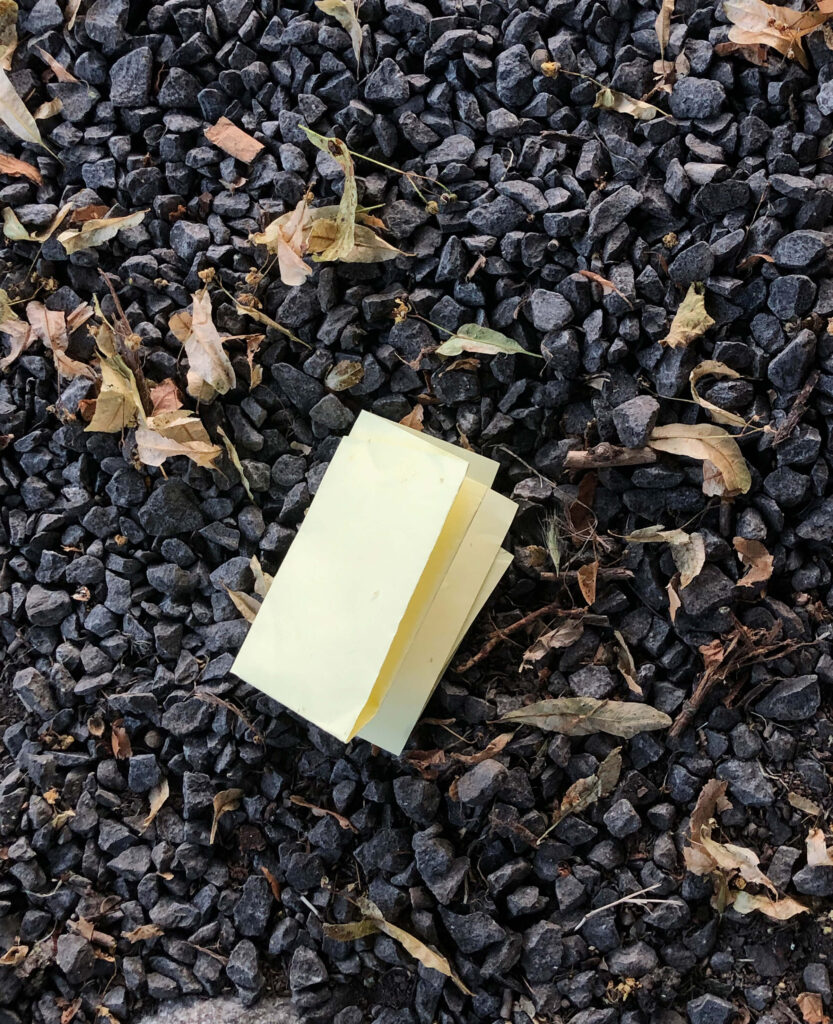
June 2022, Marche-en-Famenne. I arrived half an hour early. Waiting for my family to pick me up at the station, near a linden tree, I found a yellow page lying on the pebbles in front of the wooden bench I sat on. It had been a hot day. The sun was finally setting. Music playing in the distance. A white Volkswagen. Windows closed. Hard basses, trembling across the road. Folded three times, the sheet of paper had the size of a DIN A7. A white BMW pulled over. Seven glass jars in a container.
‘Meunerie Duyckers & Conors, les nouveaux moulins’, better known as ‘De Nieuwe Molens’, is a flour mill established in 1897 in the north of Gent along the Verbindingskanaal. Due to increased production, the original 1897 building doubled in 1904.
Only the facade of the iconic warehouse has been preserved along with the recently renovated gasometers. The building is now part of the Tondeliersite. It has been converted into lofts and flats, and was extended with a new construction.
https://inventaris.onroerenderfgoed.be/erfgoedobjecten/18269

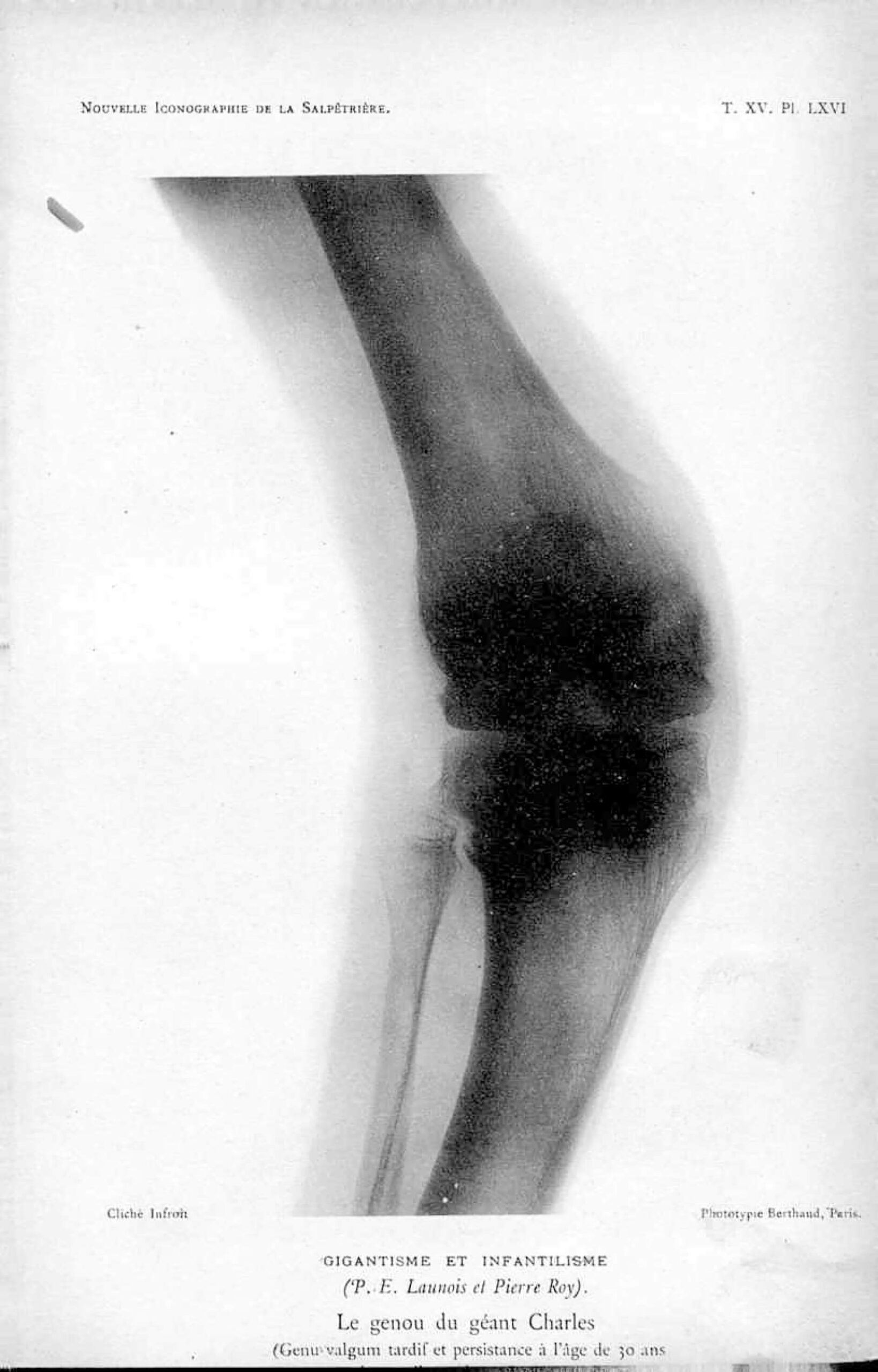
The scientific exactitude sought for in the Iconographie de la Salpêtrière and the Nouvelle Iconographie de la Salpêtrière, the (in)famous scientific publications stemming from Paris’ psychiatric hospital La Salpêtrière (1876-1918), lead to an abundance of photographic images in their pages. The photographs’ ideal: ‘Trace incontestable, incontestablement fidèle, durable, transmissible’.1 The ambition of exactitude results in cold, and often cruel depictions of patients. In the digitized version of the Sorbonne library’s copies, some photographs have left an imprint on the opposite page. The knee of Charles, ‘le géant’, adds an unwanted layer upon its measures on the opposite page, while the photograph of the knee itself loses ink.2
Didi-Huberman, G. Invention de l’hystérie. Paris: Macula, 2014, 72.
Launois, P.-E., Roy, P., ‘Gigantisme et infantilisme’, Nouvelle Iconographie de la Salpêtrière, Tome XV, 1902, 548, pl. LXVI, online: https://patrimoine.sorbonne-universite.fr/fonds/item/2613-nouvelle-iconographie-de-la-salpetriere-tome-15?offset=6

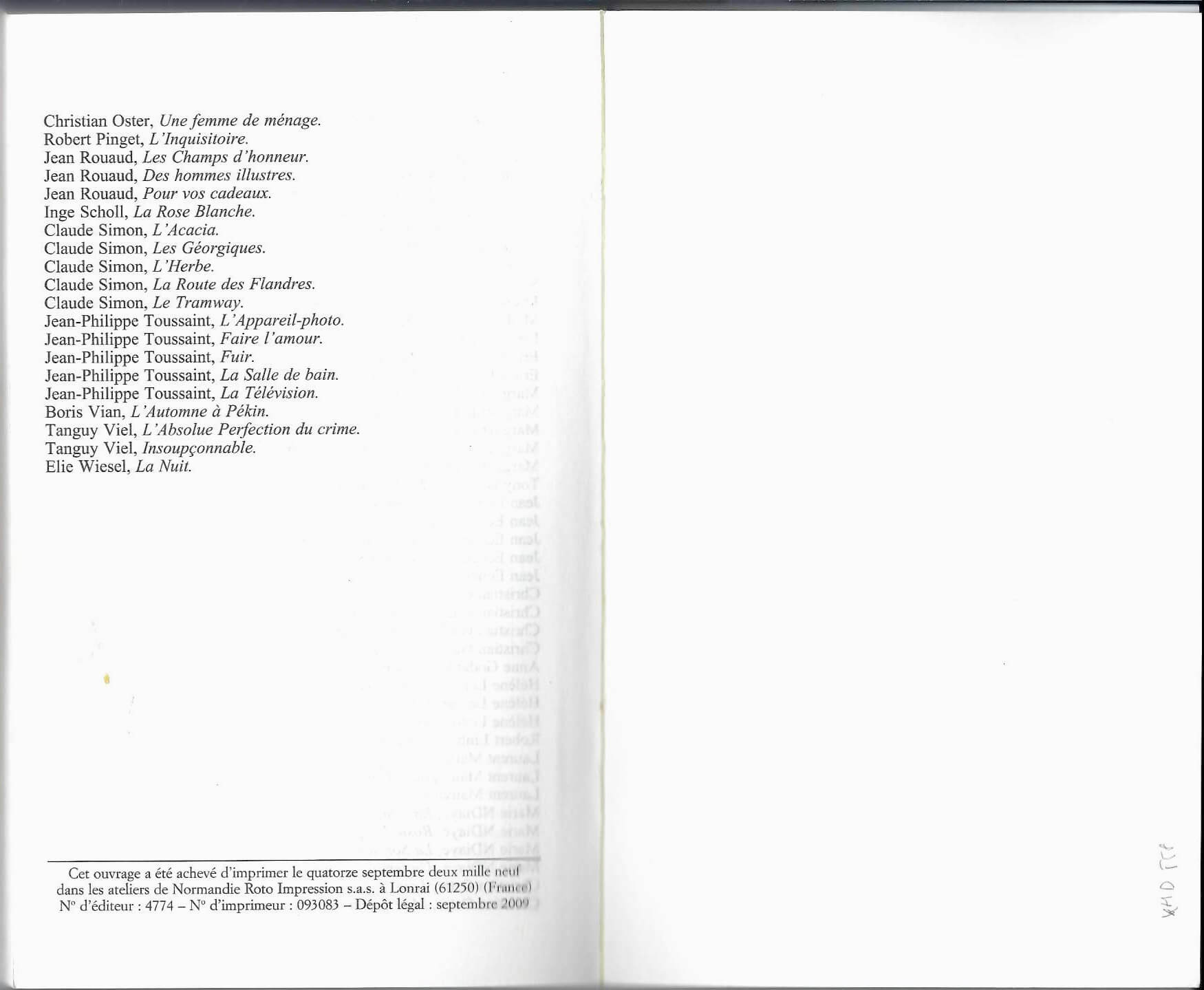
During the preparation of a seminar, I reread Pierre Bayard’s Qui a tué Roger Ackroyd? (2008). On the inside of the back cover, there’s an inscription: it appears I wrote down a license plate number – something I have the habit of doing when a situation seems suspicious.
In Qui à tué Roger Ackroyd?, Bayard analyzes Agatha Christie’s famous detective novel The Murder of Roger Ackroyd (1926). The literary critic disagrees with detective Hercule Poirot’s conclusion: Ackroyd’s murderer is not the narrator, James Sheppard, as Poirot would have it. It’s a delirious interpretation, ‘consistant à rechercher minutieusement des indices, à interpréter des faits et à organiser nos déductions en une construction d’ensemble harmonieuse’.
The car with license plate number XHD 558 is unknown to me. I can’t recall what I saw that urged me to write it down, nor the time or location when I saw it.
Bayard, P. Qui a tué Roger Ackroyd? Paris: Minuit, 2008.
In Walter Benjamin’s The Arcades Project, Convolute Q is dedicated to the panorama. Benjamin writes: ‘Setup of the panoramas: View from a raised platform, surrounded by a balustrade, of surfaces lying round about and beneath. The painting runs along a cylindrical wall approximately a hundred meters long and twenty meters high. The principal panoramas of the great panorama painter Prévost: Paris, Toulon, Rome, Naples, Amsterdam, Tilsit, Wagram, Calais, Antwerp, London, Florence, Jerusalem, Athens. Among his pupils: Daguerre’ (Q1a, 1).
Benjamin, W. The Arcades Project (H. Eiland & K. McLaughlin, trans.). Cambridge/London: The Belknap Press of Harvard University Press, 2002, p. 528.
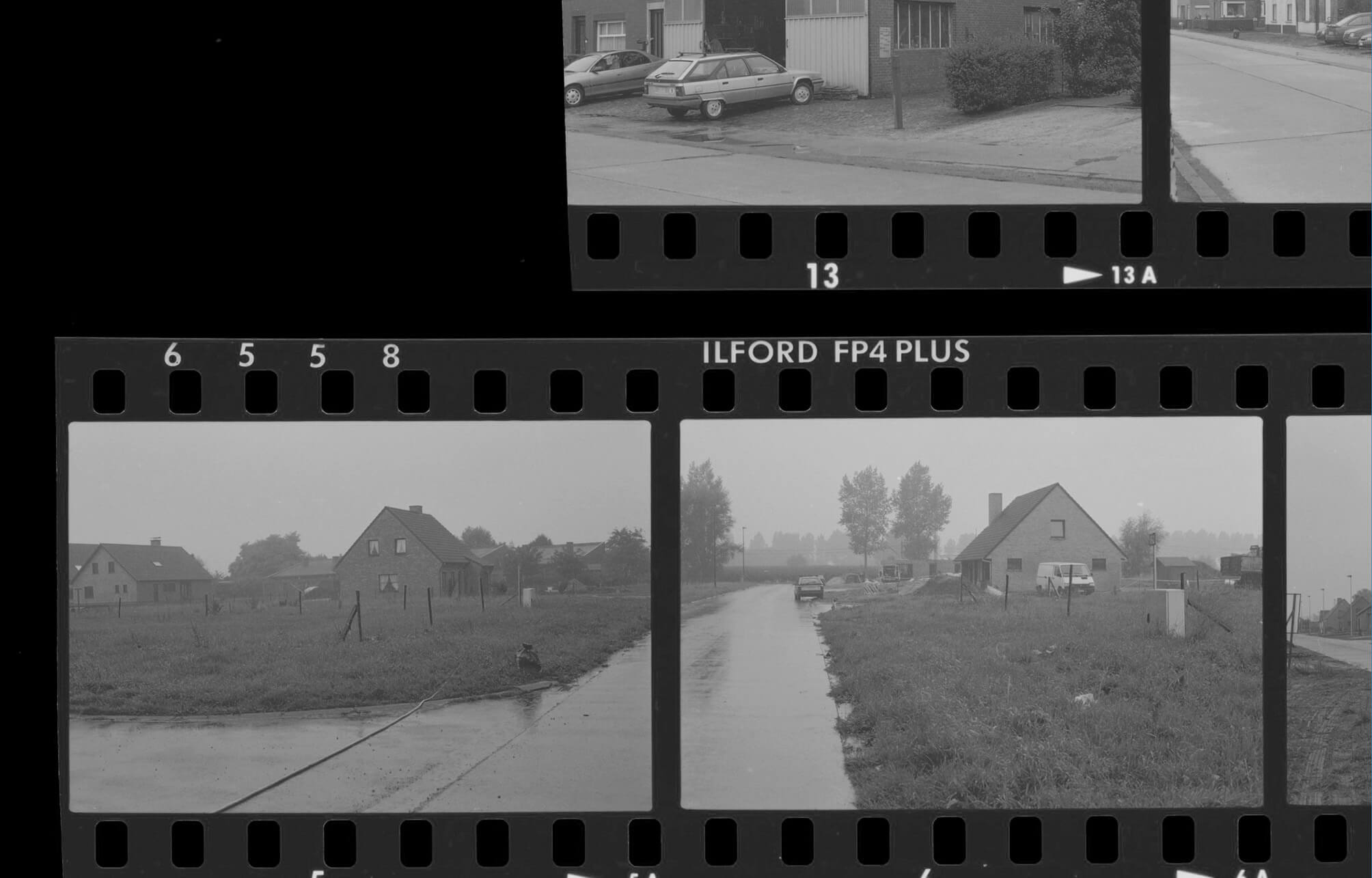
It has been snowing. A black BMW is parked on the other side of the street and is cut in half by the separation between negatives 4 and 5. Apart from a slight kink in the landscape, the negative on the right is a perfect continuation of the one on the left. The fence around the orchard, the branches of the apple tree and the power lines connect implicitly in the void between the negatives.
Based on De Cleene De Cleene, The Situation as it Is. A Photonovel in Three Movements (APE, 2022).

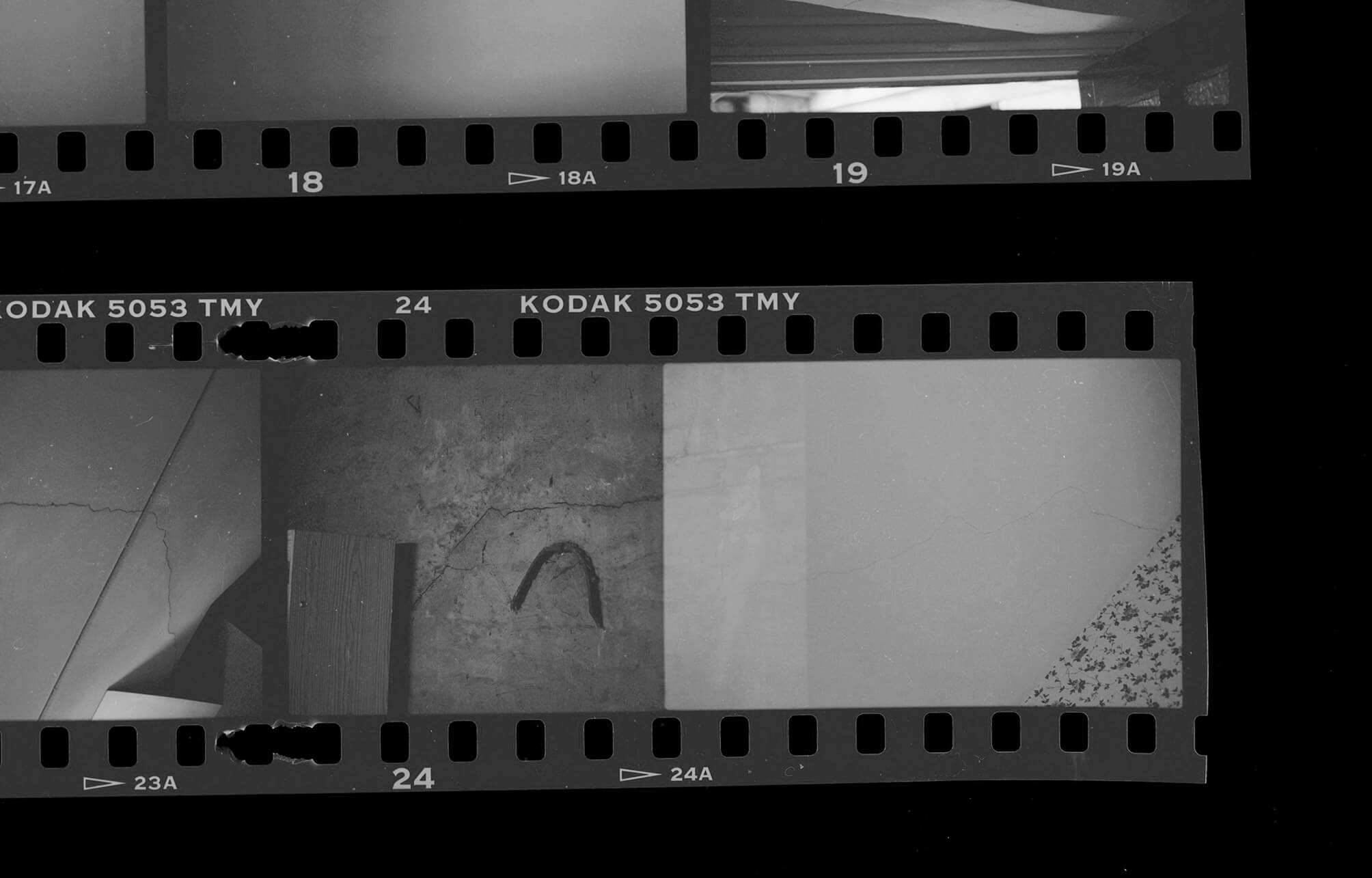
The architect’s photographic archive contains seven images that can be labelled as panoramic pictures. However, they only appear as such when the photographs are viewed in the archive, as strips of negatives. In order to see the panoramic construct, the viewer needs to be presented with two consecutive negatives.
There are two kinds of panorama in the archive: the kind that can only be attributed to a kind of laziness or a need for efficiency on behalf of the architect, and another that originates from frugality.
The former type of panorama is created when the architect is documenting the situation as it is: it is compulsory to document the context of the building or lot, as part of a building application. He simply pivots from left to right, capturing the first and second photograph consecutively. On the filmstrip a panorama appears.
The other kind of panoramic picture only appears at the end of the film role. The last negative on the film has been exposed (the twenty-fourth or thirty-sixth), after which he exerts force onto the lever to move the film forward anyway. Some films are known to have, by accident, a twenty-fifth or a thirty-seventh negative. The plastic between the sprocket holes tears and the film does not advance enough. The result differs fundamentally from the other kind of panorama: there is no separation, no void between the negatives. Rather, there is a slight overlap. A thin, vertical strip of film that has been exposed twice, suggesting contiguity that might not be there. The two exposures might be from altogether different sites, creating a new situation.
Based on De Cleene, M. & De Cleene, A. The Situation as it Is. A Photonovel in Three Movements. Gent: APE, 2022
I drove through the neighborhood seeking evidence of the disruption using a power outage map as a compass. Winding through quiet streets, I stumbled upon a lone blue PG&E truck idling opposite a charred utility pole with fragments of wood and wire strewn across the pavement. I parked my car and walked toward the truck to ask the driver what had happened. He pointed to the top of the pole where a porcelain insulator dangled precariously from a high-voltage line. “Tracking,” he said curtly. “Is that like a short circuit?” I asked. “Kind of,” he replied before pausing. He finally elaborated, explaining that the problem arises when moisture from morning fog settles on power lines, creating a pathway for electricity to arc across components.
He then input something into a handheld device before driving away, leaving the repair for another service team to complete. I gathered the debris intending to collect the remaining components that comprise a utility pole, each having failed in one form or another. I shipped the fragments to Maziar the following week.
Mathew Kneebone is an artist based in San Francisco. His interdisciplinary practices takes different forms, all in relation to an interest in electricity and technology. He teaches studio and thesis writing at California College of the Arts.

