What constitutes a ‘document’ and how does it function?
According to the Oxford English Dictionary, the etymological origin is the Latin ‘documentum’, meaning ‘lesson, proof, instance, specimen’. As a verb, it is ‘to prove or support (something) by documentary evidence’, and ‘to provide with documents’. The online version of the OED includes a draft addition, whereby a document (as a noun) is ‘a collection of data in digital form that is considered a single item and typically has a unique filename by which it can be stored, retrieved, or transmitted (as a file, a spreadsheet, or a graphic)’. The current use of the noun ‘document’ is defined as ‘something written, inscribed, etc., which furnishes evidence or information upon any subject, as a manuscript, title-deed, tomb-stone, coin, picture, etc.’ (emphasis added).
Both ‘something’ and that first ‘etc.’ leave ample room for discussion. A document doubts whether it functions as something unique, or as something reproducible. A passport is a document, but a flyer equally so. Moreover, there is a circular reasoning: to document is ‘to provide with documents’. Defining (the functioning of) a document most likely involves ideas of communication, information, evidence, inscriptions, and implies notions of objectivity and neutrality – but the document is neither reducible to one of them, nor is it equal to their sum. It is hard to pinpoint it, as it disperses into and is affected by other fields: it is intrinsically tied to the history of media and to important currents in literature, photography and art; it is linked to epistemic and power structures. However ubiquitous it is, as an often tangible thing in our environment, and as a concept, a document deranges.
the-documents.org continuously gathers documents and provides them with a short textual description, explanation,
or digression, written by multiple authors. In Paper Knowledge, Lisa Gitelman paraphrases ‘documentalist’ Suzanne Briet, stating that ‘an antelope running wild would not be a document, but an antelope taken into a zoo would be one, presumably because it would then be framed – or reframed – as an example, specimen, or instance’. The gathered files are all documents – if they weren’t before publication, they now are. That is what the-documents.org, irreversibly, does. It is a zoo turning an antelope into an ‘antelope’.
As you made your way through the collection,
the-documents.org tracked the entries you viewed.
It documented your path through the website.
As such, the time spent on the-documents.org turned
into this – a new document.
This document was compiled by ____ on 28.10.2026 12:10, printed on ____ and contains 25 documents on _ pages.
(https://the-documents.org/log/28-10-2026-6933/)
the-documents.org is a project created and edited by De Cleene De Cleene; design & development by atelier Haegeman Temmerman.
the-documents.org has been online since 23.05.2021.
- De Cleene De Cleene is Michiel De Cleene and Arnout De Cleene. Together they form a research group that focusses on novel ways of approaching the everyday, by artistic means and from a cultural and critical perspective.
www.decleenedecleene.be / info@decleenedecleene.be - This project was made possible with the support of the Flemish Government and KASK & Conservatorium, the school of arts of HOGENT and Howest. It is part of the research project Documenting Objects, financed by the HOGENT Arts Research Fund.
- Briet, S. Qu’est-ce que la documentation? Paris: Edit, 1951.
- Gitelman, L. Paper Knowledge. Toward a Media History of Documents.
Durham/ London: Duke University Press, 2014. - Oxford English Dictionary Online. Accessed on 13.05.2021.

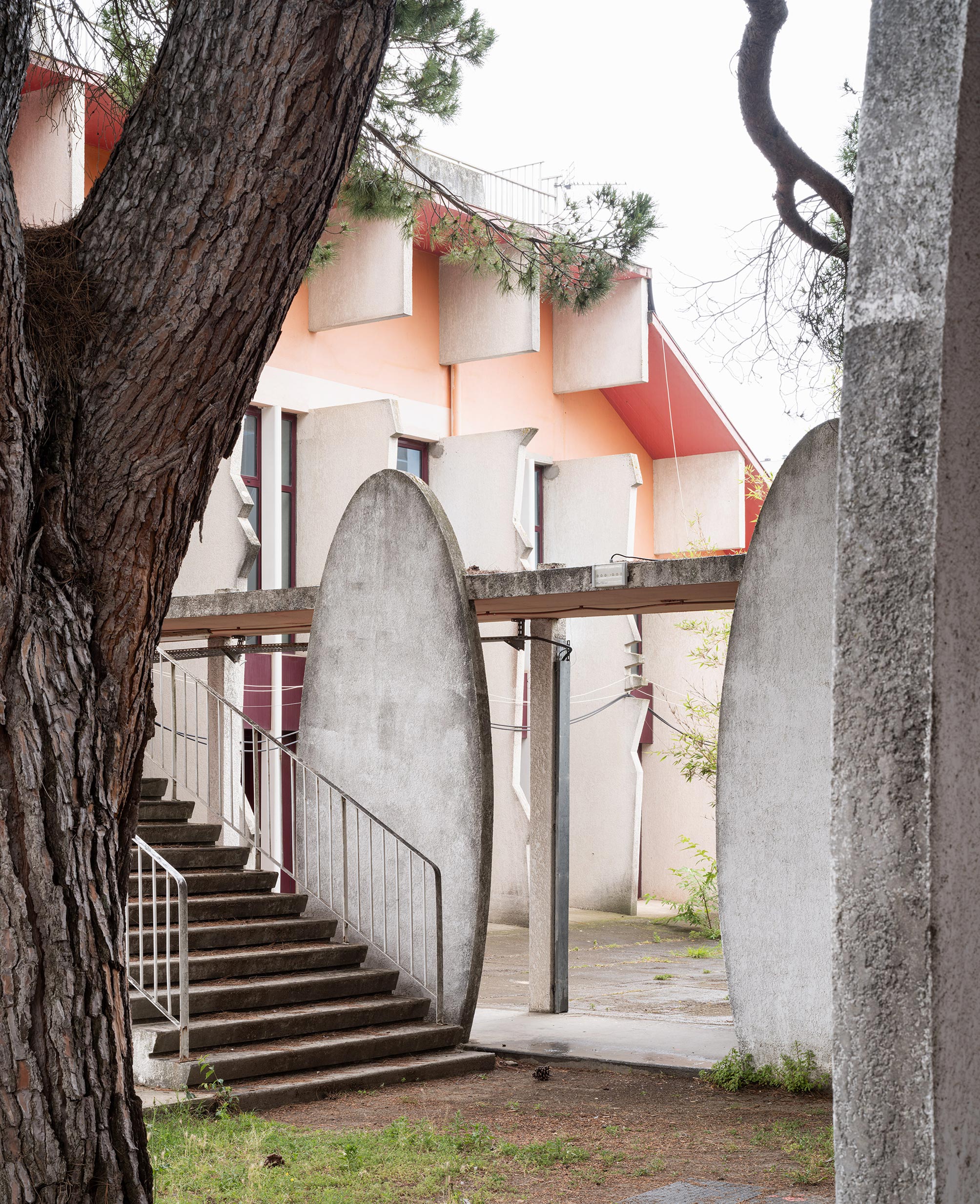
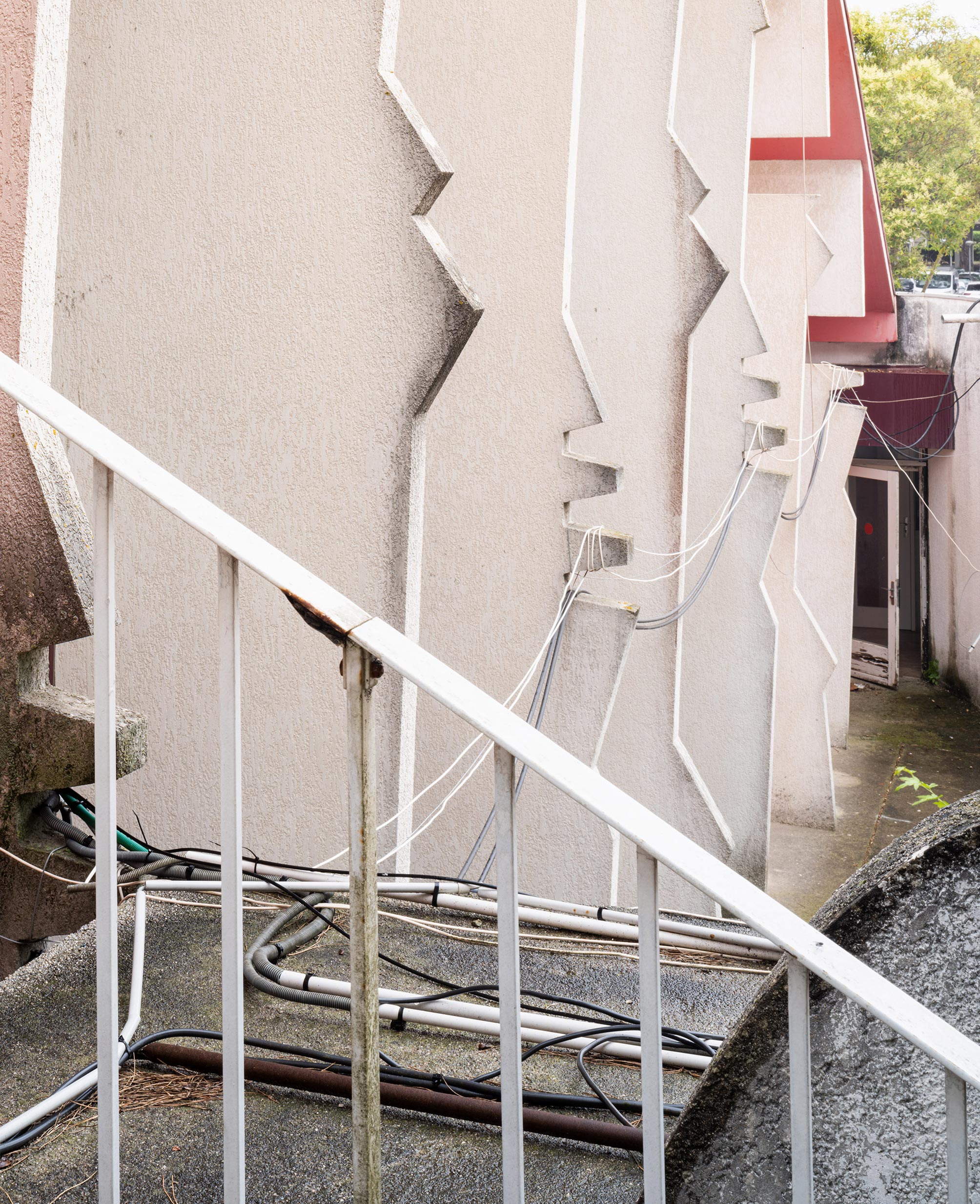
Built in 1969, the salle polyvalente1 in La Grande-Motte2 was the first venue where the residents – back when there were only 700 of them – could gather. Jean Balladur had envisioned an open-air theatre covered by a removable stretched canvas, adjacent to a single-storey multipurpose hall. The load-bearing structure, Balladur explained, consists of anthropomorphic columns sculpted by Albert Marchais: “My friend the sculptor, painter, poet and man of the theatre, Albert Marchais, devised the design for a sliding formwork that made it possible to cast the columns… they line up on either side of the hall in patterns that free them from the strict constraints of matter. This freedom is the joy of all sculpture.”3
The geometric forms that make up the hands and arms of these figures are today strung with cables carrying electricity and data.
Jean Balladur was never fond of the term ‘salle polyvalente’, he preferred ‘salle commune, dédié à la fête’ – a communal hall, dedicated to parties. Since 2019 it is officially the Centre Culturel Henri Dunoyer, after a former mayor.
La Grande-Motte is a seaside resort created by the Mission Racine, the state programme for the development of the Languedoc coastline in southern France. Intended as a holiday destination for the middle class in the 1970s, it is the work of architect Jean Balladur (1924–2002), who was tasked with designing the entire urban layout and architecture of the new town. He drew inspiration from pre-Columbian pyramids and from modernist architecture in Brazil, especially the work of Oscar Niemeyer. At a time when large housing complexes were going up all over France in the form of tower blocks and slabs, Balladur’s solutions were different enough that La Grande-Motte was a success from the very beginning.
« Mon ami le sculpteur, peintre, poète, homme de théâtre, Albert Marchais, a imaginé le dessin d’un coffrage glissant qui a permis de couler les poteaux… ils s’alignent de chaque côté de la salle dans des figures qui les affranchissent des strictes contraintes de la matière. Cette liberté fait le bonheur de toute sculpture. »
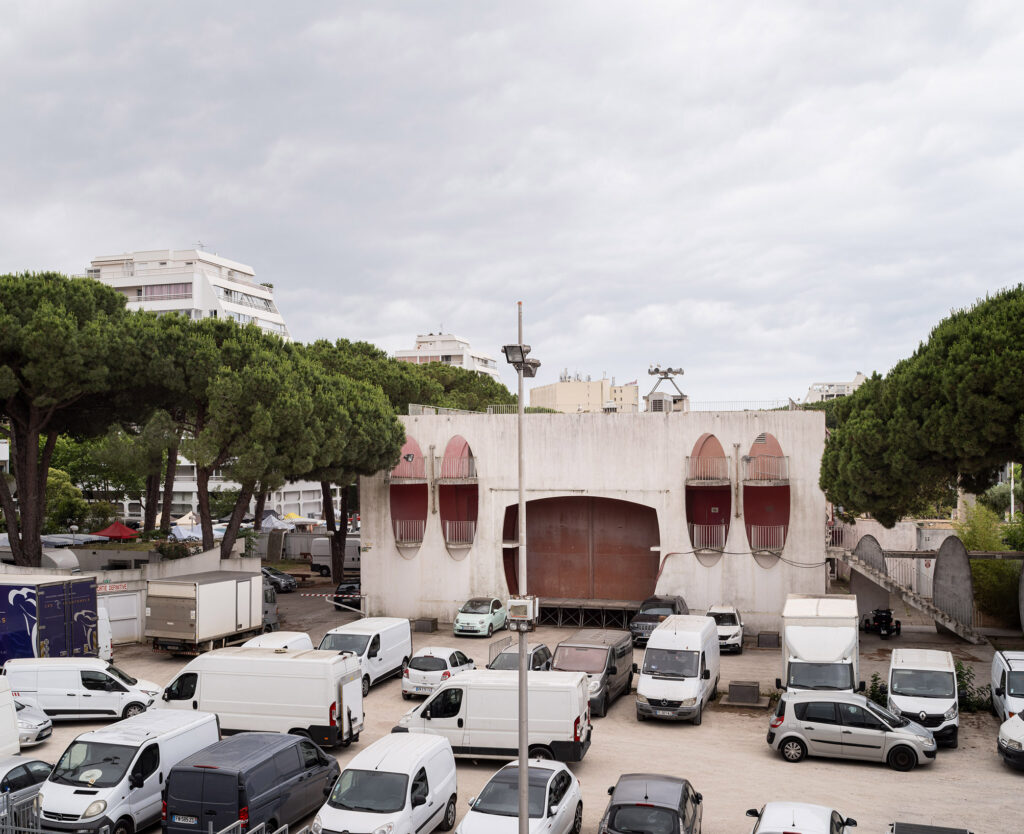
On market days, the parterre of the open-air theatre serves a a car park for the vendors’ vans and cars.
François, Michèle. Jean Balladur et la Grande-Motte: l’architecte d’une ville. Duo. Monuments historiques et objets d’art du Languedoc-Roussillon, Direction régionale des affaires culturelles, 2010, p. 41-42.
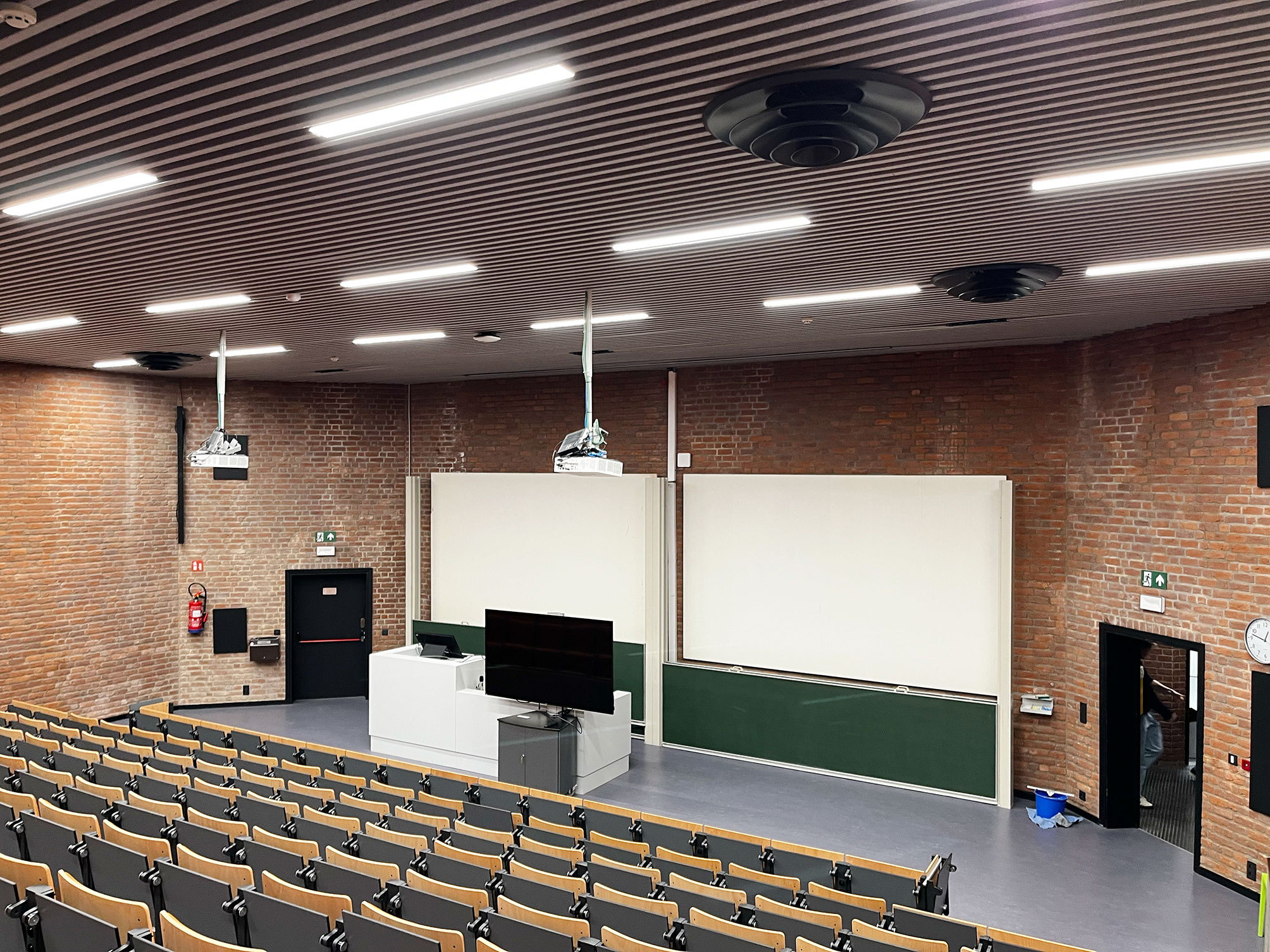
Today I was supposed to give an introduction to architectural photography. I had listed several approaches I would briefly touch on, showing work by Joel Sternfeld, Stephanie Kiwitt, Lynne Cohen, Thomas Ruff, Jeff Wall and Candida Höfer. I wanted to stress that the essence of architectural photography – and of photography as a whole – is to make the space outside the picture larger than the space within it.
The students never showed up. The secretary had forgotten to put my introduction on their timetable. While I was waiting in the empty auditorium, a colleague’s introduction to epidemiology in the auditorium next door suddenly boomed from my speakers.
In Zaffelare, young men who were called for military service but could not be missed at home were advised by the local doctor to swallow a small ball of aluminium foil an hour before the examination. In the X-ray, a gastric ulcer appeared. They were rejected for service. It is uncertain whether the increased incidence of gastric ulcers among young men in Zaffelare was a cause for concern.

The last couple of days have been dry. Rain is expected for the weekend. The office buckets are in place and are empty, except for some residue. Dirt, sand, a few hairs. Some particles must have come along with the drops when they made their way through the roof.

It’s time to have a nap. I tilt the window over its middle axis to let the butterfly out. A breeze ruffles the drapes. Now, it sits on the glass and throws an enormous shadow on the yellow cloth.


Freely adapted from interviews with residents of Sandersleben (Saxony-Anhalt). Three-act play. The first two acts take place in the present day; the third is set in the future.
From Act 1 ‘The Town of S’, Scene 2 ‘The Past’.
Characters: MR DUNST club member I, OLIVER club member II, ANJA young mother
Stills from text animation S. Anders Leben. Eine Handlung in Gesprächen/S. Anders Leben – Living Differently: An Act in Conversations
Stephanie Kiwitt (1972) is an artist based in Halle (Saale), Germany. Utilizing a large number of images, various perspectives and also textual elements, she is known for her insightful photography that explores spaces emblematic of contemporary phenomena. Over the past three years, she has focused on evolving habitats in rural areas, photographing traces of transformation and conducting interviews in Saxony-Anhalt, the region she moved to in 2020. From 2018 to 2020, Kiwitt was a guest lecturer at the LUCA School of Arts in Brussels.
In spring 2024 the-documents.org and Trigger co-publish a series of online articles with a focus on the meeting ground between photography and the document.

At the State Archive in Kortrijk, I am leafing through a 1955 photo album of the construction of the provisional church in Lokeren by the famous furniture company Kunstwerkstede De Coene. Gigantic wooden, prefabricated beams structure the building. It is cold. An old man in a grey suit shuffles between the racks to look up the date of birth of his great great grandmother. Snow covers the unfinished provisional roof. A bus passes, I reckon, through the pouring rain.
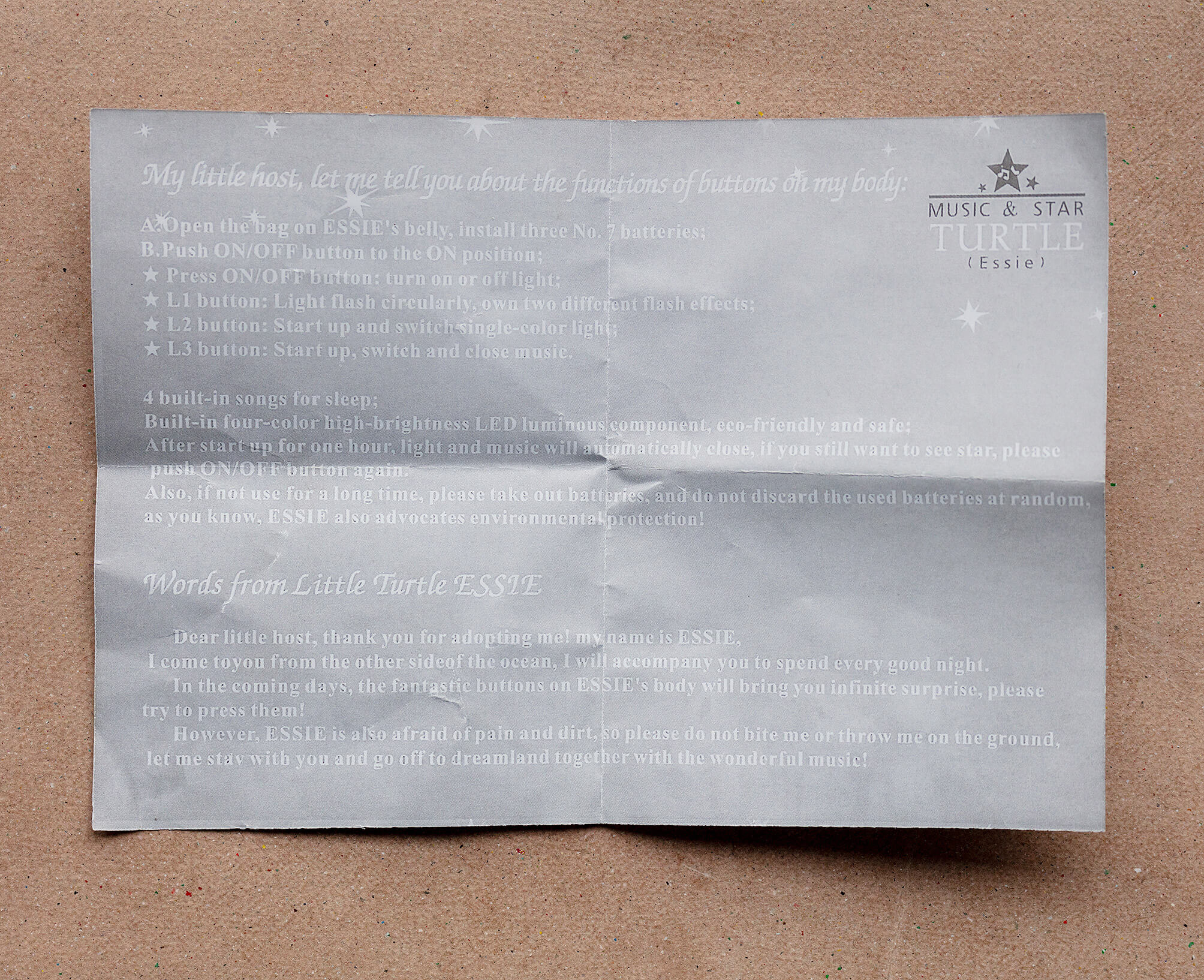
I bought my son a gift while abroad: a toy turtle named Essie whose perforated shield projects stars onto the ceiling in blue, green or amber. ‘8 actual star constellations’, the box proclaims.
The manual explains how to power up the turtle and what the four buttons on Essie’s back do. The small document (recto: Chinese, verso: English) concludes with some ‘Words from Little Turtle ESSIE’. In it the turtle shifts from direct speech to illeism1 and back.
The act of referring to oneself in the third instead of first person.
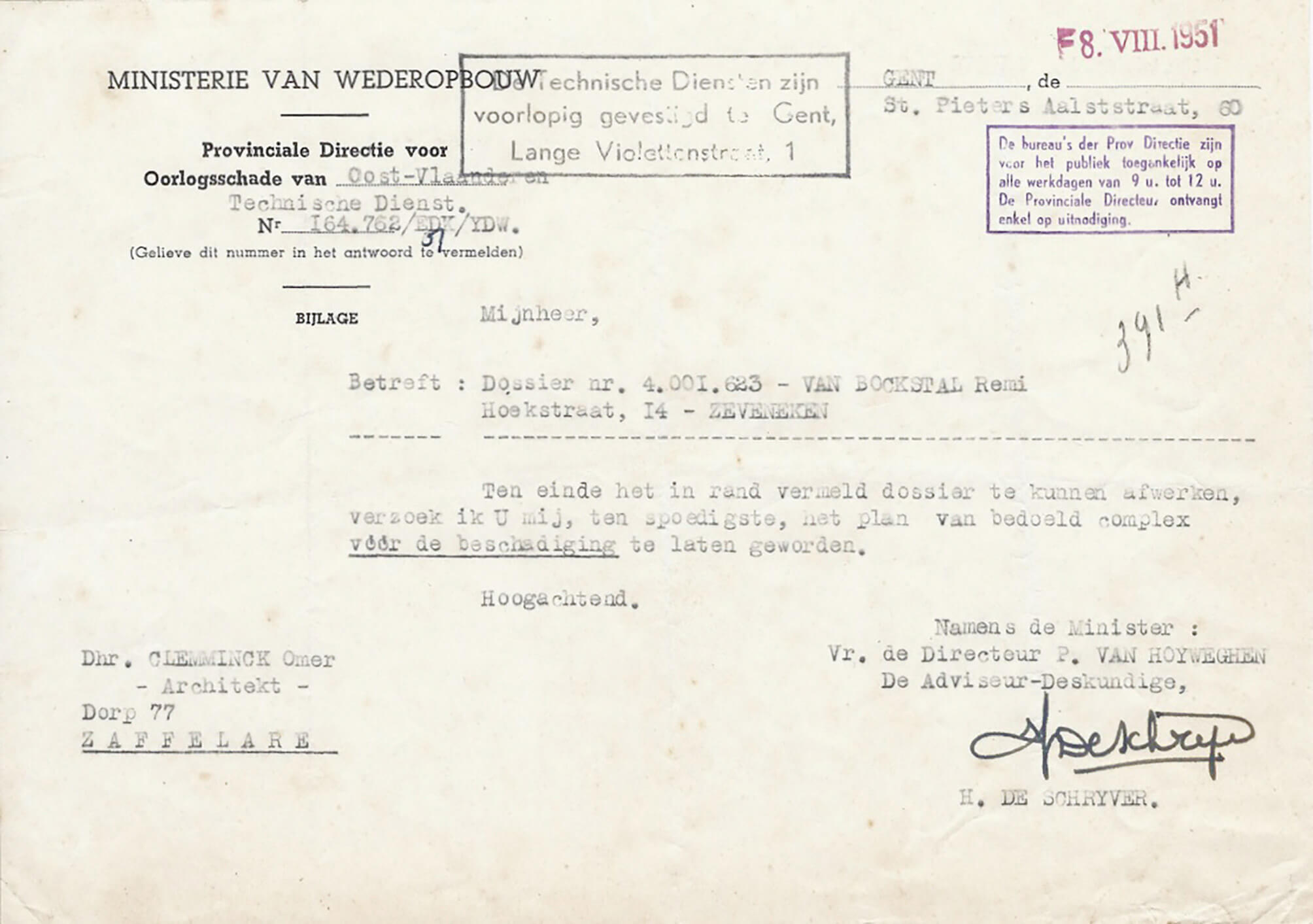
An architect in Z. receives a reminder. ‘Please send, as soon as possible, the plans of the construction before the damage.’ The reminder was sent by the Ministry of Reconstruction, in 1951. The architect’s address in Z., as mentioned in this file, is nowadays a house adjacent to Saloon Redbarn, a hall used for activities organized by a club of country and western-aficionados.
Semi-translucent paper, typoscript, stamps, handwritten notes and signature, from the archive of architect O. Clemminck, file ‘Remi Van Bockstael’
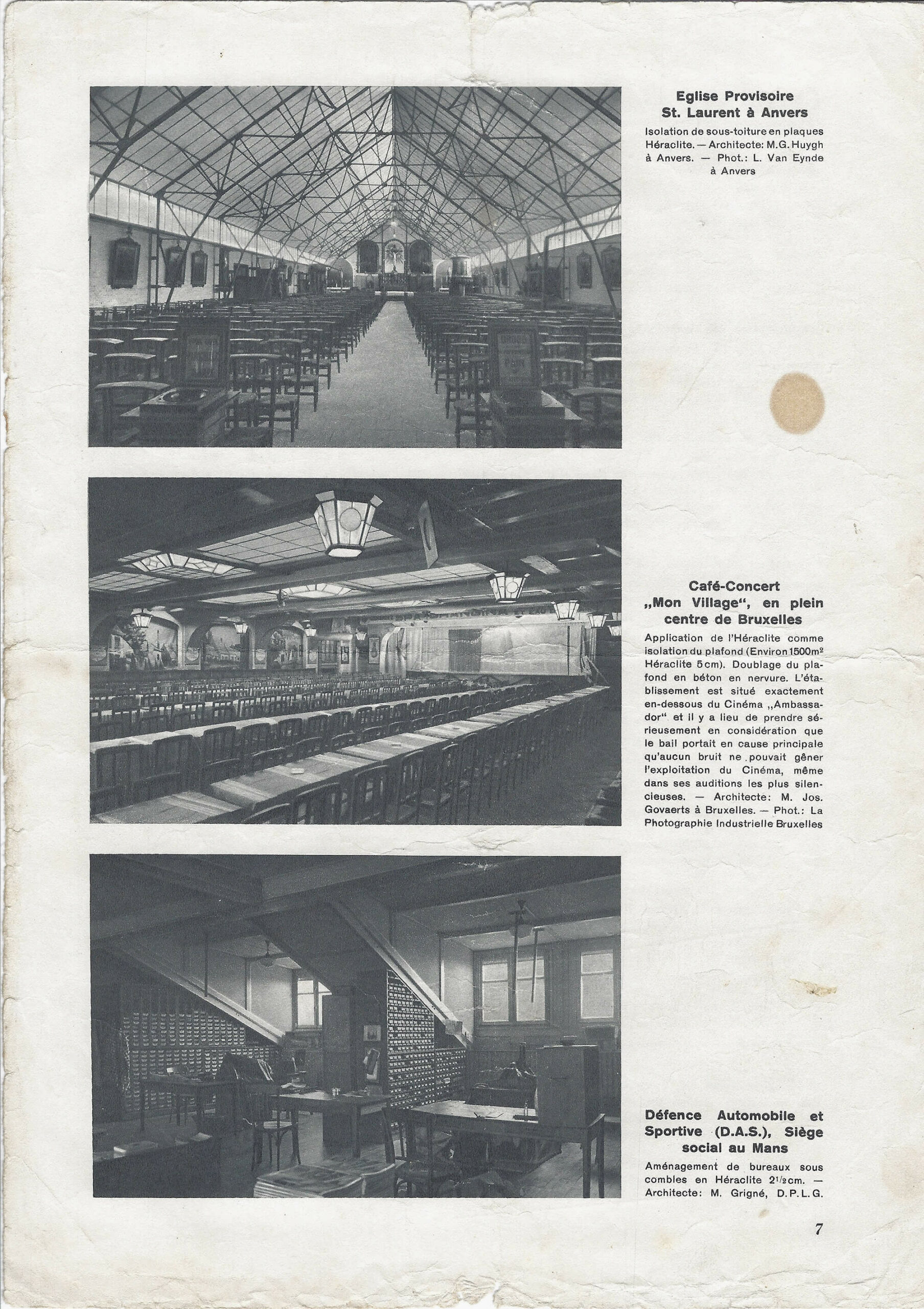
All chairs are empty, but all face something different. The bottom photograph shows empty chairs facing empty desks. In the middle picture, empty chairs face each other (underneath the inaudible sound of the cinema above). In the top photograph, the chairs seem to be facing the photographer. However, the altar’s in front of the photographer. He stands at the back of the provisional church. The chairs face the photographer and have turned their backs to the altar.
Revue Héraclite, 5 (1), april 1936, p. 7, paper, from the archive of architect O. Clemminck.
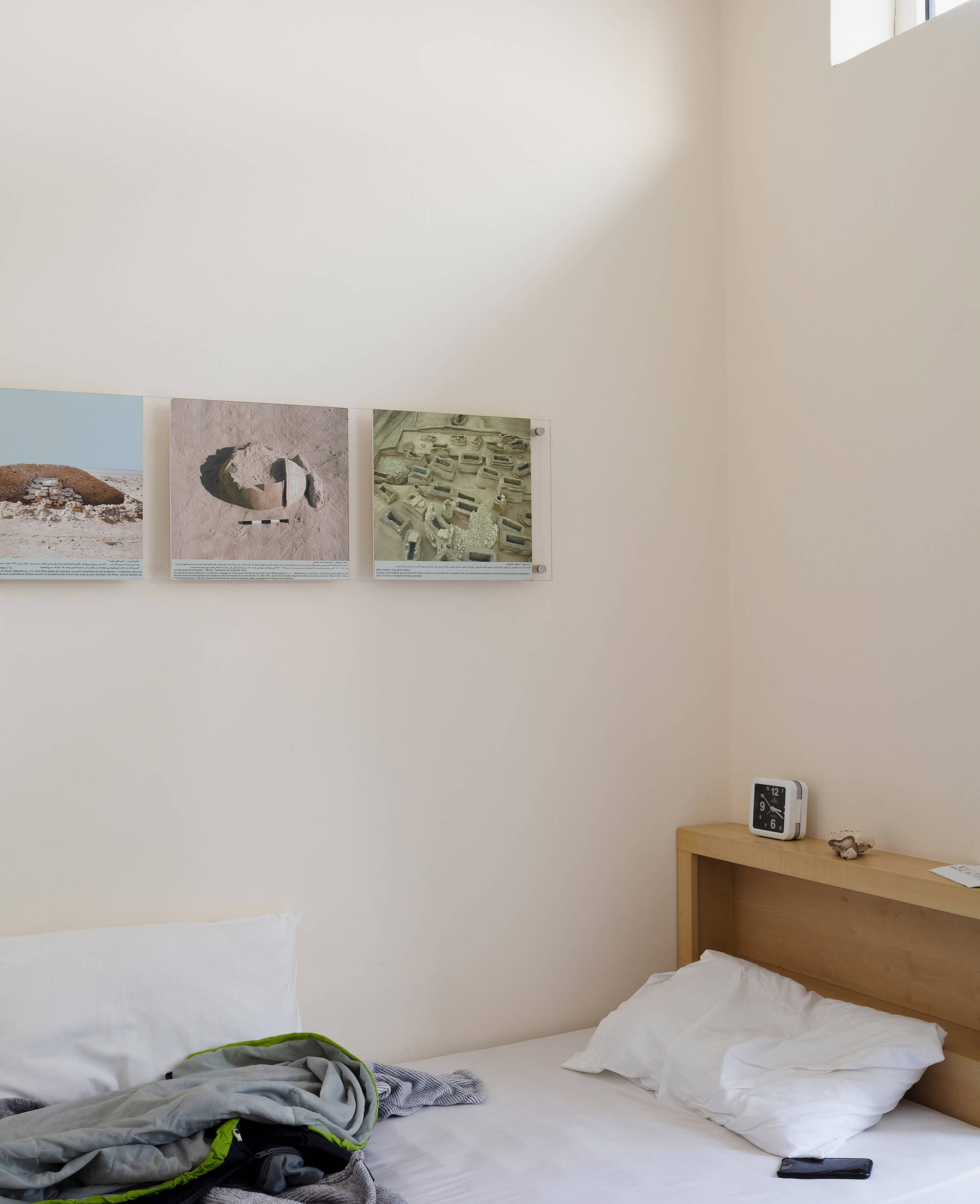
A square photograph with an Arabic and French text underneath it is mounted on a foam board, in turn mounted on a sheet of plexiglass. The picture in the middle is flanked by a photograph of and a text about the tumuli of Umm Jidr (left) and the excavations at Abou Saybi (right). They are mounted on the West wall of Guest Room 3 at the Qual’at Al-Bahrain Site Museum, Seef, Bahrain.
Necropolises make up the main archaeological testimonies of the Tylos period (4th century BC – 3rd century AD). The urn in the photograph contains the remains of several babies. They most likely fell victim to an epidemic. The size of the ruler next to the urn remains unspecified.
The photograph of Room 3 was made while in mandatory self-isolation after flying to Bahrain from Frankfurt and waiting for the result of a Covid-19 test.
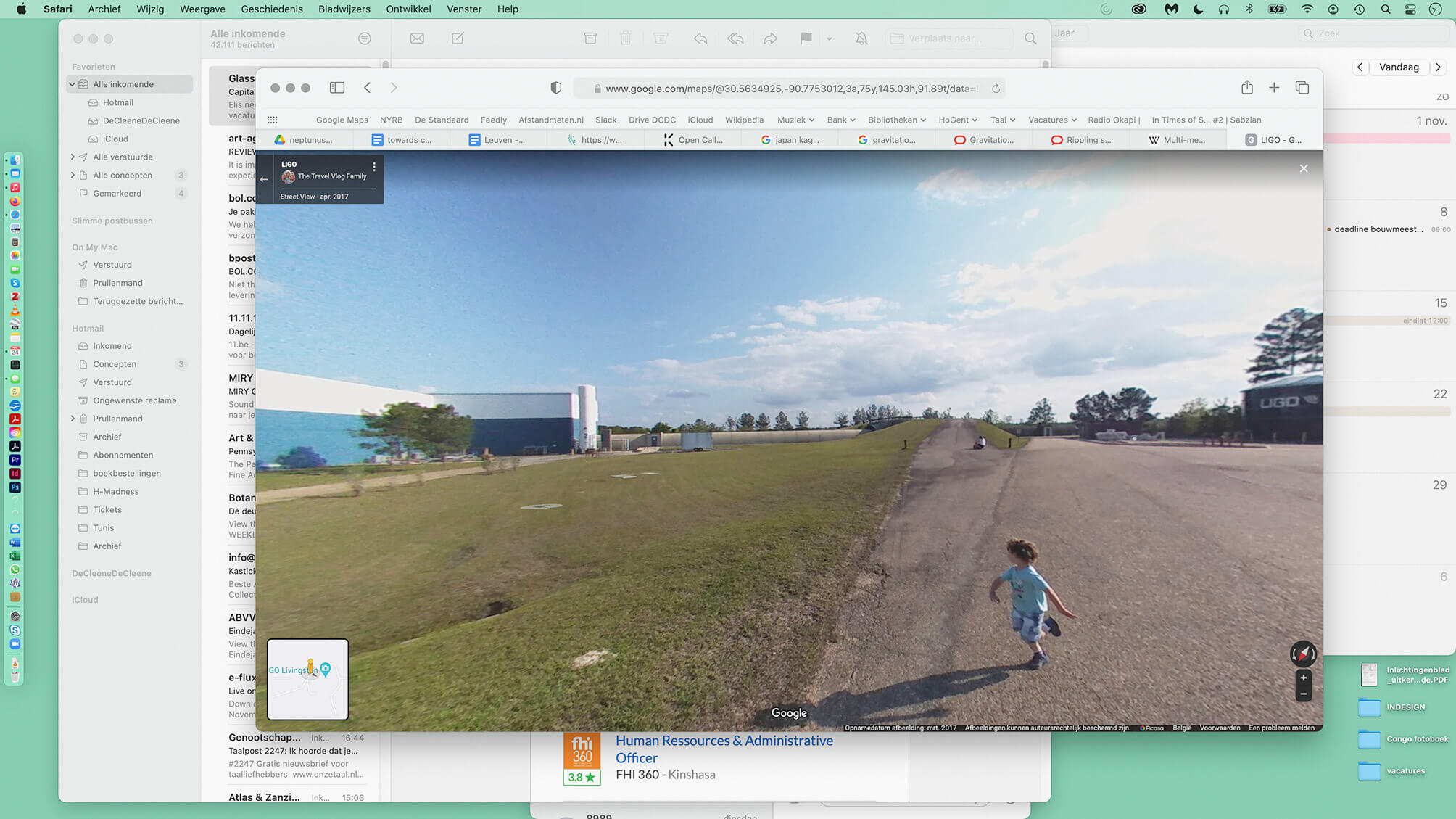
To detect gravitational waves, physicists built enormous research centers, amongst others at Livingston, Louisiana. The facility mainly consists of two tunnels in an L-shape. Mirrors inside provide data. Disturbances from gravitational waves are miniscule. To prevent interference from outside, such as vibrations caused by people passing in the neighbourhood, the mirrors have to be detached from the earth. They ‘float’, suspended by glass fibers in a pendulum-like construction. As I was watching my screen, a courier was on his way to deliver a book (Noel-Todd, J. The Penguin Book of the Prose Poem: From Baudelaire to Anne Carson. London: Penguin, 2019).
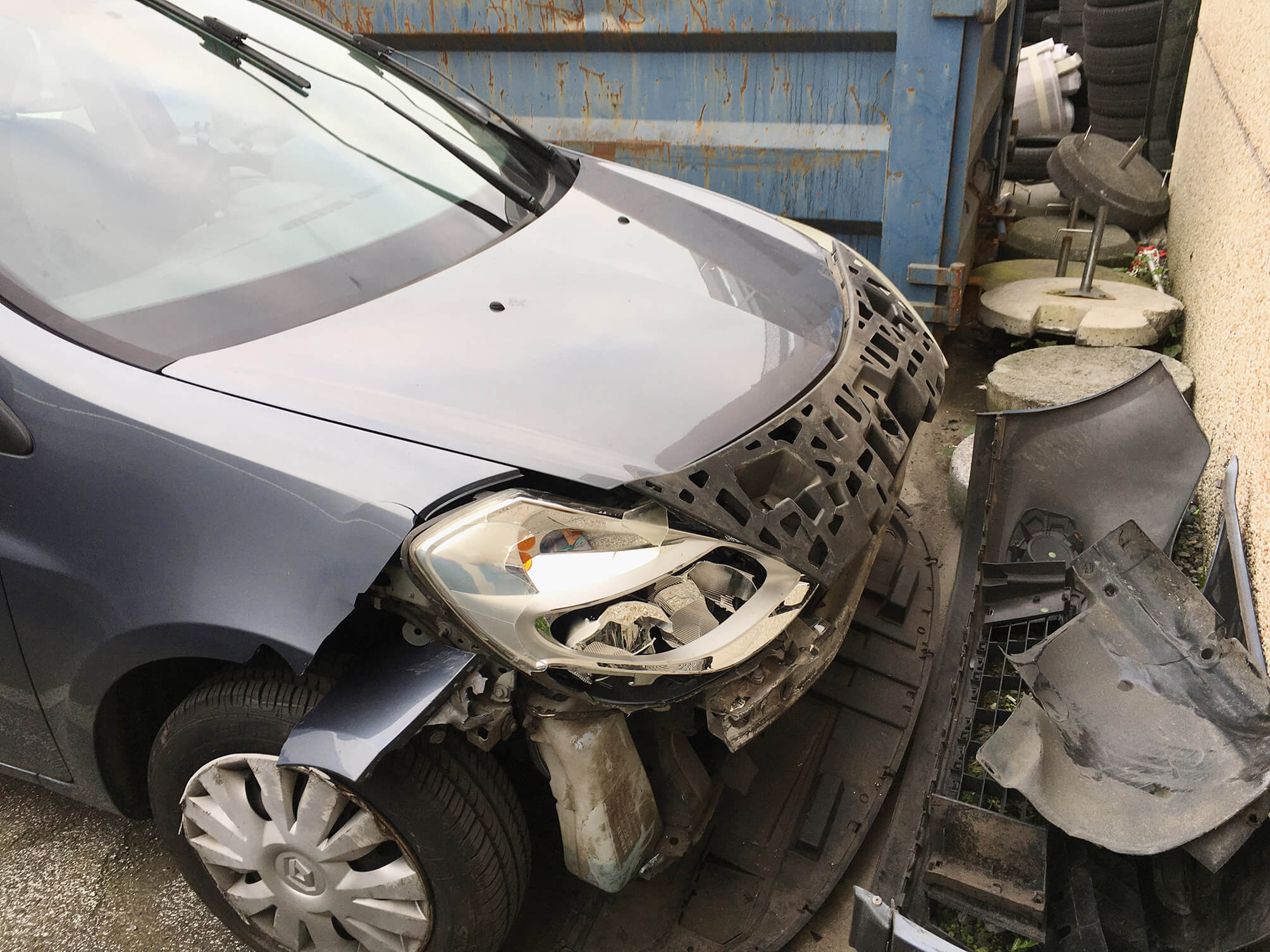
In June, 2014, a severe hailstorm hit Belgium. Warnings were broadcast. A football game between the national teams of Belgium and Tunisia was paused. The morning after, there were small dents in the hood and the roof of the car, each a square centimeter in size, some 10 centimeters separated from each other. The storm didn’t get a name.
Assessing the damage, the insurance company’s expert took the dents into account to establish the wreck’s worth.
In Zaffelare, young men who were called for military service but could not be missed at home were advised by the local doctor to swallow a small ball of aluminium foil an hour before the examination. In the X-ray, a gastric ulcer appeared. They were rejected for service. It is uncertain whether the increased incidence of gastric ulcers among young men in Zaffelare was a cause for concern.
At the office,1 a gray and a green bucket are meticulously positioned on the floor to catch the water dripping from the ceiling.2 It has been a very wet few months.
Perpendicularly above the green bucket is the office’s smoke detector, which, when it rains, could be mistaken for a sprinkler. The gray bucket is positioned perpendicularly beneath the electric line leading to the smoke detector. The lamp doesn’t leak.
The nineteenth-century building was designed by the renowned architect Adolphe Pauli.3 The offices of my former employer were also housed in a Pauli building. Over there, it was a mop that was used to evacuate water from the recurrently flooded ground floor hallway.
the-documents.org HQ
The reason for the leaks is said to be the use of screws that cause an electrolytic reaction.
Shortly after documenting the above, the roof came down. The buckets only partly catched the plaster.


It’s time to have a nap. I tilt the window over its middle axis to let the butterfly out. A breeze ruffles the drapes. Now, it sits on the glass and throws an enormous shadow on the yellow cloth.
Freely adapted from interviews with residents of Sandersleben (Saxony-Anhalt). Three-act play. The first two acts take place in the present day; the third is set in the future.
From Act 2 ‘The Inhabitants’, Scene 5, ‘Living Differently’.
Characters: MR DUNST club member I, MR WINDORF amateur astronomer
Stills from text animation S. Anders Leben. Eine Handlung in Gesprächen/S. Anders Leben – Living Differently: An Act in Conversations
Stephanie Kiwitt (1972) is an artist based in Halle (Saale), Germany. Utilizing a large number of images, various perspectives and also textual elements, she is known for her insightful photography that explores spaces emblematic of contemporary phenomena. Over the past three years, she has focused on evolving habitats in rural areas, photographing traces of transformation and conducting interviews in Saxony-Anhalt, the region she moved to in 2020. From 2018 to 2020, Kiwitt was a guest lecturer at the LUCA School of Arts in Brussels.
In spring 2024 the-documents.org and Trigger co-publish a series of online articles with a focus on the meeting ground between photography and the document.

Set in the fictitious Shanghai-based Dafeng Cotton Mill, Red Skirt Popular on the Street (1984) follows the story of an enterprising model worker as she navigates the challenges of young adult life, from workplace conflicts to choosing what clothes to wear on her days off. In the reflection of the emerging consumer consciousness of the Reform era, many of the film’s key moments happen not on the factory floor, but in the changing room where the workers seek to express themselves through their choice of dress. To this end, the film can be regarded as a document of the fashion trends being introduced into the country at the time, as best observed in the spellbinding array of colours on display as the workers leave the factory at the end of a day’s work.
The textile mill used as the setting for Dafeng Cotton Mill is Shanghai No. 1 Cotton Mill. Originally occupied by the no. 13 and 14 mills of the Japanese-owned Naigaiwata Company, the mill was formally established as the China Textile Construction Company Shanghai No. 1 Cotton Mill after the Second World War. It was located at the T-shaped intersection on Changshou Road, with the gate facing Jiaozhou Road. At that time, the area on the north side of Changshou Road extending from No. 1 Cotton Mill formed a continuous industrial zone encompassing many other factories and warehouses, all of which have since been converted into the private residences and creative parks.
Ho Rui An is an artist and writer working in the intersections of contemporary art, cinema, performance and theory. Through lectures, essays and films, his research examines the relations between labour, technology and capital across different systems of governance in a global age.
In spring 2024 the-documents.org and Trigger co-publish a series of online articles with a focus on the meeting ground between photography and the document.

United Until Tomorrow (1951) is based on the real-life events that took place at Shanghai’s Shenxin No. 9 Cotton Mill where workers led a factory-wide strike in 1948 to protest salary arrears against the background of escalating inflation. Shot at the original location of the strike, the film shows the entrance of the cotton mill transformed into a literal and ideological battlefield where workers gain class consciousness and fight to reclaim their rightful place as owners of the factory. In one climactic scene, the workers even seal the factory gate from the outside to prevent the products of their labour from being expropriated by Kuomintang forces.
Located at No. 128, Aomen Road, Shanghai, Shenxin No. 9 Cotton Mill belonged to the system of mills managed by Shenxin Textile Company, a private enterprise founded in 1915 by Wuxi-bred industrialist brothers Rong Zongjing and Rong Desheng. Following the Communist takeover of Shanghai, the cotton mill was nationalised in the 1950s and placed under the management of the Shanghai Textile Industry Bureau. With the subsequent launch of the economic reforms, the bureau was restructured into a holding company in 1998 amidst the deindustrialisation of the city. While many iconic buildings in the Shanghai Bund area today can be seen in the film, little remains of the original architecture of No. 9 Cotton Mill where the Shanghai Textile Museum is now located.
Ho Rui An is an artist and writer working in the intersections of contemporary art, cinema, performance and theory. Through lectures, essays and films, his research examines the relations between labour, technology and capital across different systems of governance in a global age.
In spring 2024 the-documents.org and Trigger co-publish a series of online articles with a focus on the meeting ground between photography and the document.

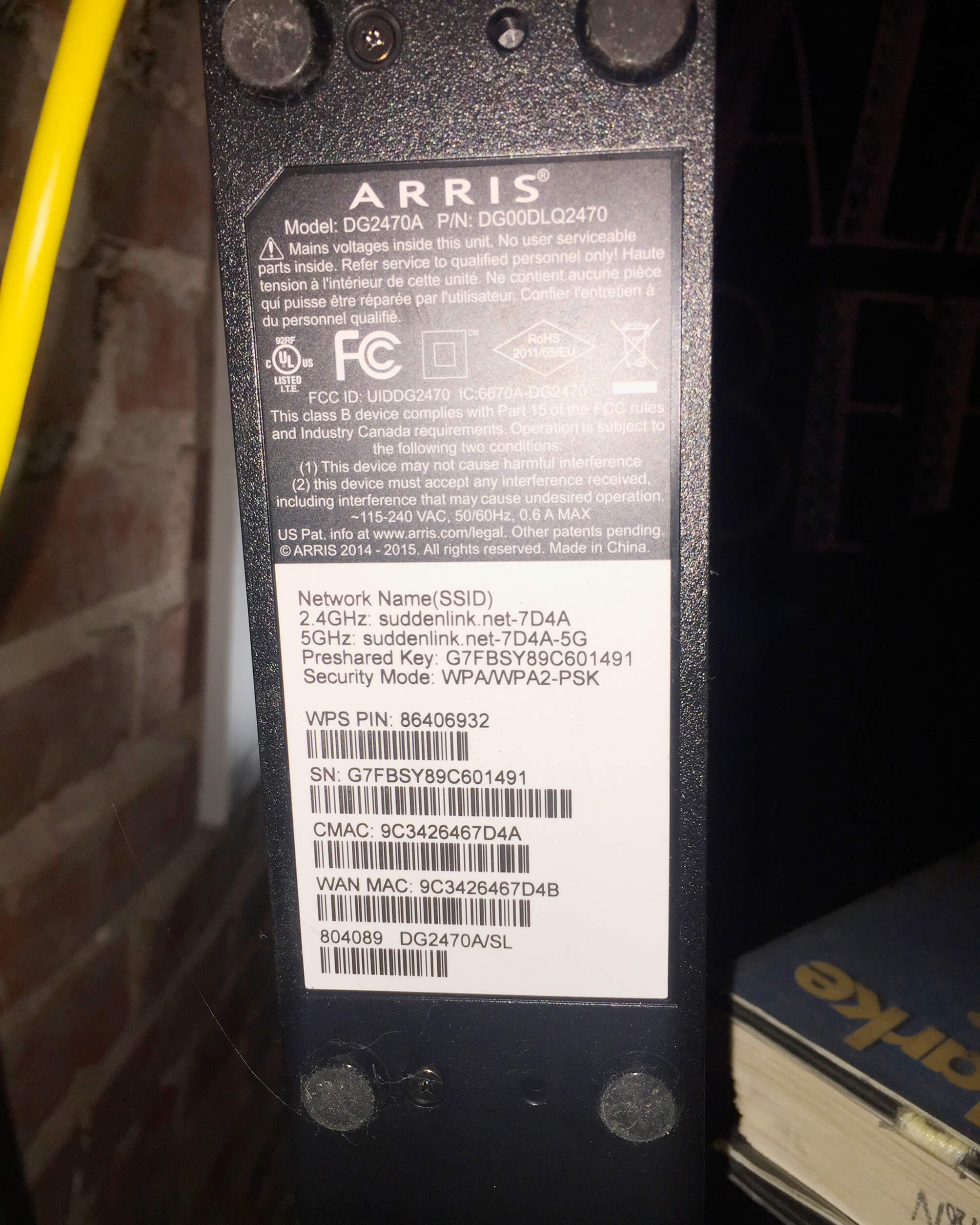
The bartender didn’t remember the passcode, so he pointed out where I could find it: on the bottom of the router box. Instead of trying to read the tiny numbers on the router label in the dark, while at the same time awkwardly typing it into my small, cumbersome smartphone keyboard, I decided to photograph the label. This allowed me to retreat back to my seat, zoom into the image and easily enter the code into my phone. The photograph immediately lost its value the moment this action was completed.
Max Pinckers (°1988, BE) and Victoria Gonzalez-Figueras (°1988, CA) are based in Brussels, Belgium. They have been working together for the past ten years on documentary photography projects. Victoria works in the cultural field as a researcher and producer. Max is a speculative documentarian, teacher and occasional writer on photography. They are married, in love, and have a son. Victoria has consistently assisted Max in his projects as a production manager, but they have recently been making new work together as co-authors. “Double Reward” is the first such project.
In spring 2024 the-documents.org and Trigger co-publish a series of online articles with a focus on the meeting ground between photography and the document.
When discussing the sensitivities around viewing British propaganda photographs from the 1950s with Mau Mau veterans in Kenya, it became clear that it was not the graphic photographs of atrocities that would trigger the veterans emotionally, but a series of straightforward portraits of men who had pledged allegiance to the British colonial administration. These portraits were catalogued along with the men’s names and another photograph of each one of them signing a declaration of collaboration. I was advised by the representative of the veterans’ association that it would be too dangerous to share these photographs with the veterans.
22 superimposed portraits from the file CO 1066/7: Kikuyu Loyalists at The National Archives (UK) depicting Kikuyu loyalists after signing a declaration of collaboration with the British on 27 January 1954.
From the series State of Emergency, Max Pinckers et al. (2024)
Max Pinckers (°1988, BE) and Victoria Gonzalez-Figueras (°1988, CA) are based in Brussels, Belgium. They have been working together for the past ten years on documentary photography projects. Victoria works in the cultural field as a researcher and producer. Max is a speculative documentarian, teacher and occasional writer on photography. They are married, in love, and have a son. Victoria has consistently assisted Max in his projects as a production manager, but they have recently been making new work together as co-authors. “Double Reward” is the first such project.
In spring 2024 the-documents.org and Trigger co-publish a series of online articles with a focus on the meeting ground between photography and the document.

‘No consent was given for the photograph to be taken. The capture of my body in this way is a form of torture.
The photograph is evidence of the entitled authority and fundamental corruptions of the male soldiers and the occupying military forces.’
Screenshot from film chapter In Her View which engages an archival document revealing the sexual exploitation of an anonymous woman by occupying Australian soldiers fighting for the Allied forces in Lebanon in 1941. The film moves through the archival evidence to sense, trace and position her encounter as a formation of poetic testimony. The image shows extracted noise, levels, focal length and balance from the archive image to generate a 3D model of its violent points of interaction, this is without showing the image itself. A technique developed with Anabel Garcia-Kurland on human/non-human modelling in the making of the film.
Frame of Accountability, 01:00:00, Helene Kazan, 2024.
Helene Kazan is an artist, writer and educator. Her work investigates ‘risk’ as a lived condition produced through the conjoined violent effects of capitalism and conflict. This is observed in the colonial roots of international law and its material formation of the lived-built environment. In response, she uses decolonial, feminist, poetic and critical-legal approaches in her work, which explores ways of dismantling the ongoing effects of neo-colonial violence towards wider frameworks of accountability and justice.
In spring 2024 the-documents.org and Trigger co-publish a series of online articles with a focus on the meeting ground between photography and the document.

‘Dust particles flew off the box, disturbed by my opening. Adding to the sense that this archival material was vibrating under the weight of its unknown importance. Amidst the boxes of ‘Top Secret’ British governments documents, I find a map labelled ‘Syria’ 3.6.41.’
Screenshot from film chapter (Un)Touching Ground. A decolonial audio visual translation of an archival map reveals the effects of the Allied military campaign into Lebanon and Syria in 1941.
Frame of Accountability, 01:00:00, Helene Kazan, 2024.
Through film, installation, writing and public engagement Frame of Accountability investigates ‘risk’ as a lived condition, produced through the co-evolution of capitalist systems and violent conflict. The project focuses on the effects across Lebanon and Syria, with a view to understanding the wider regional and global consequences. Using poetic and critical-legal methods, the work explores ways of dismantling violence perpetrated through colonial mechanisms of governance, towards wider frameworks of accountability and justice. The work is produced in multi-part, non-linear formation.
Helene Kazan is an artist, writer and educator. Her work investigates ‘risk’ as a lived condition produced through the conjoined violent effects of capitalism and conflict. This is observed in the colonial roots of international law and its material formation of the lived-built environment. In response, she uses decolonial, feminist, poetic and critical-legal approaches in her work, which explores ways of dismantling the ongoing effects of neo-colonial violence towards wider frameworks of accountability and justice.
In spring 2024 the-documents.org and Trigger co-publish a series of online articles with a focus on the meeting ground between photography and the document.

When we bought our house more than a decade ago, we were told it was listed as architectural heritage.1 The house used to be part of the Heynderyckx Foundry, in part designed by architect F. Dierkens. When submitting the planning application in the run-up to the renovation, it was therefore mandatory to include a report from the city’s heritage conservation department. They asked for plans of the proposed changes, as well as plans and photographs of the situation as it is.
The department’s advice came a few weeks later. ‘With the exception of the fireplace with its marble mantelpiece in the room at the street side on the ground floor, this building has lost many of its architectural features. The façade rendering with faux joints, the vertical pilasters with their capitals, the central curved façade finish and the joinery are elements that defined the façade and have been removed. The new design is therefore acceptable subject to the following comments:
– preservation of the marble fireplace on the ground floor.’
We replied: ‘Unfortunately, the marble mantelpiece on the ground floor is not original either. We suspect that the original fireplace disappeared along with the façade, sometime in the seventies. The mantelpiece you can see in the image is an approximation of, and a reference to, what we imagine it might once have looked like. This replica is made of sheets of MDF with a layer of Formica F3460 – Calacatta Marble.’
Formica still produces these sheets.2 They measure 3,05 x 1,3m. Similar to wallpaper, the same marble pattern appears twice on every sheet, seamlessly.


https://inventaris.onroerenderfgoed.be/erfgoedobjecten/18442
https://www.formica.com/nl-be/products/laminate/F3460

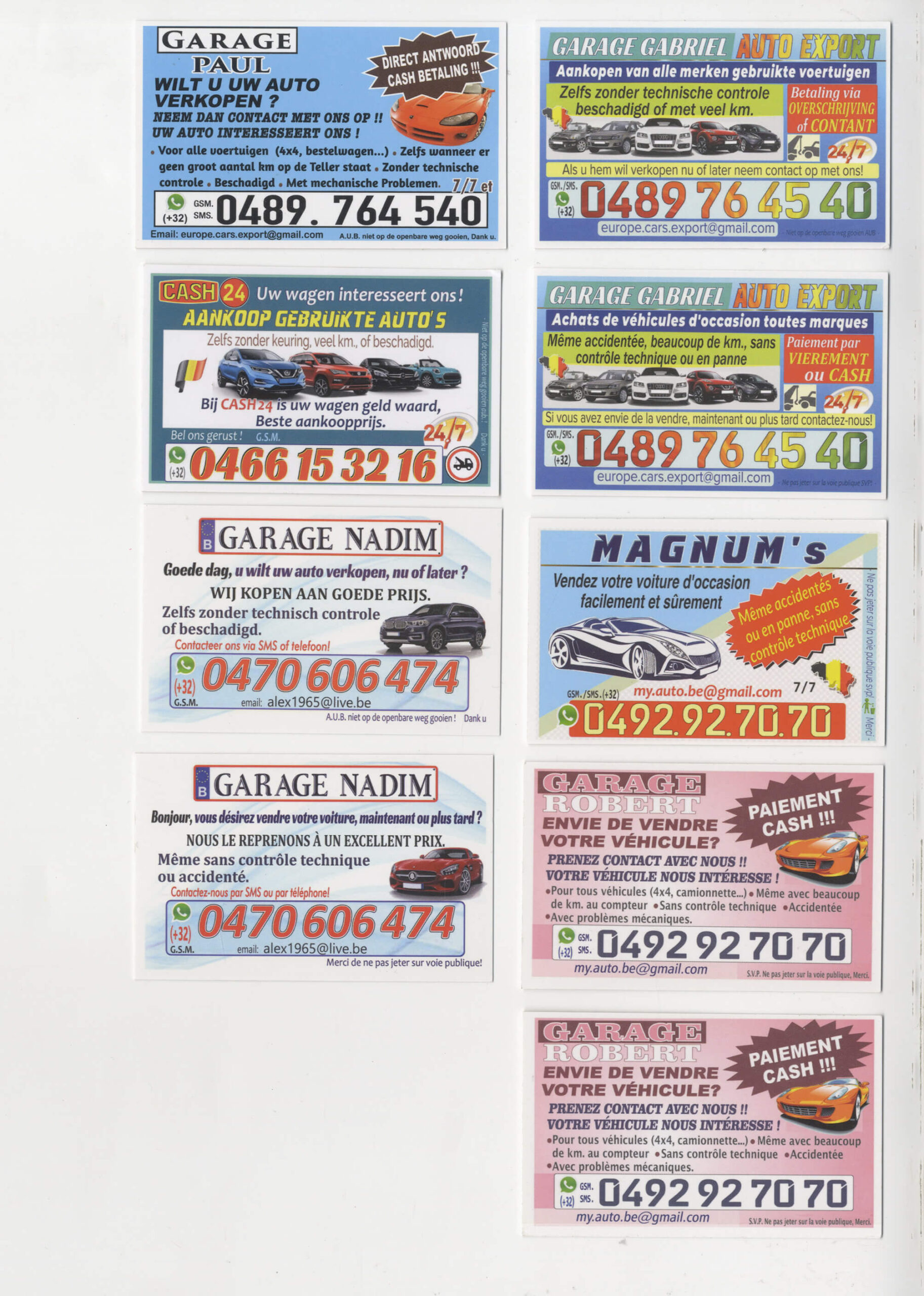
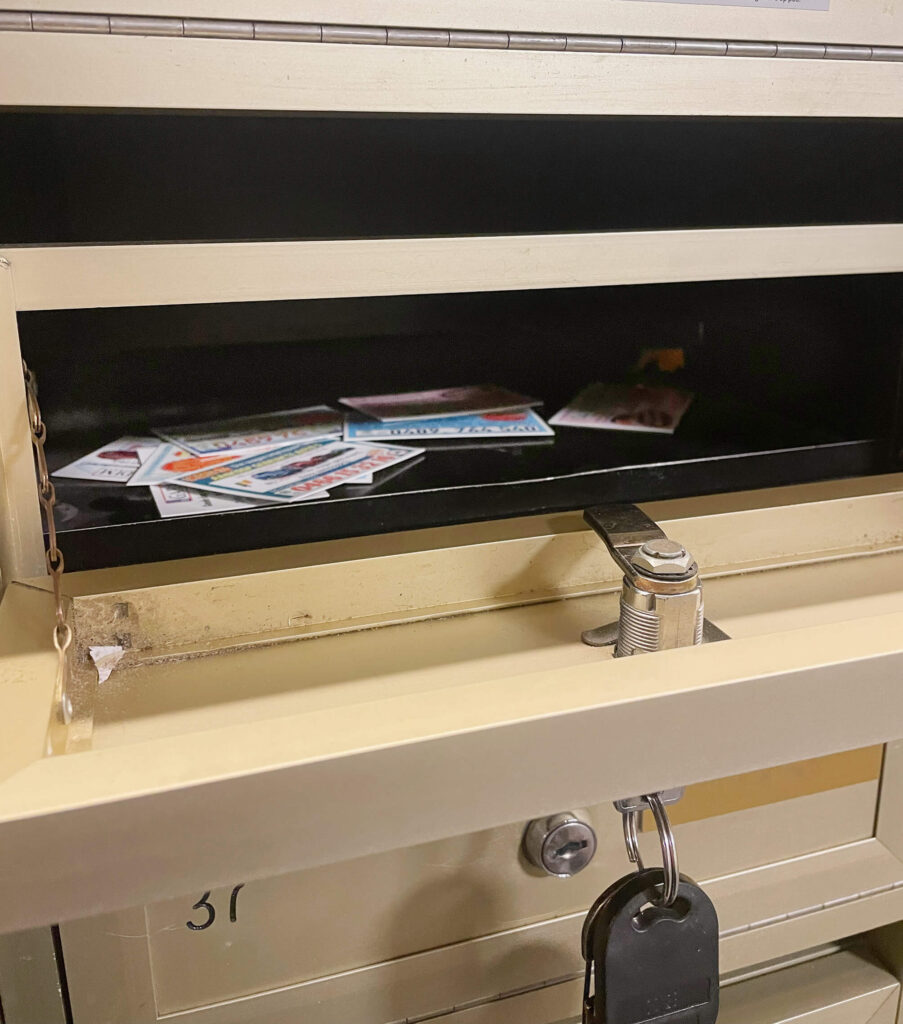
A year ago I moved into Solange’s appartement. From the balcony, I see half the parking lot and the adjacent high rise. On the mailbox, I haven’t replaced her name for mine.
1. GARAGE PAUL, (+32) 0489. 764 540 / recto-verso NL/FR
2. CASH 24, (+32) 0466 15 32 16 / recto-verso NL/FR
3. GARAGE NADIM (+32) 0470 606 474 / recto-verso NL (1)
4. GARAGE NADIM (+32) 0470 606 474 / recto-verso FR (2)
5. GARAGE GABRIEL (+32) 0489 76 45 40 / recto-verso NL (1)
6. GARAGE GABRIEL (+32) 0489 76 45 40 / recto-verso FR (2)
7. MAGNUM’s (+32) 0492 92 70 70 / recto-verso FR
8. GARAGE ROBERT (+32) 0492 92 70 70 / recto-verso FR (1)
9. GARAGE ROBERT (+32) 0492 92 70 70 / recto-verso FR (2)
I don’t know whether Solange owned a car.
Bieke Criel, lives and works in Gent (BE). Intrigued by landscape, movement, light and the poetics of what lies in between. Does not own a car, loves to drive one. Part of 019.