What constitutes a ‘document’ and how does it function?
According to the Oxford English Dictionary, the etymological origin is the Latin ‘documentum’, meaning ‘lesson, proof, instance, specimen’. As a verb, it is ‘to prove or support (something) by documentary evidence’, and ‘to provide with documents’. The online version of the OED includes a draft addition, whereby a document (as a noun) is ‘a collection of data in digital form that is considered a single item and typically has a unique filename by which it can be stored, retrieved, or transmitted (as a file, a spreadsheet, or a graphic)’. The current use of the noun ‘document’ is defined as ‘something written, inscribed, etc., which furnishes evidence or information upon any subject, as a manuscript, title-deed, tomb-stone, coin, picture, etc.’ (emphasis added).
Both ‘something’ and that first ‘etc.’ leave ample room for discussion. A document doubts whether it functions as something unique, or as something reproducible. A passport is a document, but a flyer equally so. Moreover, there is a circular reasoning: to document is ‘to provide with documents’. Defining (the functioning of) a document most likely involves ideas of communication, information, evidence, inscriptions, and implies notions of objectivity and neutrality – but the document is neither reducible to one of them, nor is it equal to their sum. It is hard to pinpoint it, as it disperses into and is affected by other fields: it is intrinsically tied to the history of media and to important currents in literature, photography and art; it is linked to epistemic and power structures. However ubiquitous it is, as an often tangible thing in our environment, and as a concept, a document deranges.
the-documents.org continuously gathers documents and provides them with a short textual description, explanation,
or digression, written by multiple authors. In Paper Knowledge, Lisa Gitelman paraphrases ‘documentalist’ Suzanne Briet, stating that ‘an antelope running wild would not be a document, but an antelope taken into a zoo would be one, presumably because it would then be framed – or reframed – as an example, specimen, or instance’. The gathered files are all documents – if they weren’t before publication, they now are. That is what the-documents.org, irreversibly, does. It is a zoo turning an antelope into an ‘antelope’.
As you made your way through the collection,
the-documents.org tracked the entries you viewed.
It documented your path through the website.
As such, the time spent on the-documents.org turned
into this – a new document.
This document was compiled by ____ on 27.05.2026 17:08, printed on ____ and contains 21 documents on _ pages.
(https://the-documents.org/log/27-05-2026-6819/)
the-documents.org is a project created and edited by De Cleene De Cleene; design & development by atelier Haegeman Temmerman.
the-documents.org has been online since 23.05.2021.
- De Cleene De Cleene is Michiel De Cleene and Arnout De Cleene. Together they form a research group that focusses on novel ways of approaching the everyday, by artistic means and from a cultural and critical perspective.
www.decleenedecleene.be / info@decleenedecleene.be - This project was made possible with the support of the Flemish Government and KASK & Conservatorium, the school of arts of HOGENT and Howest. It is part of the research project Documenting Objects, financed by the HOGENT Arts Research Fund.
- Briet, S. Qu’est-ce que la documentation? Paris: Edit, 1951.
- Gitelman, L. Paper Knowledge. Toward a Media History of Documents.
Durham/ London: Duke University Press, 2014. - Oxford English Dictionary Online. Accessed on 13.05.2021.

In Zaffelare, young men who were called for military service but could not be missed at home were advised by the local doctor to swallow a small ball of aluminium foil an hour before the examination. In the X-ray, a gastric ulcer appeared. They were rejected for service. It is uncertain whether the increased incidence of gastric ulcers among young men in Zaffelare was a cause for concern.

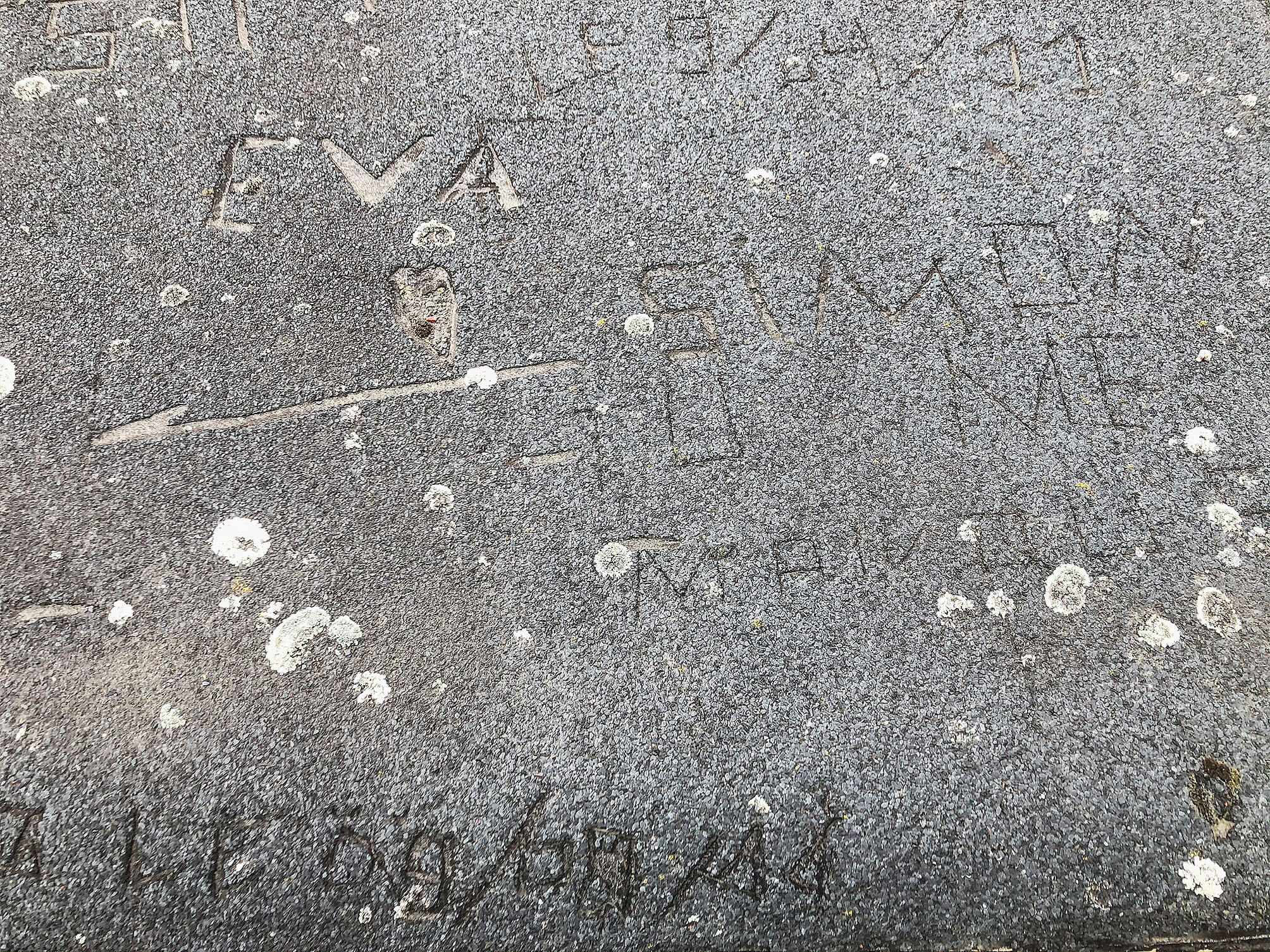
In what order and by whom the various texts and drawings were carved into the soft roofing is unclear. To the right of ‘EVA’, a heart symbol and an arrow (pointing to the left), the roofing reads ‘SIMON TU ME MANQUES’.
The short sentence usually – yet hastily – translates to ‘Simon, I miss you’. However, in French the ‘you’ (tu) is the subject and has an active role, whereas the ‘I’ (me) is the direct object. In short: by his not being there, Simon actively effectuates hurt to the one who carved this text.
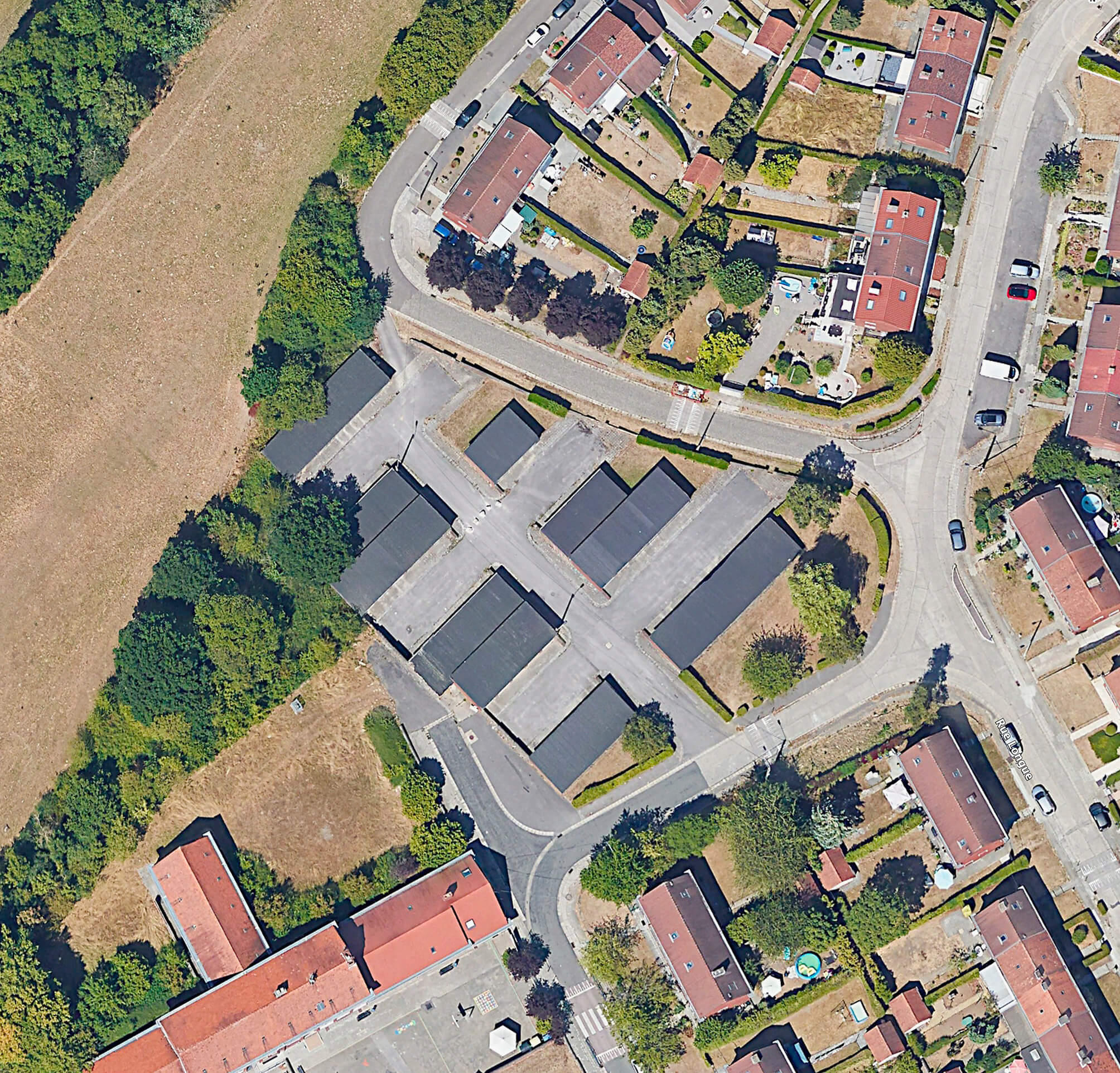
Seven very similar and rudimentary buildings take in a trapezoid plot of land in Gilly. They are located between the school on the Rue Circulaire and the houses along the Rue de l’Abbaye. The structures are built of orange brick, concrete structural elements, whitish steel gates and roofing. Every garage has its own number, hand-painted in white on the concrete lintel above each gate. In summer the roofing gets hot and soft.
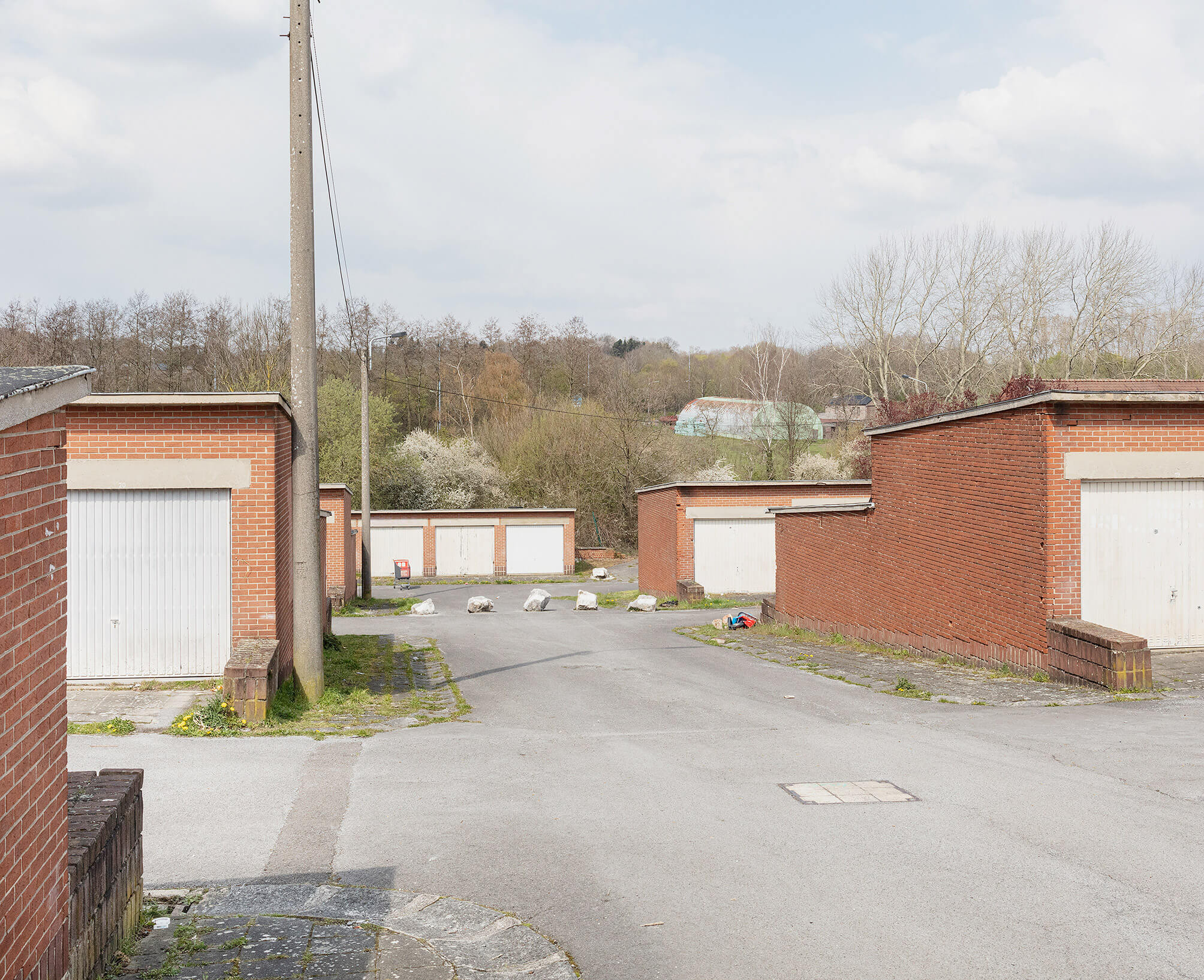
Five white boulders close off a shortcut for motorists who attempt to cut the bend in the road. The southernmost roof’s pitch runs opposite to the landscape’s slope. The lower roofline is, therefore, only about one meter above a small, triangular patch of grass which is hidden from view by a hedge. In summer, when the roofing gets hot and soft, text and drawings get pressed or carved into it.
Google Earth
A carving that looks like a stitched-up scar (a long, slightly curved line crossed at a right angle by eleven short straight lines) is inserted into a short statement about Celine and Logan. An initial of Celine’s last name is included. At first sight it looks like a ‘D’, but the line through the middle might just as well make it a ‘B’. Maybe it was Celine D who added the line in an attempt to convince those reading the roofing that it’s actually Celine B who blows Logan.

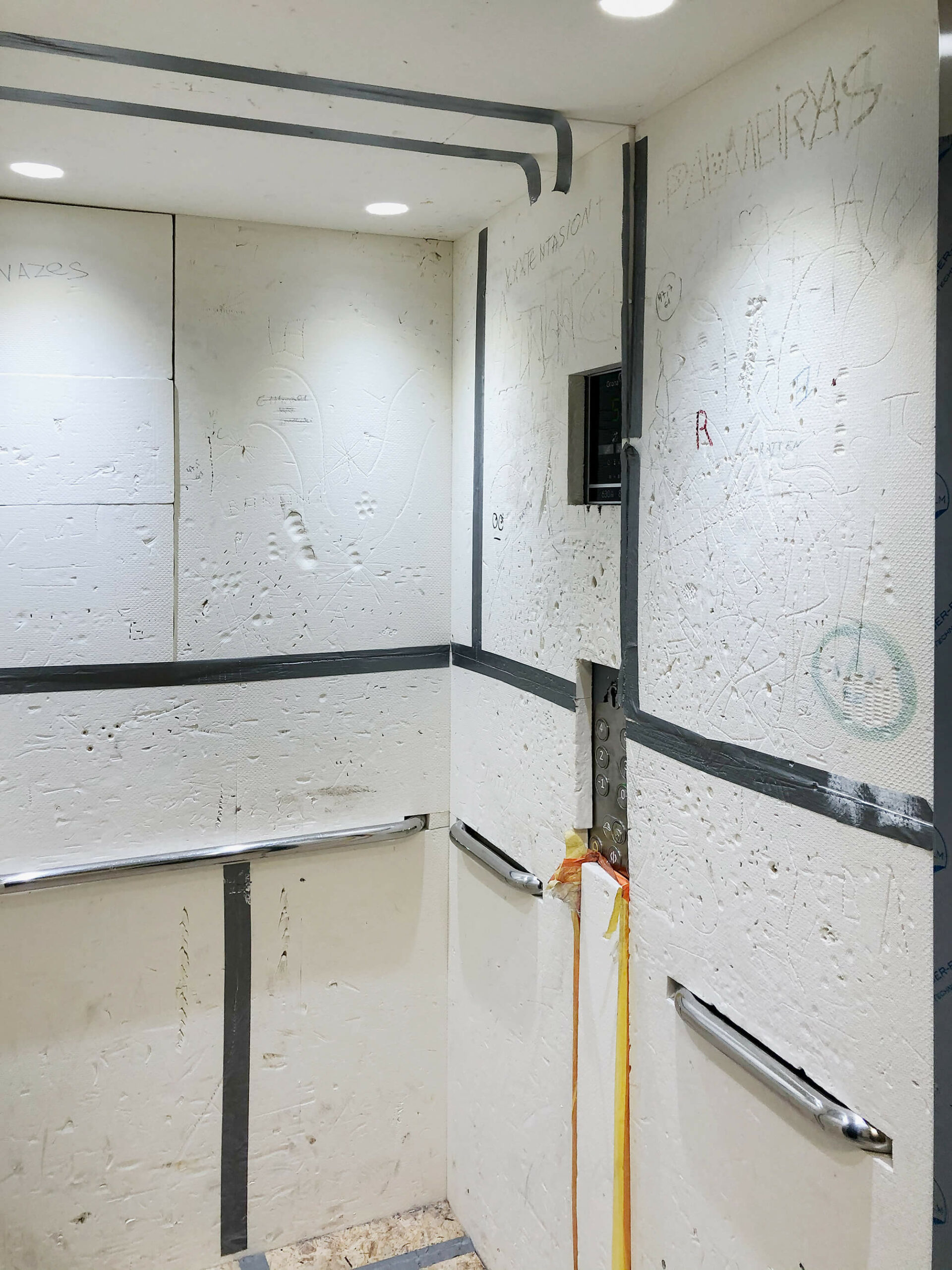
The building is almost finished. One apartment is still up for sale, on the top floor. The contractor is finishing up. There’s a long list of comments and deficiencies that need to be addressed before the building can be handed over definitively to the owner. The elevator’s walls are protected by styrofoam to prevent squares, levels, measures, drills, air compressors, chairs, bird cages, etc. from making scratches on the brand new wooden panelling.
In 1932 Brassaï began taking photographs of graffiti scratched into walls of Parisian buildings. On his long walks he was often accompanied by the author Raymond Queneau, who lived in the same building but on a different floor. Brassaï published a small collection of the photographs in Minotaure, illustrating an article titled ‘Du mur des cavernes au mur d’usine’ [‘From cave wall to factory wall’].
In an attempt to make it his own, Gino – it might also be Dino – has taken a can of bright pink spray paint to his hard hat and – as the paint was drying – dragged his gloved finger from top to bottom. G – or D –, I, N, O. In the dust on a demolished floor tile, someone has written 12,10. Perhaps a measurement, a quantity, a position, a date, a reference.
Subtractive writing is not uncommon. With the tip of a passer-by’s index finger ‘WASH ME’ is subtracted from the dust on a dirty car. In freshly poured concrete, a name is embedded forever with a twig. In hot and soft roofing drawings and obscenities are scratched. Styrofoam lining a brand new elevator gets impressed with names, jokes and knuckles.
In the twenty-third canto of Ariosto’s Orlando Furioso (1516), Orlando comes across the name of his love and another man, carved in the bark of a tree. He doubts. But that night, a gossiping shepherd tells him he’s seen Angelica and Medoro together. Orlando returns to the forest, and in a four-day frenzy, he uproots every tree and pollutes the rivers forever.
CXXXI
For he turf, stone, and trunk, and shoot, and lop,
Cast without cease into the beauteous source;
Till, turbid from the bottom to the top,
Never again was clear the troubled course.
At length, for lack of breath, compelled to stop,
(When he is bathed in sweat, and wasted force,
Serves not his fury more) he falls, and lies
Upon the mead, and, gazing upward, sighs.1
Ariosto, L. Orlando Furioso. Translated by William Stewart Rose, Echo Library, 2006, p. 267.

Holding two cans of spray paint, a city employee walks through a sweet chestnut grove on the graveyard. He’s looking for potholes.
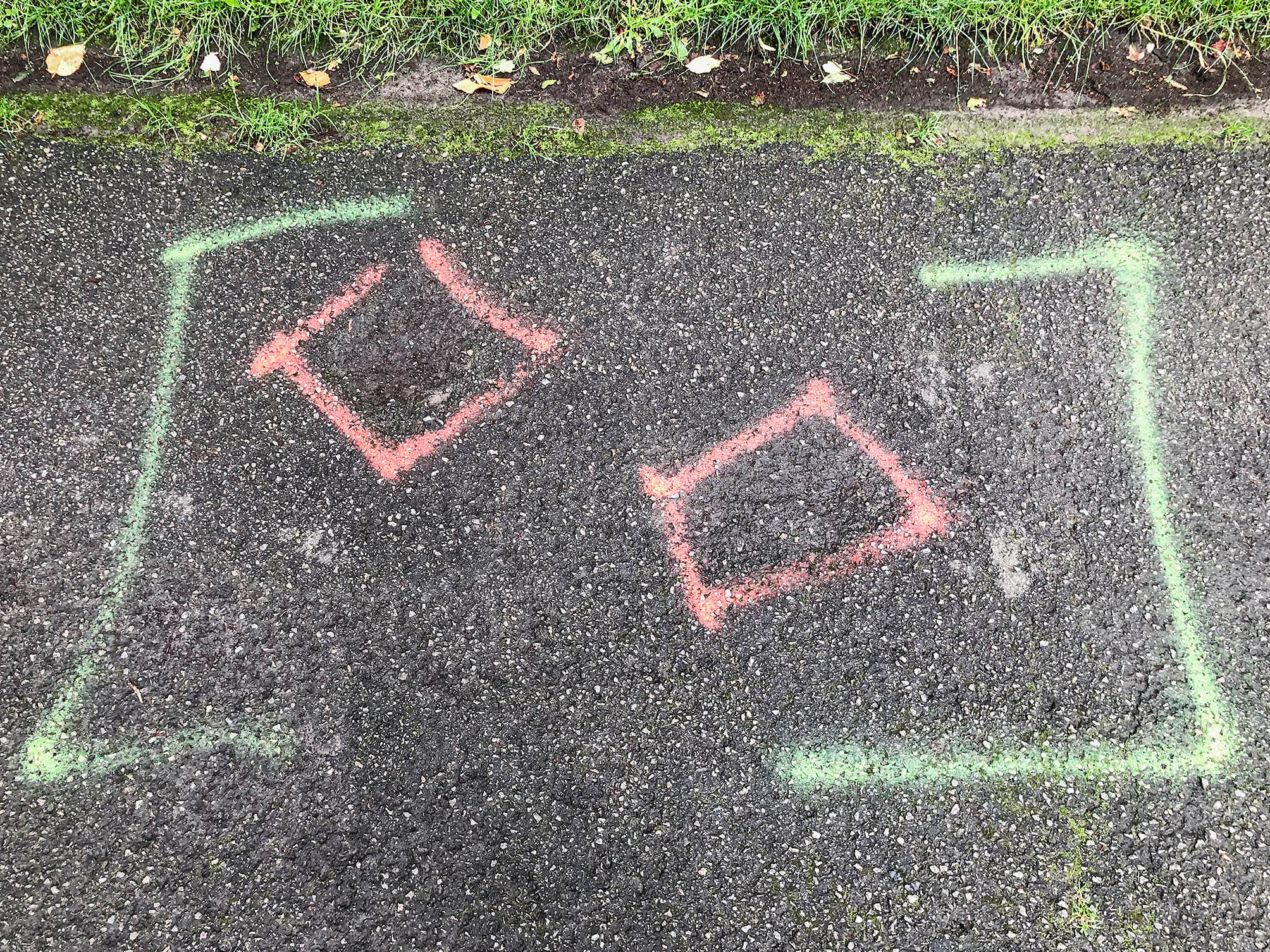
In an attempt to make it his own, Gino – it might also be Dino – has taken a can of bright pink spray paint to his hard hat and – as the paint was drying – dragged his gloved finger from top to bottom. G – or D –, I, N, O. In the dust on a demolished floor tile, someone has written 12,10. Perhaps a measurement, a quantity, a position, a date, a reference.
Subtractive writing is not uncommon. With the tip of a passer-by’s index finger ‘WASH ME’ is subtracted from the dust on a dirty car. In freshly poured concrete, a name is embedded forever with a twig. In hot and soft roofing drawings and obscenities are scratched. Styrofoam lining a brand new elevator gets impressed with names, jokes and knuckles.
In the twenty-third canto of Ariosto’s Orlando Furioso (1516), Orlando comes across the name of his love and another man, carved in the bark of a tree. He doubts. But that night, a gossiping shepherd tells him he’s seen Angelica and Medoro together. Orlando returns to the forest, and in a four-day frenzy, he uproots every tree and pollutes the rivers forever.
CXXXI
For he turf, stone, and trunk, and shoot, and lop,
Cast without cease into the beauteous source;
Till, turbid from the bottom to the top,
Never again was clear the troubled course.
At length, for lack of breath, compelled to stop,
(When he is bathed in sweat, and wasted force,
Serves not his fury more) he falls, and lies
Upon the mead, and, gazing upward, sighs.1
Ariosto, L. Orlando Furioso. Translated by William Stewart Rose, Echo Library, 2006, p. 267.
Photographing the house and the clearing it stood in proved difficult. During summer, the nettles and brambles slowed down the pace. Some plants stung the elbows. The clearing only became visible when the sun fell through the opening in the canopy. On cloudy days the clearing disappeared.
‘As the order of institutions follows its course, or as huts give way to villages and then to cities and finally to cosmopolitan academies, the forests move further and further away from the center of the clearing. At the center one eventually forgets that one is dwelling in a clearing. […] Yet however wide the circle may get through the inertia of civic expansion, it presumably retains an edge of opacity where history meets the earth, where the human abode reaches its limits.’
Pogue Harrison, R. ‘The Ecology of Finitude’, in: id., Forests. Chicago, 1992, 245.

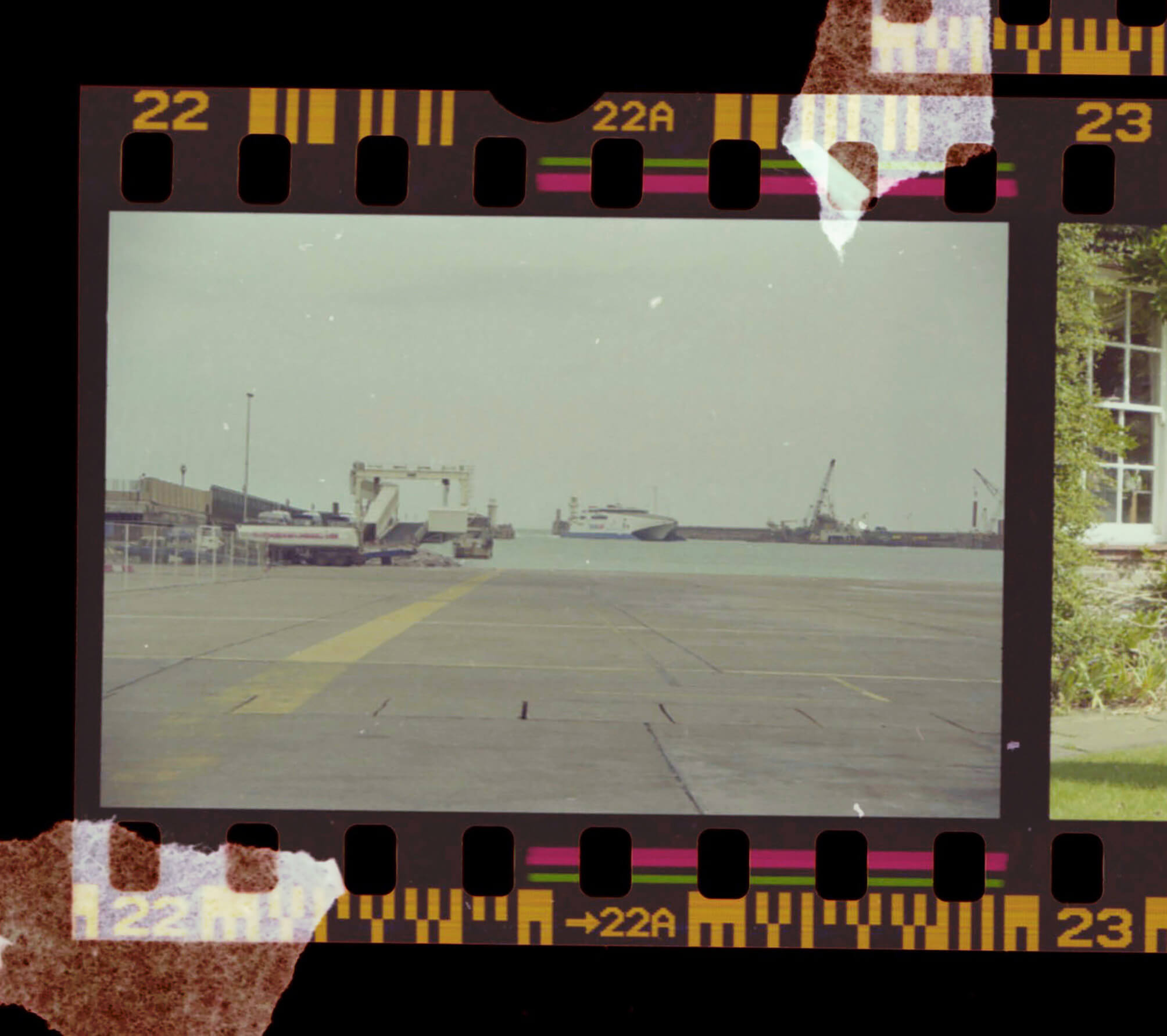
Coming back from holidays, we were waiting for the ferry to take us from Ramsgate to Ostend. We were well on time. As the ship entered the harbour, I asked my parents if I could take a photograph. It’s the first photograph I recall taking. I remember my dad telling me to wait long enough for the ship to get closer. I didn’t. I only got one try.1
It took a while before the film was developed. I couldn’t stop imagining what the photograph would look like: some picturesque waves in the foreground, the shining white ship, the red and blue text on the side, and a cloud filled sky.
Following every holiday, when we got home, the garden and our house would be photographed with the remaining exposures on the roll of film in the camera.
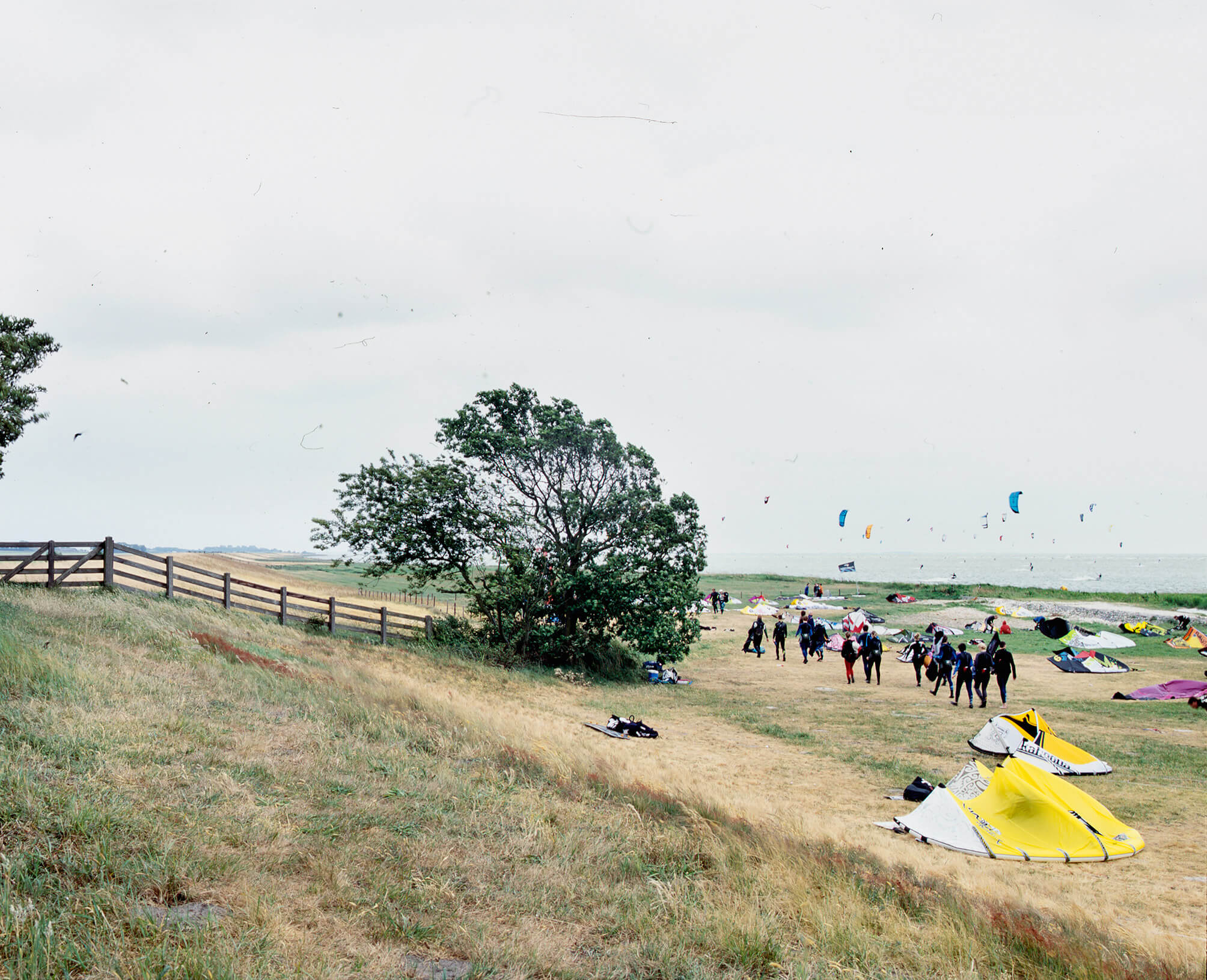
Ten years ago, in November, I drove up to Frisia – the northernmost province of The Netherlands. I was there to document the remains of air watchtowers: a network of 276 towers that were built in the fifties and sixties to warn the troops and population of possible aerial danger coming from the Soviet Union. It was very windy. The camera shook heavily. The poplars surrounding the concrete tower leaned heavily to one side.
I drove up to the seaside, a few kilometers farther. The wind was still strong when I reached the grassy dike that overlooked the kite-filled beach. I exposed the last piece of film left on the roll. Strong gusts of wind blew landwards.
Months later I didn’t bother to blow off the dust that had settled on the film before scanning it. A photograph without use, with low resolution, made for the sake of the archive’s completeness.
The dust on the film appears to be carried landwards, by the same gust of wind lifting the kites.
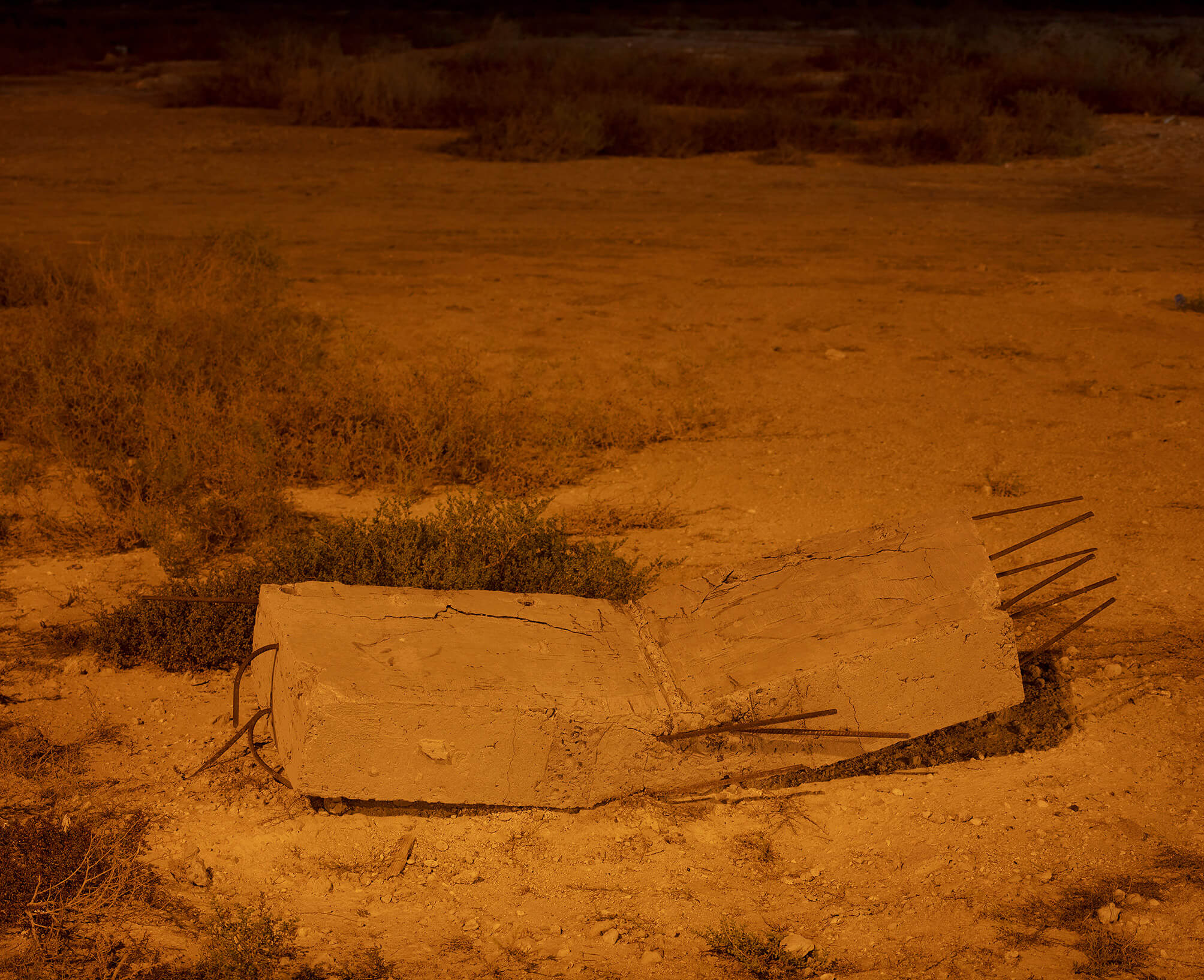
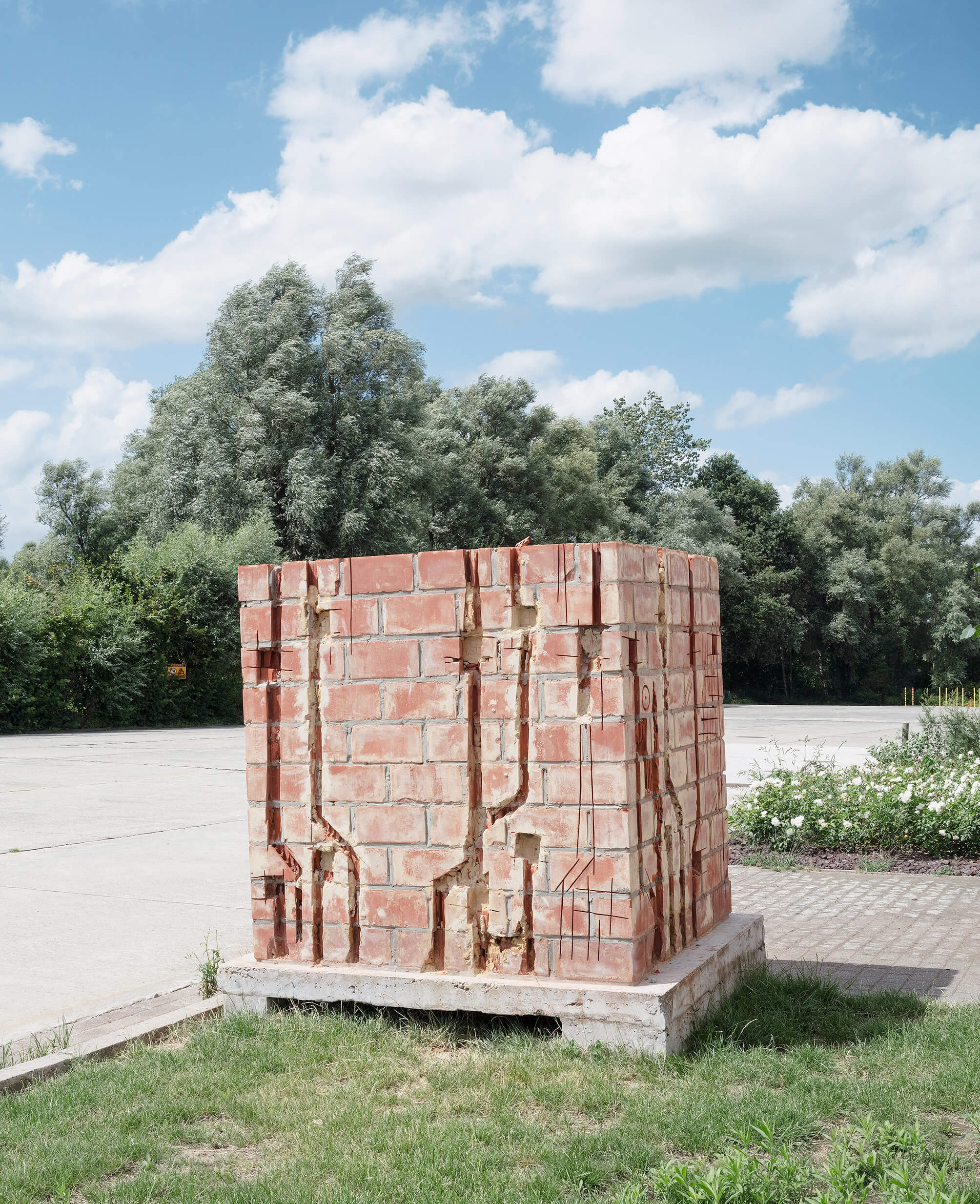
A block of concrete. Fissures are showing and rebar is sticking out from all sides. If it were still straight, the block would measure approximately 130 x 15 x 40cm.
It is lying by the side of the road, a few hundred meters from a construction site. It appears to be shaped by impact. Maybe the block plummeted to the ground from a great height. Perhaps, something heavy hit it. For all one knows, it served as a column and was exposed to an unforeseen amount of pressure, causing it to buckle.
According to Eyal Weizman ‘[a]rchitecture emerges as a documentary form, not because photographs of it circulate in the public domain but rather because it performs variations on the following three things: it registers the effect of force fields, it contains or stores these forces in material deformations, and, with the help of other mediating technologies and the forum, it transmits this information further.’1
Weizman, E. ‘Introduction’, in: Forensic Architecture. Forensis. The Architecture of Public Truth. London/Berlin: Sternberg Press, 2014.
‘The masons in training pour a concrete slab and build four walls upon it in a stretcher bond. Then the block comes to our department and the students in the course Electrical installer (residential) can grind channels and drill cavities in it.’
[…]
‘It’s not always a success from the outset, but they learn quickly.’
[…]
‘Never grind horizontally, always vertically. Diagonally if there is no other way.’
[…]
‘Two fingers wide.’
[…]
‘After this it goes to the sanitary department. After the bell drilling, the demolition hammer follows and the masons make us a new block.’
Competentiecentrum VDAB, Wondelgem, July 2019.
First published in A+ Architecture in Belgium, A+ 279, Schools (August, September 2019), https://www.a-plus.be/nl/tijdschrift/schools
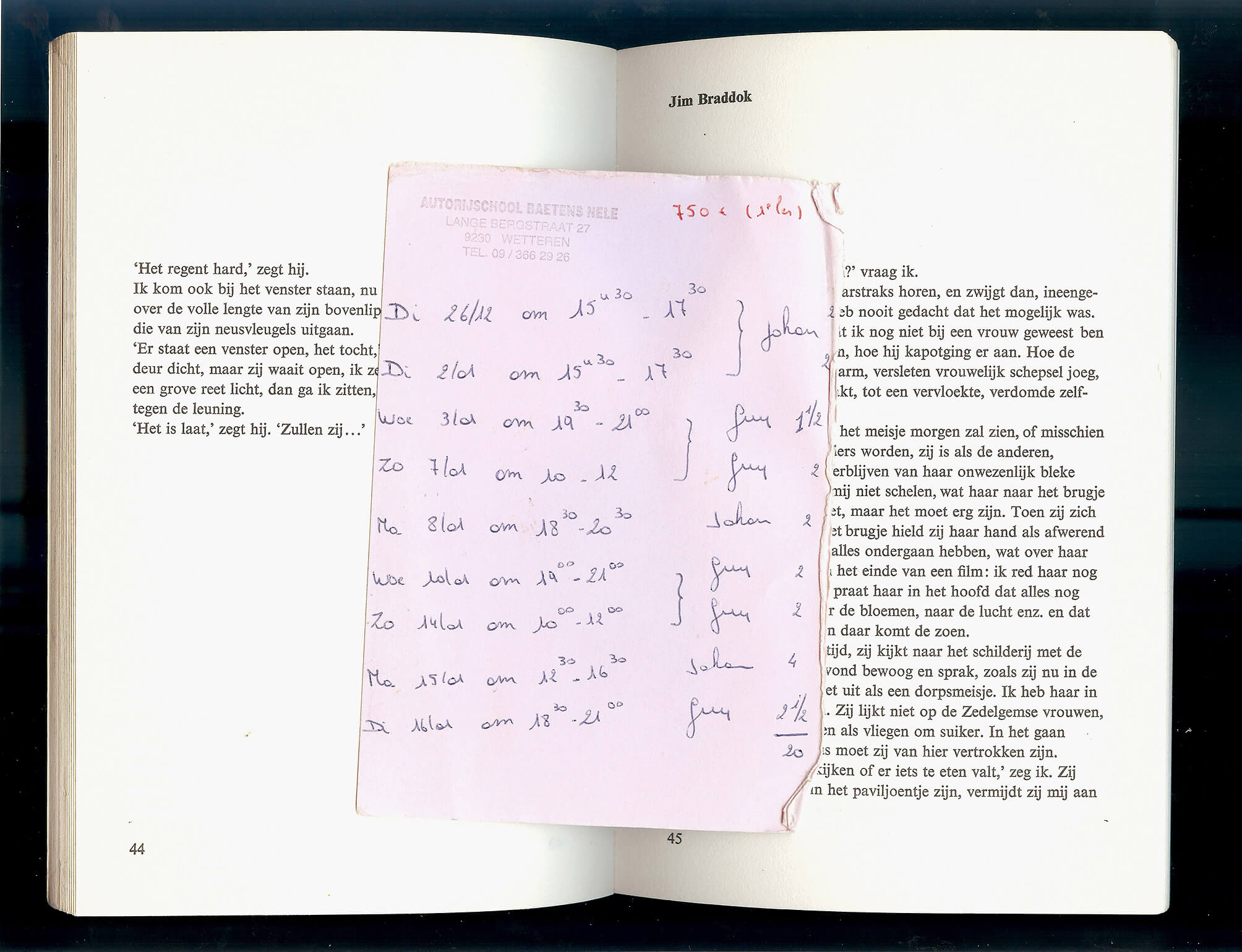
In his debut novel ‘De Metsiers’ Hugo Claus employs a multiple narrative perspective. In the copy I picked up in a thrift store, there’s a bookmarker between pages 44 and 45 where the perspective shifts from Ana to Jim Braddok. It’s pouring. The pink piece of paper lists 9 sessions at a driving school. There’s a total of 20 hours, taught alternately by Johan and Guy.
In 2000, 2006 and 2017 the twenty-sixth of December was a Tuesday. (Earlier years are improbable, since the Euro was not introduced yet.)
Claus, H. De Metsiers. Amsterdam: Uitgeverij De Bezige Bij, 1978.
It’s time to have a nap. I tilt the window over its middle axis to let the butterfly out. A breeze ruffles the drapes. Now, it sits on the glass and throws an enormous shadow on the yellow cloth.


In the world of National Geographic, white people overlooking a landscape are not uncommon. “The Red Shirt School of Photography” was a label used to describe National Geographic photographers who allegedly brought red clothing and props with them on assignment to put on their subjects in order to make better photographs when working with Kodachrome film, which is famous for its capability of rendering rich colors. Overlooking a landscape wearing red, the observer asserts dominance over the land. They glorify it, seeing a country that is beautiful, rich in resources, and therefore “worth taking”.
Max Pinckers (°1988, BE) and Victoria Gonzalez-Figueras (°1988, CA) are based in Brussels, Belgium. They have been working together for the past ten years on documentary photography projects. Victoria works in the cultural field as a researcher and producer. Max is a speculative documentarian, teacher and occasional writer on photography. They are married, in love, and have a son. Victoria has consistently assisted Max in his projects as a production manager, but they have recently been making new work together as co-authors. “Double Reward” is the first such project.
In spring 2024 the-documents.org and Trigger co-publish a series of online articles with a focus on the meeting ground between photography and the document.

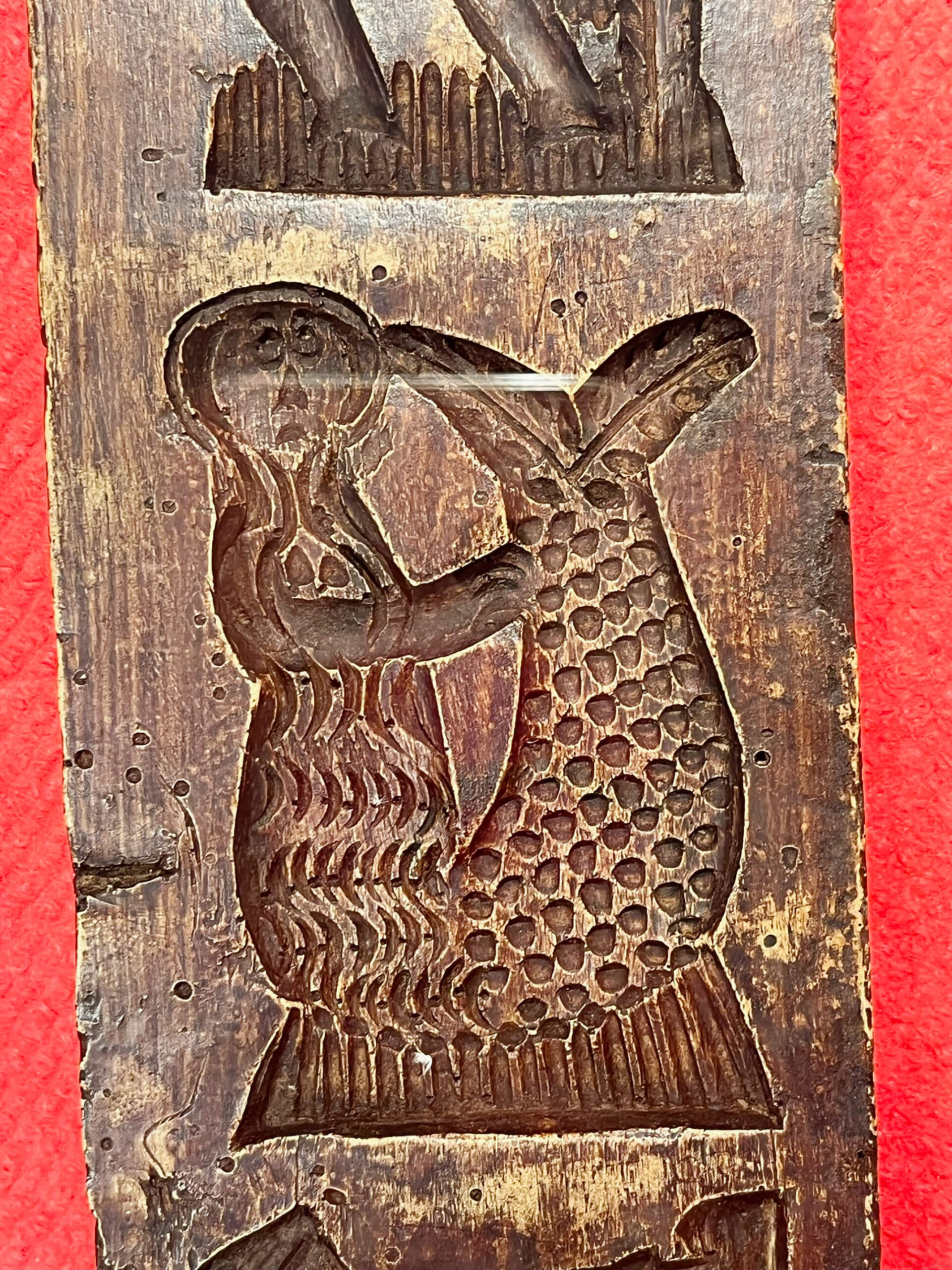
In Veurne, at the bakery museum, old speculaas moulds are presented in an almost religious fashion. Looking at these wooden blocks, they appear to be the negatives to Romanesque sculptures.
How does it feel to be conserved and showcased when your nature is to be a tool? What would it mean to re-use them, to fill those empty moulds, to shape something new without altering the matrix, to project what it would be like, to try out recipes and different baking, to learn from it and enjoy the results together? What scenes are even depicted? We lost part of their meaning, we could dig further, browse the books, ask our grandparents and collectively invent whatever narrative they might hold.
Clementine Vaultier’s interests, although trained as a ceramist, are in the warm surroundings of the fire rather than the production it engenders.
This stack of seaweed was offered by Henning, a farmer of the wonderful island of Laeso. This matriarchal pirate island, north of Denmark, is known for its tradition of building roofs from the seaweed growing in the surrounding salty water. Back in time, women would harvest and slowly weave the material around wooden beams from shipwrecks. This time-consuming process and technique of building shelters from what comes from the sea engaged the population in working together, building a ritual around each construction. Then those wild, yet full-of-care roofs, conserved in salt, would last for hundreds of years.
When I arrived on his land, Henning told me about how he restores those old beauties, weaving fresh seaweed around old beams and pressing the collected old material into insulation panels for new buildings. We talked about the clay of his land and how seaweed can become a material for ceramics in the process of making glazes.
Clementine Vaultier’s interests, although trained as a ceramist, are in the warm surroundings of the fire rather than the production it engenders.

On a morning sometime in January 2022 at the dinner table, after a cozy sleepover, she took a deep sigh full of relief and cracked a charismatic smile while looking at the festive breakfast that was in front of us, saying how she felt. Alone in a park I wrote in my notes: ‘Spoiled & Blessed’. Half a year later I was going through my purse, dehoarding some stuff I gathered in the past weeks. I stumbled upon an old receipt from the laundromat. It had a drawing on it that I drew some time ago, when we were having drinks to round up an exhausting project that took way too much time and energy. After putting the receipt back in my purse, I returned to my work to finish some stuff. Back at my computer I emailed myself: ‘don’t forget to plant sunflower seeds’.
Tjobo Kho is a graphic designer and publisher based in Amsterdam. Since 2017 part of the floating collective and publishing platform OUTLINE, and recently started his own publishing house no kiss?.

During a two hour tour, H.V. (head of the science collection) guided us from the library to the observatory and back. Along the way, he touched upon various rarities: one hundred ninety-five volumes of the Encyclopédie Méthodique (according to H.V. the most complete copy left in the world), the severed summit of Mont Blanc (‘Actually de Saussure brought back a triangular piece of rock from just below the snow line near the summit’), an original copy of the publication on the infamous Lügensteine (‘These date back to the time before the hoax was unveiled’)…
In guiding us from room to room, H.V. piled oddity upon curiosity. He showed a particular interest in all things fish-related.
First published in: De Cleene, M. Reference Guide. Amsterdam: Roma Publications, 2019
