What constitutes a ‘document’ and how does it function?
According to the Oxford English Dictionary, the etymological origin is the Latin ‘documentum’, meaning ‘lesson, proof, instance, specimen’. As a verb, it is ‘to prove or support (something) by documentary evidence’, and ‘to provide with documents’. The online version of the OED includes a draft addition, whereby a document (as a noun) is ‘a collection of data in digital form that is considered a single item and typically has a unique filename by which it can be stored, retrieved, or transmitted (as a file, a spreadsheet, or a graphic)’. The current use of the noun ‘document’ is defined as ‘something written, inscribed, etc., which furnishes evidence or information upon any subject, as a manuscript, title-deed, tomb-stone, coin, picture, etc.’ (emphasis added).
Both ‘something’ and that first ‘etc.’ leave ample room for discussion. A document doubts whether it functions as something unique, or as something reproducible. A passport is a document, but a flyer equally so. Moreover, there is a circular reasoning: to document is ‘to provide with documents’. Defining (the functioning of) a document most likely involves ideas of communication, information, evidence, inscriptions, and implies notions of objectivity and neutrality – but the document is neither reducible to one of them, nor is it equal to their sum. It is hard to pinpoint it, as it disperses into and is affected by other fields: it is intrinsically tied to the history of media and to important currents in literature, photography and art; it is linked to epistemic and power structures. However ubiquitous it is, as an often tangible thing in our environment, and as a concept, a document deranges.
the-documents.org continuously gathers documents and provides them with a short textual description, explanation,
or digression, written by multiple authors. In Paper Knowledge, Lisa Gitelman paraphrases ‘documentalist’ Suzanne Briet, stating that ‘an antelope running wild would not be a document, but an antelope taken into a zoo would be one, presumably because it would then be framed – or reframed – as an example, specimen, or instance’. The gathered files are all documents – if they weren’t before publication, they now are. That is what the-documents.org, irreversibly, does. It is a zoo turning an antelope into an ‘antelope’.
As you made your way through the collection,
the-documents.org tracked the entries you viewed.
It documented your path through the website.
As such, the time spent on the-documents.org turned
into this – a new document.
This document was compiled by ____ on 23.08.2025 15:47, printed on ____ and contains 19 documents on _ pages.
(https://the-documents.org/log/23-08-2025-6645/)
the-documents.org is a project created and edited by De Cleene De Cleene; design & development by atelier Haegeman Temmerman.
the-documents.org has been online since 23.05.2021.
- De Cleene De Cleene is Michiel De Cleene and Arnout De Cleene. Together they form a research group that focusses on novel ways of approaching the everyday, by artistic means and from a cultural and critical perspective.
www.decleenedecleene.be / info@decleenedecleene.be - This project was made possible with the support of the Flemish Government and KASK & Conservatorium, the school of arts of HOGENT and Howest. It is part of the research project Documenting Objects, financed by the HOGENT Arts Research Fund.
- Briet, S. Qu’est-ce que la documentation? Paris: Edit, 1951.
- Gitelman, L. Paper Knowledge. Toward a Media History of Documents.
Durham/ London: Duke University Press, 2014. - Oxford English Dictionary Online. Accessed on 13.05.2021.

The last couple of days have been dry. Rain is expected for the weekend. The office buckets are in place and are empty, except for some residue. Dirt, sand, a few hairs. Some particles must have come along with the drops when they made their way through the roof.

At the office,1 a gray and a green bucket are meticulously positioned on the floor to catch the water dripping from the ceiling.2 It has been a very wet few months.
Perpendicularly above the green bucket is the office’s smoke detector, which, when it rains, could be mistaken for a sprinkler. The gray bucket is positioned perpendicularly beneath the electric line leading to the smoke detector. The lamp doesn’t leak.
The nineteenth-century building was designed by the renowned architect Adolphe Pauli.3 The offices of my former employer were also housed in a Pauli building. Over there, it was a mop that was used to evacuate water from the recurrently flooded ground floor hallway.
the-documents.org HQ
The reason for the leaks is said to be the use of screws that cause an electrolytic reaction.
Shortly after documenting the above, the roof came down. The buckets only partly catched the plaster.


On May 7th, 1992, an anonymous photographer records the ice cellar, a stone’s throw from my parents’ house. It’s a beautiful day in spring. Quite a bit of wind, it seems. A Thursday. Surely, I am at school. Third grade kindergarten. It houses bats.
The photograph is part of an online heritage inventory, maintained by a government department. On the same day, the photographer took a photograph of the orangery, the entrance gate to the allotment, and the castle.
https://id.erfgoed.net/afbeeldingen/264680

“… the late-Gothic St Mary’s Church in Sandersleben … was consecrated in 1519, just two years after Martin Luther published his Ninety-five Theses. After extensive renovation, part of it is still home to Sandersleben’s Protestant community. The building spans the historical period encountered throughout this region, the various stages of which continue to resonate today. Parts of the church predate the Reformation and the Peasants’ War; its tower, for instance, was initially a city tower before its subsequent role as a watchtower. The contemporary folding glass barrier inside the church is a nod to the future. Since 2013, this feature has enabled the church to host secular events, as it separates the choir from the nave. The significance of a structure or place is derived from its function. If it ceases to serve a purpose or meet a need, it loses its societal relevance. This lack of societal meaning becomes evident in its dilapidation and, ultimately, in its decay, removal or demolition. Lesser-known structures that haven’t been captured in photographs or documented can thus vanish completely, leaving no archaeological footprint, especially when replaced by new constructions. They leave no vestiges behind, not even a trace, which is usually an indicator of the presence of nothingness …”1
Sequence of images from Flächenland/Sprawling Region
Stephanie Kiwitt (1972) is an artist based in Halle (Saale), Germany. Utilizing a large number of images, various perspectives and also textual elements, she is known for her insightful photography that explores spaces emblematic of contemporary phenomena. Over the past three years, she has focused on evolving habitats in rural areas, photographing traces of transformation and conducting interviews in Saxony-Anhalt, the region she moved to in 2020. From 2018 to 2020, Kiwitt was a guest lecturer at the LUCA School of Arts in Brussels.
In spring 2024 the-documents.org and Trigger co-publish a series of online articles with a focus on the meeting ground between photography and the document.
Jonathan Everts, ‘A Long Farewell to the Present’, Flächenland (2020–22), Stephanie Kiwitt, Spector Books, Leipzig, 2023

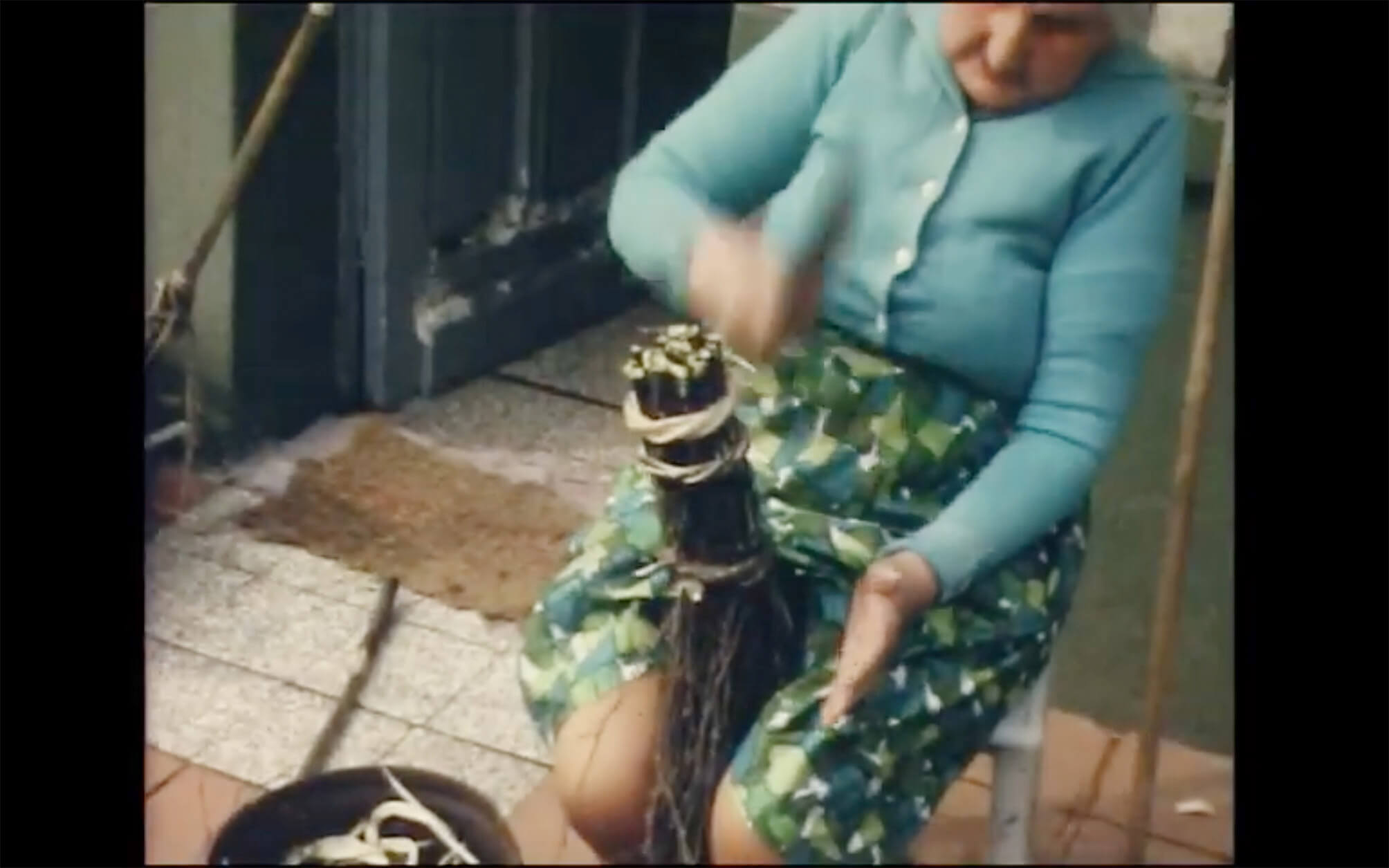
This video-still is taken from a documentary about ‘Le Coin du Balai – De Bezemhoek’, a Brussels neighborhood on the edge of the Sonian Wood. Historically, the inhabitants had the exclusive right to harvest young shoots of trees to make and sell brooms. In 1976, filmmaker Willy Biesemans captured the last broom-maker, still in possession of this vernacular knowledge.
Nowadays, the Sonian Wood is commonly understood as a place of natural beauty surrounding the city. The wood the forest produces is managed as a chain of production and sold in public auction to the best buyer. The bulk of the forest’s produce is exported abroad and eventually imported back as manufactured goods.
Clementine Vaultier’s interests, although trained as a ceramist, are in the warm surroundings of the fire rather than the production it engenders.
Biesemans, W. De Bezemhoek. 1976 (YouTube – De Bezemhoek)
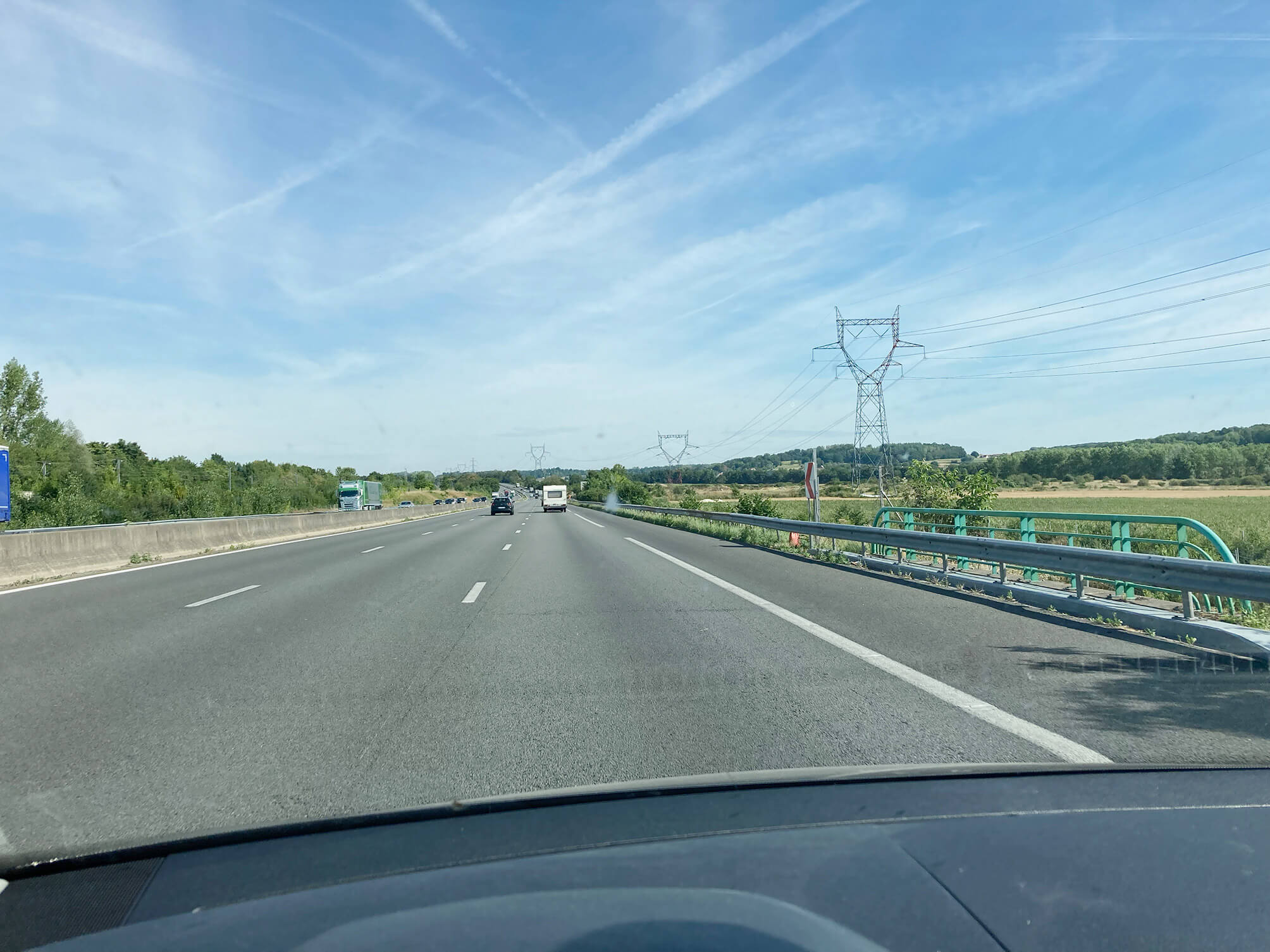
For about an hour, he has been saying ‘owl’ at regular intervals. A cartoon character he picked up somewhere and is now fantasizing about, I guess. Or a Disney reference in one of the songs that have been playing on repeat all day, in the car, driving home from holidays.
50 kilometers further, I recognize the birds in the high-voltage pylons along the highway.
According to the amateur experts at hoogspanningsforum.com, these French pylons – used for conducting electricity from 63kV to 400kV – are nicknamed ‘chats’: the wiring can be interpreted as feline whiskers.
Some genera of owls, such as the Megascops or Screech owls, have whiskers.
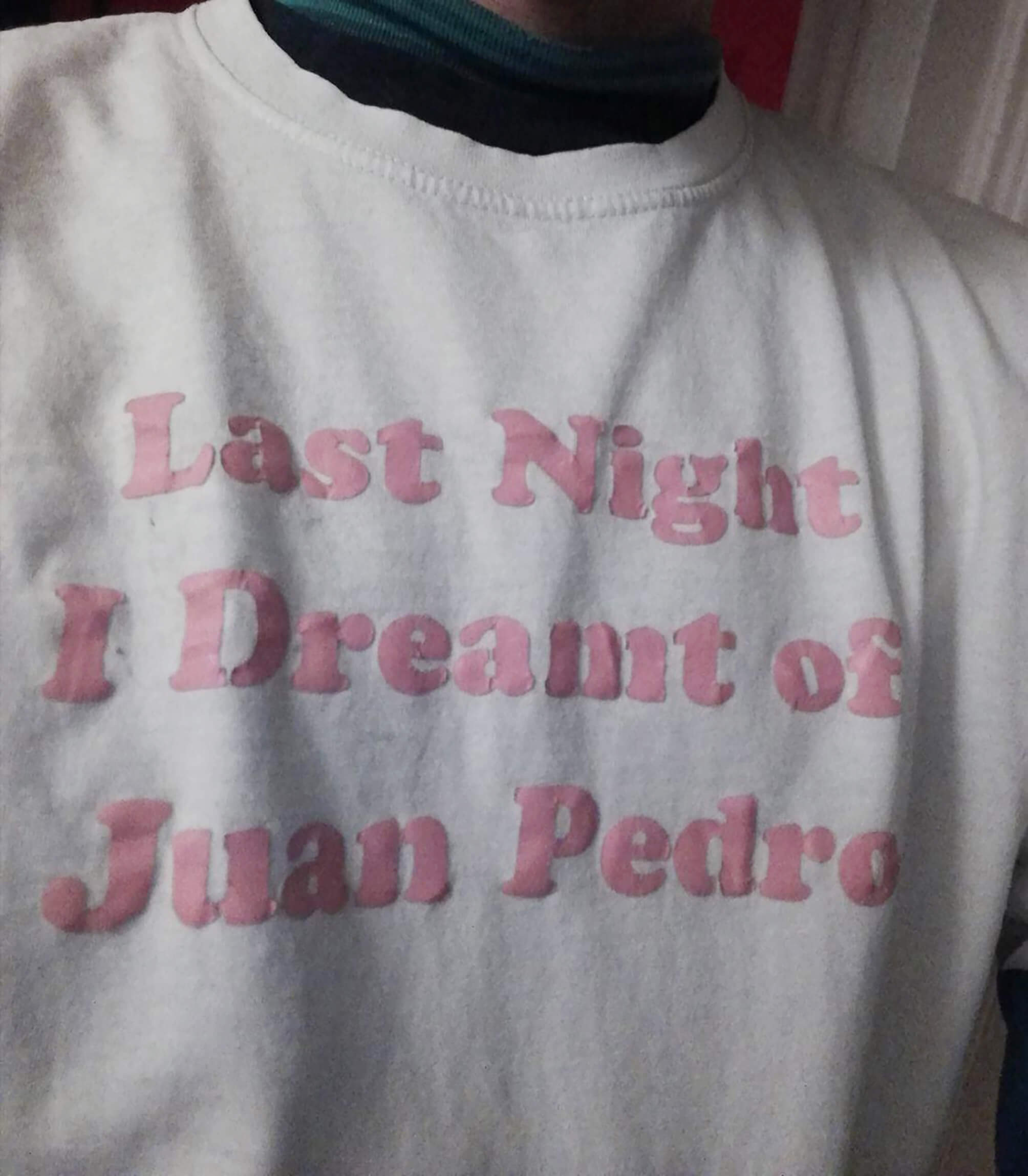
While I was sitting in the laundromat one evening waiting for my laundry to finish its cycle, La Isla Bonita by Madonna came on the radio. Competing with the rustle of seven rotating laundry machines, the song reminded me of a T-shirt that was now being washed.
The short phrase in the song’s lyrics ‘last night I dreamt of San Pedro’ would nestle itself somewhere in the back of my head and bubble up every now and again for no particular reason. I made this shirt for the occasion of Valentine’s Day in 2019 to commemorate my friendship with Jan-Pieter. I remember once mumbling the lyrics to La Isla Bonita, replacing ‘San Pedro’ for ‘Juan Pedro’, forgetting it for some time and then a while later printing it on a T-shirt.
Tjobo Kho is a graphic designer and publisher based in Amsterdam. Since 2017 part of the floating collective and publishing platform OUTLINE, and recently started his own publishing house no kiss?.
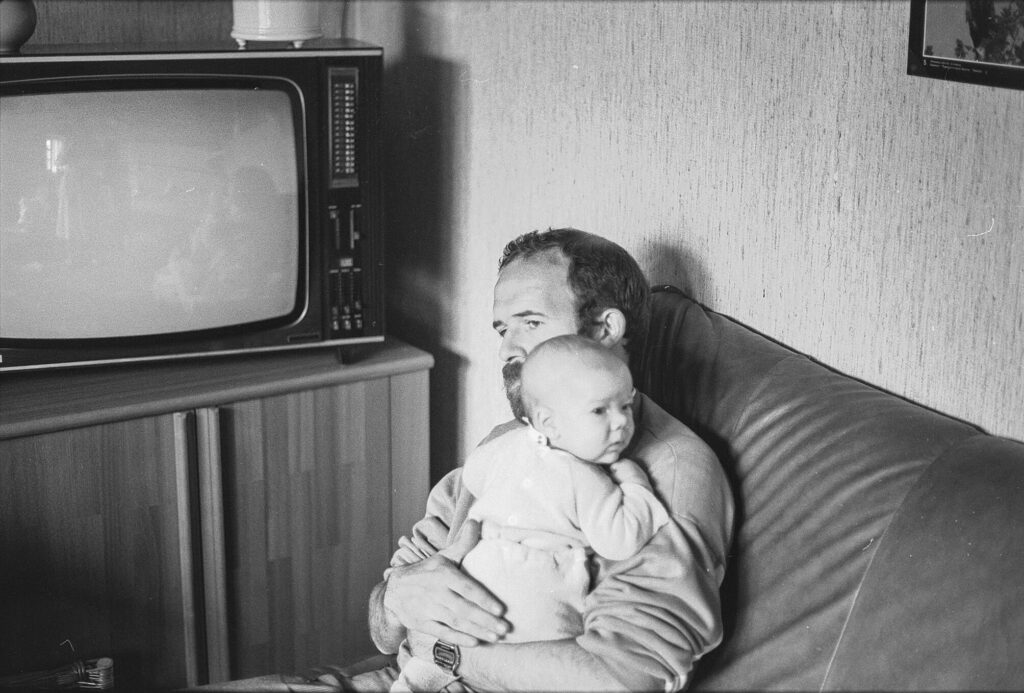
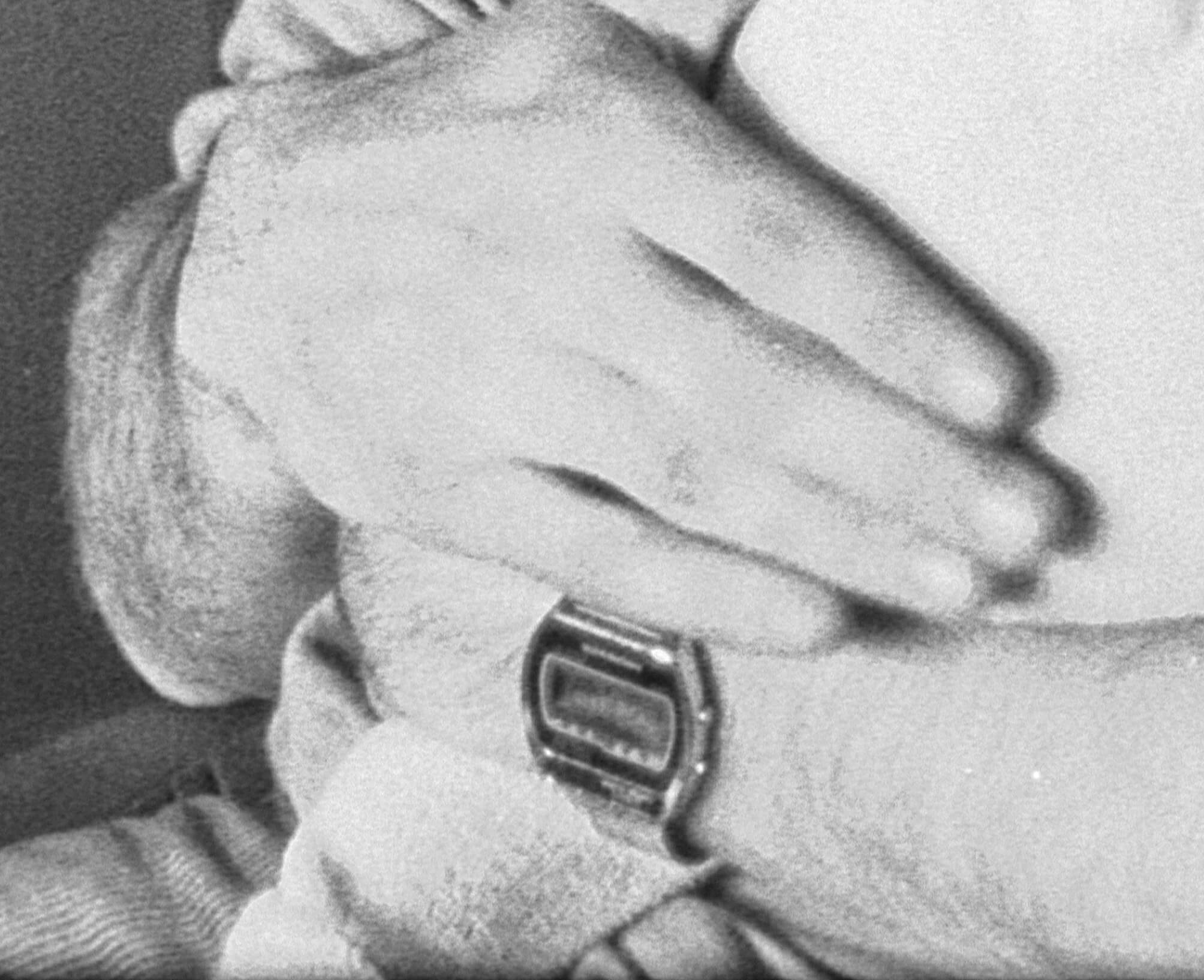
He’s wearing a digital watch. It looks like a Casio. It’s impossible to read the time, no matter whether you are studying the high-resolution scan of the negative or the negative itself, with the aid of a loupe and lightbox.
The device had a stopwatch function. When we were around eight and ten, we used to compete in trying to start and stop the stopwatch in the shortest possible interval. The smaller the gap, the closer to zero. Sometimes he would also have a try. We once managed to get it down to 00:00:00:03. Neither of us dared to press ‘reset’ and try again.
At the beach of Cap d’Antifer in Normandy one can find ‘sea glass’ between the pebbles: pieces of broken glass that have naturally weathered by being tumbled by the ocean, over and over. Sharp edges and smooth surfaces vanish. The historical origin of the glass pebbles (glass bottles, a shipwreck) erodes. Only the colour of the pebbles gives an indication of their history, be it vaguely. Varieties of green sea glass are common, but other colours, such as red (Shlitz beer bottles) or yellow (interbellum Vaseline containers), are more rare and have to be sought after attentively.
It’s 4.15 PM. The tide is pushing three people towards the cliffs.

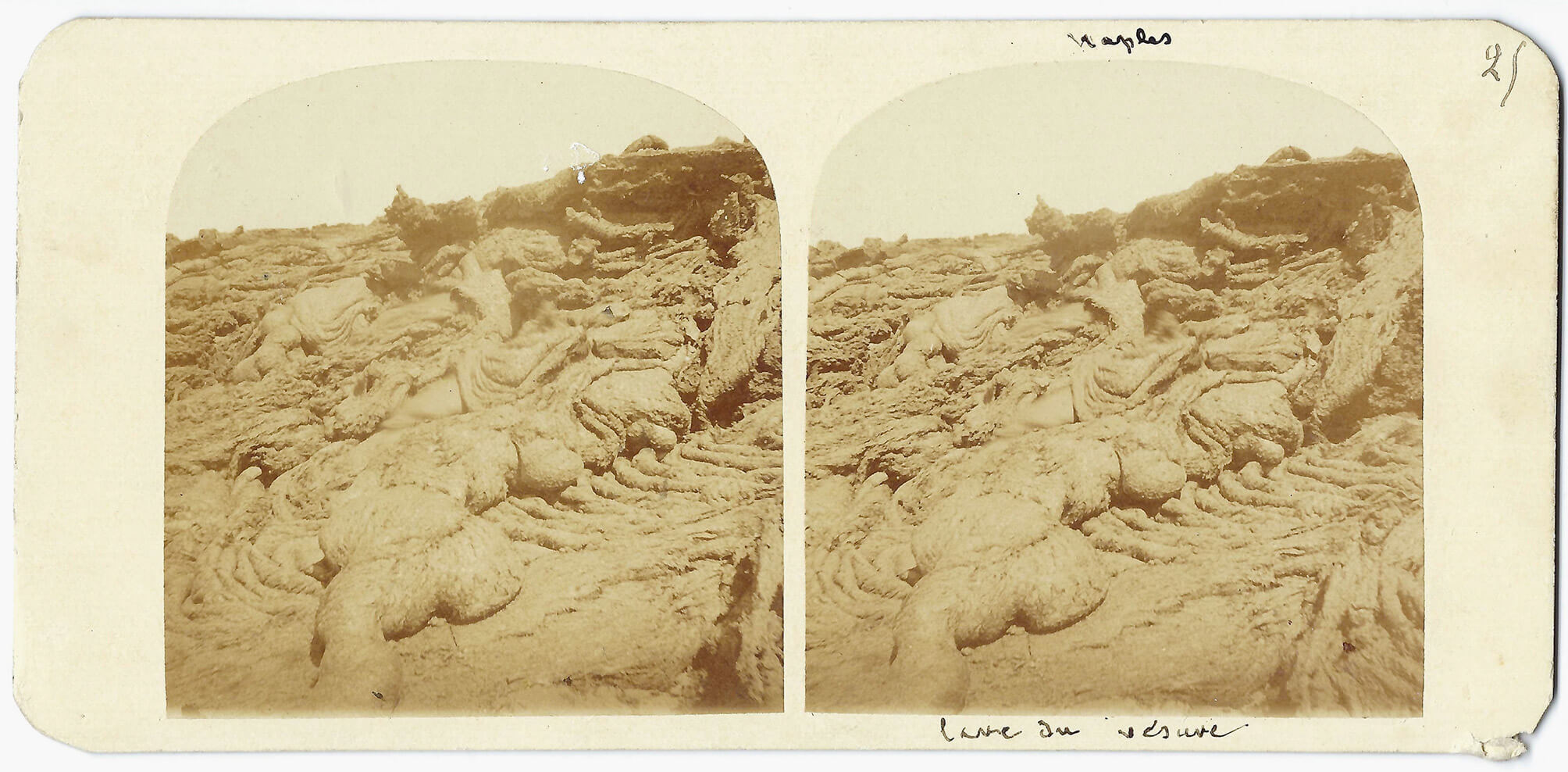
According to art critic Rosalind Krauss, nineteenth-century stereographic images presented ‘views’, not ‘landscapes’. Looking at a stereographic image through a stereoscope involves a particular experience that is altogether different from looking at other types of photographs, or paintings, as it is defined by ‘the isolation of the viewer with an image from which surrounding interference is masked out‘.1 An image of a violent and sudden eruption, higher up on the mountain, hanging next to a stereographic image of a petrified lava flow, would not be perceived.
Krauss, R. The Originality of the Avant-Garde and Other Modernist Myths. Cambridge, Mass./London: The MIT Press, 1986, 139.
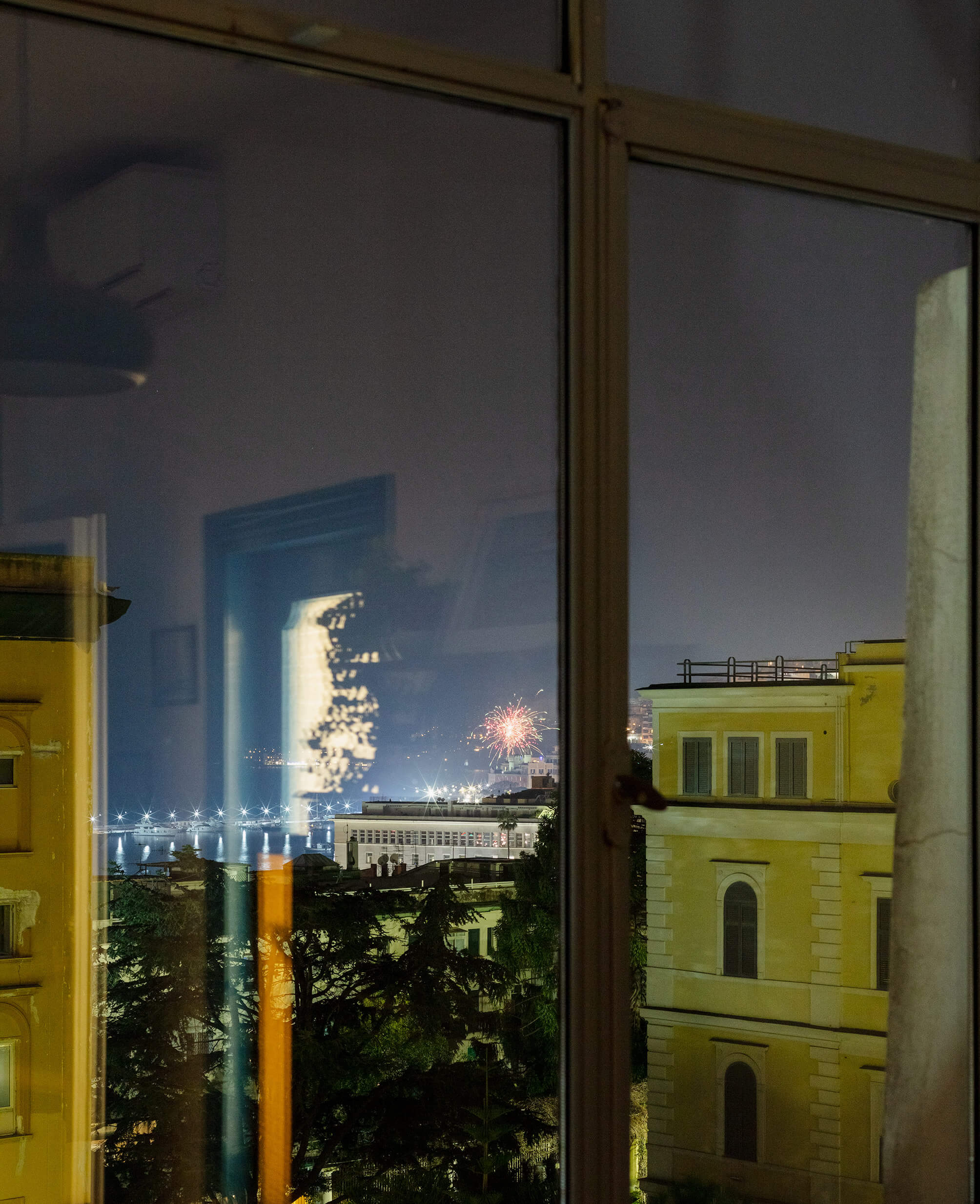
During the night, both of us get unwell. One of us is shaking, intensely and relentlessly. The windows are open. For minutes that seem to be hours, it feels like it’s freezing. We get extra blankets. Then, it gets too hot.
One of us dreams about coccodrillos. It starts out with a single animal, like the one we saw in the National Archaeological Museum, escaping from an aquarium, and ends with lots of little ones crawling all over the place. It’s impossible to know how many have escaped.
The other dreams about seismologist Luigi Palmieri’s unfortunate assistant and his family’s quest to redeem his good name. To deprive him of the burden and guilt set upon him by Luigi Palmieri’s report of the 1872 eruption of Vesuvius, the assistant’s offspring were building a monument just below the observatory in which their great-grandfather fell asleep. The monument was permanently, and continuously, unfinished.
We both dream of hearing fireworks in Naples.
In the morning, we’re slightly alarmed that we both got sick and feverish at the same instant. It’s the middle of January, and the weather has been summerlike all week. A gentle morning breeze flies in from the Neapolitan bay while we wait for the bus to take us to the airport.
First published as part of De Cleene De Cleene. ‘Amidst the Fire, I Was Not Burnt’, Trigger (Special issue: Uncertainty), 2. FOMU/Fw:Books, 25-30
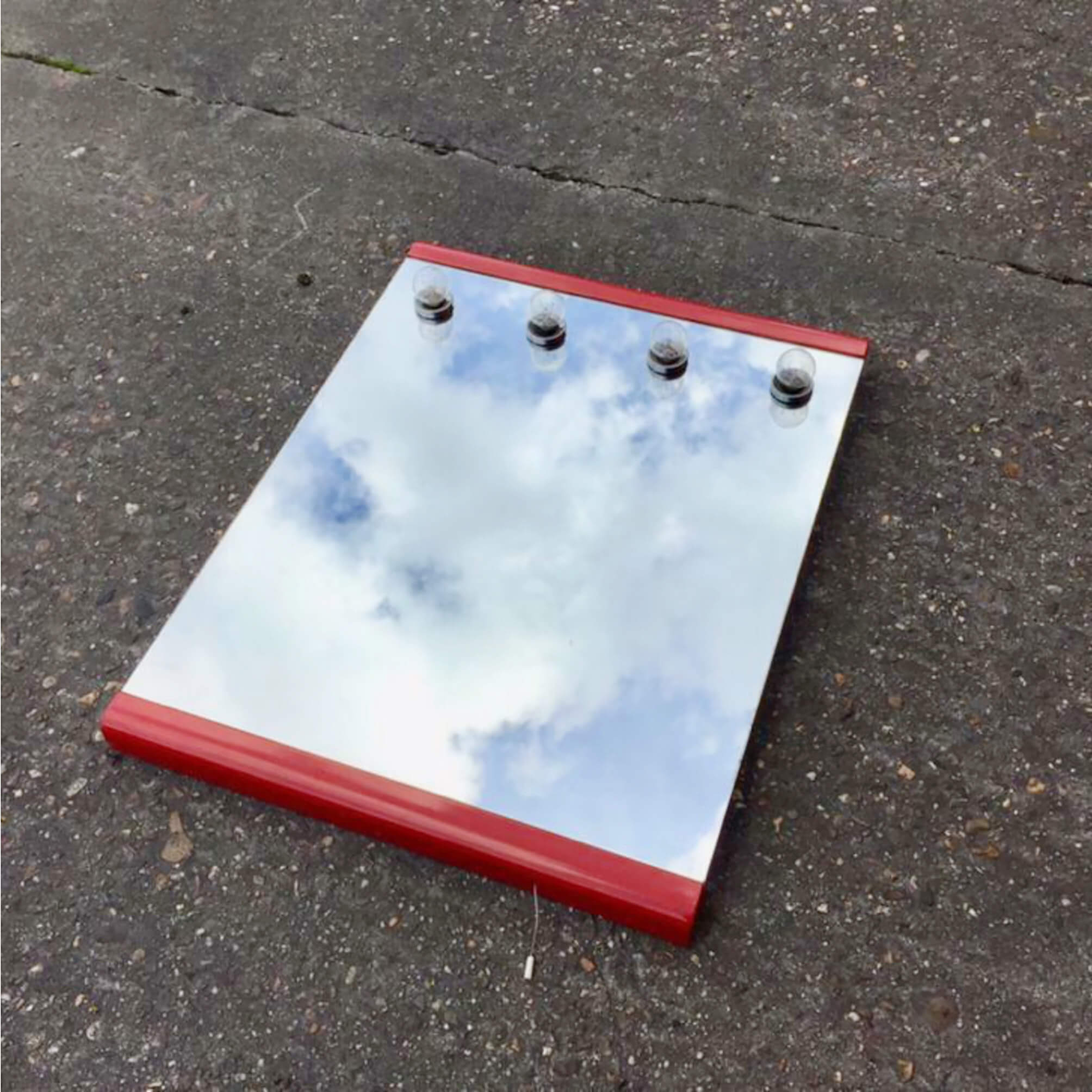
On the online thrift shop 2dehands.be the homepage generates a ‘for you’ section. On November 9th this section listed, among other things, a picture of the sky on a patch of concrete. On closer inspection, it became clear that it was the sky’s reflection in a mirror with a red frame and four lightbulbs in it, the kind you might see at the hairdresser’s or backstage in a television studio or theatre. The seller estimates the mirror’s current value to be 45,00 EUR. The listing includes five photographs. In the fifth one, the object for sale reflects a bucolic landscape: a blue sky, white clouds, some trees and a fragment of a barn.
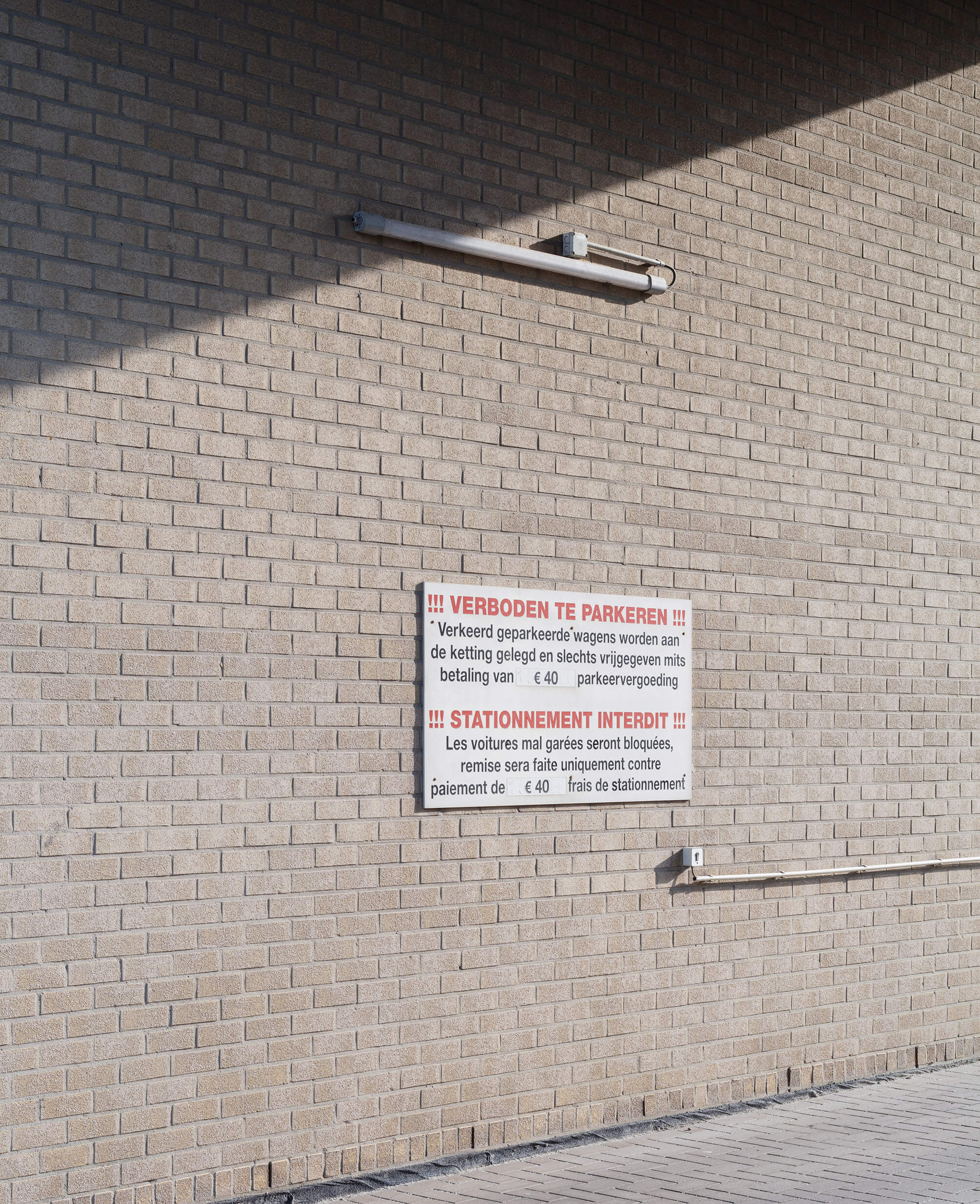
A 250 meter walk away from the seaside. A sign states in Dutch and French:
‘!!! NO PARKING !!!
Wrongly parked cars will be chained and only released upon payment of a € 40 parking fee’
The 40 EUR parking fee the sign threatens to charge is communicated by a relatively new sticker stuck on an older sign. Underneath the three black characters (€, 4 and 0) on a white background, there’s a relief: 7 characters declaring a parking fee of 1500 BEF.
1500 BEF equals 37,18 EUR1. In changing currency, the fee increased by 7,58%.
The Belgian franc was the currency of the Kingdom of Belgium from 1832 until 2002 when the Euro was introduced. 1 EUR is worth 40,3399 BEF.
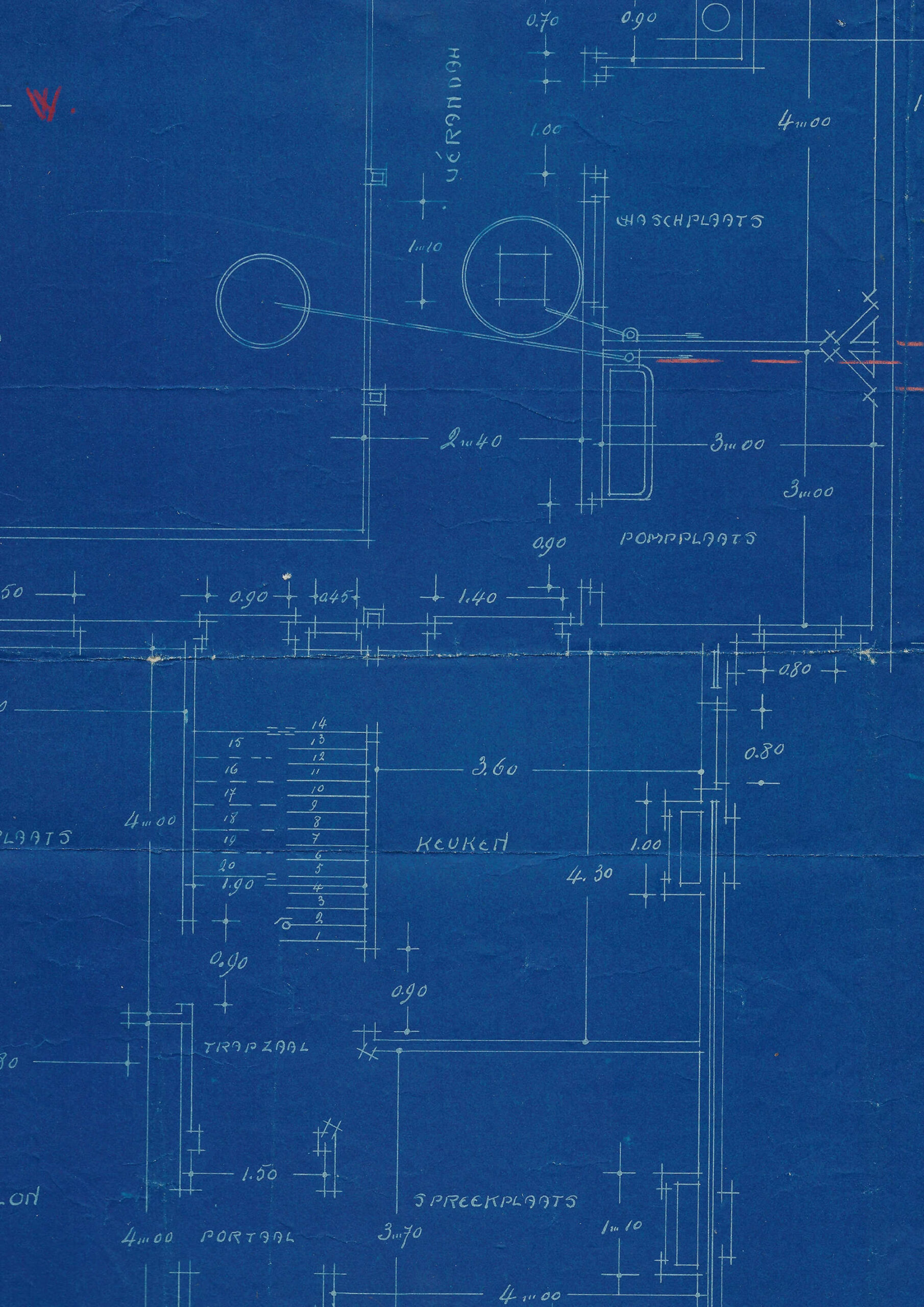
In the archive of the architect O. Clemminck, there is a piece of a plan of a building in a suburb in Gent. It presents the ground floor. There is a kitchen, a salon, an eating place, a meeting place. The missing part would have stated the exact address, the name, and maybe the profession of the owners. The plan of the first floor might have given an indication of the number of (anticipated) family members, based on the number and size of sleeping rooms.
At the southern edge of (the plan of) the lot, O. Clemminck has drawn a laundry room that gives out to a vérandah. The spelling of the Dutch word – nowadays written as veranda – is remarkable, as is its etymology, which is unclear and a matter of debate among scholars. The word might have Portuguese (varanda: railing) and Catalan roots (baranda: barrier), maybe also origins in the Lithuanian Žemaitan dialect (varanda: loop plaited from flexible wings) and might also be traced back to a Sanskrit root (varandaka: rampart separating two fighting elephants).
The vérandah O. Clemminck proposes is 2,40 meters by, at least, 2,80 meters.
Where once there was twelve million cubic metres of water, excavators and trucks are moving dirt and rocks that have been hidden from sight for 56 years; piling them up into a temporary dam: a batardeau.

It snows on December 19, but the situation changes on the 22nd with the arrival of an Atlantic low-pressure area, bringing masses of hot and humid air. Thaw follows.
And then, it snows again on December 26 and 27, before the arrival of a new warm front on the same day. A significant and brutal rise in temperature ensues: at Lac Noir, at 920 m, the temperature shoots up from 0,3 °C on December 27 at 7 AM to 7,4 ° C on the 28th at 9 PM.

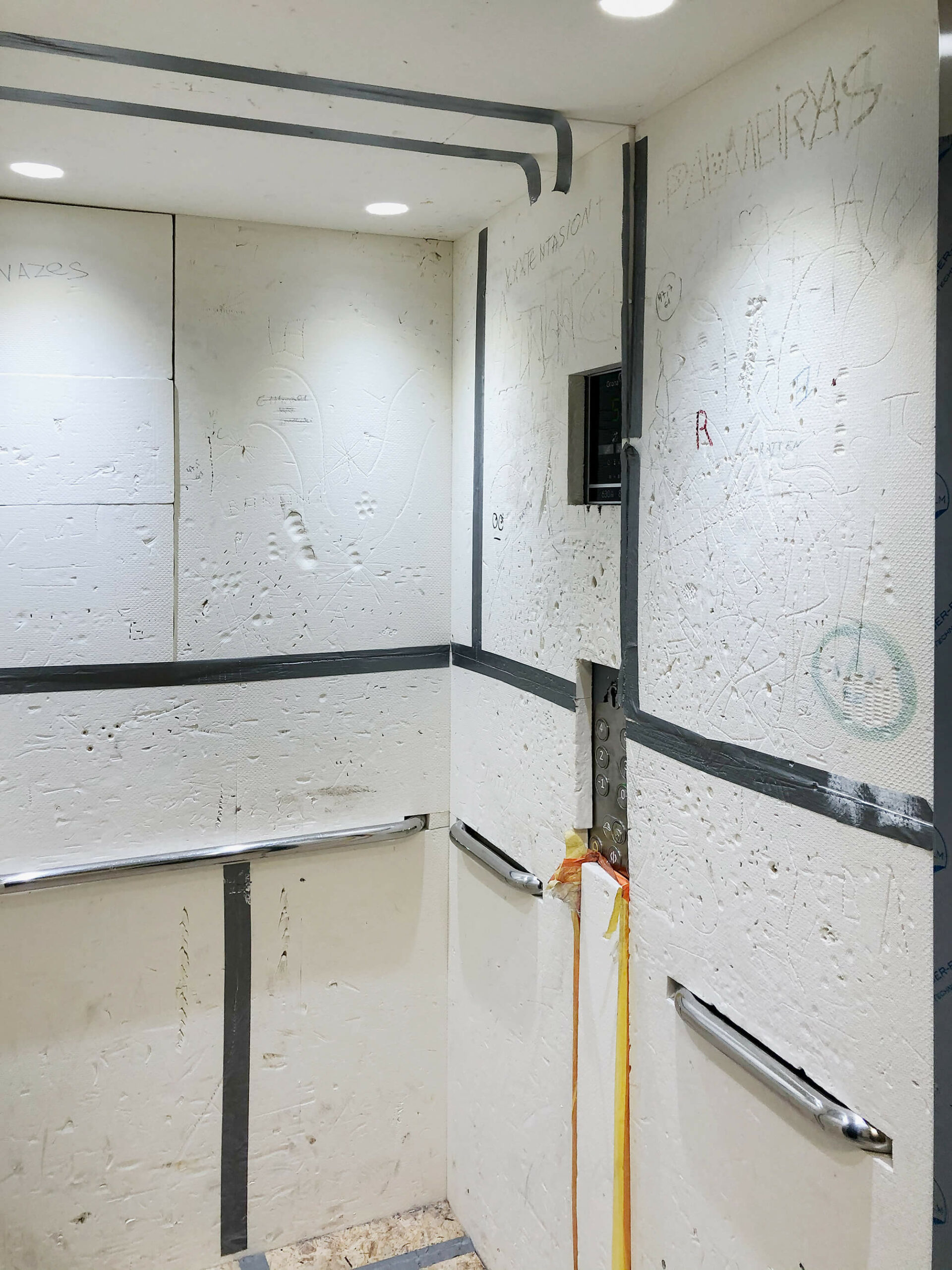
The building is almost finished. One apartment is still up for sale, on the top floor. The contractor is finishing up. There’s a long list of comments and deficiencies that need to be addressed before the building can be handed over definitively to the owner. The elevator’s walls are protected by styrofoam to prevent squares, levels, measures, drills, air compressors, chairs, bird cages, etc. from making scratches on the brand new wooden panelling.
In 1932 Brassaï began taking photographs of graffiti scratched into walls of Parisian buildings. On his long walks he was often accompanied by the author Raymond Queneau, who lived in the same building but on a different floor. Brassaï published a small collection of the photographs in Minotaure, illustrating an article titled ‘Du mur des cavernes au mur d’usine’ [‘From cave wall to factory wall’].
Cathedral glass, or Flemish glass, lets light through, but distorts visibility. It can show something or someone is present behind it, but not in detail. Often used in front doors, it marks the opaque edge between the private and the public sphere, laying bare their presence, without disclosing their contents.
A blue hand, or a spider (Cyriopagopus lividus), traces the cracks that testify to the fact that the jammed door had to be closed with force. The hinges need oiling. Cobalt blue tarantulas are said to be extremely defensive.


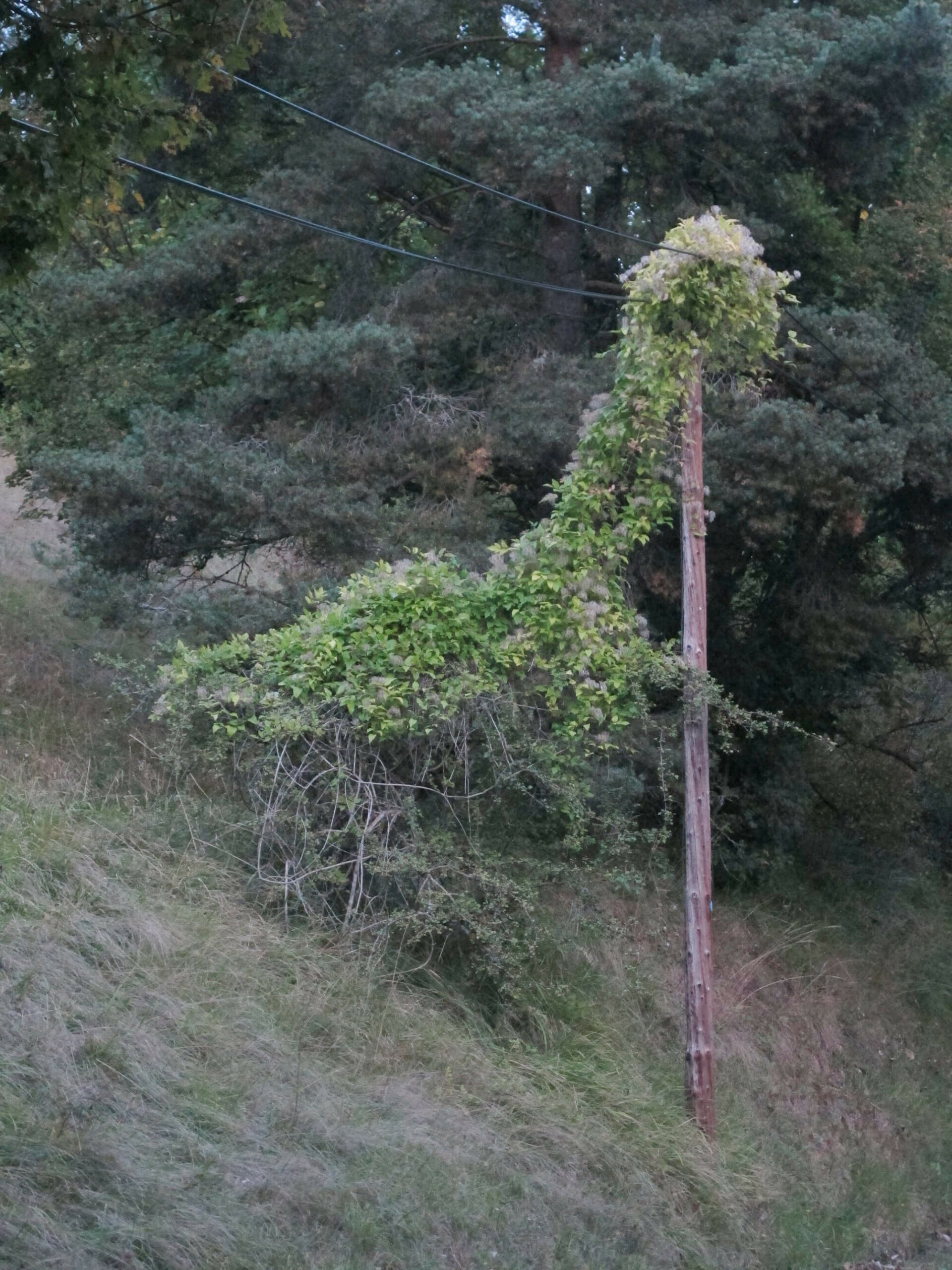
I recognized it in a flash, the late Jurassic-early Cretaceous herbivore looming dangerously over the road I was cycling on. I thought of Some Windy Trees.1
A utility pole (425638, 07/99, 07/2002, COBRA), electrical wires, a hawthorn (Crataegus) and an old man’s beard (Clematis vitalba). A symbiosis.
Delbrouck, V. Some Windy Trees. Loupoigne: Wilderness, 2013.