What constitutes a ‘document’ and how does it function?
According to the Oxford English Dictionary, the etymological origin is the Latin ‘documentum’, meaning ‘lesson, proof, instance, specimen’. As a verb, it is ‘to prove or support (something) by documentary evidence’, and ‘to provide with documents’. The online version of the OED includes a draft addition, whereby a document (as a noun) is ‘a collection of data in digital form that is considered a single item and typically has a unique filename by which it can be stored, retrieved, or transmitted (as a file, a spreadsheet, or a graphic)’. The current use of the noun ‘document’ is defined as ‘something written, inscribed, etc., which furnishes evidence or information upon any subject, as a manuscript, title-deed, tomb-stone, coin, picture, etc.’ (emphasis added).
Both ‘something’ and that first ‘etc.’ leave ample room for discussion. A document doubts whether it functions as something unique, or as something reproducible. A passport is a document, but a flyer equally so. Moreover, there is a circular reasoning: to document is ‘to provide with documents’. Defining (the functioning of) a document most likely involves ideas of communication, information, evidence, inscriptions, and implies notions of objectivity and neutrality – but the document is neither reducible to one of them, nor is it equal to their sum. It is hard to pinpoint it, as it disperses into and is affected by other fields: it is intrinsically tied to the history of media and to important currents in literature, photography and art; it is linked to epistemic and power structures. However ubiquitous it is, as an often tangible thing in our environment, and as a concept, a document deranges.
the-documents.org continuously gathers documents and provides them with a short textual description, explanation,
or digression, written by multiple authors. In Paper Knowledge, Lisa Gitelman paraphrases ‘documentalist’ Suzanne Briet, stating that ‘an antelope running wild would not be a document, but an antelope taken into a zoo would be one, presumably because it would then be framed – or reframed – as an example, specimen, or instance’. The gathered files are all documents – if they weren’t before publication, they now are. That is what the-documents.org, irreversibly, does. It is a zoo turning an antelope into an ‘antelope’.
As you made your way through the collection,
the-documents.org tracked the entries you viewed.
It documented your path through the website.
As such, the time spent on the-documents.org turned
into this – a new document.
This document was compiled by ____ on 23.04.2026 16:42, printed on ____ and contains 16 documents on _ pages.
(https://the-documents.org/log/23-04-2026-6812/)
the-documents.org is a project created and edited by De Cleene De Cleene; design & development by atelier Haegeman Temmerman.
the-documents.org has been online since 23.05.2021.
- De Cleene De Cleene is Michiel De Cleene and Arnout De Cleene. Together they form a research group that focusses on novel ways of approaching the everyday, by artistic means and from a cultural and critical perspective.
www.decleenedecleene.be / info@decleenedecleene.be - This project was made possible with the support of the Flemish Government and KASK & Conservatorium, the school of arts of HOGENT and Howest. It is part of the research project Documenting Objects, financed by the HOGENT Arts Research Fund.
- Briet, S. Qu’est-ce que la documentation? Paris: Edit, 1951.
- Gitelman, L. Paper Knowledge. Toward a Media History of Documents.
Durham/ London: Duke University Press, 2014. - Oxford English Dictionary Online. Accessed on 13.05.2021.

In Zaffelare, young men who were called for military service but could not be missed at home were advised by the local doctor to swallow a small ball of aluminium foil an hour before the examination. In the X-ray, a gastric ulcer appeared. They were rejected for service. It is uncertain whether the increased incidence of gastric ulcers among young men in Zaffelare was a cause for concern.

The last couple of days have been dry. Rain is expected for the weekend. The office buckets are in place and are empty, except for some residue. Dirt, sand, a few hairs. Some particles must have come along with the drops when they made their way through the roof.

It’s time to have a nap. I tilt the window over its middle axis to let the butterfly out. A breeze ruffles the drapes. Now, it sits on the glass and throws an enormous shadow on the yellow cloth.


Freely adapted from interviews with residents of Sandersleben (Saxony-Anhalt). Three-act play. The first two acts take place in the present day; the third is set in the future.
From Act 1 ‘The Town of S’, Scene 2 ‘The Past’.
Characters: MR DUNST club member I, OLIVER club member II, ANJA young mother
Stills from text animation S. Anders Leben. Eine Handlung in Gesprächen/S. Anders Leben – Living Differently: An Act in Conversations
Stephanie Kiwitt (1972) is an artist based in Halle (Saale), Germany. Utilizing a large number of images, various perspectives and also textual elements, she is known for her insightful photography that explores spaces emblematic of contemporary phenomena. Over the past three years, she has focused on evolving habitats in rural areas, photographing traces of transformation and conducting interviews in Saxony-Anhalt, the region she moved to in 2020. From 2018 to 2020, Kiwitt was a guest lecturer at the LUCA School of Arts in Brussels.
In spring 2024 the-documents.org and Trigger co-publish a series of online articles with a focus on the meeting ground between photography and the document.

‘My backyard is oriented perfectly, I can see the entire southern sky without obstructions.
In two years, they will start building an apartment block, though, two floors high with a roof on top. The height is not a problem, but of course it does mean heat and potential turbulence. I just hope they will be well insulated.
This is what I like doing. I have never been interested in remote observations.1 In my backyard. I hear the geese flying overhead at night. An owl. The silence. I want to be near.’
In the photograph John Sussenbach is manipulating the telescope’s focus slightly during the recording.
To make better images, astrophotographers can rent time on a ‘remote observatory’: a fully equipped observatory located in a less light-polluted region and with a more stable atmosphere than the one the average amateur astronomer lives in. A command given from a computer directs a massive telescope in Chile towards a desired spot.
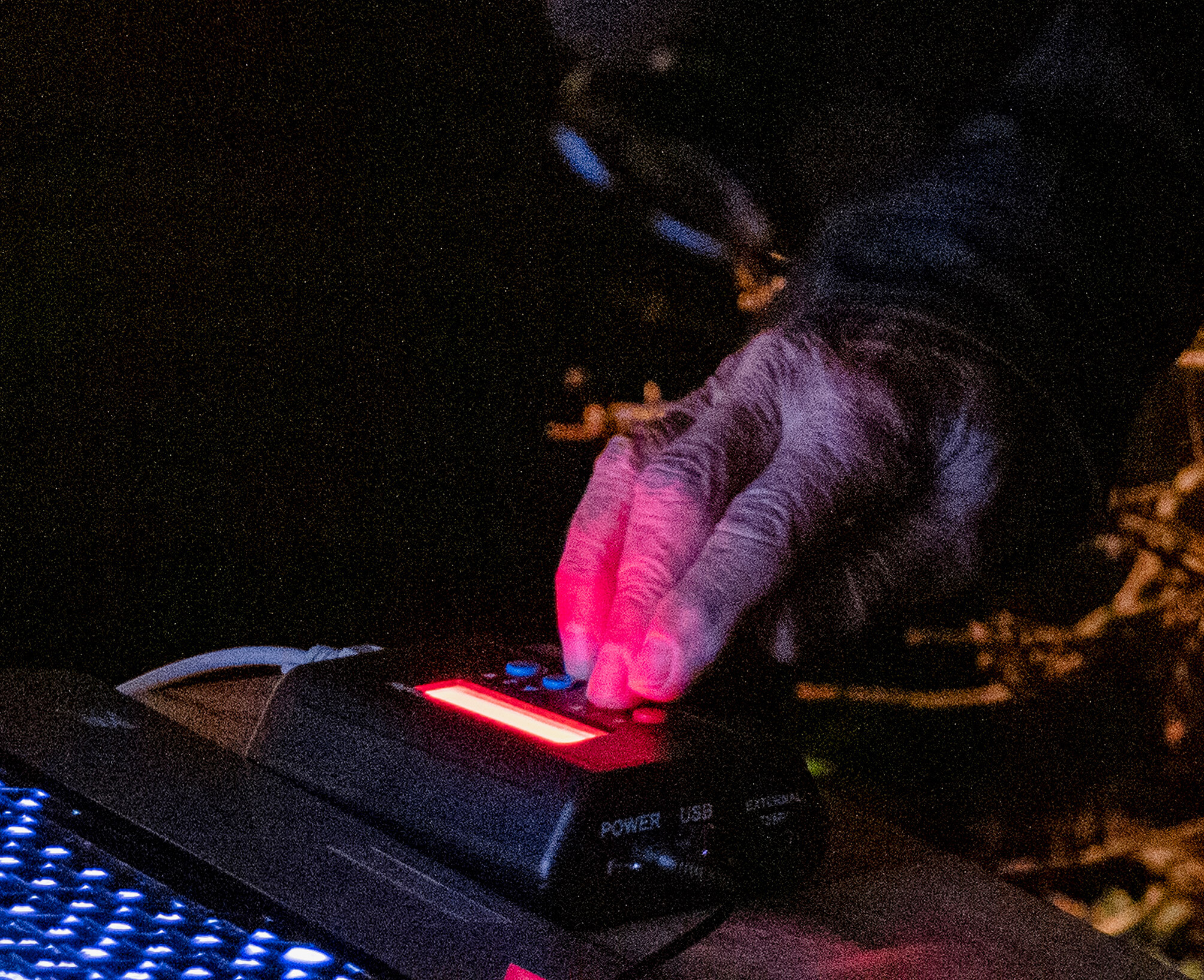
I drove through the neighborhood seeking evidence of the disruption using a power outage map as a compass. Winding through quiet streets, I stumbled upon a lone blue PG&E truck idling opposite a charred utility pole with fragments of wood and wire strewn across the pavement. I parked my car and walked toward the truck to ask the driver what had happened. He pointed to the top of the pole where a porcelain insulator dangled precariously from a high-voltage line. “Tracking,” he said curtly. “Is that like a short circuit?” I asked. “Kind of,” he replied before pausing. He finally elaborated, explaining that the problem arises when moisture from morning fog settles on power lines, creating a pathway for electricity to arc across components.
He then input something into a handheld device before driving away, leaving the repair for another service team to complete. I gathered the debris intending to collect the remaining components that comprise a utility pole, each having failed in one form or another. I shipped the fragments to Maziar the following week.
Mathew Kneebone is an artist based in San Francisco. His interdisciplinary practices takes different forms, all in relation to an interest in electricity and technology. He teaches studio and thesis writing at California College of the Arts.


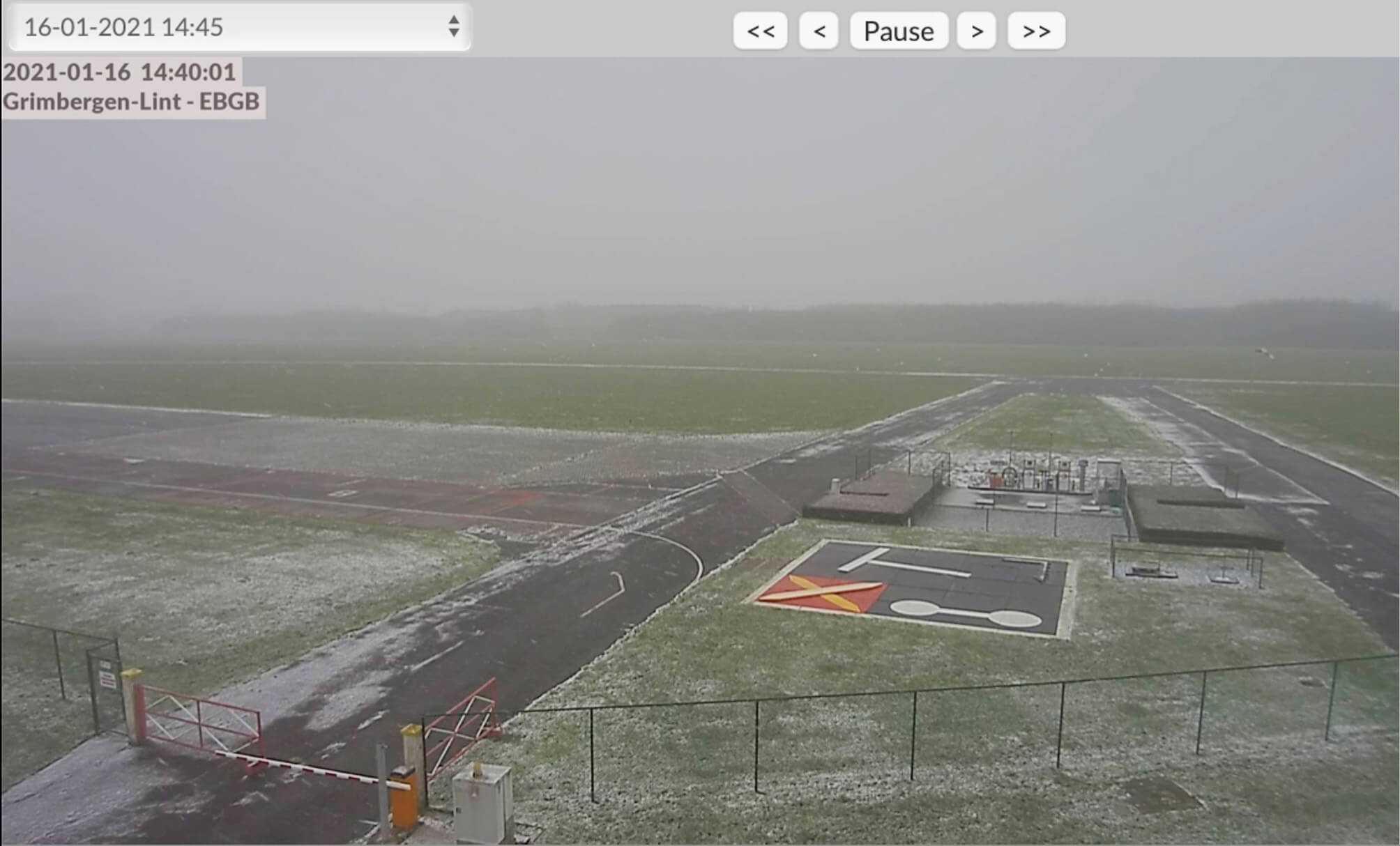
Recreational airfield at Grimbergen, webcam footage.
09:10:00The frame shows the first movement on the terrain. The gate has been opened, the barrier lowered. A black car is in the back. In the forefront, aviation signs on the ground: a yellow cross on a surface painted red; an arrow in a 90° angular shape; two circles connected by a line; a T-shaped line.
09:20:00Two men talking, each one on one side of the barrier. The man on the side of the airstrip has two dogs with him. The aviation signs have changed: the arrow is gone; the horizontal bar of the T-symbol has moved to the other side of the vertical line; one yellow line that made up the cross on the red surface is gone, leaving one yellow diagonal line.
10:09:01A small white aircraft (the two men and the dogs are gone).
10:20:01The aircraft in the same position, with what seems to be an open roof.
10:40:00Aircraft leaving the gas station where it was before.
11:10:01A white car at the gas station, where previously the aircraft was stationed; a silhouette of a man, perhaps.
11:30:01White car gone.
11:50:01Small white aircraft at the gas station; man in red jacket next to the aircraft. Not clear if it is the same aircraft seen in frame 10:09:01.
12:10:01Aircraft appears to be heading for take-off.
12:20:01Aircraft gone.
12:40:01White dots on the grass that appear to be birds.
14:10:00First precipitation: snow, visibility lessens.
14:20:00More snow, wind is stronger; someone has replaced the yellow stripe so that, again, a yellow cross is formed on the red background.
15:10:00The grass and the concrete get increasingly white. No aircrafts, vehicles or persons can be discerned. The aviation signs beneath the thin-layered snow are still visible, and unaltered.
Every so often architects ask me to photograph projects of theirs under a blanket of snow. Snow-days are rare around here. In an attempt to avoid a futile drive along roads in winter conditions, I check webcams near the project-to-be-photographed before setting out.
Webcam Grimbergen, meteobelgie.be: https://www.meteobelgie.be/waarnemingen/belgie/webcam/272/grimbergen
http://www.rvg.be
Freely adapted from interviews with residents of Sandersleben (Saxony-Anhalt). Three-act play. The first two acts take place in the present day; the third is set in the future.
From Act 1 ‘The Town of S’, Scene 2 ‘The Past’.
Characters: MR DUNST club member I, OLIVER club member II, ANJA young mother
Stills from text animation S. Anders Leben. Eine Handlung in Gesprächen/S. Anders Leben – Living Differently: An Act in Conversations
Stephanie Kiwitt (1972) is an artist based in Halle (Saale), Germany. Utilizing a large number of images, various perspectives and also textual elements, she is known for her insightful photography that explores spaces emblematic of contemporary phenomena. Over the past three years, she has focused on evolving habitats in rural areas, photographing traces of transformation and conducting interviews in Saxony-Anhalt, the region she moved to in 2020. From 2018 to 2020, Kiwitt was a guest lecturer at the LUCA School of Arts in Brussels.
In spring 2024 the-documents.org and Trigger co-publish a series of online articles with a focus on the meeting ground between photography and the document.
Every two weeks, The New York Review of Books falls into my letterbox. Those are good days. Most often, I won’t get to reading it, but what I instantly do, is check the last page with ‘The Classifieds’. The people writing the (genuine, not fictitious) adverts and inquiries reappear every so often. I happily assume the position of the implied reader, as they address the presumed readers of the review. There’s a ‘charismatic, aging French rock star’ providing original songs in Franglais. There are top notch apartments in Paris for aspiring writers. There are those seeking love and astronomical peculiarities: ‘Hitch my wagon to a star – Looking for a bright sophisticated senior star gazer! CStein3981@aol.com’.
The New York Review of Books, March 11, 2021, Volume LXVIII, Number 4.

Where once there was twelve million cubic metres of water, excavators and trucks are moving dirt and rocks that have been hidden from sight for 56 years; piling them up into a temporary dam: a batardeau.

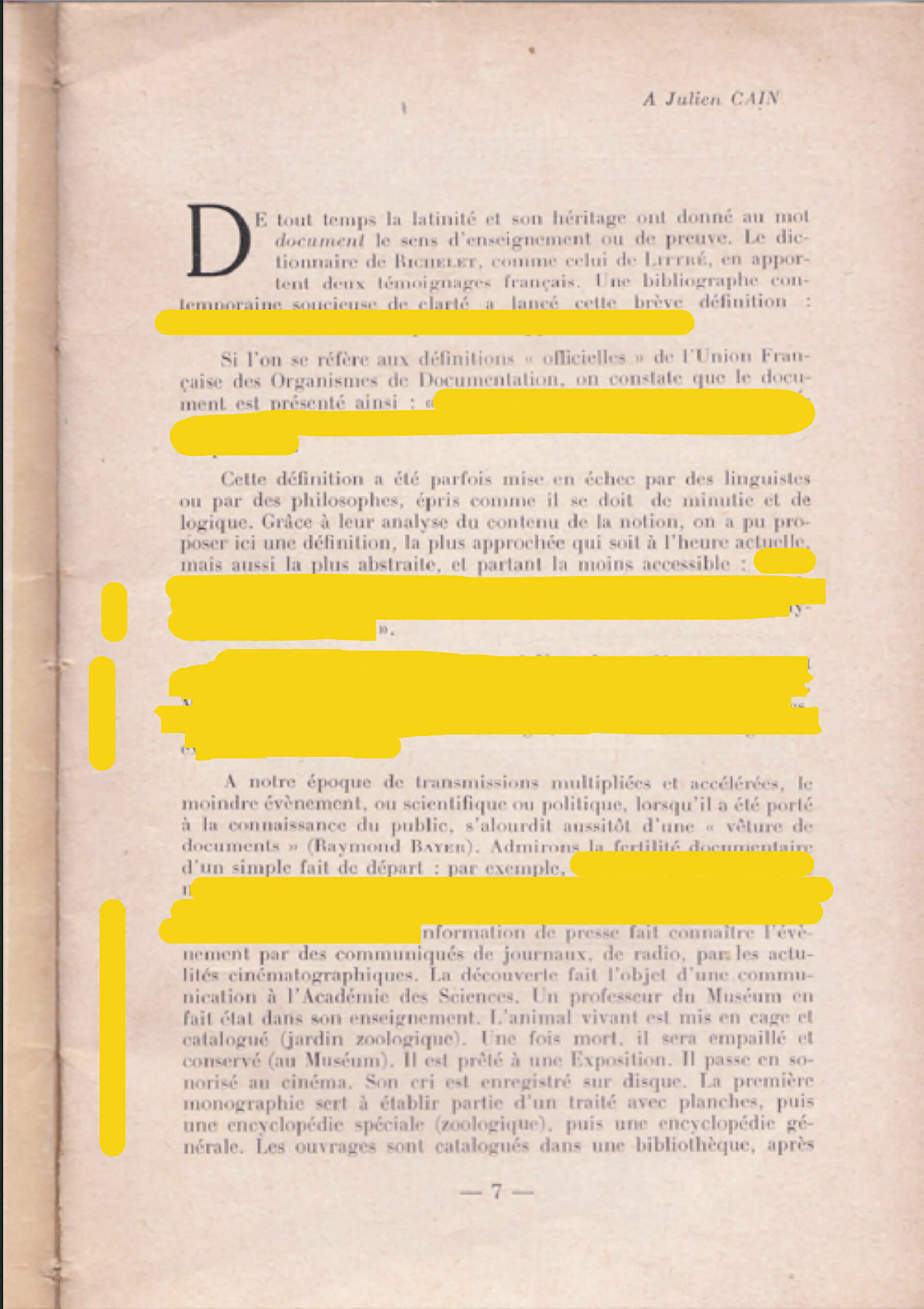
In the introduction to her book Qu’est-ce que la documentation?, French ‘documentalist’ Suzanne Briet asks what a document is. In a scrappy scan of her book I found online I am highlighting almost everything she writes. Is a star a document? Briet says it isn’t. But the catalogues and photographs of stars are. When I quickly opened the file with Apple’s ‘Preview’ application to check the above paraphrase, the highlighted sentences were illegible.
Briet is cited in Lisa Gitelman’s Paper Knowledge (2014).
Briet, S. Qu’est-ce que la documentation? Paris: Edit, 1951. Online: http://martinetl.free.fr/suzannebriet/questcequeladocumentation/briet.pdf
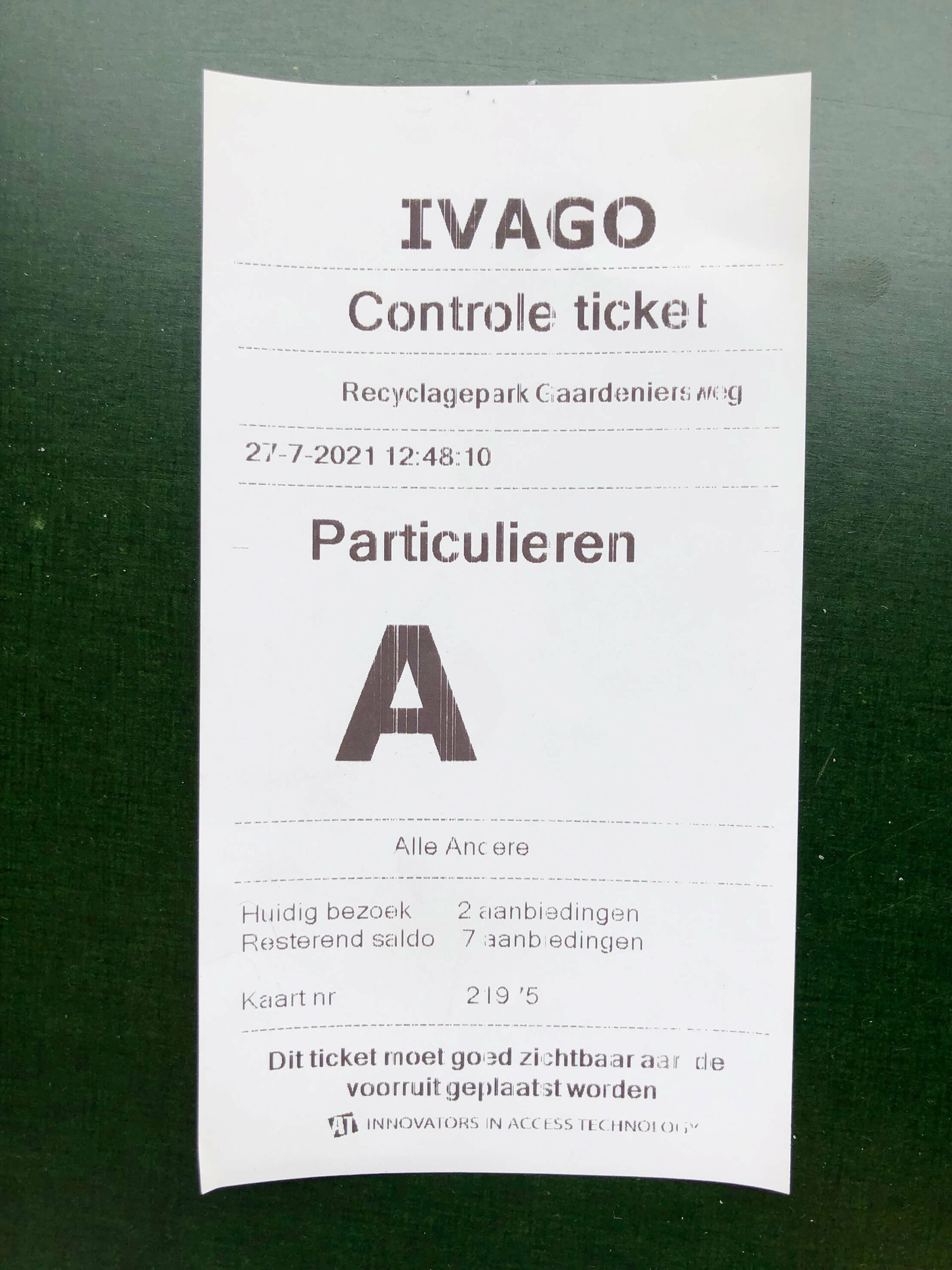
Today I brought an old bedspring, the styrofoam the air-humidifier came in, a few bags of sawdust and some scrap pieces of plywood to the municipal recycling center. As I was waiting to mount the stairs to the scrap metal container, a gray-haired man wearing blue leather shoes, dark jeans and a checkered shirt was tipping – with relative ease – a weight bench over the edge of the container.
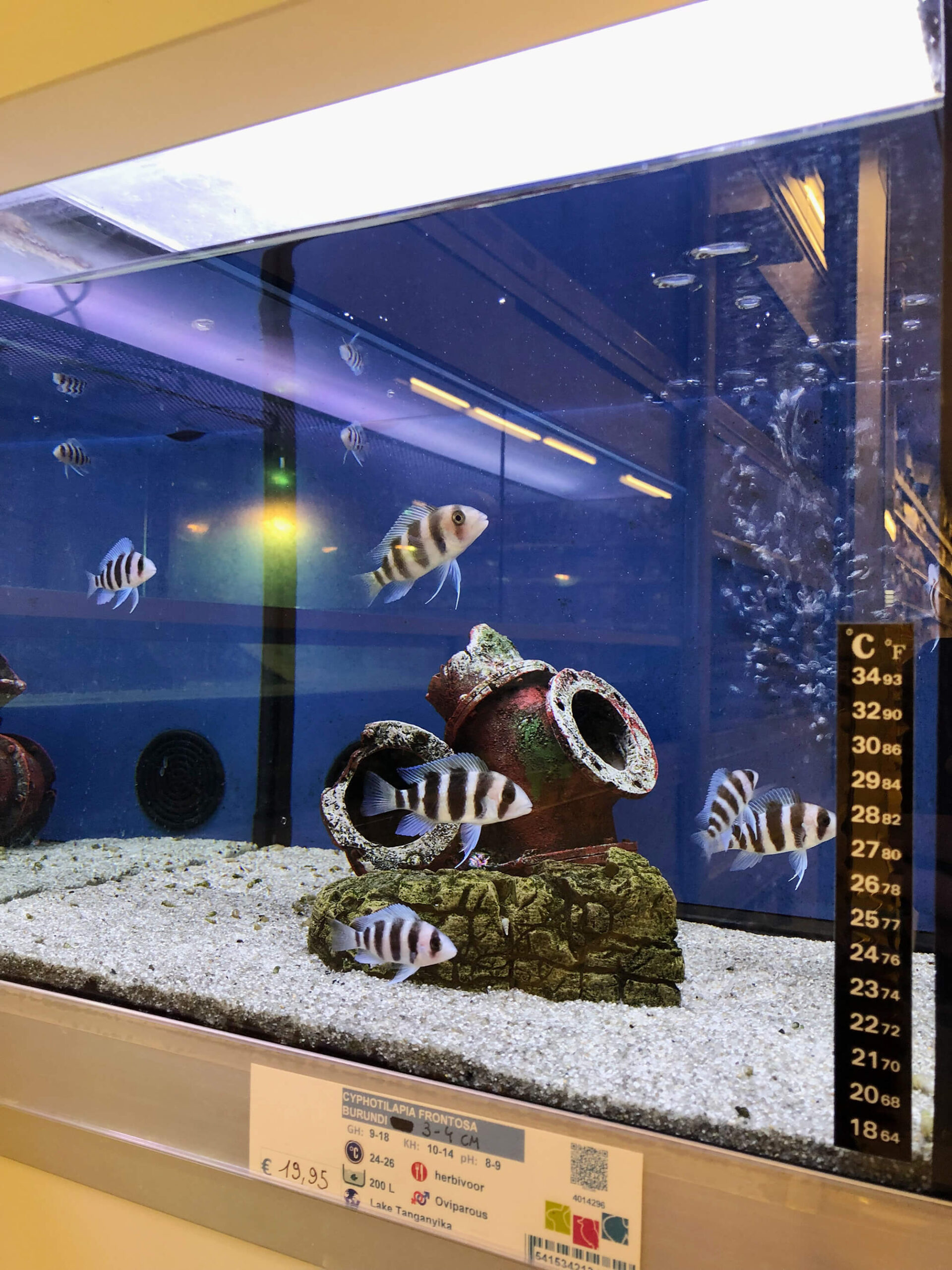
On Mondays, before noon, I go to the supermarket with my two-year-old son. After passing the lasagnes, the loaves of bread and the fruit and vegetables, we make a short stop at the aquarium with the lobsters. Around New Year, there are two of them.
After we’ve paid for the groceries and have put them in the car, we walk into the pet shop. We look at the parrots (Jacques, Louis and Marie-José), the rabbits, the guinea pigs, the assorted caged birds and the fish and turtles. He’s very fond of the Cyphotilapia Frontosa Burundi. He calls them zebras. They hail from Lake Tanganyika, the label says. It’s the second-oldest freshwater lake, the second-largest by volume and the second-deepest. The pet shop has adorned their aquarium with a scene of ocean waste.
In an effort to avert guilt, I look for something cheap and more or less useful to buy: birdseed, a snack for the neighbour’s cat, a comb for his grandparent’s Labrador, etc.
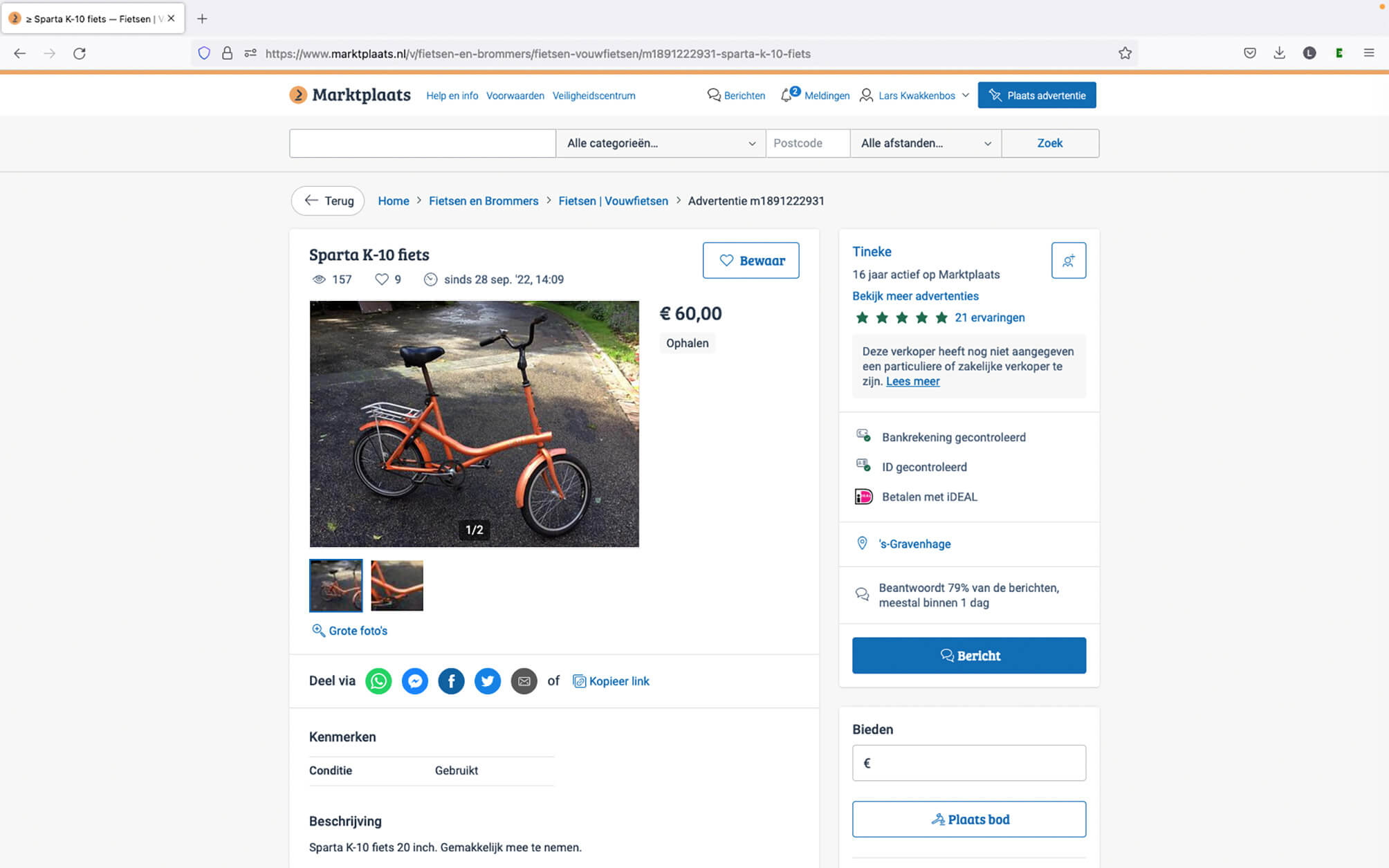
On 29 September 2022, I search the internet for the factory details of an original Sparta K-10. First I come across some second-hand K-10s. On marktplaats.nl, a Sparta K-10 is for sale for 60 euros, but anyone interested may also make an offer. The seller’s name is Tineke. She lives in The Hague and writes that the bike is ‘easy to take along’. The K-10 she is selling has no chain guard, but it does have a chrome luggage rack. This makes the bike more practical, but in my opinion also less attractive. Her bike also has a bell, but no elegant loop at the end of the long, curved tube around which the frame is built – most other K-10s do have such a loop – or has it disappeared behind the top tube of the luggage carrier? If Tineke is also the owner of the bike, she is much taller than the owner of the Brussels bike, as her saddle is a lot higher, and it is also more or less straight. Moreover, the handlebars are very high thanks to a different stem, which makes the model of the bike a bit unbalanced. I don’t know if I would have photographed the bike for sale in The Hague.
Lars Kwakkenbos lives and works in Brussels and Ghent (B). He teaches at KASK & Conservatorium in Ghent, where he is currently working on the research project ‘On Instructing Photography’ (2023-2024), together with Michiel and Arnout De Cleene.
‘You see?!’
[The man points at the waybill1 on the floor behind the glass door that closes off the abandoned and dismantled hall.]
‘It used to be here, I’m sure.’
[He looks around.]
‘I’m sure.’
[He turns towards me.]
‘Are you also here for the Leen Bakker?2 This used to be a Leen Bakker. I just looked it up on their website. They are open from 9 to 6 today.’
[He points at the waybill again.]
‘It was here. I remember well. It’s been years. But it’s here.’
[He walks away.]
‘I’ll look around.’
The waybill documents the transport of a 30m3 container filled with approximately 5000 kg of waste from this branch of Leen Bakker to a scrap processing company in nearby Ninove. They take care of scrap, both ferrous and non-ferrous metals. They also have a recognized depollution center for end-of-life vehicles.
A chain of furniture and interior stores with branches in the Netherlands, Belgium and the Caribbean part of the Kingdom of the Netherlands.

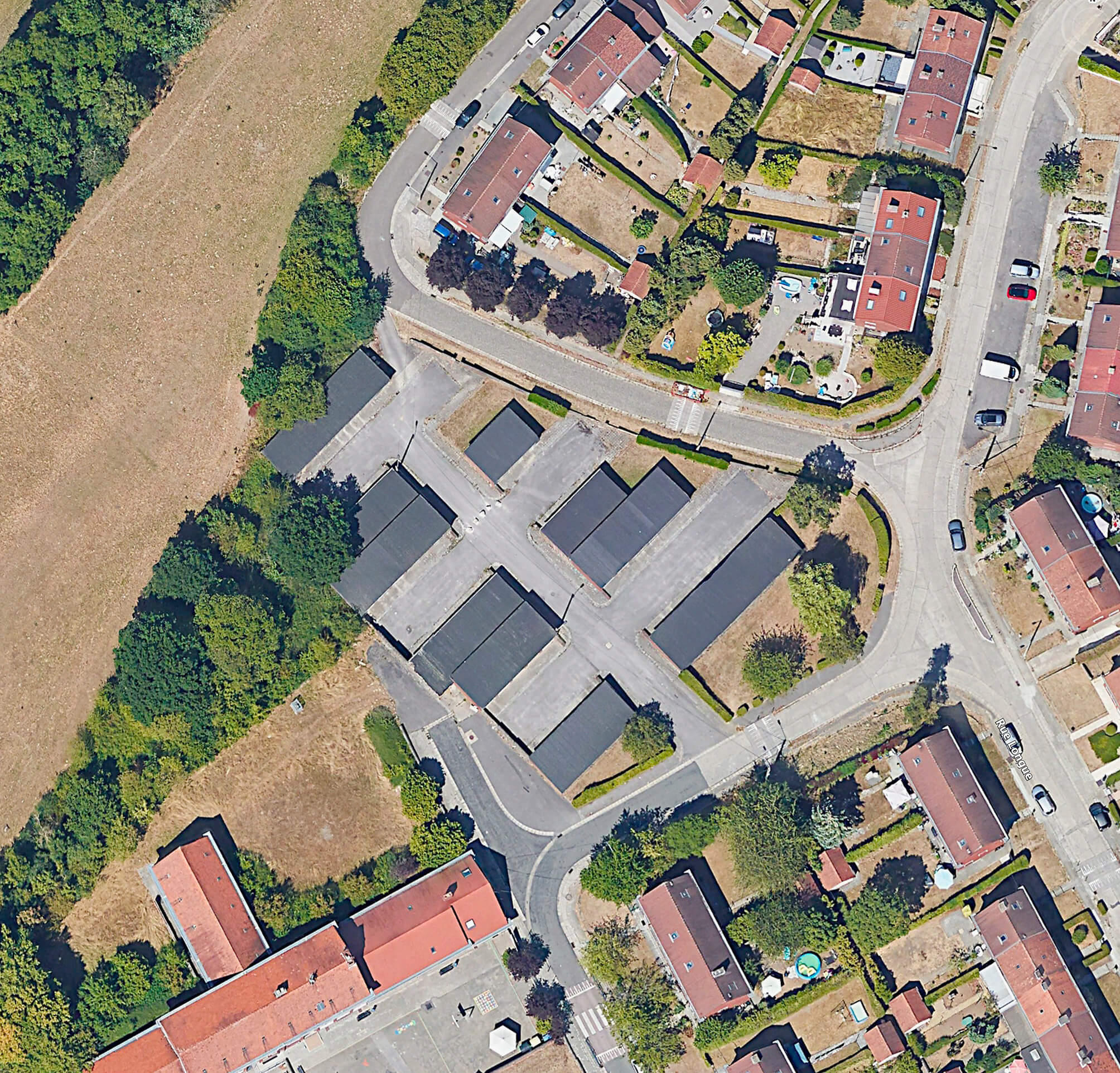
Five white boulders close off a shortcut for motorists who attempt to cut the bend in the road. The southernmost roof’s pitch runs opposite to the landscape’s slope. The lower roofline is, therefore, only about one meter above a small, triangular patch of grass which is hidden from view by a hedge. In summer, when the roofing gets hot and soft, text and drawings get pressed or carved into it.
Google Earth