What constitutes a ‘document’ and how does it function?
According to the Oxford English Dictionary, the etymological origin is the Latin ‘documentum’, meaning ‘lesson, proof, instance, specimen’. As a verb, it is ‘to prove or support (something) by documentary evidence’, and ‘to provide with documents’. The online version of the OED includes a draft addition, whereby a document (as a noun) is ‘a collection of data in digital form that is considered a single item and typically has a unique filename by which it can be stored, retrieved, or transmitted (as a file, a spreadsheet, or a graphic)’. The current use of the noun ‘document’ is defined as ‘something written, inscribed, etc., which furnishes evidence or information upon any subject, as a manuscript, title-deed, tomb-stone, coin, picture, etc.’ (emphasis added).
Both ‘something’ and that first ‘etc.’ leave ample room for discussion. A document doubts whether it functions as something unique, or as something reproducible. A passport is a document, but a flyer equally so. Moreover, there is a circular reasoning: to document is ‘to provide with documents’. Defining (the functioning of) a document most likely involves ideas of communication, information, evidence, inscriptions, and implies notions of objectivity and neutrality – but the document is neither reducible to one of them, nor is it equal to their sum. It is hard to pinpoint it, as it disperses into and is affected by other fields: it is intrinsically tied to the history of media and to important currents in literature, photography and art; it is linked to epistemic and power structures. However ubiquitous it is, as an often tangible thing in our environment, and as a concept, a document deranges.
the-documents.org continuously gathers documents and provides them with a short textual description, explanation,
or digression, written by multiple authors. In Paper Knowledge, Lisa Gitelman paraphrases ‘documentalist’ Suzanne Briet, stating that ‘an antelope running wild would not be a document, but an antelope taken into a zoo would be one, presumably because it would then be framed – or reframed – as an example, specimen, or instance’. The gathered files are all documents – if they weren’t before publication, they now are. That is what the-documents.org, irreversibly, does. It is a zoo turning an antelope into an ‘antelope’.
As you made your way through the collection,
the-documents.org tracked the entries you viewed.
It documented your path through the website.
As such, the time spent on the-documents.org turned
into this – a new document.
This document was compiled by ____ on 22.06.2026 21:55, printed on ____ and contains 15 documents on _ pages.
(https://the-documents.org/log/22-06-2026-6827/)
the-documents.org is a project created and edited by De Cleene De Cleene; design & development by atelier Haegeman Temmerman.
the-documents.org has been online since 23.05.2021.
- De Cleene De Cleene is Michiel De Cleene and Arnout De Cleene. Together they form a research group that focusses on novel ways of approaching the everyday, by artistic means and from a cultural and critical perspective.
www.decleenedecleene.be / info@decleenedecleene.be - This project was made possible with the support of the Flemish Government and KASK & Conservatorium, the school of arts of HOGENT and Howest. It is part of the research project Documenting Objects, financed by the HOGENT Arts Research Fund.
- Briet, S. Qu’est-ce que la documentation? Paris: Edit, 1951.
- Gitelman, L. Paper Knowledge. Toward a Media History of Documents.
Durham/ London: Duke University Press, 2014. - Oxford English Dictionary Online. Accessed on 13.05.2021.

In Zaffelare, young men who were called for military service but could not be missed at home were advised by the local doctor to swallow a small ball of aluminium foil an hour before the examination. In the X-ray, a gastric ulcer appeared. They were rejected for service. It is uncertain whether the increased incidence of gastric ulcers among young men in Zaffelare was a cause for concern.

In an attempt to make it his own, Gino – it might also be Dino – has taken a can of bright pink spray paint to his hard hat and – as the paint was drying – dragged his gloved finger from top to bottom. G – or D –, I, N, O. In the dust on a demolished floor tile, someone has written 12,10. Perhaps a measurement, a quantity, a position, a date, a reference.
Subtractive writing is not uncommon. With the tip of a passer-by’s index finger ‘WASH ME’ is subtracted from the dust on a dirty car. In freshly poured concrete, a name is embedded forever with a twig. In hot and soft roofing drawings and obscenities are scratched. Styrofoam lining a brand new elevator gets impressed with names, jokes and knuckles.
In the twenty-third canto of Ariosto’s Orlando Furioso (1516), Orlando comes across the name of his love and another man, carved in the bark of a tree. He doubts. But that night, a gossiping shepherd tells him he’s seen Angelica and Medoro together. Orlando returns to the forest, and in a four-day frenzy, he uproots every tree and pollutes the rivers forever.
CXXXI
For he turf, stone, and trunk, and shoot, and lop,
Cast without cease into the beauteous source;
Till, turbid from the bottom to the top,
Never again was clear the troubled course.
At length, for lack of breath, compelled to stop,
(When he is bathed in sweat, and wasted force,
Serves not his fury more) he falls, and lies
Upon the mead, and, gazing upward, sighs.1
Ariosto, L. Orlando Furioso. Translated by William Stewart Rose, Echo Library, 2006, p. 267.

A constant, dependable presence. With the camera focused on the North Star for an extended period, the rotation of the Earth becomes visible. Nearby, in the municipality of Wiederstedt, the geologist, poet and philosopher Friedrich von Hardenberg (better known by his pen name Novalis) spent his childhood years between 1772 and 1784. A quote of his is engraved on a stone bench in the park surrounding the chateau where he was raised: “The human being does not speak alone – the universe also speaks – everything speaks – infinite languages.”
From S. Anders Leben. Eine Handlung in Gesprächen/S. Anders Leben – Living Differently: An Act in Conversations
Stephanie Kiwitt (1972) is an artist based in Halle (Saale), Germany. Utilizing a large number of images, various perspectives and also textual elements, she is known for her insightful photography that explores spaces emblematic of contemporary phenomena. Over the past three years, she has focused on evolving habitats in rural areas, photographing traces of transformation and conducting interviews in Saxony-Anhalt, the region she moved to in 2020. From 2018 to 2020, Kiwitt was a guest lecturer at the LUCA School of Arts in Brussels.
In spring 2024 the-documents.org and Trigger co-publish a series of online articles with a focus on the meeting ground between photography and the document.

Freely adapted from interviews with residents of Sandersleben (Saxony-Anhalt). Three-act play. The first two acts take place in the present day; the third is set in the future.
From Act 2 ‘The Inhabitants’, Scene 5, ‘Living Differently’.
Characters: MR DUNST club member I, MR WINDORF amateur astronomer
Stills from text animation S. Anders Leben. Eine Handlung in Gesprächen/S. Anders Leben – Living Differently: An Act in Conversations
Stephanie Kiwitt (1972) is an artist based in Halle (Saale), Germany. Utilizing a large number of images, various perspectives and also textual elements, she is known for her insightful photography that explores spaces emblematic of contemporary phenomena. Over the past three years, she has focused on evolving habitats in rural areas, photographing traces of transformation and conducting interviews in Saxony-Anhalt, the region she moved to in 2020. From 2018 to 2020, Kiwitt was a guest lecturer at the LUCA School of Arts in Brussels.
In spring 2024 the-documents.org and Trigger co-publish a series of online articles with a focus on the meeting ground between photography and the document.

“… the late-Gothic St Mary’s Church in Sandersleben … was consecrated in 1519, just two years after Martin Luther published his Ninety-five Theses. After extensive renovation, part of it is still home to Sandersleben’s Protestant community. The building spans the historical period encountered throughout this region, the various stages of which continue to resonate today. Parts of the church predate the Reformation and the Peasants’ War; its tower, for instance, was initially a city tower before its subsequent role as a watchtower. The contemporary folding glass barrier inside the church is a nod to the future. Since 2013, this feature has enabled the church to host secular events, as it separates the choir from the nave. The significance of a structure or place is derived from its function. If it ceases to serve a purpose or meet a need, it loses its societal relevance. This lack of societal meaning becomes evident in its dilapidation and, ultimately, in its decay, removal or demolition. Lesser-known structures that haven’t been captured in photographs or documented can thus vanish completely, leaving no archaeological footprint, especially when replaced by new constructions. They leave no vestiges behind, not even a trace, which is usually an indicator of the presence of nothingness …”1
Sequence of images from Flächenland/Sprawling Region
Stephanie Kiwitt (1972) is an artist based in Halle (Saale), Germany. Utilizing a large number of images, various perspectives and also textual elements, she is known for her insightful photography that explores spaces emblematic of contemporary phenomena. Over the past three years, she has focused on evolving habitats in rural areas, photographing traces of transformation and conducting interviews in Saxony-Anhalt, the region she moved to in 2020. From 2018 to 2020, Kiwitt was a guest lecturer at the LUCA School of Arts in Brussels.
In spring 2024 the-documents.org and Trigger co-publish a series of online articles with a focus on the meeting ground between photography and the document.
Jonathan Everts, ‘A Long Farewell to the Present’, Flächenland (2020–22), Stephanie Kiwitt, Spector Books, Leipzig, 2023

Gu Eryi’s Shanghainese opera film A Single Spark (1959) dramatises a violent confrontation between indentured labourers and their managers at the Japanese-owned Naigaiwata Company No. 7 Cotton Mill in 1925. The film’s protagonist is Yang Guiying, a peasant who moves to Shanghai to join her daughter only to find her at her last breath on the factory floor after being brutally beaten by her supervisor. The incident sparks protests among the workers at the factory, eventually resulting in one of them, Gu Zhenghong, being killed by a gunshot fired by a guard in the heat of the moment. This further escalates the unrest to a citywide scale, catalysing the May Thirtieth Movement.
The scenes of workers striking were filmed at Shenxin No. 9 Cotton Mill, also the location for another worker-themed film, United Until Tomorrow (1951). Those of Yang Guiying taking to the streets in support of anti-imperialism and patriotism were filmed at the Bund and the area surrounding Waibaidu Bridge. As for Naigaiwata Company No. 7 Cotton Mill where the events depicted in the film actually took place, the enterprise was merged with No. 5 and No. 8 Cotton Mills after the war and nationalised as Shanghai No. 2 Cotton Mill. Today, the site once occupied by the mill is a residential area where a statue of martyr Gu Zhenghong, first erected in 1959, stands before a memorial hall that was established in 2008.
Ho Rui An is an artist and writer working in the intersections of contemporary art, cinema, performance and theory. Through lectures, essays and films, his research examines the relations between labour, technology and capital across different systems of governance in a global age.
In spring 2024 the-documents.org and Trigger co-publish a series of online articles with a focus on the meeting ground between photography and the document.

The invalidity of this official document is caused by the fact that it is produced by a machine. Unlike a photograph, the authenticity of this document relies on direct contact between hand, pen and paper.
Max Pinckers (°1988, BE) and Victoria Gonzalez-Figueras (°1988, CA) are based in Brussels, Belgium. They have been working together for the past ten years on documentary photography projects. Victoria works in the cultural field as a researcher and producer. Max is a speculative documentarian, teacher and occasional writer on photography. They are married, in love, and have a son. Victoria has consistently assisted Max in his projects as a production manager, but they have recently been making new work together as co-authors. “Double Reward” is the first such project.
In spring 2024 the-documents.org and Trigger co-publish a series of online articles with a focus on the meeting ground between photography and the document.

In the world of National Geographic, white people overlooking a landscape are not uncommon. “The Red Shirt School of Photography” was a label used to describe National Geographic photographers who allegedly brought red clothing and props with them on assignment to put on their subjects in order to make better photographs when working with Kodachrome film, which is famous for its capability of rendering rich colors. Overlooking a landscape wearing red, the observer asserts dominance over the land. They glorify it, seeing a country that is beautiful, rich in resources, and therefore “worth taking”.
Max Pinckers (°1988, BE) and Victoria Gonzalez-Figueras (°1988, CA) are based in Brussels, Belgium. They have been working together for the past ten years on documentary photography projects. Victoria works in the cultural field as a researcher and producer. Max is a speculative documentarian, teacher and occasional writer on photography. They are married, in love, and have a son. Victoria has consistently assisted Max in his projects as a production manager, but they have recently been making new work together as co-authors. “Double Reward” is the first such project.
In spring 2024 the-documents.org and Trigger co-publish a series of online articles with a focus on the meeting ground between photography and the document.

During the second half of April 2018, passers-by complained on Twitter about the massive chopping of trees and bushes in the area of the park site in Ranst, Belgium, along the E313 highway, in close proximity to the city of Antwerp.
Initially, the Department of Road and Highway Maintenance answered on Twitter that no pruning activities had taken place. They wouldn’t want to disturb breeding birds. But soon after, they admitted to the pruning. Their argumentation took a turn: ‘These are pruning activities in the context of the transmigration-problem on parking lots, as requested by the Police Department and the State Governor, so that transmigrants will no longer be able to hide. In the future, we will take up this discussion in our pruning policy for the upcoming breeding season.’
Upon closer investigation (an inquiry by Nature Inspection), the scale of the chopping became clear. The trees closest to the highway and the parking lot were chopped, while other trees were pruned at the bottom. Species such as European black elderberry, maple tree, sorbus, hazel, English holly, wild black cherry and breaking buckthorn disappeared. Rare species, only found in ancient forests, such as Solomon’s seal, were severely damaged.
These activities resulted in what the investigators described as a ‘transparent forest’ – a forest without density at lower levels, which is ecologically speaking not valuable. It has no ‘forest feeling’.
In spring 2024 the-documents.org and Trigger co-publish a series of online articles with a focus on the meeting ground between photography and the document.
‘These attempts to dismantle occur amidst timeless acts of protest and resistance.’
Screenshot from film chapter (Un)Touching Ground where archival images that document a history of protest and resistance movements in Lebanon are put through a process of data-moshing. The disruption of the image in this pixelated moment in the film, forms to highlight the mass of people that make up these movements for intersectional revolution.
Frame of Accountability, 01:00:00, Helene Kazan, 2024.
Helene Kazan is an artist, writer and educator. Her work investigates ‘risk’ as a lived condition produced through the conjoined violent effects of capitalism and conflict. This is observed in the colonial roots of international law and its material formation of the lived-built environment. In response, she uses decolonial, feminist, poetic and critical-legal approaches in her work, which explores ways of dismantling the ongoing effects of neo-colonial violence towards wider frameworks of accountability and justice.
In spring 2024 the-documents.org and Trigger co-publish a series of online articles with a focus on the meeting ground between photography and the document.

Set in the fictitious Shanghai-based Dafeng Cotton Mill, Red Skirt Popular on the Street (1984) follows the story of an enterprising model worker as she navigates the challenges of young adult life, from workplace conflicts to choosing what clothes to wear on her days off. In the reflection of the emerging consumer consciousness of the Reform era, many of the film’s key moments happen not on the factory floor, but in the changing room where the workers seek to express themselves through their choice of dress. To this end, the film can be regarded as a document of the fashion trends being introduced into the country at the time, as best observed in the spellbinding array of colours on display as the workers leave the factory at the end of a day’s work.
The textile mill used as the setting for Dafeng Cotton Mill is Shanghai No. 1 Cotton Mill. Originally occupied by the no. 13 and 14 mills of the Japanese-owned Naigaiwata Company, the mill was formally established as the China Textile Construction Company Shanghai No. 1 Cotton Mill after the Second World War. It was located at the T-shaped intersection on Changshou Road, with the gate facing Jiaozhou Road. At that time, the area on the north side of Changshou Road extending from No. 1 Cotton Mill formed a continuous industrial zone encompassing many other factories and warehouses, all of which have since been converted into the private residences and creative parks.
Ho Rui An is an artist and writer working in the intersections of contemporary art, cinema, performance and theory. Through lectures, essays and films, his research examines the relations between labour, technology and capital across different systems of governance in a global age.
In spring 2024 the-documents.org and Trigger co-publish a series of online articles with a focus on the meeting ground between photography and the document.

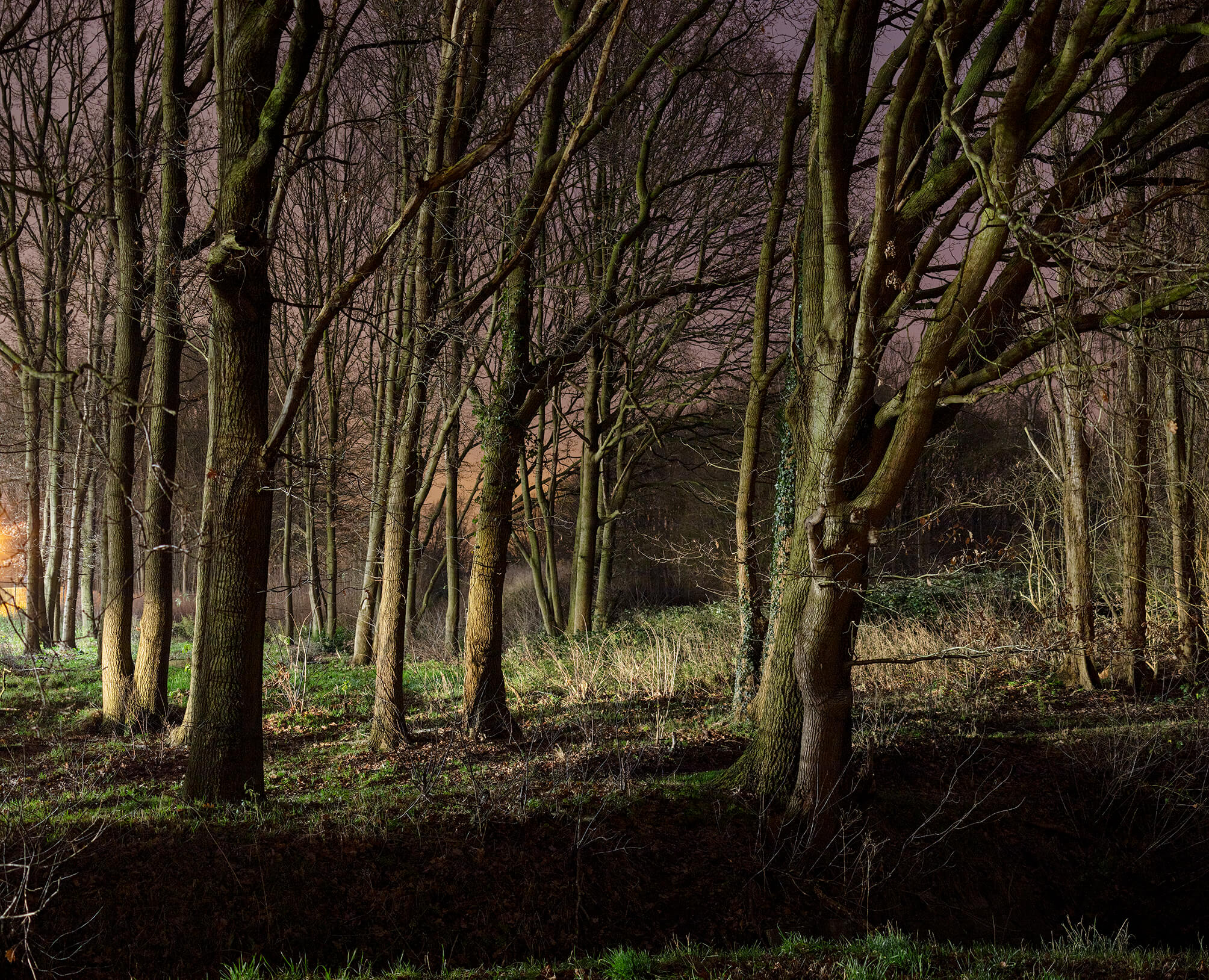
The road down from the top of Mount Vesuvius, at Atrio Del Cavallo. The sun sets. The last tourist bus has headed down. Then the headlights of the guardian’s car swing their way down. It must be freezing. I am holding an orange-sized piece of petrified lava, probably stemming from the 1872 or 1944 eruption. A kilometer further down the road, the old Observatory is empty. Nowadays, monitoring seismic changes is done in a research centre in the city of Naples. Their seismographic registrations can be followed online, in real time. Two headlights swirling along the slopes, underneath me, are coming upwards.

The car is parked on a gravel path, a few metres down from the small road crossing the village. It would be hopelessly stuck the next morning. While trying to capture Neptune through the rental telescope, I run back and forth between the tripod on the small lawn and the trunk several times to get other eyepieces and adapters.
I align the telescope, using three stars: Vega, Arcturus and Deneb.
I hear an animal. I look up and notice the interior light of the car has switched on.
A motorcycle around 3:14. The driver is shifting gears rapidly. I don’t see any headlights in the valley.
Fog sets in. Saturn practically disappears from sight. Jupiter appears as a blob.
I’m 380m above sea level. The highest hill in the area is barely 500m of height. Still, the fog and the settling dew, along with the nightly cold give it something strangely alpine.
The fog lifts.
I can still clearly see the ridge in the east. It should be darker.
During the night, both of us get unwell. One of us is shaking, intensely and relentlessly. The windows are open. For minutes that seem to be hours, it feels like it’s freezing. We get extra blankets. Then, it gets too hot.
One of us dreams about coccodrillos. It starts out with a single animal, like the one we saw in the National Archaeological Museum, escaping from an aquarium, and ends with lots of little ones crawling all over the place. It’s impossible to know how many have escaped.
The other dreams about seismologist Luigi Palmieri’s unfortunate assistant and his family’s quest to redeem his good name. To deprive him of the burden and guilt set upon him by Luigi Palmieri’s report of the 1872 eruption of Vesuvius, the assistant’s offspring were building a monument just below the observatory in which their great-grandfather fell asleep. The monument was permanently, and continuously, unfinished.
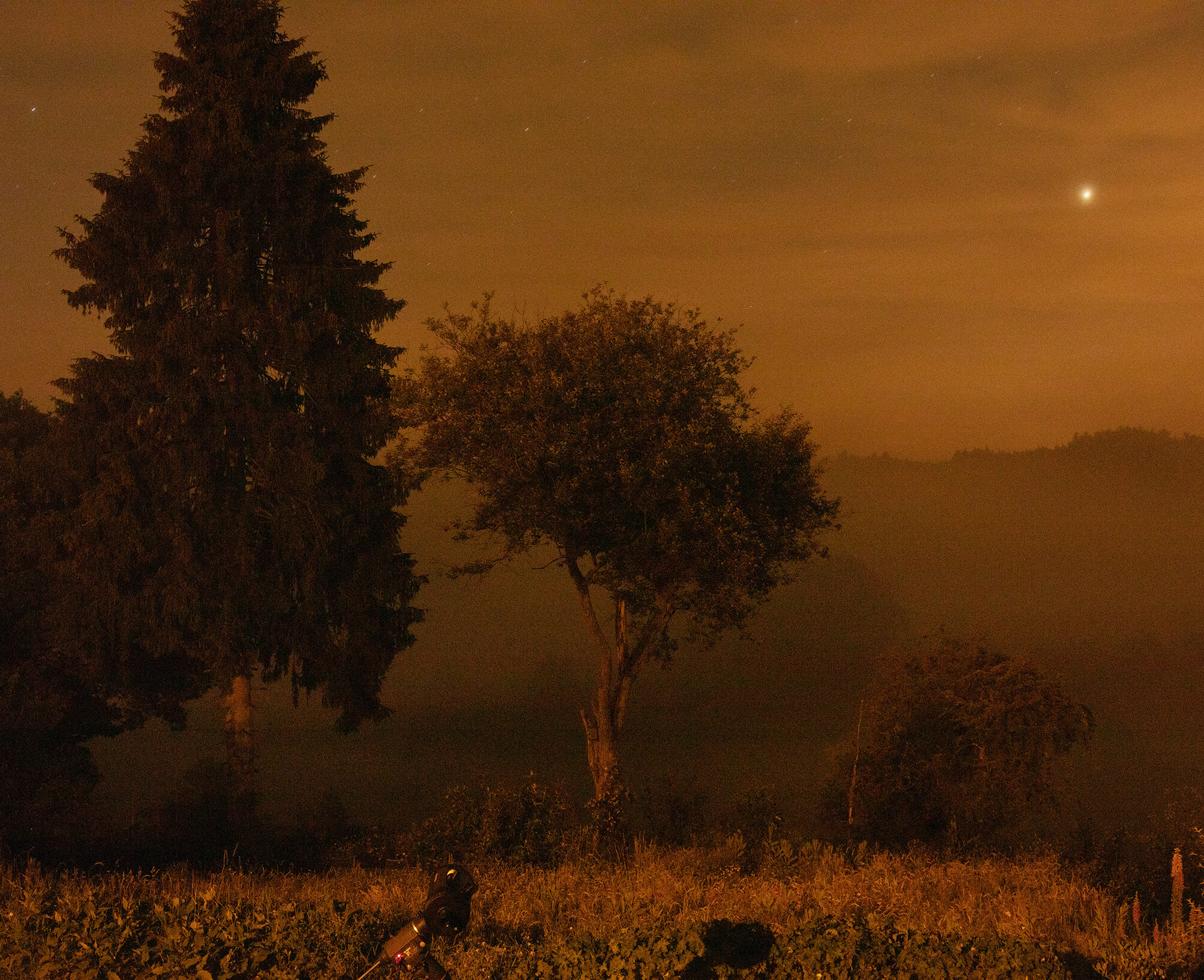
We both dream of hearing fireworks in Naples.
In the morning, we’re slightly alarmed that we both got sick and feverish at the same instant. It’s the middle of January, and the weather has been summerlike all week. A gentle morning breeze flies in from the Neapolitan bay while we wait for the bus to take us to the airport.
First published as part of De Cleene De Cleene. ‘Amidst the Fire, I Was Not Burnt’, Trigger (Special issue: Uncertainty), 2. FOMU/Fw:Books, 25-30
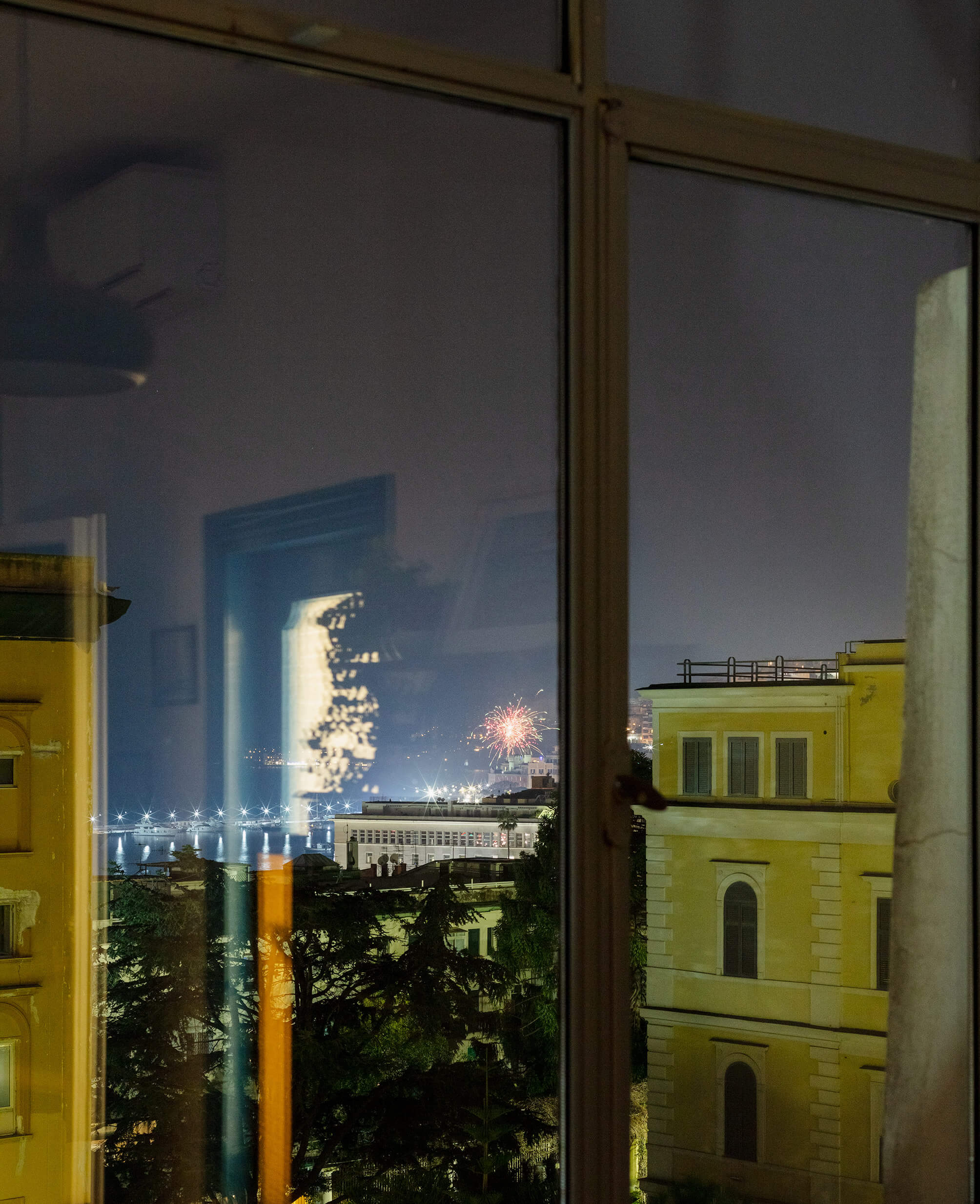
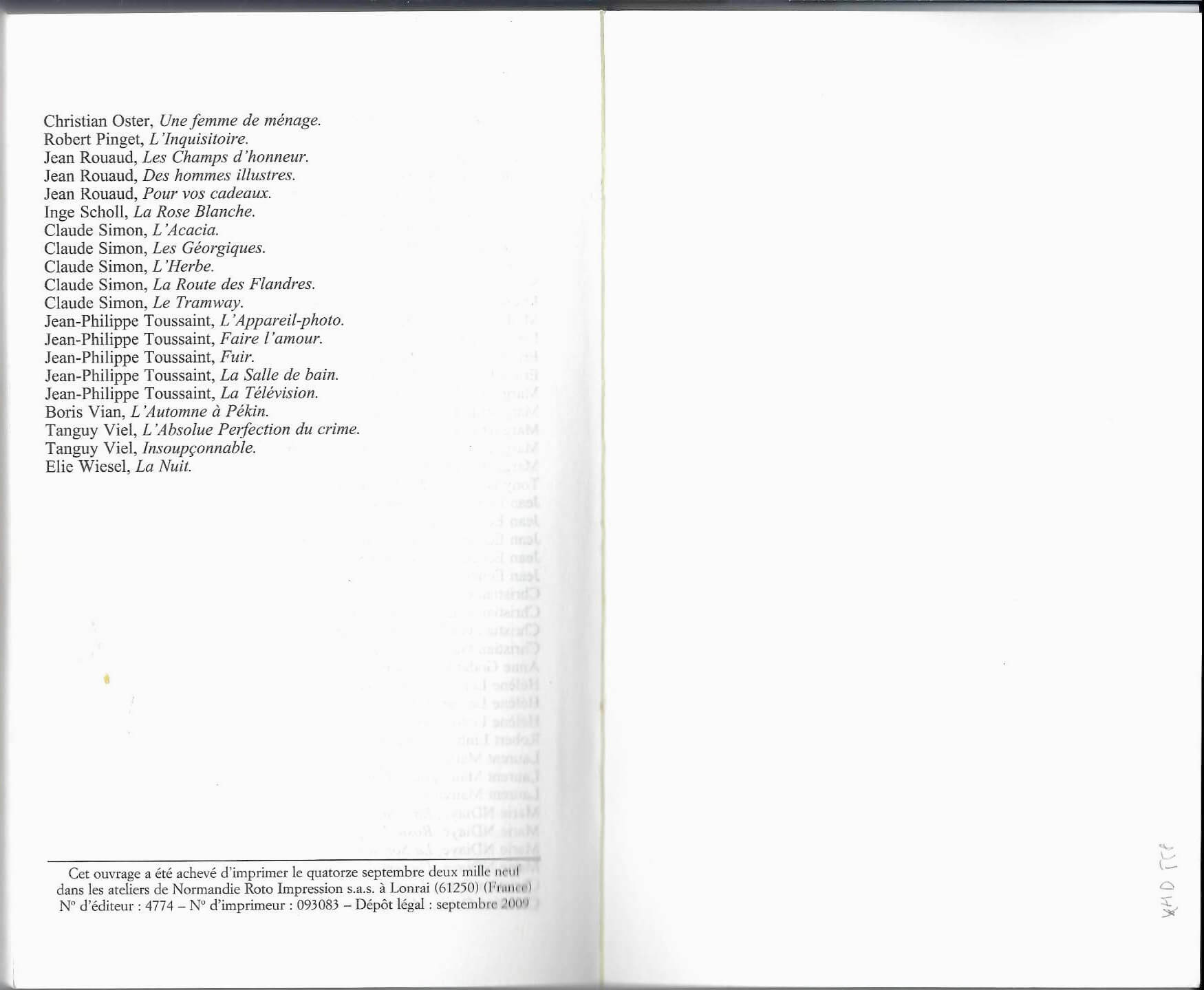
During the preparation of a seminar, I reread Pierre Bayard’s Qui a tué Roger Ackroyd? (2008). On the inside of the back cover, there’s an inscription: it appears I wrote down a license plate number – something I have the habit of doing when a situation seems suspicious.
In Qui à tué Roger Ackroyd?, Bayard analyzes Agatha Christie’s famous detective novel The Murder of Roger Ackroyd (1926). The literary critic disagrees with detective Hercule Poirot’s conclusion: Ackroyd’s murderer is not the narrator, James Sheppard, as Poirot would have it. It’s a delirious interpretation, ‘consistant à rechercher minutieusement des indices, à interpréter des faits et à organiser nos déductions en une construction d’ensemble harmonieuse’.
The car with license plate number XHD 558 is unknown to me. I can’t recall what I saw that urged me to write it down, nor the time or location when I saw it.
Bayard, P. Qui a tué Roger Ackroyd? Paris: Minuit, 2008.