What constitutes a ‘document’ and how does it function?
According to the Oxford English Dictionary, the etymological origin is the Latin ‘documentum’, meaning ‘lesson, proof, instance, specimen’. As a verb, it is ‘to prove or support (something) by documentary evidence’, and ‘to provide with documents’. The online version of the OED includes a draft addition, whereby a document (as a noun) is ‘a collection of data in digital form that is considered a single item and typically has a unique filename by which it can be stored, retrieved, or transmitted (as a file, a spreadsheet, or a graphic)’. The current use of the noun ‘document’ is defined as ‘something written, inscribed, etc., which furnishes evidence or information upon any subject, as a manuscript, title-deed, tomb-stone, coin, picture, etc.’ (emphasis added).
Both ‘something’ and that first ‘etc.’ leave ample room for discussion. A document doubts whether it functions as something unique, or as something reproducible. A passport is a document, but a flyer equally so. Moreover, there is a circular reasoning: to document is ‘to provide with documents’. Defining (the functioning of) a document most likely involves ideas of communication, information, evidence, inscriptions, and implies notions of objectivity and neutrality – but the document is neither reducible to one of them, nor is it equal to their sum. It is hard to pinpoint it, as it disperses into and is affected by other fields: it is intrinsically tied to the history of media and to important currents in literature, photography and art; it is linked to epistemic and power structures. However ubiquitous it is, as an often tangible thing in our environment, and as a concept, a document deranges.
the-documents.org continuously gathers documents and provides them with a short textual description, explanation,
or digression, written by multiple authors. In Paper Knowledge, Lisa Gitelman paraphrases ‘documentalist’ Suzanne Briet, stating that ‘an antelope running wild would not be a document, but an antelope taken into a zoo would be one, presumably because it would then be framed – or reframed – as an example, specimen, or instance’. The gathered files are all documents – if they weren’t before publication, they now are. That is what the-documents.org, irreversibly, does. It is a zoo turning an antelope into an ‘antelope’.
As you made your way through the collection,
the-documents.org tracked the entries you viewed.
It documented your path through the website.
As such, the time spent on the-documents.org turned
into this – a new document.
This document was compiled by ____ on 21.11.2025 13:28, printed on ____ and contains 18 documents on _ pages.
(https://the-documents.org/log/21-11-2025-6689/)
the-documents.org is a project created and edited by De Cleene De Cleene; design & development by atelier Haegeman Temmerman.
the-documents.org has been online since 23.05.2021.
- De Cleene De Cleene is Michiel De Cleene and Arnout De Cleene. Together they form a research group that focusses on novel ways of approaching the everyday, by artistic means and from a cultural and critical perspective.
www.decleenedecleene.be / info@decleenedecleene.be - This project was made possible with the support of the Flemish Government and KASK & Conservatorium, the school of arts of HOGENT and Howest. It is part of the research project Documenting Objects, financed by the HOGENT Arts Research Fund.
- Briet, S. Qu’est-ce que la documentation? Paris: Edit, 1951.
- Gitelman, L. Paper Knowledge. Toward a Media History of Documents.
Durham/ London: Duke University Press, 2014. - Oxford English Dictionary Online. Accessed on 13.05.2021.

The last couple of days have been dry. Rain is expected for the weekend. The office buckets are in place and are empty, except for some residue. Dirt, sand, a few hairs. Some particles must have come along with the drops when they made their way through the roof.

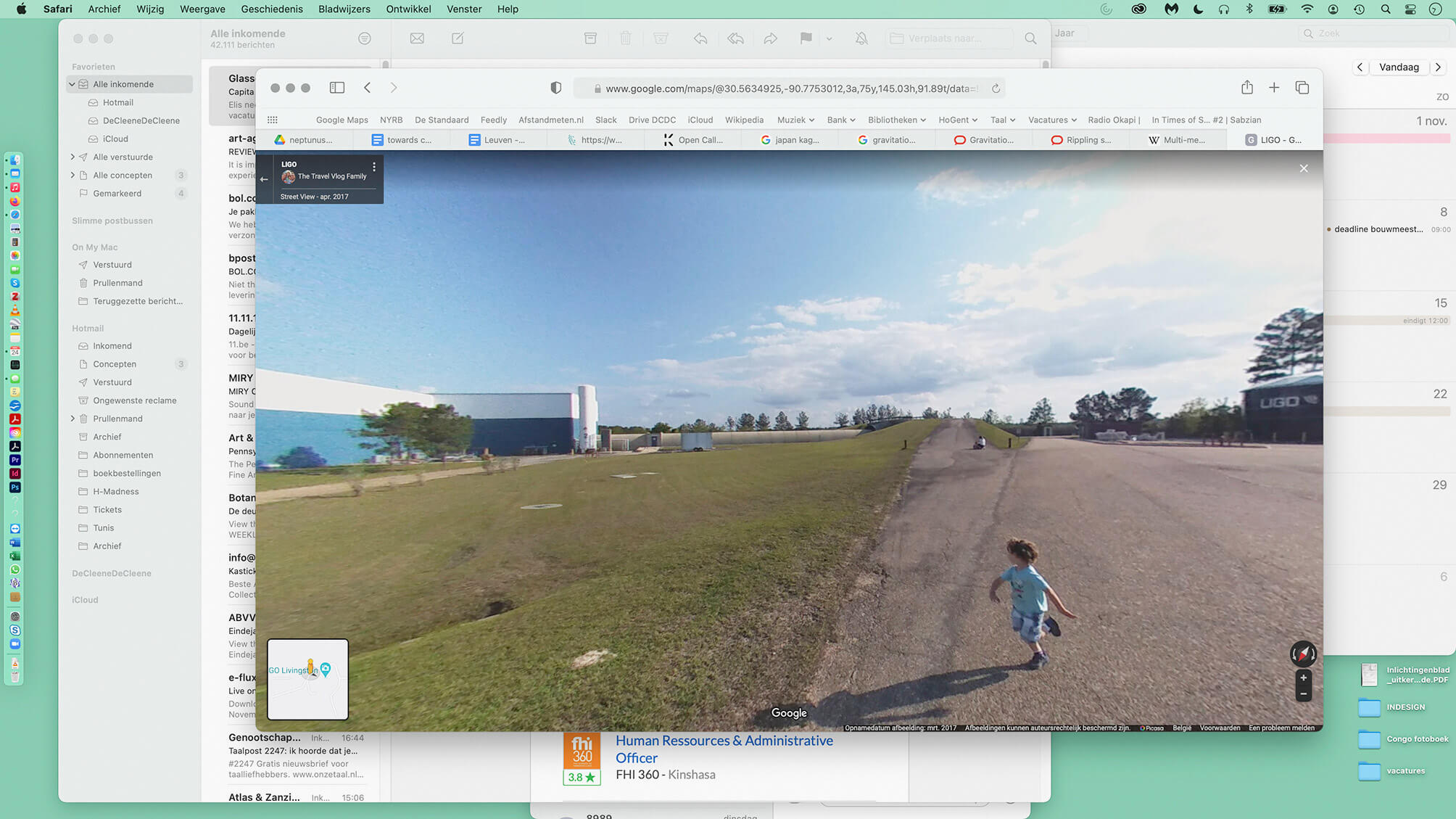
To detect gravitational waves, physicists built enormous research centers, amongst others at Livingston, Louisiana. The facility mainly consists of two tunnels in an L-shape. Mirrors inside provide data. Disturbances from gravitational waves are miniscule. To prevent interference from outside, such as vibrations caused by people passing in the neighbourhood, the mirrors have to be detached from the earth. They ‘float’, suspended by glass fibers in a pendulum-like construction. As I was watching my screen, a courier was on his way to deliver a book (Noel-Todd, J. The Penguin Book of the Prose Poem: From Baudelaire to Anne Carson. London: Penguin, 2019).
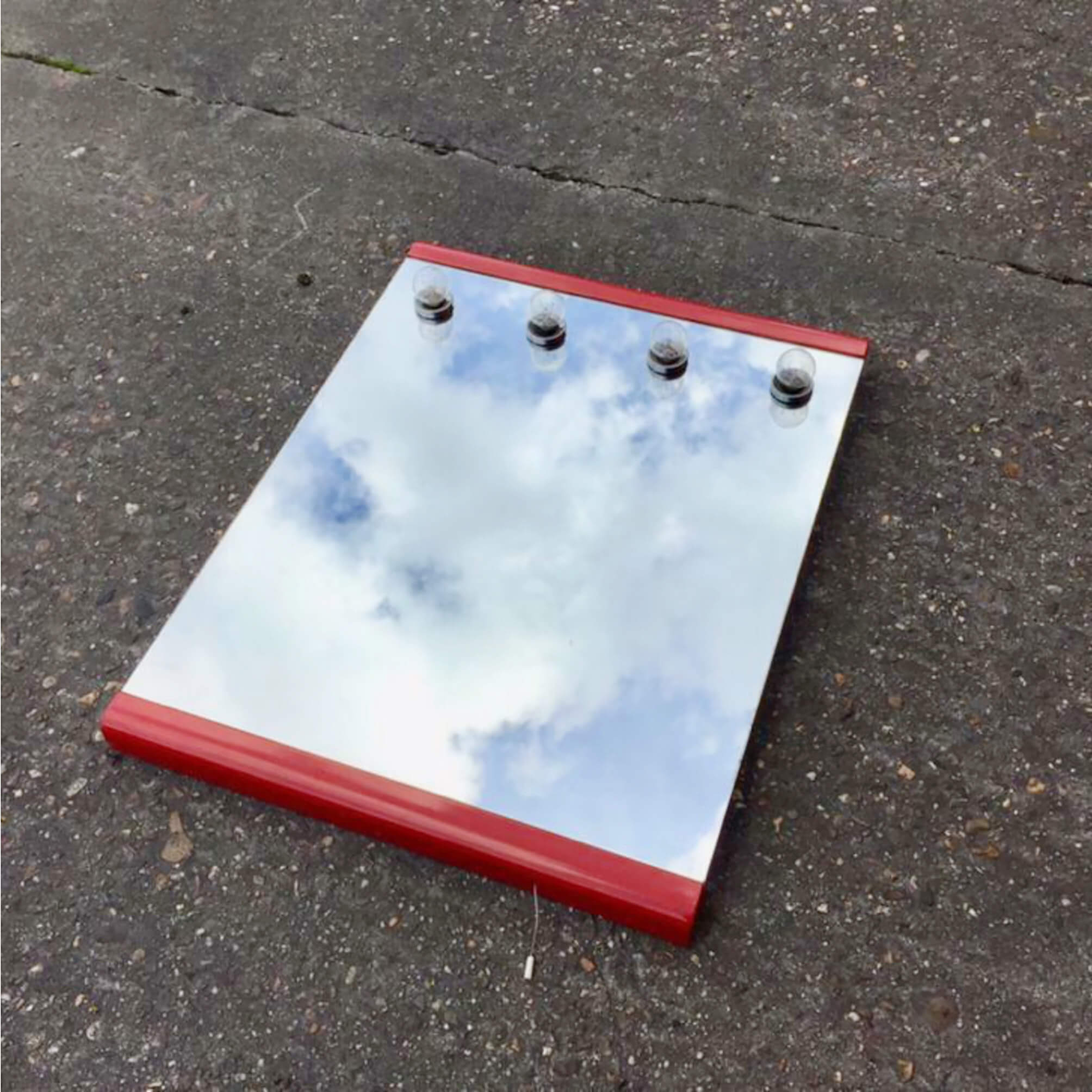
On the online thrift shop 2dehands.be the homepage generates a ‘for you’ section. On November 9th this section listed, among other things, a picture of the sky on a patch of concrete. On closer inspection, it became clear that it was the sky’s reflection in a mirror with a red frame and four lightbulbs in it, the kind you might see at the hairdresser’s or backstage in a television studio or theatre. The seller estimates the mirror’s current value to be 45,00 EUR. The listing includes five photographs. In the fifth one, the object for sale reflects a bucolic landscape: a blue sky, white clouds, some trees and a fragment of a barn.
As we point the telescope to the sky – cloudy, and filled with chaotic bursts of rain – the dispersion of the city lights accentuates the swirling, frantic raindrops. The roof we are standing on is uneven. A puddle forms underneath the apparatus, around the right leg of the tripod and our feet. The sound of a car on a wet street, below. A kitchen light is flicked on. Temperature is low for a mid-September night, and getting lower by the minute. It seems impossible to tell the depth of field we are documenting, and at what distance from our position these fleeting constellations occur.
Excerpt from Towards Civil Dusk (De Cleene De Cleene, 2020)
Neptune in opposition [1-20] is part of ‘Documenting Objects’, a research project by Arnout De Cleene and Michiel De Cleene at KASK & Conservatorium, the school of arts of HOGENT and Howest. Their research is financed by the HOGENT Arts Research Fund. Previous research into this subject has amongst other things led to the documentary film Towards Civil Dusk and temporary public observatories at 019, Gent and Kunsthal Extra City, Antwerp.
Thanks to:
Angelo Van Daele
Arthur Haegeman
Chris De Pauw
Emi Kodama
Frédéric Thill
Gentil Van de Vijver
Guy Wauters
Hannah De Cleene
Jan Scheers
Jonas Temmerman
John Sussenbach
Kunsthal Extra City
Philippe Molet
019
Astropolis (Oostende)
Cercle Astronomique Mosan (Herbuchenne)
Koninklijk Observatorium Ukkel
Observatoire Astronomique Antoine Thomas S.J. (Namur)
Observatoire Astronomique Centre Ardenne (Grapfontaine)
Publieke Sterrenwacht van de Westkust (Koksijde)
Volkssterrenwacht Armand Pien (Gent)
Volkssterrenwacht AstroLAB IRIS (Zillebeke)
Volkssterrenwacht Beisbroek (Brugge)
Volkssterrenwacht Mira (Grimbergen)
Volkssterrenwacht Urania (Hove)

A scene in German author and director Alexander Kluge’s Die Patriotin: a half-dome opens; the protagonist, Gabi Teichert, stares into the telescope. A montage follows: the waxing crescent moon coming into focus; a night vision of a cityscape with industrial elements; archival footage of a cityscape with skyscrapers during daytime; a giant fire; a woman giving birth aided by a midwife; raindrops falling into a puddle of water; a time-lapse video of a city at sundown; a ship floating by with, in the background, on the shore, windmills; images of tanks rolling by; close-ups of a purple-lit face of someone looking into the camera; archival footage of an air raid.1, 2
In a conversation with Ben Lerner, Kluge sees himself as someone ‘creating constellations’: ‘We deal with moving bodies. “Moving reality.” […] And this is something that you cannot present in a linear way, but in the form of constellations. “Constellation” refers to cosmic matter and gravitation. There are suns, moons, planets. There are also the dust particles, tiny particles that orbit around the sun for centuries according to physical laws. And there’s no hinge, no screw that connects them. Invisible connections.’3
Kluge, A. (dir.) Die Patriotin. München: Kairos Film, 1979. https://youtu.be/ZRuQ3SUgSSk?t=449
Kluge, A. Die Patriotin. Texte/Bilder 1-6. Frankfurt am Main: Zweitausendeins, 1979, 60-64. https://monoskop.org/images/4/49/Kluge_Alexander_Die_Patriotin.pdf
Lerner, B. & Kluge, A. The Snows of Venice. The Lerner-Kluge-container. Leipzig: Spector Books, 2018, 66.
Excerpt from Towards Civil Dusk (De Cleene De Cleene, 2020)
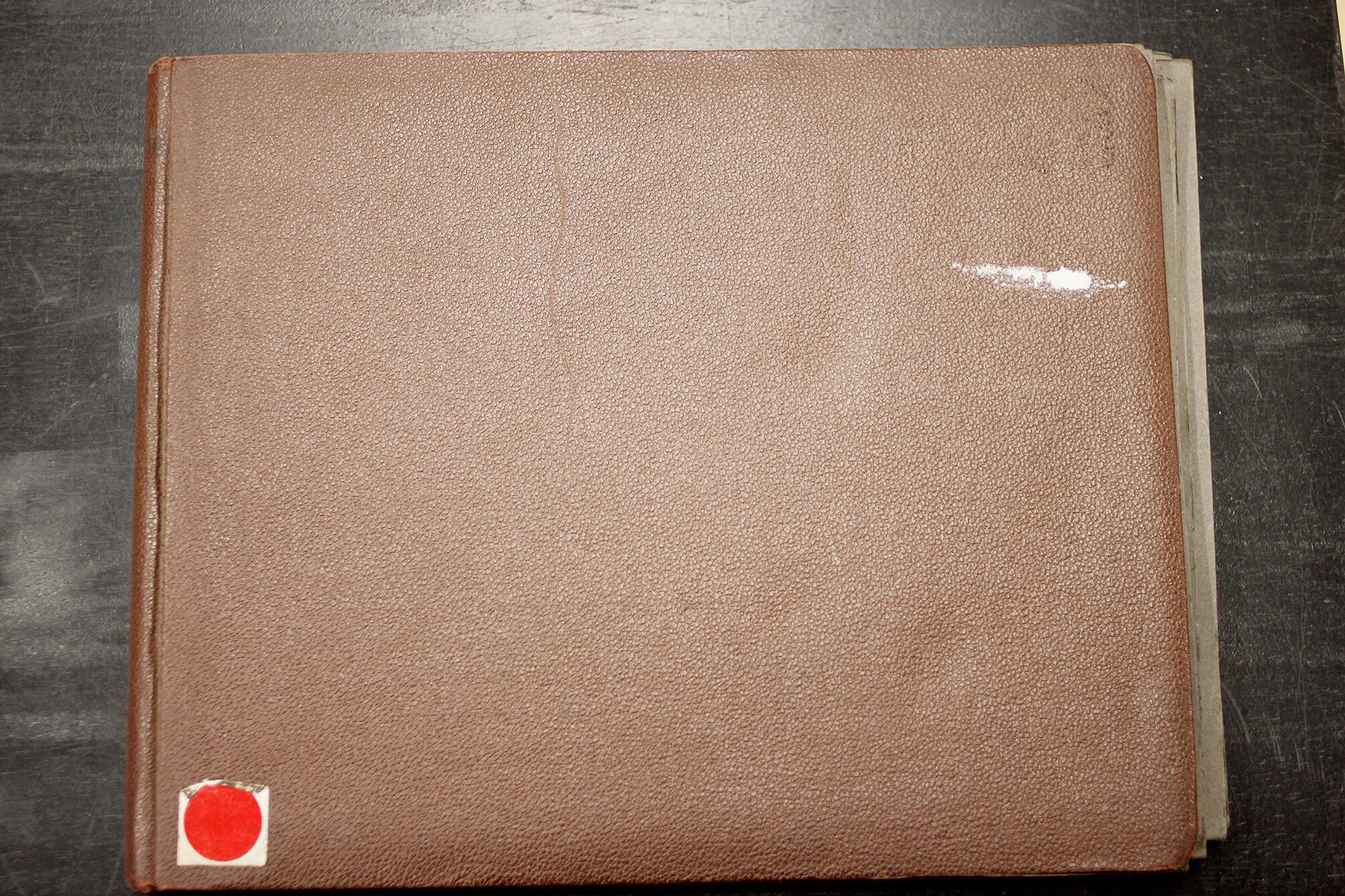
At the State Archive in Kortrijk, I am leafing through a 1955 photo album of the construction of the provisional church in Lokeren by the famous furniture company Kunstwerkstede De Coene. Gigantic wooden, prefabricated beams structure the building. It is cold. An old man in a grey suit shuffles between the racks to look up the date of birth of his great great grandmother. Snow covers the unfinished provisional roof. A bus passes, I reckon, through the pouring rain.
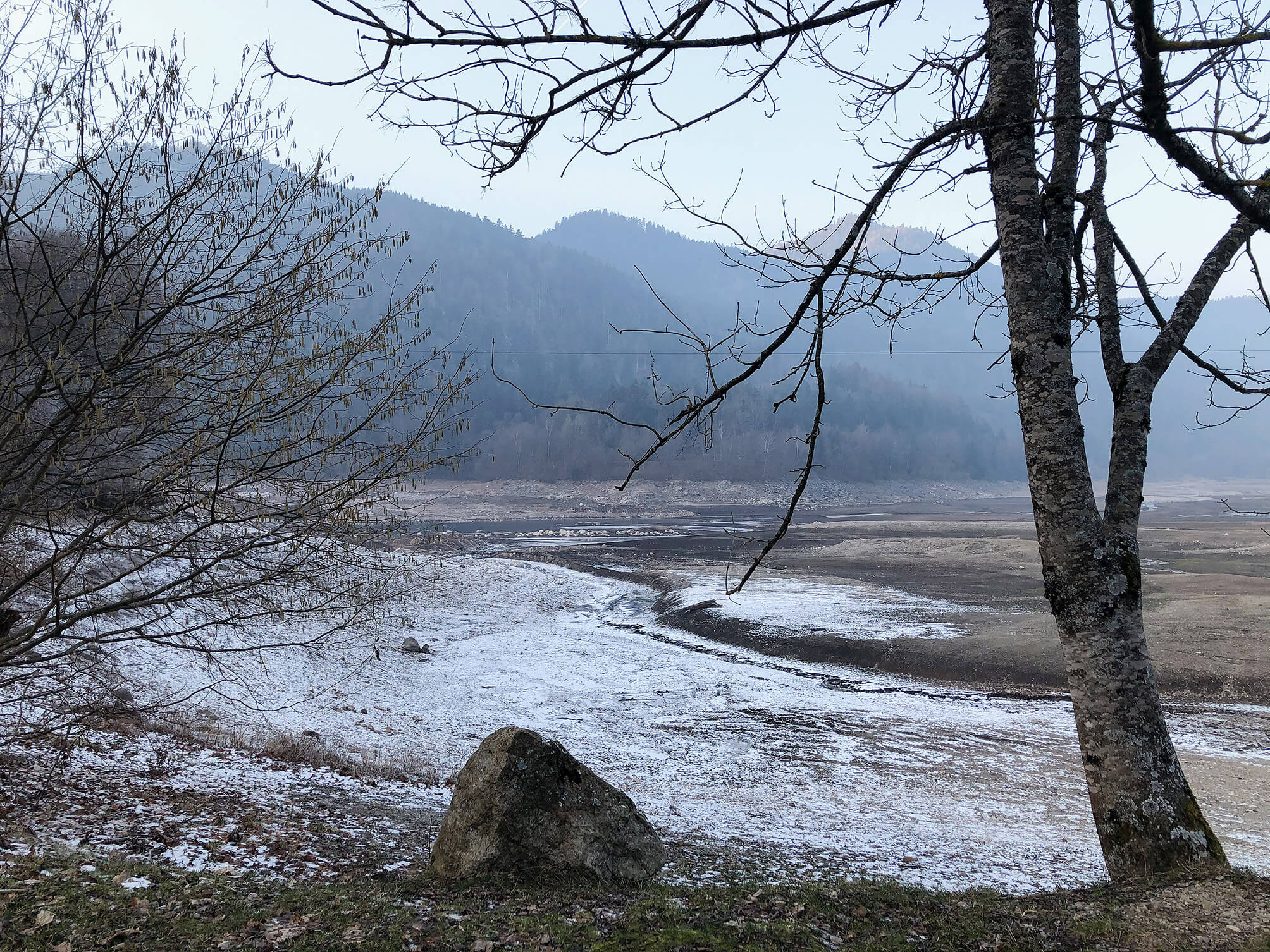
December, 1947. Rapid snowmelt coincides with torrential precipitation. At the bottom of the Thur valley, in Wildenstein, the water gathers.
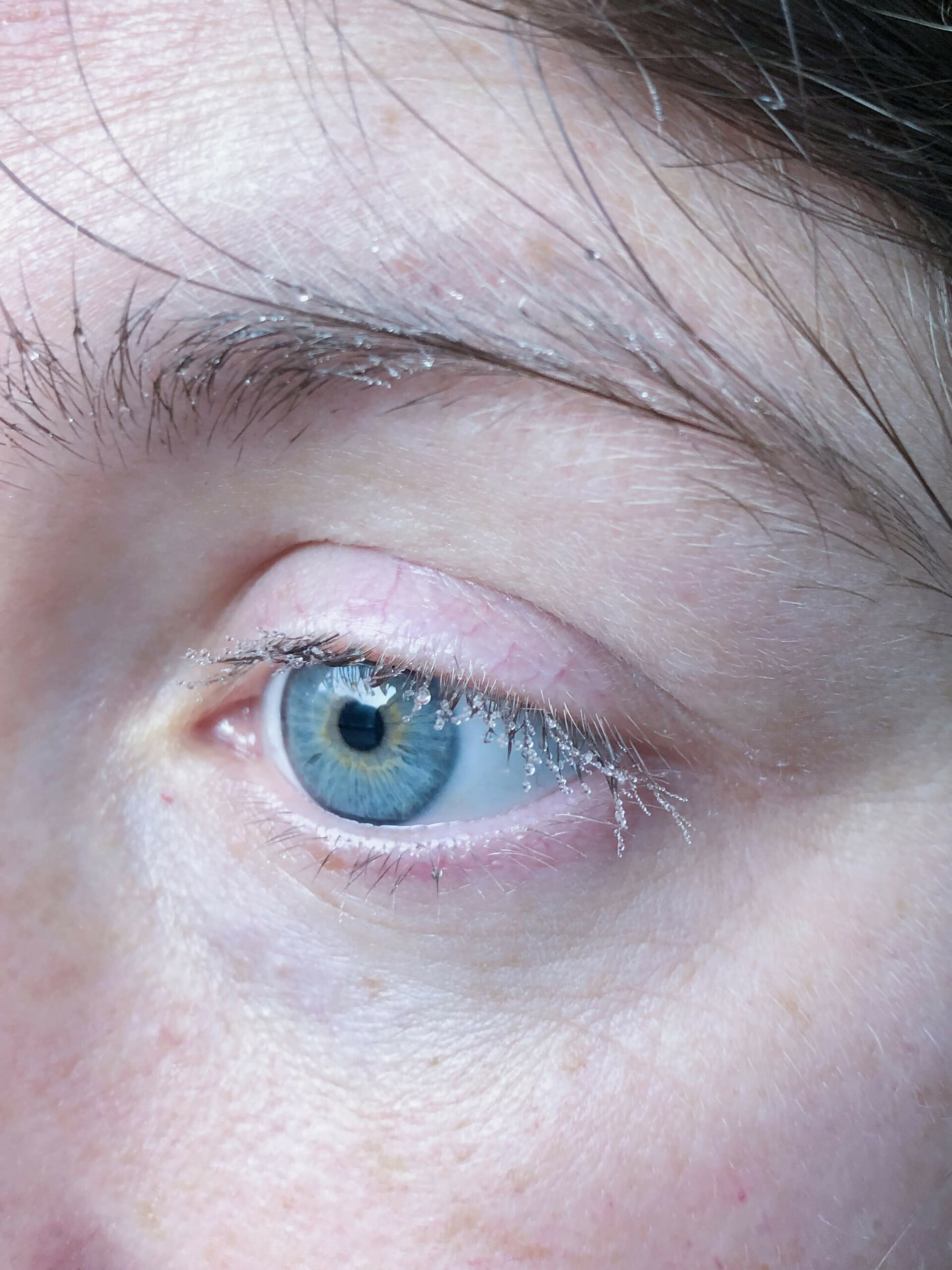
As we point the telescope to the sky – cloudy, and filled with chaotic bursts of rain – the dispersion of the city lights accentuates the swirling, frantic raindrops. The roof we are standing on is uneven. A puddle forms underneath the apparatus, around the right leg of the tripod and our feet. The sound of a car on a wet street, below. A kitchen light is flicked on. Temperature is low for a mid-September night, and getting lower by the minute. It seems impossible to tell the depth of field we are documenting, and at what distance from our position these fleeting constellations occur.
Excerpt from Towards Civil Dusk (De Cleene De Cleene, 2020)
Neptune in opposition [1-20] is part of ‘Documenting Objects’, a research project by Arnout De Cleene and Michiel De Cleene at KASK & Conservatorium, the school of arts of HOGENT and Howest. Their research is financed by the HOGENT Arts Research Fund. Previous research into this subject has amongst other things led to the documentary film Towards Civil Dusk and temporary public observatories at 019, Gent and Kunsthal Extra City, Antwerp.
Thanks to:
Angelo Van Daele
Arthur Haegeman
Chris De Pauw
Emi Kodama
Frédéric Thill
Gentil Van de Vijver
Guy Wauters
Hannah De Cleene
Jan Scheers
Jonas Temmerman
John Sussenbach
Kunsthal Extra City
Philippe Molet
019
Astropolis (Oostende)
Cercle Astronomique Mosan (Herbuchenne)
Koninklijk Observatorium Ukkel
Observatoire Astronomique Antoine Thomas S.J. (Namur)
Observatoire Astronomique Centre Ardenne (Grapfontaine)
Publieke Sterrenwacht van de Westkust (Koksijde)
Volkssterrenwacht Armand Pien (Gent)
Volkssterrenwacht AstroLAB IRIS (Zillebeke)
Volkssterrenwacht Beisbroek (Brugge)
Volkssterrenwacht Mira (Grimbergen)
Volkssterrenwacht Urania (Hove)
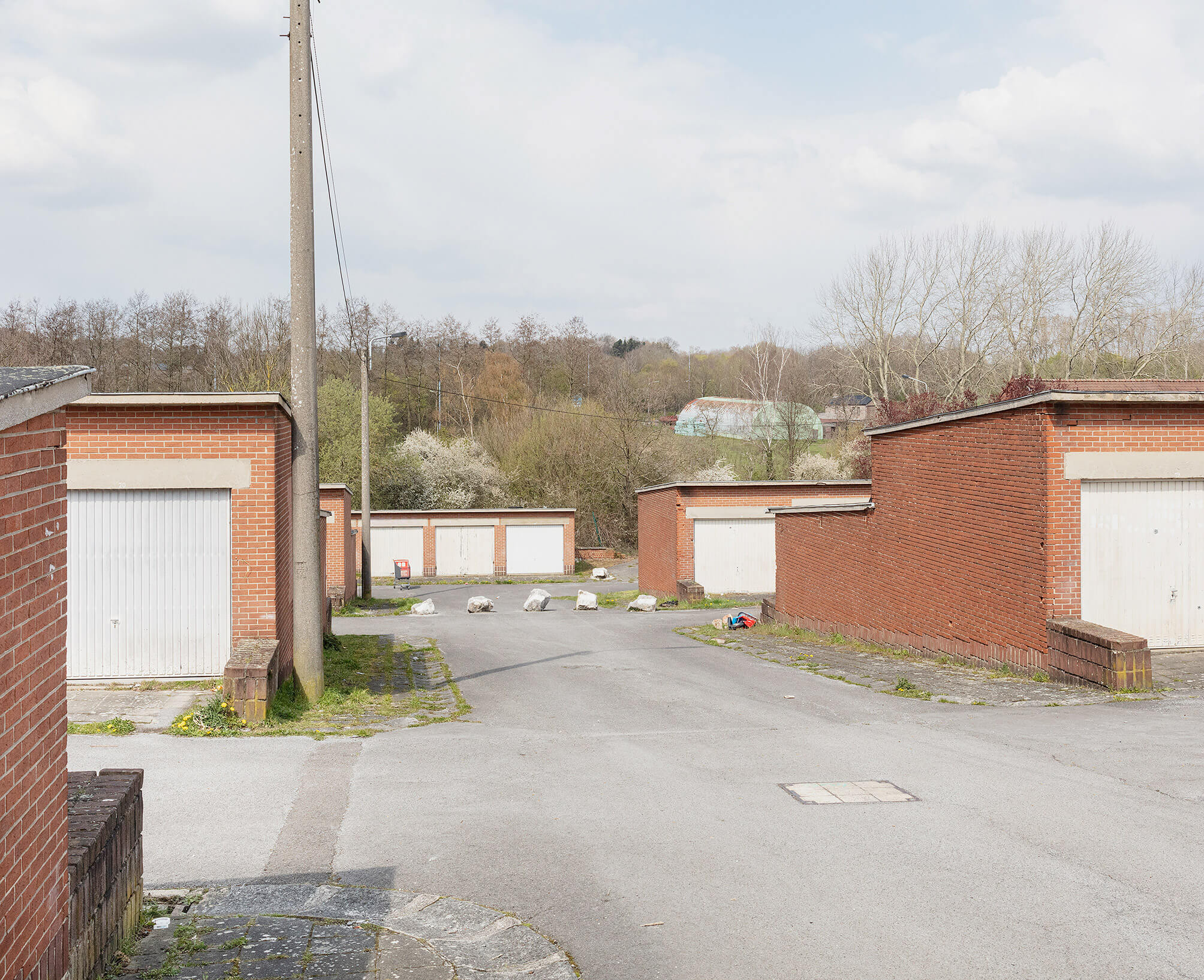
Seven very similar and rudimentary buildings take in a trapezoid plot of land in Gilly. They are located between the school on the Rue Circulaire and the houses along the Rue de l’Abbaye. The structures are built of orange brick, concrete structural elements, whitish steel gates and roofing. Every garage has its own number, hand-painted in white on the concrete lintel above each gate. In summer the roofing gets hot and soft.
At the office,1 a gray and a green bucket are meticulously positioned on the floor to catch the water dripping from the ceiling.2 It has been a very wet few months.
Perpendicularly above the green bucket is the office’s smoke detector, which, when it rains, could be mistaken for a sprinkler. The gray bucket is positioned perpendicularly beneath the electric line leading to the smoke detector. The lamp doesn’t leak.
The nineteenth-century building was designed by the renowned architect Adolphe Pauli.3 The offices of my former employer were also housed in a Pauli building. Over there, it was a mop that was used to evacuate water from the recurrently flooded ground floor hallway.
the-documents.org HQ
The reason for the leaks is said to be the use of screws that cause an electrolytic reaction.
Shortly after documenting the above, the roof came down. The buckets only partly catched the plaster.


In between two cities along the Belgian coast, water has run from the dunes (and the Second World War Heritage site scattered among them), underneath the coastal road and tram rails, to the beach. It has formed a small S-shaped estuary, bound to disappear due to the increasingly harsh wind coming from the coast of Britain, blowing North-easterly, and hammering down on the levee. The vibrations of the empty Ostend-bound tram passing just before the photograph was taken, had no visible impact on the estuary.

[13:42] Maziar: Power out at Rib now.
[13:45] Mathew: It’s windy here today, sorry!
[13:45] Maziar: Saying from the comfort of his electrified home, or…you also have no power?
[13:45] Mathew: No, I don’t. But, typically, outages in the city are shorter than in regional areas. PG&E website estimates service within two hours…Maybe you could post a business sign on Rib’s window?1
[13:52] Maziar: Yes. Though my phone is almost dead. No light. Can you send me a text for the sign? I can’t access the drive.
[13:52] Mathew: Yeah.
[13:52] Maziar: I feel reality hitting. Not so much the reality of blackouts in the U.S., but the reality of life and work…and that it is time to go home.
[13:55] Mathew: “CLOSED NO POWER For prescriptions go to Walgreens 2690 Mission OPEN UNTIL 5 PM.”
[13:55] Maziar: Thanks.
[13:56] Mathew: Yeah, maybe it’s time for you to leave for the night. I’m going to drive around to see what’s happening.
[13:59] Maziar: Okay, enjoy.
Local businesses experiencing a blackout typically post handwritten notices on their street-facing windows. These condensed notes detail acute symptoms felt at a community level, hinting at the improvisation required to maintain social harmony.
Mathew Kneebone is an artist based in San Francisco. His interdisciplinary practices takes different forms, all in relation to an interest in electricity and technology. He teaches studio and thesis writing at California College of the Arts.

Directed by Xie Jin, Huang Baomei (1958) is a docudrama based on the real-life experiences of the national model worker of the same name, who also plays herself in the film. Reflecting the economic priorities of the day following the launch of the Great Leap Forward—a far-reaching and ultimately devastating campaign that sought to replace the prevailing Soviet-style expert-managerial system with workers’ self-organisation and mass mobilisation—the film focuses on the challenges faced by machine operators as they strive for a technical breakthrough while working with their aging machines.
Located at No. 2866, Yangshupu Road, Shanghai No. 17 Cotton Mill, which had its origins in the Japanese-owned Yuho Spinning Company, was one of Shanghai’s best known cotton mills. The launch of China’s economic reforms opened a new era for the mill, as reflected cinematically in No. 17 Cotton Mill Shanghai Blues (1984), a British documentary that attests to the vibrant workers’ music scene blossoming within the factory walls. In 1992, the state-owned enterprise was restructured as one of the first batch of joint-stock companies in the Reform era and renamed as Longtou Company after the brand name of a fabric manufactured by the mill. Following the relocation of the mill’s original machinery to Jiangsu in 2007, work commenced to redesign the entire complex and relaunch it as the Shanghai International Fashion Center. In Jia Zhangke’s I Wish I Knew (2010), an elderly Huang Baomei is seen walking amidst the ruins that are all that remain of the cotton mill as it awaits refurbishment.
Ho Rui An is an artist and writer working in the intersections of contemporary art, cinema, performance and theory. Through lectures, essays and films, his research examines the relations between labour, technology and capital across different systems of governance in a global age.
In spring 2024 the-documents.org and Trigger co-publish a series of online articles with a focus on the meeting ground between photography and the document.

Set in the fictitious Shanghai-based Dafeng Cotton Mill, Red Skirt Popular on the Street (1984) follows the story of an enterprising model worker as she navigates the challenges of young adult life, from workplace conflicts to choosing what clothes to wear on her days off. In the reflection of the emerging consumer consciousness of the Reform era, many of the film’s key moments happen not on the factory floor, but in the changing room where the workers seek to express themselves through their choice of dress. To this end, the film can be regarded as a document of the fashion trends being introduced into the country at the time, as best observed in the spellbinding array of colours on display as the workers leave the factory at the end of a day’s work.
The textile mill used as the setting for Dafeng Cotton Mill is Shanghai No. 1 Cotton Mill. Originally occupied by the no. 13 and 14 mills of the Japanese-owned Naigaiwata Company, the mill was formally established as the China Textile Construction Company Shanghai No. 1 Cotton Mill after the Second World War. It was located at the T-shaped intersection on Changshou Road, with the gate facing Jiaozhou Road. At that time, the area on the north side of Changshou Road extending from No. 1 Cotton Mill formed a continuous industrial zone encompassing many other factories and warehouses, all of which have since been converted into the private residences and creative parks.
Ho Rui An is an artist and writer working in the intersections of contemporary art, cinema, performance and theory. Through lectures, essays and films, his research examines the relations between labour, technology and capital across different systems of governance in a global age.
In spring 2024 the-documents.org and Trigger co-publish a series of online articles with a focus on the meeting ground between photography and the document.

A classic of Republican-era cinema, the 1926 silent film A String of Pearls follows the trials and tribulations of a middle-class Shanghai couple after a pearl necklace borrowed by the husband to please his materialistic wife is stolen. In order to pay for a replacement, the protagonist resorts to embezzling public funds and consequently ends up in prison. After working as a weaver during his sentence, he becomes a worker at Zhenhua Cotton Mill following his release. In an obvious homage to the Lumières’ seminal film, a scene in the film shows workers, including children, entering the factory to begin a day’s work.
Even though the precise location of the factory gate in the film cannot be determined, it happens that the first enterprise that attracted the investment of Rong Ruixin—a relative of cotton magnates Rong Zongjing and Rong Desheng—was called Zhenhua Cotton Mill. Established in 1905, Zhenhua Cotton Mill was not fully mechanised, which would correspond with the appearance of a hand-operated loom in the film. Today, a residential community sits on the original site of the cotton mill.
Ho Rui An is an artist and writer working in the intersections of contemporary art, cinema, performance and theory. Through lectures, essays and films, his research examines the relations between labour, technology and capital across different systems of governance in a global age.
In spring 2024 the-documents.org and Trigger co-publish a series of online articles with a focus on the meeting ground between photography and the document.

On January 23, 2020 a young couple walks around the drained reservoir of Kruth-Wildenstein.
It’s freezing. They’re expecting their first child within a month.
Freely adapted from interviews with residents of Sandersleben (Saxony-Anhalt). Three-act play. The first two acts take place in the present day; the third is set in the future.
From Act 1 ‘The Town of S’, Scene 2 ‘The Past’.
Characters: MR DUNST club member I, OLIVER club member II, ANJA young mother
Stills from text animation S. Anders Leben. Eine Handlung in Gesprächen/S. Anders Leben – Living Differently: An Act in Conversations
Stephanie Kiwitt (1972) is an artist based in Halle (Saale), Germany. Utilizing a large number of images, various perspectives and also textual elements, she is known for her insightful photography that explores spaces emblematic of contemporary phenomena. Over the past three years, she has focused on evolving habitats in rural areas, photographing traces of transformation and conducting interviews in Saxony-Anhalt, the region she moved to in 2020. From 2018 to 2020, Kiwitt was a guest lecturer at the LUCA School of Arts in Brussels.
In spring 2024 the-documents.org and Trigger co-publish a series of online articles with a focus on the meeting ground between photography and the document.

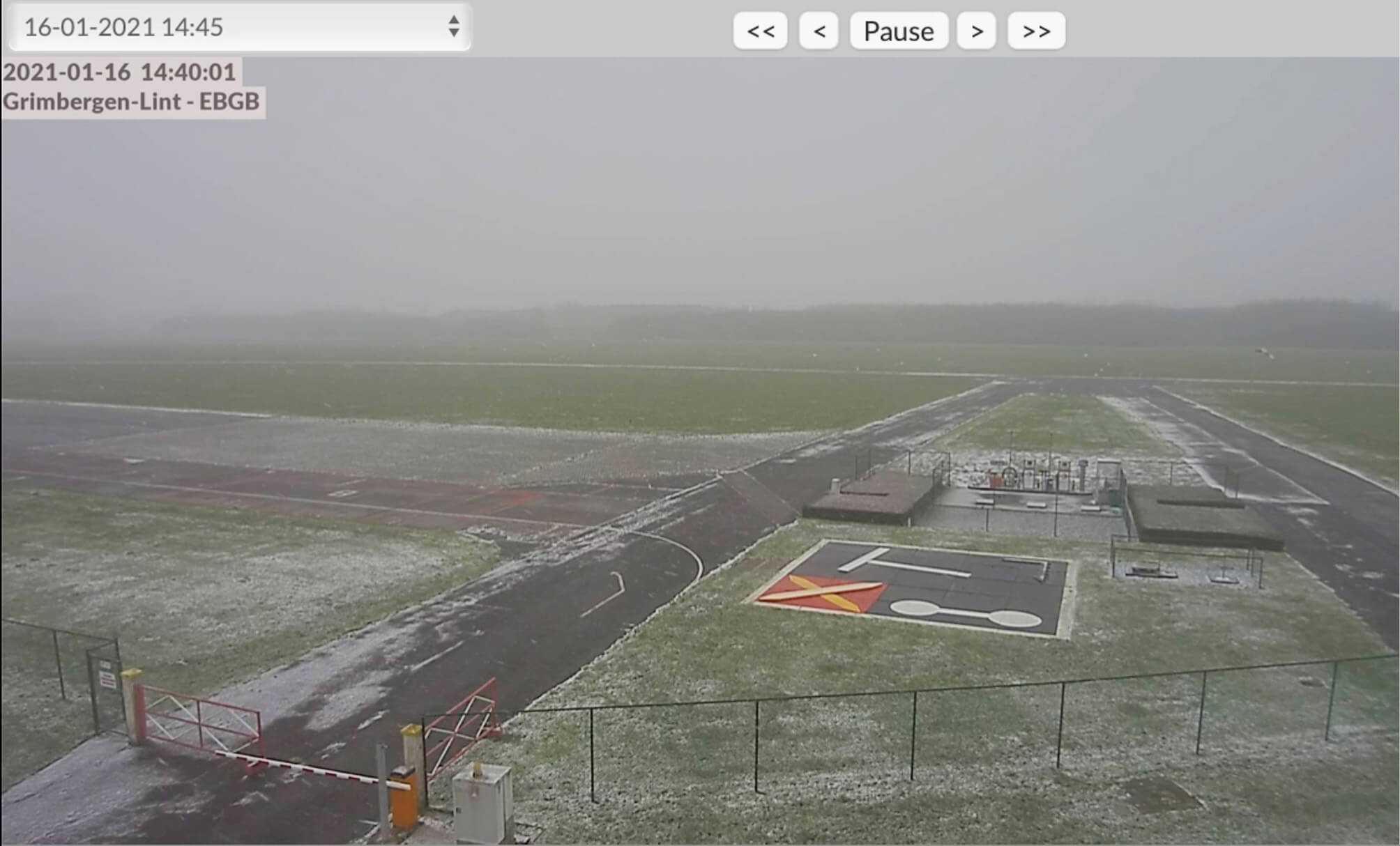
Recreational airfield at Grimbergen, webcam footage.
09:10:00The frame shows the first movement on the terrain. The gate has been opened, the barrier lowered. A black car is in the back. In the forefront, aviation signs on the ground: a yellow cross on a surface painted red; an arrow in a 90° angular shape; two circles connected by a line; a T-shaped line.
09:20:00Two men talking, each one on one side of the barrier. The man on the side of the airstrip has two dogs with him. The aviation signs have changed: the arrow is gone; the horizontal bar of the T-symbol has moved to the other side of the vertical line; one yellow line that made up the cross on the red surface is gone, leaving one yellow diagonal line.
10:09:01A small white aircraft (the two men and the dogs are gone).
10:20:01The aircraft in the same position, with what seems to be an open roof.
10:40:00Aircraft leaving the gas station where it was before.
11:10:01A white car at the gas station, where previously the aircraft was stationed; a silhouette of a man, perhaps.
11:30:01White car gone.
11:50:01Small white aircraft at the gas station; man in red jacket next to the aircraft. Not clear if it is the same aircraft seen in frame 10:09:01.
12:10:01Aircraft appears to be heading for take-off.
12:20:01Aircraft gone.
12:40:01White dots on the grass that appear to be birds.
14:10:00First precipitation: snow, visibility lessens.
14:20:00More snow, wind is stronger; someone has replaced the yellow stripe so that, again, a yellow cross is formed on the red background.
15:10:00The grass and the concrete get increasingly white. No aircrafts, vehicles or persons can be discerned. The aviation signs beneath the thin-layered snow are still visible, and unaltered.
Every so often architects ask me to photograph projects of theirs under a blanket of snow. Snow-days are rare around here. In an attempt to avoid a futile drive along roads in winter conditions, I check webcams near the project-to-be-photographed before setting out.
Webcam Grimbergen, meteobelgie.be: https://www.meteobelgie.be/waarnemingen/belgie/webcam/272/grimbergen
http://www.rvg.be