What constitutes a ‘document’ and how does it function?
According to the Oxford English Dictionary, the etymological origin is the Latin ‘documentum’, meaning ‘lesson, proof, instance, specimen’. As a verb, it is ‘to prove or support (something) by documentary evidence’, and ‘to provide with documents’. The online version of the OED includes a draft addition, whereby a document (as a noun) is ‘a collection of data in digital form that is considered a single item and typically has a unique filename by which it can be stored, retrieved, or transmitted (as a file, a spreadsheet, or a graphic)’. The current use of the noun ‘document’ is defined as ‘something written, inscribed, etc., which furnishes evidence or information upon any subject, as a manuscript, title-deed, tomb-stone, coin, picture, etc.’ (emphasis added).
Both ‘something’ and that first ‘etc.’ leave ample room for discussion. A document doubts whether it functions as something unique, or as something reproducible. A passport is a document, but a flyer equally so. Moreover, there is a circular reasoning: to document is ‘to provide with documents’. Defining (the functioning of) a document most likely involves ideas of communication, information, evidence, inscriptions, and implies notions of objectivity and neutrality – but the document is neither reducible to one of them, nor is it equal to their sum. It is hard to pinpoint it, as it disperses into and is affected by other fields: it is intrinsically tied to the history of media and to important currents in literature, photography and art; it is linked to epistemic and power structures. However ubiquitous it is, as an often tangible thing in our environment, and as a concept, a document deranges.
the-documents.org continuously gathers documents and provides them with a short textual description, explanation,
or digression, written by multiple authors. In Paper Knowledge, Lisa Gitelman paraphrases ‘documentalist’ Suzanne Briet, stating that ‘an antelope running wild would not be a document, but an antelope taken into a zoo would be one, presumably because it would then be framed – or reframed – as an example, specimen, or instance’. The gathered files are all documents – if they weren’t before publication, they now are. That is what the-documents.org, irreversibly, does. It is a zoo turning an antelope into an ‘antelope’.
As you made your way through the collection,
the-documents.org tracked the entries you viewed.
It documented your path through the website.
As such, the time spent on the-documents.org turned
into this – a new document.
This document was compiled by ____ on 21.08.2025 12:12, printed on ____ and contains 22 documents on _ pages.
(https://the-documents.org/log/21-08-2025-6643/)
the-documents.org is a project created and edited by De Cleene De Cleene; design & development by atelier Haegeman Temmerman.
the-documents.org has been online since 23.05.2021.
- De Cleene De Cleene is Michiel De Cleene and Arnout De Cleene. Together they form a research group that focusses on novel ways of approaching the everyday, by artistic means and from a cultural and critical perspective.
www.decleenedecleene.be / info@decleenedecleene.be - This project was made possible with the support of the Flemish Government and KASK & Conservatorium, the school of arts of HOGENT and Howest. It is part of the research project Documenting Objects, financed by the HOGENT Arts Research Fund.
- Briet, S. Qu’est-ce que la documentation? Paris: Edit, 1951.
- Gitelman, L. Paper Knowledge. Toward a Media History of Documents.
Durham/ London: Duke University Press, 2014. - Oxford English Dictionary Online. Accessed on 13.05.2021.

The last couple of days have been dry. Rain is expected for the weekend. The office buckets are in place and are empty, except for some residue. Dirt, sand, a few hairs. Some particles must have come along with the drops when they made their way through the roof.

At the office,1 a gray and a green bucket are meticulously positioned on the floor to catch the water dripping from the ceiling.2 It has been a very wet few months.
Perpendicularly above the green bucket is the office’s smoke detector, which, when it rains, could be mistaken for a sprinkler. The gray bucket is positioned perpendicularly beneath the electric line leading to the smoke detector. The lamp doesn’t leak.
The nineteenth-century building was designed by the renowned architect Adolphe Pauli.3 The offices of my former employer were also housed in a Pauli building. Over there, it was a mop that was used to evacuate water from the recurrently flooded ground floor hallway.
the-documents.org HQ
The reason for the leaks is said to be the use of screws that cause an electrolytic reaction.
Shortly after documenting the above, the roof came down. The buckets only partly catched the plaster.


On May 7th, 1992, an anonymous photographer records the ice cellar, a stone’s throw from my parents’ house. It’s a beautiful day in spring. Quite a bit of wind, it seems. A Thursday. Surely, I am at school. Third grade kindergarten. It houses bats.
The photograph is part of an online heritage inventory, maintained by a government department. On the same day, the photographer took a photograph of the orangery, the entrance gate to the allotment, and the castle.
https://id.erfgoed.net/afbeeldingen/264680

Freely adapted from interviews with residents of Sandersleben (Saxony-Anhalt). Three-act play. The first two acts take place in the present day; the third is set in the future.
From Act 1 ‘The Town of S’, Scene 2 ‘The Past’.
Characters: MR DUNST club member I, OLIVER club member II, ANJA young mother
Stills from text animation S. Anders Leben. Eine Handlung in Gesprächen/S. Anders Leben – Living Differently: An Act in Conversations
Stephanie Kiwitt (1972) is an artist based in Halle (Saale), Germany. Utilizing a large number of images, various perspectives and also textual elements, she is known for her insightful photography that explores spaces emblematic of contemporary phenomena. Over the past three years, she has focused on evolving habitats in rural areas, photographing traces of transformation and conducting interviews in Saxony-Anhalt, the region she moved to in 2020. From 2018 to 2020, Kiwitt was a guest lecturer at the LUCA School of Arts in Brussels.
In spring 2024 the-documents.org and Trigger co-publish a series of online articles with a focus on the meeting ground between photography and the document.

Set in the fictitious Shanghai-based Dafeng Cotton Mill, Red Skirt Popular on the Street (1984) follows the story of an enterprising model worker as she navigates the challenges of young adult life, from workplace conflicts to choosing what clothes to wear on her days off. In the reflection of the emerging consumer consciousness of the Reform era, many of the film’s key moments happen not on the factory floor, but in the changing room where the workers seek to express themselves through their choice of dress. To this end, the film can be regarded as a document of the fashion trends being introduced into the country at the time, as best observed in the spellbinding array of colours on display as the workers leave the factory at the end of a day’s work.
The textile mill used as the setting for Dafeng Cotton Mill is Shanghai No. 1 Cotton Mill. Originally occupied by the no. 13 and 14 mills of the Japanese-owned Naigaiwata Company, the mill was formally established as the China Textile Construction Company Shanghai No. 1 Cotton Mill after the Second World War. It was located at the T-shaped intersection on Changshou Road, with the gate facing Jiaozhou Road. At that time, the area on the north side of Changshou Road extending from No. 1 Cotton Mill formed a continuous industrial zone encompassing many other factories and warehouses, all of which have since been converted into the private residences and creative parks.
Ho Rui An is an artist and writer working in the intersections of contemporary art, cinema, performance and theory. Through lectures, essays and films, his research examines the relations between labour, technology and capital across different systems of governance in a global age.
In spring 2024 the-documents.org and Trigger co-publish a series of online articles with a focus on the meeting ground between photography and the document.

Directed by Xie Jin, Huang Baomei (1958) is a docudrama based on the real-life experiences of the national model worker of the same name, who also plays herself in the film. Reflecting the economic priorities of the day following the launch of the Great Leap Forward—a far-reaching and ultimately devastating campaign that sought to replace the prevailing Soviet-style expert-managerial system with workers’ self-organisation and mass mobilisation—the film focuses on the challenges faced by machine operators as they strive for a technical breakthrough while working with their aging machines.
Located at No. 2866, Yangshupu Road, Shanghai No. 17 Cotton Mill, which had its origins in the Japanese-owned Yuho Spinning Company, was one of Shanghai’s best known cotton mills. The launch of China’s economic reforms opened a new era for the mill, as reflected cinematically in No. 17 Cotton Mill Shanghai Blues (1984), a British documentary that attests to the vibrant workers’ music scene blossoming within the factory walls. In 1992, the state-owned enterprise was restructured as one of the first batch of joint-stock companies in the Reform era and renamed as Longtou Company after the brand name of a fabric manufactured by the mill. Following the relocation of the mill’s original machinery to Jiangsu in 2007, work commenced to redesign the entire complex and relaunch it as the Shanghai International Fashion Center. In Jia Zhangke’s I Wish I Knew (2010), an elderly Huang Baomei is seen walking amidst the ruins that are all that remain of the cotton mill as it awaits refurbishment.
Ho Rui An is an artist and writer working in the intersections of contemporary art, cinema, performance and theory. Through lectures, essays and films, his research examines the relations between labour, technology and capital across different systems of governance in a global age.
In spring 2024 the-documents.org and Trigger co-publish a series of online articles with a focus on the meeting ground between photography and the document.

United Until Tomorrow (1951) is based on the real-life events that took place at Shanghai’s Shenxin No. 9 Cotton Mill where workers led a factory-wide strike in 1948 to protest salary arrears against the background of escalating inflation. Shot at the original location of the strike, the film shows the entrance of the cotton mill transformed into a literal and ideological battlefield where workers gain class consciousness and fight to reclaim their rightful place as owners of the factory. In one climactic scene, the workers even seal the factory gate from the outside to prevent the products of their labour from being expropriated by Kuomintang forces.
Located at No. 128, Aomen Road, Shanghai, Shenxin No. 9 Cotton Mill belonged to the system of mills managed by Shenxin Textile Company, a private enterprise founded in 1915 by Wuxi-bred industrialist brothers Rong Zongjing and Rong Desheng. Following the Communist takeover of Shanghai, the cotton mill was nationalised in the 1950s and placed under the management of the Shanghai Textile Industry Bureau. With the subsequent launch of the economic reforms, the bureau was restructured into a holding company in 1998 amidst the deindustrialisation of the city. While many iconic buildings in the Shanghai Bund area today can be seen in the film, little remains of the original architecture of No. 9 Cotton Mill where the Shanghai Textile Museum is now located.
Ho Rui An is an artist and writer working in the intersections of contemporary art, cinema, performance and theory. Through lectures, essays and films, his research examines the relations between labour, technology and capital across different systems of governance in a global age.
In spring 2024 the-documents.org and Trigger co-publish a series of online articles with a focus on the meeting ground between photography and the document.

The invalidity of this official document is caused by the fact that it is produced by a machine. Unlike a photograph, the authenticity of this document relies on direct contact between hand, pen and paper.
Max Pinckers (°1988, BE) and Victoria Gonzalez-Figueras (°1988, CA) are based in Brussels, Belgium. They have been working together for the past ten years on documentary photography projects. Victoria works in the cultural field as a researcher and producer. Max is a speculative documentarian, teacher and occasional writer on photography. They are married, in love, and have a son. Victoria has consistently assisted Max in his projects as a production manager, but they have recently been making new work together as co-authors. “Double Reward” is the first such project.
In spring 2024 the-documents.org and Trigger co-publish a series of online articles with a focus on the meeting ground between photography and the document.

When discussing the sensitivities around viewing British propaganda photographs from the 1950s with Mau Mau veterans in Kenya, it became clear that it was not the graphic photographs of atrocities that would trigger the veterans emotionally, but a series of straightforward portraits of men who had pledged allegiance to the British colonial administration. These portraits were catalogued along with the men’s names and another photograph of each one of them signing a declaration of collaboration. I was advised by the representative of the veterans’ association that it would be too dangerous to share these photographs with the veterans.
22 superimposed portraits from the file CO 1066/7: Kikuyu Loyalists at The National Archives (UK) depicting Kikuyu loyalists after signing a declaration of collaboration with the British on 27 January 1954.
From the series State of Emergency, Max Pinckers et al. (2024)
Max Pinckers (°1988, BE) and Victoria Gonzalez-Figueras (°1988, CA) are based in Brussels, Belgium. They have been working together for the past ten years on documentary photography projects. Victoria works in the cultural field as a researcher and producer. Max is a speculative documentarian, teacher and occasional writer on photography. They are married, in love, and have a son. Victoria has consistently assisted Max in his projects as a production manager, but they have recently been making new work together as co-authors. “Double Reward” is the first such project.
In spring 2024 the-documents.org and Trigger co-publish a series of online articles with a focus on the meeting ground between photography and the document.

Getty Images charges a fee for the use of a 1953 image depicting Mau Mau detainees building a wall. Working together with the Bristol Archives in the case of this collection, Getty claims to sell services such as “image search tools” and “research support”. These images are public domain and in fact available for free but as long as Getty does not charge the fee as a copyright claim, there is no legal obstacle to charging money for images to which they hold no copyright.
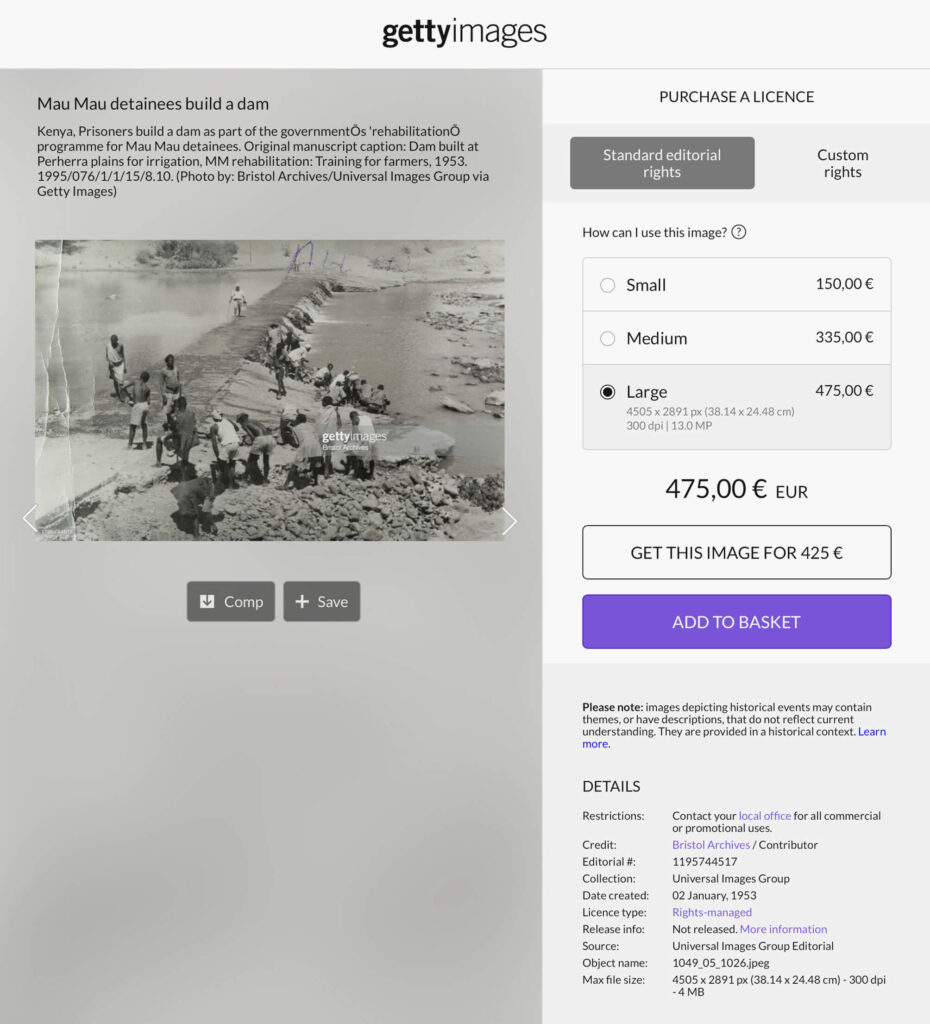
Mau Mau detainees build a dam, 1953, Elspeth Huxley (1995/076/1/1/15/8.10). British Empire & Commonwealth Collection, Bristol Archives, UK Public domain
Max Pinckers (°1988, BE) and Victoria Gonzalez-Figueras (°1988, CA) are based in Brussels, Belgium. They have been working together for the past ten years on documentary photography projects. Victoria works in the cultural field as a researcher and producer. Max is a speculative documentarian, teacher and occasional writer on photography. They are married, in love, and have a son. Victoria has consistently assisted Max in his projects as a production manager, but they have recently been making new work together as co-authors. “Double Reward” is the first such project.
In spring 2024 the-documents.org and Trigger co-publish a series of online articles with a focus on the meeting ground between photography and the document.


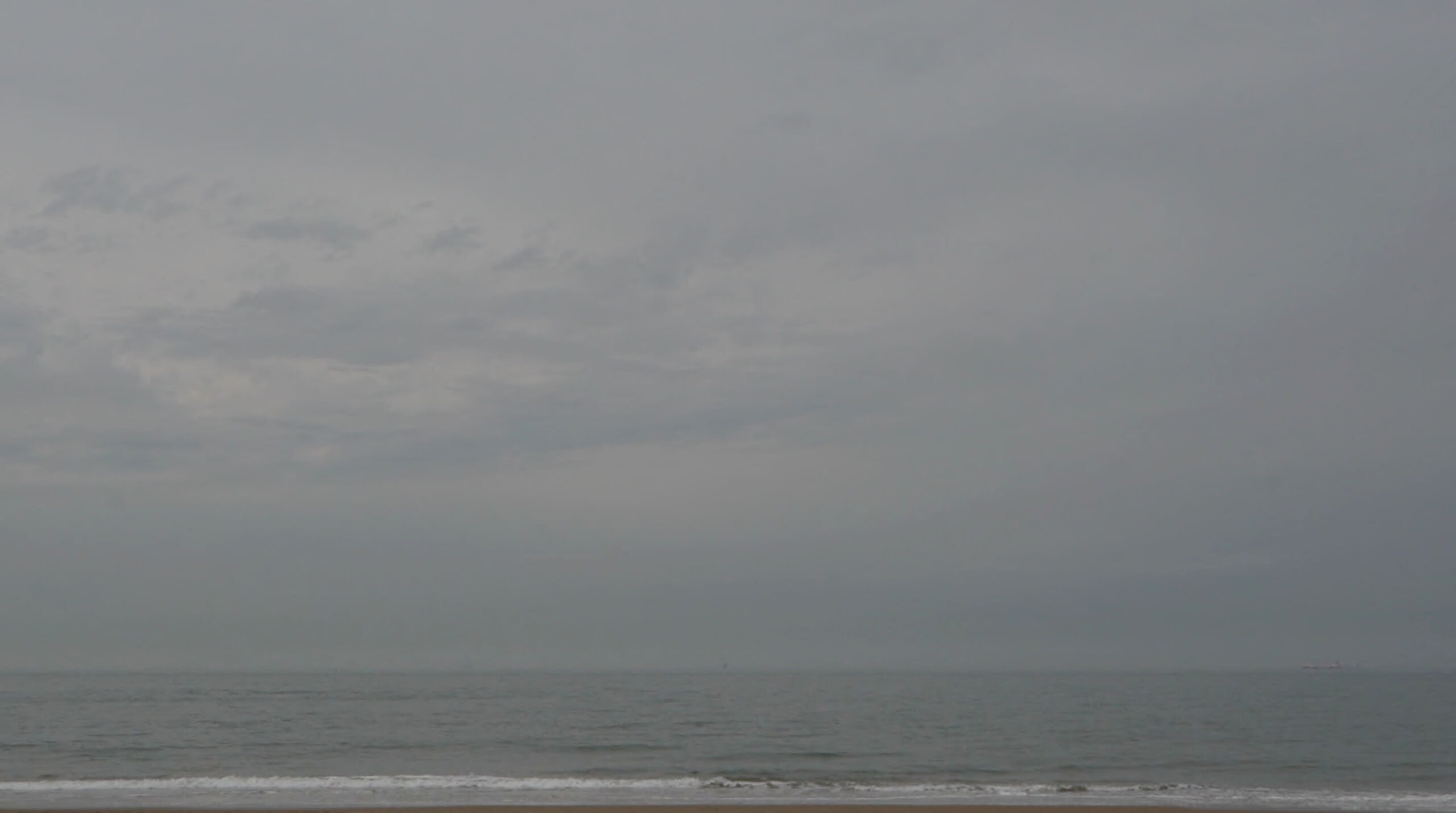
‘In the human design and use of weapons, natural elements are harnessed and deployed as a destructive technology. In this engineering, there is a break, fissure, and crack whereby the human and non-human entity, having been elastic, on impact becomes plastic, and forever changed from its original self.’
Screenshot from the film showing the calm shoreline situated close to the International Criminal Court (ICJ) in the Netherlands.
Frame of Accountability, 01:00:00, Helene Kazan, 2024.
Film chapter Beyond the Sky’s Limits narrates law as a consciousness coming to terms with its own failings: the speculative voice of a feminist, queered, decolonial international law. Unravelling this complex non-human subjectivity, it narrates the drafting of the Rules of Air Warfare in 1923. A filmic study of the legal archival document reveals how these international laws of war become corrupted by the self-interests of the strong states and colonial powers involved in their making: their ambitions fail quickly and critically.
Helene Kazan is an artist, writer and educator. Her work investigates ‘risk’ as a lived condition produced through the conjoined violent effects of capitalism and conflict. This is observed in the colonial roots of international law and its material formation of the lived-built environment. In response, she uses decolonial, feminist, poetic and critical-legal approaches in her work, which explores ways of dismantling the ongoing effects of neo-colonial violence towards wider frameworks of accountability and justice.
In spring 2024 the-documents.org and Trigger co-publish a series of online articles with a focus on the meeting ground between photography and the document.
‘Dust particles flew off the box, disturbed by my opening. Adding to the sense that this archival material was vibrating under the weight of its unknown importance. Amidst the boxes of ‘Top Secret’ British governments documents, I find a map labelled ‘Syria’ 3.6.41.’
Screenshot from film chapter (Un)Touching Ground. A decolonial audio visual translation of an archival map reveals the effects of the Allied military campaign into Lebanon and Syria in 1941.
Frame of Accountability, 01:00:00, Helene Kazan, 2024.
Through film, installation, writing and public engagement Frame of Accountability investigates ‘risk’ as a lived condition, produced through the co-evolution of capitalist systems and violent conflict. The project focuses on the effects across Lebanon and Syria, with a view to understanding the wider regional and global consequences. Using poetic and critical-legal methods, the work explores ways of dismantling violence perpetrated through colonial mechanisms of governance, towards wider frameworks of accountability and justice. The work is produced in multi-part, non-linear formation.
Helene Kazan is an artist, writer and educator. Her work investigates ‘risk’ as a lived condition produced through the conjoined violent effects of capitalism and conflict. This is observed in the colonial roots of international law and its material formation of the lived-built environment. In response, she uses decolonial, feminist, poetic and critical-legal approaches in her work, which explores ways of dismantling the ongoing effects of neo-colonial violence towards wider frameworks of accountability and justice.
In spring 2024 the-documents.org and Trigger co-publish a series of online articles with a focus on the meeting ground between photography and the document.

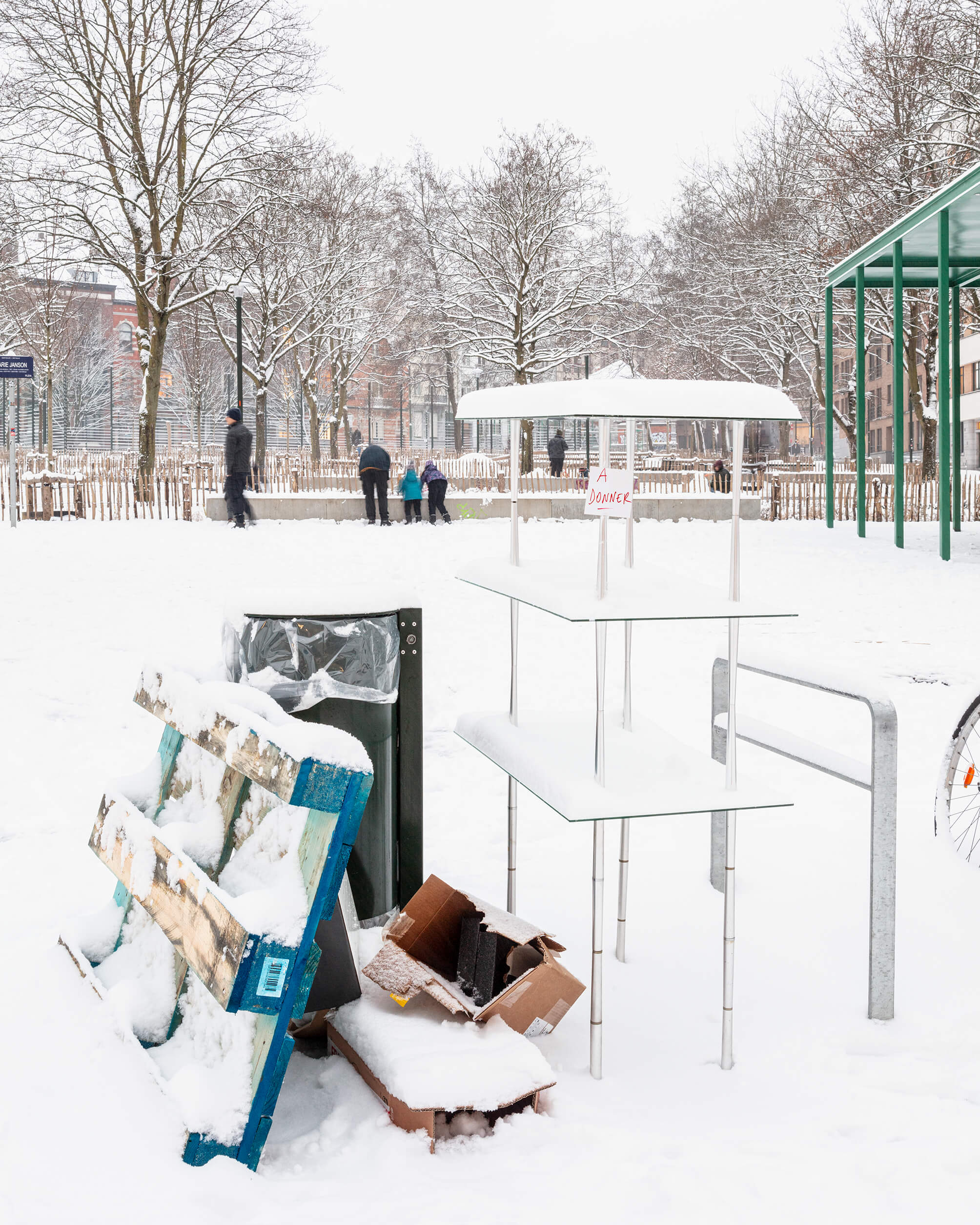
A snow-covered stainless steel and glass shelf has a note, written in red marker, cello-taped to one of the steel supports: ‘A DONNER’.
Now a park, the Place Marie Janson – colloquially called Carré Moscou or Carré Monnaies – used to house L’Hôtel des Monnaies/het Munthof. For a century, the coins of some twenty-two countries were minted in this building.
hotel_monnaies_nl.pdf
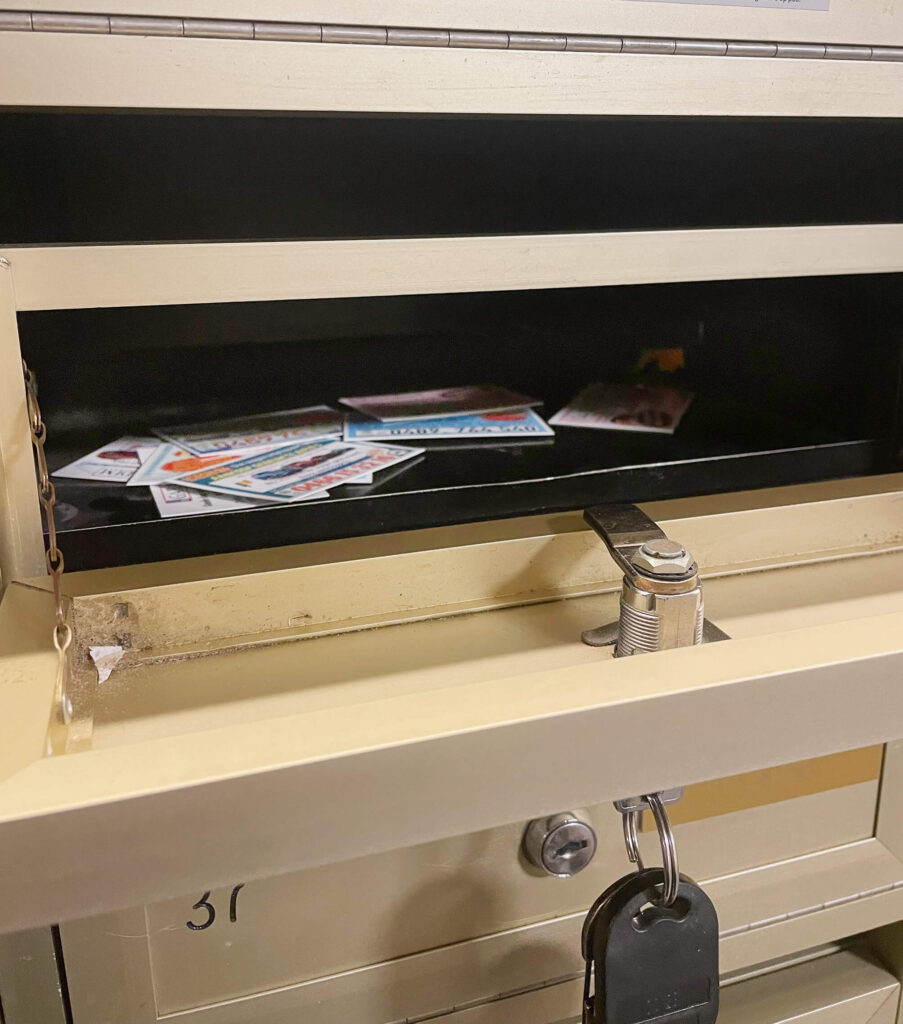
A year ago I moved into Solange’s appartement. From the balcony, I see half the parking lot and the adjacent high rise. On the mailbox, I haven’t replaced her name for mine.
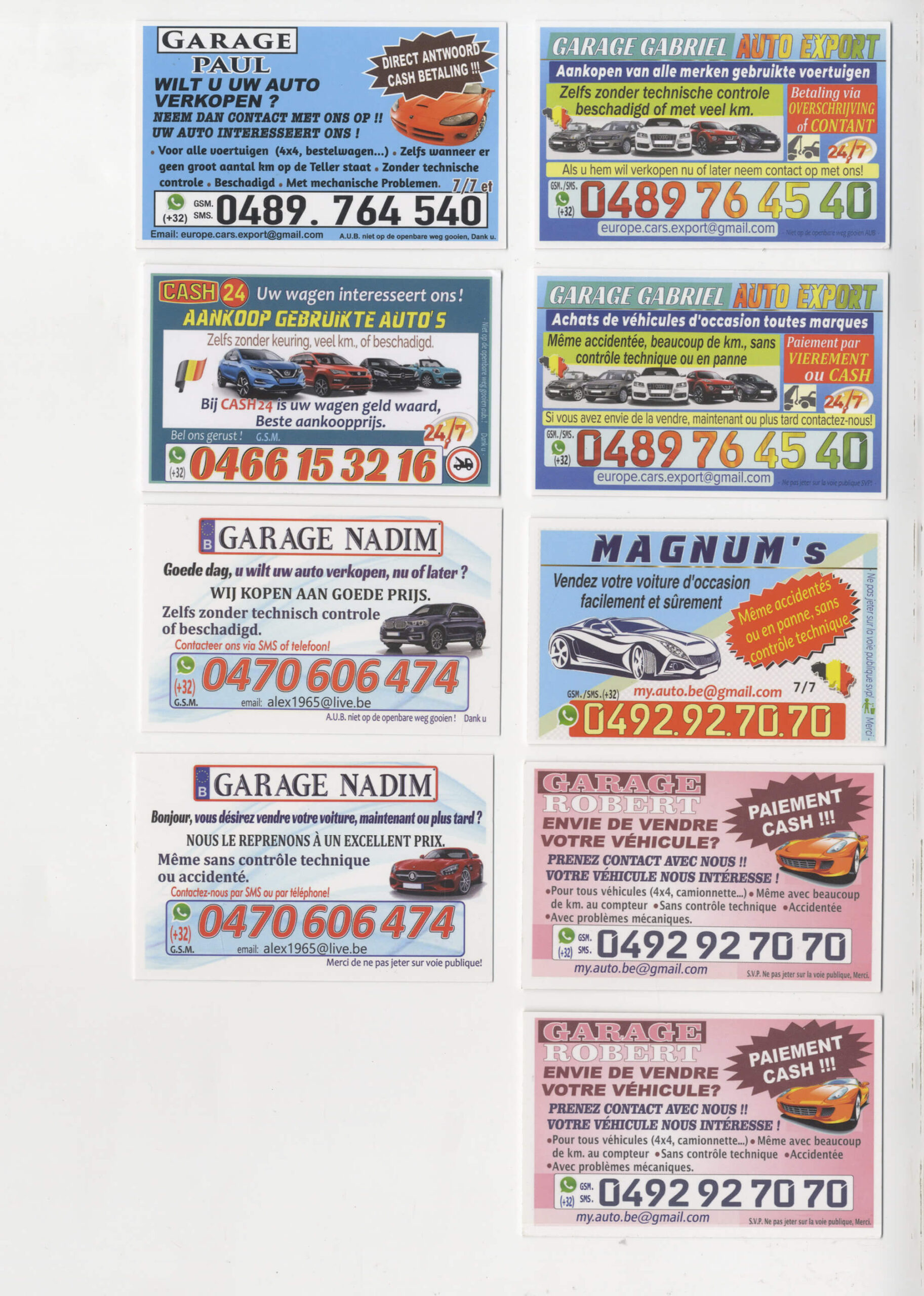
1. GARAGE PAUL, (+32) 0489. 764 540 / recto-verso NL/FR
2. CASH 24, (+32) 0466 15 32 16 / recto-verso NL/FR
3. GARAGE NADIM (+32) 0470 606 474 / recto-verso NL (1)
4. GARAGE NADIM (+32) 0470 606 474 / recto-verso FR (2)
5. GARAGE GABRIEL (+32) 0489 76 45 40 / recto-verso NL (1)
6. GARAGE GABRIEL (+32) 0489 76 45 40 / recto-verso FR (2)
7. MAGNUM’s (+32) 0492 92 70 70 / recto-verso FR
8. GARAGE ROBERT (+32) 0492 92 70 70 / recto-verso FR (1)
9. GARAGE ROBERT (+32) 0492 92 70 70 / recto-verso FR (2)
I don’t know whether Solange owned a car.
Bieke Criel, lives and works in Gent (BE). Intrigued by landscape, movement, light and the poetics of what lies in between. Does not own a car, loves to drive one. Part of 019.
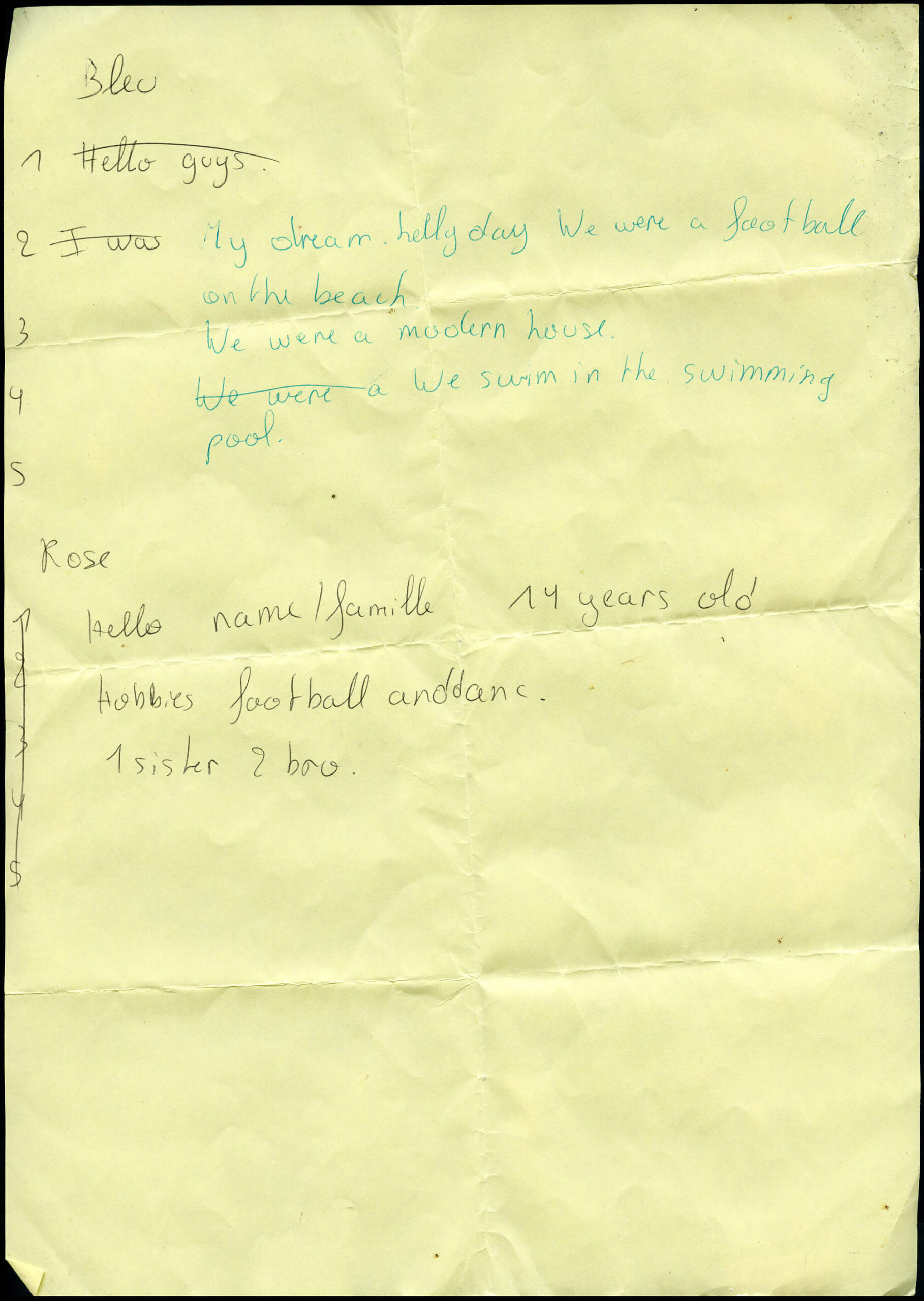
My dream hollyday We were a football
on the beach
We were a modern house.
We were a We swim in the swimming
pool.
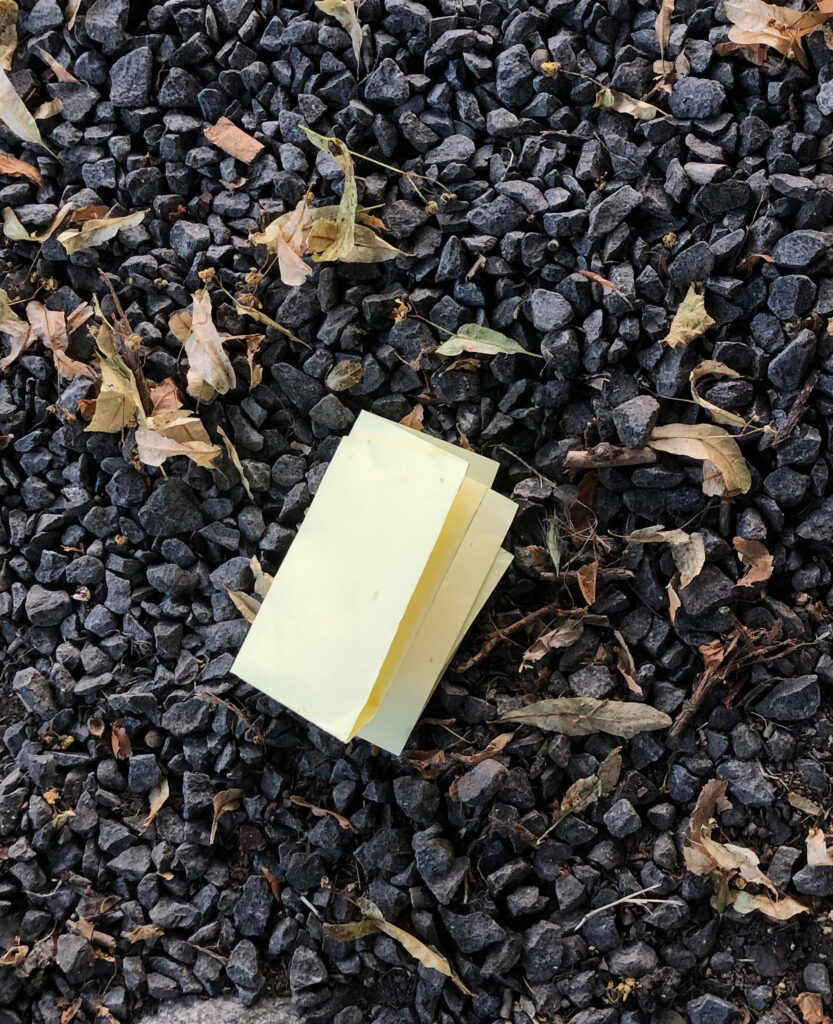
June 2022, Marche-en-Famenne. I arrived half an hour early. Waiting for my family to pick me up at the station, near a linden tree, I found a yellow page lying on the pebbles in front of the wooden bench I sat on. It had been a hot day. The sun was finally setting. Music playing in the distance. A white Volkswagen. Windows closed. Hard basses, trembling across the road. Folded three times, the sheet of paper had the size of a DIN A7. A white BMW pulled over. Seven glass jars in a container.
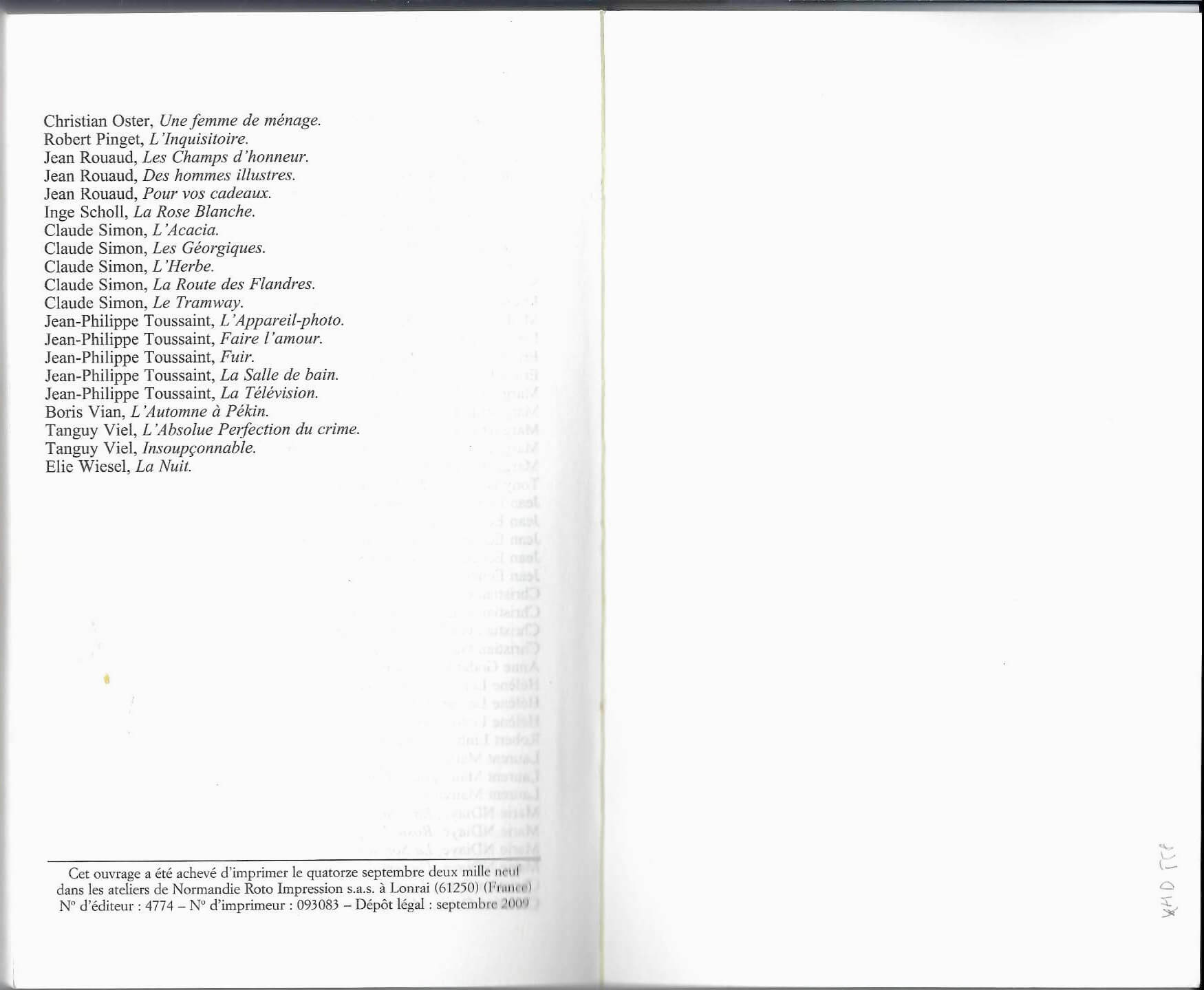
During the preparation of a seminar, I reread Pierre Bayard’s Qui a tué Roger Ackroyd? (2008). On the inside of the back cover, there’s an inscription: it appears I wrote down a license plate number – something I have the habit of doing when a situation seems suspicious.
In Qui à tué Roger Ackroyd?, Bayard analyzes Agatha Christie’s famous detective novel The Murder of Roger Ackroyd (1926). The literary critic disagrees with detective Hercule Poirot’s conclusion: Ackroyd’s murderer is not the narrator, James Sheppard, as Poirot would have it. It’s a delirious interpretation, ‘consistant à rechercher minutieusement des indices, à interpréter des faits et à organiser nos déductions en une construction d’ensemble harmonieuse’.
The car with license plate number XHD 558 is unknown to me. I can’t recall what I saw that urged me to write it down, nor the time or location when I saw it.
Bayard, P. Qui a tué Roger Ackroyd? Paris: Minuit, 2008.
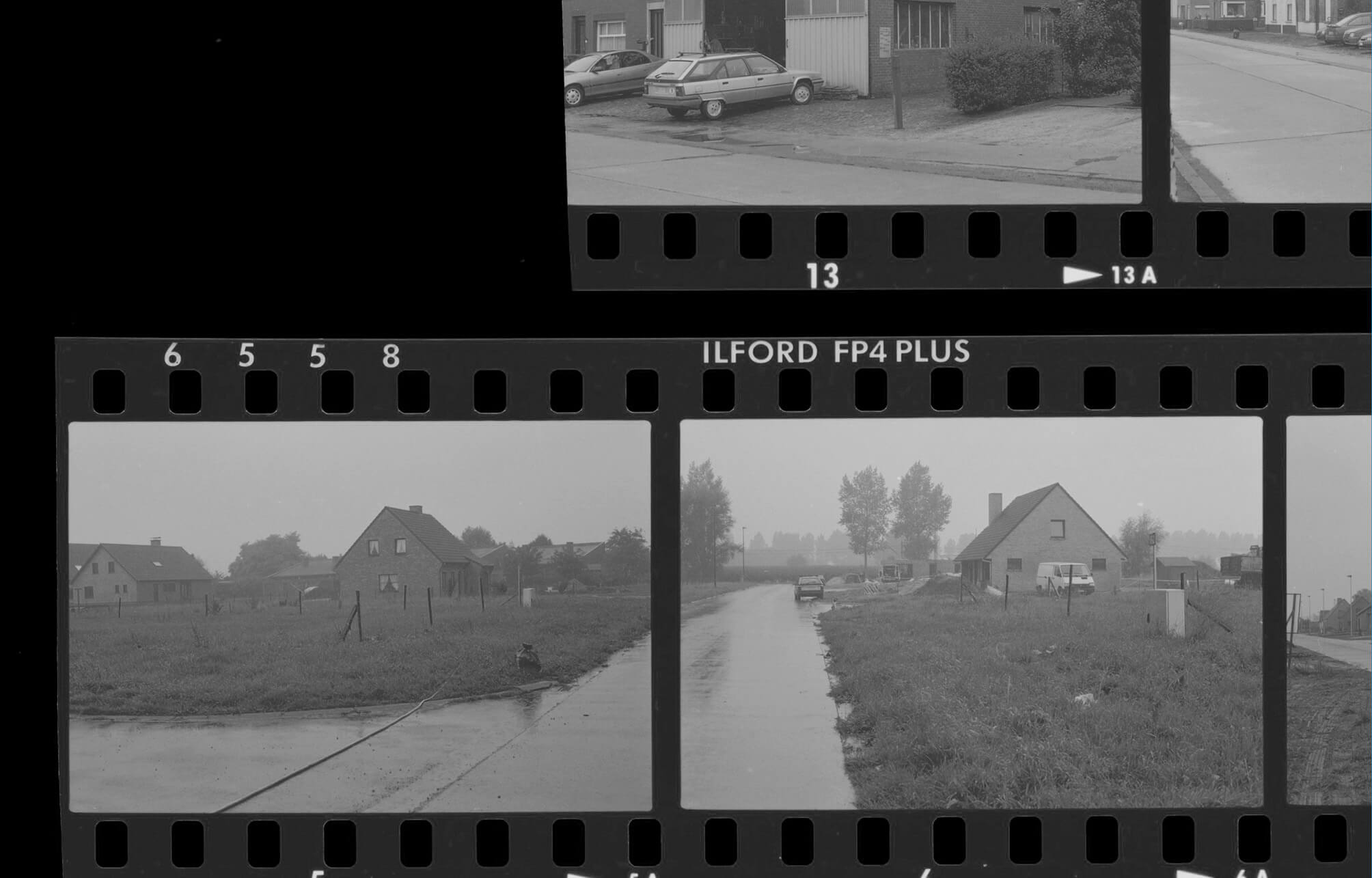
The architect’s photographic archive contains seven images that can be labelled as panoramic pictures. However, they only appear as such when the photographs are viewed in the archive, as strips of negatives. In order to see the panoramic construct, the viewer needs to be presented with two consecutive negatives.
There are two kinds of panorama in the archive: the kind that can only be attributed to a kind of laziness or a need for efficiency on behalf of the architect, and another that originates from frugality.
The former type of panorama is created when the architect is documenting the situation as it is: it is compulsory to document the context of the building or lot, as part of a building application. He simply pivots from left to right, capturing the first and second photograph consecutively. On the filmstrip a panorama appears.
The other kind of panoramic picture only appears at the end of the film role. The last negative on the film has been exposed (the twenty-fourth or thirty-sixth), after which he exerts force onto the lever to move the film forward anyway. Some films are known to have, by accident, a twenty-fifth or a thirty-seventh negative. The plastic between the sprocket holes tears and the film does not advance enough. The result differs fundamentally from the other kind of panorama: there is no separation, no void between the negatives. Rather, there is a slight overlap. A thin, vertical strip of film that has been exposed twice, suggesting contiguity that might not be there. The two exposures might be from altogether different sites, creating a new situation.
Based on De Cleene, M. & De Cleene, A. The Situation as it Is. A Photonovel in Three Movements. Gent: APE, 2022
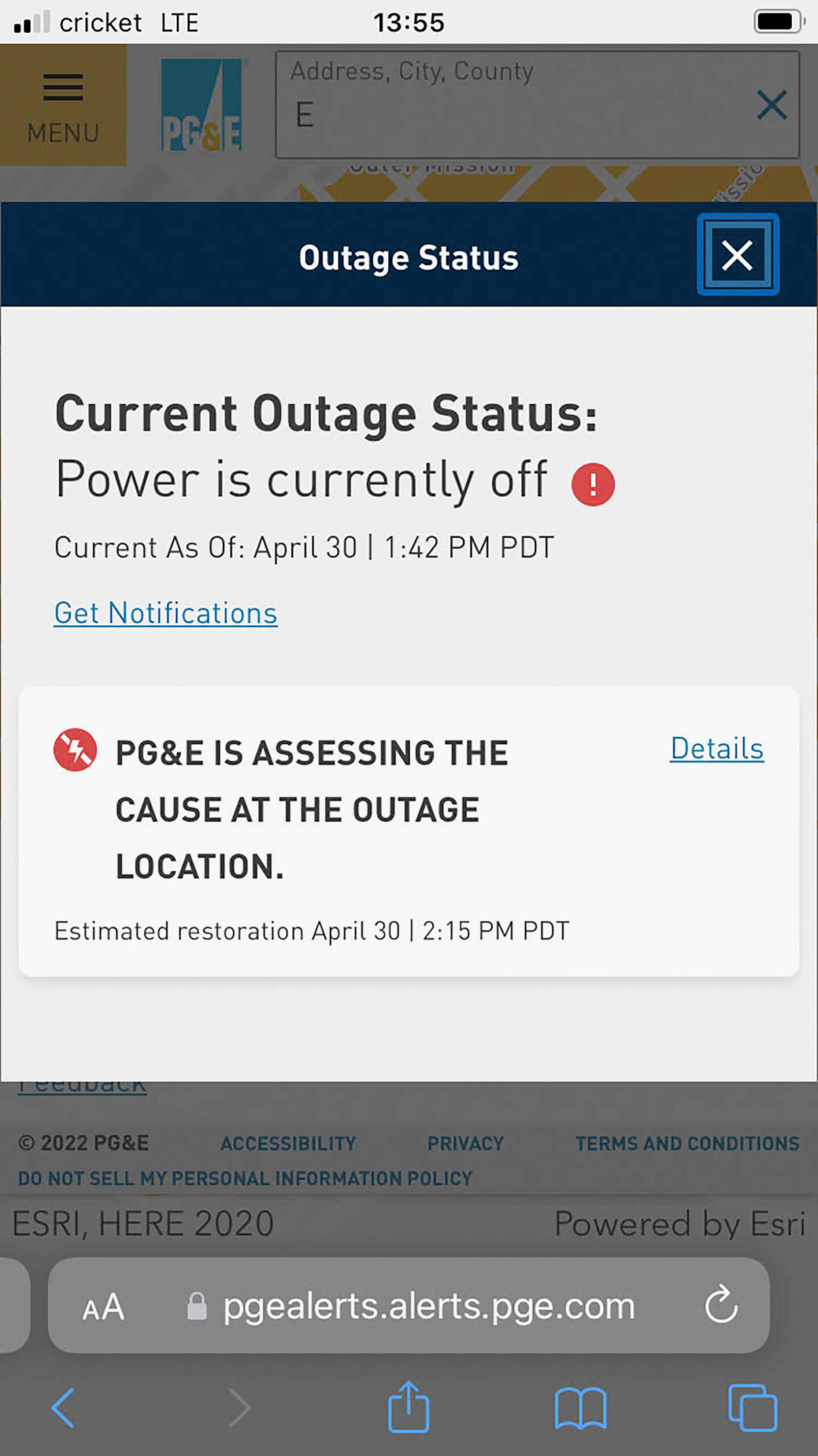
On a windy morning in April, I was on a video call with a friend, curator Maziar Afrassiabi. He listened patiently from Rotterdam as I labored over a direction for my research. It concerned a device I installed in his art space, Rib, six months prior, that monitored blackouts across California by scraping real-time data from utility companies. When a county experienced a significant blackout, it would cut Rib’s electricity in kind—causing Rib to inherit and adapt to conditions that shape Californian infrastructure. During its operation, I’d been researching the grid—learning what it is, why it fails, and how communities respond when it does.
We took a short break. Maziar, with tired eyes, stepped away for a smoke. While waiting, I watched the power lines outside my window sway limply in the breeze. In spite of its apparent lifelessness, I’ve always thought of electricity as a psychological force. My mind wandered through a cursory model of the grid, idiosyncratically cloudy and detailed.
Energy simultaneously generated and used, cascading infrastructural operations in a blink. Outlying stations burning, vaporizing, absorbing fuel, spinning vast electromagnetic turbines. Oscillating current. Neighboring transformers boosting volts to kilovolts, compensating for lost energy coursing through long-distance transmission supported by pylons peppered across Menlo Park.
Current flows into enclosed substations. Transformers, insulators, resembling a kind of industrial Watts Towers—though uninhabitable and anonymous by comparison—step voltages back down to levels safe enough for wires traversing the city. They branch out through streets via buried cables or, like the lines outside my window, are strung atop Douglas fir utility poles at roughly 30-meter intervals…curious vestigial markers. I’d read somewhere they were provisionally pitched when Samuel Morse found that telegraph signals wouldn’t transmit through the earth.
Each pole divides vertically into distinct zones, spaced apart for safety. Treacherous high-voltage wires from substations pass along the top, while safer signals—cable internet and landlines—hang nearest to the ground. The high-voltage wires enter through a barrel-shaped pole-mounted transformer. Within, submerged in oil, two tightly wound copper coils magnetically harmonize, delivering 240 and 120 volts to three exiting wires, each connected to the electrical meter attached to the building…
A blackout in my neighborhood cut my thoughts and the meeting short. The sudden silence in my apartment indicated Maziar was also in the dark. I received a text message from him and the utility company.
Mathew Kneebone is an artist based in San Francisco. His interdisciplinary practices takes different forms, all in relation to an interest in electricity and technology. He teaches studio and thesis writing at California College of the Arts.
On 12 October 2022, I see a third orange Sparta K-10 listed on marktplaats.nl, after Tineke and Fred‘s. It is sold by one Fr from Zevenaar. Fr put the bike up for sale four days earlier. According to Fr, it is a ‘luxury station bike’ and ‘camping bike’. He is asking 199 euros for it. Fr explains the bike as follows:
‘Luxury sparta unisex bike with 3-speed shimano-nexus.
Striking specimen.
Looks like new.
Please note……fixed price!
Ideal for station, camping or for some nice touring.
Equipped with:
Front and rear battery lighting
Handy front and rear luggage rack
All-terrain tyres
3-speed gearbox
Comfortable drifter saddle
Integrated cable lock
Large dingdong bell
A real eye-catcher’1
According to Fr, the price is fixed, but on the website you can make an offer, albeit only from 199 euros. Fr’s Sparta K-10 has three gears. The Sparta K-10s of Tineke, John and Fred that are still for sale do not have gears, the Sparta K-10s in Rue Verte in Brussels and on cyclonewebshop.be do not have them, and in the 2011 Sparta leaflet we did not see that option either. In short, we come across a Sparta K-10 with gears for the first time. There is a small typing error in Fr’s explanation in Dutch – the t in geïntegreerd is missing – but those who like to browse on marktplaats.nl read smoothly over that. One of the photos of Fr’s ad shows the loop attached to the back of the bike. You can clearly see how that loop forms the end of an integrated cable lock.
‘Luxe sparta unisex fiets met 3 versnellingen shimano-nexus.
Opvallend design exemplaar.
Ziet er uit als nieuw.
Let op……vaste prijs!
Ideaal voor station, camping of zo om lekker mee te toeren.
Voorzien van:
Batterijverlichting voor én achter
Handig bagagerek voor én achter
All terreinbanden
3 versnellingen
Verende zadelpen
Comfortabel drifter zadel
Geïnegreerd kabelslot
Grote dingdong bel
Een echte eye-catcher’
Lars Kwakkenbos lives and works in Brussels and Ghent (B). He teaches at KASK & Conservatorium in Ghent, where he is currently working on the research project ‘On Instructing Photography’ (2023-2024), together with Michiel and Arnout De Cleene.

According to @missbluesette, the green K-10 put up for sale by Fred from Zwolle that I came across on marktplaats.nl on 29 September 2022 is not green, but blue. The colour resembles turquoise, I explain, a colour I have always called green. No, turquoise is not green, but blue, she replies. And the texts of my Instagram posts are too long, she says, so she doesn’t read them.
Lars Kwakkenbos lives and works in Brussels and Ghent (B). He teaches at KASK & Conservatorium in Ghent, where he is currently working on the research project ‘On Instructing Photography’ (2023-2024), together with Michiel and Arnout De Cleene.

John from Middelburg offers a K-10 without a loop at the back on marktplaats.nl. His K-10 does have a front light, which strangely never seems to be mounted in the front of the long tube of the frame. The asking price is 75 euros, bids may start from 50 euros.
Lars Kwakkenbos lives and works in Brussels and Ghent (B). He teaches at KASK & Conservatorium in Ghent, where he is currently working on the research project ‘On Instructing Photography’ (2023-2024), together with Michiel and Arnout De Cleene.

This is a trace, and it is not.
Ceci est une trace et ne l’est pas.
What is a trace?
Qu’est-ce qu’une trace?
Le document n’en est pas, le document documente.
Documents what?
Peu importe, le mot ‘document’ est dérivé du latin docere, c’est à dire…
to show, to teach, to instruct. The document is docile, unlike the trace.
La trace ne montre pas, n’enseigne pas, n’instruit en rien, à moins d’interpréter.
The trace as indexical: it does not ‘show’ though one can see it. It does not teach,
sauf que tout nous pré-existe, ou plutôt, nous insiste, n’est-ce pas?
It doesn’t: it’s never there as such until we name it so.
Documenti!
Papiere!
Poètes, vos papiers!
(Léo Ferre 1956)
Le document.
Le dos-cul ment.
Le d’au-cul ment.
Le dé au cul ment.
Mais co-ment?
Butt how?
The do-cum-meant.
The doc-cue-mint.
The dock-comment.
This is a cardboard mousepad.
Are you happy now?
Are you happy?
Are you?
Now?
document: a paper or set of papers with written or printed information, especially of an official type.
(https://dictionary.cambridge.org/us/dictionary/english/document)
‘He’s more of an official type.’
A document is a written, drawn, presented, or memorialized representation of thought, often the manifestation of non-fictional, as well as fictional, content.
(https://en.wikipedia.org/wiki/Document)
‘She was quite content.’
Tha back-ass lies!
Sébastien Conard (1982) is a graphic artist, writer and teacher. He draws, writes and publishes comics, post-comics and artist’s books. From 2023 until 2026, he will explore the graphic trace in the context of a postdoctoral research project at LUCA School of Arts.