What constitutes a ‘document’ and how does it function?
According to the Oxford English Dictionary, the etymological origin is the Latin ‘documentum’, meaning ‘lesson, proof, instance, specimen’. As a verb, it is ‘to prove or support (something) by documentary evidence’, and ‘to provide with documents’. The online version of the OED includes a draft addition, whereby a document (as a noun) is ‘a collection of data in digital form that is considered a single item and typically has a unique filename by which it can be stored, retrieved, or transmitted (as a file, a spreadsheet, or a graphic)’. The current use of the noun ‘document’ is defined as ‘something written, inscribed, etc., which furnishes evidence or information upon any subject, as a manuscript, title-deed, tomb-stone, coin, picture, etc.’ (emphasis added).
Both ‘something’ and that first ‘etc.’ leave ample room for discussion. A document doubts whether it functions as something unique, or as something reproducible. A passport is a document, but a flyer equally so. Moreover, there is a circular reasoning: to document is ‘to provide with documents’. Defining (the functioning of) a document most likely involves ideas of communication, information, evidence, inscriptions, and implies notions of objectivity and neutrality – but the document is neither reducible to one of them, nor is it equal to their sum. It is hard to pinpoint it, as it disperses into and is affected by other fields: it is intrinsically tied to the history of media and to important currents in literature, photography and art; it is linked to epistemic and power structures. However ubiquitous it is, as an often tangible thing in our environment, and as a concept, a document deranges.
the-documents.org continuously gathers documents and provides them with a short textual description, explanation,
or digression, written by multiple authors. In Paper Knowledge, Lisa Gitelman paraphrases ‘documentalist’ Suzanne Briet, stating that ‘an antelope running wild would not be a document, but an antelope taken into a zoo would be one, presumably because it would then be framed – or reframed – as an example, specimen, or instance’. The gathered files are all documents – if they weren’t before publication, they now are. That is what the-documents.org, irreversibly, does. It is a zoo turning an antelope into an ‘antelope’.
As you made your way through the collection,
the-documents.org tracked the entries you viewed.
It documented your path through the website.
As such, the time spent on the-documents.org turned
into this – a new document.
This document was compiled by ____ on 19.10.2026 21:14, printed on ____ and contains 27 documents on _ pages.
(https://the-documents.org/log/19-10-2026-6925/)
the-documents.org is a project created and edited by De Cleene De Cleene; design & development by atelier Haegeman Temmerman.
the-documents.org has been online since 23.05.2021.
- De Cleene De Cleene is Michiel De Cleene and Arnout De Cleene. Together they form a research group that focusses on novel ways of approaching the everyday, by artistic means and from a cultural and critical perspective.
www.decleenedecleene.be / info@decleenedecleene.be - This project was made possible with the support of the Flemish Government and KASK & Conservatorium, the school of arts of HOGENT and Howest. It is part of the research project Documenting Objects, financed by the HOGENT Arts Research Fund.
- Briet, S. Qu’est-ce que la documentation? Paris: Edit, 1951.
- Gitelman, L. Paper Knowledge. Toward a Media History of Documents.
Durham/ London: Duke University Press, 2014. - Oxford English Dictionary Online. Accessed on 13.05.2021.

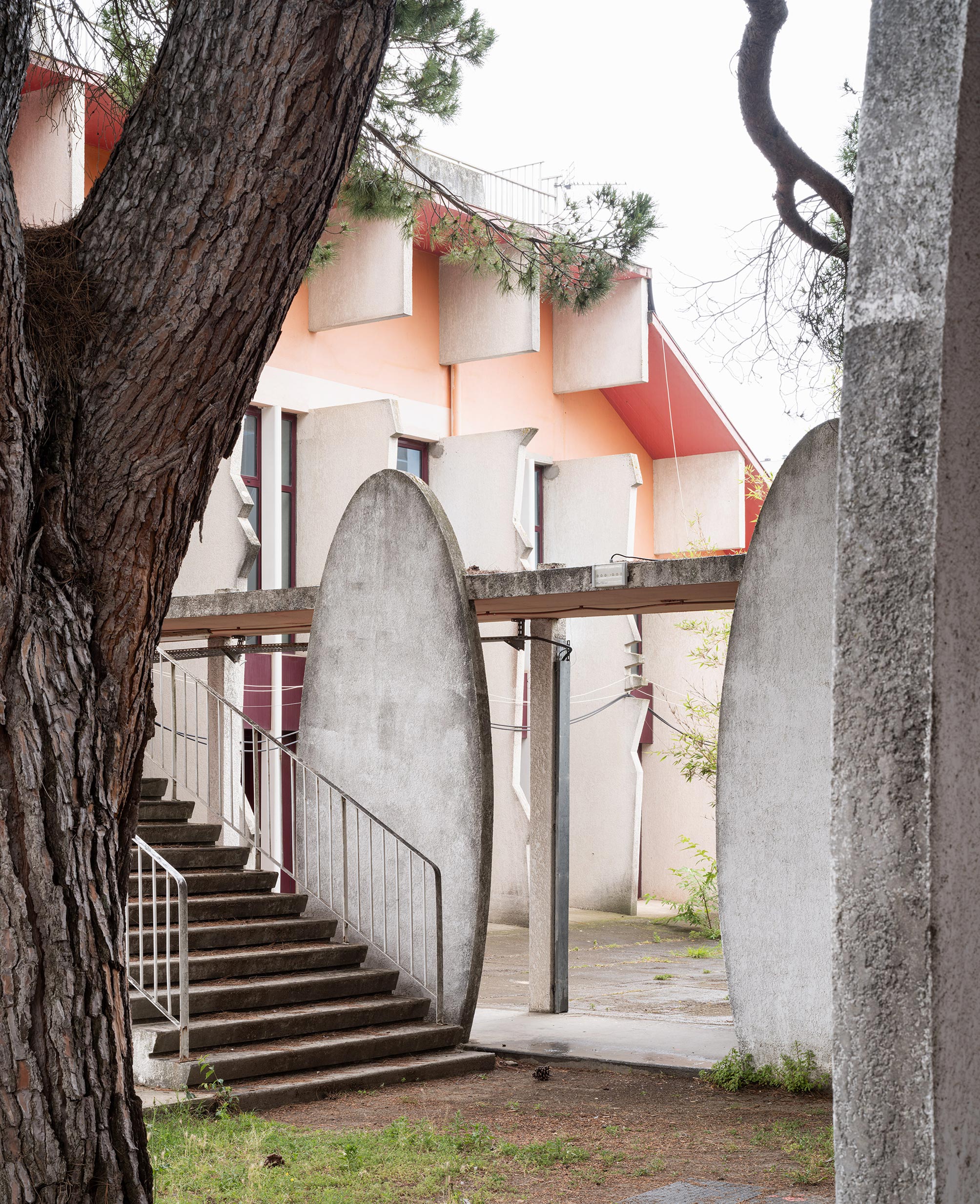
Built in 1969, the salle polyvalente1 in La Grande-Motte2 was the first venue where the residents – back when there were only 700 of them – could gather. Jean Balladur had envisioned an open-air theatre covered by a removable stretched canvas, adjacent to a single-storey multipurpose hall. The load-bearing structure, Balladur explained, consists of anthropomorphic columns sculpted by Albert Marchais: “My friend the sculptor, painter, poet and man of the theatre, Albert Marchais, devised the design for a sliding formwork that made it possible to cast the columns… they line up on either side of the hall in patterns that free them from the strict constraints of matter. This freedom is the joy of all sculpture.”3
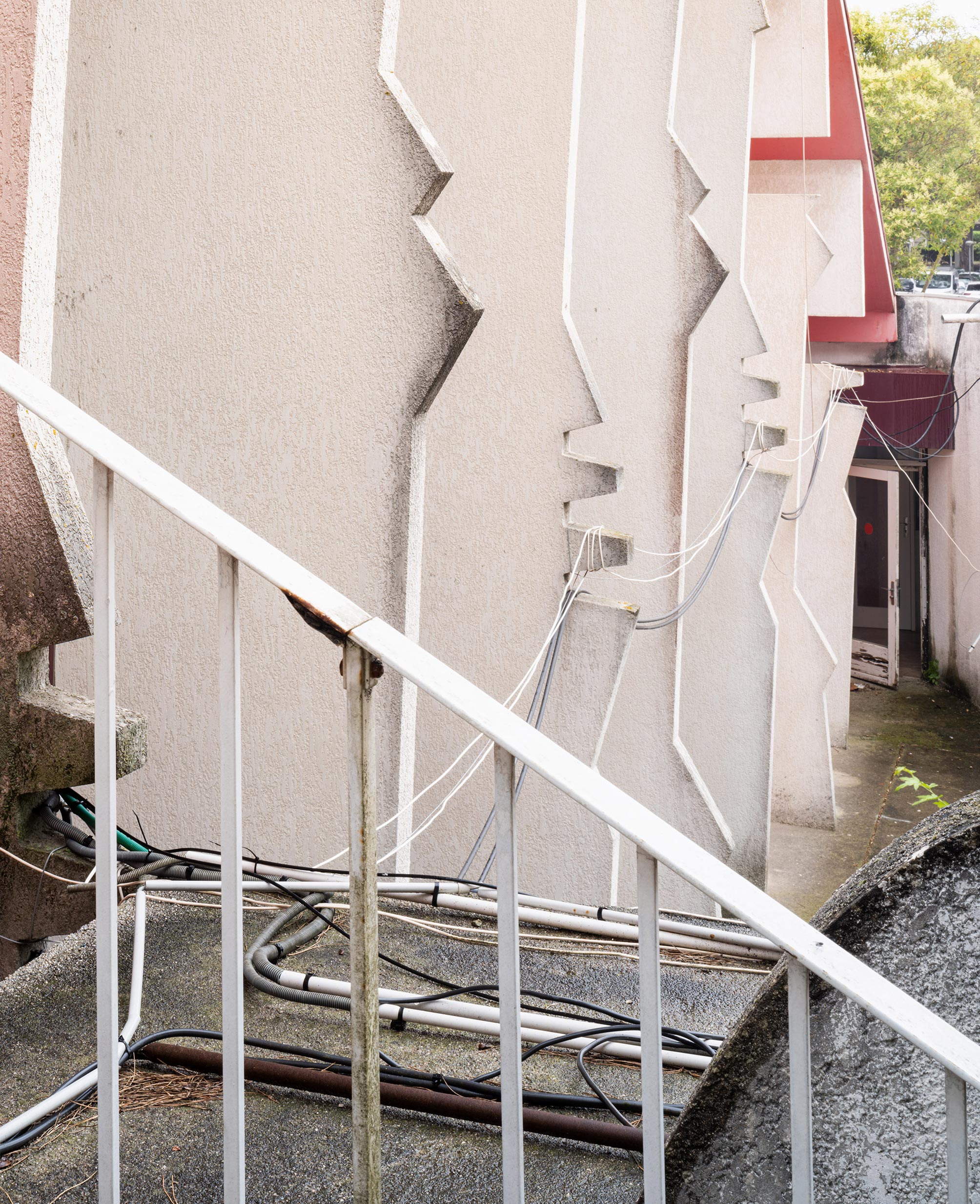
The geometric forms that make up the hands and arms of these figures are today strung with cables carrying electricity and data.
Jean Balladur was never fond of the term ‘salle polyvalente’, he preferred ‘salle commune, dédié à la fête’ – a communal hall, dedicated to parties. Since 2019 it is officially the Centre Culturel Henri Dunoyer, after a former mayor.
La Grande-Motte is a seaside resort created by the Mission Racine, the state programme for the development of the Languedoc coastline in southern France. Intended as a holiday destination for the middle class in the 1970s, it is the work of architect Jean Balladur (1924–2002), who was tasked with designing the entire urban layout and architecture of the new town. He drew inspiration from pre-Columbian pyramids and from modernist architecture in Brazil, especially the work of Oscar Niemeyer. At a time when large housing complexes were going up all over France in the form of tower blocks and slabs, Balladur’s solutions were different enough that La Grande-Motte was a success from the very beginning.
« Mon ami le sculpteur, peintre, poète, homme de théâtre, Albert Marchais, a imaginé le dessin d’un coffrage glissant qui a permis de couler les poteaux… ils s’alignent de chaque côté de la salle dans des figures qui les affranchissent des strictes contraintes de la matière. Cette liberté fait le bonheur de toute sculpture. »
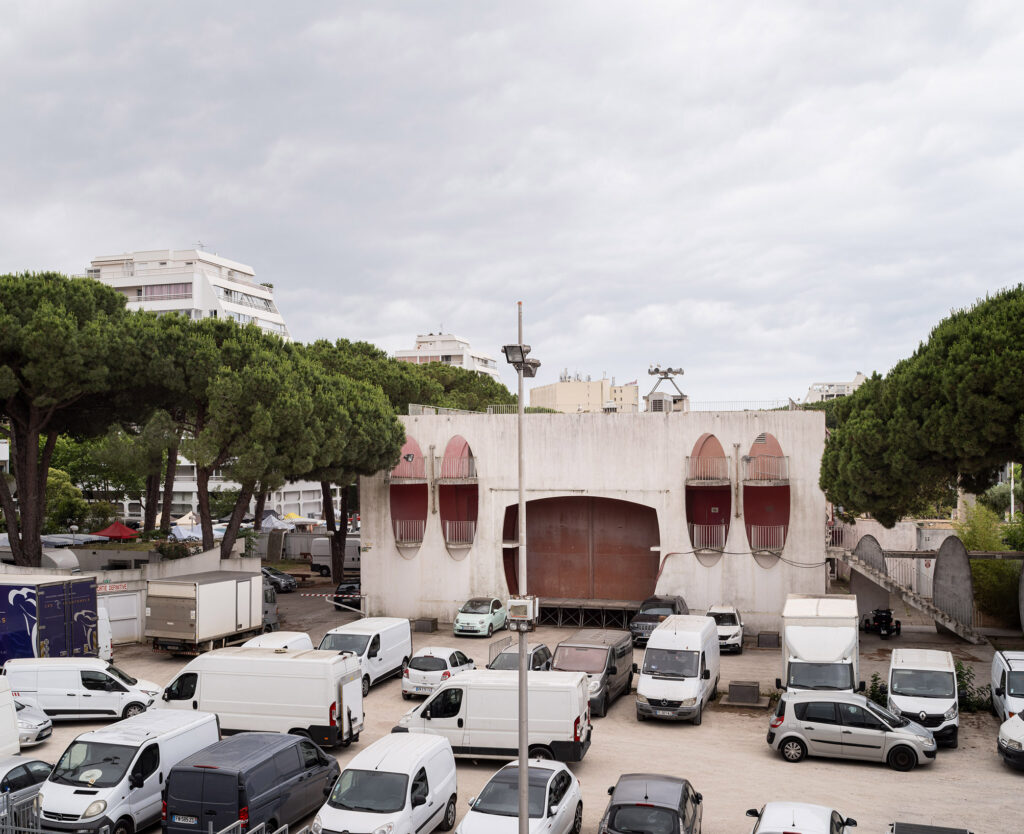
On market days, the parterre of the open-air theatre serves a a car park for the vendors’ vans and cars.
François, Michèle. Jean Balladur et la Grande-Motte: l’architecte d’une ville. Duo. Monuments historiques et objets d’art du Languedoc-Roussillon, Direction régionale des affaires culturelles, 2010, p. 41-42.
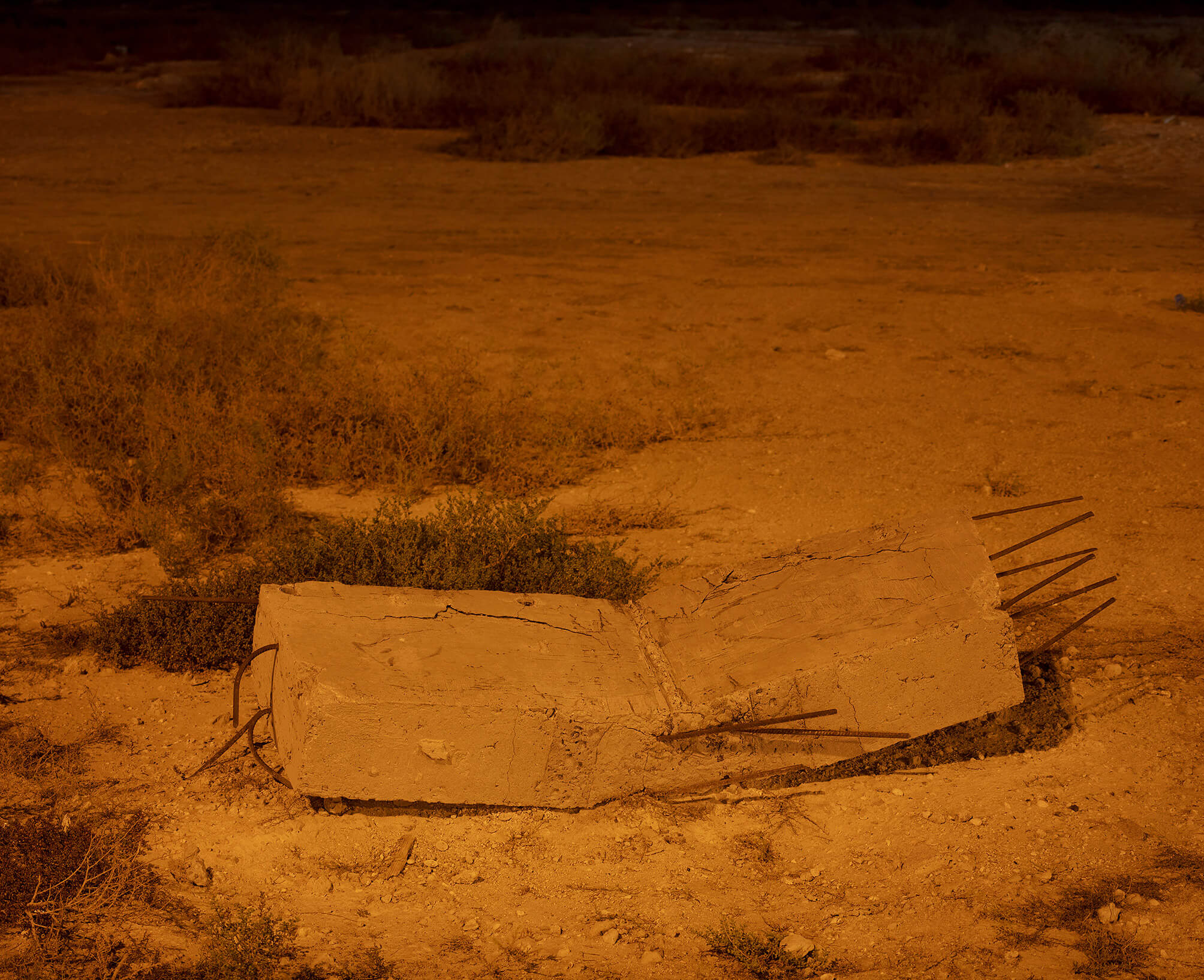
A block of concrete. Fissures are showing and rebar is sticking out from all sides. If it were still straight, the block would measure approximately 130 x 15 x 40cm.
It is lying by the side of the road, a few hundred meters from a construction site. It appears to be shaped by impact. Maybe the block plummeted to the ground from a great height. Perhaps, something heavy hit it. For all one knows, it served as a column and was exposed to an unforeseen amount of pressure, causing it to buckle.
According to Eyal Weizman ‘[a]rchitecture emerges as a documentary form, not because photographs of it circulate in the public domain but rather because it performs variations on the following three things: it registers the effect of force fields, it contains or stores these forces in material deformations, and, with the help of other mediating technologies and the forum, it transmits this information further.’1
Weizman, E. ‘Introduction’, in: Forensic Architecture. Forensis. The Architecture of Public Truth. London/Berlin: Sternberg Press, 2014.
In an attempt to make it his own, Gino – it might also be Dino – has taken a can of bright pink spray paint to his hard hat and – as the paint was drying – dragged his gloved finger from top to bottom. G – or D –, I, N, O. In the dust on a demolished floor tile, someone has written 12,10. Perhaps a measurement, a quantity, a position, a date, a reference.
Subtractive writing is not uncommon. With the tip of a passer-by’s index finger ‘WASH ME’ is subtracted from the dust on a dirty car. In freshly poured concrete, a name is embedded forever with a twig. In hot and soft roofing drawings and obscenities are scratched. Styrofoam lining a brand new elevator gets impressed with names, jokes and knuckles.
In the twenty-third canto of Ariosto’s Orlando Furioso (1516), Orlando comes across the name of his love and another man, carved in the bark of a tree. He doubts. But that night, a gossiping shepherd tells him he’s seen Angelica and Medoro together. Orlando returns to the forest, and in a four-day frenzy, he uproots every tree and pollutes the rivers forever.
CXXXI
For he turf, stone, and trunk, and shoot, and lop,
Cast without cease into the beauteous source;
Till, turbid from the bottom to the top,
Never again was clear the troubled course.
At length, for lack of breath, compelled to stop,
(When he is bathed in sweat, and wasted force,
Serves not his fury more) he falls, and lies
Upon the mead, and, gazing upward, sighs.1
Ariosto, L. Orlando Furioso. Translated by William Stewart Rose, Echo Library, 2006, p. 267.

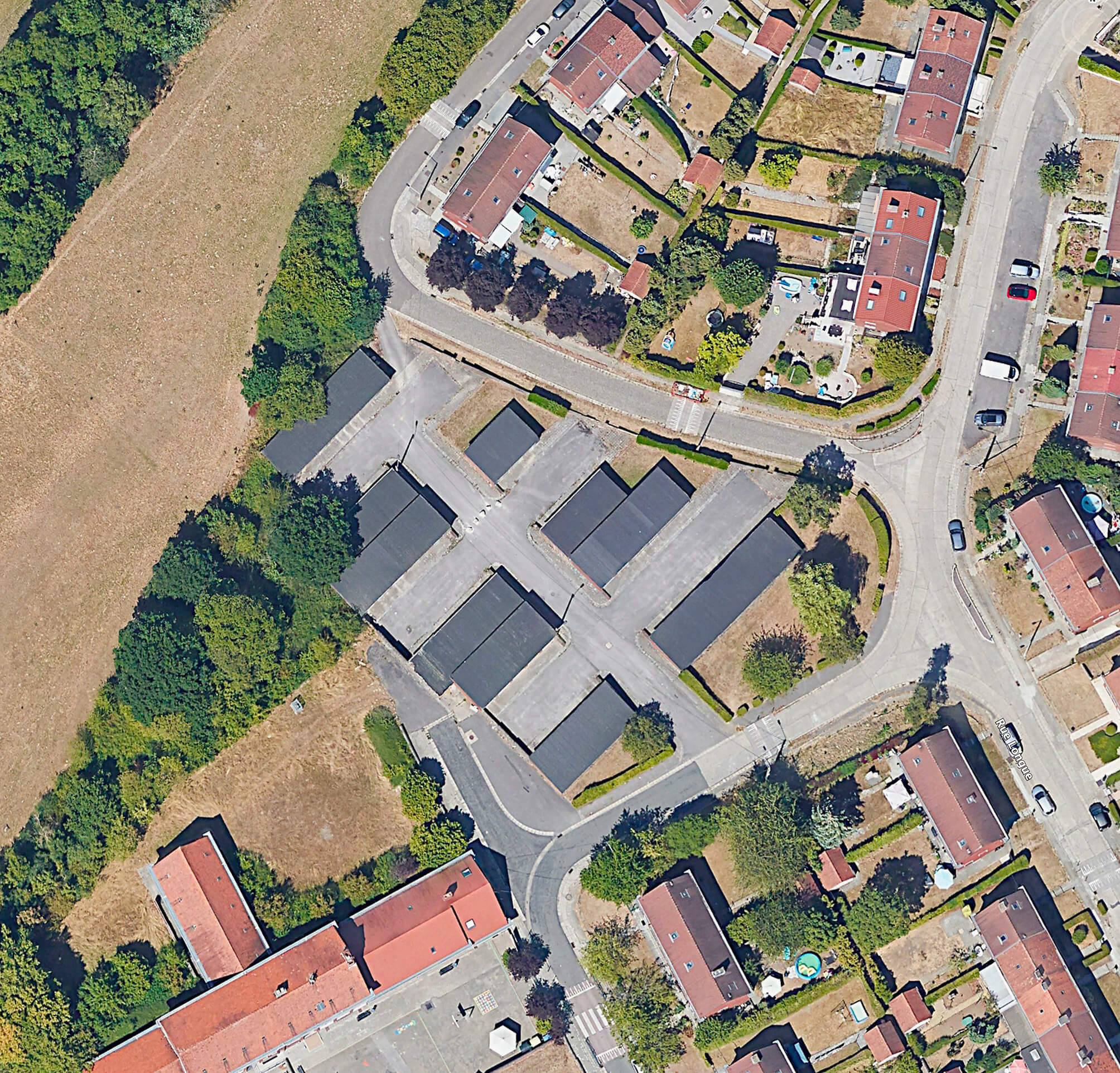
Seven very similar and rudimentary buildings take in a trapezoid plot of land in Gilly. They are located between the school on the Rue Circulaire and the houses along the Rue de l’Abbaye. The structures are built of orange brick, concrete structural elements, whitish steel gates and roofing. Every garage has its own number, hand-painted in white on the concrete lintel above each gate. In summer the roofing gets hot and soft.
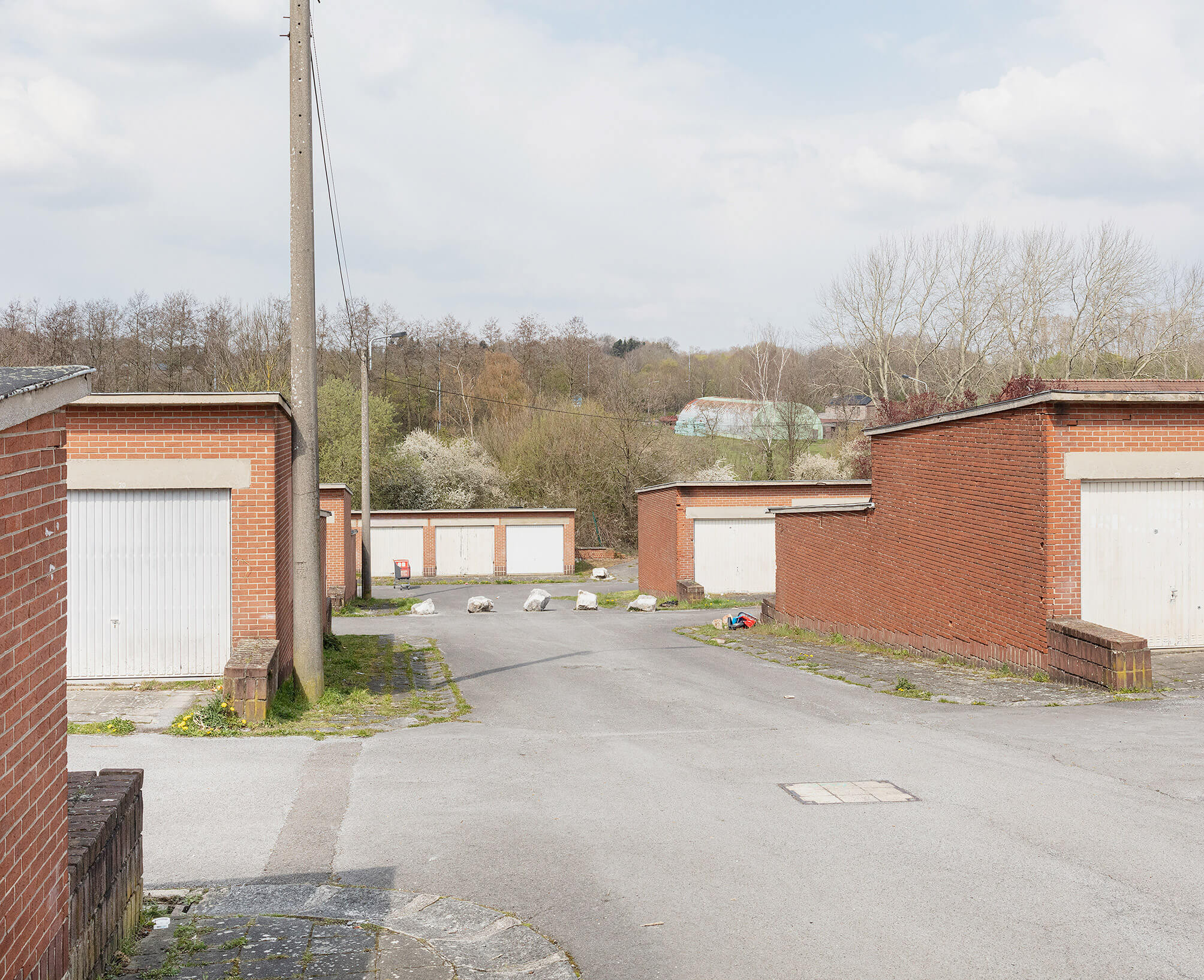
Five white boulders close off a shortcut for motorists who attempt to cut the bend in the road. The southernmost roof’s pitch runs opposite to the landscape’s slope. The lower roofline is, therefore, only about one meter above a small, triangular patch of grass which is hidden from view by a hedge. In summer, when the roofing gets hot and soft, text and drawings get pressed or carved into it.
Google Earth
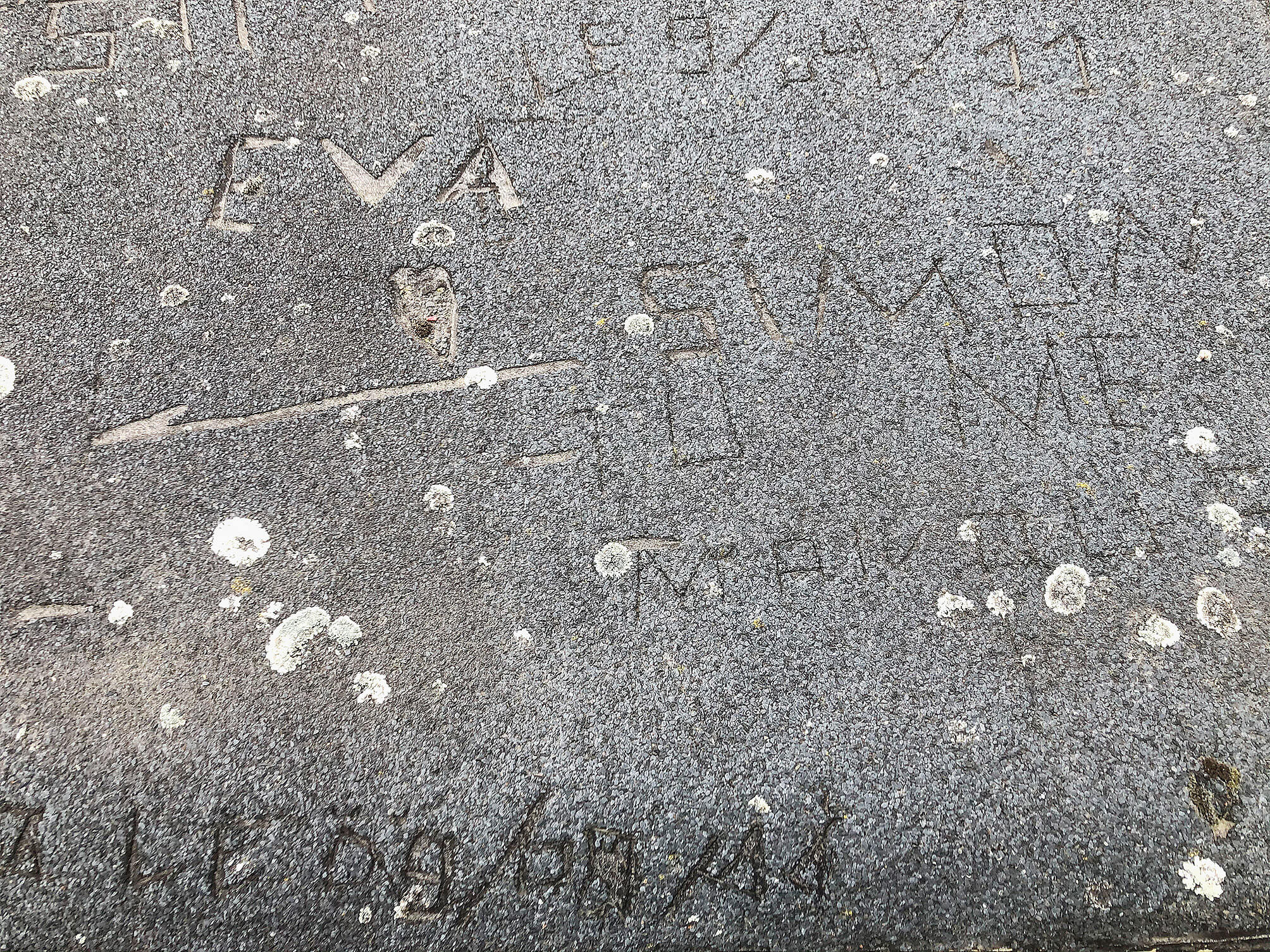
In what order and by whom the various texts and drawings were carved into the soft roofing is unclear. To the right of ‘EVA’, a heart symbol and an arrow (pointing to the left), the roofing reads ‘SIMON TU ME MANQUES’.
The short sentence usually – yet hastily – translates to ‘Simon, I miss you’. However, in French the ‘you’ (tu) is the subject and has an active role, whereas the ‘I’ (me) is the direct object. In short: by his not being there, Simon actively effectuates hurt to the one who carved this text.
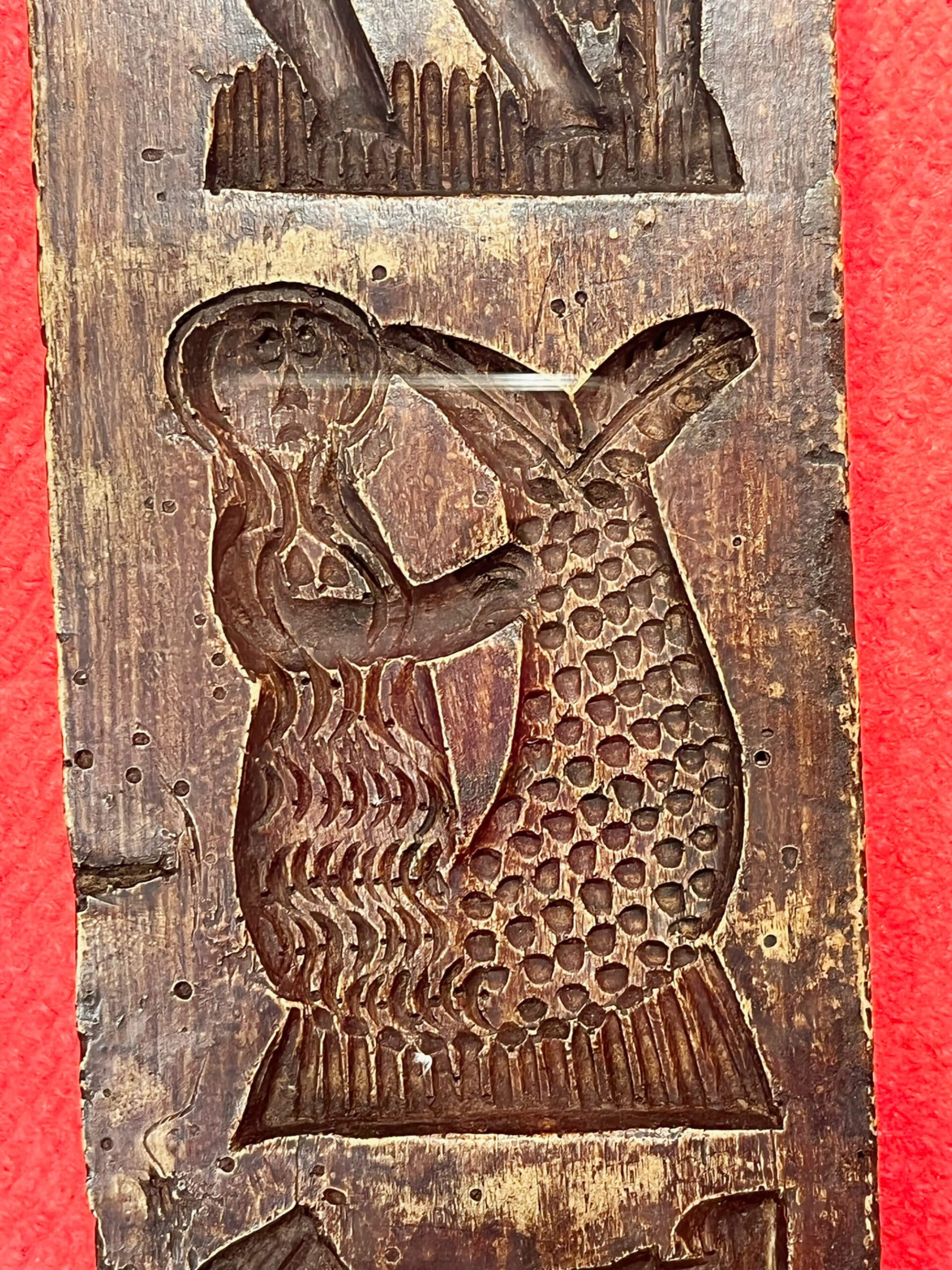
In Veurne, at the bakery museum, old speculaas moulds are presented in an almost religious fashion. Looking at these wooden blocks, they appear to be the negatives to Romanesque sculptures.
How does it feel to be conserved and showcased when your nature is to be a tool? What would it mean to re-use them, to fill those empty moulds, to shape something new without altering the matrix, to project what it would be like, to try out recipes and different baking, to learn from it and enjoy the results together? What scenes are even depicted? We lost part of their meaning, we could dig further, browse the books, ask our grandparents and collectively invent whatever narrative they might hold.
Clementine Vaultier’s interests, although trained as a ceramist, are in the warm surroundings of the fire rather than the production it engenders.
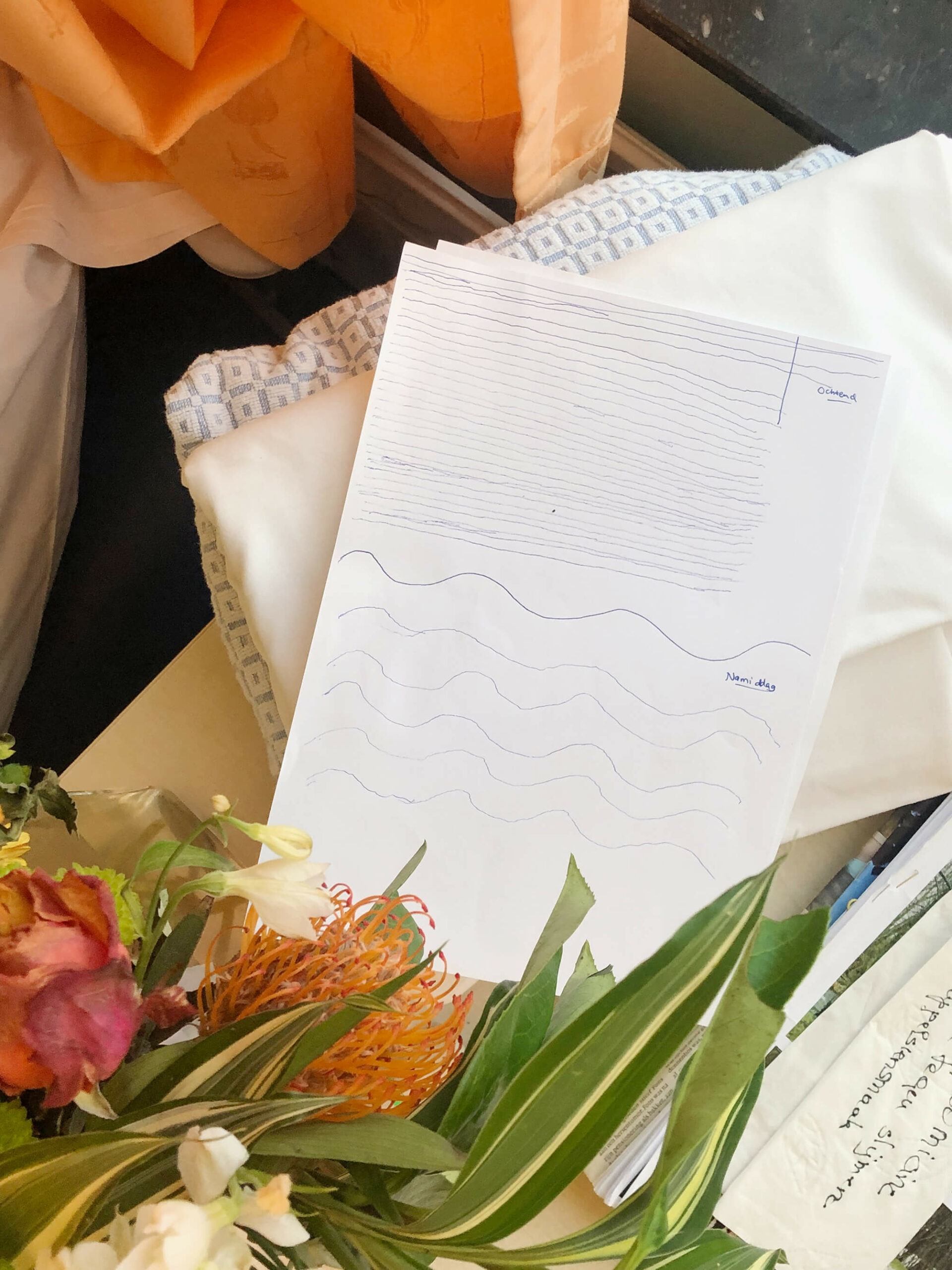
On a pile of fresh hospital sheets, near the radiator, the tangerine curtains and the black marble window sill (the window looks out over the parking lot), underneath the two-day-old bouquet of flowers and next to a pile of magazines with a handwritten note on top (about a syrup that relieves slime and tastes like oranges), lie two sheets of paper.
Earlier that day the physiotherapist had come by. Twice. Once in the morning and once in the afternoon. He had each time drawn the first line, as an example. A straight line in the morning, a curvy line in the afternoon.
With a ballpoint pen my grandfather, who is recovering from an accident, diligently copied the examples (31 in the morning, 5 in the afternoon).
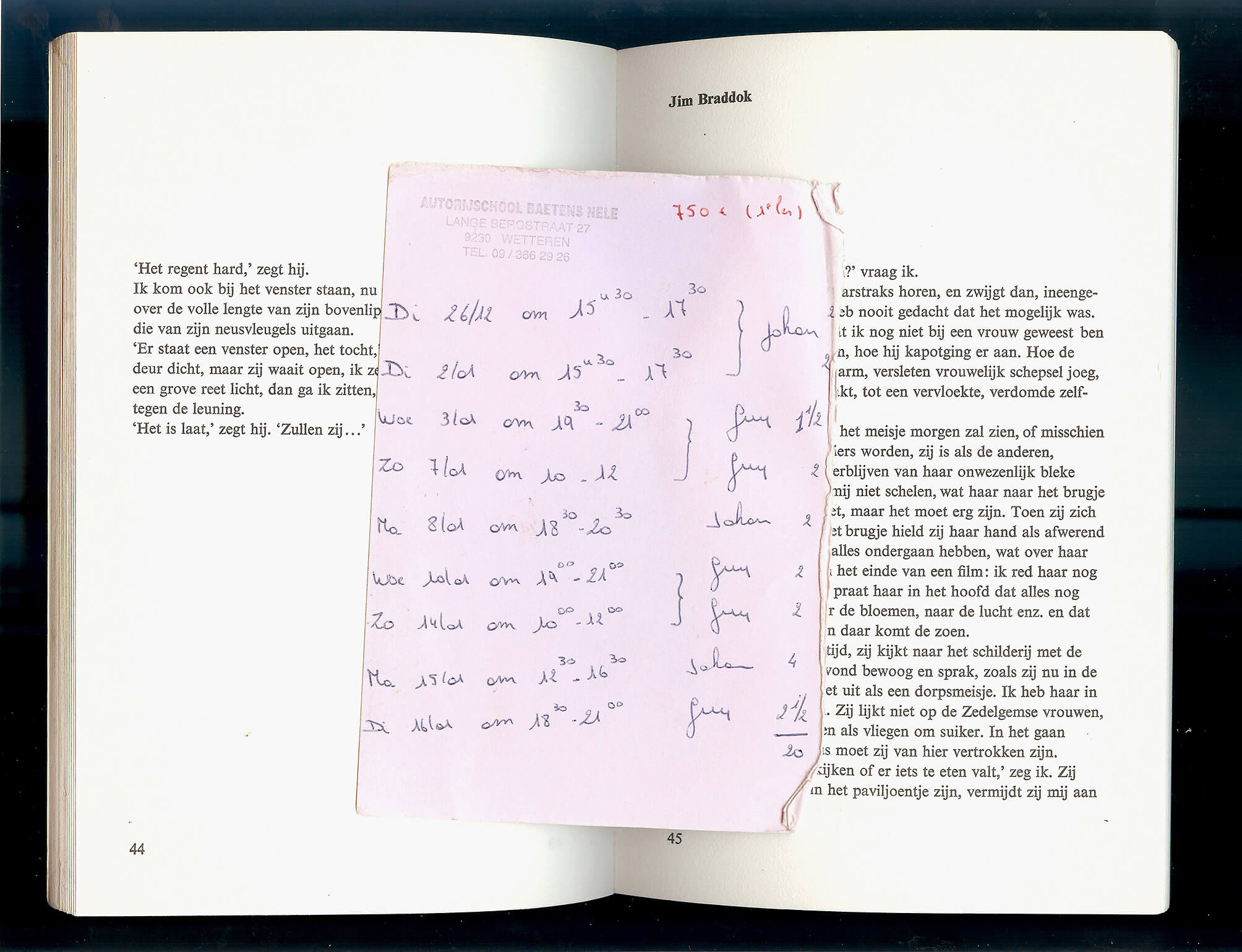
In his debut novel ‘De Metsiers’ Hugo Claus employs a multiple narrative perspective. In the copy I picked up in a thrift store, there’s a bookmarker between pages 44 and 45 where the perspective shifts from Ana to Jim Braddok. It’s pouring. The pink piece of paper lists 9 sessions at a driving school. There’s a total of 20 hours, taught alternately by Johan and Guy.
In 2000, 2006 and 2017 the twenty-sixth of December was a Tuesday. (Earlier years are improbable, since the Euro was not introduced yet.)
Claus, H. De Metsiers. Amsterdam: Uitgeverij De Bezige Bij, 1978.
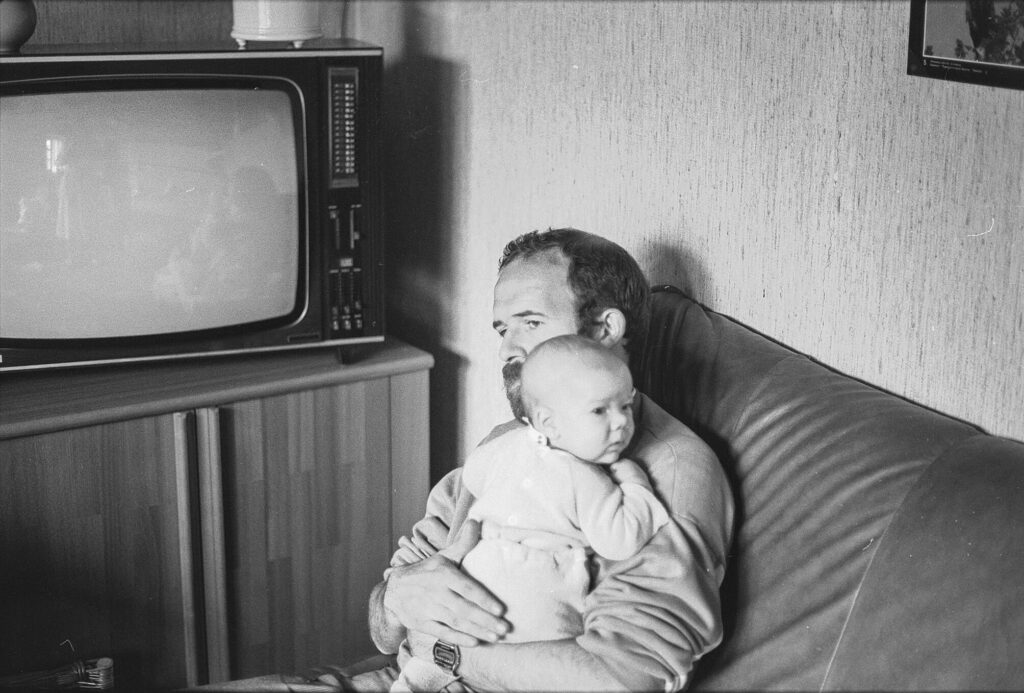
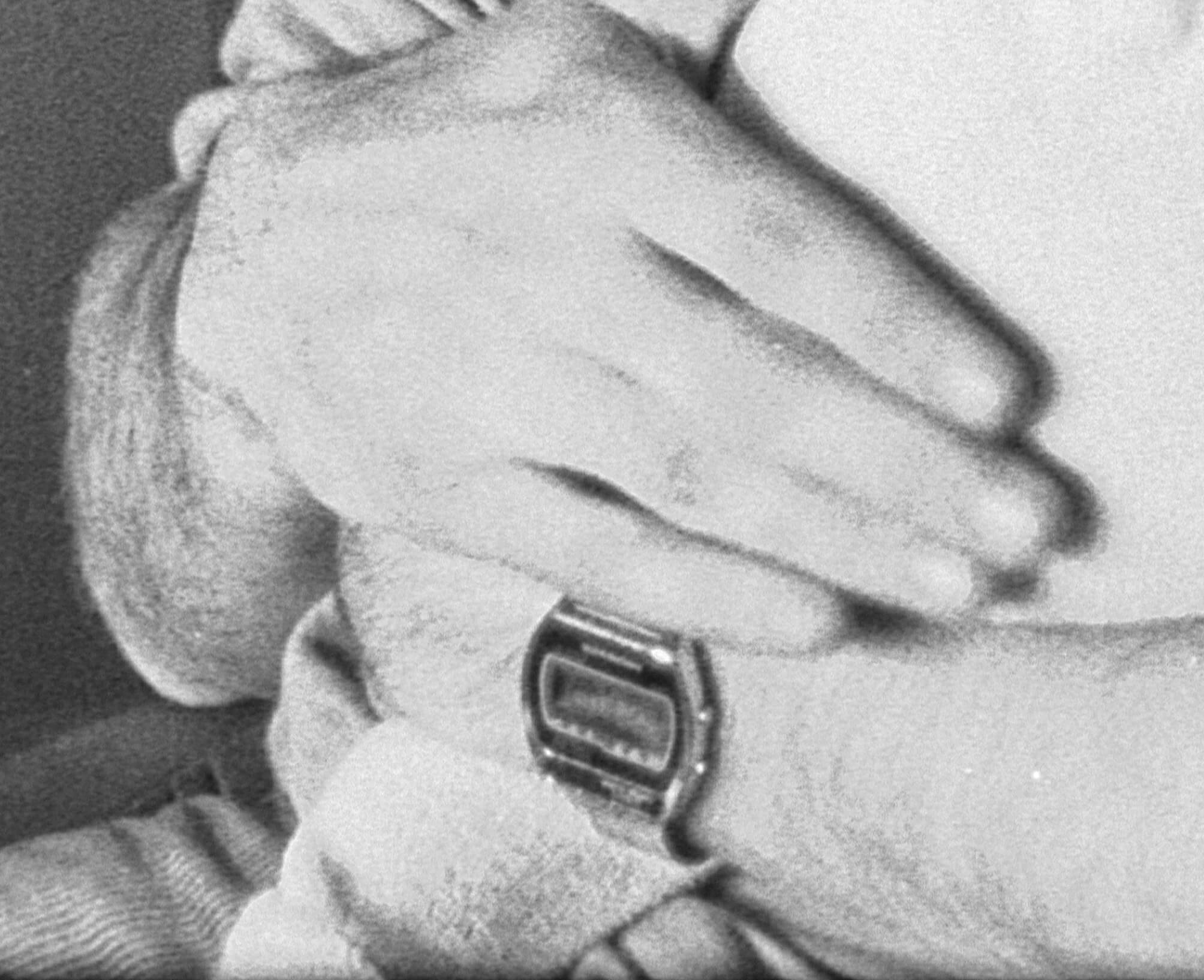
He’s wearing a digital watch. It looks like a Casio. It’s impossible to read the time, no matter whether you are studying the high-resolution scan of the negative or the negative itself, with the aid of a loupe and lightbox.
The device had a stopwatch function. When we were around eight and ten, we used to compete in trying to start and stop the stopwatch in the shortest possible interval. The smaller the gap, the closer to zero. Sometimes he would also have a try. We once managed to get it down to 00:00:00:03. Neither of us dared to press ‘reset’ and try again.
Halfway March my dad started finding empty clam shells on the banks of the Zuidlede along the pasture where he used to herd sheep. He had never seen this type of clam before. There were easily seventy of them along a hundred metre stretch of riverbank.
He brought two specimens to someone he knows in the neighbouring provincial domain. She would look into it, she said, and that she would probably pass it on to someone at the educational department.
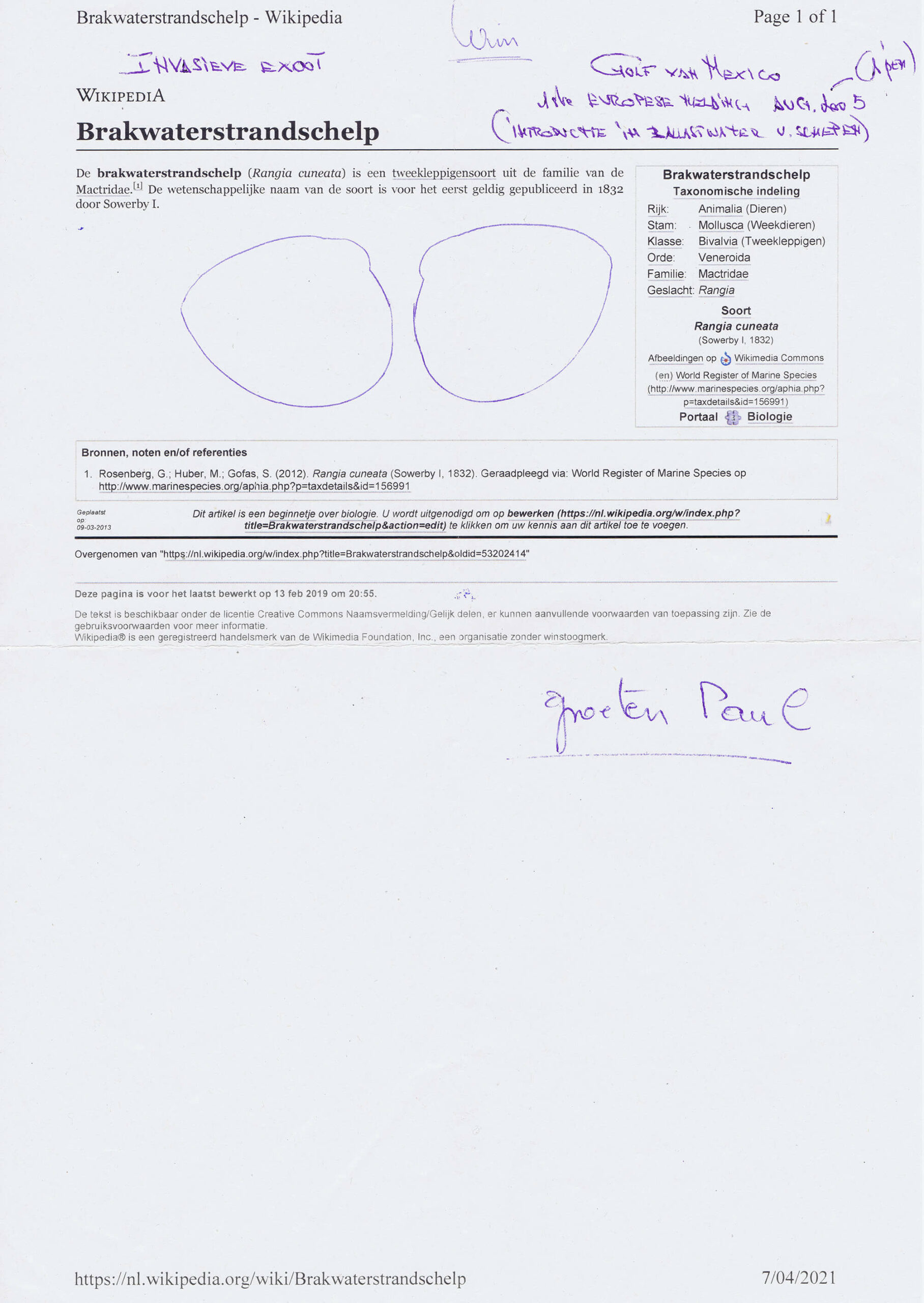
Yesterday he (my dad) received a printout of the Dutch wikipedia-page on the Brakwaterstrandschelp (Rangia Cuneata). On the page Paul (who sends his regards at the bottom of the document) traced around the scallops with a blue ballpoint pen.
My dad added in capitals – also with a blue ballpoint pen – that the Rangia Cuneata is an invasive species, native to the Gulf of Mexico. The first time it was observed in Europe was in Antwerp in August 2005, most probably they reached Europe in the ballast water tanks of large ships.
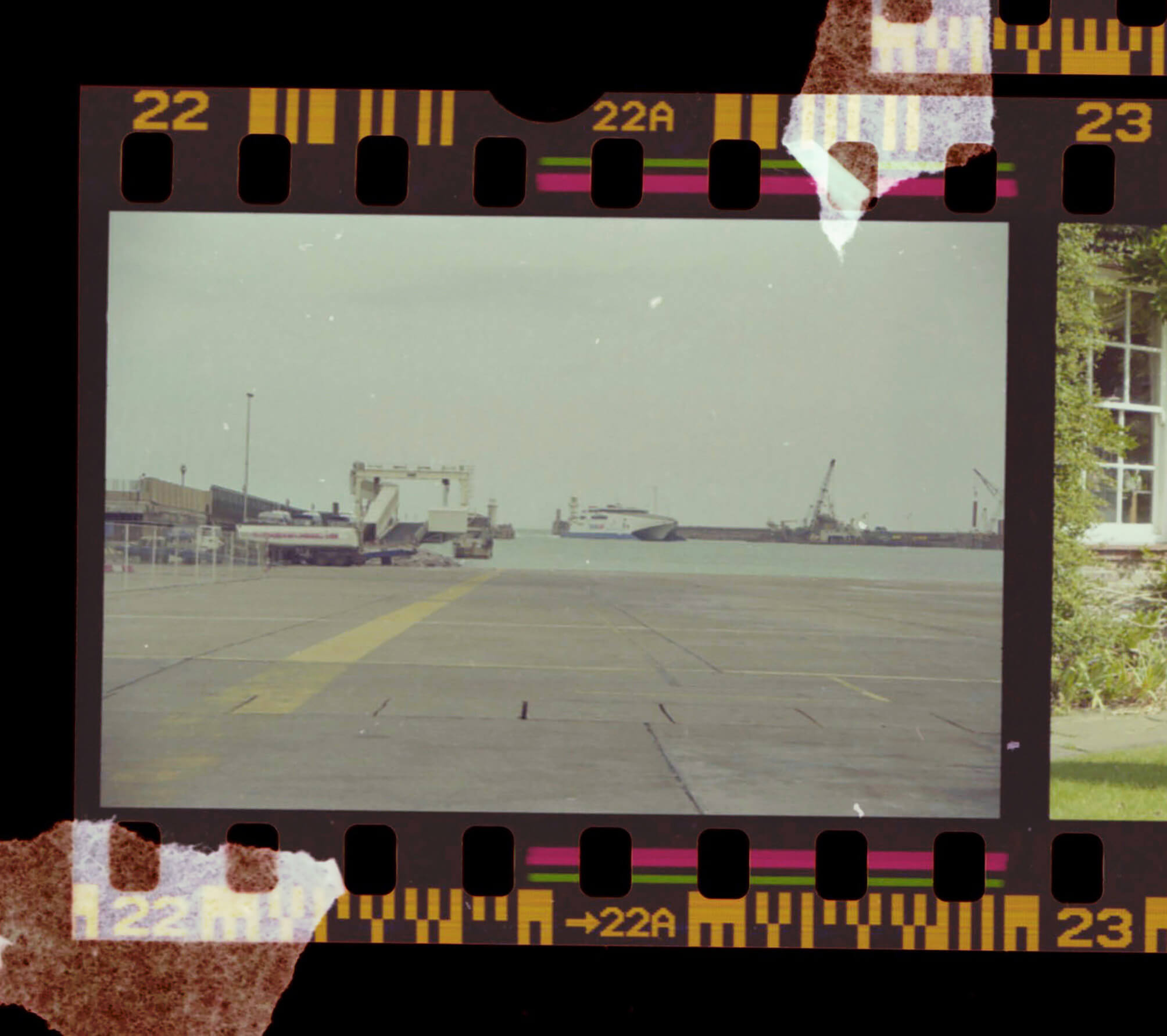
Coming back from holidays, we were waiting for the ferry to take us from Ramsgate to Ostend. We were well on time. As the ship entered the harbour, I asked my parents if I could take a photograph. It’s the first photograph I recall taking. I remember my dad telling me to wait long enough for the ship to get closer. I didn’t. I only got one try.1
It took a while before the film was developed. I couldn’t stop imagining what the photograph would look like: some picturesque waves in the foreground, the shining white ship, the red and blue text on the side, and a cloud filled sky.
Following every holiday, when we got home, the garden and our house would be photographed with the remaining exposures on the roll of film in the camera.
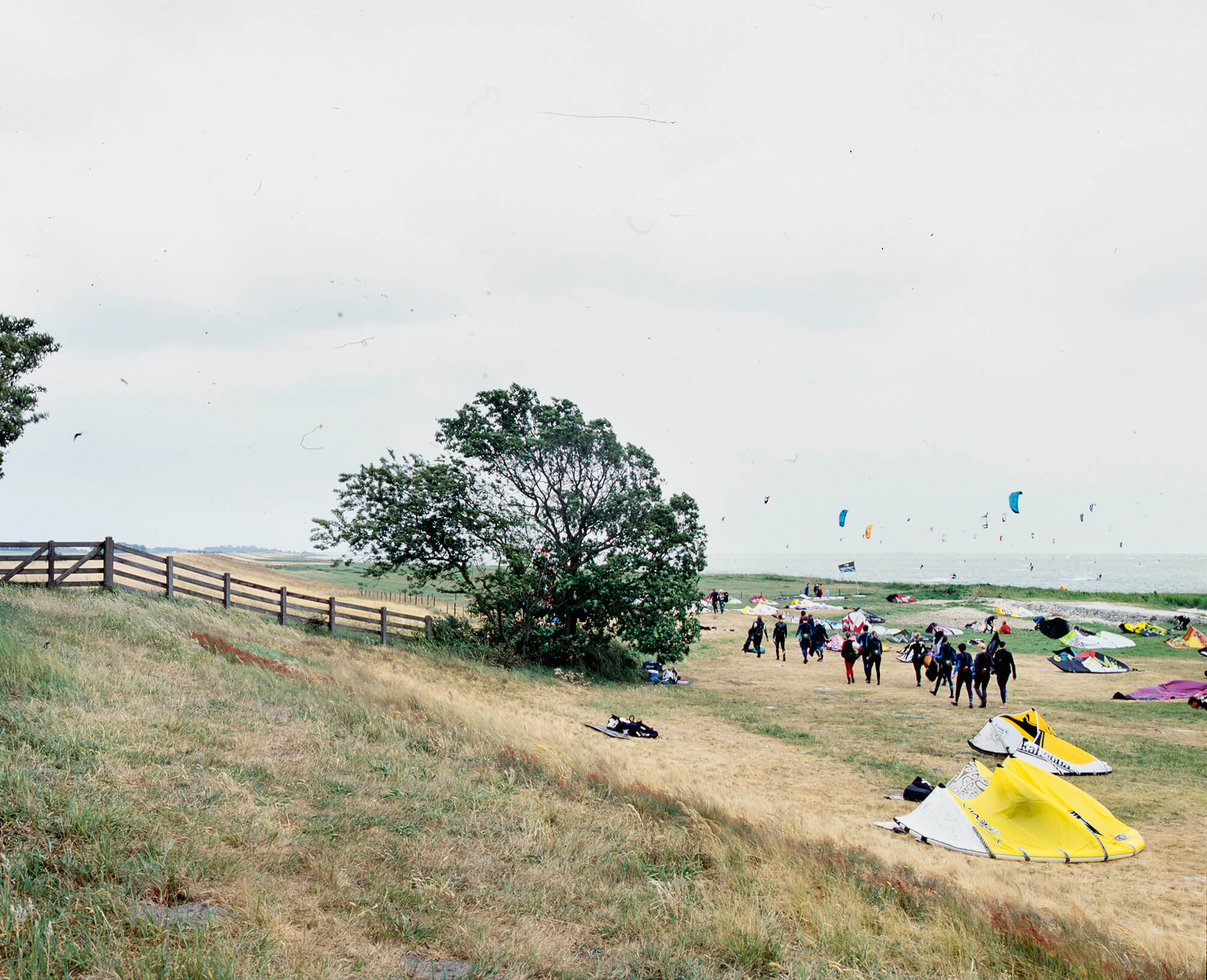
Ten years ago, in November, I drove up to Frisia – the northernmost province of The Netherlands. I was there to document the remains of air watchtowers: a network of 276 towers that were built in the fifties and sixties to warn the troops and population of possible aerial danger coming from the Soviet Union. It was very windy. The camera shook heavily. The poplars surrounding the concrete tower leaned heavily to one side.
I drove up to the seaside, a few kilometers farther. The wind was still strong when I reached the grassy dike that overlooked the kite-filled beach. I exposed the last piece of film left on the roll. Strong gusts of wind blew landwards.
Months later I didn’t bother to blow off the dust that had settled on the film before scanning it. A photograph without use, with low resolution, made for the sake of the archive’s completeness.
The dust on the film appears to be carried landwards, by the same gust of wind lifting the kites.
December, 1947. Rapid snowmelt coincides with torrential precipitation. At the bottom of the Thur valley, in Wildenstein, the water gathers.
It snows on December 19, but the situation changes on the 22nd with the arrival of an Atlantic low-pressure area, bringing masses of hot and humid air. Thaw follows.
And then, it snows again on December 26 and 27, before the arrival of a new warm front on the same day. A significant and brutal rise in temperature ensues: at Lac Noir, at 920 m, the temperature shoots up from 0,3 °C on December 27 at 7 AM to 7,4 ° C on the 28th at 9 PM.

The river swells and eventually overflows, causing the death of six people and extensive damage: washed away bridges, damaged homes, submerged factories, destroyed food stocks, heavily eroded roads and paths.
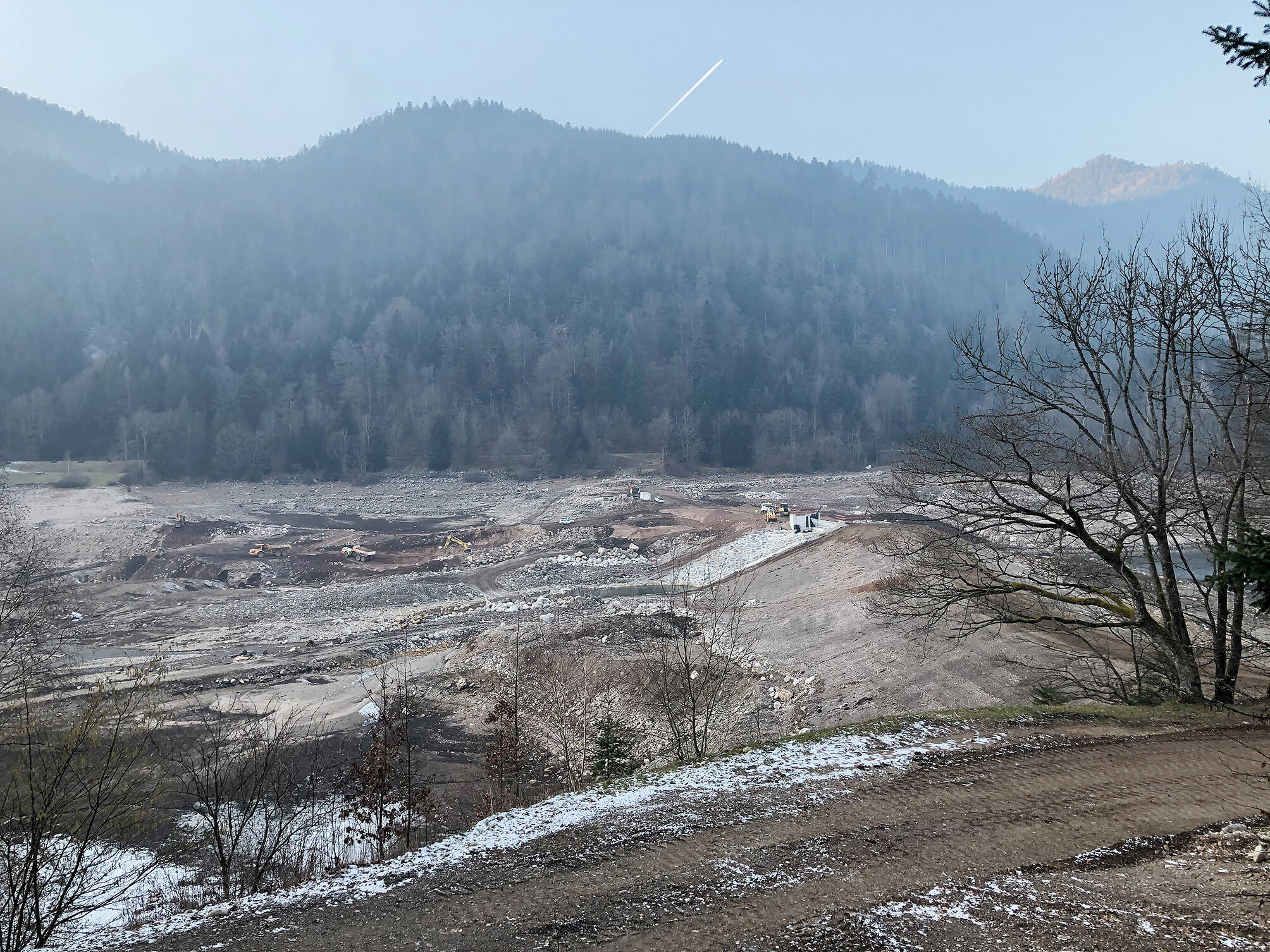
Seven years after the devastating flood, in 1954, the building of the dam is decided upon. Between 1959 and 1963 the infrastructure is built, and the reservoir gets filled with water in 1964 to act as a buffer for sudden floods and to guarantee a flowing Thur through the highly industrialized area downstream.
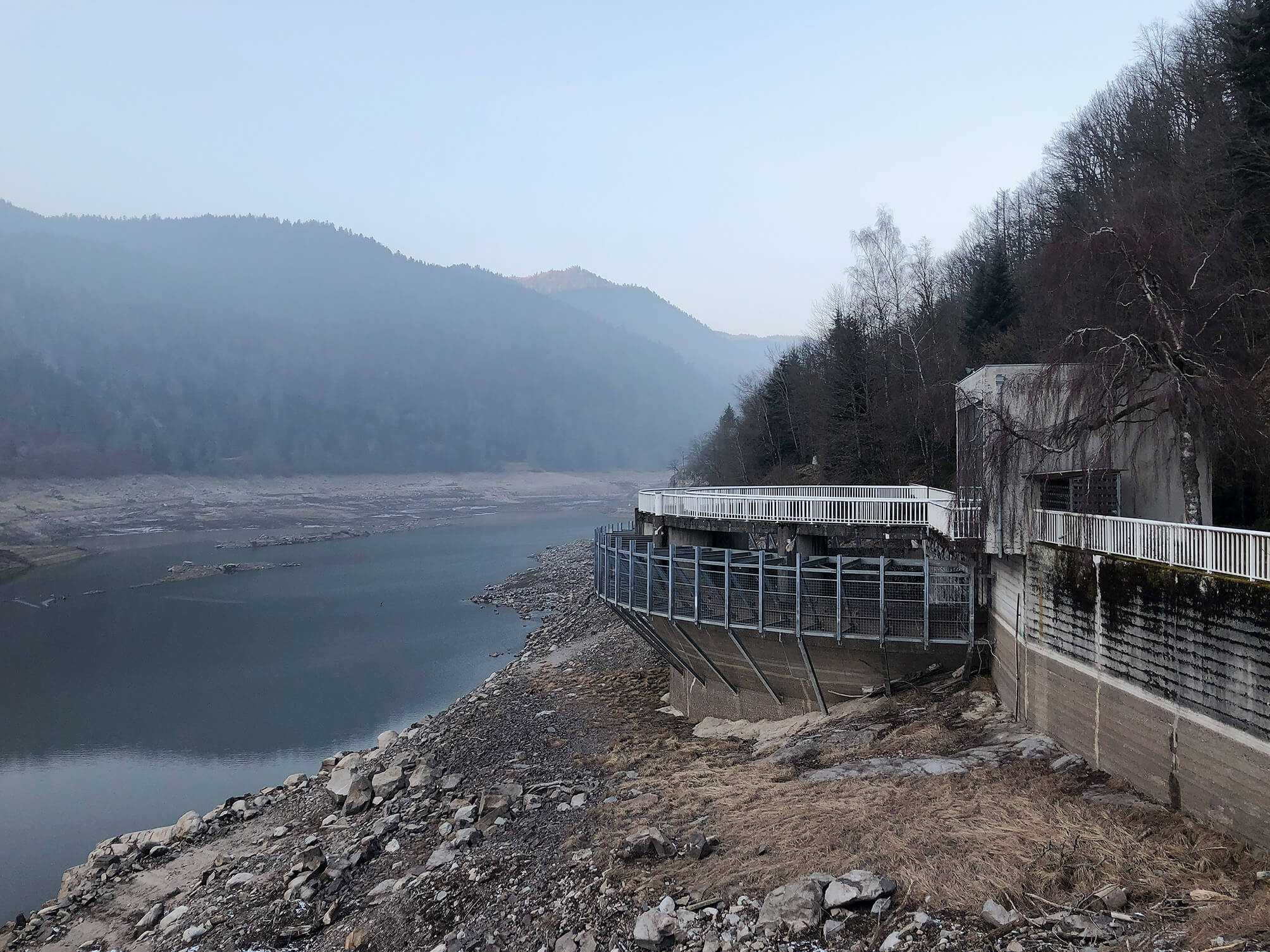
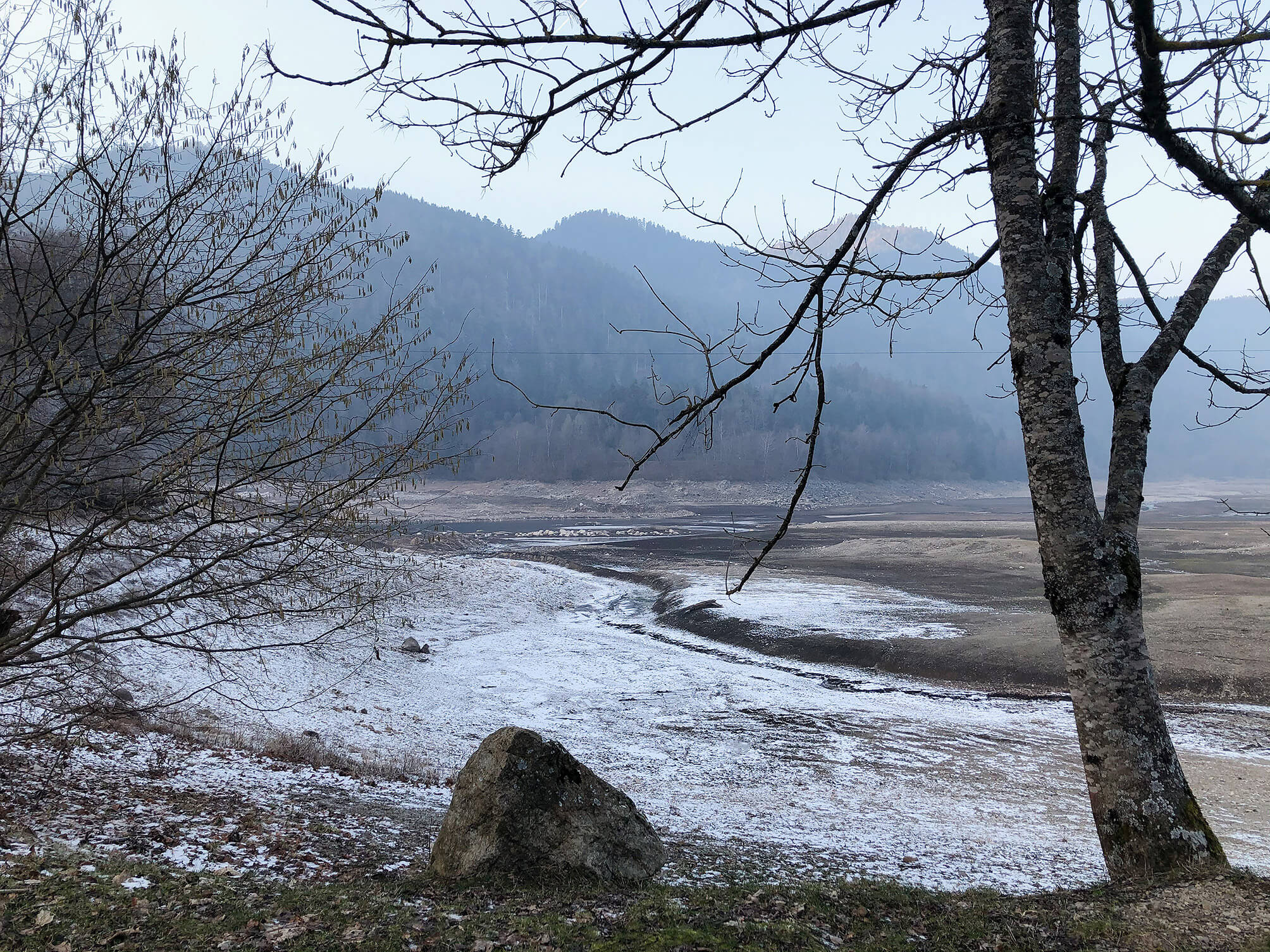
On January 23, 2020 a young couple walks around the drained reservoir of Kruth-Wildenstein.
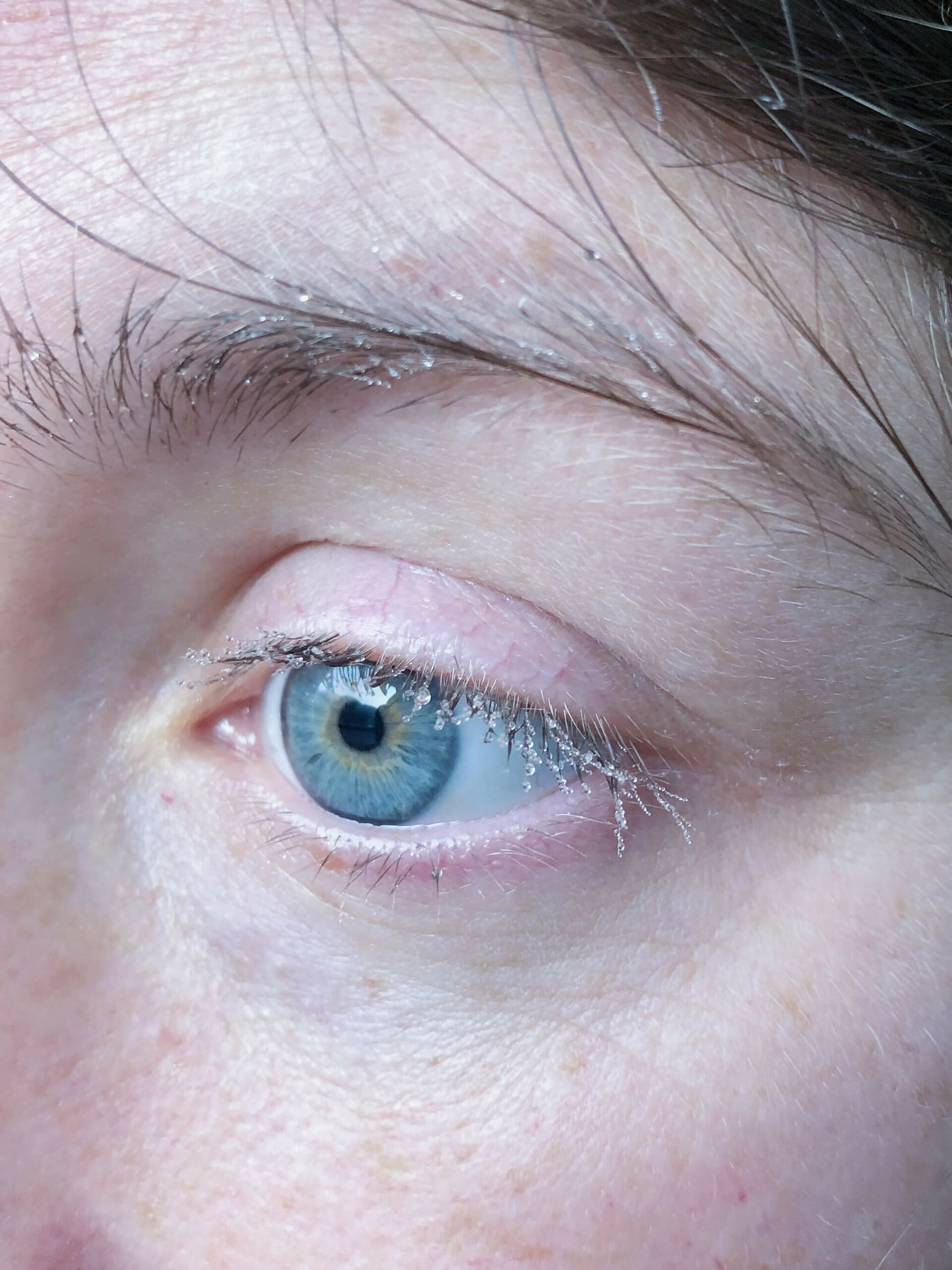
It’s freezing. They’re expecting their first child within a month.
Where once there was twelve million cubic metres of water, excavators and trucks are moving dirt and rocks that have been hidden from sight for 56 years; piling them up into a temporary dam: a batardeau.

What they took for ice that slid down the dam’s slope, appears to be the reason for draining the reservoir: a fissure in the watertight layer. The dam became unreliable.
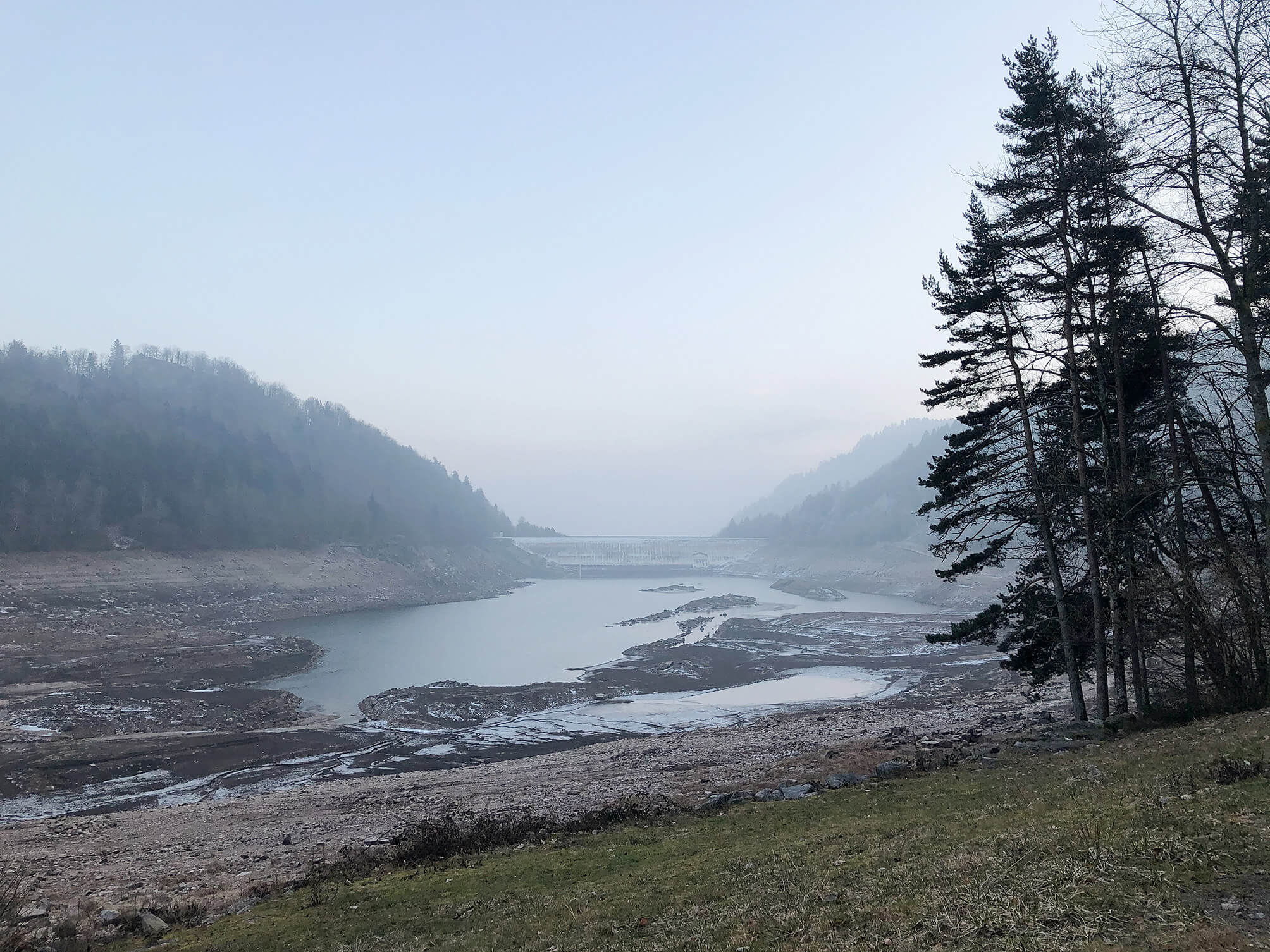
Shortly after crossing the Thur the couple reaches their car. They’re freezing. As the sun sets they drive through the mountainous landscape. The heating hurts their fingers.
The next day, they return, but the scene looks different. It’s warmer. The Thur appears to flow faster.

In the introduction to her book Qu’est-ce que la documentation?, French ‘documentalist’ Suzanne Briet asks what a document is. In a scrappy scan of her book I found online I am highlighting almost everything she writes. Is a star a document? Briet says it isn’t. But the catalogues and photographs of stars are. When I quickly opened the file with Apple’s ‘Preview’ application to check the above paraphrase, the highlighted sentences were illegible.
Briet is cited in Lisa Gitelman’s Paper Knowledge (2014).
Briet, S. Qu’est-ce que la documentation? Paris: Edit, 1951. Online: http://martinetl.free.fr/suzannebriet/questcequeladocumentation/briet.pdf
Depending on the language one chooses, the Wikipedia entry for ‘document’ shows a different picture. The French-language page shows what appears to be a Slovenian thesis written in 1984. The caption states it is a ‘book of Czechoslovak computer science author Květoslav Šoustal about computer networks’. The image was uploaded by Kelovy, a Slovakian mushroom-picker.
The anonymous hand rests on a lemon-yellow tablecloth, on which a yellow book and a blue binded file lie. The top left corner is the most intriguing, however: the tablecloth seems to be draped over a lemon, alongside a drinking glass. The cloth, however, does not get shaped by the lemon. Nor does the shadow-side of the lemon coincide with the shadow the other documents throw on the tablecloth. A closer look seems to indicate that the lemon is in fact an image of a lemon, printed on a plastic napkin.
The Russian wikipedia shows the image of a lease agreement. The German wikipedia for ‘document’ is text only.
https://fr.wikipedia.org/wiki/Document#/media/Fichier:KVETOSLAV_SOUSTAL_BOOK.JPG, created October 3, 2006 / original in original: paper, 1984

Every year, migrant workers in Bahrain attempt to temporarily halt wind erosion in the desert. To prevent sand from covering the track and entering the air ducts and engines, the ground near Bahrain’s Formula 1 track is sprayed with an adhesive.
The Bahrain Grand Prix has been held every year since 2004, except in 2011, when the race was cancelled due to protests in the wake of the Arab Spring. The surrounding desert was only half glued down by the time the workers left. A rare southeasterly gust blew in from the Gulf.
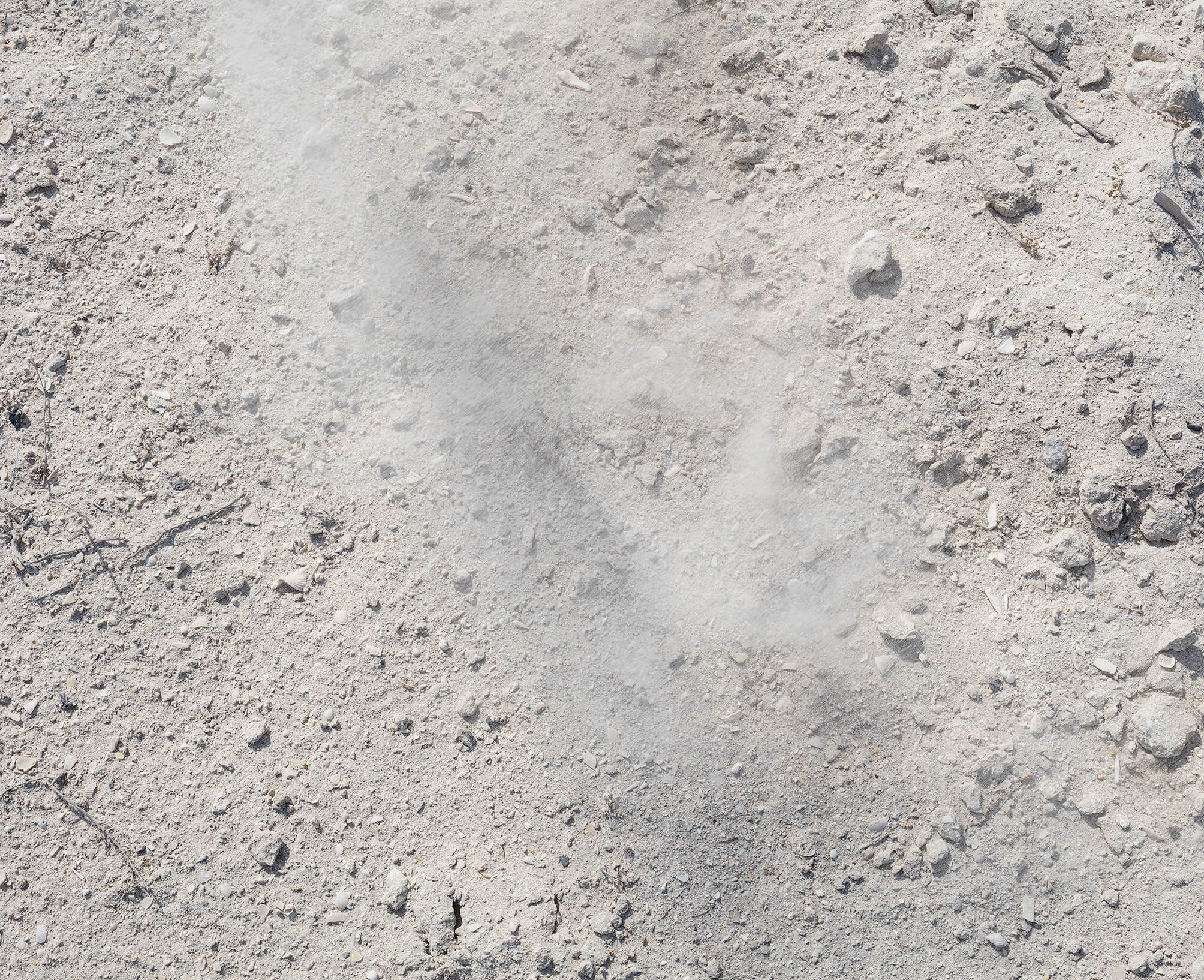
The cloud of sand in the picture (made near Avenue 61 on an artificial island close to Seef) was made by kicking it into the frame while M.R. and M.D.C. had to stop and wait for a truck that was being towed after the driver lost control over the vehicle and flipped it onto its side. Days earlier M.D.C. had tried to make a photograph of the F1-track, but couldn’t get close enough to make a decent picture.
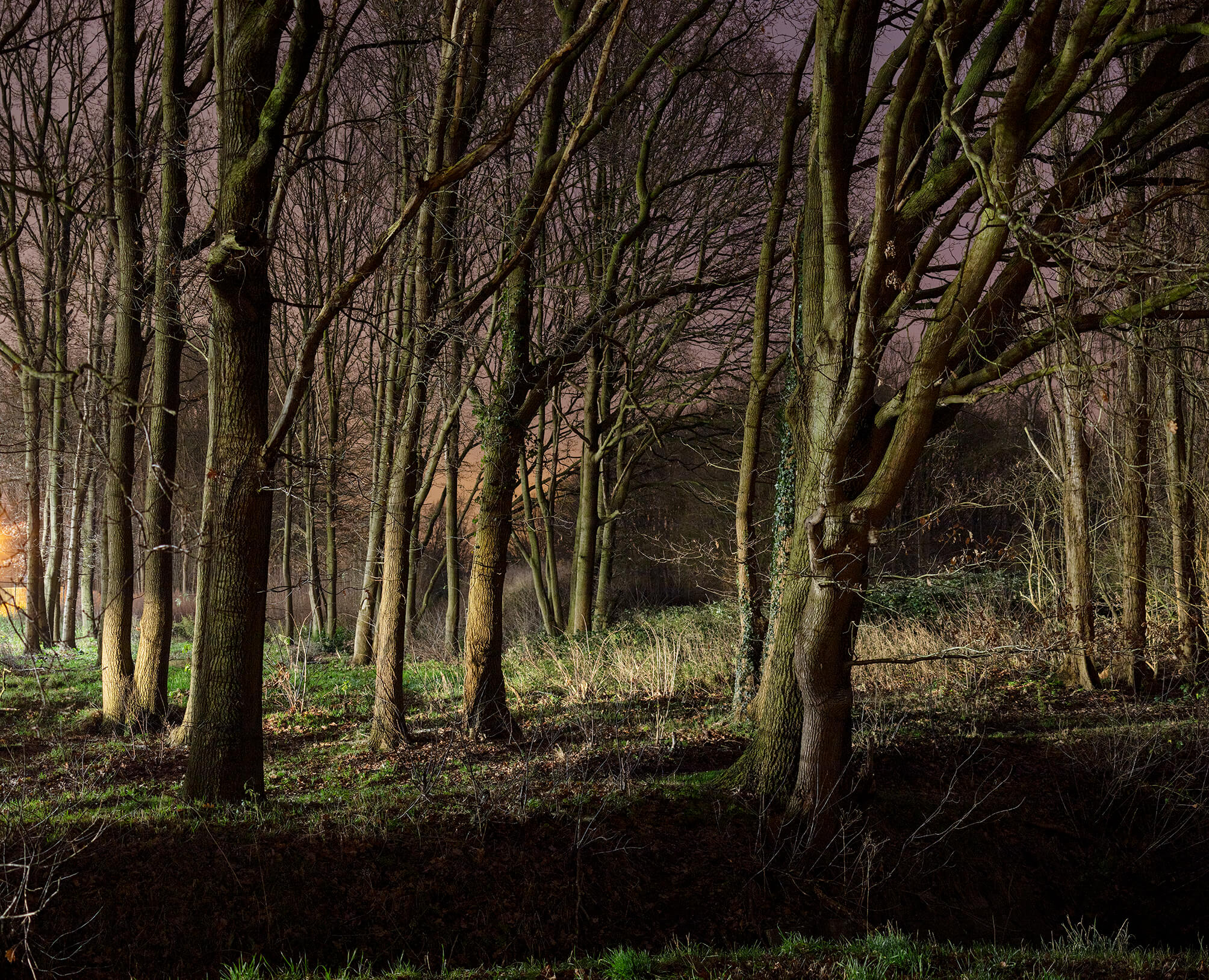
During the second half of April 2018, passers-by complained on Twitter about the massive chopping of trees and bushes in the area of the park site in Ranst, Belgium, along the E313 highway, in close proximity to the city of Antwerp.
Initially, the Department of Road and Highway Maintenance answered on Twitter that no pruning activities had taken place. They wouldn’t want to disturb breeding birds. But soon after, they admitted to the pruning. Their argumentation took a turn: ‘These are pruning activities in the context of the transmigration-problem on parking lots, as requested by the Police Department and the State Governor, so that transmigrants will no longer be able to hide. In the future, we will take up this discussion in our pruning policy for the upcoming breeding season.’
Upon closer investigation (an inquiry by Nature Inspection), the scale of the chopping became clear. The trees closest to the highway and the parking lot were chopped, while other trees were pruned at the bottom. Species such as European black elderberry, maple tree, sorbus, hazel, English holly, wild black cherry and breaking buckthorn disappeared. Rare species, only found in ancient forests, such as Solomon’s seal, were severely damaged.
These activities resulted in what the investigators described as a ‘transparent forest’ – a forest without density at lower levels, which is ecologically speaking not valuable. It has no ‘forest feeling’.
In spring 2024 the-documents.org and Trigger co-publish a series of online articles with a focus on the meeting ground between photography and the document.
_44A6588.dng
At 13:26:43 I took a photograph of a concrete building without windows in an industrial zone just south of Brussels.
_44A6590.dng
At 16:46:15 I photographed a succession of office buildings in the same industrial zone.
_44A6589.dng
I must have walked about 1 kilometer between the concrete building without windows and the section of the industrial zone with the offices. At 13:43:49, the camera, safely stored in my backpack, recorded 0.4 seconds of the 20 minutes it took me to get there.
In The Snows of Venice, Alexander Kluge wonders whether he can take the liberty to conjure up what the sky looked like on 31 December 1799, as Schiller made his way to Goethe’s house. He goes on by saying that, historically, there’s a ‘LACK OF SENSORY ATTENTION AT CRUCIAL MOMENTS’.1 There are exceptions, though, like the cameraman that was sent out to document the fireworks on New Year’s Day 2000. The camera was turned on prematurely. The batteries were used up by midnight, but ‘certain gray tones, however, filtered through the cracks of its protective case, conveyed the motion of the walking cameraman, the transportation. The incompletely shut, low-information container was documented exactly […] To this day it provides inexact testimony as to the qualities of the leather of a twenty-first century carrying case and the precise sensitivity to light and dark demonstrated by a twenty-first century recording medium.’2
Lerner, B., Kluge, A. The Snows of Venice. Leipzig: Spector Books, 2018, p. 53
Ibid.
During a two hour tour, H.V. (head of the science collection) guided us from the library to the observatory and back. Along the way, he touched upon various rarities: one hundred ninety-five volumes of the Encyclopédie Méthodique (according to H.V. the most complete copy left in the world), the severed summit of Mont Blanc (‘Actually de Saussure brought back a triangular piece of rock from just below the snow line near the summit’), an original copy of the publication on the infamous Lügensteine (‘These date back to the time before the hoax was unveiled’)…
In guiding us from room to room, H.V. piled oddity upon curiosity. He showed a particular interest in all things fish-related.
First published in: De Cleene, M. Reference Guide. Amsterdam: Roma Publications, 2019
