What constitutes a ‘document’ and how does it function?
According to the Oxford English Dictionary, the etymological origin is the Latin ‘documentum’, meaning ‘lesson, proof, instance, specimen’. As a verb, it is ‘to prove or support (something) by documentary evidence’, and ‘to provide with documents’. The online version of the OED includes a draft addition, whereby a document (as a noun) is ‘a collection of data in digital form that is considered a single item and typically has a unique filename by which it can be stored, retrieved, or transmitted (as a file, a spreadsheet, or a graphic)’. The current use of the noun ‘document’ is defined as ‘something written, inscribed, etc., which furnishes evidence or information upon any subject, as a manuscript, title-deed, tomb-stone, coin, picture, etc.’ (emphasis added).
Both ‘something’ and that first ‘etc.’ leave ample room for discussion. A document doubts whether it functions as something unique, or as something reproducible. A passport is a document, but a flyer equally so. Moreover, there is a circular reasoning: to document is ‘to provide with documents’. Defining (the functioning of) a document most likely involves ideas of communication, information, evidence, inscriptions, and implies notions of objectivity and neutrality – but the document is neither reducible to one of them, nor is it equal to their sum. It is hard to pinpoint it, as it disperses into and is affected by other fields: it is intrinsically tied to the history of media and to important currents in literature, photography and art; it is linked to epistemic and power structures. However ubiquitous it is, as an often tangible thing in our environment, and as a concept, a document deranges.
the-documents.org continuously gathers documents and provides them with a short textual description, explanation,
or digression, written by multiple authors. In Paper Knowledge, Lisa Gitelman paraphrases ‘documentalist’ Suzanne Briet, stating that ‘an antelope running wild would not be a document, but an antelope taken into a zoo would be one, presumably because it would then be framed – or reframed – as an example, specimen, or instance’. The gathered files are all documents – if they weren’t before publication, they now are. That is what the-documents.org, irreversibly, does. It is a zoo turning an antelope into an ‘antelope’.
As you made your way through the collection,
the-documents.org tracked the entries you viewed.
It documented your path through the website.
As such, the time spent on the-documents.org turned
into this – a new document.
This document was compiled by ____ on 17.10.2026 23:58, printed on ____ and contains 20 documents on _ pages.
(https://the-documents.org/log/17-10-2026-6913/)
the-documents.org is a project created and edited by De Cleene De Cleene; design & development by atelier Haegeman Temmerman.
the-documents.org has been online since 23.05.2021.
- De Cleene De Cleene is Michiel De Cleene and Arnout De Cleene. Together they form a research group that focusses on novel ways of approaching the everyday, by artistic means and from a cultural and critical perspective.
www.decleenedecleene.be / info@decleenedecleene.be - This project was made possible with the support of the Flemish Government and KASK & Conservatorium, the school of arts of HOGENT and Howest. It is part of the research project Documenting Objects, financed by the HOGENT Arts Research Fund.
- Briet, S. Qu’est-ce que la documentation? Paris: Edit, 1951.
- Gitelman, L. Paper Knowledge. Toward a Media History of Documents.
Durham/ London: Duke University Press, 2014. - Oxford English Dictionary Online. Accessed on 13.05.2021.

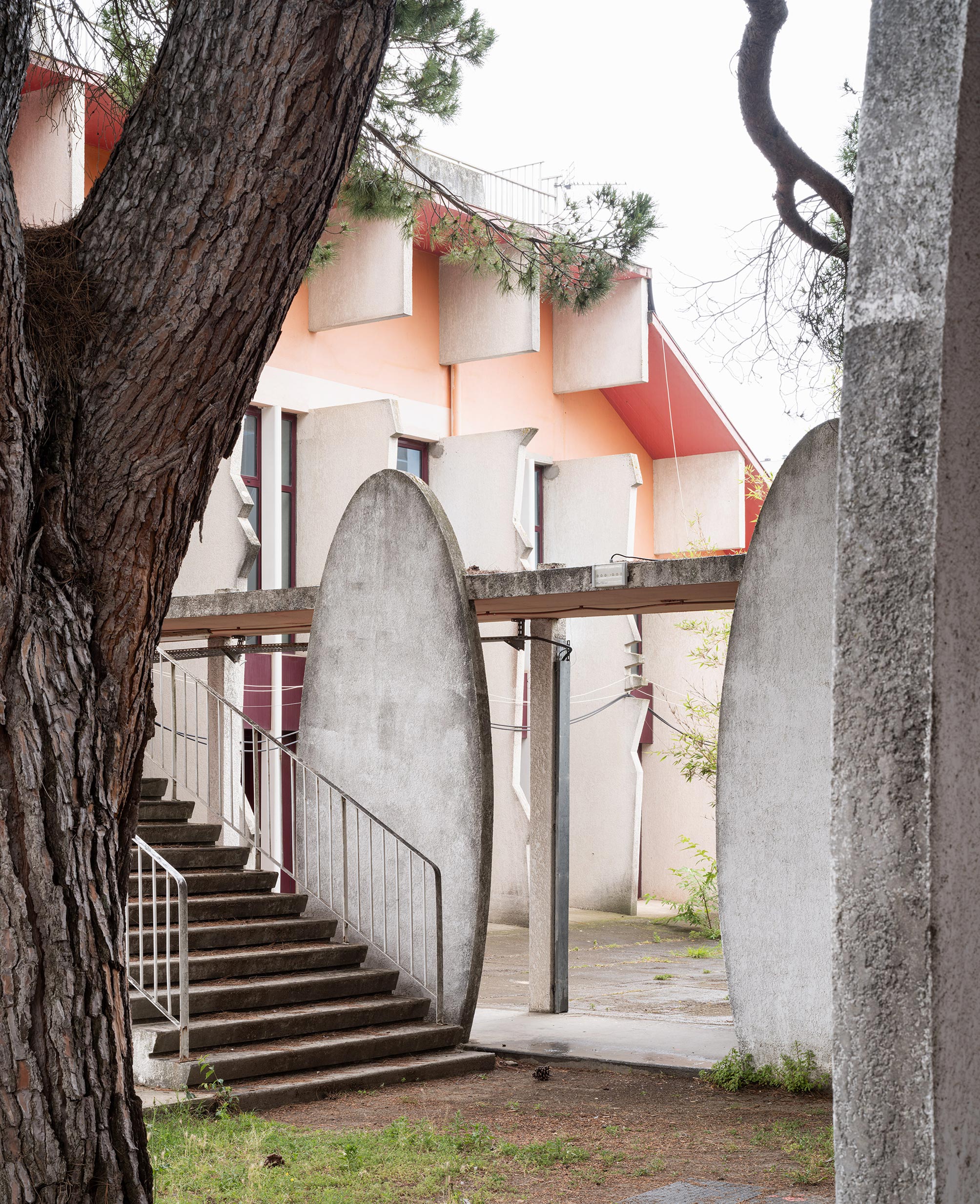
Built in 1969, the salle polyvalente1 in La Grande-Motte2 was the first venue where the residents – back when there were only 700 of them – could gather. Jean Balladur had envisioned an open-air theatre covered by a removable stretched canvas, adjacent to a single-storey multipurpose hall. The load-bearing structure, Balladur explained, consists of anthropomorphic columns sculpted by Albert Marchais: “My friend the sculptor, painter, poet and man of the theatre, Albert Marchais, devised the design for a sliding formwork that made it possible to cast the columns… they line up on either side of the hall in patterns that free them from the strict constraints of matter. This freedom is the joy of all sculpture.”3
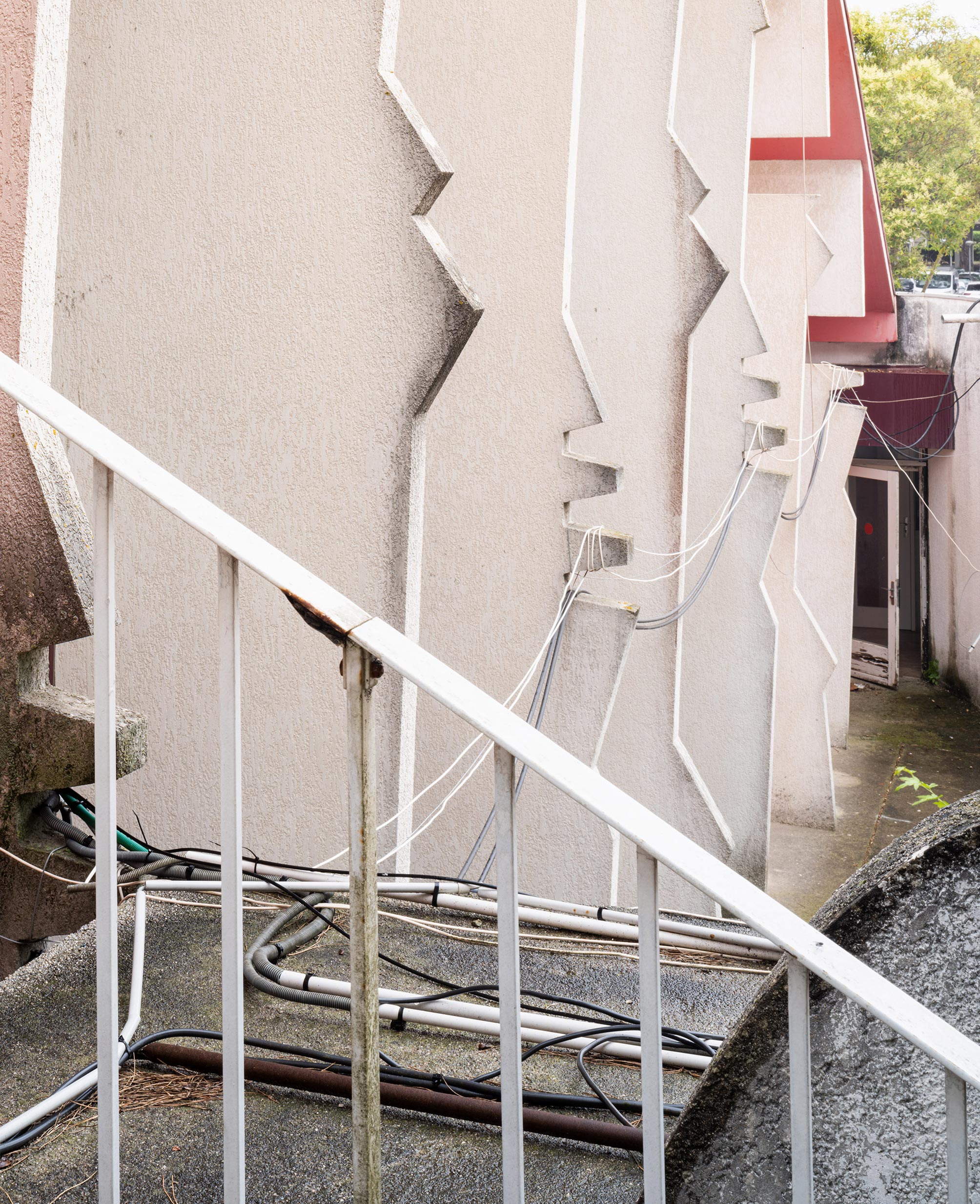
The geometric forms that make up the hands and arms of these figures are today strung with cables carrying electricity and data.
Jean Balladur was never fond of the term ‘salle polyvalente’, he preferred ‘salle commune, dédié à la fête’ – a communal hall, dedicated to parties. Since 2019 it is officially the Centre Culturel Henri Dunoyer, after a former mayor.
La Grande-Motte is a seaside resort created by the Mission Racine, the state programme for the development of the Languedoc coastline in southern France. Intended as a holiday destination for the middle class in the 1970s, it is the work of architect Jean Balladur (1924–2002), who was tasked with designing the entire urban layout and architecture of the new town. He drew inspiration from pre-Columbian pyramids and from modernist architecture in Brazil, especially the work of Oscar Niemeyer. At a time when large housing complexes were going up all over France in the form of tower blocks and slabs, Balladur’s solutions were different enough that La Grande-Motte was a success from the very beginning.
« Mon ami le sculpteur, peintre, poète, homme de théâtre, Albert Marchais, a imaginé le dessin d’un coffrage glissant qui a permis de couler les poteaux… ils s’alignent de chaque côté de la salle dans des figures qui les affranchissent des strictes contraintes de la matière. Cette liberté fait le bonheur de toute sculpture. »
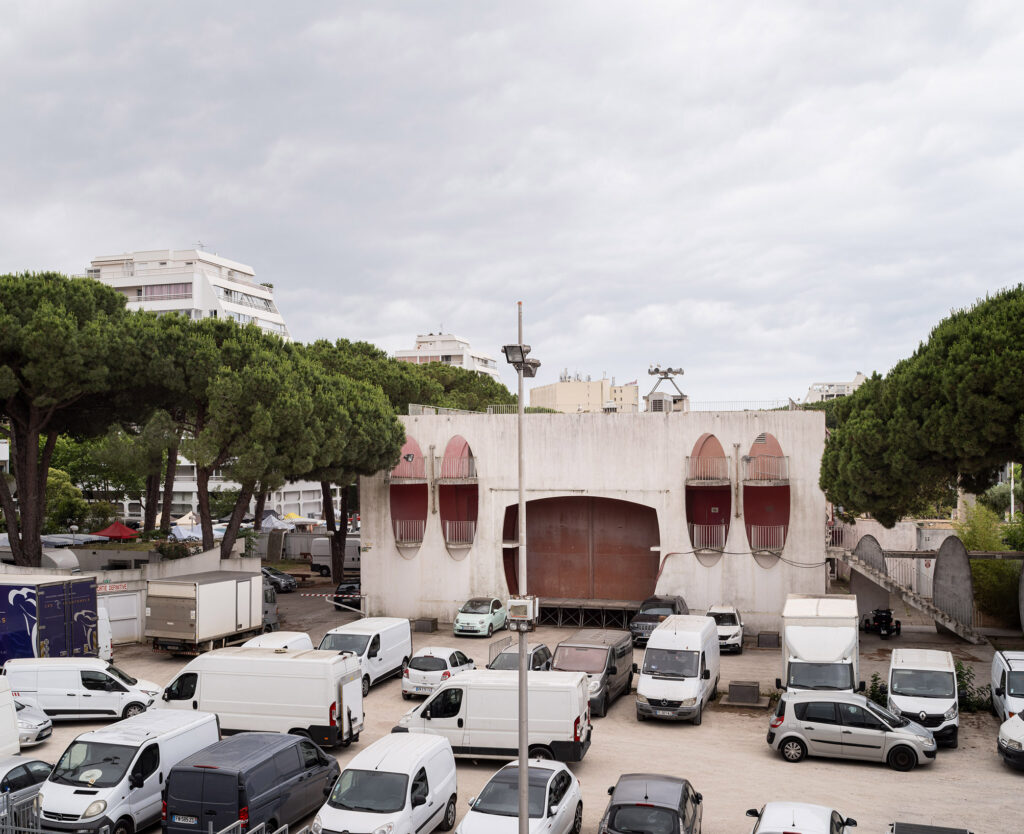
On market days, the parterre of the open-air theatre serves a a car park for the vendors’ vans and cars.
François, Michèle. Jean Balladur et la Grande-Motte: l’architecte d’une ville. Duo. Monuments historiques et objets d’art du Languedoc-Roussillon, Direction régionale des affaires culturelles, 2010, p. 41-42.
July. Our eight-month-old son has a fever. We have a hard time getting him to drink enough. The tally marks on the back of a tortellini-box keep track of the diapers he wets and the millilitres of milk and electrolytes he’s able to hold down.
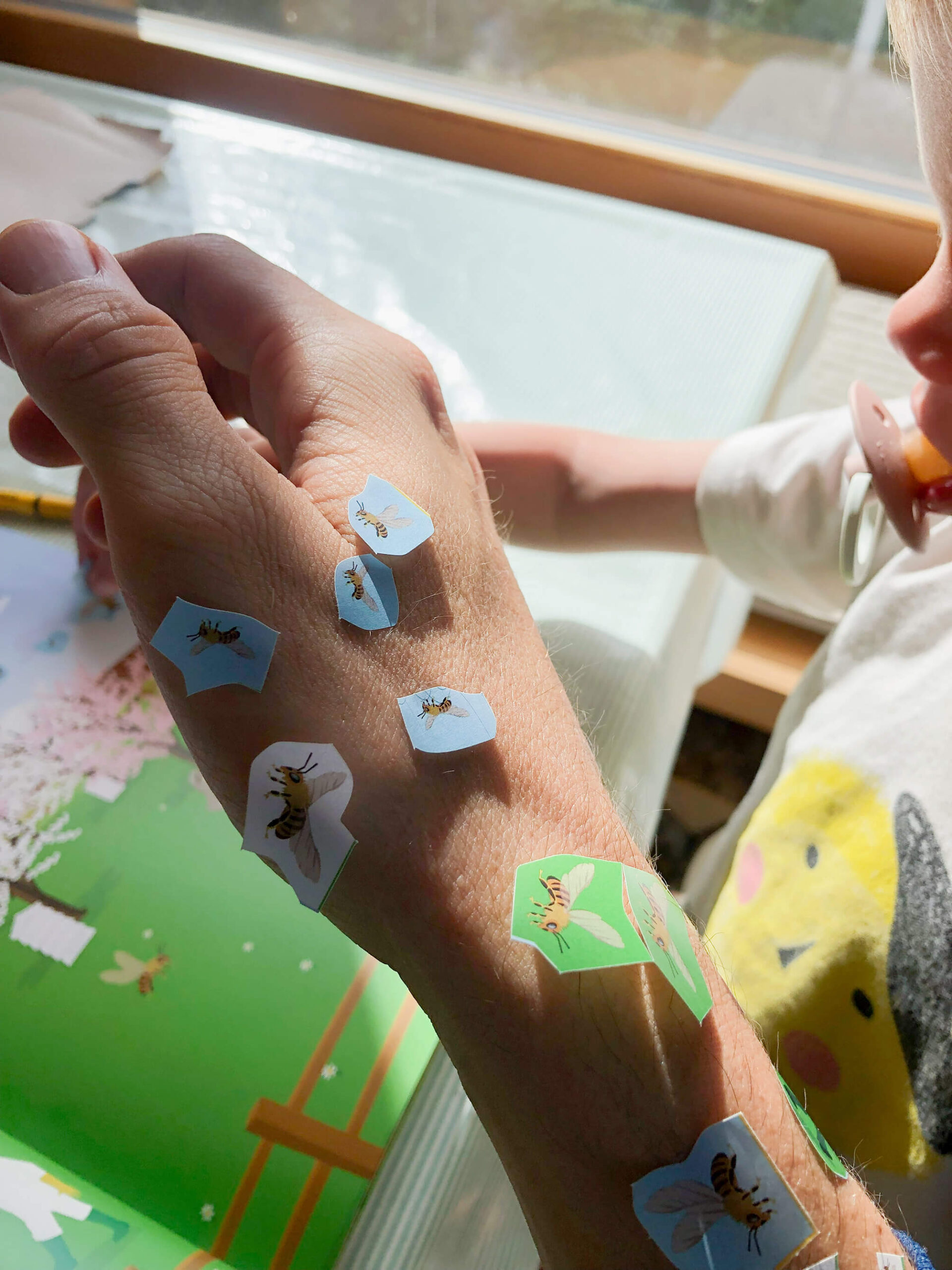
Stuck inside with worrying parents, a sticker-book about a farm is his brother’s favourite pass-time. Tired of having to go back and forth between the pastures and the sticker-filled sheets we decide to use my arm as a repository for animals that share a habitat.
Our one year old’s favourite toy he’s not supposed to play with is the HP Officejet Pro L7590 All-in-one in my office. I have given up on forbidding him to play with it. We have a new game: he brings me one of his other toys, we put it on the flatbed, close the lid – as far as possible –, press the button ‘START COPY – COLOR’ and wait for the print to come out of the machine. When we place the original onto the copy, he laughs. So far we have copied his blue pacifier, his planet-earth-bouncy-ball and his rattling crocodile.

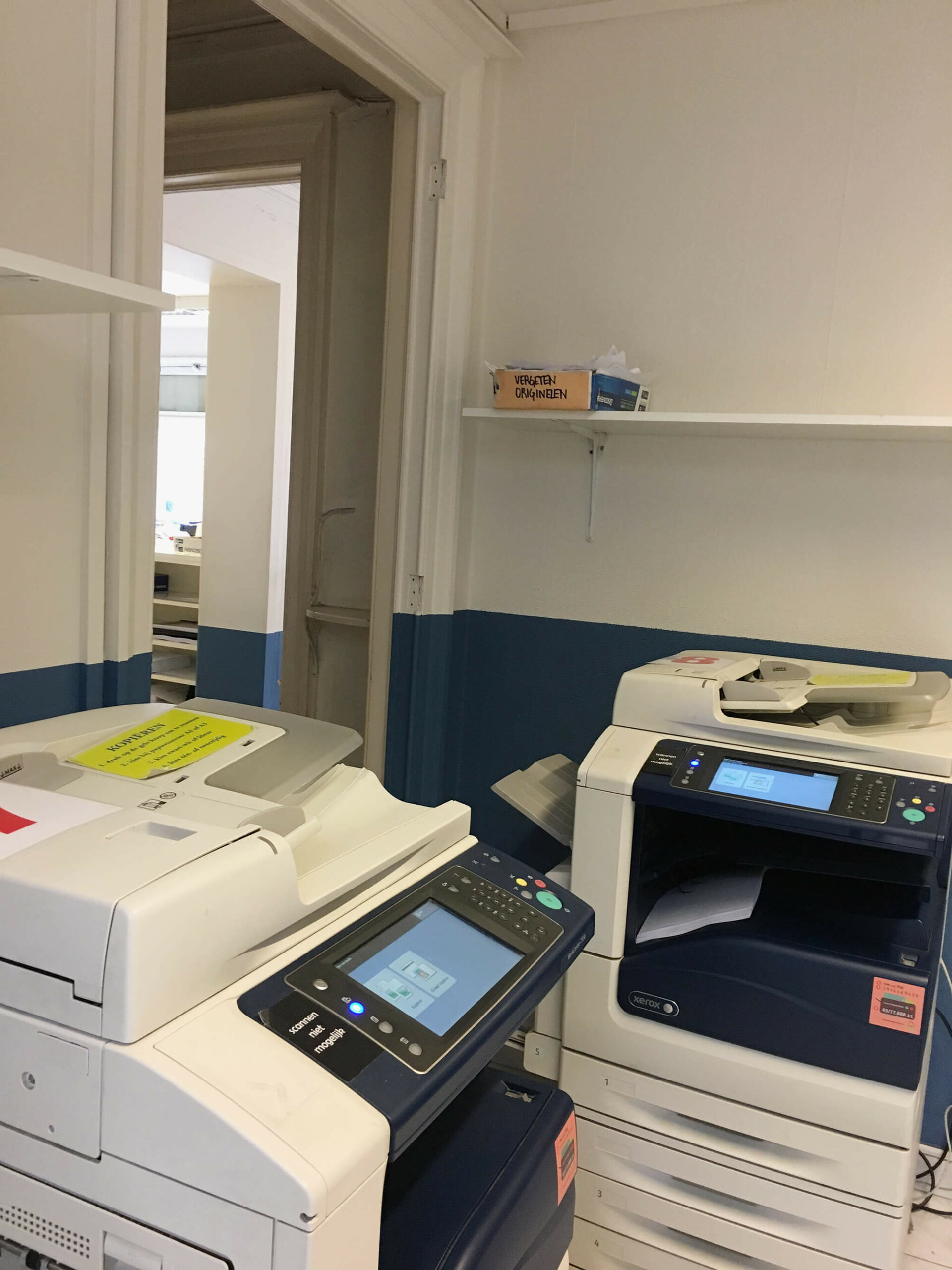
At the copyshop, on a shelf above photocopier 8, the lid of a box of paper serves as the container for ‘forgotten originals’.1
The book being copied: Didi-Huberman, G. La ressemblance par contact. Archéologie, anachronisme et modernité de l’empreinte. Paris: Les Editions de Minuit, 2008.
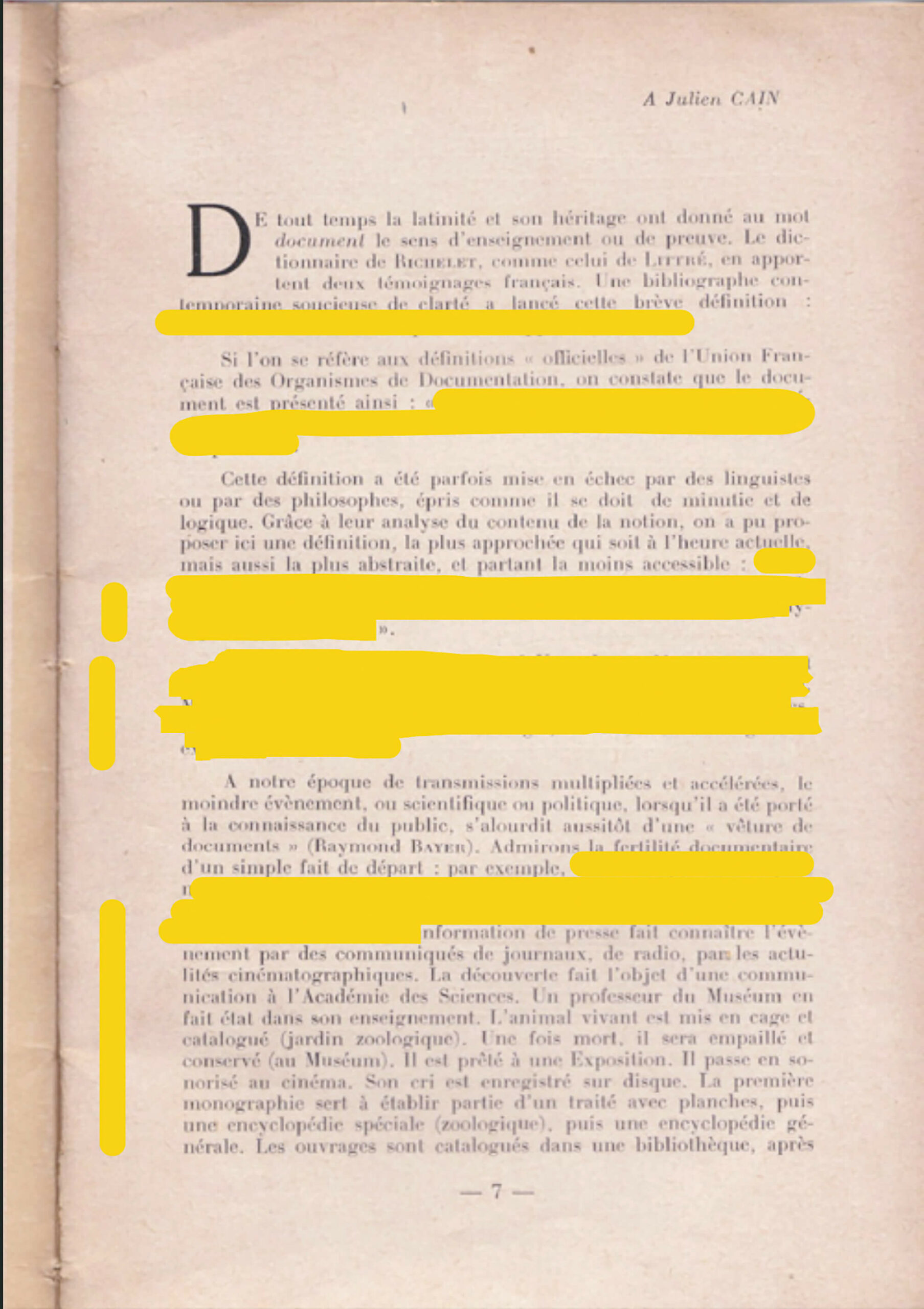
In the introduction to her book Qu’est-ce que la documentation?, French ‘documentalist’ Suzanne Briet asks what a document is. In a scrappy scan of her book I found online I am highlighting almost everything she writes. Is a star a document? Briet says it isn’t. But the catalogues and photographs of stars are. When I quickly opened the file with Apple’s ‘Preview’ application to check the above paraphrase, the highlighted sentences were illegible.
Briet is cited in Lisa Gitelman’s Paper Knowledge (2014).
Briet, S. Qu’est-ce que la documentation? Paris: Edit, 1951. Online: http://martinetl.free.fr/suzannebriet/questcequeladocumentation/briet.pdf
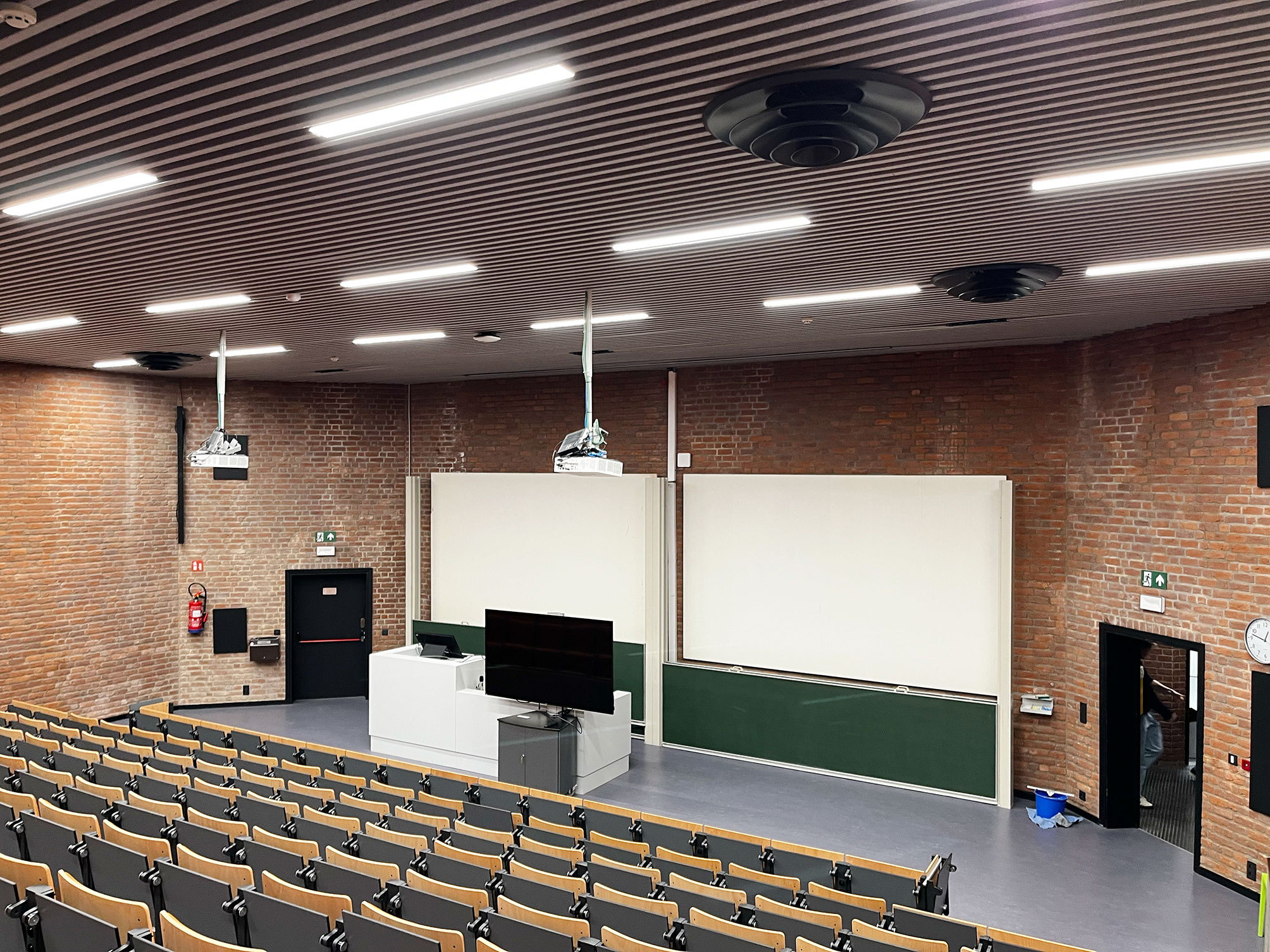
Today I was supposed to give an introduction to architectural photography. I had listed several approaches I would briefly touch on, showing work by Joel Sternfeld, Stephanie Kiwitt, Lynne Cohen, Thomas Ruff, Jeff Wall and Candida Höfer. I wanted to stress that the essence of architectural photography – and of photography as a whole – is to make the space outside the picture larger than the space within it.
The students never showed up. The secretary had forgotten to put my introduction on their timetable. While I was waiting in the empty auditorium, a colleague’s introduction to epidemiology in the auditorium next door suddenly boomed from my speakers.
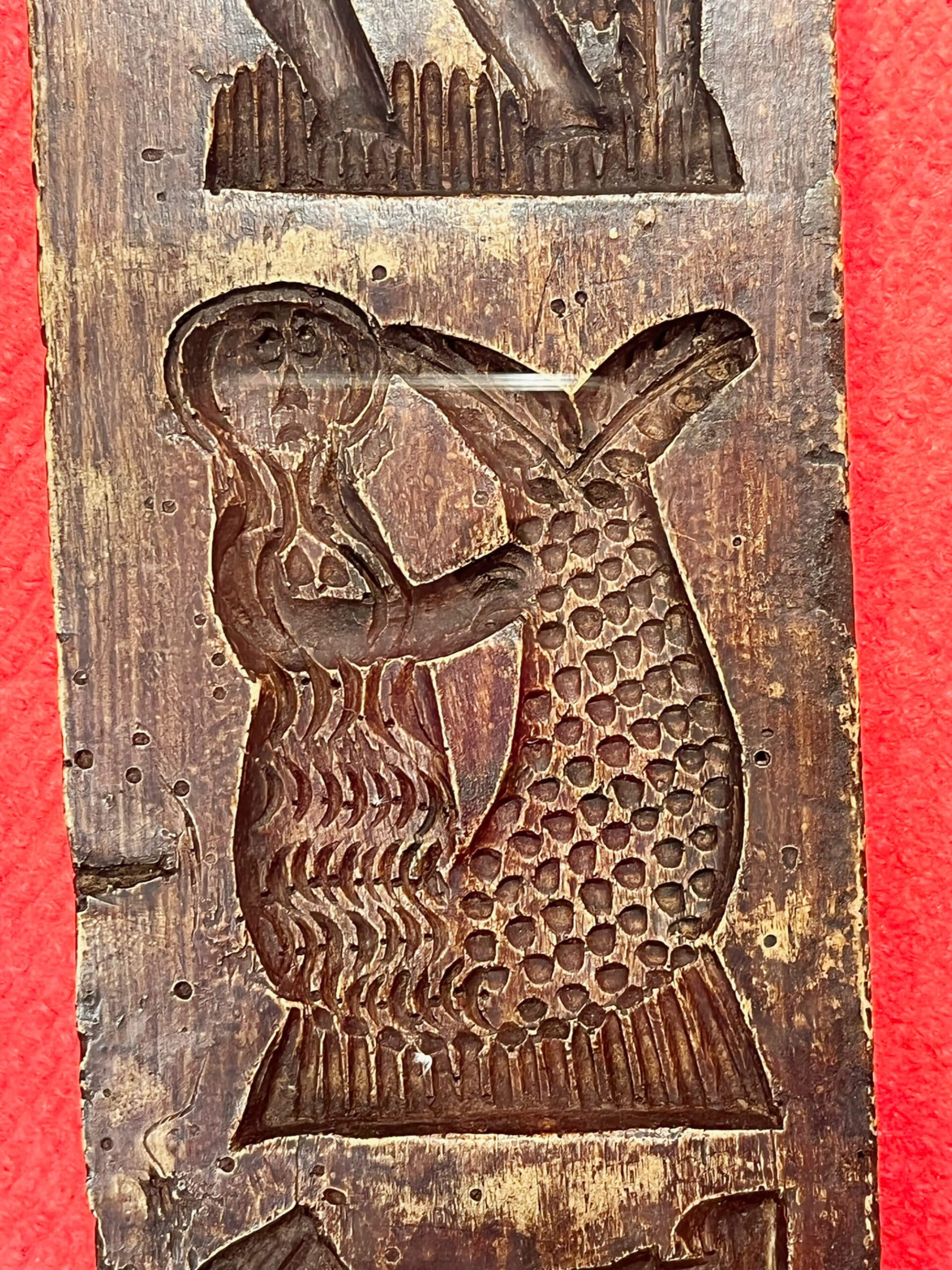
In Veurne, at the bakery museum, old speculaas moulds are presented in an almost religious fashion. Looking at these wooden blocks, they appear to be the negatives to Romanesque sculptures.
How does it feel to be conserved and showcased when your nature is to be a tool? What would it mean to re-use them, to fill those empty moulds, to shape something new without altering the matrix, to project what it would be like, to try out recipes and different baking, to learn from it and enjoy the results together? What scenes are even depicted? We lost part of their meaning, we could dig further, browse the books, ask our grandparents and collectively invent whatever narrative they might hold.
Clementine Vaultier’s interests, although trained as a ceramist, are in the warm surroundings of the fire rather than the production it engenders.
Besides the scale indicating the length in centimeters, and the marks made by using it, a folding ruler displays other marks. These are the marks found on the weber broutin www.weber-broutin.be folding ruler, from left to right:
- 2m (in a frame, between 1cm and 2cm); indicating the total length of the folding ruler.
- a hexagon, barely visible, punched into the wood (between 2cm and 3cm); unknown signification.
- LUXMA (in a frame, between 4cm and 5cm); the manufacturer of the folding ruler (different from the company who ordered the folding ruler, their (the company’s, i.c. weber-broutin’s) name is printed on the sides of the ruler, and is only readable when the ruler is folded together for at least 50% (=1m).
- III (in an oval, between 6cm and 7cm); indication of the preciseness of the scale in centimeters, with ‘I’ in roman numbers meaning the most precise, and ‘IV’ in roman numbers meaning the least precise. (It is therefore not entirely certain that the ‘III’ on weber-broutin’s folding ruler can actually be found between 6cm and 7cm.)
- D 99 (in an oval, probably between 7cm and 8cm, see argument mentioned above); unknown signification.
- 1.1.60 (in an oval, probably between 7cm and 8cm, beneath D 99), signification unknown.

At the State Archive in Kortrijk, I am leafing through a 1955 photo album of the construction of the provisional church in Lokeren by the famous furniture company Kunstwerkstede De Coene. Gigantic wooden, prefabricated beams structure the building. It is cold. An old man in a grey suit shuffles between the racks to look up the date of birth of his great great grandmother. Snow covers the unfinished provisional roof. A bus passes, I reckon, through the pouring rain.

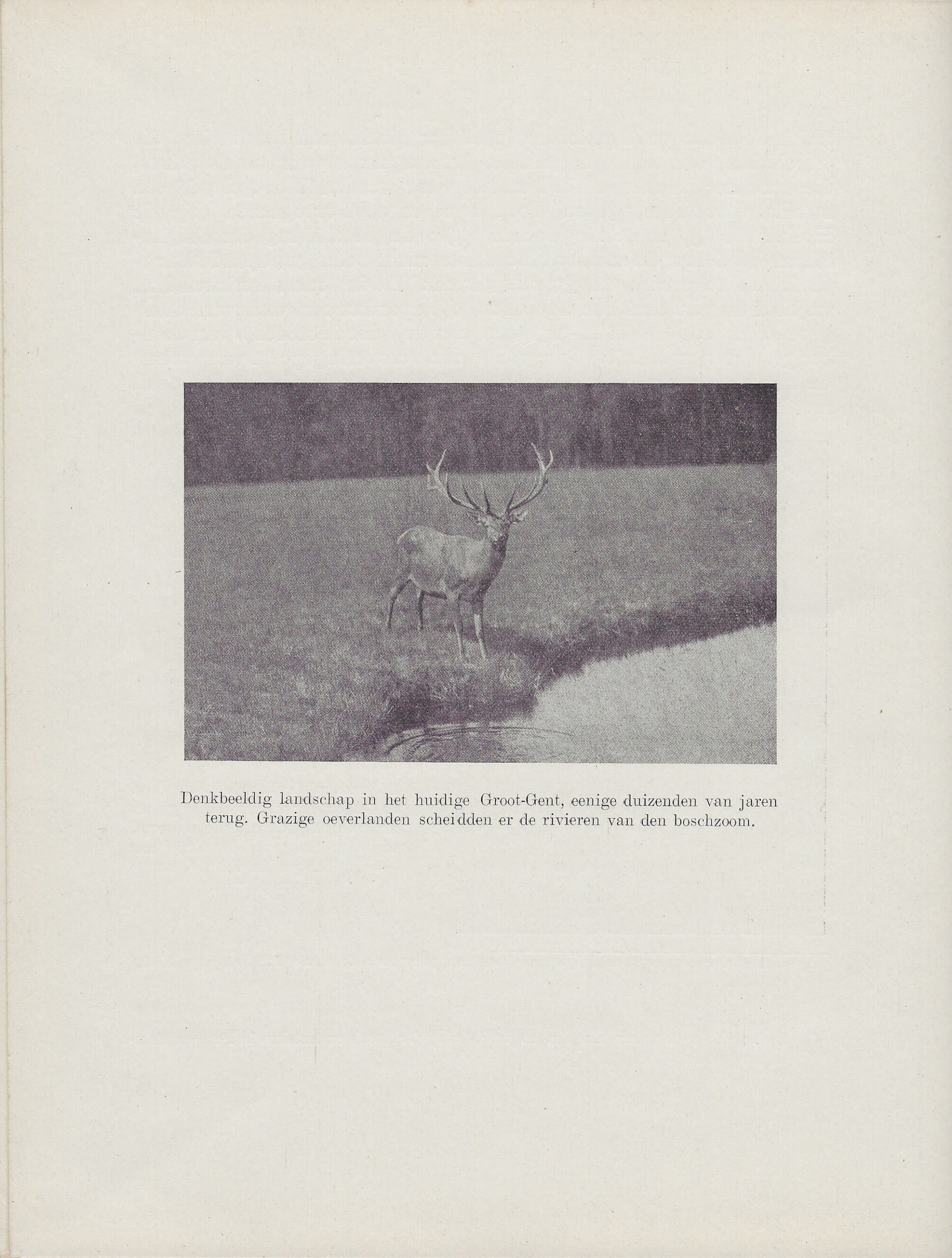
(‘Imaginary landscape in the actual greater Gent, some thousands of years ago. A grassy riparian zone separates rivers from the edge of the forests’)
Imagine a deserted city of Gent, overtaken by nature, Thiery asks the reader in his book Het woud (The Forest). After fifty years, you return to the city. Buildings have collapsed, streets are overgrown. It has become an impenetrable, dense forest, except for the river on which the reader makes his or her way through it. In the first half of the twentieth century, Leo Michel Thiery made one of Belgium’s first botanical gardens for educational purposes. In the middle of an industrialized quarter of the city of Gent, the garden presented different sceneries. There were landscapes from the Alps, dunes, the Ardennes, steppe. Besides sceneries with chalk-, loam-, marl- and sand-based vegetation, there were forests, grasslands and swamps.
After his death, Thiery’s garden decayed. Decades later, it was restored, with the Alps, dunes, the Ardennes and steppe now classified as a protected view.
Thiery, M. Het woud. Een proeve van plantenaardrijkskunde. Gent: De Garve, s.d., p. 14
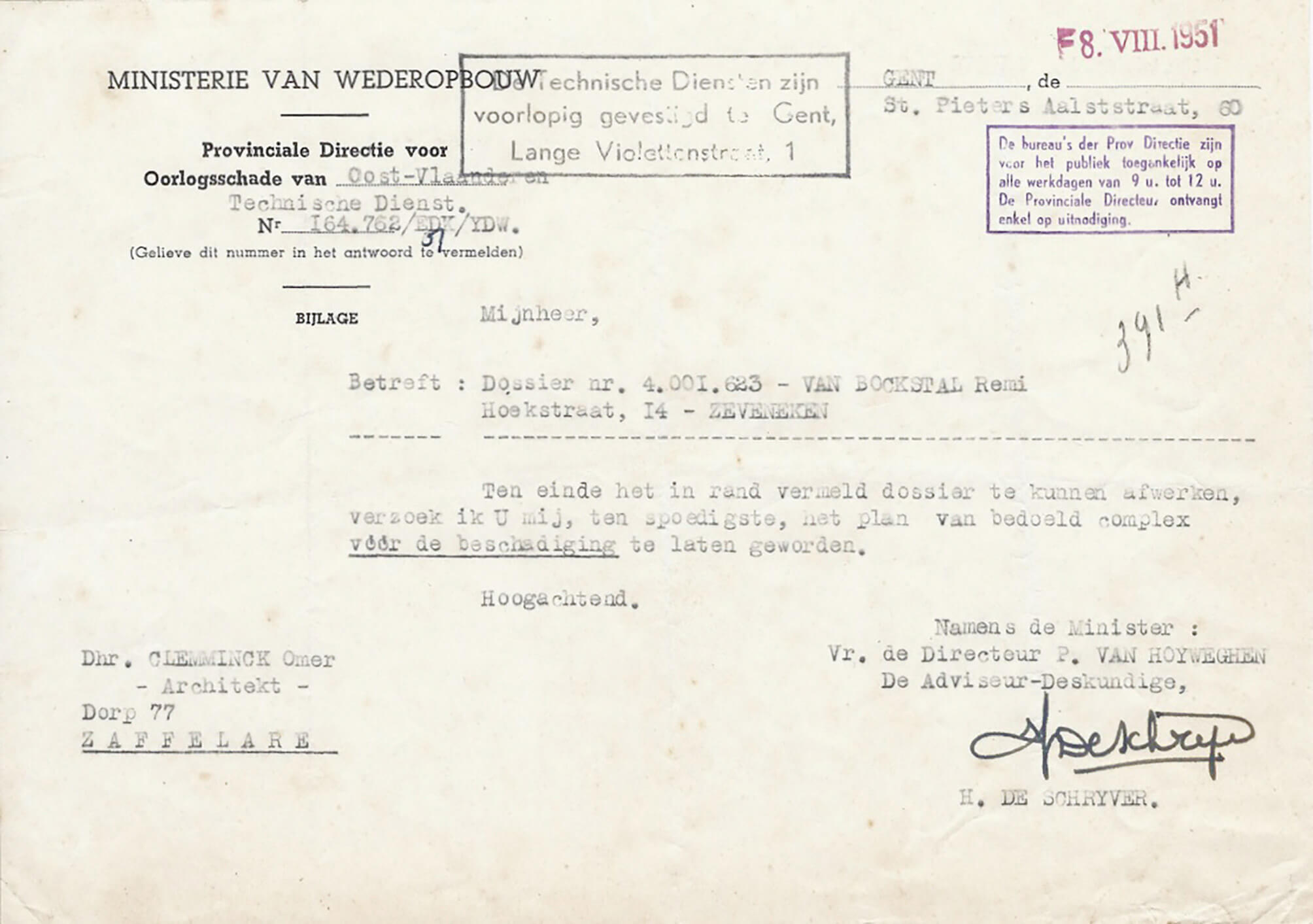
An architect in Z. receives a reminder. ‘Please send, as soon as possible, the plans of the construction before the damage.’ The reminder was sent by the Ministry of Reconstruction, in 1951. The architect’s address in Z., as mentioned in this file, is nowadays a house adjacent to Saloon Redbarn, a hall used for activities organized by a club of country and western-aficionados.
Semi-translucent paper, typoscript, stamps, handwritten notes and signature, from the archive of architect O. Clemminck, file ‘Remi Van Bockstael’
In Zaffelare, young men who were called for military service but could not be missed at home were advised by the local doctor to swallow a small ball of aluminium foil an hour before the examination. In the X-ray, a gastric ulcer appeared. They were rejected for service. It is uncertain whether the increased incidence of gastric ulcers among young men in Zaffelare was a cause for concern.

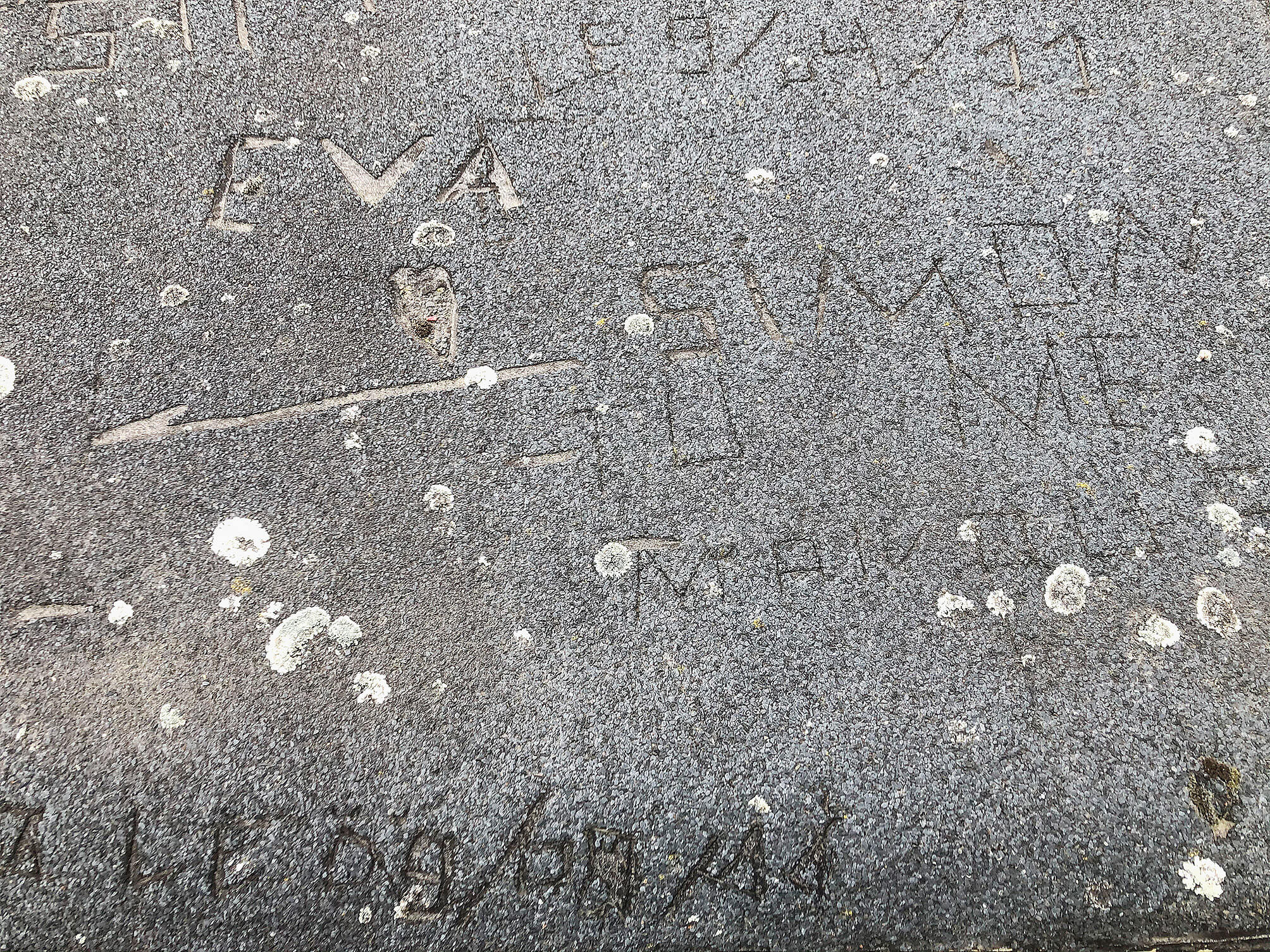
In what order and by whom the various texts and drawings were carved into the soft roofing is unclear. To the right of ‘EVA’, a heart symbol and an arrow (pointing to the left), the roofing reads ‘SIMON TU ME MANQUES’.
The short sentence usually – yet hastily – translates to ‘Simon, I miss you’. However, in French the ‘you’ (tu) is the subject and has an active role, whereas the ‘I’ (me) is the direct object. In short: by his not being there, Simon actively effectuates hurt to the one who carved this text.
In an attempt to make it his own, Gino – it might also be Dino – has taken a can of bright pink spray paint to his hard hat and – as the paint was drying – dragged his gloved finger from top to bottom. G – or D –, I, N, O. In the dust on a demolished floor tile, someone has written 12,10. Perhaps a measurement, a quantity, a position, a date, a reference.
Subtractive writing is not uncommon. With the tip of a passer-by’s index finger ‘WASH ME’ is subtracted from the dust on a dirty car. In freshly poured concrete, a name is embedded forever with a twig. In hot and soft roofing drawings and obscenities are scratched. Styrofoam lining a brand new elevator gets impressed with names, jokes and knuckles.
In the twenty-third canto of Ariosto’s Orlando Furioso (1516), Orlando comes across the name of his love and another man, carved in the bark of a tree. He doubts. But that night, a gossiping shepherd tells him he’s seen Angelica and Medoro together. Orlando returns to the forest, and in a four-day frenzy, he uproots every tree and pollutes the rivers forever.
CXXXI
For he turf, stone, and trunk, and shoot, and lop,
Cast without cease into the beauteous source;
Till, turbid from the bottom to the top,
Never again was clear the troubled course.
At length, for lack of breath, compelled to stop,
(When he is bathed in sweat, and wasted force,
Serves not his fury more) he falls, and lies
Upon the mead, and, gazing upward, sighs.1
Ariosto, L. Orlando Furioso. Translated by William Stewart Rose, Echo Library, 2006, p. 267.

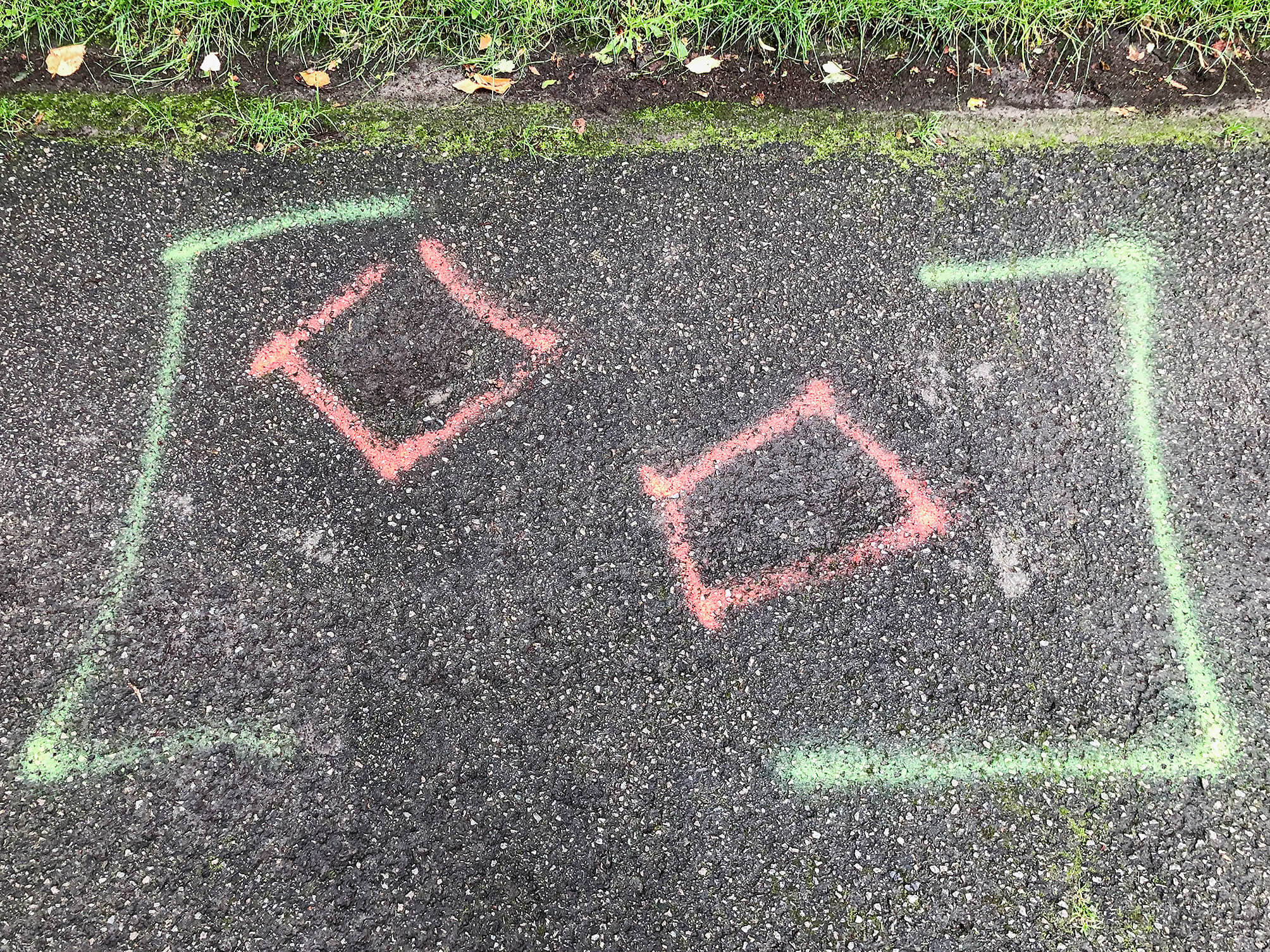
Holding two cans of spray paint, a city employee walks through a sweet chestnut grove on the graveyard. He’s looking for potholes.
In an attempt to make it his own, Gino – it might also be Dino – has taken a can of bright pink spray paint to his hard hat and – as the paint was drying – dragged his gloved finger from top to bottom. G – or D –, I, N, O. In the dust on a demolished floor tile, someone has written 12,10. Perhaps a measurement, a quantity, a position, a date, a reference.
Subtractive writing is not uncommon. With the tip of a passer-by’s index finger ‘WASH ME’ is subtracted from the dust on a dirty car. In freshly poured concrete, a name is embedded forever with a twig. In hot and soft roofing drawings and obscenities are scratched. Styrofoam lining a brand new elevator gets impressed with names, jokes and knuckles.
In the twenty-third canto of Ariosto’s Orlando Furioso (1516), Orlando comes across the name of his love and another man, carved in the bark of a tree. He doubts. But that night, a gossiping shepherd tells him he’s seen Angelica and Medoro together. Orlando returns to the forest, and in a four-day frenzy, he uproots every tree and pollutes the rivers forever.
CXXXI
For he turf, stone, and trunk, and shoot, and lop,
Cast without cease into the beauteous source;
Till, turbid from the bottom to the top,
Never again was clear the troubled course.
At length, for lack of breath, compelled to stop,
(When he is bathed in sweat, and wasted force,
Serves not his fury more) he falls, and lies
Upon the mead, and, gazing upward, sighs.1
Ariosto, L. Orlando Furioso. Translated by William Stewart Rose, Echo Library, 2006, p. 267.
A half a day’s walk from the Fuente Dé teleférico, there are less and less traces of passers-by. The path to Sotres suddenly runs through a lusher green. The fence between two pastures keeps the sheep from crossing and coincides with the border between two regions. A hole in the fence would change the landscape’s hue.

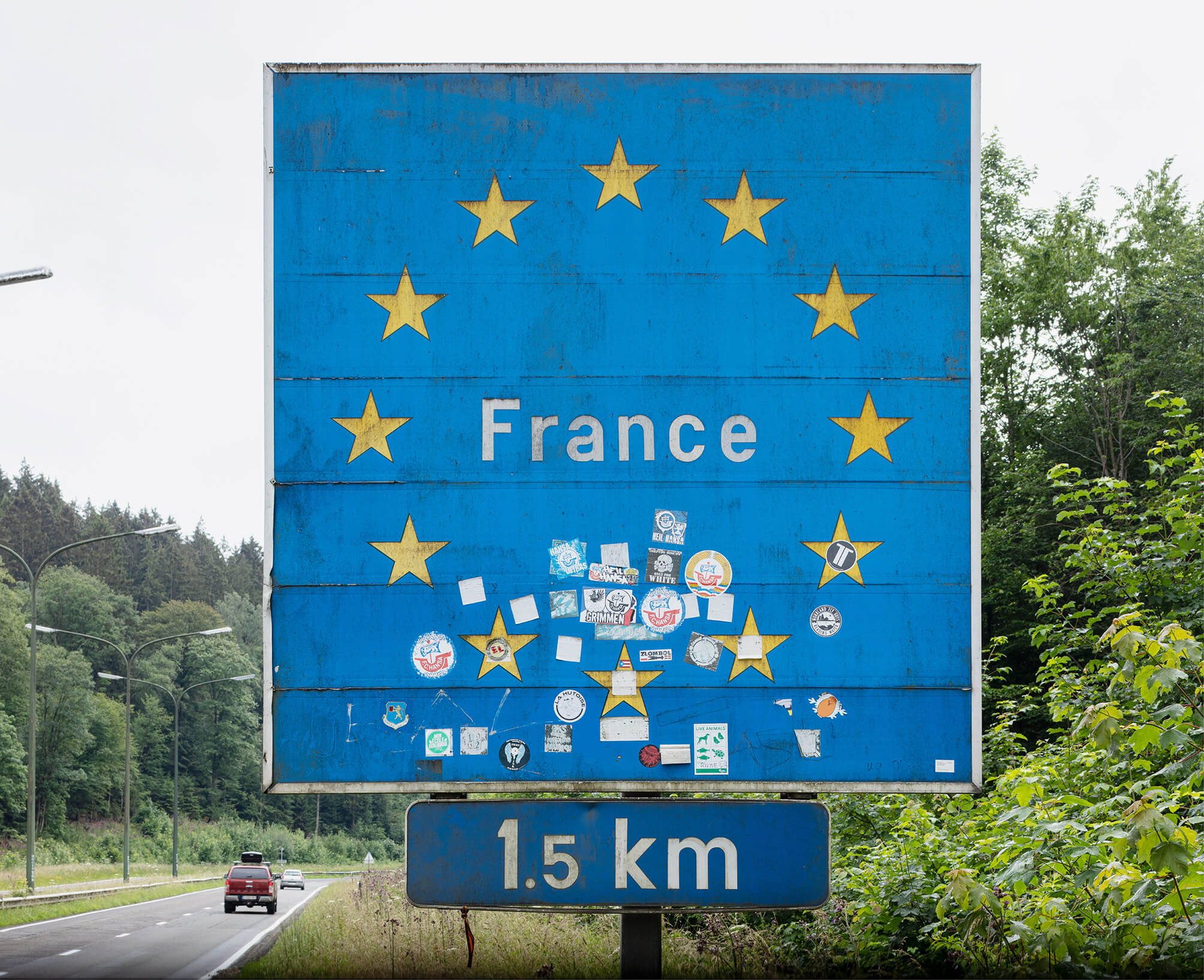
Belgium, approximately 1.5km from the French border, photograph made on 16.06.2018.
The European flag symbolises both the European Union and, more broadly, the identity and unity of Europe. It features a circle of 12 gold stars on a blue background. They stand for the ideals of unity, solidarity and harmony among the peoples of Europe. The number of stars has nothing to do with the number of member countries, though the circle is a symbol of unity.1
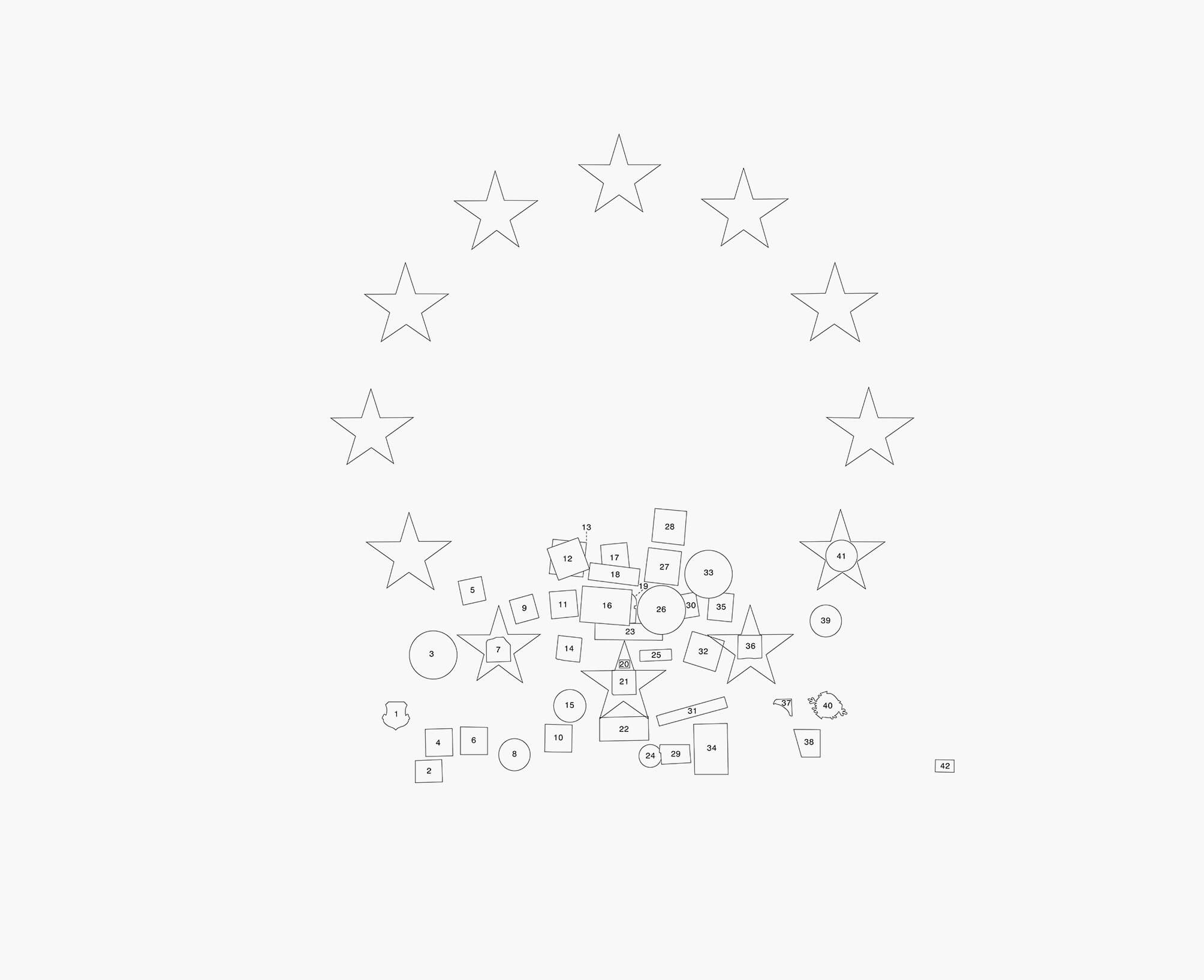
- Coat of arms of Gmina Puck, a rural district in Puck County, Pomeranian Voivodeship, in northern Poland.
- Illegible.
- F.C. Hansa, Mecklenburg, Pommern, FC Hansa Rostock is a German association football club based in the city of Rostock, Mecklenburg-Vorpommern. They have emerged as one of the most successful clubs from the former East Germany and have made several appearances in the top-flight Bundesliga. Hansa Rostock’s official anthem is “FC Hansa, wir lieben Dich total”. Hansa struggles with hooliganism, estimating up to 500 supporters to be leaning towards violence. The club’s logo consists of a red sailing ship with a blue sail showing the Rostock Griffin.
- Mon École Écologique.org is an organization for environmental conservation. On 07.01.2021 there was no website listed on this URL.
- Illegible.
- Illegible, apart from ’1962’ in the middle.
- Innocenti Bruderschaft, EL, 2018, a community of German Lambretta Innocenti riders and aficionados.
- Imag’Ink, Bretignolles Sur Mer, Tatoueur, 06 06 44 13 51, a French tattoo shop.
- Illegible.
- Hardly legible, the only word that can be made out is ‘Futbolom’: Russian for soccer.
- Kaluga on tour. Kaluga is a Russian city 150km southwest of Moscow. It is often called the cradle of space exploration thanks to the city’s most famous resident: Konstantin Tsiolkovsky.
- Hansa Ultras, F.C. Hansa. The Ultras are a group of F.C. Hansa fans (see: ‘3’).
- Illegible because ‘12’ was stuck over it.
- Illegible.
- La Hutoise is a regional student-association for higher education students from the Belgian town of Huy and its surroundings. Its aim is to bring together students from Huy in a spirit of camaraderie and to perpetuate student folklore. The logo consists of a two headed bird of prey with a cap on each head. The bird wears a scarf over one shoulder and holds a glass of beer in each paw.
- F.C. Hansa, Grimmen. The F.C. Hansa logo (see ‘3’ and ‘12’) is combined with the coat of arms of Grimmen: a griffin on a pile of 10 bricks. Grimmen is a German town in Nordvorpommern on the banks of the river Trebel.
- Illegible.
- Heil Hansa. To the left of this text the F.C. Hansa logo (see ‘3’, ‘12’ and ‘16’), on the right a logo consisting of a black bull with his tongue out and a golden crown on his head. This controversial sticker lead to several arrests in the run-up to the match between F.C. Hansa Rostock and Bayern München in February 2020. Supporters of F.C. Hansa had attached this sticker to public buildings on their way to the stadium.
- Illegible because ‘16’ was stuck over it.
- The Cuban flag.
- Illegible.
- Illegible.
- Kaluga (see ‘11’).
- De Veterinnen, a round, black sticker with a red print of a head wearing a round hat and a carnivalesque collar with a carrot for a nose. No further information found.
- Zlombol 11. Złombol is a yearly charity car rally racing event that starts in Katowice Poland. Contesters must drive a car that was built or designed during the communist era. The destination of the 2011 edition was Loch Ness.
- F.C. Hansa, Mecklenburg, Pommern, identical sticker to ‘3’, see also ‘12’, ‘16’, and ‘18’.
- Torpedo Moscow, only for white. Football club Torpedo Moscow is a Russian professional club based in Moscow, founded in 1930. Some fans of the club wave far-right symbols and banners, both during and outside of matches. Massive fan-protest ensued when the club tried to sign a black player in 2018. The player’s contract was cancelled.
- Heil Hansa. See ‘3’, ‘12’, ‘16’, ‘18’ and ‘26’.
- Illegible.
- Illegible.
- Illegible.
- Illegible.
- F.C. Hansa. Variation of ‘3’ and ‘26’ with a circle of yellow crops around the logo. See also ‘12’, ‘16’, ‘18’ and ‘28’.
- Live animals, contents: Rivne UA. These stickers are required by the International Air Transport Association for airline cargo pet travel. Rivne is a city in western Ukraine (UA) with an international airport. The sticker does not specify the transported animal but displays a dog, two birds, two fish and a turtle.
- Illegible.
- Illegible.
- Illegible.
- Illegible, apart from ‘lska’ on the bottom.
- Norrland Fly Guys, Reading Water. The sticker displays a minimal landscape with two pine trees, and a shed on a chunk of floating ice, a single four-point star shines in the sky. Norrland is the northernmost part of Sweden. No further information found. Whether the ‘fly guys’ own airplanes or are involved in fly fishing is unclear.
- This sticker displays – what appears to be – a smiling potato in front of an enlarged snow crystal. No further information found.
- Traumsucht is an artist collective from Berlin. Their website lists German rap-artists
- Illegible.
https://europa.eu/european-union/about-eu/symbols/flag_en
The GPS-plotter displays the ship near Keyhaven Lake, indefinitely. The sea appears calm, the horizon is level from one perspective.

In his Handboek Varende Scheepsmodellen (Handbook Sailing Ship Models) André Veenstra explains the different classes in ship model-competitions. There’s a wide variety. For static ship models the most important one is ‘truth-to-nature’. A jury compares the model to photographs of the actual ship and brings into account categories such as amount of work, degree of difficulty, scale ratio, construction execution and painting.
The most interesting class – according to Veenstra – is F 6. In this particular class, a number of participants with different boats will form a team. Together, they will perform a certain ‘act’ with a maximum duration of ten minutes. During the act, they mimic a slice of reality. Such as, for example, ‘rescuing’ and towing a ship in distress; extinguishing a fire on a tanker or oil rig, lichen and/or tow the sunken wreckage to the harbor, stage a naval battle, etc.
Page 262 shows a photograph of such a mimicked slice of reality. The caption explains: ‘Image 14.15. The Dutch demonstration in the F 6 class during the European Championship of 1975: the oil rig is set on fire by a motorboat with terrorists. The fire is extinguished and the oil rig is quickly towed to a safe harbor by tugs. The show was performed by six people and took a very creditable fourth place.’
