What constitutes a ‘document’ and how does it function?
According to the Oxford English Dictionary, the etymological origin is the Latin ‘documentum’, meaning ‘lesson, proof, instance, specimen’. As a verb, it is ‘to prove or support (something) by documentary evidence’, and ‘to provide with documents’. The online version of the OED includes a draft addition, whereby a document (as a noun) is ‘a collection of data in digital form that is considered a single item and typically has a unique filename by which it can be stored, retrieved, or transmitted (as a file, a spreadsheet, or a graphic)’. The current use of the noun ‘document’ is defined as ‘something written, inscribed, etc., which furnishes evidence or information upon any subject, as a manuscript, title-deed, tomb-stone, coin, picture, etc.’ (emphasis added).
Both ‘something’ and that first ‘etc.’ leave ample room for discussion. A document doubts whether it functions as something unique, or as something reproducible. A passport is a document, but a flyer equally so. Moreover, there is a circular reasoning: to document is ‘to provide with documents’. Defining (the functioning of) a document most likely involves ideas of communication, information, evidence, inscriptions, and implies notions of objectivity and neutrality – but the document is neither reducible to one of them, nor is it equal to their sum. It is hard to pinpoint it, as it disperses into and is affected by other fields: it is intrinsically tied to the history of media and to important currents in literature, photography and art; it is linked to epistemic and power structures. However ubiquitous it is, as an often tangible thing in our environment, and as a concept, a document deranges.
the-documents.org continuously gathers documents and provides them with a short textual description, explanation,
or digression, written by multiple authors. In Paper Knowledge, Lisa Gitelman paraphrases ‘documentalist’ Suzanne Briet, stating that ‘an antelope running wild would not be a document, but an antelope taken into a zoo would be one, presumably because it would then be framed – or reframed – as an example, specimen, or instance’. The gathered files are all documents – if they weren’t before publication, they now are. That is what the-documents.org, irreversibly, does. It is a zoo turning an antelope into an ‘antelope’.
As you made your way through the collection,
the-documents.org tracked the entries you viewed.
It documented your path through the website.
As such, the time spent on the-documents.org turned
into this – a new document.
This document was compiled by ____ on 16.12.2025 10:54, printed on ____ and contains 30 documents on _ pages.
(https://the-documents.org/log/16-12-2025-6732/)
the-documents.org is a project created and edited by De Cleene De Cleene; design & development by atelier Haegeman Temmerman.
the-documents.org has been online since 23.05.2021.
- De Cleene De Cleene is Michiel De Cleene and Arnout De Cleene. Together they form a research group that focusses on novel ways of approaching the everyday, by artistic means and from a cultural and critical perspective.
www.decleenedecleene.be / info@decleenedecleene.be - This project was made possible with the support of the Flemish Government and KASK & Conservatorium, the school of arts of HOGENT and Howest. It is part of the research project Documenting Objects, financed by the HOGENT Arts Research Fund.
- Briet, S. Qu’est-ce que la documentation? Paris: Edit, 1951.
- Gitelman, L. Paper Knowledge. Toward a Media History of Documents.
Durham/ London: Duke University Press, 2014. - Oxford English Dictionary Online. Accessed on 13.05.2021.

‘Exit at the dock and kill some rats. Go around the building to the left, killing the guard and his rats before flipping the switch. Another guard arrives kill him too, taking the medkits from both your victims. Enter the now open front door and kill the guard on the balcony and his friend who appears on the ground floor. Grab the shells from your second kill then shoot out the window and kill the Dobermans who jump through when you get too close.’
Tomb Raider II. The Complete Guide to the Dagger of Xian. Downloaded from http://www.the-spoiler.com on 4 August, 1999, at 15:03.

Bricks and stones of various origin (aerated concrete blocks, clinker bricks, quarry stones).
From Fortlaufend/Ongoing
Stephanie Kiwitt (1972) is an artist based in Halle (Saale), Germany. Utilizing a large number of images, various perspectives and also textual elements, she is known for her insightful photography that explores spaces emblematic of contemporary phenomena. Over the past three years, she has focused on evolving habitats in rural areas, photographing traces of transformation and conducting interviews in Saxony-Anhalt, the region she moved to in 2020. From 2018 to 2020, Kiwitt was a guest lecturer at the LUCA School of Arts in Brussels.
In spring 2024 the-documents.org and Trigger co-publish a series of online articles with a focus on the meeting ground between photography and the document.

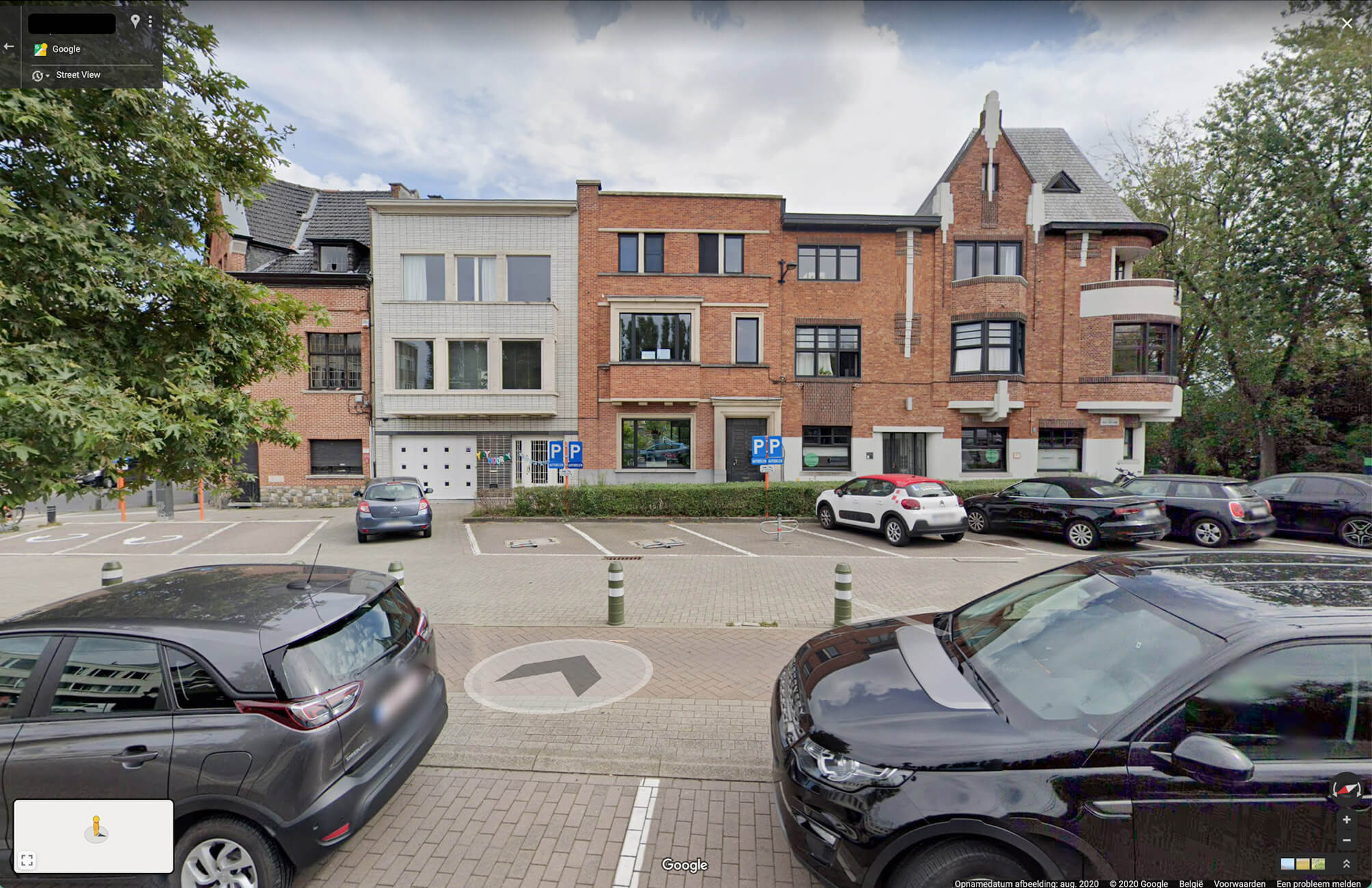
Depending on the perspective one chooses to look at the address, the house is adorned or not. The perspective from the main road is an image made in August 2020, the website (Google Maps) says. Our car is in front of the garage. It must be the end of August. We drive home from the hospital with the newborn, who doesn’t stop crying. Maybe I tightened the belts in the car seat too much. Arriving at our house, we see the slogans and decorations friends have hung at our front door. On the sill of the neighbour’s first floor window, there’s a brick that must have fallen from the second floor facade.
The last couple of days have been dry. Rain is expected for the weekend. The office buckets are in place and are empty, except for some residue. Dirt, sand, a few hairs. Some particles must have come along with the drops when they made their way through the roof.

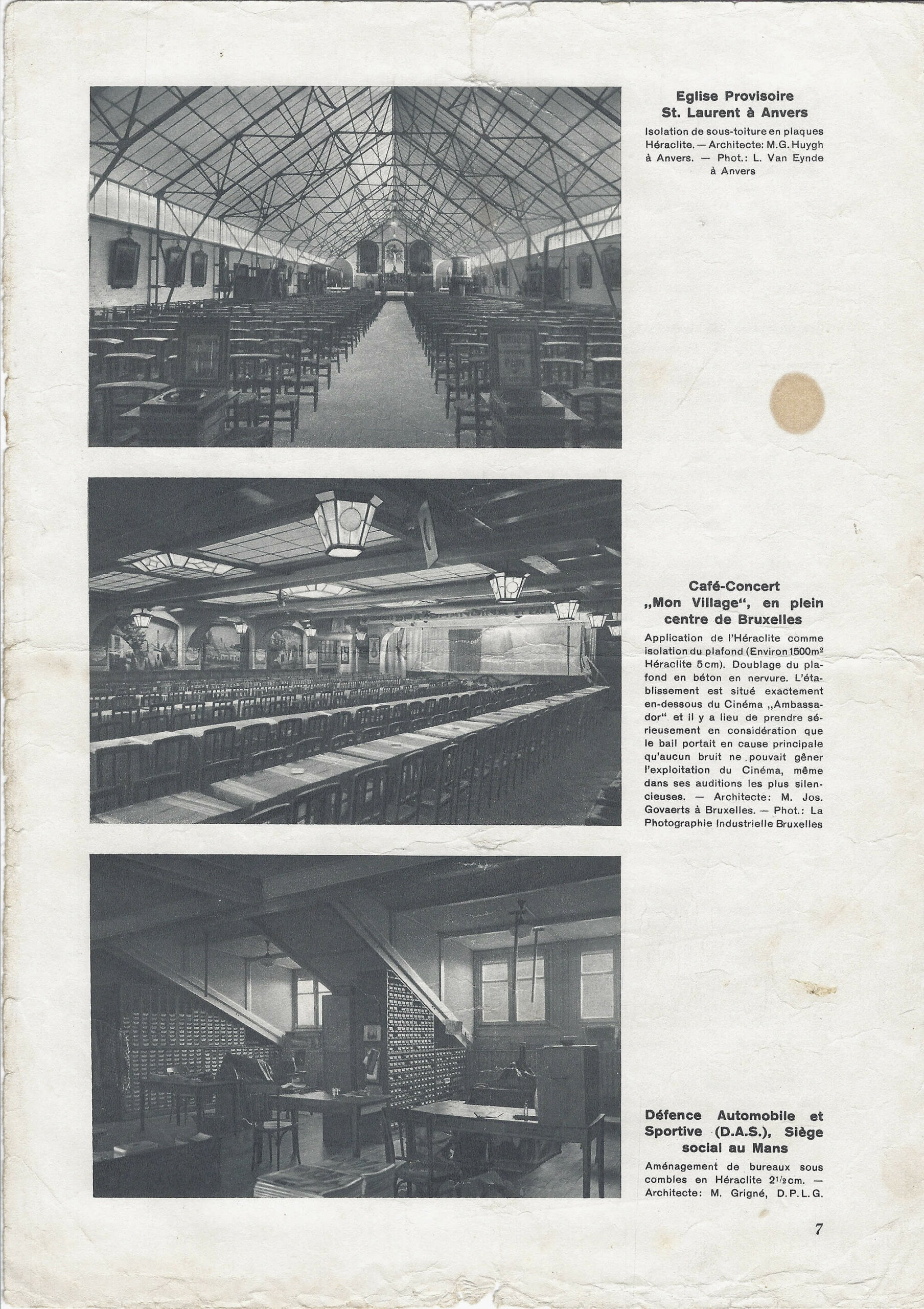
All chairs are empty, but all face something different. The bottom photograph shows empty chairs facing empty desks. In the middle picture, empty chairs face each other (underneath the inaudible sound of the cinema above). In the top photograph, the chairs seem to be facing the photographer. However, the altar’s in front of the photographer. He stands at the back of the provisional church. The chairs face the photographer and have turned their backs to the altar.
Revue Héraclite, 5 (1), april 1936, p. 7, paper, from the archive of architect O. Clemminck.
Robert Nemiroff and Jerry Bonnell’s lesser known project (R.N. and J.B. being the creators of Astronomy Picture of The Day), was making websites containing over a million of digits of square roots of irrational numbers, e.g. seven. ‘They were computed during spare time on a VAX alpha class machine over the course of a weekend. […] We believe these are the most digits ever computed for the square root of seven on or before 1 April 1994.’ Elsewhere, R.N. states: ‘They are not copyrighted and we do not think it is legally justifiable to copyright such a basic thing as the digits of a commonly used irrational number.’ If one wanted to get a copy of the 10 million digits of the square root of the number e R.N. and J.B. computed in their spare time, one can send an email to R.N. at nemiroff@grossc.gsfc.nasa.gov.
https://apod.nasa.gov/htmltest/gifcity/sqrt7.1mil
https://apod.nasa.gov/htmltest/rjn_dig.html
https://apod.nasa.gov/htmltest/rjn.html

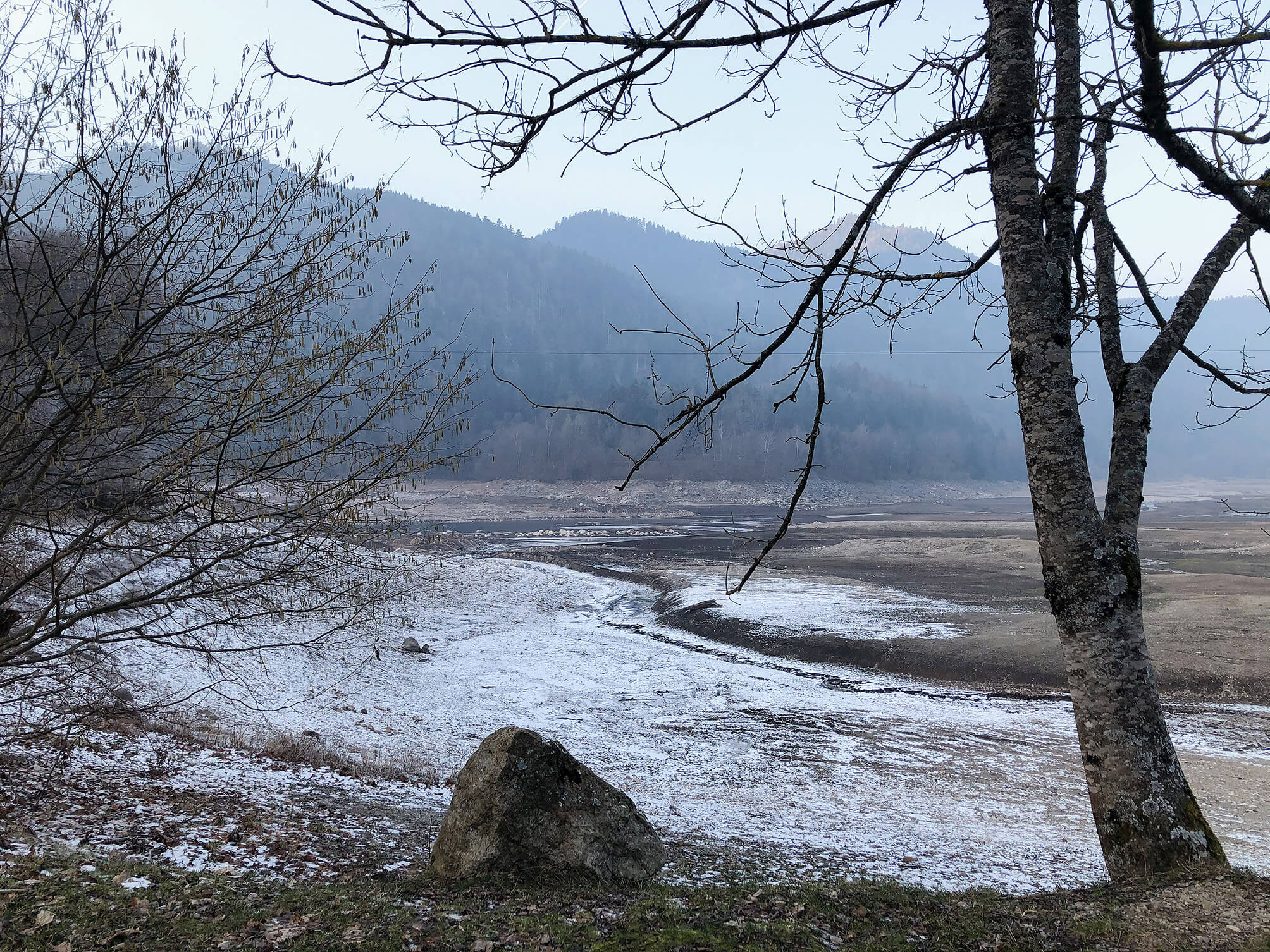
December, 1947. Rapid snowmelt coincides with torrential precipitation. At the bottom of the Thur valley, in Wildenstein, the water gathers.
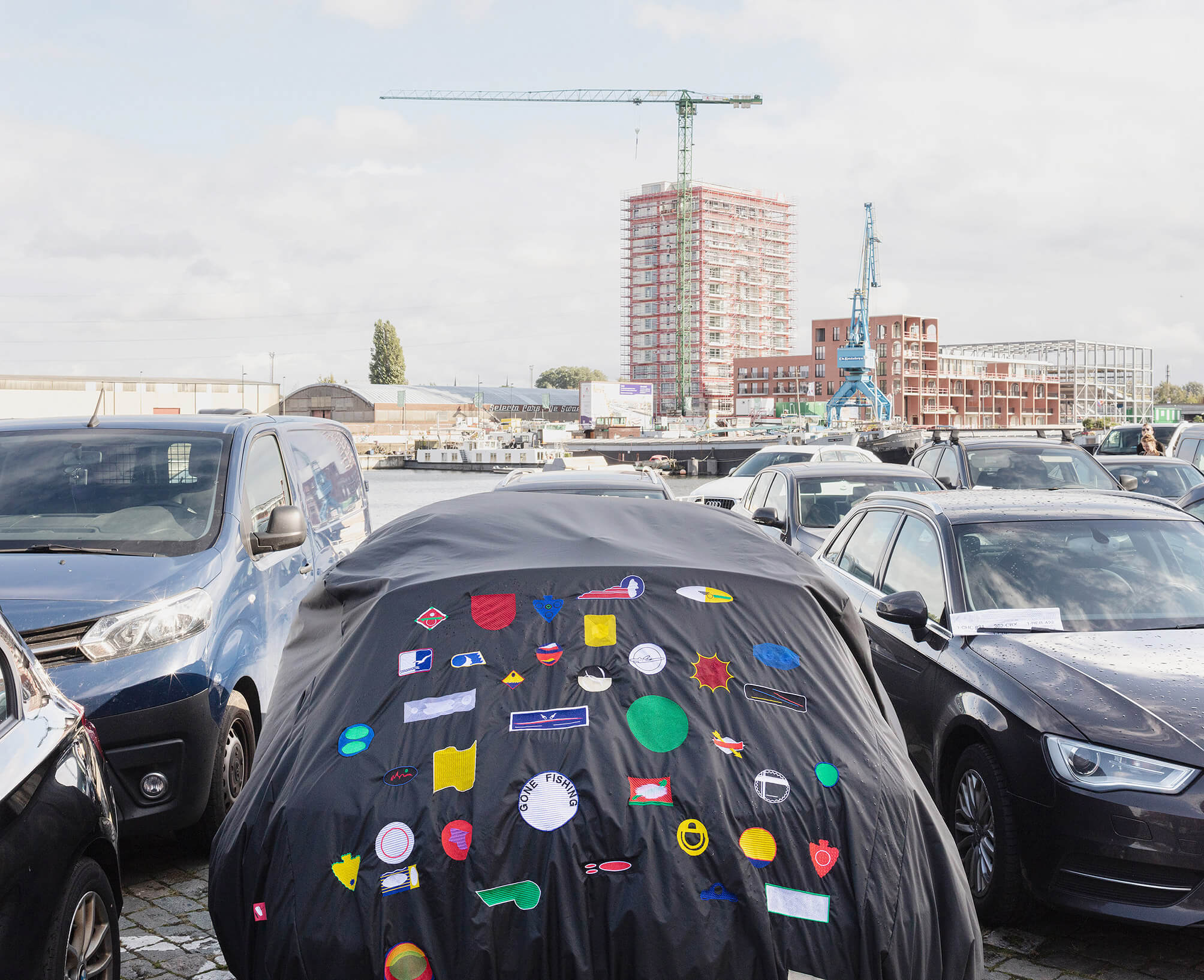
A year before the crash, Swiss artist Charlotte Stuby designed a tailor-made cover for the car. The dents caused by the unfortunate hailstorm weren’t visible. The work, called Gone Fishing, was on view during an open air exhibition on the theme of the parking lot. Heavy wind had caused the temporary traffic signs on the parking lot, left there by the city services, to tip over. One hit a car and caused a scratch. It was unclear if this would be something the insurance company would accept. We attached Stuby’s cover a second time. Parking fines flew irregularly across the lot.
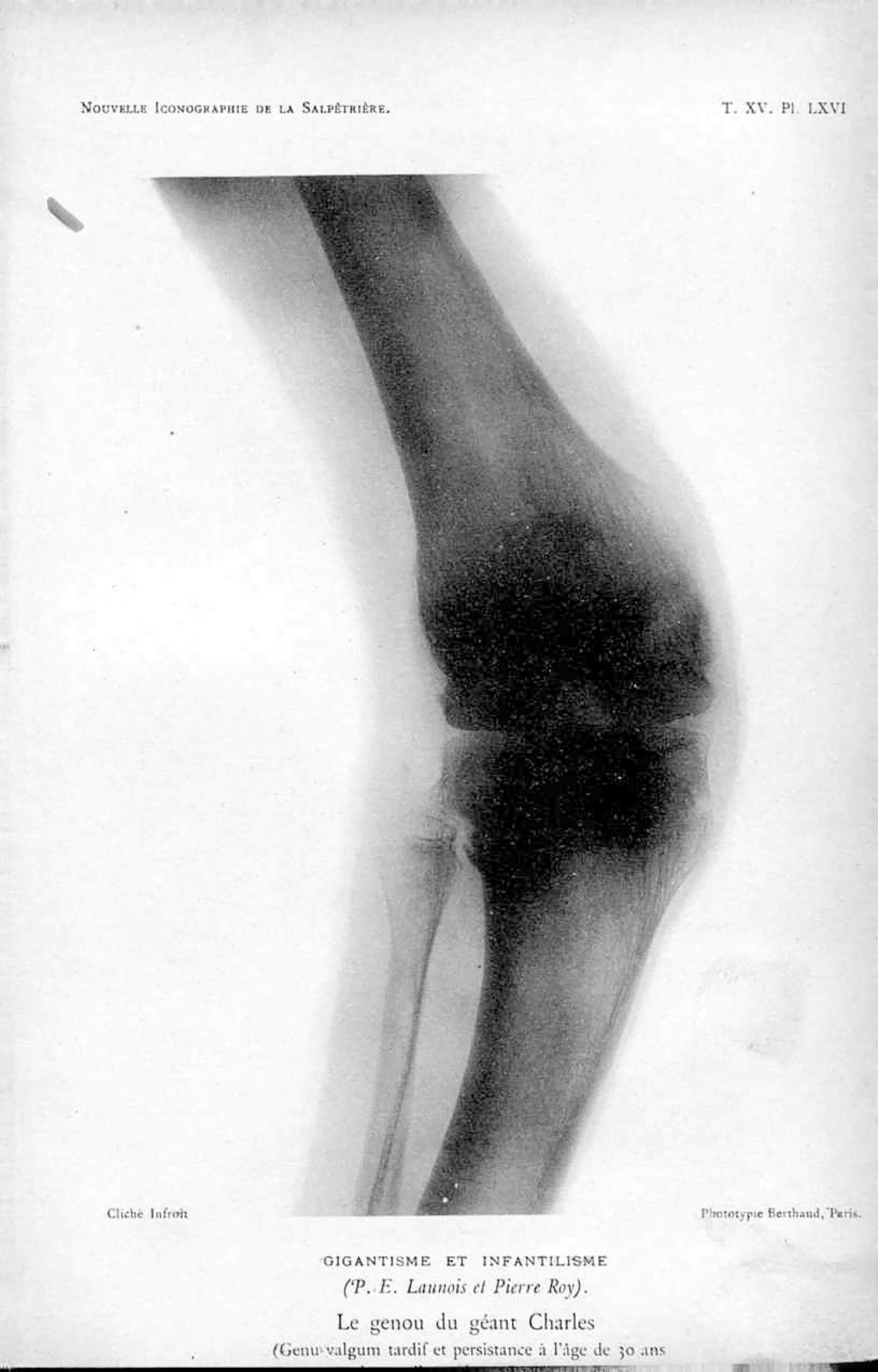
The scientific exactitude sought for in the Iconographie de la Salpêtrière and the Nouvelle Iconographie de la Salpêtrière, the (in)famous scientific publications stemming from Paris’ psychiatric hospital La Salpêtrière (1876-1918), lead to an abundance of photographic images in their pages. The photographs’ ideal: ‘Trace incontestable, incontestablement fidèle, durable, transmissible’.1 The ambition of exactitude results in cold, and often cruel depictions of patients. In the digitized version of the Sorbonne library’s copies, some photographs have left an imprint on the opposite page. The knee of Charles, ‘le géant’, adds an unwanted layer upon its measures on the opposite page, while the photograph of the knee itself loses ink.2
Didi-Huberman, G. Invention de l’hystérie. Paris: Macula, 2014, 72.
Launois, P.-E., Roy, P., ‘Gigantisme et infantilisme’, Nouvelle Iconographie de la Salpêtrière, Tome XV, 1902, 548, pl. LXVI, online: https://patrimoine.sorbonne-universite.fr/fonds/item/2613-nouvelle-iconographie-de-la-salpetriere-tome-15?offset=6

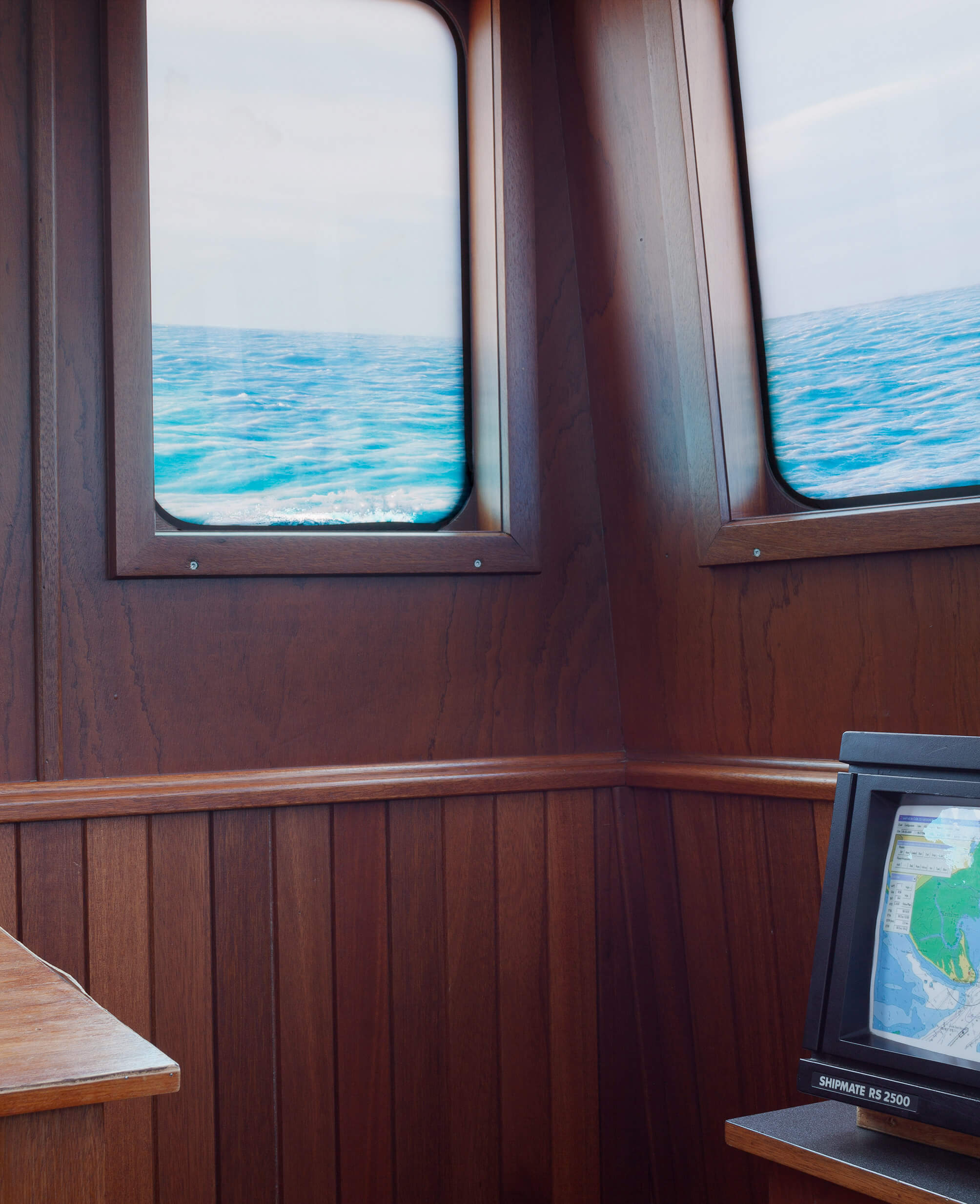
The GPS-plotter displays the ship near Keyhaven Lake, indefinitely. The sea appears calm, the horizon is level from one perspective.
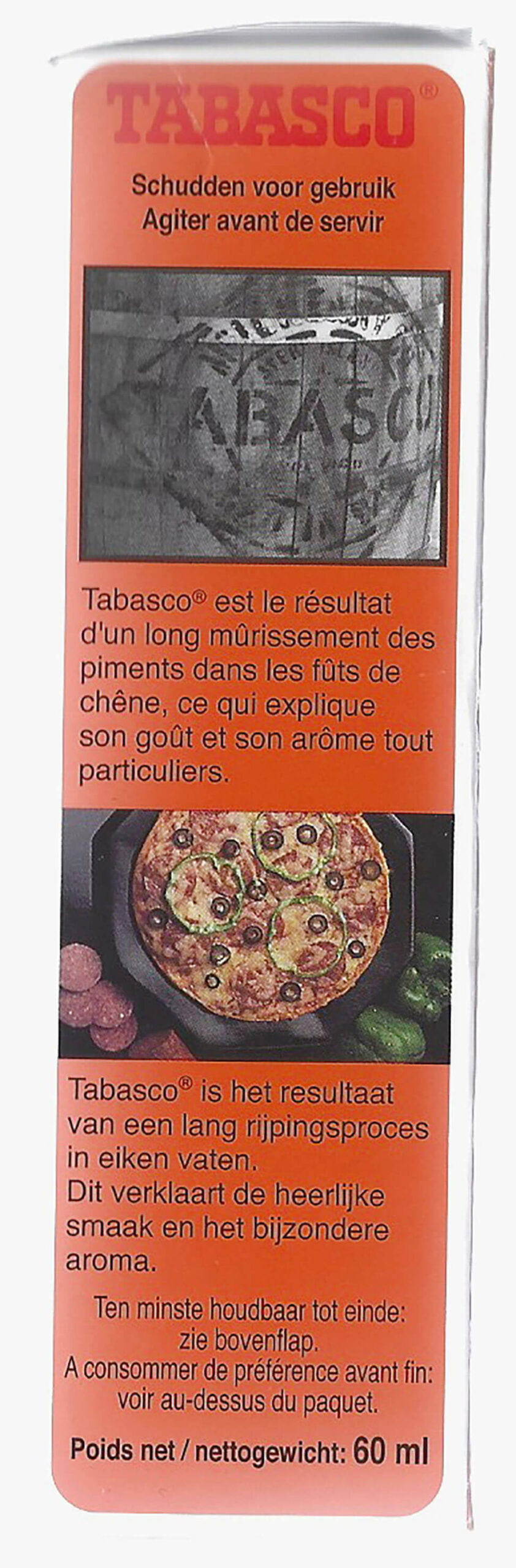
It must have been four or five years ago, that I noticed the change in Tabasco’s® up until then stable, unchanged and thus kind of unfashionable presence in supermarkets (vinegar section). On one of the box’s sides, there had always been a photograph of a man, clipboard in hand, looking upwards to a huge wooden barrel full of Tabasco®. He was inspecting something, from the outside, writing it down.
A couple of years ago, the man disappeared from the packaging. I think he was replaced by a pizza (as one of the suggestions for using Tabasco® on, besides on hashed meat (with an egg yolk, fries and lettuce) and spaghetti bolognese) or a black-and-white image of a part of an oak barrel. It is unclear who is inspecting the barrels now.
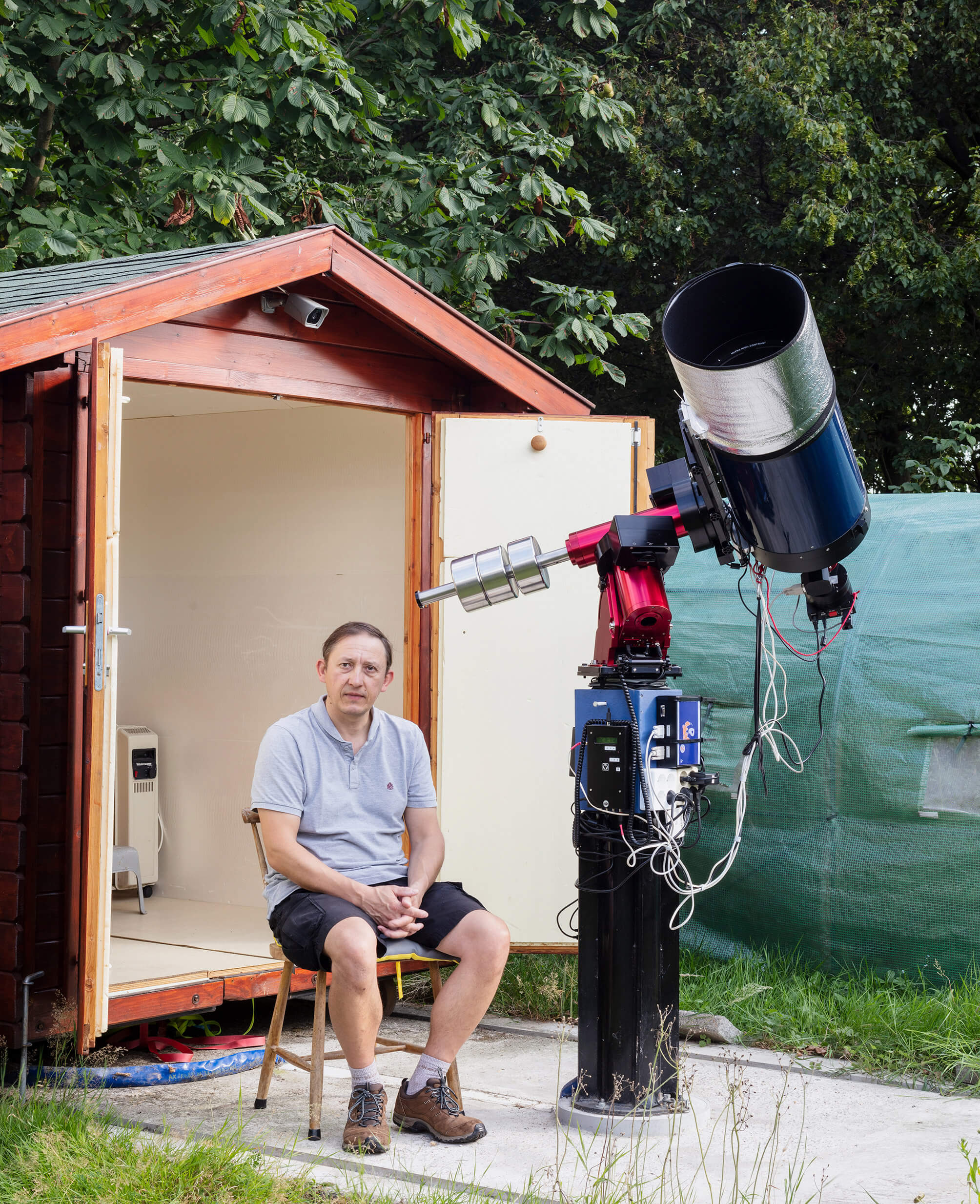
Summer 2019, between the swingset and the mesh greenhouse, astrophotographer Angelo Van Daele closes the observatory. The wheels roll smoothly across the rails embedded within a concrete slab. His former observatory is now a chicken coop. His neighbour’s trees need pruning. The camera mounted on the exterior of the shed allows him to see the instrument from inside the house.
French writer Raymond Queneau did extensive research into what he called hétéroclites, and at other times fous littéraires, a continuation of a longstanding bibliographic project of assembling texts proposing eccentric theories that were never picked up by the scientific community. Disappointed by the results of his research and unable to find a publisher, he abandoned the idea of publishing the encyclopaedia he was compiling. Later, in his encyclopaedic novel Les enfants du limon, he picks up the thread, from a different perspective. It tells the story of two quirky characters, Chambernac and Purpulan, wanting to compile an encyclopedia on fous littéraires. The novel cites from the texts they have dug up. The novel ends when they give up on the project, and give their findings to a novelist they meet and who says to be interested in the material, and asks if it would be OK if he’d attribute it to a character in a story he’s writing. Chambernac agrees, asking the name of the novelist he’s meeting: ‘Monsieur comment?’ – ‘Queneau’.
Queneau, R. Aux confins des ténèbres. Les fous littéraires du XIXe siècle (M. Velguth, red.). Paris: Gallimard, 2002.
Queneau, R. Les enfants du limon. Paris: Gallimard, 2004 [1938].

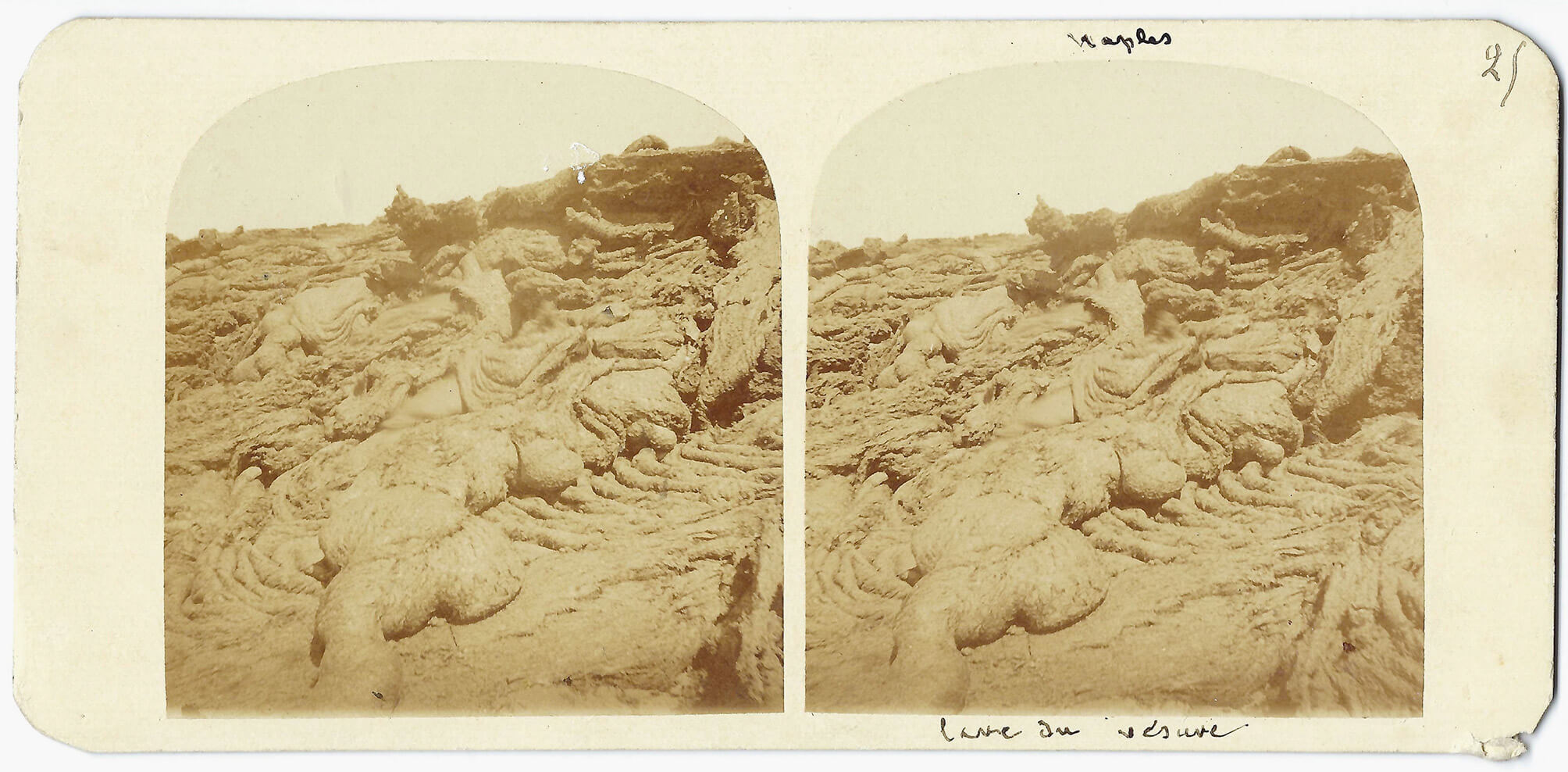
According to art critic Rosalind Krauss, nineteenth-century stereographic images presented ‘views’, not ‘landscapes’. Looking at a stereographic image through a stereoscope involves a particular experience that is altogether different from looking at other types of photographs, or paintings, as it is defined by ‘the isolation of the viewer with an image from which surrounding interference is masked out‘.1 An image of a violent and sudden eruption, higher up on the mountain, hanging next to a stereographic image of a petrified lava flow, would not be perceived.
Krauss, R. The Originality of the Avant-Garde and Other Modernist Myths. Cambridge, Mass./London: The MIT Press, 1986, 139.
Until recently, for as long as I could remember, the packaging of Tabasco® Pepper Sauce had been unchanged. On the front of the packaging, there is a photograph of a bottle of Tabasco®, scale 1:1, against an orange background.As far as packaged goods go, this is a highly idiosyncratic and quirky example.
The background colour approximates the colour of the liquid inside the bottle, resulting in as good as no contrast. Moreover, as the image of the bottle is scale 1:1, the packaging becomes kind of unnecessary and superfluous, also because the life-sized image of the bottle is the only way information is given to the customer: there are no additional slogans, no repetition of the brand name, no props and no decor. The image of the bottle advertises the bottle. It seems to add nothing the bottle could not do by its own (like a bottle of wine does).
What makes the packaging truly stand out, however, is the fact that the image of the bottle is not positioned vertically, but is slightly askew. It seems to be the result of a design error, and has an amateur feel to it. The decision to keep it as such and not correct it up until today, is, however, a stroke of genius. The non-vertical positioning alters the relation of the image of the bottle to the bottle inside: as the box is standing on a shelf, the tilted image of the bottle undermines its representational superfluousness.

‘My backyard is oriented perfectly, I can see the entire southern sky without obstructions.
In two years, they will start building an apartment block, though, two floors high with a roof on top. The height is not a problem, but of course it does mean heat and potential turbulence. I just hope they will be well insulated.
This is what I like doing. I have never been interested in remote observations.1 In my backyard. I hear the geese flying overhead at night. An owl. The silence. I want to be near.’
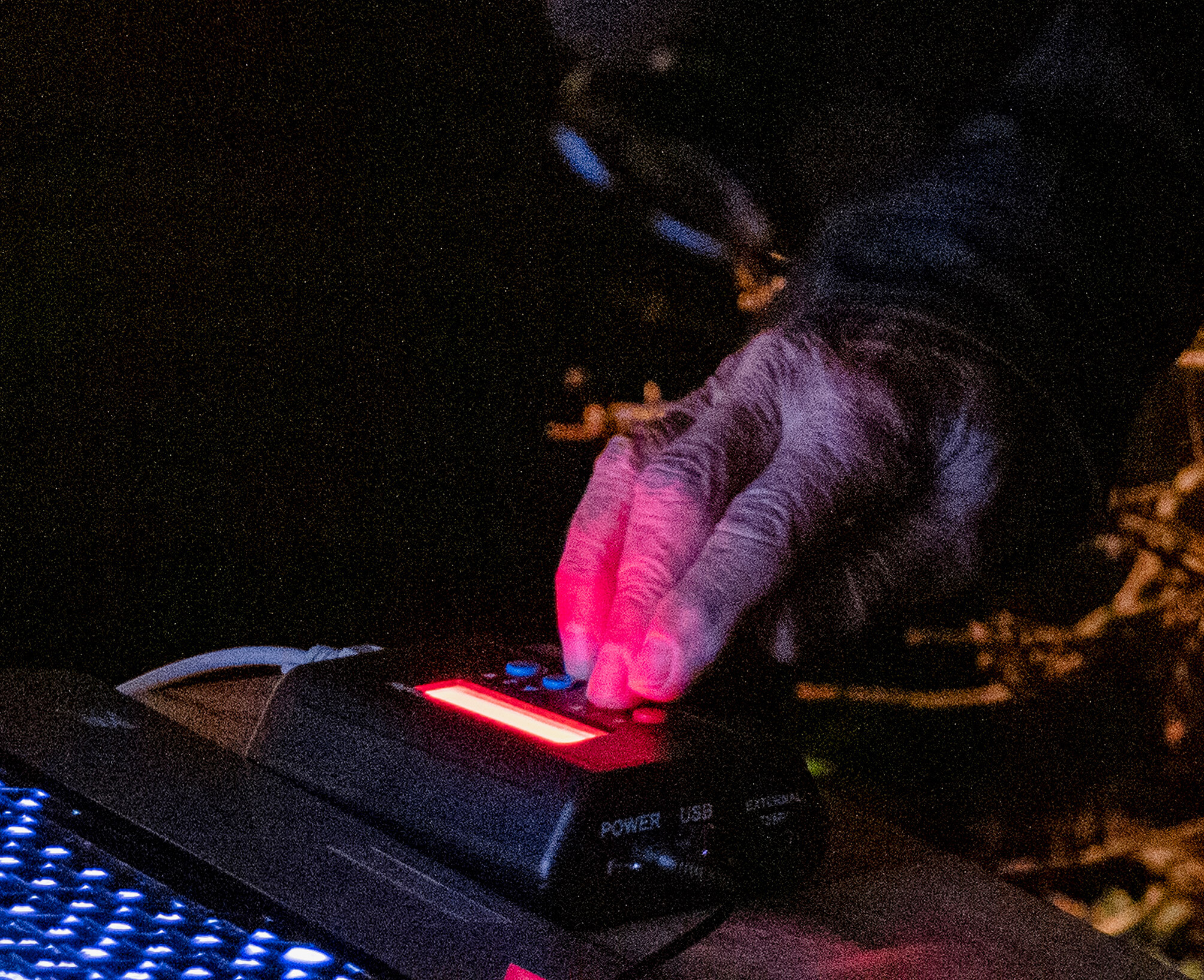
In the photograph John Sussenbach is manipulating the telescope’s focus slightly during the recording.
To make better images, astrophotographers can rent time on a ‘remote observatory’: a fully equipped observatory located in a less light-polluted region and with a more stable atmosphere than the one the average amateur astronomer lives in. A command given from a computer directs a massive telescope in Chile towards a desired spot.
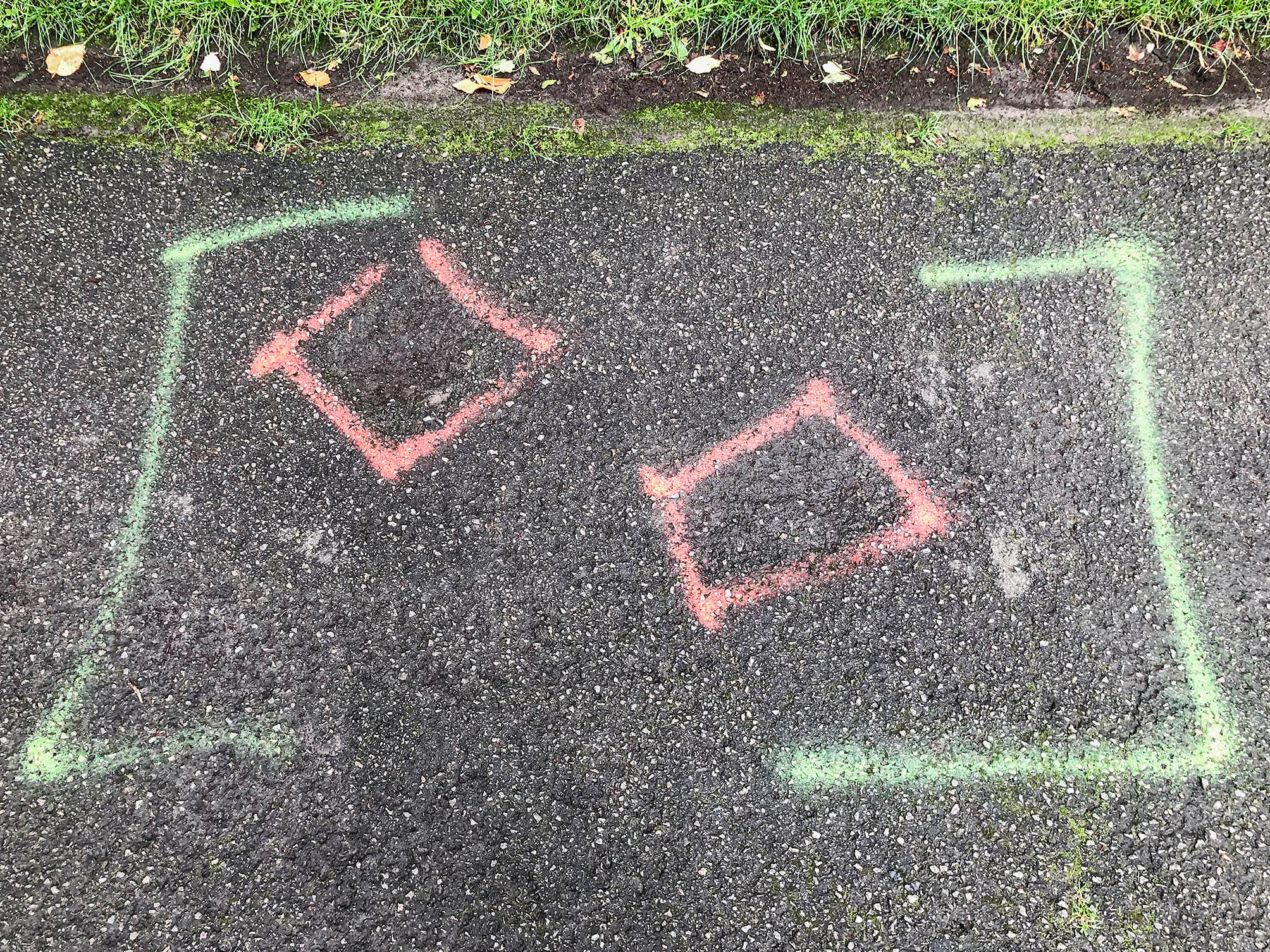
Holding two cans of spray paint, a city employee walks through a sweet chestnut grove on the graveyard. He’s looking for potholes.
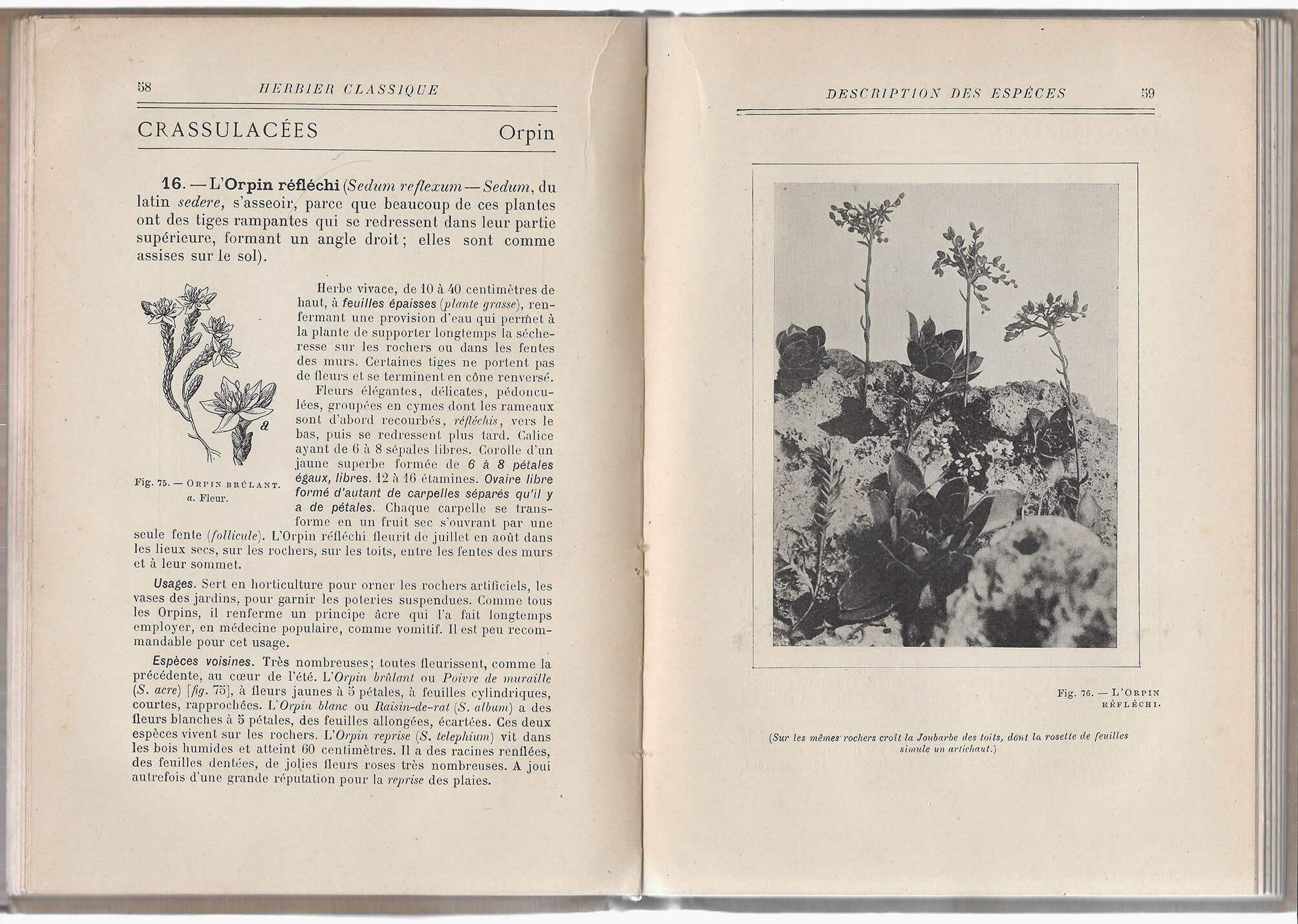
The Sedum reflexum grows on rocky soils and in crevices of walls. In L’herbier classique, it is depicted in two ways, just like the other plants in the book. This double portraiture is important, the author states in the introduction: ‘one consists of the reproductions of the photographs taken by the author of this book […]; the other, drawings made by excellent artists who observed the plants themselves, showing details photography can’t reproduce, highlighting aspects the photographs leave untouched. […] From this double representation, interesting comparisons can be made, highly enlightening from an artistic point of view, between the realistic aspect of nature’s “productions” and the interpretation thereof by the draftsman’ (5).
A detail not covered by the drawing of the sedum reflexum, is the presence of other species in the vicinity of the plant, a detail shown in the photograph and described in the caption: ‘The Common houseleek grows on the same rocks, with its rosette of leaves pretending to be an artichoke’ (59).
Until recently, for as long as I could remember, the packaging of Tabasco® Pepper Sauce had been unchanged. On the front of the packaging, there is a photograph of a bottle of Tabasco®, scale 1:1, against an orange background.As far as packaged goods go, this is a highly idiosyncratic and quirky example.
The background colour approximates the colour of the liquid inside the bottle, resulting in as good as no contrast. Moreover, as the image of the bottle is scale 1:1, the packaging becomes kind of unnecessary and superfluous, also because the life-sized image of the bottle is the only way information is given to the customer: there are no additional slogans, no repetition of the brand name, no props and no decor. The image of the bottle advertises the bottle. It seems to add nothing the bottle could not do by its own (like a bottle of wine does).
What makes the packaging truly stand out, however, is the fact that the image of the bottle is not positioned vertically, but is slightly askew. It seems to be the result of a design error, and has an amateur feel to it. The decision to keep it as such and not correct it up until today, is, however, a stroke of genius. The non-vertical positioning alters the relation of the image of the bottle to the bottle inside: as the box is standing on a shelf, the tilted image of the bottle undermines its representational superfluousness.
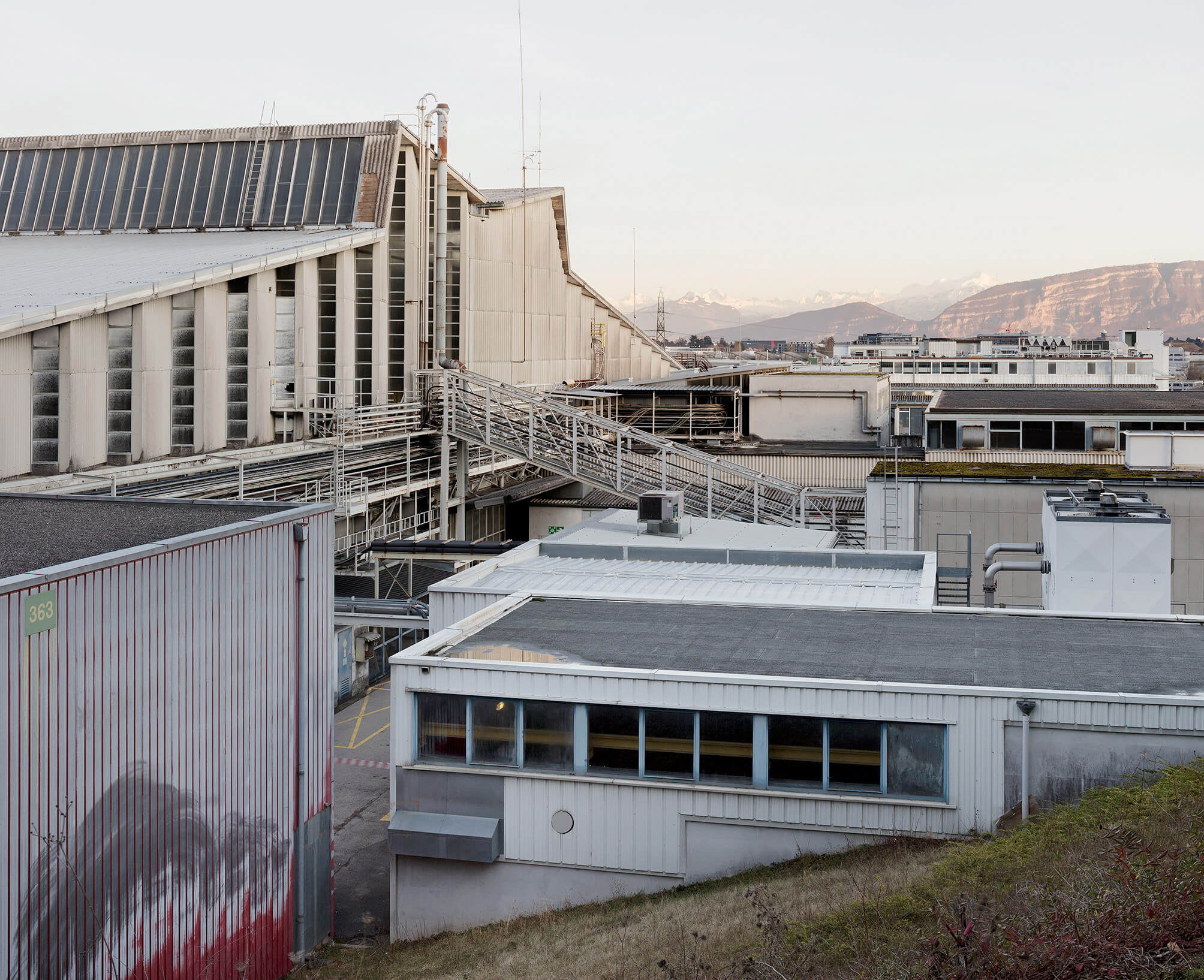
On the second to last day of a research visit at CERN, there was some spare time in the schedule. I took a long walk towards building 282 in search of some excavation samples: cylindrical pieces of rock that were preserved when the tunnel was dug, glued to a block of wood and frequently exhibited in museums over the last three decades as material evidence of the earthwork and as a witness to the depth. The route led me along the back of building 363 where the wind caused young trees – now gone – to scuff the facade over time.
First published in: De Cleene, M. Reference Guide. Amsterdam: Roma Publications, 2019, as W.569.EXC CERN, Towards Building 282, in search of excavation samples
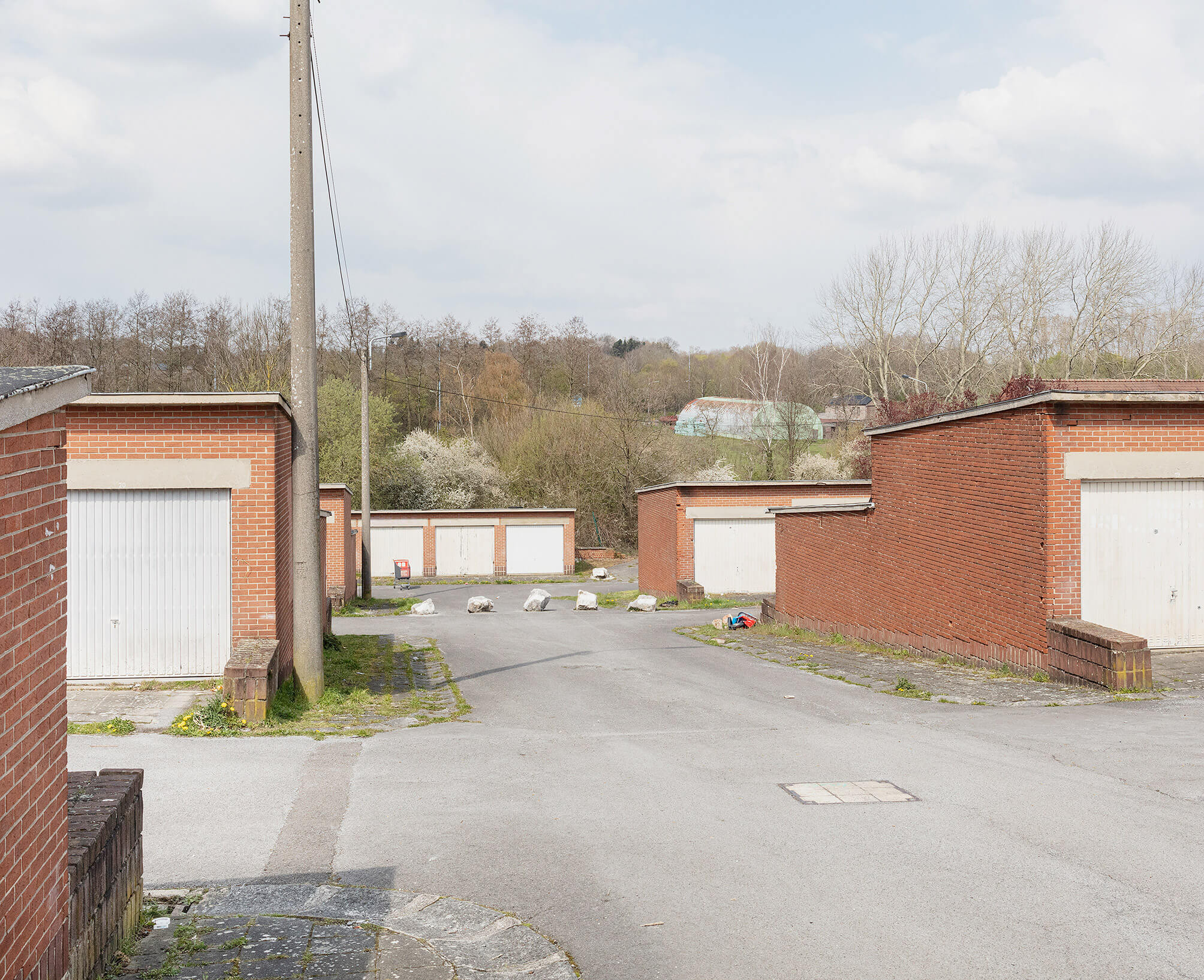
Seven very similar and rudimentary buildings take in a trapezoid plot of land in Gilly. They are located between the school on the Rue Circulaire and the houses along the Rue de l’Abbaye. The structures are built of orange brick, concrete structural elements, whitish steel gates and roofing. Every garage has its own number, hand-painted in white on the concrete lintel above each gate. In summer the roofing gets hot and soft.
According to @missbluesette, the green K-10 put up for sale by Fred from Zwolle that I came across on marktplaats.nl on 29 September 2022 is not green, but blue. The colour resembles turquoise, I explain, a colour I have always called green. No, turquoise is not green, but blue, she replies. And the texts of my Instagram posts are too long, she says, so she doesn’t read them.
Lars Kwakkenbos lives and works in Brussels and Ghent (B). He teaches at KASK & Conservatorium in Ghent, where he is currently working on the research project ‘On Instructing Photography’ (2023-2024), together with Michiel and Arnout De Cleene.

Due to strict regulations during the COVID-19-pandemic, the yearly vehicle inspection had to be scheduled by appointment. Getting ready to drive to the DMV, the car wouldn’t start. It had rained heavily, the preceding days. The day before the DMV-appointment, water had come running into the car on pushing the pedals. My socks were wet.
I called the DMV to say I needed to cancel the appointment and make a new one (but that the car, besides not being able to drive, was perfectly fine, vehicle-inspection-wise).
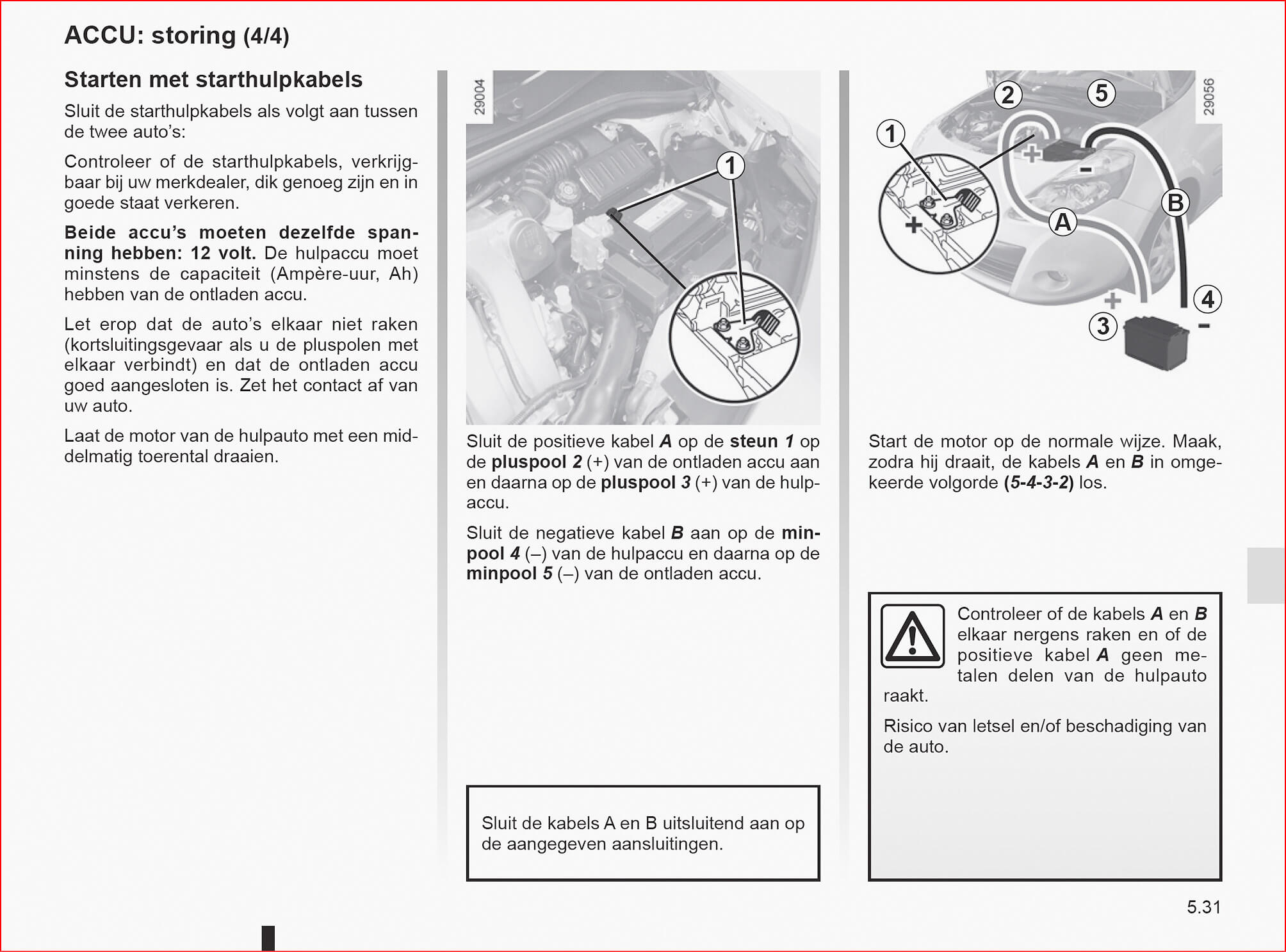
Later that day, we got the engine up and running again, using jumper cables and a second car, so we would be able to drive to meet the midwife the next day.
Renault Clio. Instructieboekje. 2012. PDF-file
A visit to the Royal Observatory of Belgium, in Ukkel. Most of the domes are damaged and need repairing. Only a few telescopes are in use. It is difficult to find a good spot from which to film the site. When we asked the people at the Royal Meteorological Institute – the Observatory’s neighbouring institution – if we could access their building’s roof to film the observatory, the answer was ‘no’.
I (M.D.C.) remember there was a fire nearby. We couldn’t see the flames, but a tall dark plume of smoke rose above the trees lining the site. We didn’t insist any longer and ceased our attempt to access the roof, hoping we might find a good spot to film the smoke with a dome in the foreground.
Kesteloot, J. Leerboek van Cosmografie voor Middelbaar en Lager Normaal Onderwijs (derde vermeerderde uitgave). Brugge: Firma Karel Beyaert, 1948.

On May 7th, 1992, an anonymous photographer records the ice cellar, a stone’s throw from my parents’ house. It’s a beautiful day in spring. Quite a bit of wind, it seems. A Thursday. Surely, I am at school. Third grade kindergarten. It houses bats.
The photograph is part of an online heritage inventory, maintained by a government department. On the same day, the photographer took a photograph of the orangery, the entrance gate to the allotment, and the castle.
https://id.erfgoed.net/afbeeldingen/264680

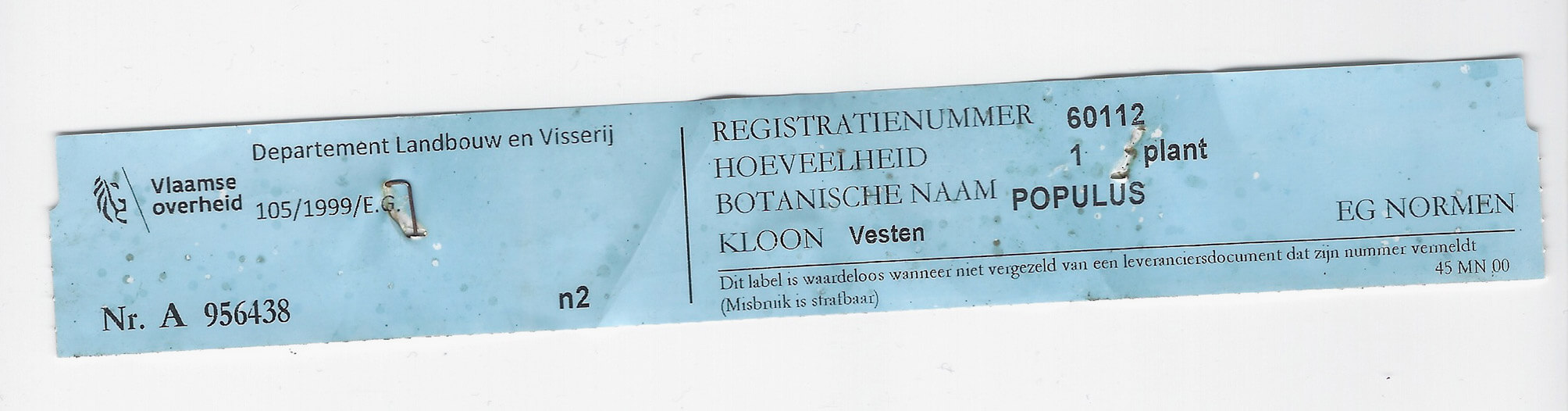
A Sunday stroll near my parents’ house. Along one of the roads between the fields, old poplars have been felled. Young trees have been planted. Each one has a baby blue coloured label, identifying them as Poplar tree, and, more specifically, the ‘Vesten’ cultivar. This cultivar is planted since it is one of the cultivars known for its resistance with regards to bacteria, diseases and insects. The tags on the trunks have staples keeping them together. They’re like bracelets. Come spring, the expanding diameter of the fast growing poplar species’ trunk will tear them apart.
Steenackers, M., Schamp, K., & De Clercq, W. (2018). De INBO variëteiten van populier, een aanwinst voor de Europese populierenteelt. Silva belgica : tijdschrift van de koninklijke belgische bosbouwmaatschappij = bulletin de la société royale forestière de belgique, N°4/2018, 40-47. [5].
https://purews.inbo.be/ws/portalfiles/portal/15044340/Dossier_populier_INBO_KBBM.pdf
Cathedral glass, or Flemish glass, lets light through, but distorts visibility. It can show something or someone is present behind it, but not in detail. Often used in front doors, it marks the opaque edge between the private and the public sphere, laying bare their presence, without disclosing their contents.
A blue hand, or a spider (Cyriopagopus lividus), traces the cracks that testify to the fact that the jammed door had to be closed with force. The hinges need oiling. Cobalt blue tarantulas are said to be extremely defensive.


Between the rhinos and the kangaroos in the Antwerp Zoo a wooden footpath curves through a grove of Sequoiadendron Giganteum trees. In the middle of this Californian forest, visitors find the giant slice of a felled tree of the same species. It was brought to the zoo in 1962 and was approximately 650 years old at the time. Eleven labels point out significant moments in history on the tree’s growth rings. They range from zoo- and zoology-related moments (for instance: ‘1901: The Okapi is described as a species’, or ‘1843: Foundation of the RZSA and opening of the Zoo’, or ‘1859: Darwin publishes The Origin of Species’, etc.), to cultural and historical milestones (‘1555: Plantijn starts publishing books in Antwerp’, or ‘1640: Rubens (baroque painter) dies’, or ‘1492: Columbus in America’). Another label points to the last growth ring and reads: ‘1962: this tree is felled and this tree disc is installed at the Zoo.’
The label pointing to the centre of the tree implies a simultaneity between the tree’s first growth year and the Battle of the Golden Spurs in 1302.
On closer inspection the slice seems to consist of two halves that were put together like a jigsaw puzzle. The resulting gap is skilfully patched with what appears to be wood from the same species – possibly even the same mammoth tree.

On Mondays, before noon, I go to the supermarket with my two-year-old son. After passing the lasagnes, the loaves of bread and the fruit and vegetables, we make a short stop at the aquarium with the lobsters. Around New Year, there are two of them.
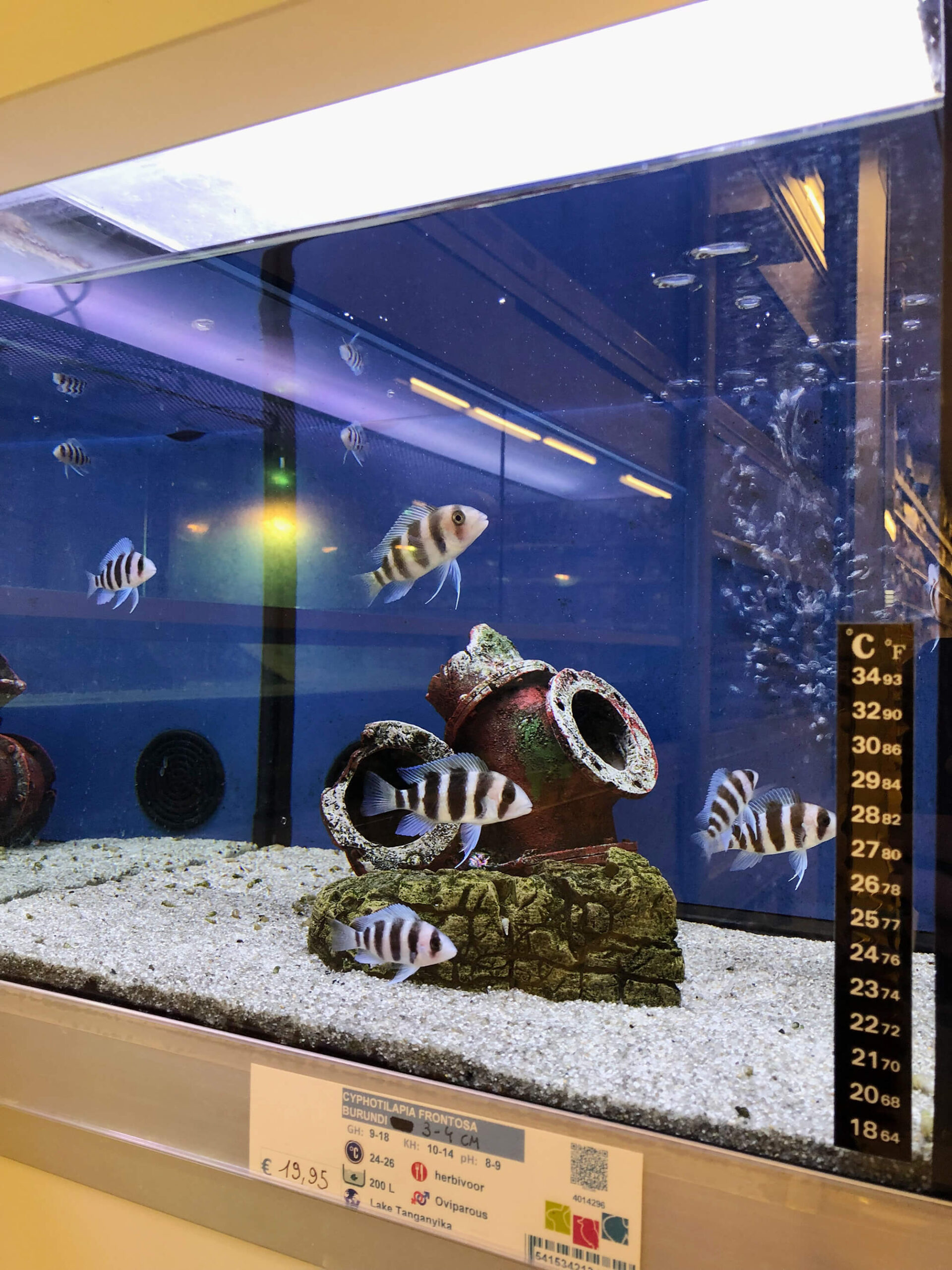
After we’ve paid for the groceries and have put them in the car, we walk into the pet shop. We look at the parrots (Jacques, Louis and Marie-José), the rabbits, the guinea pigs, the assorted caged birds and the fish and turtles. He’s very fond of the Cyphotilapia Frontosa Burundi. He calls them zebras. They hail from Lake Tanganyika, the label says. It’s the second-oldest freshwater lake, the second-largest by volume and the second-deepest. The pet shop has adorned their aquarium with a scene of ocean waste.
In an effort to avert guilt, I look for something cheap and more or less useful to buy: birdseed, a snack for the neighbour’s cat, a comb for his grandparent’s Labrador, etc.
July. Our eight-month-old son has a fever. We have a hard time getting him to drink enough. The tally marks on the back of a tortellini-box keep track of the diapers he wets and the millilitres of milk and electrolytes he’s able to hold down.
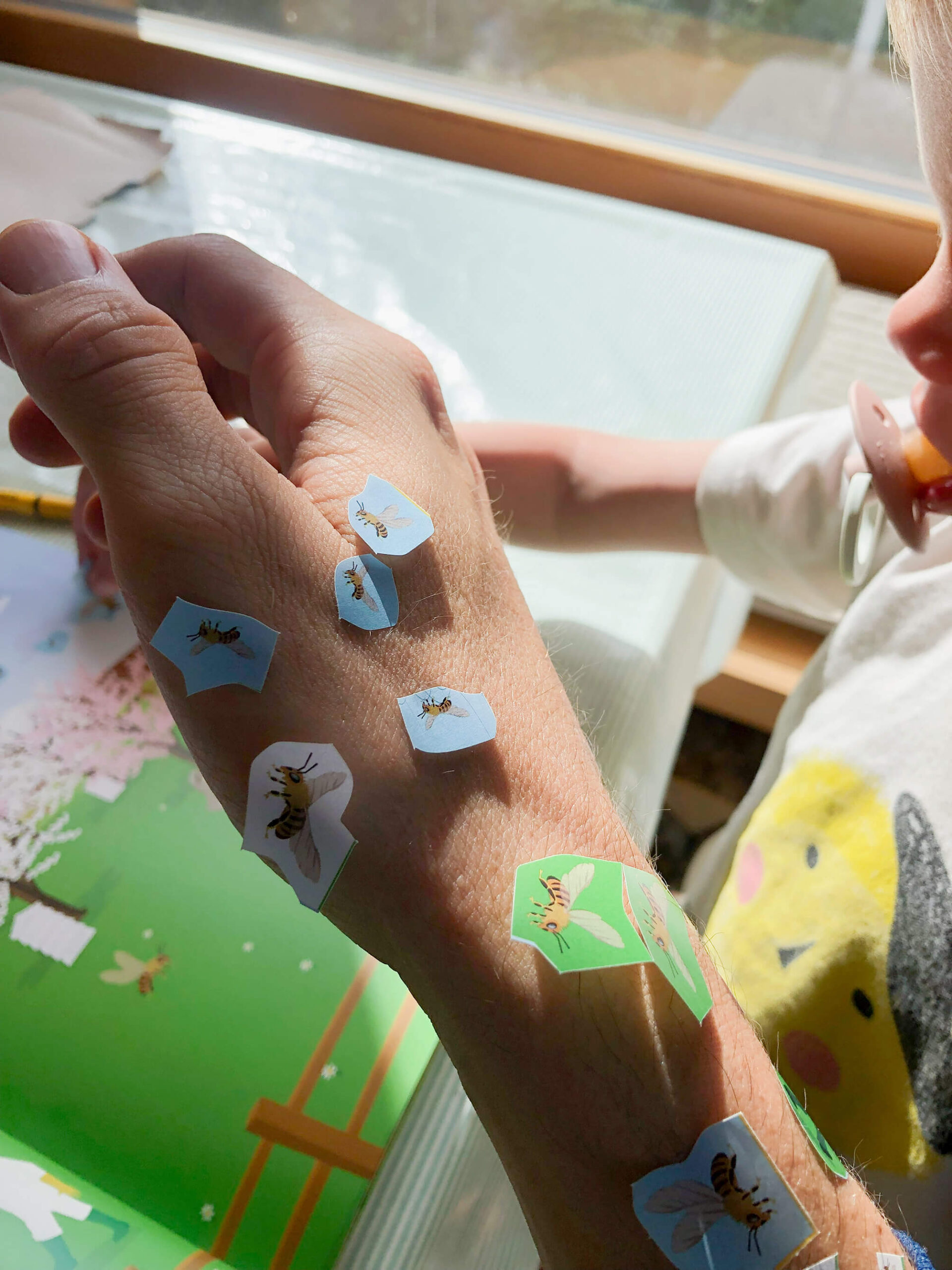
Stuck inside with worrying parents, a sticker-book about a farm is his brother’s favourite pass-time. Tired of having to go back and forth between the pastures and the sticker-filled sheets we decide to use my arm as a repository for animals that share a habitat.