What constitutes a ‘document’ and how does it function?
According to the Oxford English Dictionary, the etymological origin is the Latin ‘documentum’, meaning ‘lesson, proof, instance, specimen’. As a verb, it is ‘to prove or support (something) by documentary evidence’, and ‘to provide with documents’. The online version of the OED includes a draft addition, whereby a document (as a noun) is ‘a collection of data in digital form that is considered a single item and typically has a unique filename by which it can be stored, retrieved, or transmitted (as a file, a spreadsheet, or a graphic)’. The current use of the noun ‘document’ is defined as ‘something written, inscribed, etc., which furnishes evidence or information upon any subject, as a manuscript, title-deed, tomb-stone, coin, picture, etc.’ (emphasis added).
Both ‘something’ and that first ‘etc.’ leave ample room for discussion. A document doubts whether it functions as something unique, or as something reproducible. A passport is a document, but a flyer equally so. Moreover, there is a circular reasoning: to document is ‘to provide with documents’. Defining (the functioning of) a document most likely involves ideas of communication, information, evidence, inscriptions, and implies notions of objectivity and neutrality – but the document is neither reducible to one of them, nor is it equal to their sum. It is hard to pinpoint it, as it disperses into and is affected by other fields: it is intrinsically tied to the history of media and to important currents in literature, photography and art; it is linked to epistemic and power structures. However ubiquitous it is, as an often tangible thing in our environment, and as a concept, a document deranges.
the-documents.org continuously gathers documents and provides them with a short textual description, explanation,
or digression, written by multiple authors. In Paper Knowledge, Lisa Gitelman paraphrases ‘documentalist’ Suzanne Briet, stating that ‘an antelope running wild would not be a document, but an antelope taken into a zoo would be one, presumably because it would then be framed – or reframed – as an example, specimen, or instance’. The gathered files are all documents – if they weren’t before publication, they now are. That is what the-documents.org, irreversibly, does. It is a zoo turning an antelope into an ‘antelope’.
As you made your way through the collection,
the-documents.org tracked the entries you viewed.
It documented your path through the website.
As such, the time spent on the-documents.org turned
into this – a new document.
This document was compiled by ____ on 16.12.2025 10:53, printed on ____ and contains 32 documents on _ pages.
(https://the-documents.org/log/16-12-2025-6730/)
the-documents.org is a project created and edited by De Cleene De Cleene; design & development by atelier Haegeman Temmerman.
the-documents.org has been online since 23.05.2021.
- De Cleene De Cleene is Michiel De Cleene and Arnout De Cleene. Together they form a research group that focusses on novel ways of approaching the everyday, by artistic means and from a cultural and critical perspective.
www.decleenedecleene.be / info@decleenedecleene.be - This project was made possible with the support of the Flemish Government and KASK & Conservatorium, the school of arts of HOGENT and Howest. It is part of the research project Documenting Objects, financed by the HOGENT Arts Research Fund.
- Briet, S. Qu’est-ce que la documentation? Paris: Edit, 1951.
- Gitelman, L. Paper Knowledge. Toward a Media History of Documents.
Durham/ London: Duke University Press, 2014. - Oxford English Dictionary Online. Accessed on 13.05.2021.

‘Exit at the dock and kill some rats. Go around the building to the left, killing the guard and his rats before flipping the switch. Another guard arrives kill him too, taking the medkits from both your victims. Enter the now open front door and kill the guard on the balcony and his friend who appears on the ground floor. Grab the shells from your second kill then shoot out the window and kill the Dobermans who jump through when you get too close.’
Tomb Raider II. The Complete Guide to the Dagger of Xian. Downloaded from http://www.the-spoiler.com on 4 August, 1999, at 15:03.

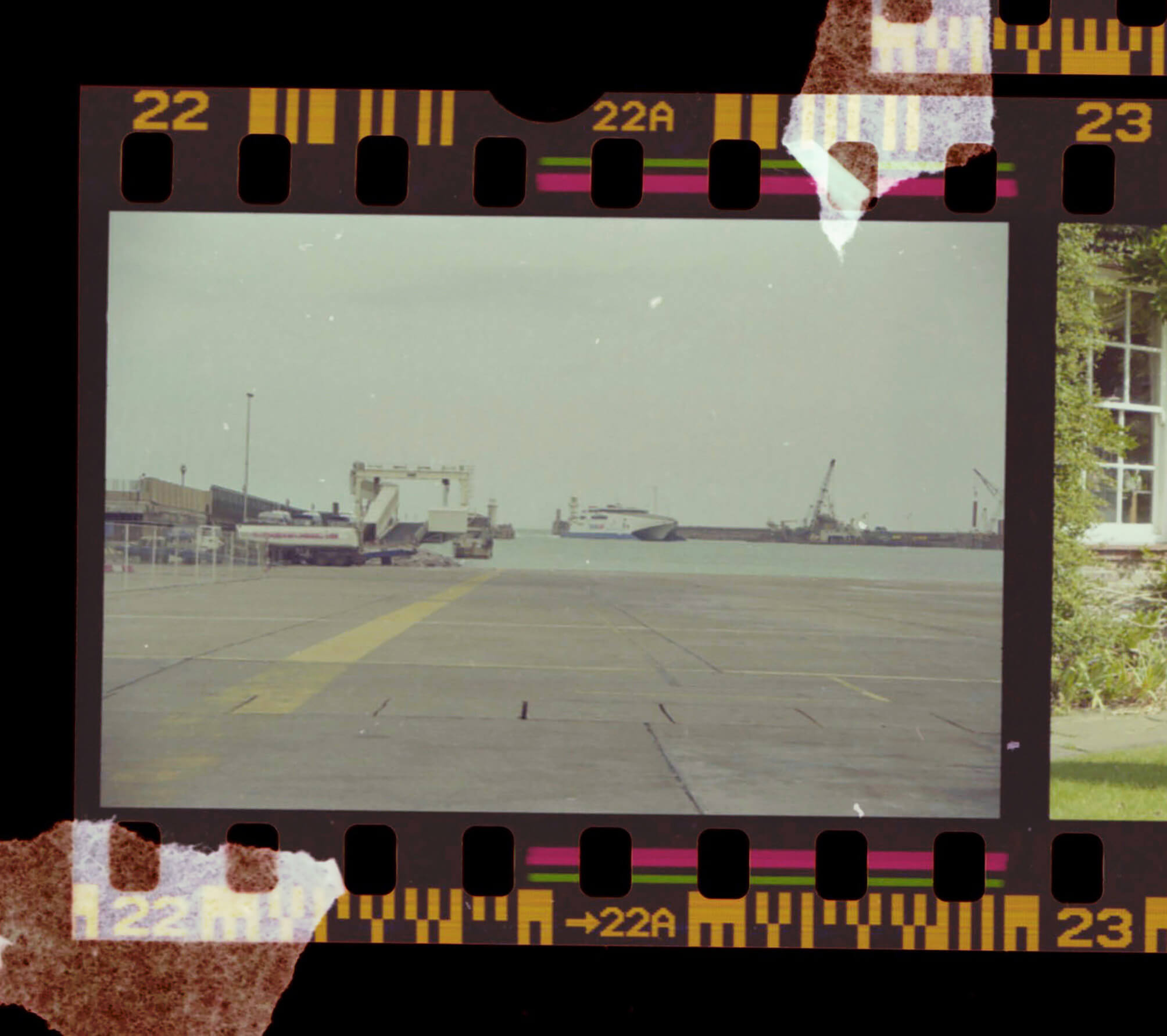
Coming back from holidays, we were waiting for the ferry to take us from Ramsgate to Ostend. We were well on time. As the ship entered the harbour, I asked my parents if I could take a photograph. It’s the first photograph I recall taking. I remember my dad telling me to wait long enough for the ship to get closer. I didn’t. I only got one try.1
It took a while before the film was developed. I couldn’t stop imagining what the photograph would look like: some picturesque waves in the foreground, the shining white ship, the red and blue text on the side, and a cloud filled sky.
Following every holiday, when we got home, the garden and our house would be photographed with the remaining exposures on the roll of film in the camera.
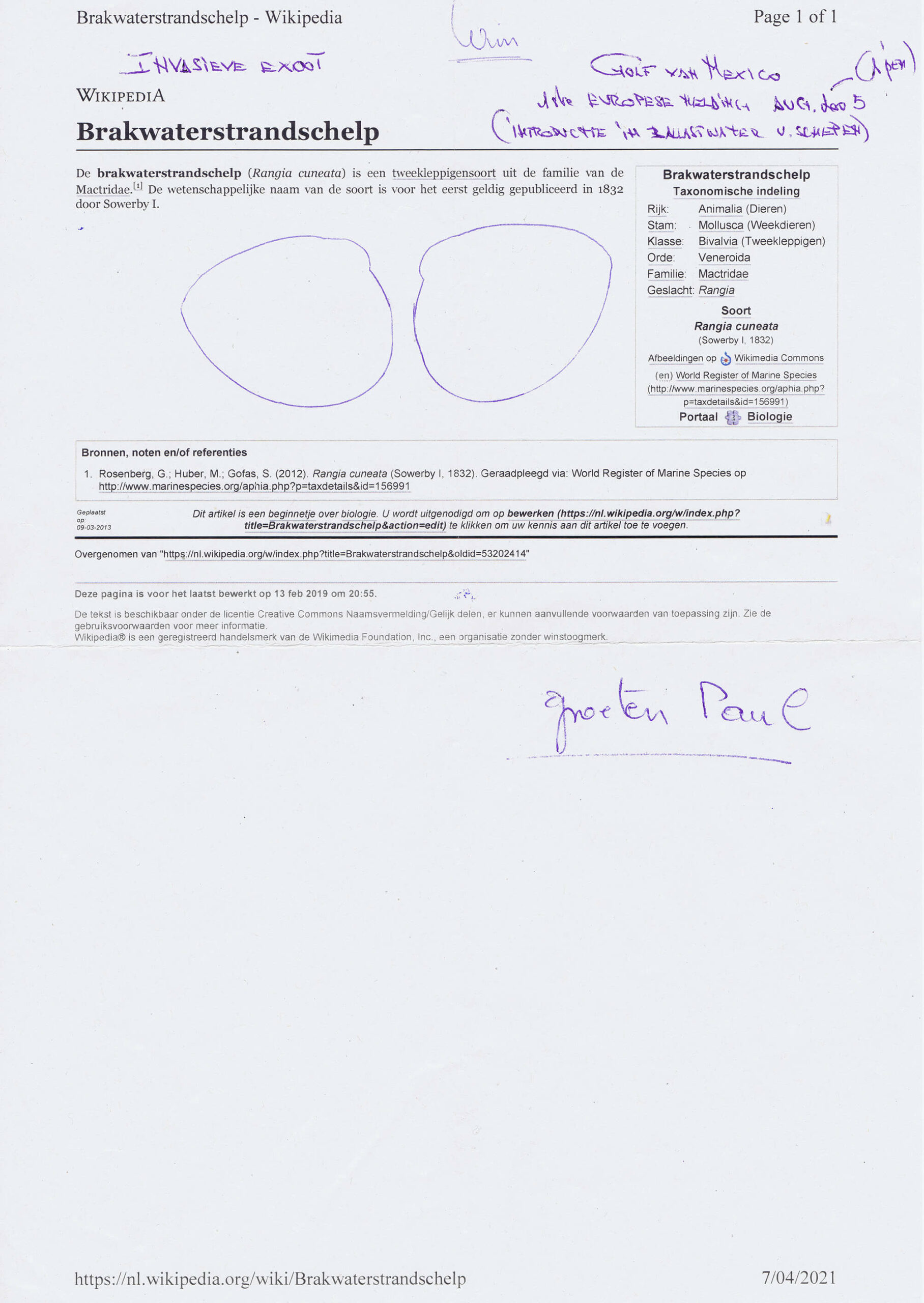
Halfway March my dad started finding empty clam shells on the banks of the Zuidlede along the pasture where he used to herd sheep. He had never seen this type of clam before. There were easily seventy of them along a hundred metre stretch of riverbank.
He brought two specimens to someone he knows in the neighbouring provincial domain. She would look into it, she said, and that she would probably pass it on to someone at the educational department.
Yesterday he (my dad) received a printout of the Dutch wikipedia-page on the Brakwaterstrandschelp (Rangia Cuneata). On the page Paul (who sends his regards at the bottom of the document) traced around the scallops with a blue ballpoint pen.
My dad added in capitals – also with a blue ballpoint pen – that the Rangia Cuneata is an invasive species, native to the Gulf of Mexico. The first time it was observed in Europe was in Antwerp in August 2005, most probably they reached Europe in the ballast water tanks of large ships.
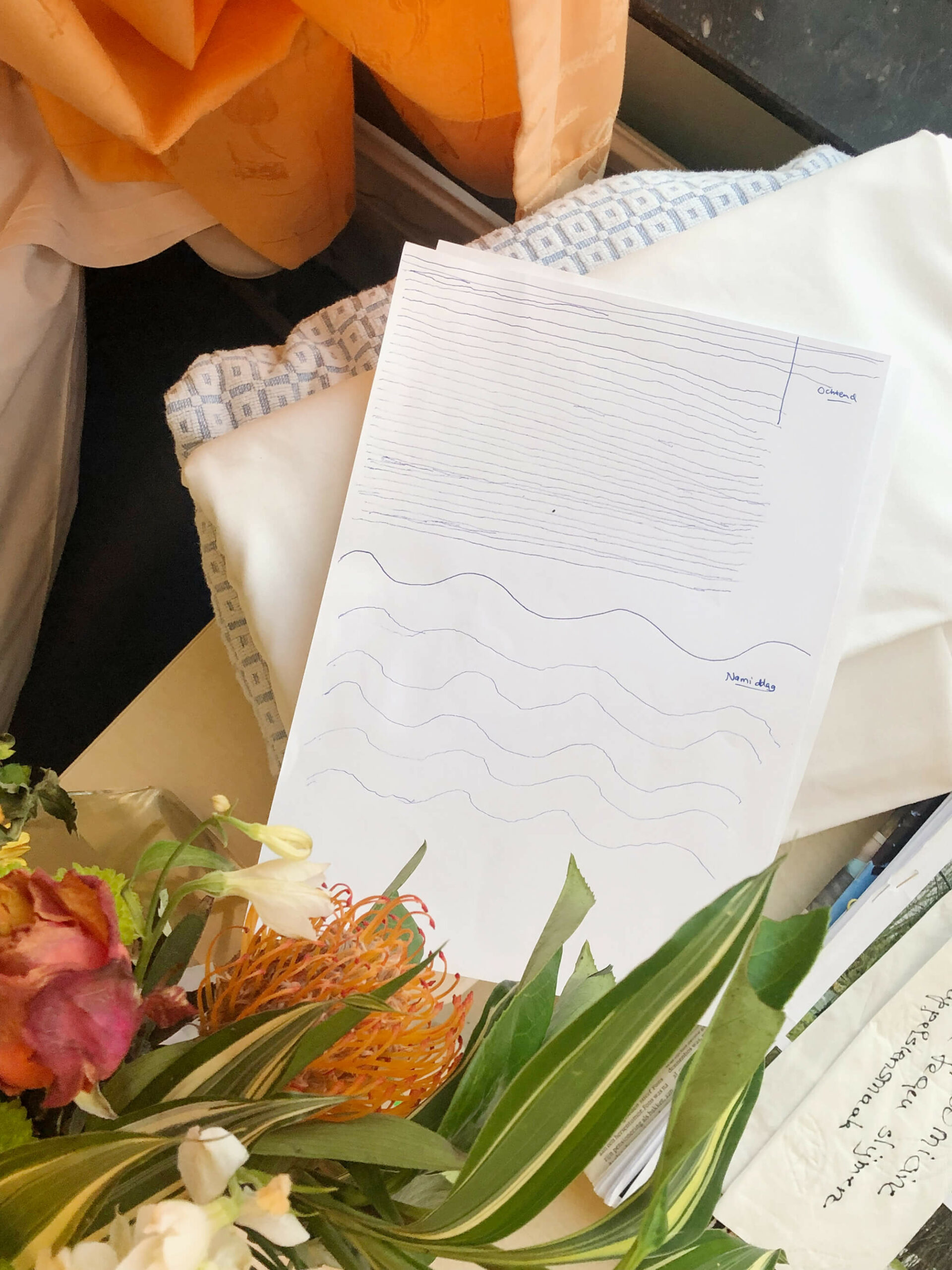
On a pile of fresh hospital sheets, near the radiator, the tangerine curtains and the black marble window sill (the window looks out over the parking lot), underneath the two-day-old bouquet of flowers and next to a pile of magazines with a handwritten note on top (about a syrup that relieves slime and tastes like oranges), lie two sheets of paper.
Earlier that day the physiotherapist had come by. Twice. Once in the morning and once in the afternoon. He had each time drawn the first line, as an example. A straight line in the morning, a curvy line in the afternoon.
With a ballpoint pen my grandfather, who is recovering from an accident, diligently copied the examples (31 in the morning, 5 in the afternoon).
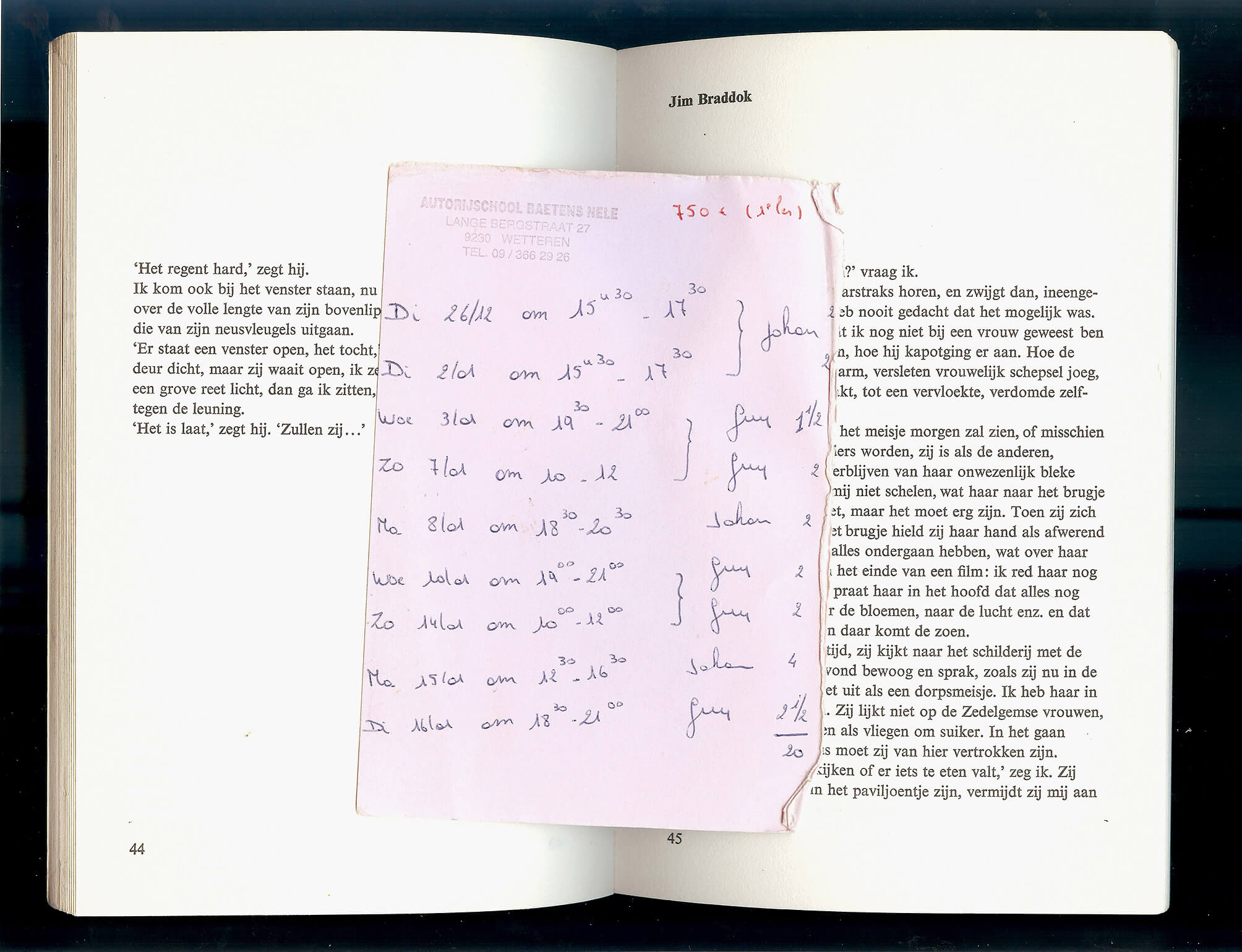
In his debut novel ‘De Metsiers’ Hugo Claus employs a multiple narrative perspective. In the copy I picked up in a thrift store, there’s a bookmarker between pages 44 and 45 where the perspective shifts from Ana to Jim Braddok. It’s pouring. The pink piece of paper lists 9 sessions at a driving school. There’s a total of 20 hours, taught alternately by Johan and Guy.
In 2000, 2006 and 2017 the twenty-sixth of December was a Tuesday. (Earlier years are improbable, since the Euro was not introduced yet.)
Claus, H. De Metsiers. Amsterdam: Uitgeverij De Bezige Bij, 1978.
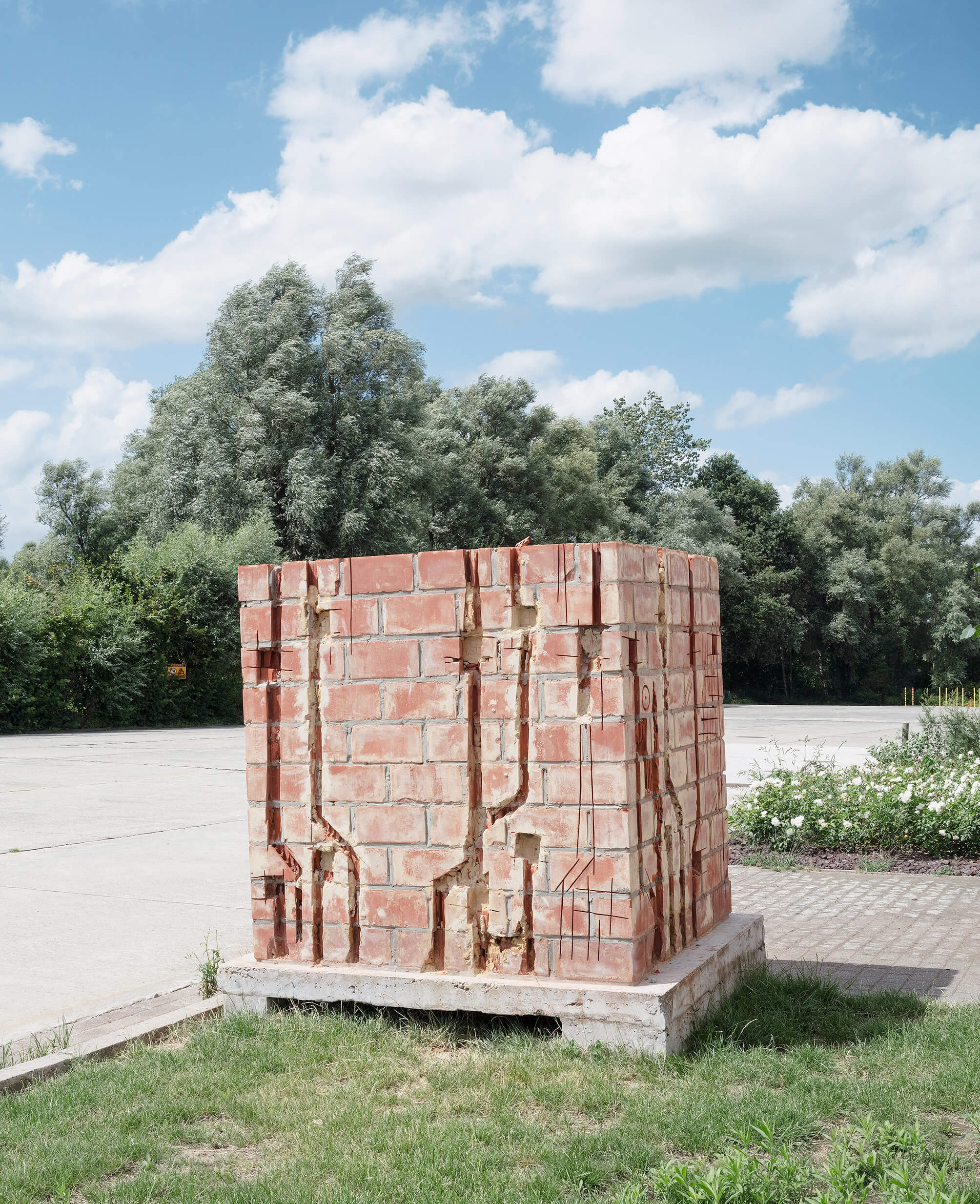
‘The masons in training pour a concrete slab and build four walls upon it in a stretcher bond. Then the block comes to our department and the students in the course Electrical installer (residential) can grind channels and drill cavities in it.’
[…]
‘It’s not always a success from the outset, but they learn quickly.’
[…]
‘Never grind horizontally, always vertically. Diagonally if there is no other way.’
[…]
‘Two fingers wide.’
[…]
‘After this it goes to the sanitary department. After the bell drilling, the demolition hammer follows and the masons make us a new block.’
Competentiecentrum VDAB, Wondelgem, July 2019.
First published in A+ Architecture in Belgium, A+ 279, Schools (August, September 2019), https://www.a-plus.be/nl/tijdschrift/schools
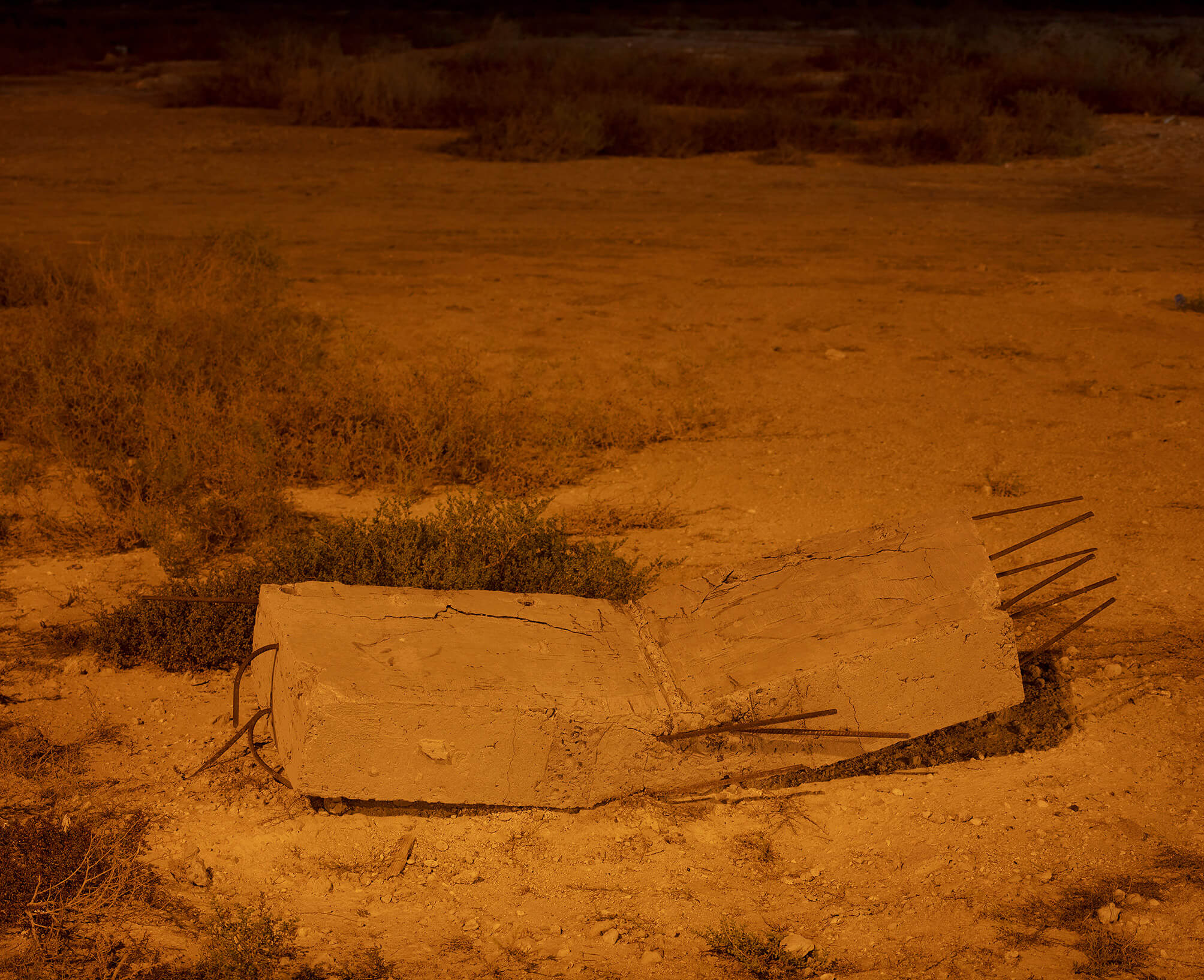
A block of concrete. Fissures are showing and rebar is sticking out from all sides. If it were still straight, the block would measure approximately 130 x 15 x 40cm.
It is lying by the side of the road, a few hundred meters from a construction site. It appears to be shaped by impact. Maybe the block plummeted to the ground from a great height. Perhaps, something heavy hit it. For all one knows, it served as a column and was exposed to an unforeseen amount of pressure, causing it to buckle.
According to Eyal Weizman ‘[a]rchitecture emerges as a documentary form, not because photographs of it circulate in the public domain but rather because it performs variations on the following three things: it registers the effect of force fields, it contains or stores these forces in material deformations, and, with the help of other mediating technologies and the forum, it transmits this information further.’1
Weizman, E. ‘Introduction’, in: Forensic Architecture. Forensis. The Architecture of Public Truth. London/Berlin: Sternberg Press, 2014.
In an attempt to make it his own, Gino – it might also be Dino – has taken a can of bright pink spray paint to his hard hat and – as the paint was drying – dragged his gloved finger from top to bottom. G – or D –, I, N, O. In the dust on a demolished floor tile, someone has written 12,10. Perhaps a measurement, a quantity, a position, a date, a reference.
Subtractive writing is not uncommon. With the tip of a passer-by’s index finger ‘WASH ME’ is subtracted from the dust on a dirty car. In freshly poured concrete, a name is embedded forever with a twig. In hot and soft roofing drawings and obscenities are scratched. Styrofoam lining a brand new elevator gets impressed with names, jokes and knuckles.
In the twenty-third canto of Ariosto’s Orlando Furioso (1516), Orlando comes across the name of his love and another man, carved in the bark of a tree. He doubts. But that night, a gossiping shepherd tells him he’s seen Angelica and Medoro together. Orlando returns to the forest, and in a four-day frenzy, he uproots every tree and pollutes the rivers forever.
CXXXI
For he turf, stone, and trunk, and shoot, and lop,
Cast without cease into the beauteous source;
Till, turbid from the bottom to the top,
Never again was clear the troubled course.
At length, for lack of breath, compelled to stop,
(When he is bathed in sweat, and wasted force,
Serves not his fury more) he falls, and lies
Upon the mead, and, gazing upward, sighs.1
Ariosto, L. Orlando Furioso. Translated by William Stewart Rose, Echo Library, 2006, p. 267.

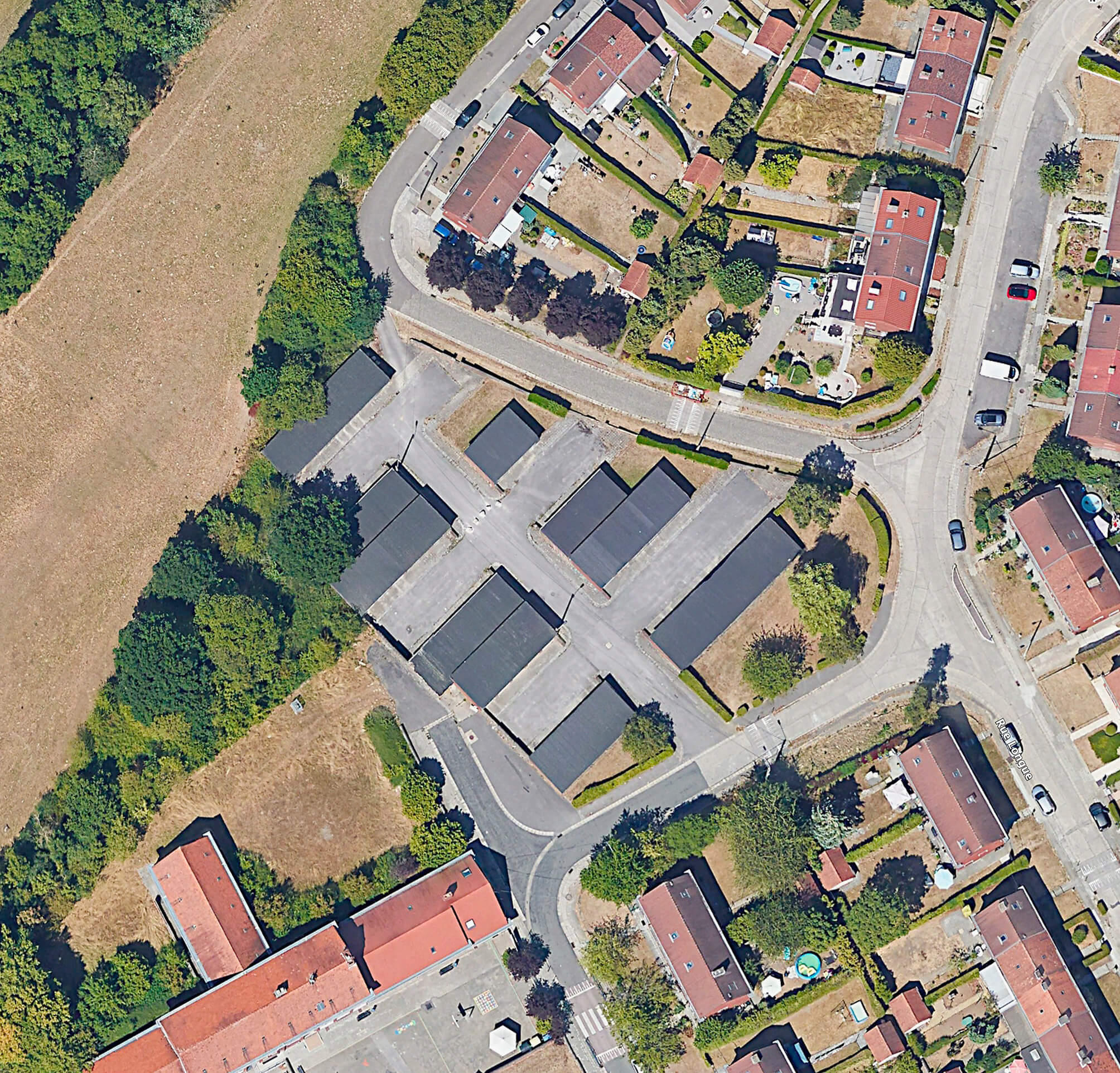
Seven very similar and rudimentary buildings take in a trapezoid plot of land in Gilly. They are located between the school on the Rue Circulaire and the houses along the Rue de l’Abbaye. The structures are built of orange brick, concrete structural elements, whitish steel gates and roofing. Every garage has its own number, hand-painted in white on the concrete lintel above each gate. In summer the roofing gets hot and soft.
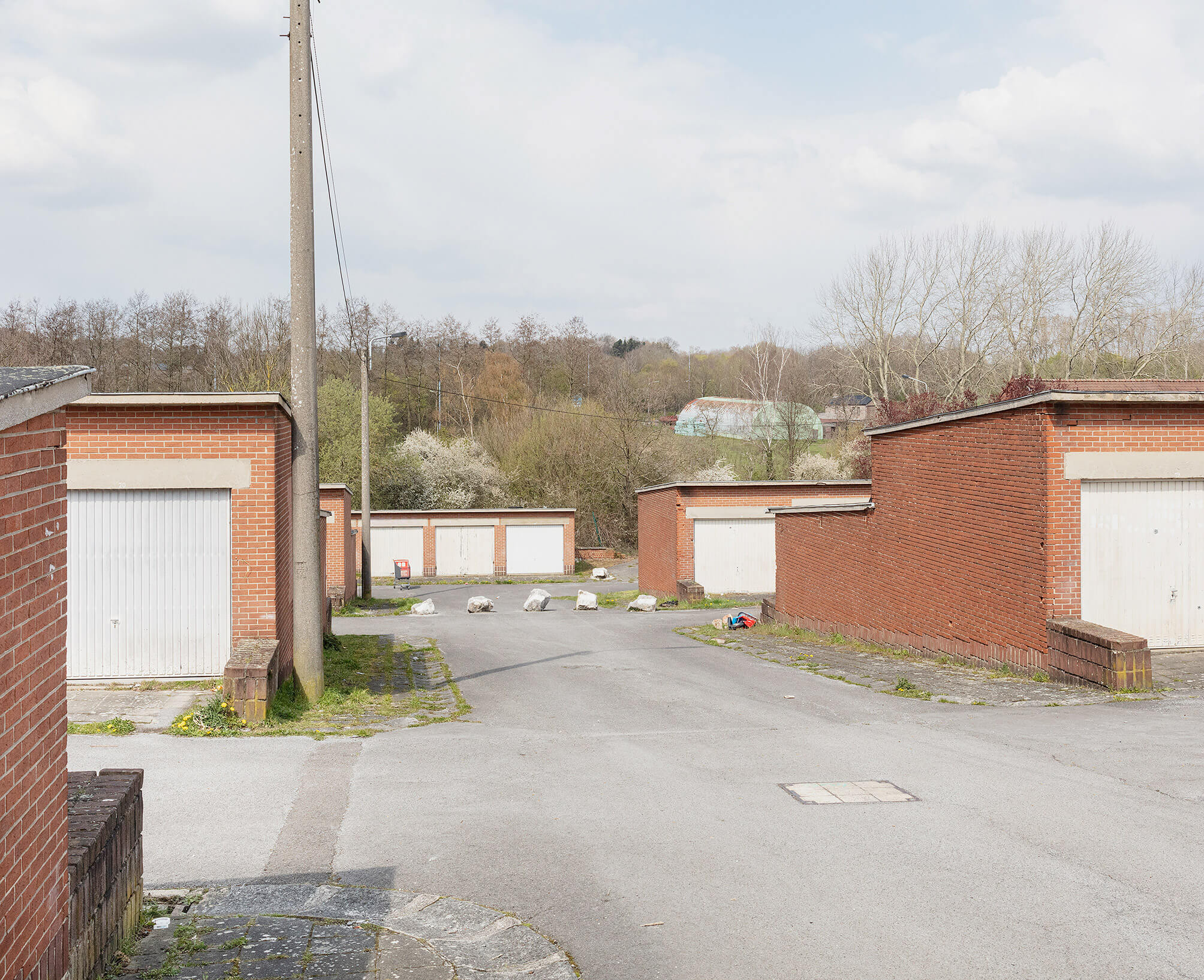
Five white boulders close off a shortcut for motorists who attempt to cut the bend in the road. The southernmost roof’s pitch runs opposite to the landscape’s slope. The lower roofline is, therefore, only about one meter above a small, triangular patch of grass which is hidden from view by a hedge. In summer, when the roofing gets hot and soft, text and drawings get pressed or carved into it.
Google Earth
In what order and by whom the various texts and drawings were carved into the soft roofing is unclear. To the right of ‘EVA’, a heart symbol and an arrow (pointing to the left), the roofing reads ‘SIMON TU ME MANQUES’.
The short sentence usually – yet hastily – translates to ‘Simon, I miss you’. However, in French the ‘you’ (tu) is the subject and has an active role, whereas the ‘I’ (me) is the direct object. In short: by his not being there, Simon actively effectuates hurt to the one who carved this text.
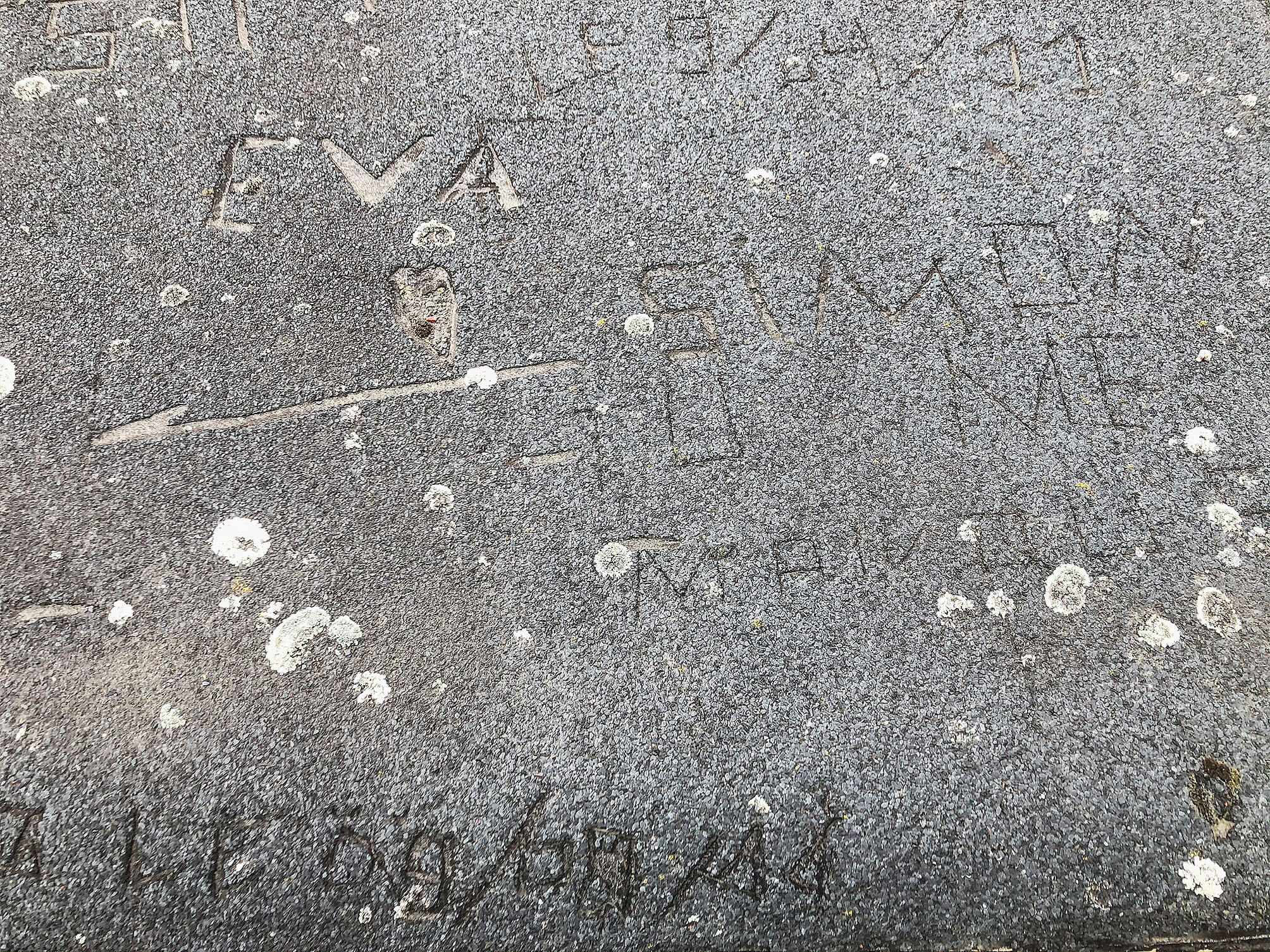
A carving that looks like a stitched-up scar (a long, slightly curved line crossed at a right angle by eleven short straight lines) is inserted into a short statement about Celine and Logan. An initial of Celine’s last name is included. At first sight it looks like a ‘D’, but the line through the middle might just as well make it a ‘B’. Maybe it was Celine D who added the line in an attempt to convince those reading the roofing that it’s actually Celine B who blows Logan.

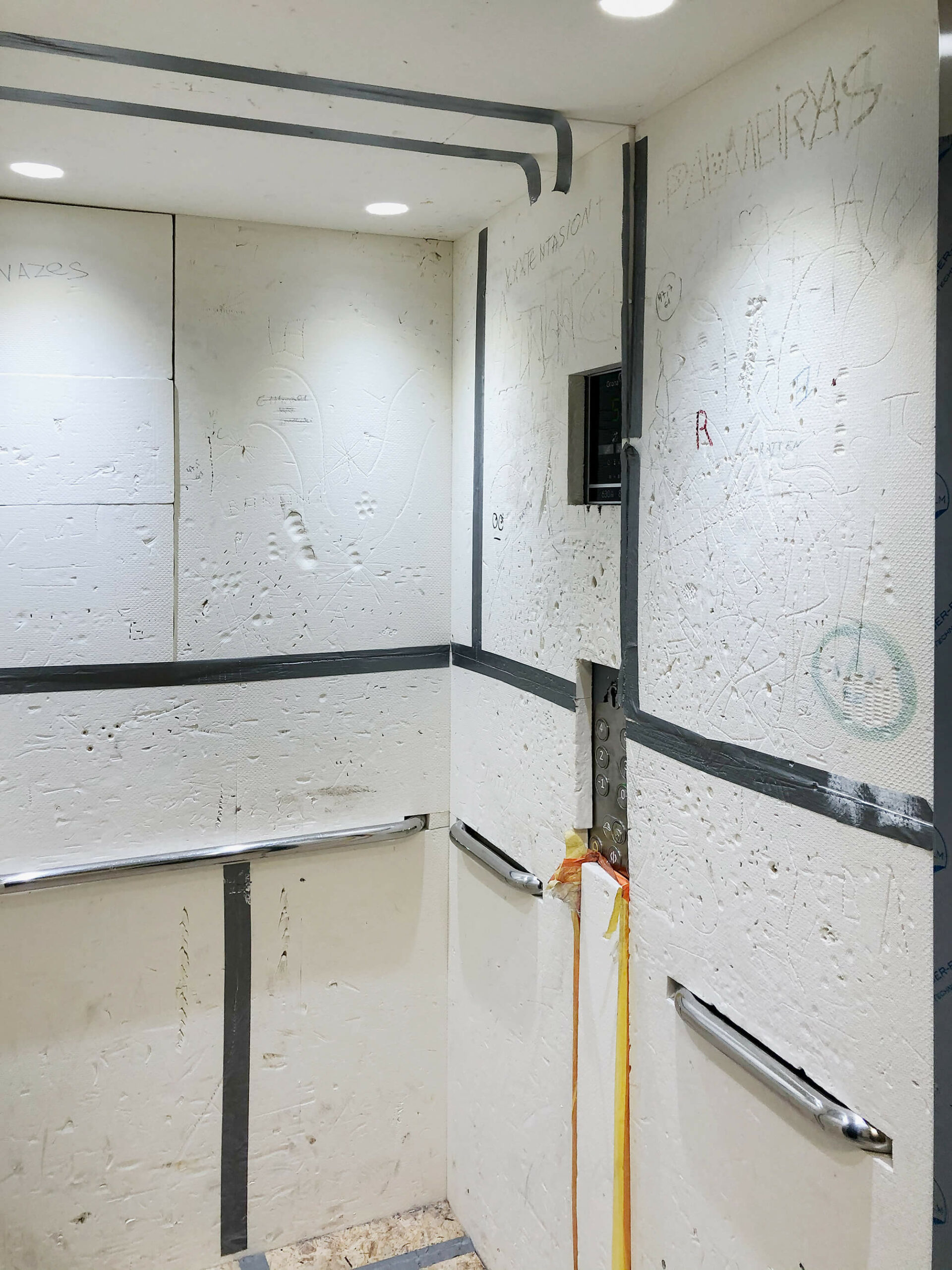
The building is almost finished. One apartment is still up for sale, on the top floor. The contractor is finishing up. There’s a long list of comments and deficiencies that need to be addressed before the building can be handed over definitively to the owner. The elevator’s walls are protected by styrofoam to prevent squares, levels, measures, drills, air compressors, chairs, bird cages, etc. from making scratches on the brand new wooden panelling.
In 1932 Brassaï began taking photographs of graffiti scratched into walls of Parisian buildings. On his long walks he was often accompanied by the author Raymond Queneau, who lived in the same building but on a different floor. Brassaï published a small collection of the photographs in Minotaure, illustrating an article titled ‘Du mur des cavernes au mur d’usine’ [‘From cave wall to factory wall’].
On Mondays, before noon, I go to the supermarket with my two-year-old son. After passing the lasagnes, the loaves of bread and the fruit and vegetables, we make a short stop at the aquarium with the lobsters. Around New Year, there are two of them.
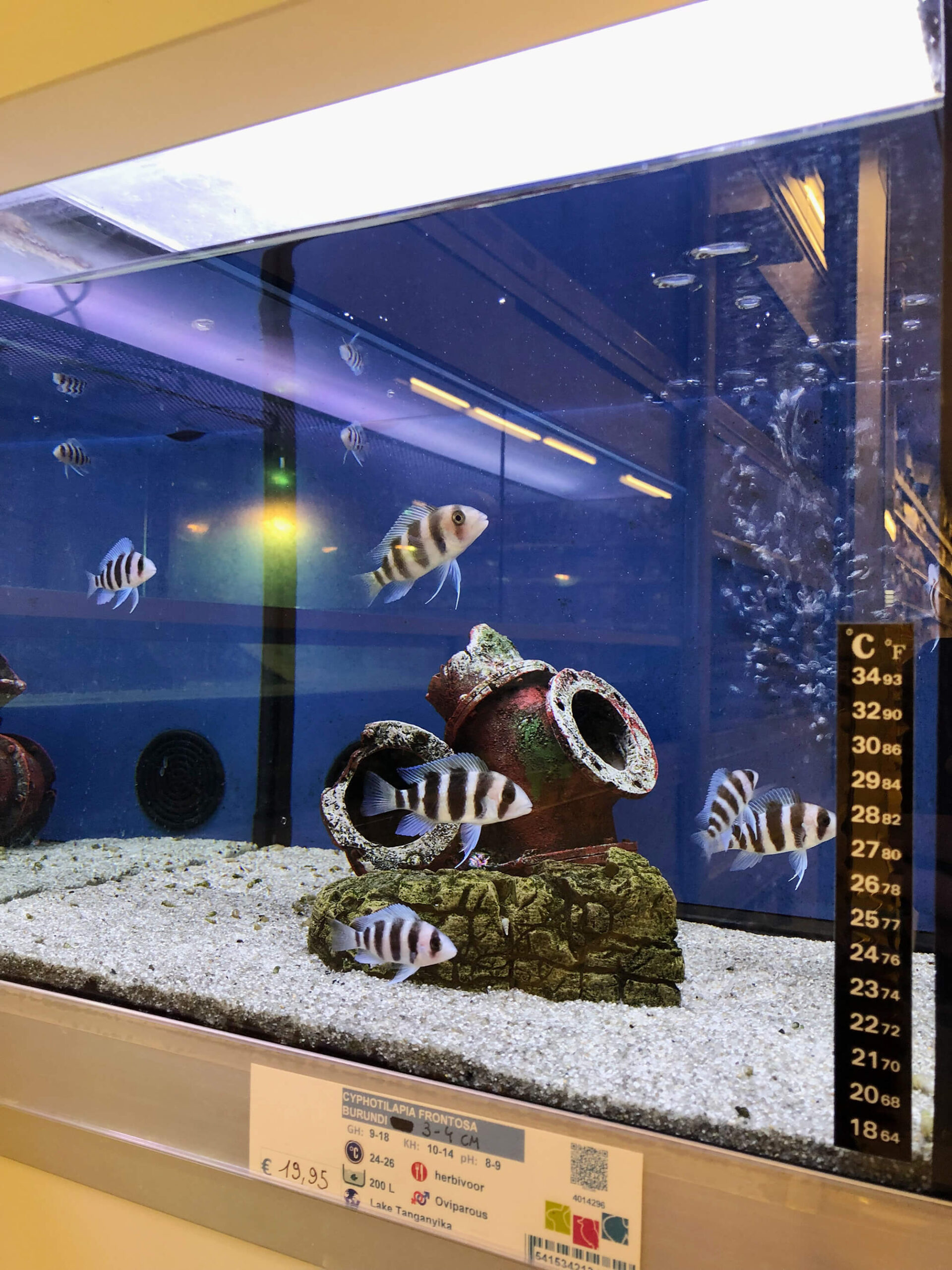
After we’ve paid for the groceries and have put them in the car, we walk into the pet shop. We look at the parrots (Jacques, Louis and Marie-José), the rabbits, the guinea pigs, the assorted caged birds and the fish and turtles. He’s very fond of the Cyphotilapia Frontosa Burundi. He calls them zebras. They hail from Lake Tanganyika, the label says. It’s the second-oldest freshwater lake, the second-largest by volume and the second-deepest. The pet shop has adorned their aquarium with a scene of ocean waste.
In an effort to avert guilt, I look for something cheap and more or less useful to buy: birdseed, a snack for the neighbour’s cat, a comb for his grandparent’s Labrador, etc.
A skiing holiday with my in-laws. The ski pass does not allow you to visit Schatzalp. We buy a separate ticket and take the train up the hill to the hotel, which served as the backdrop for Thomas Mann’s Magic Mountain. The stately hotel and former sanatorium is gorgeous.
Meanwhile, a new virus is spreading. Some people are coughing. I am keeping distance while waiting in line to take the train back down to the snow-covered village.

When discussing the sensitivities around viewing British propaganda photographs from the 1950s with Mau Mau veterans in Kenya, it became clear that it was not the graphic photographs of atrocities that would trigger the veterans emotionally, but a series of straightforward portraits of men who had pledged allegiance to the British colonial administration. These portraits were catalogued along with the men’s names and another photograph of each one of them signing a declaration of collaboration. I was advised by the representative of the veterans’ association that it would be too dangerous to share these photographs with the veterans.
22 superimposed portraits from the file CO 1066/7: Kikuyu Loyalists at The National Archives (UK) depicting Kikuyu loyalists after signing a declaration of collaboration with the British on 27 January 1954.
From the series State of Emergency, Max Pinckers et al. (2024)
Max Pinckers (°1988, BE) and Victoria Gonzalez-Figueras (°1988, CA) are based in Brussels, Belgium. They have been working together for the past ten years on documentary photography projects. Victoria works in the cultural field as a researcher and producer. Max is a speculative documentarian, teacher and occasional writer on photography. They are married, in love, and have a son. Victoria has consistently assisted Max in his projects as a production manager, but they have recently been making new work together as co-authors. “Double Reward” is the first such project.
In spring 2024 the-documents.org and Trigger co-publish a series of online articles with a focus on the meeting ground between photography and the document.

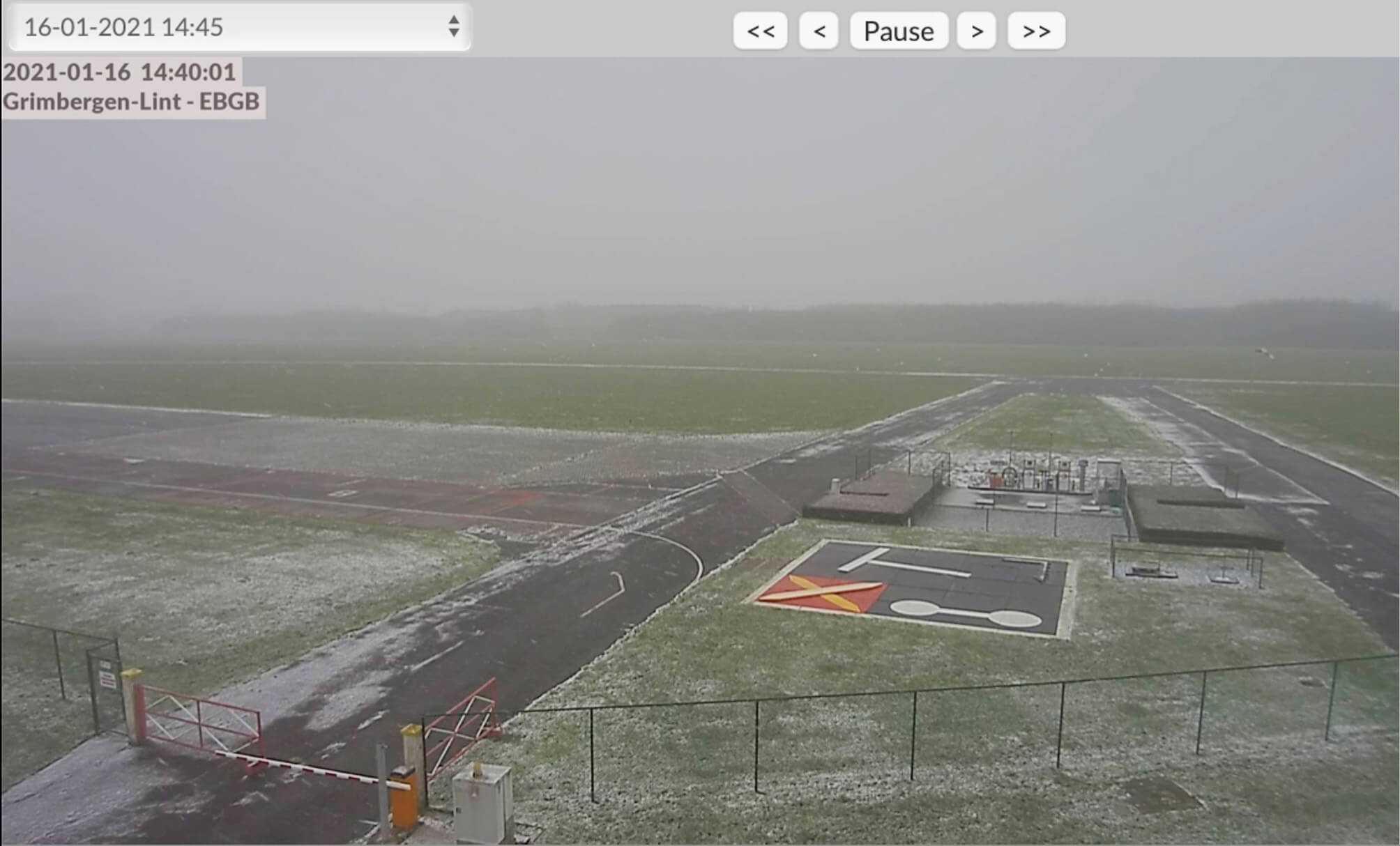
Recreational airfield at Grimbergen, webcam footage.
09:10:00The frame shows the first movement on the terrain. The gate has been opened, the barrier lowered. A black car is in the back. In the forefront, aviation signs on the ground: a yellow cross on a surface painted red; an arrow in a 90° angular shape; two circles connected by a line; a T-shaped line.
09:20:00Two men talking, each one on one side of the barrier. The man on the side of the airstrip has two dogs with him. The aviation signs have changed: the arrow is gone; the horizontal bar of the T-symbol has moved to the other side of the vertical line; one yellow line that made up the cross on the red surface is gone, leaving one yellow diagonal line.
10:09:01A small white aircraft (the two men and the dogs are gone).
10:20:01The aircraft in the same position, with what seems to be an open roof.
10:40:00Aircraft leaving the gas station where it was before.
11:10:01A white car at the gas station, where previously the aircraft was stationed; a silhouette of a man, perhaps.
11:30:01White car gone.
11:50:01Small white aircraft at the gas station; man in red jacket next to the aircraft. Not clear if it is the same aircraft seen in frame 10:09:01.
12:10:01Aircraft appears to be heading for take-off.
12:20:01Aircraft gone.
12:40:01White dots on the grass that appear to be birds.
14:10:00First precipitation: snow, visibility lessens.
14:20:00More snow, wind is stronger; someone has replaced the yellow stripe so that, again, a yellow cross is formed on the red background.
15:10:00The grass and the concrete get increasingly white. No aircrafts, vehicles or persons can be discerned. The aviation signs beneath the thin-layered snow are still visible, and unaltered.
Every so often architects ask me to photograph projects of theirs under a blanket of snow. Snow-days are rare around here. In an attempt to avoid a futile drive along roads in winter conditions, I check webcams near the project-to-be-photographed before setting out.
Webcam Grimbergen, meteobelgie.be: https://www.meteobelgie.be/waarnemingen/belgie/webcam/272/grimbergen
http://www.rvg.be
The building is almost finished. One apartment is still up for sale, on the top floor. The contractor is finishing up. There’s a long list of comments and deficiencies that need to be addressed before the building can be handed over definitively to the owner. The elevator’s walls are protected by styrofoam to prevent squares, levels, measures, drills, air compressors, chairs, bird cages, etc. from making scratches on the brand new wooden panelling.
In 1932 Brassaï began taking photographs of graffiti scratched into walls of Parisian buildings. On his long walks he was often accompanied by the author Raymond Queneau, who lived in the same building but on a different floor. Brassaï published a small collection of the photographs in Minotaure, illustrating an article titled ‘Du mur des cavernes au mur d’usine’ [‘From cave wall to factory wall’].
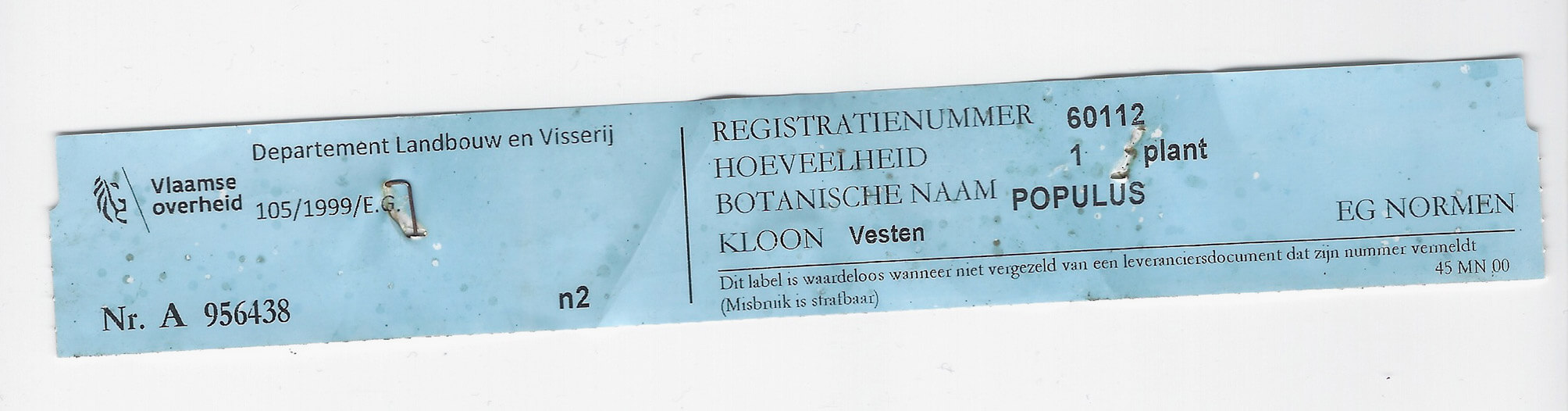
A Sunday stroll near my parents’ house. Along one of the roads between the fields, old poplars have been felled. Young trees have been planted. Each one has a baby blue coloured label, identifying them as Poplar tree, and, more specifically, the ‘Vesten’ cultivar. This cultivar is planted since it is one of the cultivars known for its resistance with regards to bacteria, diseases and insects. The tags on the trunks have staples keeping them together. They’re like bracelets. Come spring, the expanding diameter of the fast growing poplar species’ trunk will tear them apart.
Steenackers, M., Schamp, K., & De Clercq, W. (2018). De INBO variëteiten van populier, een aanwinst voor de Europese populierenteelt. Silva belgica : tijdschrift van de koninklijke belgische bosbouwmaatschappij = bulletin de la société royale forestière de belgique, N°4/2018, 40-47. [5].
https://purews.inbo.be/ws/portalfiles/portal/15044340/Dossier_populier_INBO_KBBM.pdf
Between the rhinos and the kangaroos in the Antwerp Zoo a wooden footpath curves through a grove of Sequoiadendron Giganteum trees. In the middle of this Californian forest, visitors find the giant slice of a felled tree of the same species. It was brought to the zoo in 1962 and was approximately 650 years old at the time. Eleven labels point out significant moments in history on the tree’s growth rings. They range from zoo- and zoology-related moments (for instance: ‘1901: The Okapi is described as a species’, or ‘1843: Foundation of the RZSA and opening of the Zoo’, or ‘1859: Darwin publishes The Origin of Species’, etc.), to cultural and historical milestones (‘1555: Plantijn starts publishing books in Antwerp’, or ‘1640: Rubens (baroque painter) dies’, or ‘1492: Columbus in America’). Another label points to the last growth ring and reads: ‘1962: this tree is felled and this tree disc is installed at the Zoo.’
The label pointing to the centre of the tree implies a simultaneity between the tree’s first growth year and the Battle of the Golden Spurs in 1302.
On closer inspection the slice seems to consist of two halves that were put together like a jigsaw puzzle. The resulting gap is skilfully patched with what appears to be wood from the same species – possibly even the same mammoth tree.

During the second half of April 2018, passers-by complained on Twitter about the massive chopping of trees and bushes in the area of the park site in Ranst, Belgium, along the E313 highway, in close proximity to the city of Antwerp.
Initially, the Department of Road and Highway Maintenance answered on Twitter that no pruning activities had taken place. They wouldn’t want to disturb breeding birds. But soon after, they admitted to the pruning. Their argumentation took a turn: ‘These are pruning activities in the context of the transmigration-problem on parking lots, as requested by the Police Department and the State Governor, so that transmigrants will no longer be able to hide. In the future, we will take up this discussion in our pruning policy for the upcoming breeding season.’
Upon closer investigation (an inquiry by Nature Inspection), the scale of the chopping became clear. The trees closest to the highway and the parking lot were chopped, while other trees were pruned at the bottom. Species such as European black elderberry, maple tree, sorbus, hazel, English holly, wild black cherry and breaking buckthorn disappeared. Rare species, only found in ancient forests, such as Solomon’s seal, were severely damaged.
These activities resulted in what the investigators described as a ‘transparent forest’ – a forest without density at lower levels, which is ecologically speaking not valuable. It has no ‘forest feeling’.
In spring 2024 the-documents.org and Trigger co-publish a series of online articles with a focus on the meeting ground between photography and the document.
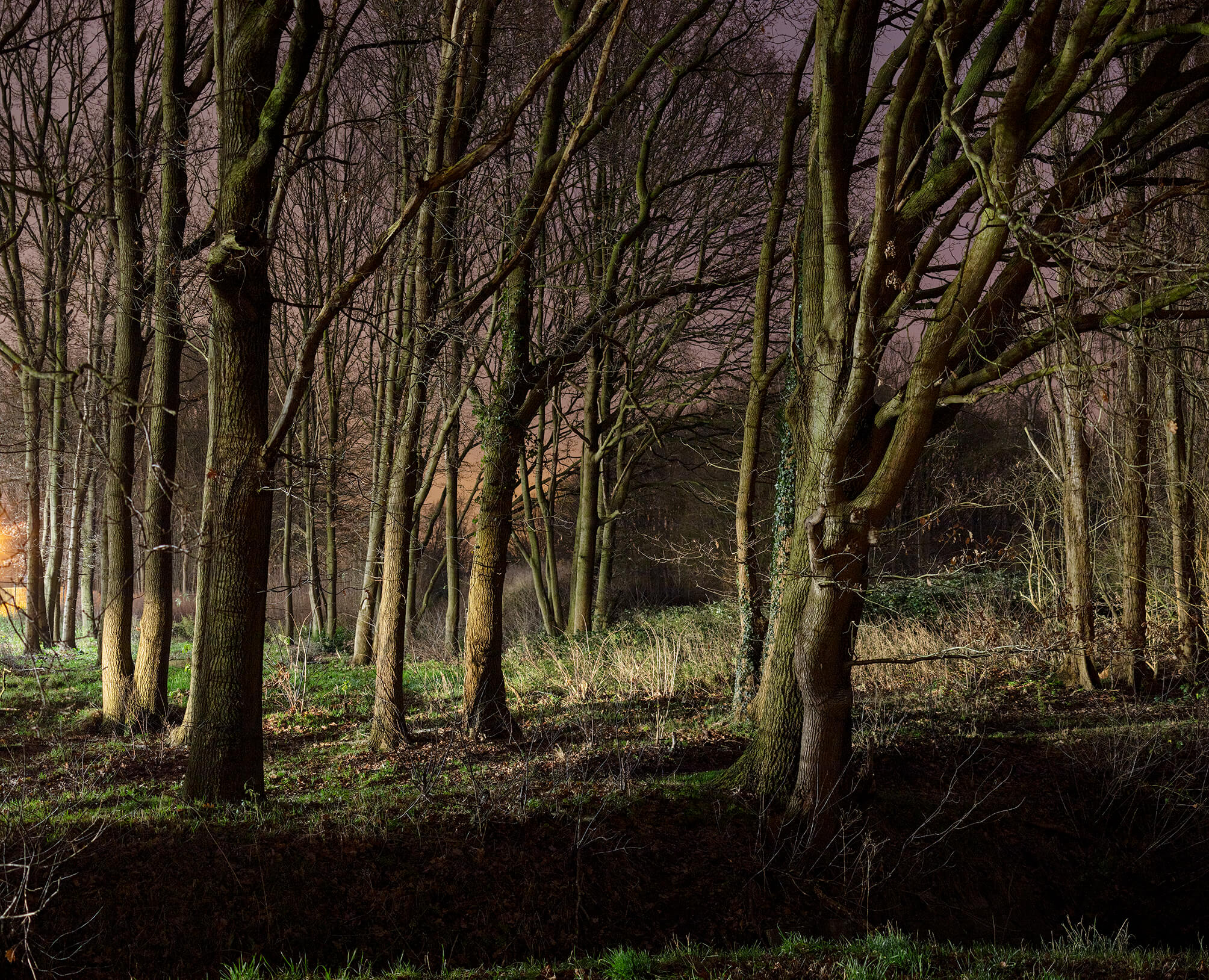
_44A6588.dng
At 13:26:43 I took a photograph of a concrete building without windows in an industrial zone just south of Brussels.
_44A6590.dng
At 16:46:15 I photographed a succession of office buildings in the same industrial zone.
_44A6589.dng
I must have walked about 1 kilometer between the concrete building without windows and the section of the industrial zone with the offices. At 13:43:49, the camera, safely stored in my backpack, recorded 0.4 seconds of the 20 minutes it took me to get there.
In The Snows of Venice, Alexander Kluge wonders whether he can take the liberty to conjure up what the sky looked like on 31 December 1799, as Schiller made his way to Goethe’s house. He goes on by saying that, historically, there’s a ‘LACK OF SENSORY ATTENTION AT CRUCIAL MOMENTS’.1 There are exceptions, though, like the cameraman that was sent out to document the fireworks on New Year’s Day 2000. The camera was turned on prematurely. The batteries were used up by midnight, but ‘certain gray tones, however, filtered through the cracks of its protective case, conveyed the motion of the walking cameraman, the transportation. The incompletely shut, low-information container was documented exactly […] To this day it provides inexact testimony as to the qualities of the leather of a twenty-first century carrying case and the precise sensitivity to light and dark demonstrated by a twenty-first century recording medium.’2
Lerner, B., Kluge, A. The Snows of Venice. Leipzig: Spector Books, 2018, p. 53
Ibid.
December, 1947. Rapid snowmelt coincides with torrential precipitation. At the bottom of the Thur valley, in Wildenstein, the water gathers.
It snows on December 19, but the situation changes on the 22nd with the arrival of an Atlantic low-pressure area, bringing masses of hot and humid air. Thaw follows.
And then, it snows again on December 26 and 27, before the arrival of a new warm front on the same day. A significant and brutal rise in temperature ensues: at Lac Noir, at 920 m, the temperature shoots up from 0,3 °C on December 27 at 7 AM to 7,4 ° C on the 28th at 9 PM.

The river swells and eventually overflows, causing the death of six people and extensive damage: washed away bridges, damaged homes, submerged factories, destroyed food stocks, heavily eroded roads and paths.
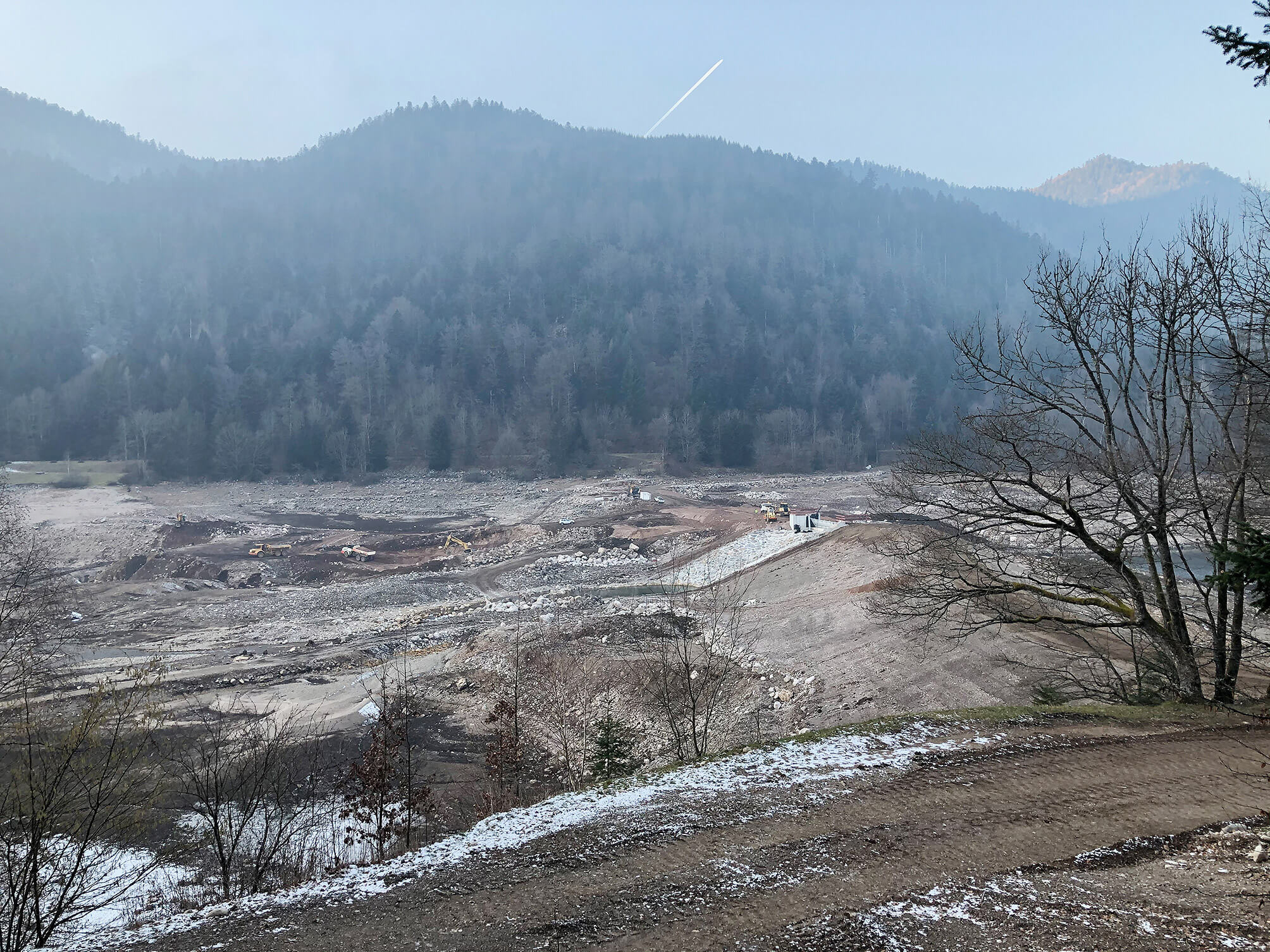
Seven years after the devastating flood, in 1954, the building of the dam is decided upon. Between 1959 and 1963 the infrastructure is built, and the reservoir gets filled with water in 1964 to act as a buffer for sudden floods and to guarantee a flowing Thur through the highly industrialized area downstream.
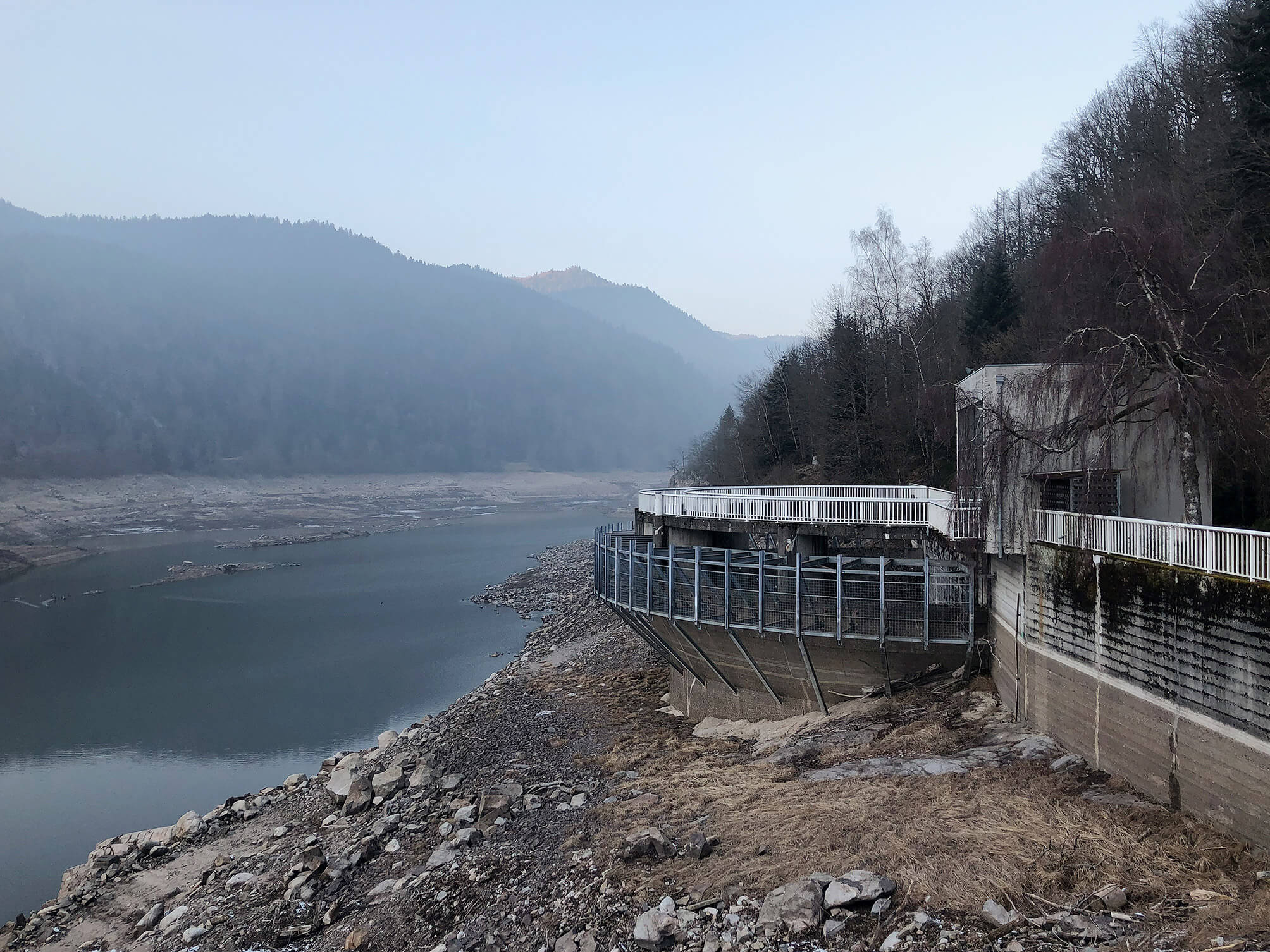
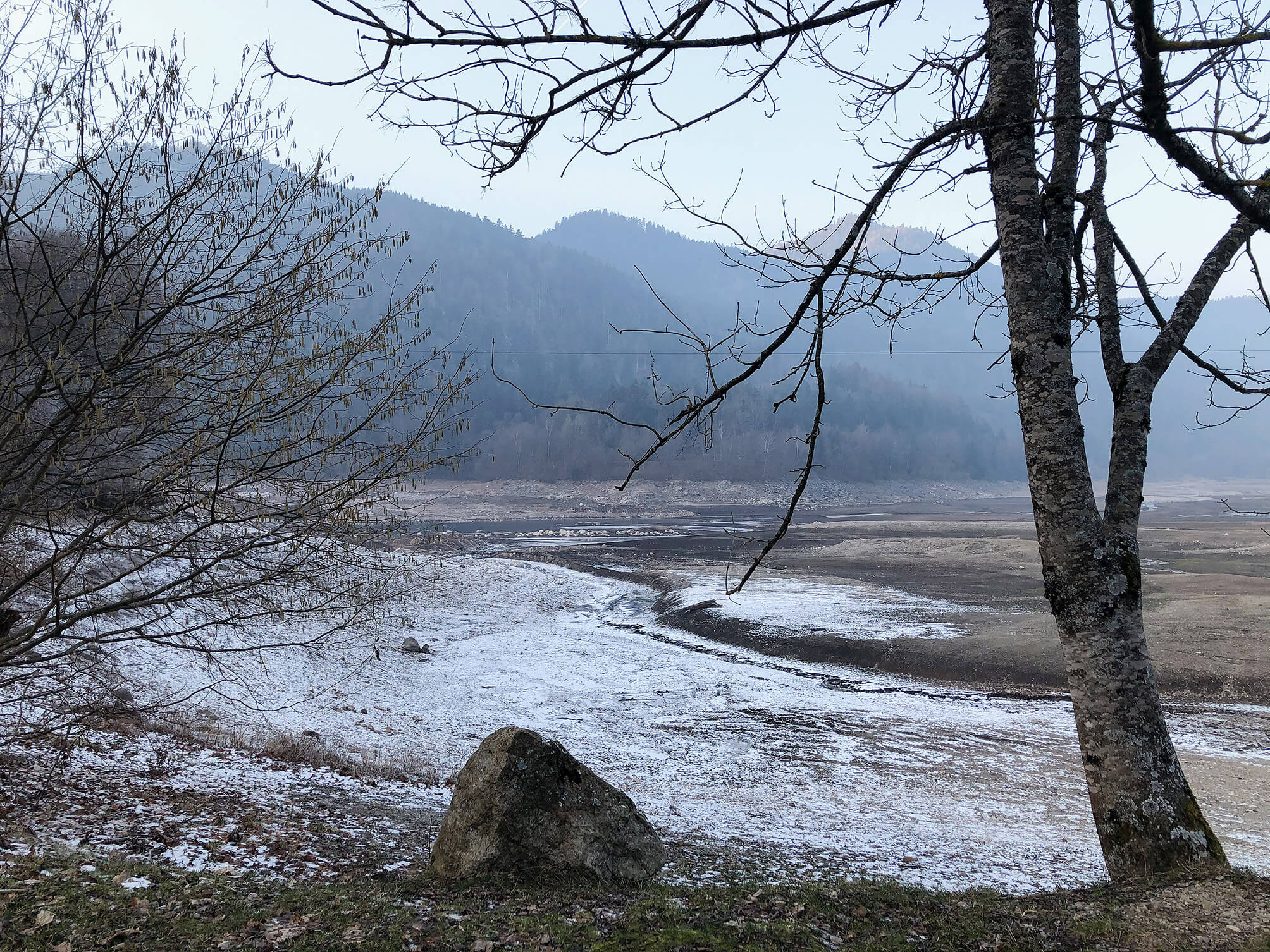
On January 23, 2020 a young couple walks around the drained reservoir of Kruth-Wildenstein.
It’s freezing. They’re expecting their first child within a month.
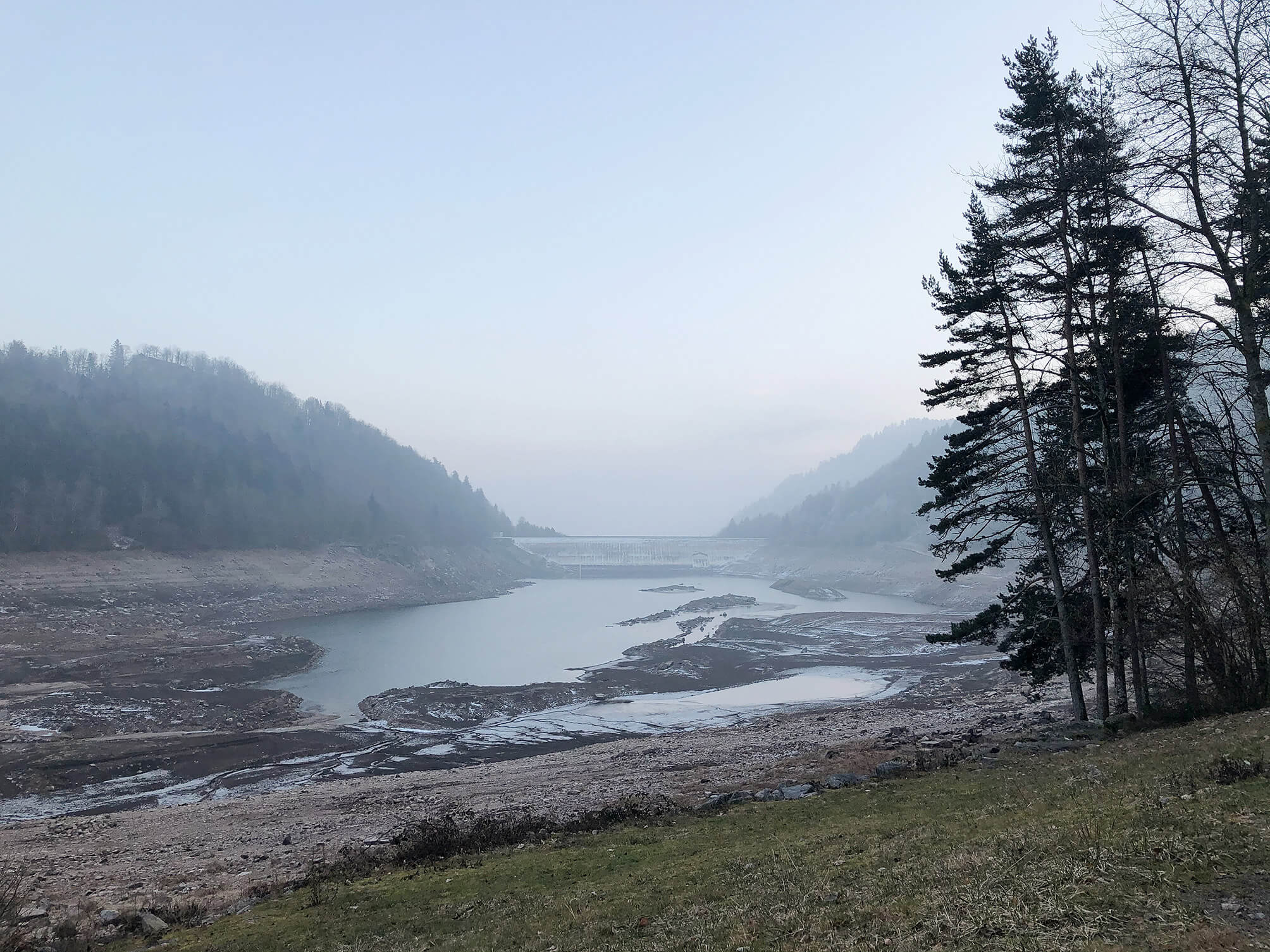
Where once there was twelve million cubic metres of water, excavators and trucks are moving dirt and rocks that have been hidden from sight for 56 years; piling them up into a temporary dam: a batardeau.

What they took for ice that slid down the dam’s slope, appears to be the reason for draining the reservoir: a fissure in the watertight layer. The dam became unreliable.
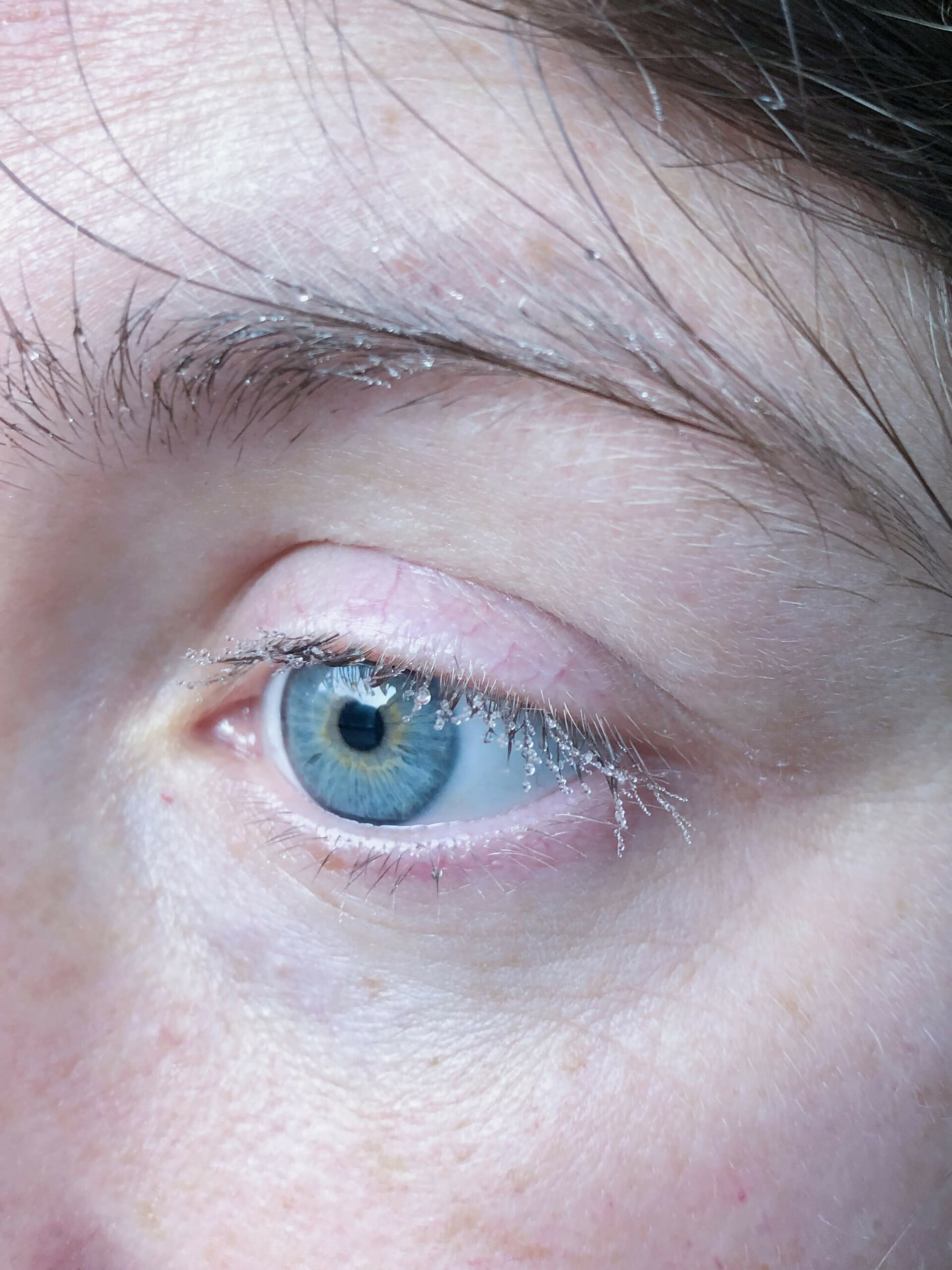
Shortly after crossing the Thur the couple reaches their car. They’re freezing. As the sun sets they drive through the mountainous landscape. The heating hurts their fingers.
The next day, they return, but the scene looks different. It’s warmer. The Thur appears to flow faster.

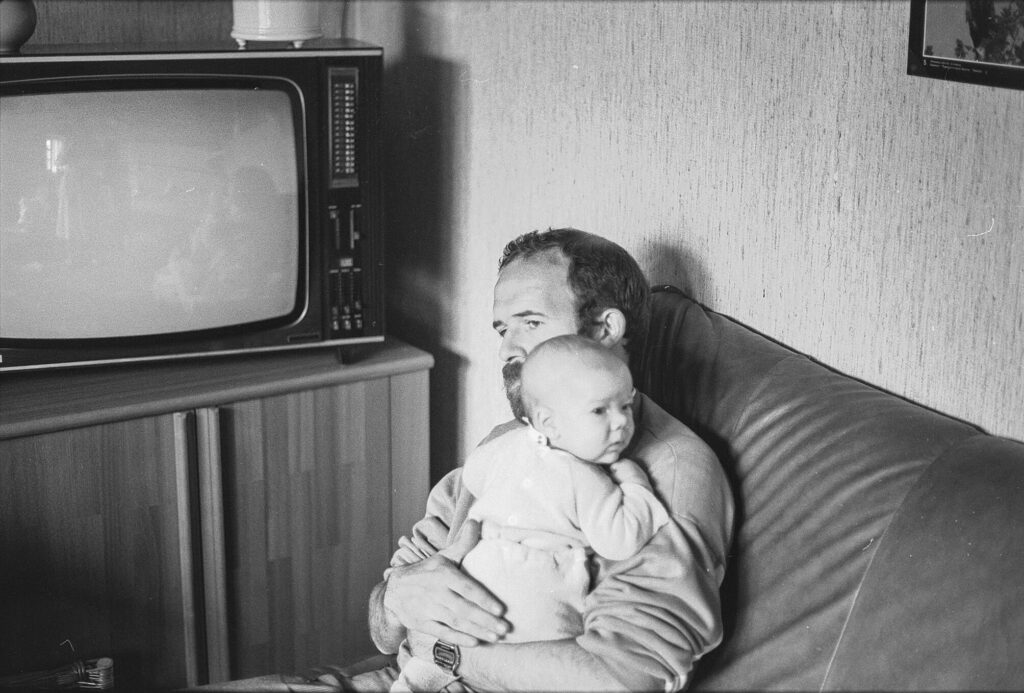
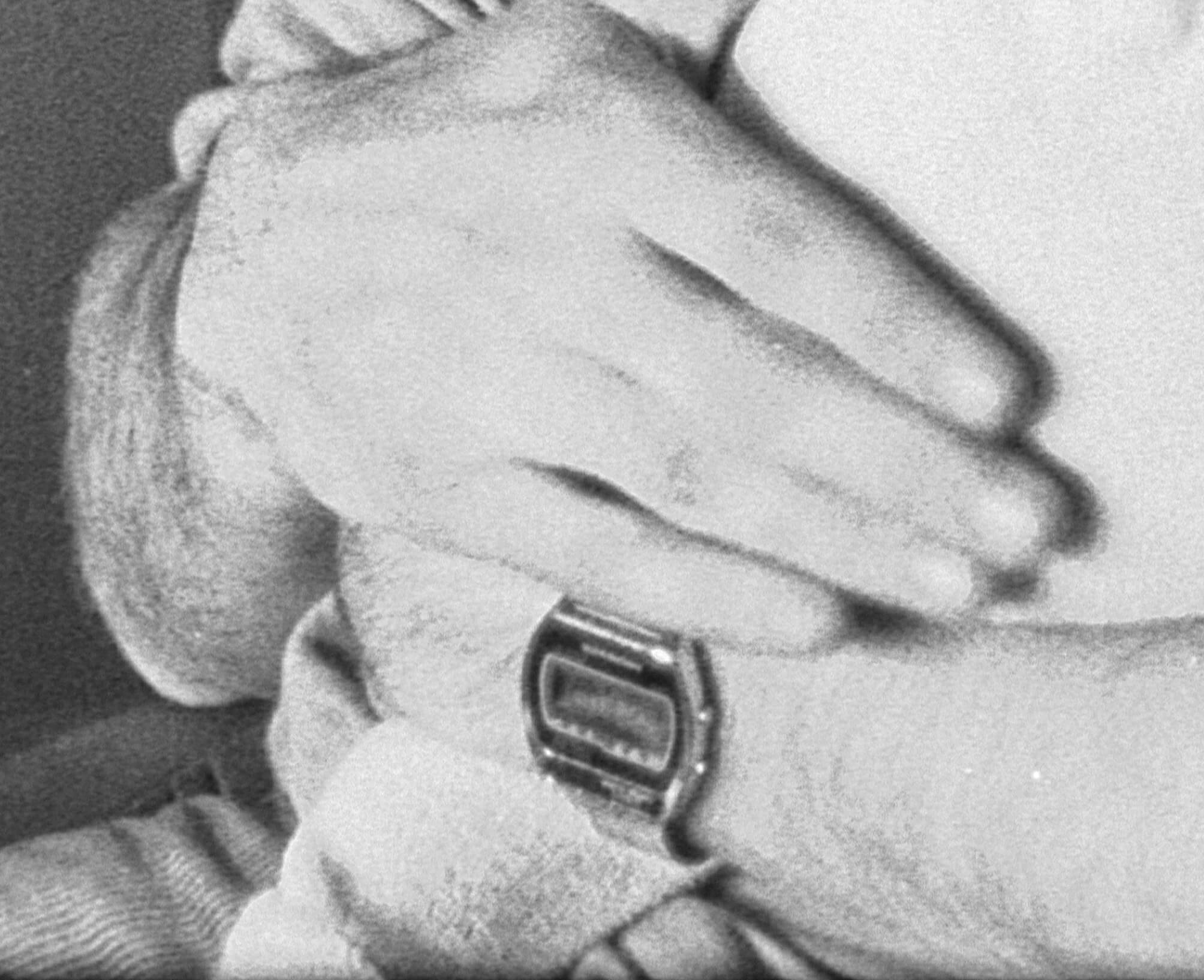
He’s wearing a digital watch. It looks like a Casio. It’s impossible to read the time, no matter whether you are studying the high-resolution scan of the negative or the negative itself, with the aid of a loupe and lightbox.
The device had a stopwatch function. When we were around eight and ten, we used to compete in trying to start and stop the stopwatch in the shortest possible interval. The smaller the gap, the closer to zero. Sometimes he would also have a try. We once managed to get it down to 00:00:00:03. Neither of us dared to press ‘reset’ and try again.
During a two hour tour, H.V. (head of the science collection) guided us from the library to the observatory and back. Along the way, he touched upon various rarities: one hundred ninety-five volumes of the Encyclopédie Méthodique (according to H.V. the most complete copy left in the world), the severed summit of Mont Blanc (‘Actually de Saussure brought back a triangular piece of rock from just below the snow line near the summit’), an original copy of the publication on the infamous Lügensteine (‘These date back to the time before the hoax was unveiled’)…
In guiding us from room to room, H.V. piled oddity upon curiosity. He showed a particular interest in all things fish-related.
First published in: De Cleene, M. Reference Guide. Amsterdam: Roma Publications, 2019
