What constitutes a ‘document’ and how does it function?
According to the Oxford English Dictionary, the etymological origin is the Latin ‘documentum’, meaning ‘lesson, proof, instance, specimen’. As a verb, it is ‘to prove or support (something) by documentary evidence’, and ‘to provide with documents’. The online version of the OED includes a draft addition, whereby a document (as a noun) is ‘a collection of data in digital form that is considered a single item and typically has a unique filename by which it can be stored, retrieved, or transmitted (as a file, a spreadsheet, or a graphic)’. The current use of the noun ‘document’ is defined as ‘something written, inscribed, etc., which furnishes evidence or information upon any subject, as a manuscript, title-deed, tomb-stone, coin, picture, etc.’ (emphasis added).
Both ‘something’ and that first ‘etc.’ leave ample room for discussion. A document doubts whether it functions as something unique, or as something reproducible. A passport is a document, but a flyer equally so. Moreover, there is a circular reasoning: to document is ‘to provide with documents’. Defining (the functioning of) a document most likely involves ideas of communication, information, evidence, inscriptions, and implies notions of objectivity and neutrality – but the document is neither reducible to one of them, nor is it equal to their sum. It is hard to pinpoint it, as it disperses into and is affected by other fields: it is intrinsically tied to the history of media and to important currents in literature, photography and art; it is linked to epistemic and power structures. However ubiquitous it is, as an often tangible thing in our environment, and as a concept, a document deranges.
the-documents.org continuously gathers documents and provides them with a short textual description, explanation,
or digression, written by multiple authors. In Paper Knowledge, Lisa Gitelman paraphrases ‘documentalist’ Suzanne Briet, stating that ‘an antelope running wild would not be a document, but an antelope taken into a zoo would be one, presumably because it would then be framed – or reframed – as an example, specimen, or instance’. The gathered files are all documents – if they weren’t before publication, they now are. That is what the-documents.org, irreversibly, does. It is a zoo turning an antelope into an ‘antelope’.
As you made your way through the collection,
the-documents.org tracked the entries you viewed.
It documented your path through the website.
As such, the time spent on the-documents.org turned
into this – a new document.
This document was compiled by ____ on 14.10.2025 14:32, printed on ____ and contains 18 documents on _ pages.
(https://the-documents.org/log/14-10-2025-6681/)
the-documents.org is a project created and edited by De Cleene De Cleene; design & development by atelier Haegeman Temmerman.
the-documents.org has been online since 23.05.2021.
- De Cleene De Cleene is Michiel De Cleene and Arnout De Cleene. Together they form a research group that focusses on novel ways of approaching the everyday, by artistic means and from a cultural and critical perspective.
www.decleenedecleene.be / info@decleenedecleene.be - This project was made possible with the support of the Flemish Government and KASK & Conservatorium, the school of arts of HOGENT and Howest. It is part of the research project Documenting Objects, financed by the HOGENT Arts Research Fund.
- Briet, S. Qu’est-ce que la documentation? Paris: Edit, 1951.
- Gitelman, L. Paper Knowledge. Toward a Media History of Documents.
Durham/ London: Duke University Press, 2014. - Oxford English Dictionary Online. Accessed on 13.05.2021.

The last couple of days have been dry. Rain is expected for the weekend. The office buckets are in place and are empty, except for some residue. Dirt, sand, a few hairs. Some particles must have come along with the drops when they made their way through the roof.

On May 7th, 1992, an anonymous photographer records the ice cellar, a stone’s throw from my parents’ house. It’s a beautiful day in spring. Quite a bit of wind, it seems. A Thursday. Surely, I am at school. Third grade kindergarten. It houses bats.
The photograph is part of an online heritage inventory, maintained by a government department. On the same day, the photographer took a photograph of the orangery, the entrance gate to the allotment, and the castle.
https://id.erfgoed.net/afbeeldingen/264680

Freely adapted from interviews with residents of Sandersleben (Saxony-Anhalt). Three-act play. The first two acts take place in the present day; the third is set in the future.
From Act 2 ‘The Inhabitants’, Scene 5, ‘Living Differently’.
Characters: MR DUNST club member I, MR WINDORF amateur astronomer
Stills from text animation S. Anders Leben. Eine Handlung in Gesprächen/S. Anders Leben – Living Differently: An Act in Conversations
Stephanie Kiwitt (1972) is an artist based in Halle (Saale), Germany. Utilizing a large number of images, various perspectives and also textual elements, she is known for her insightful photography that explores spaces emblematic of contemporary phenomena. Over the past three years, she has focused on evolving habitats in rural areas, photographing traces of transformation and conducting interviews in Saxony-Anhalt, the region she moved to in 2020. From 2018 to 2020, Kiwitt was a guest lecturer at the LUCA School of Arts in Brussels.
In spring 2024 the-documents.org and Trigger co-publish a series of online articles with a focus on the meeting ground between photography and the document.

Freely adapted from interviews with residents of Sandersleben (Saxony-Anhalt). Three-act play. The first two acts take place in the present day; the third is set in the future.
From Act 1 ‘The Town of S’, Scene 2 ‘The Past’.
Characters: MR DUNST club member I, OLIVER club member II, ANJA young mother
Stills from text animation S. Anders Leben. Eine Handlung in Gesprächen/S. Anders Leben – Living Differently: An Act in Conversations
Stephanie Kiwitt (1972) is an artist based in Halle (Saale), Germany. Utilizing a large number of images, various perspectives and also textual elements, she is known for her insightful photography that explores spaces emblematic of contemporary phenomena. Over the past three years, she has focused on evolving habitats in rural areas, photographing traces of transformation and conducting interviews in Saxony-Anhalt, the region she moved to in 2020. From 2018 to 2020, Kiwitt was a guest lecturer at the LUCA School of Arts in Brussels.
In spring 2024 the-documents.org and Trigger co-publish a series of online articles with a focus on the meeting ground between photography and the document.

According to @missbluesette, the green K-10 put up for sale by Fred from Zwolle that I came across on marktplaats.nl on 29 September 2022 is not green, but blue. The colour resembles turquoise, I explain, a colour I have always called green. No, turquoise is not green, but blue, she replies. And the texts of my Instagram posts are too long, she says, so she doesn’t read them.
Lars Kwakkenbos lives and works in Brussels and Ghent (B). He teaches at KASK & Conservatorium in Ghent, where he is currently working on the research project ‘On Instructing Photography’ (2023-2024), together with Michiel and Arnout De Cleene.

Fairly detailed map of the two major marble quarries on the island of Tinos, Greece. The spontaneous route-advice was prepared by a local marble worker, P.D., in the Karia region of the island on a locally extracted, green marble slab. The waved lines represent roads traversing uphill, while the straight lines represent roads following a contour line of the topography.
‘Tell your friend that the wine is for girls; it’s very sweet,’ the marble worker alerted my travel companion K.S. after offering us local sweet wine. The workshop smelled like boiled meat and bones.
Notes on map from left to right, top to bottom:
- Towards Vathi
- Quarry
- incomprehensible
- Towards Vathi Bleu
- Isternia
- Pirgos
Márk Redele pursues projects that fundamentally relate to architecture and its practice but rarely look like architecture. www.markredele.com

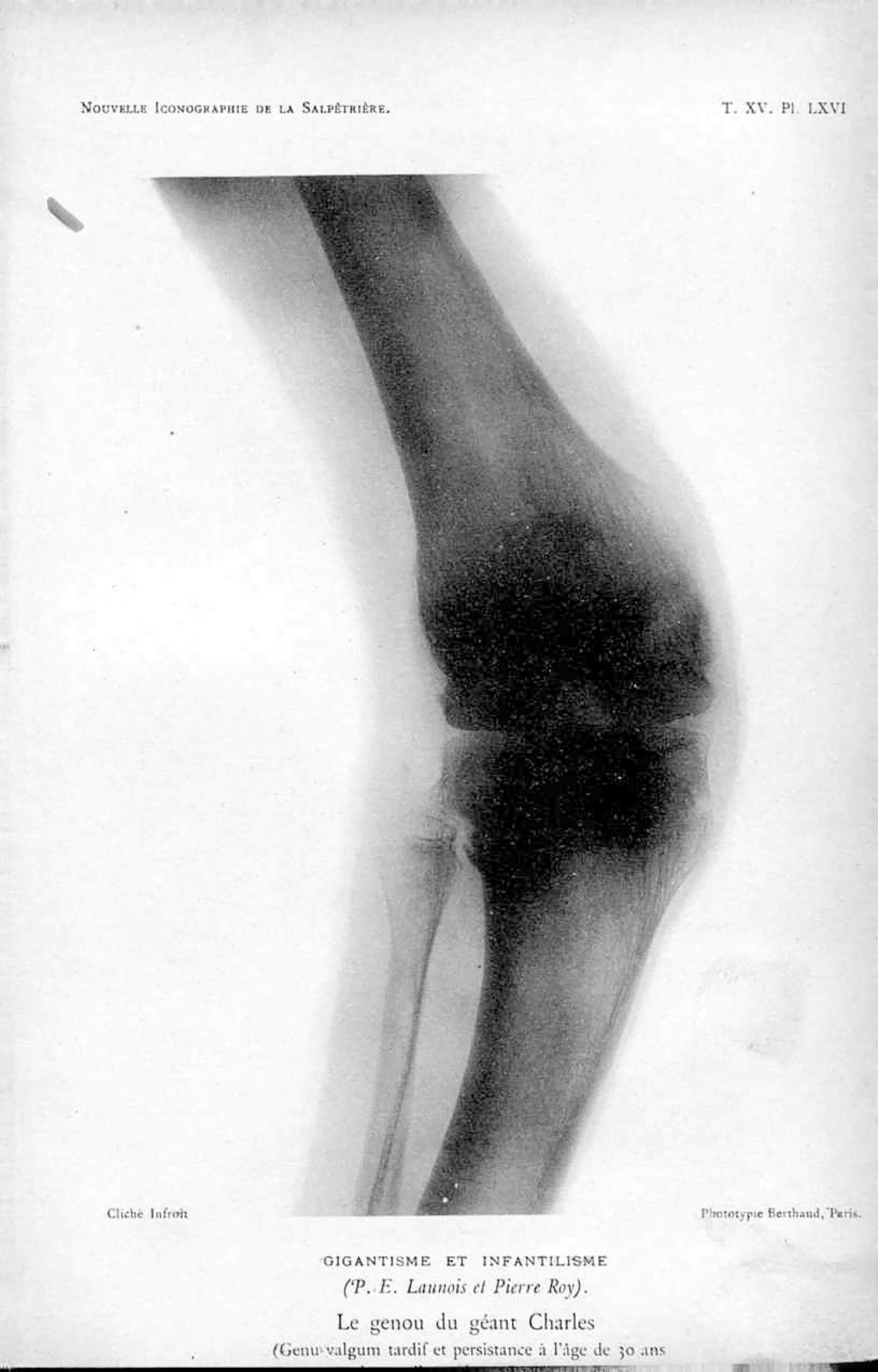
The scientific exactitude sought for in the Iconographie de la Salpêtrière and the Nouvelle Iconographie de la Salpêtrière, the (in)famous scientific publications stemming from Paris’ psychiatric hospital La Salpêtrière (1876-1918), lead to an abundance of photographic images in their pages. The photographs’ ideal: ‘Trace incontestable, incontestablement fidèle, durable, transmissible’.1 The ambition of exactitude results in cold, and often cruel depictions of patients. In the digitized version of the Sorbonne library’s copies, some photographs have left an imprint on the opposite page. The knee of Charles, ‘le géant’, adds an unwanted layer upon its measures on the opposite page, while the photograph of the knee itself loses ink.2
Didi-Huberman, G. Invention de l’hystérie. Paris: Macula, 2014, 72.
Launois, P.-E., Roy, P., ‘Gigantisme et infantilisme’, Nouvelle Iconographie de la Salpêtrière, Tome XV, 1902, 548, pl. LXVI, online: https://patrimoine.sorbonne-universite.fr/fonds/item/2613-nouvelle-iconographie-de-la-salpetriere-tome-15?offset=6

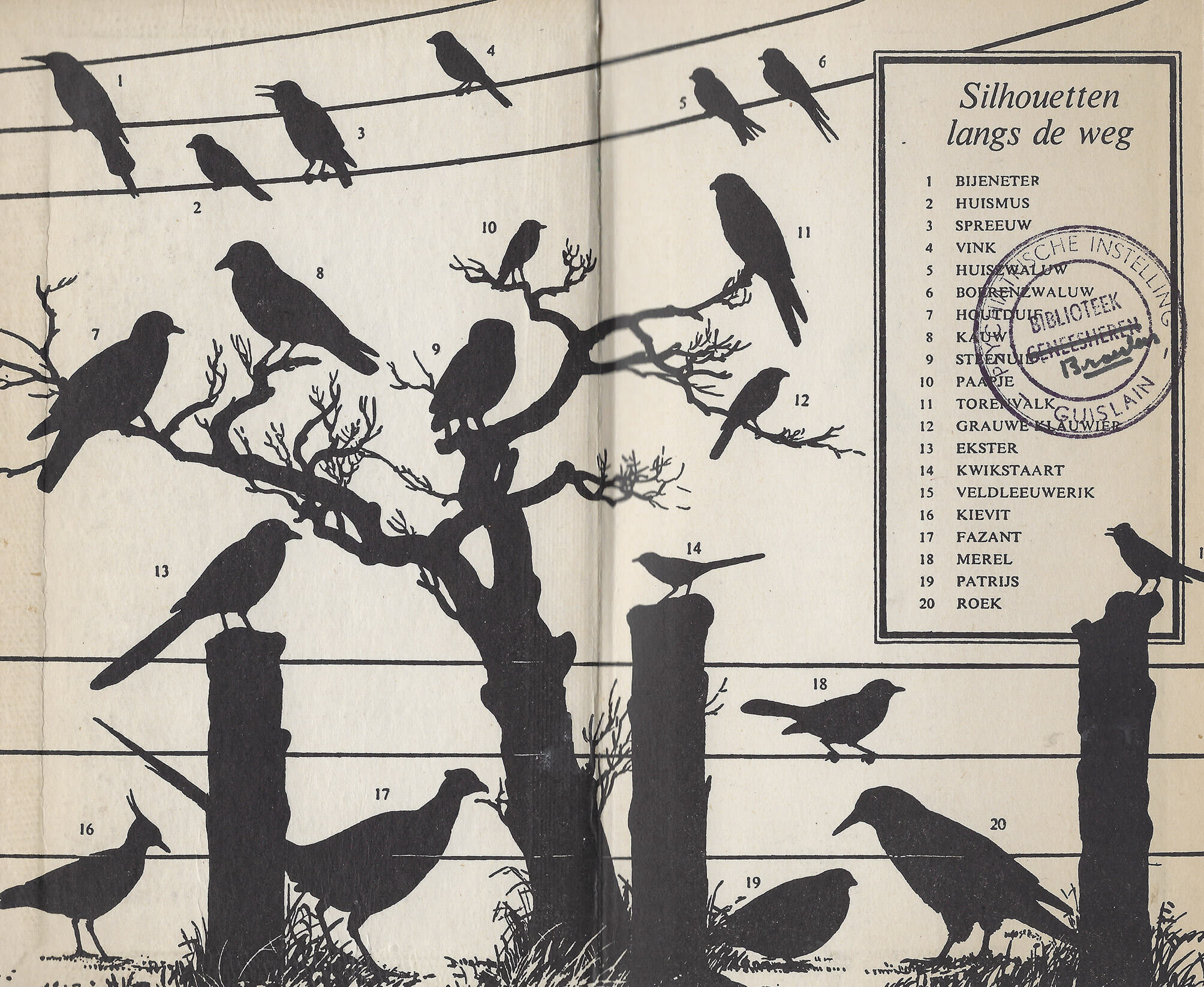
This is the spread one sees upon opening the bird field guide that once stood, as the stamp indicates, in the library of a psychiatric institution.1 It shows birds’ silhouettes, as they can be seen beside the road.
The drawing has a kind of Hitchcock feel to it.2 The birds seem to be spying on each other, as they also seem to be spying on the unsuspecting passer-by.
The composition of the scene is marvelous. The electric wires, the tree, the wire fence, the double framed list with the birds’ names, handsomely positioned in a birdless patch, at once superimposed on the telephone wires, and pushed to the background by the skylark.
Imagine seeing this scene. What are the odds: to see the silhouettes of Europe’s twenty most common species of birds in one glance, from your car’s window, as you are driving home at dusk.
Before closing the book, the last spread seems to show the birds fleeing, maybe attacking.3
The stamp indicates that, at the psychiatric institution, the book was part of the sublibrary for the Catholic Brothers of Charity. The crossed-out part indicates that there was also a separate physicians’ library, to which the book might have originally belonged.
On the web, discussions on whether Alfred Hitchcock’s The Birds (1963) was shot in colour or in black and white, abound.
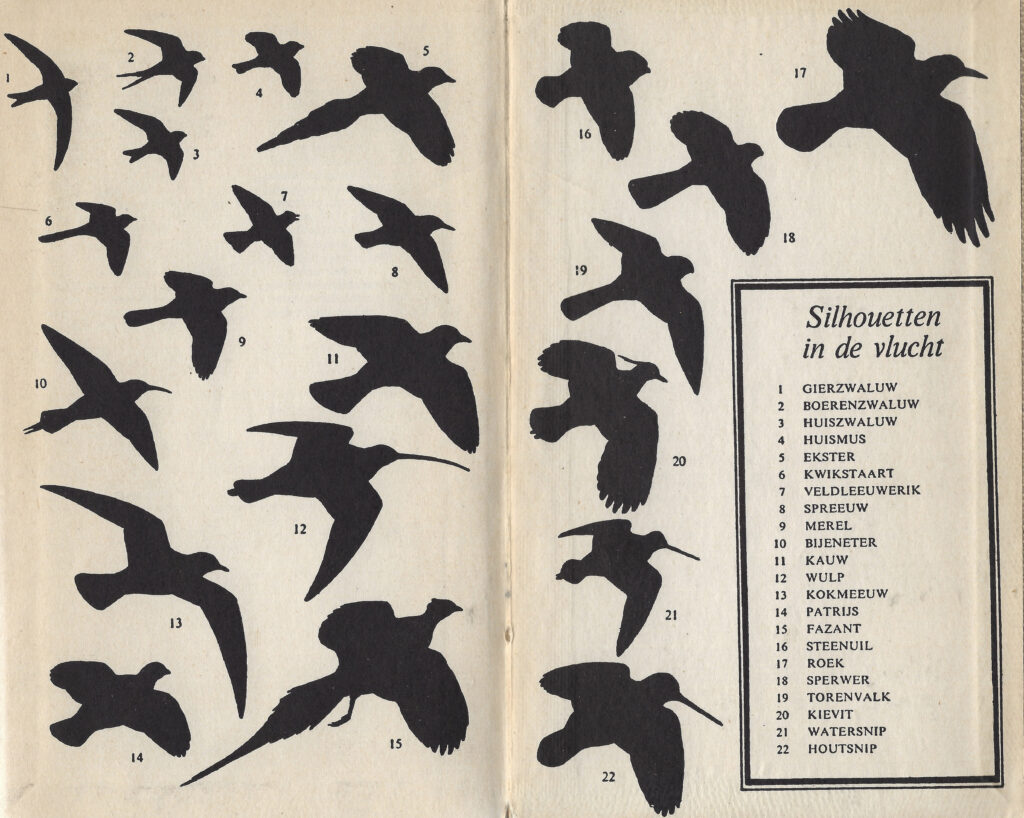
Peterson, R.T., Mountfort, G. & P.A.D. Hollom. Vogelgids voor alle in ons land en overig Europa voorkomende vogelsoorten (J. Kist, transl.). 3d ed. Amsterdam/Brussels: Elsevier, 1955.
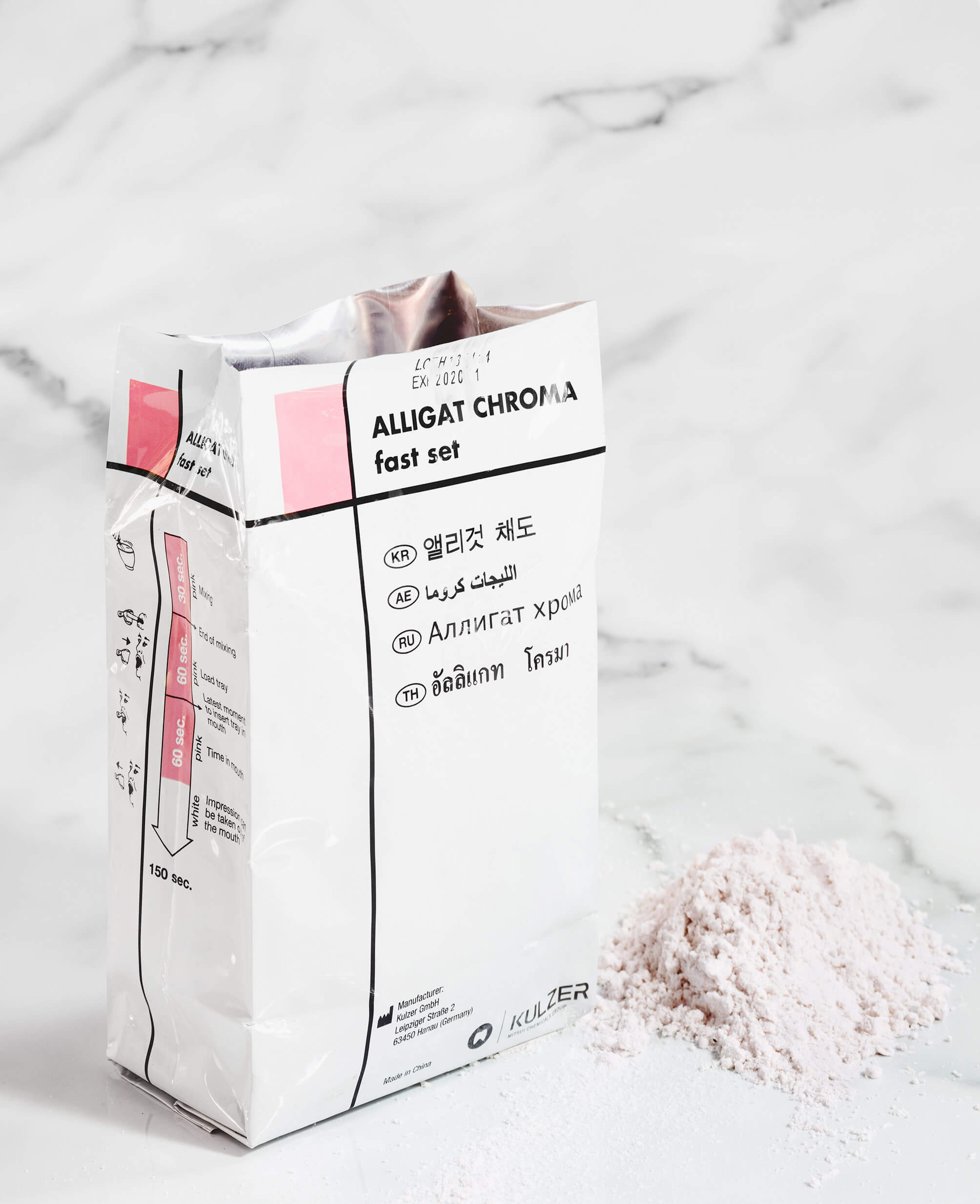
At a dental practice, the white Alligat®-powder is mixed with the right amount of water to get a mouldable dough that is pressed upon a patient’s teeth. After thirty seconds, the Alligat®-dough stiffens and takes on a rubber-like quality. At that point, still white, it must be removed from the patient’s mouth. Over the next few hours, the mould turns increasingly pink as the substance becomes less humid. Now, it can be used as a mould to create a positive master cast of the patient’s teeth.
Outside the dental practice, the powder’s possibilities remain to be fully explored.

First published as part of De Cleene De Cleene. ‘Amidst the Fire, I Was Not Burnt’, Trigger (Special issue: Uncertainty), 2. FOMU/Fw:Books, 25-30
The last couple of days have been dry. Rain is expected for the weekend. The office buckets are in place and are empty, except for some residue. Dirt, sand, a few hairs. Some particles must have come along with the drops when they made their way through the roof.
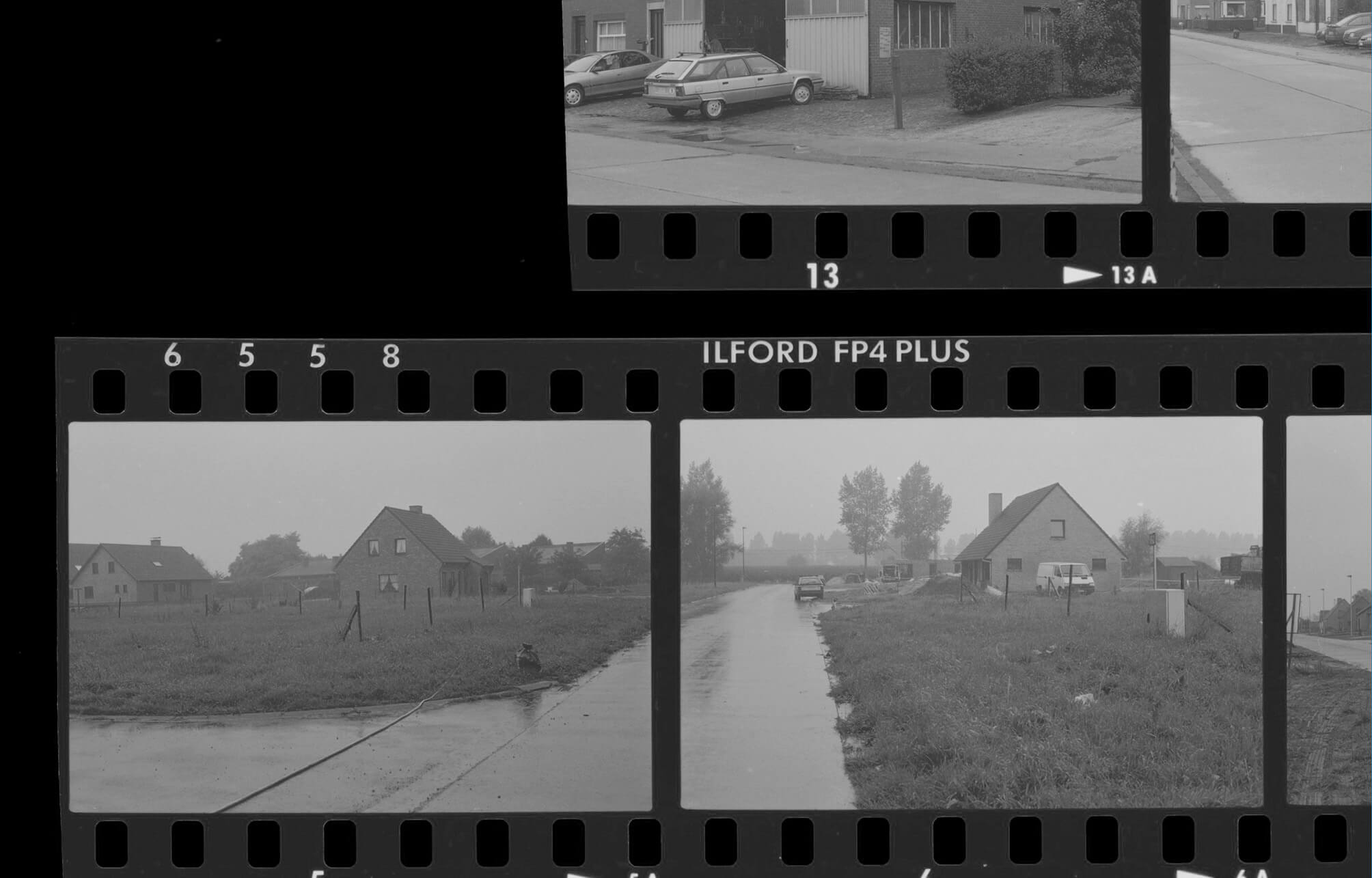
The architect’s photographic archive contains seven images that can be labelled as panoramic pictures. However, they only appear as such when the photographs are viewed in the archive, as strips of negatives. In order to see the panoramic construct, the viewer needs to be presented with two consecutive negatives.
There are two kinds of panorama in the archive: the kind that can only be attributed to a kind of laziness or a need for efficiency on behalf of the architect, and another that originates from frugality.
The former type of panorama is created when the architect is documenting the situation as it is: it is compulsory to document the context of the building or lot, as part of a building application. He simply pivots from left to right, capturing the first and second photograph consecutively. On the filmstrip a panorama appears.
The other kind of panoramic picture only appears at the end of the film role. The last negative on the film has been exposed (the twenty-fourth or thirty-sixth), after which he exerts force onto the lever to move the film forward anyway. Some films are known to have, by accident, a twenty-fifth or a thirty-seventh negative. The plastic between the sprocket holes tears and the film does not advance enough. The result differs fundamentally from the other kind of panorama: there is no separation, no void between the negatives. Rather, there is a slight overlap. A thin, vertical strip of film that has been exposed twice, suggesting contiguity that might not be there. The two exposures might be from altogether different sites, creating a new situation.
Based on De Cleene, M. & De Cleene, A. The Situation as it Is. A Photonovel in Three Movements. Gent: APE, 2022
In his Handboek Varende Scheepsmodellen (Handbook Sailing Ship Models) André Veenstra explains the different classes in ship model-competitions. There’s a wide variety. For static ship models the most important one is ‘truth-to-nature’. A jury compares the model to photographs of the actual ship and brings into account categories such as amount of work, degree of difficulty, scale ratio, construction execution and painting.
The most interesting class – according to Veenstra – is F 6. In this particular class, a number of participants with different boats will form a team. Together, they will perform a certain ‘act’ with a maximum duration of ten minutes. During the act, they mimic a slice of reality. Such as, for example, ‘rescuing’ and towing a ship in distress; extinguishing a fire on a tanker or oil rig, lichen and/or tow the sunken wreckage to the harbor, stage a naval battle, etc.
Page 262 shows a photograph of such a mimicked slice of reality. The caption explains: ‘Image 14.15. The Dutch demonstration in the F 6 class during the European Championship of 1975: the oil rig is set on fire by a motorboat with terrorists. The fire is extinguished and the oil rig is quickly towed to a safe harbor by tugs. The show was performed by six people and took a very creditable fourth place.’

Getty Images charges a fee for the use of a 1953 image depicting Mau Mau detainees building a wall. Working together with the Bristol Archives in the case of this collection, Getty claims to sell services such as “image search tools” and “research support”. These images are public domain and in fact available for free but as long as Getty does not charge the fee as a copyright claim, there is no legal obstacle to charging money for images to which they hold no copyright.
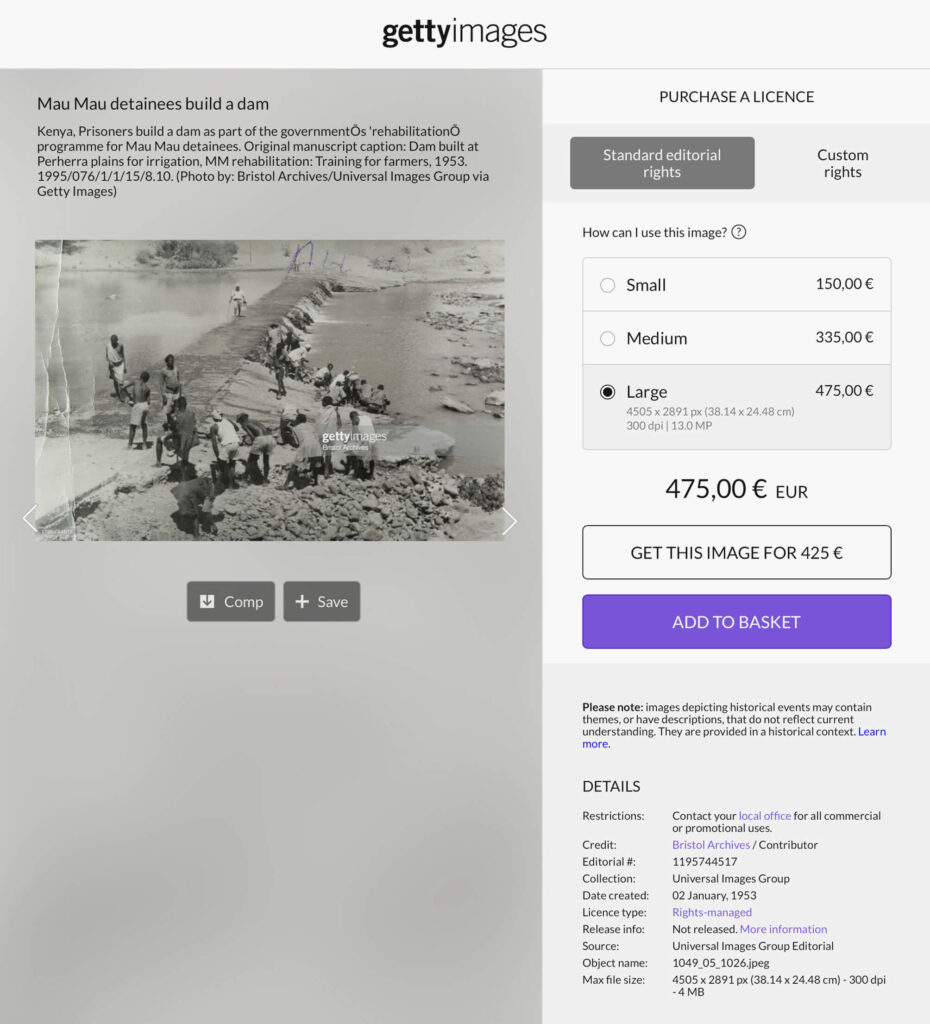
Mau Mau detainees build a dam, 1953, Elspeth Huxley (1995/076/1/1/15/8.10). British Empire & Commonwealth Collection, Bristol Archives, UK Public domain
Max Pinckers (°1988, BE) and Victoria Gonzalez-Figueras (°1988, CA) are based in Brussels, Belgium. They have been working together for the past ten years on documentary photography projects. Victoria works in the cultural field as a researcher and producer. Max is a speculative documentarian, teacher and occasional writer on photography. They are married, in love, and have a son. Victoria has consistently assisted Max in his projects as a production manager, but they have recently been making new work together as co-authors. “Double Reward” is the first such project.
In spring 2024 the-documents.org and Trigger co-publish a series of online articles with a focus on the meeting ground between photography and the document.


‘These attempts to dismantle occur amidst timeless acts of protest and resistance.’
Screenshot from film chapter (Un)Touching Ground where archival images that document a history of protest and resistance movements in Lebanon are put through a process of data-moshing. The disruption of the image in this pixelated moment in the film, forms to highlight the mass of people that make up these movements for intersectional revolution.
Frame of Accountability, 01:00:00, Helene Kazan, 2024.
Helene Kazan is an artist, writer and educator. Her work investigates ‘risk’ as a lived condition produced through the conjoined violent effects of capitalism and conflict. This is observed in the colonial roots of international law and its material formation of the lived-built environment. In response, she uses decolonial, feminist, poetic and critical-legal approaches in her work, which explores ways of dismantling the ongoing effects of neo-colonial violence towards wider frameworks of accountability and justice.
In spring 2024 the-documents.org and Trigger co-publish a series of online articles with a focus on the meeting ground between photography and the document.

In Boarhunt, close to Winchester (UK), the fort houses the Royal Armouries’ artillery collection. It contains parts of the ‘Project Babylon’ space gun, the two part bronze Dardanelles Gun and a collection of French field guns, captured in Waterloo. On the lawn to the South of the fort two neat piles of fifteen1 36” shells flank a Mallet’s Mortar. Manufactured in 1857, the mortar remains unfired up to this day.2 In 1873, its inventor – the engineer and geophysicist Robert Mallet – publishes his translation of Luigi Palmieri’s Incendio Vesuviano. Before giving a lengthy account of his take on the present state of vulcanicity, he briefly introduces the famous Italian vulcanologist’s report: ‘The following Memoir of Signor Palmieri on the eruption of Vesuvius in April of this year (1872), brief as it is, embraces two distinct subjects, viz., his narrative as an eye-witness of the actual events of the eruption as they occurred upon the cone and slopes of the mountain, and his observations as to pulses emanating from its interior, as indicated by his Seismograph, and as to the electric conditions of the overhanging cloud of smoke (so called) and ashes, as indicated by his bifilar electrometer, both established at the Observatory.’
O
O OOO
OOO OOOOOOO
In the outskirts of East of London, along Repository road in Woolwich, the only other mortar of this type is installed. This particular one fired nineteen shells on three occasions. Each time resulting in a damaged mortar.
Screenshot taken from AbeBooks, where the first edition of The Eruption of Vesuvius in 1872 with Notes, and an Introductory Sketch on the Present State of Knowledge of Terrestrial Vulcanicity, the Cosmical Nature and Relations of Volcanoes and Earthquakes is listed for 1895,00 USD. https://www.abebooks.com/first-edition/Eruption-Vesuvius-1872.with-Notes-Introductory-Sketch/439314424/bd
Project Gutenberg’s The Eruption of Vesuvius in 1872, by Luigi Palmieri (translated by Mallet) can be found at: https://www.gutenberg.org/files/33483/33483-h/33483-h.htm
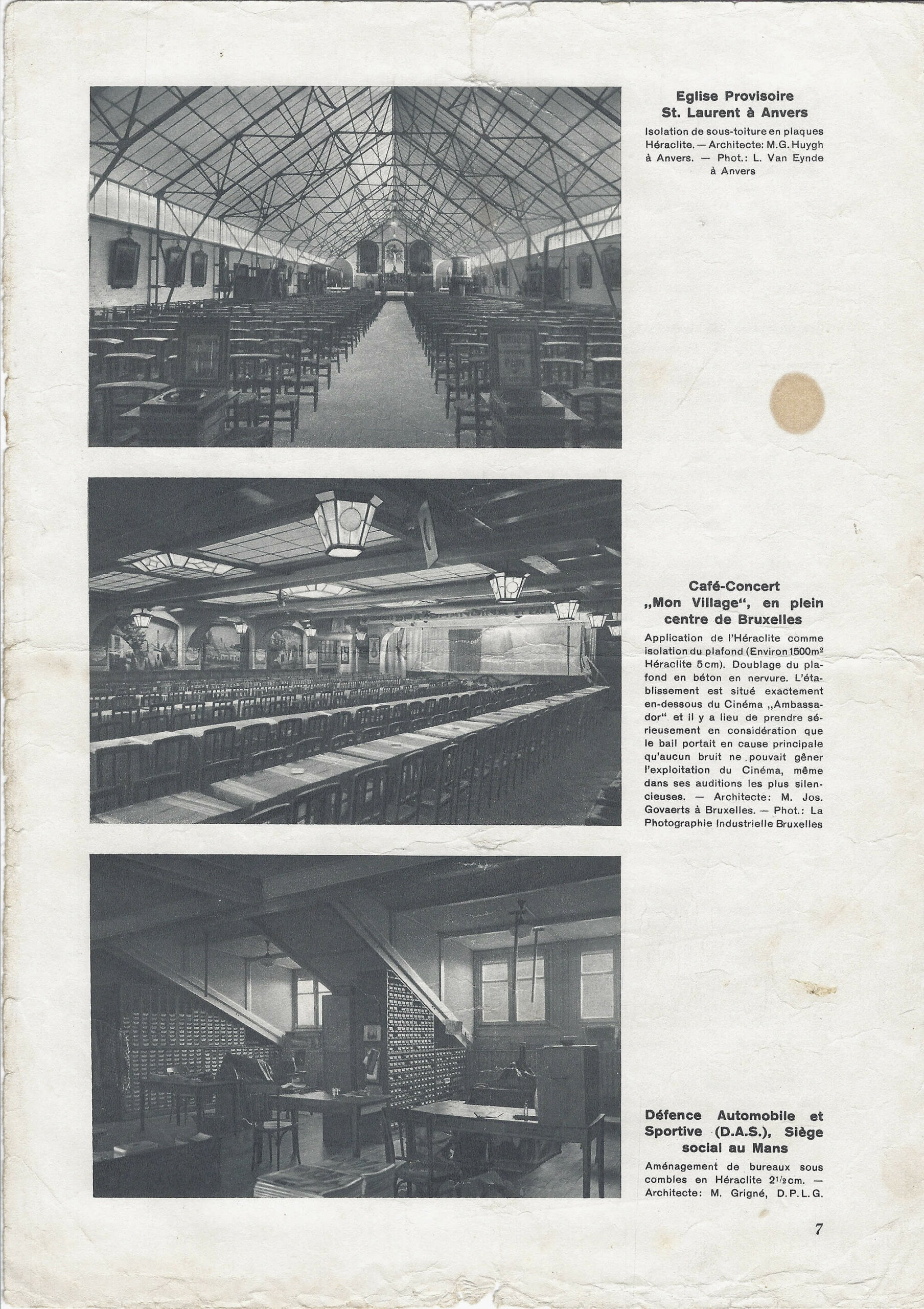
All chairs are empty, but all face something different. The bottom photograph shows empty chairs facing empty desks. In the middle picture, empty chairs face each other (underneath the inaudible sound of the cinema above). In the top photograph, the chairs seem to be facing the photographer. However, the altar’s in front of the photographer. He stands at the back of the provisional church. The chairs face the photographer and have turned their backs to the altar.
Revue Héraclite, 5 (1), april 1936, p. 7, paper, from the archive of architect O. Clemminck.
(‘Slice of more than three meters in diameter, sawn from a Mammoth-tree, given by California to the botanical garden of New York, and presented there’)
Thiery describes the ‘patriarchs’ of the plant world. This slice of a Sequoia, which fell in 1917 in Yosemite National Park, is 1694 years old. A woman of the New York Botanical Institue, where the slice of the patriarch is presented, counted the rings. If one would look at the picture with a magnifying glass, Thiery writes in a footnote, the reader (with good eyes and a fair amount of knowledge of the English language) would be able to read the labels indicating the important global events the tree witnessed. They are transcribed and translated by the author. The end of the Roman occupation of Great Britain. Columbus arriving in America. The Declaration of Independence. This is a lie: the text is illegible, even when using a magnifier.
In the photograph, the slice, as on view in the New York Botanical Institute, is presented upright. To prevent it from rolling away, two small triangular slices of wood were posited at the left and right side of the slice. The type of wood of these slices, nor the age of the patriarch from which they stem, are known.
Thiery, M. Het woud. Een proeve van plantenaardrijkskunde. Gent: De Garve, s.d., p. 59.

The river swells and eventually overflows, causing the death of six people and extensive damage: washed away bridges, damaged homes, submerged factories, destroyed food stocks, heavily eroded roads and paths.