What constitutes a ‘document’ and how does it function?
According to the Oxford English Dictionary, the etymological origin is the Latin ‘documentum’, meaning ‘lesson, proof, instance, specimen’. As a verb, it is ‘to prove or support (something) by documentary evidence’, and ‘to provide with documents’. The online version of the OED includes a draft addition, whereby a document (as a noun) is ‘a collection of data in digital form that is considered a single item and typically has a unique filename by which it can be stored, retrieved, or transmitted (as a file, a spreadsheet, or a graphic)’. The current use of the noun ‘document’ is defined as ‘something written, inscribed, etc., which furnishes evidence or information upon any subject, as a manuscript, title-deed, tomb-stone, coin, picture, etc.’ (emphasis added).
Both ‘something’ and that first ‘etc.’ leave ample room for discussion. A document doubts whether it functions as something unique, or as something reproducible. A passport is a document, but a flyer equally so. Moreover, there is a circular reasoning: to document is ‘to provide with documents’. Defining (the functioning of) a document most likely involves ideas of communication, information, evidence, inscriptions, and implies notions of objectivity and neutrality – but the document is neither reducible to one of them, nor is it equal to their sum. It is hard to pinpoint it, as it disperses into and is affected by other fields: it is intrinsically tied to the history of media and to important currents in literature, photography and art; it is linked to epistemic and power structures. However ubiquitous it is, as an often tangible thing in our environment, and as a concept, a document deranges.
the-documents.org continuously gathers documents and provides them with a short textual description, explanation,
or digression, written by multiple authors. In Paper Knowledge, Lisa Gitelman paraphrases ‘documentalist’ Suzanne Briet, stating that ‘an antelope running wild would not be a document, but an antelope taken into a zoo would be one, presumably because it would then be framed – or reframed – as an example, specimen, or instance’. The gathered files are all documents – if they weren’t before publication, they now are. That is what the-documents.org, irreversibly, does. It is a zoo turning an antelope into an ‘antelope’.
As you made your way through the collection,
the-documents.org tracked the entries you viewed.
It documented your path through the website.
As such, the time spent on the-documents.org turned
into this – a new document.
This document was compiled by ____ on 13.12.2025 18:22, printed on ____ and contains 17 documents on _ pages.
(https://the-documents.org/log/13-12-2025-6707/)
the-documents.org is a project created and edited by De Cleene De Cleene; design & development by atelier Haegeman Temmerman.
the-documents.org has been online since 23.05.2021.
- De Cleene De Cleene is Michiel De Cleene and Arnout De Cleene. Together they form a research group that focusses on novel ways of approaching the everyday, by artistic means and from a cultural and critical perspective.
www.decleenedecleene.be / info@decleenedecleene.be - This project was made possible with the support of the Flemish Government and KASK & Conservatorium, the school of arts of HOGENT and Howest. It is part of the research project Documenting Objects, financed by the HOGENT Arts Research Fund.
- Briet, S. Qu’est-ce que la documentation? Paris: Edit, 1951.
- Gitelman, L. Paper Knowledge. Toward a Media History of Documents.
Durham/ London: Duke University Press, 2014. - Oxford English Dictionary Online. Accessed on 13.05.2021.

The last couple of days have been dry. Rain is expected for the weekend. The office buckets are in place and are empty, except for some residue. Dirt, sand, a few hairs. Some particles must have come along with the drops when they made their way through the roof.

The torn off section of roofing on the grass has part of a text carved in it: ‘UDI’ and ‘EN’ are still legible. It must have come from another roof; the one shown in the photograph has no missing sections, nor visible repairs.
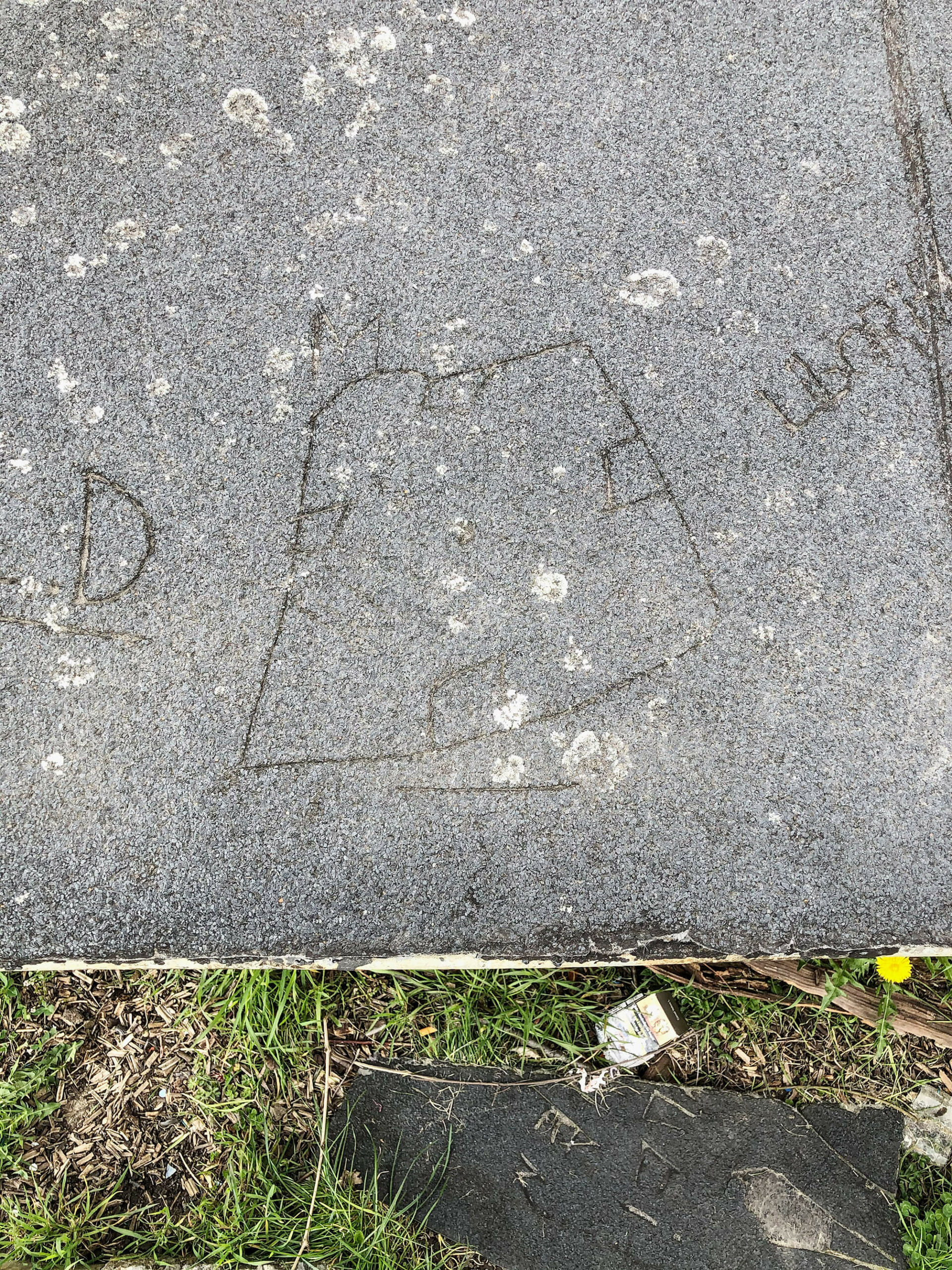
The roofing that is still on the garage shows a drawing of some kind. A floorplan for a squarish building with a supporting column along each side, or the layout for a tactical explanation, perhaps.
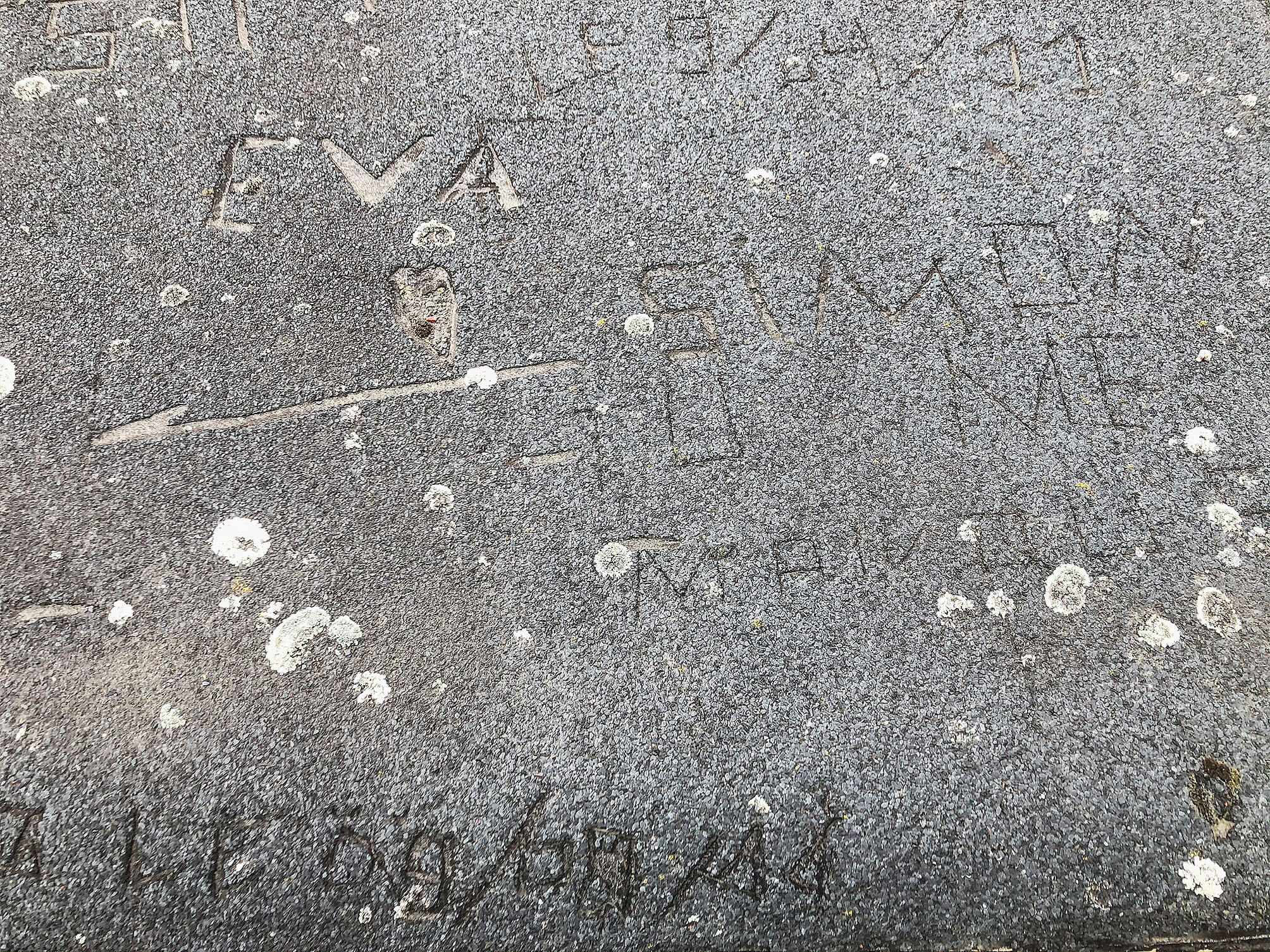
In what order and by whom the various texts and drawings were carved into the soft roofing is unclear. To the right of ‘EVA’, a heart symbol and an arrow (pointing to the left), the roofing reads ‘SIMON TU ME MANQUES’.
The short sentence usually – yet hastily – translates to ‘Simon, I miss you’. However, in French the ‘you’ (tu) is the subject and has an active role, whereas the ‘I’ (me) is the direct object. In short: by his not being there, Simon actively effectuates hurt to the one who carved this text.
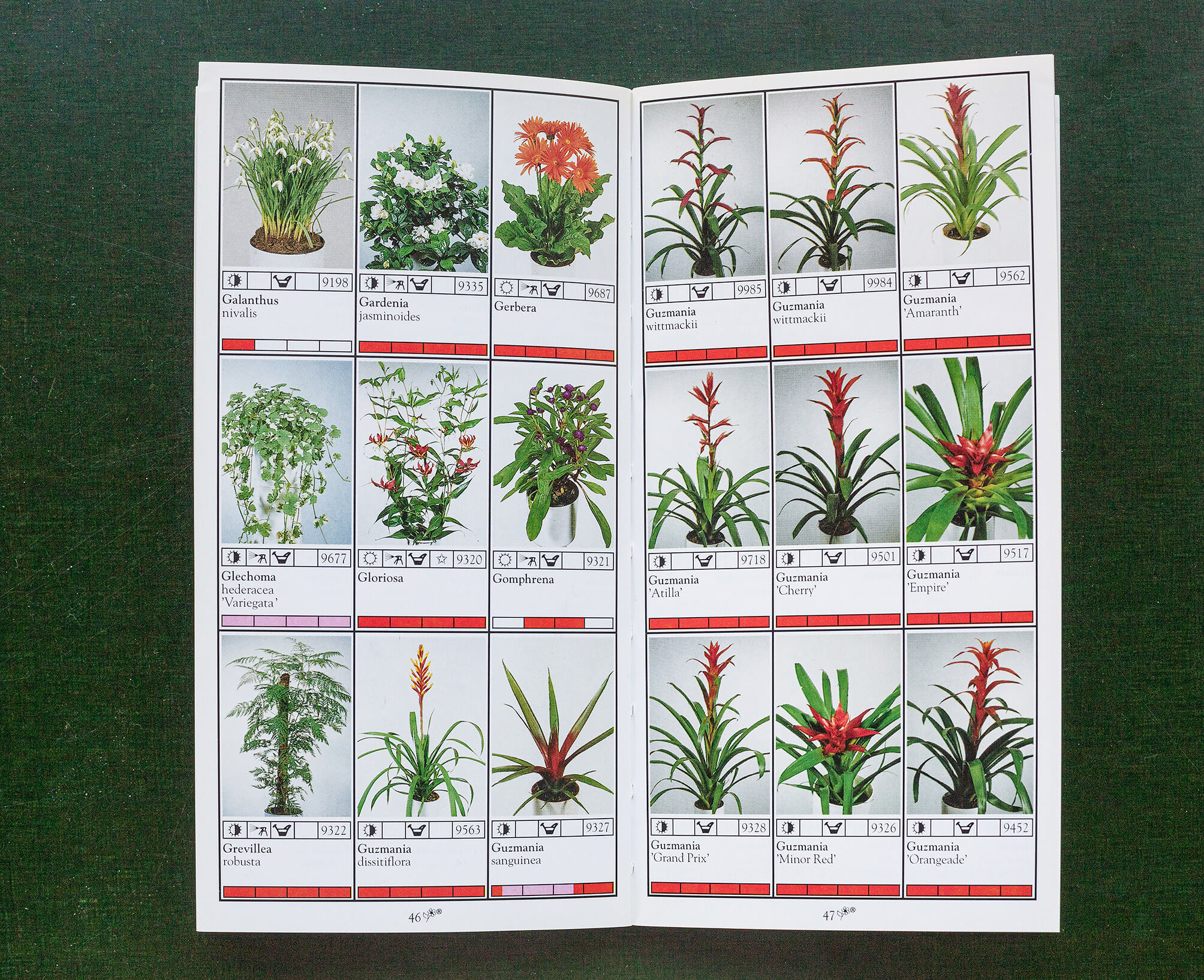
Anastasio Guzmán was a Spanish pharmacist and naturalist. He spent most of his career in South-America. He died in 1807 during an expedition in the Cordillera de Los Llanganates in Ecuador, in search of the lost treasure of the Incas. Some time after his death, his colleague Juan José Tafalla suggested naming a certain genus of plants after his friend.
Guzmanias are mainly stemless, evergreen, epiphytic perennials native to Florida, the West Indies, southern Mexico, Central America, and northern and western South America.They are found at altitudes of up to 3.500m in the Andean rainforests.
The symbols beneath the photographs indicate that these Guzmanias require full light, but it is advised to avoid bright sunlight in spring and summer (HALF WHITE, HALF BLACK SUN), the compost should be kept moderately moist during growth, allowing it to dry slightly between each watering period (HALF FILLED WATERING CAN). Unlike, for instance, the Grevillea Robusta, a Guzmania does not require being sprayed regularly (SPRAYER). The four digit code is the AUCTION CODE: ‘Every product has a code. This code is indispensable for the trade.’ The COLOURED BAR at the bottom shows the availability of a plant quarterly. RED means good, PINK means moderate and WHITE means not available.
The introduction to this booklet mentions that ‘[p]rinted colours are often not as accurate as the colours of the plants themselves, which is why it is possible that colours shown in pictures in this booklet may be a little different from the colours of the real pot plant.’
Bloemenbureau Holland. Potplanten, pot plants, topfpflanzen, plantes en pot, piante da vaso, planta en particular 1995/96. Leiden: Bloemenbureau Holland, 1995.
The road down from the top of Mount Vesuvius, at Atrio Del Cavallo. The sun sets. The last tourist bus has headed down. Then the headlights of the guardian’s car swing their way down. It must be freezing. I am holding an orange-sized piece of petrified lava, probably stemming from the 1872 or 1944 eruption. A kilometer further down the road, the old Observatory is empty. Nowadays, monitoring seismic changes is done in a research centre in the city of Naples. Their seismographic registrations can be followed online, in real time. Two headlights swirling along the slopes, underneath me, are coming upwards.

(‘Slice of more than three meters in diameter, sawn from a Mammoth-tree, given by California to the botanical garden of New York, and presented there’)
Thiery describes the ‘patriarchs’ of the plant world. This slice of a Sequoia, which fell in 1917 in Yosemite National Park, is 1694 years old. A woman of the New York Botanical Institue, where the slice of the patriarch is presented, counted the rings. If one would look at the picture with a magnifying glass, Thiery writes in a footnote, the reader (with good eyes and a fair amount of knowledge of the English language) would be able to read the labels indicating the important global events the tree witnessed. They are transcribed and translated by the author. The end of the Roman occupation of Great Britain. Columbus arriving in America. The Declaration of Independence. This is a lie: the text is illegible, even when using a magnifier.
In the photograph, the slice, as on view in the New York Botanical Institute, is presented upright. To prevent it from rolling away, two small triangular slices of wood were posited at the left and right side of the slice. The type of wood of these slices, nor the age of the patriarch from which they stem, are known.
Thiery, M. Het woud. Een proeve van plantenaardrijkskunde. Gent: De Garve, s.d., p. 59.

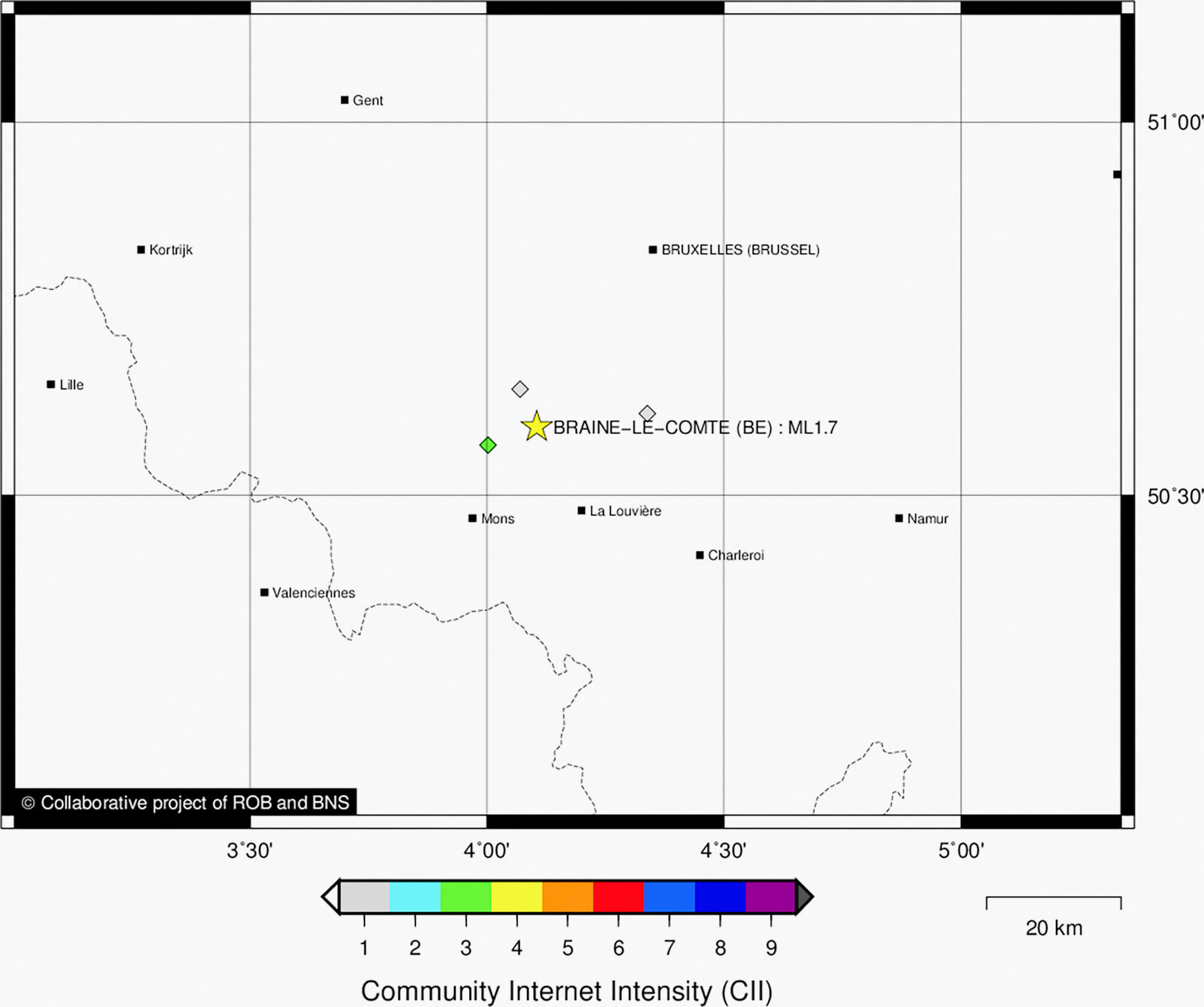
On May 6th 2020, 14h06 and 31 seconds, the Belgian Seismological Institute records an earthquake with a 1,7 magnitude in the region of Braine-Le-Compte. Three reactions from people in the neighbourhood, filed by the Institute, confirm the official seismological recordings. The Institute’s website classifies the earthquake as a ‘quarry blast’.
http://seismologie.be/nl/seismologie/aardbevingen-in-belgie/en130qj1o
A sheet of brushed aluminium serves as the base for a monochromatic print showing a circular floor plan and seven photographs. The nearby Prosopis cineraria, known as the ‘Tree of Life’, is a well-known tourist attraction in the Arabian Desert near Jebel Dukhan. The plaque shows how the recently constructed concrete structure, circling the four hundred year old tree, allows the visitors to see and photograph the landmark in new and – because of the tree’s decentralized position – surprising ways. In summer the temperature can rise well over 40°C. The different expansion rates of the aluminium and its imprint cause the latter to crack.

On May 7th, 1992, an anonymous photographer records the ice cellar, a stone’s throw from my parents’ house. It’s a beautiful day in spring. Quite a bit of wind, it seems. A Thursday. Surely, I am at school. Third grade kindergarten. It houses bats.
The photograph is part of an online heritage inventory, maintained by a government department. On the same day, the photographer took a photograph of the orangery, the entrance gate to the allotment, and the castle.
https://id.erfgoed.net/afbeeldingen/264680

The planet Uranus should have followed a course as predicted by Newton’s laws. It didn’t. There were ‘residuals’, the 19th-century observers said: irregular data, which had to be interpreted as Uranus deviating from the projected trajectory. They could think of three possibilities. A) The planet Uranus was too far away from the Sun, which might render the Law of Gravitation invalid. B) The observations were incorrect. C) There was another planet, still further and yet unknown, with its own gravitational field and pull, causing Uranus to deviate from its course.
Following hypothesis C, astronomers predicted the position of a planet with a gravitational field, influencing Uranus, by means of mathematical calculations. Telescopes were directed to that calculated spot. There was a luminous point, with a touch of bright azure blue.

It is said that ‘if a space traveller were unfortunate enough to enter the atmosphere of one of the giant planets [such as Neptune], he or she would not find a single solid surface. Instead, as he or she descended into the planet, our traveller would find that the temperature, pressure, and density would all continue to increase smoothly, with no sharp transitions. Assuming that he or she was adequately protected from the temperature, pressure, and radiation, our traveller would eventually “float” at that level in the atmosphere where the surrounding density and his or her own density were equal.’1
It is said that it storms on Neptune.
Violently.
1200 mph.
They observed a great dark spot and called it: The Great Dark Spot.
It rains diamonds on Neptune.
Miner, E.D. & R.R. Wessen. Neptune. The Planet, Rings and Satellites. Chichester: Springer-Praxis, 2002, p. 18.

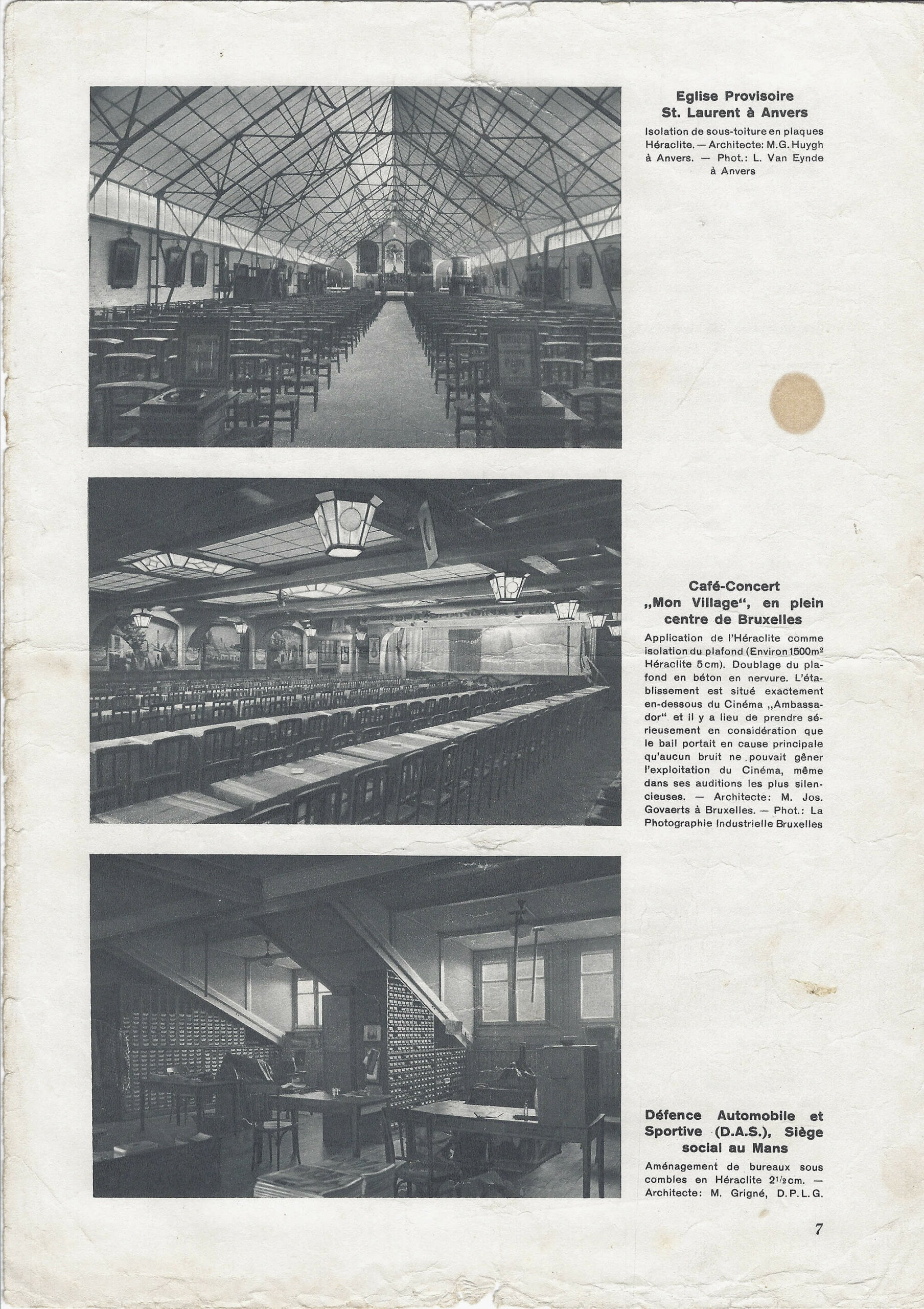
All chairs are empty, but all face something different. The bottom photograph shows empty chairs facing empty desks. In the middle picture, empty chairs face each other (underneath the inaudible sound of the cinema above). In the top photograph, the chairs seem to be facing the photographer. However, the altar’s in front of the photographer. He stands at the back of the provisional church. The chairs face the photographer and have turned their backs to the altar.
Revue Héraclite, 5 (1), april 1936, p. 7, paper, from the archive of architect O. Clemminck.
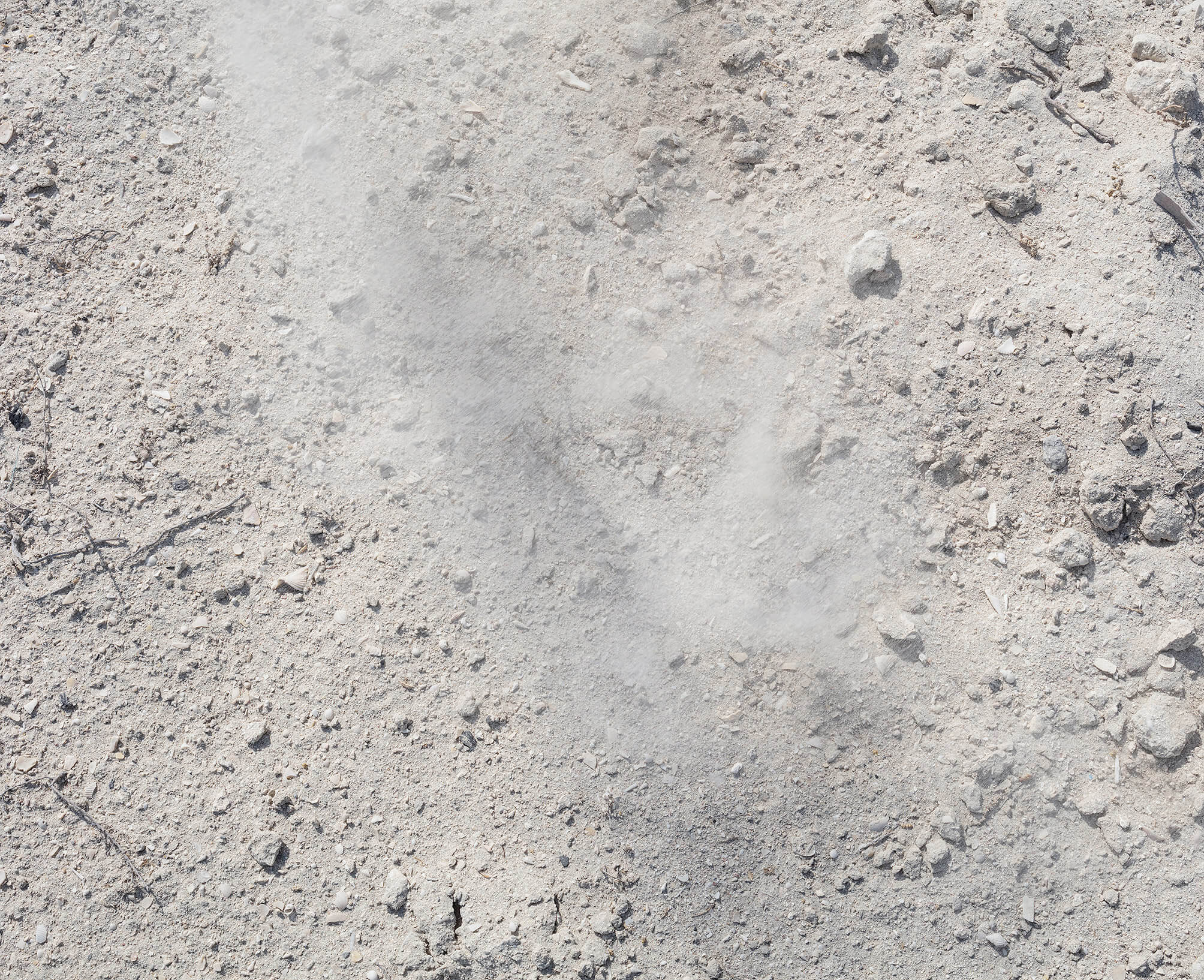
The Bahrain Formula 1 Grand Prix takes place every year since the track’s inauguration in 2004 – except for 2011 when the race was cancelled due to protests in the wake of the Arab Spring. To prevent sand from covering the track and entering the air-ducts and engines, the sand near the track is sprayed with an adhesive to keep it from blowing around.
The cloud of sand in the picture (made near Avenue 61 on an artificial island close to Seef) was made by kicking it into the frame while M.R. and M.D.C. had to stop and wait for a truck that was being towed after the driver lost control over the vehicle and flipped it onto its side. Days earlier M.D.C. had tried to make a photograph of the F1-track, but couldn’t get close enough to make a decent picture.
A constant, dependable presence. With the camera focused on the North Star for an extended period, the rotation of the Earth becomes visible. Nearby, in the municipality of Wiederstedt, the geologist, poet and philosopher Friedrich von Hardenberg (better known by his pen name Novalis) spent his childhood years between 1772 and 1784. A quote of his is engraved on a stone bench in the park surrounding the chateau where he was raised: “The human being does not speak alone – the universe also speaks – everything speaks – infinite languages.”
From S. Anders Leben. Eine Handlung in Gesprächen/S. Anders Leben – Living Differently: An Act in Conversations
Stephanie Kiwitt (1972) is an artist based in Halle (Saale), Germany. Utilizing a large number of images, various perspectives and also textual elements, she is known for her insightful photography that explores spaces emblematic of contemporary phenomena. Over the past three years, she has focused on evolving habitats in rural areas, photographing traces of transformation and conducting interviews in Saxony-Anhalt, the region she moved to in 2020. From 2018 to 2020, Kiwitt was a guest lecturer at the LUCA School of Arts in Brussels.
In spring 2024 the-documents.org and Trigger co-publish a series of online articles with a focus on the meeting ground between photography and the document.

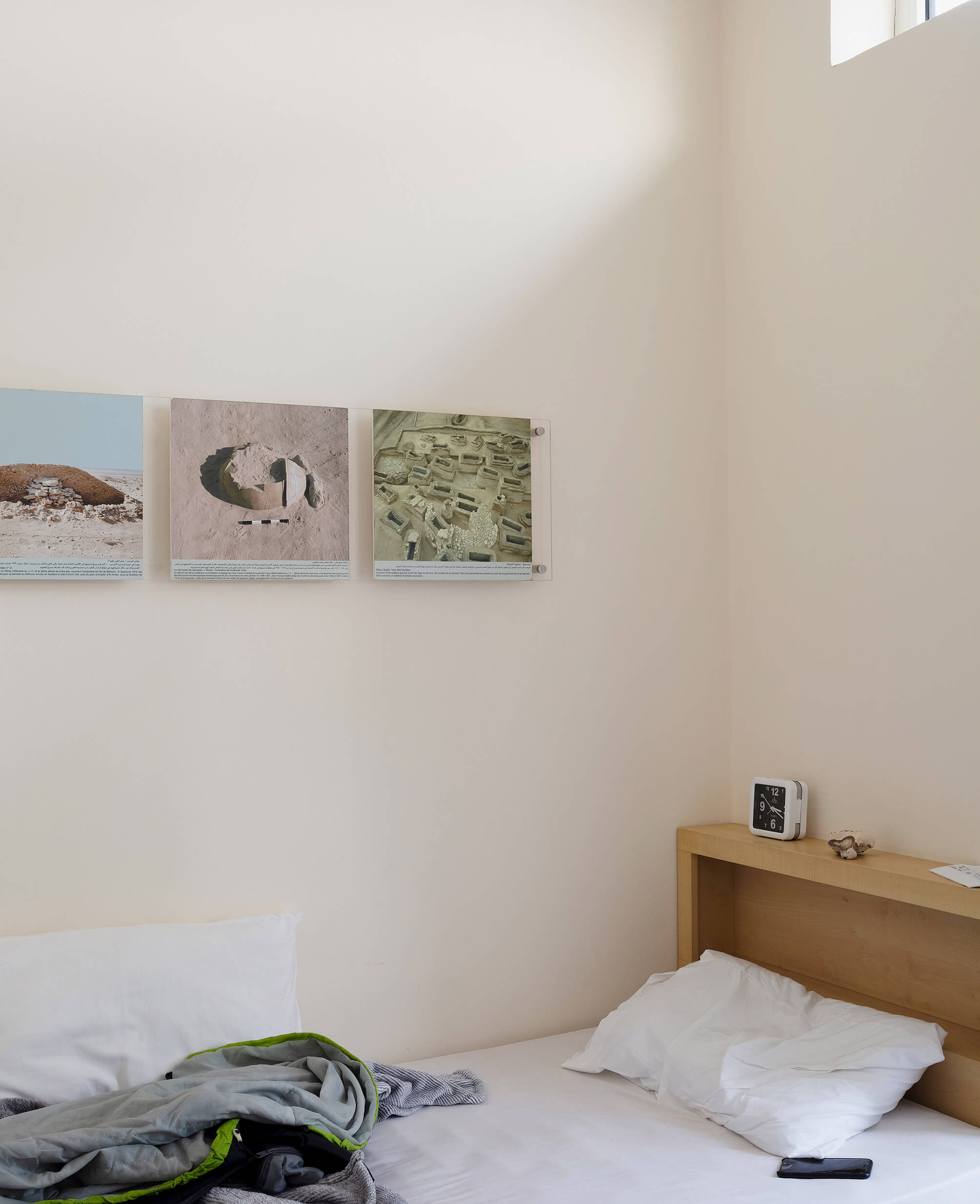
A square photograph with an Arabic and French text underneath it is mounted on a foam board, in turn mounted on a sheet of plexiglass. The picture in the middle is flanked by a photograph of and a text about the tumuli of Umm Jidr (left) and the excavations at Abou Saybi (right). They are mounted on the West wall of Guest Room 3 at the Qual’at Al-Bahrain Site Museum, Seef, Bahrain.
Necropolises make up the main archaeological testimonies of the Tylos period (4th century BC – 3rd century AD). The urn in the photograph contains the remains of several babies. They most likely fell victim to an epidemic. The size of the ruler next to the urn remains unspecified.
The photograph of Room 3 was made while in mandatory self-isolation after flying to Bahrain from Frankfurt and waiting for the result of a Covid-19 test.
‘Meunerie Duyckers & Conors, les nouveaux moulins’, better known as ‘De Nieuwe Molens’, is a flour mill established in 1897 in the north of Gent along the Verbindingskanaal. Due to increased production, the original 1897 building doubled in 1904.
Only the facade of the iconic warehouse has been preserved along with the recently renovated gasometers. The building is now part of the Tondeliersite. It has been converted into lofts and flats, and was extended with a new construction.
https://inventaris.onroerenderfgoed.be/erfgoedobjecten/18269

In summer, the roofing gets hot and soft. In winter, it gets cold, hard and brittle. None of the gates to the garages are open. It’s unsure whether the numerous texts and drawings – some dig deeper than others – have caused leakages.
