What constitutes a ‘document’ and how does it function?
According to the Oxford English Dictionary, the etymological origin is the Latin ‘documentum’, meaning ‘lesson, proof, instance, specimen’. As a verb, it is ‘to prove or support (something) by documentary evidence’, and ‘to provide with documents’. The online version of the OED includes a draft addition, whereby a document (as a noun) is ‘a collection of data in digital form that is considered a single item and typically has a unique filename by which it can be stored, retrieved, or transmitted (as a file, a spreadsheet, or a graphic)’. The current use of the noun ‘document’ is defined as ‘something written, inscribed, etc., which furnishes evidence or information upon any subject, as a manuscript, title-deed, tomb-stone, coin, picture, etc.’ (emphasis added).
Both ‘something’ and that first ‘etc.’ leave ample room for discussion. A document doubts whether it functions as something unique, or as something reproducible. A passport is a document, but a flyer equally so. Moreover, there is a circular reasoning: to document is ‘to provide with documents’. Defining (the functioning of) a document most likely involves ideas of communication, information, evidence, inscriptions, and implies notions of objectivity and neutrality – but the document is neither reducible to one of them, nor is it equal to their sum. It is hard to pinpoint it, as it disperses into and is affected by other fields: it is intrinsically tied to the history of media and to important currents in literature, photography and art; it is linked to epistemic and power structures. However ubiquitous it is, as an often tangible thing in our environment, and as a concept, a document deranges.
the-documents.org continuously gathers documents and provides them with a short textual description, explanation,
or digression, written by multiple authors. In Paper Knowledge, Lisa Gitelman paraphrases ‘documentalist’ Suzanne Briet, stating that ‘an antelope running wild would not be a document, but an antelope taken into a zoo would be one, presumably because it would then be framed – or reframed – as an example, specimen, or instance’. The gathered files are all documents – if they weren’t before publication, they now are. That is what the-documents.org, irreversibly, does. It is a zoo turning an antelope into an ‘antelope’.
As you made your way through the collection,
the-documents.org tracked the entries you viewed.
It documented your path through the website.
As such, the time spent on the-documents.org turned
into this – a new document.
This document was compiled by ____ on 13.10.2026 15:00, printed on ____ and contains 24 documents on _ pages.
(https://the-documents.org/log/13-10-2026-6909/)
the-documents.org is a project created and edited by De Cleene De Cleene; design & development by atelier Haegeman Temmerman.
the-documents.org has been online since 23.05.2021.
- De Cleene De Cleene is Michiel De Cleene and Arnout De Cleene. Together they form a research group that focusses on novel ways of approaching the everyday, by artistic means and from a cultural and critical perspective.
www.decleenedecleene.be / info@decleenedecleene.be - This project was made possible with the support of the Flemish Government and KASK & Conservatorium, the school of arts of HOGENT and Howest. It is part of the research project Documenting Objects, financed by the HOGENT Arts Research Fund.
- Briet, S. Qu’est-ce que la documentation? Paris: Edit, 1951.
- Gitelman, L. Paper Knowledge. Toward a Media History of Documents.
Durham/ London: Duke University Press, 2014. - Oxford English Dictionary Online. Accessed on 13.05.2021.

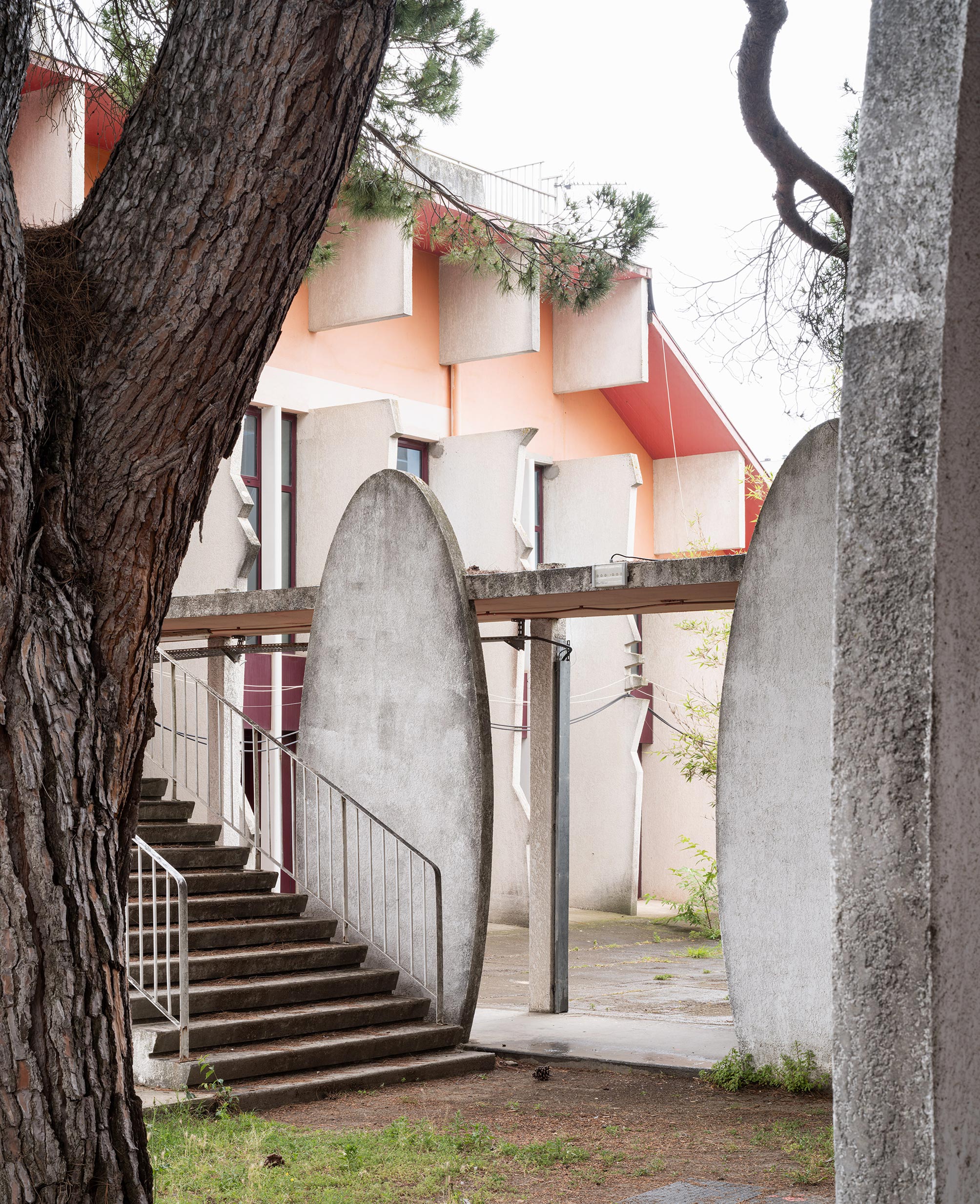
Built in 1969, the salle polyvalente1 in La Grande-Motte2 was the first venue where the residents – back when there were only 700 of them – could gather. Jean Balladur had envisioned an open-air theatre covered by a removable stretched canvas, adjacent to a single-storey multipurpose hall. The load-bearing structure, Balladur explained, consists of anthropomorphic columns sculpted by Albert Marchais: “My friend the sculptor, painter, poet and man of the theatre, Albert Marchais, devised the design for a sliding formwork that made it possible to cast the columns… they line up on either side of the hall in patterns that free them from the strict constraints of matter. This freedom is the joy of all sculpture.”3
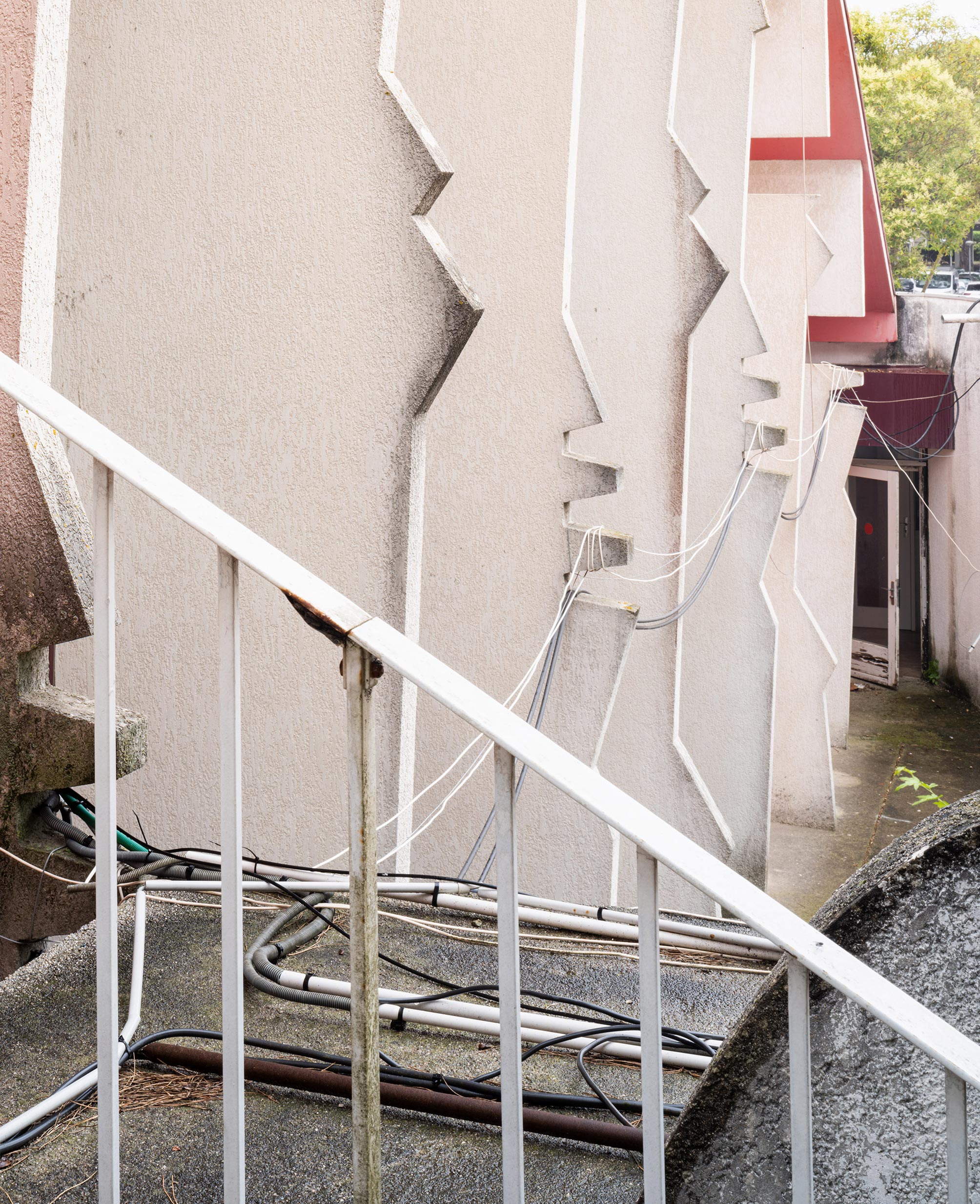
The geometric forms that make up the hands and arms of these figures are today strung with cables carrying electricity and data.
Jean Balladur was never fond of the term ‘salle polyvalente’, he preferred ‘salle commune, dédié à la fête’ – a communal hall, dedicated to parties. Since 2019 it is officially the Centre Culturel Henri Dunoyer, after a former mayor.
La Grande-Motte is a seaside resort created by the Mission Racine, the state programme for the development of the Languedoc coastline in southern France. Intended as a holiday destination for the middle class in the 1970s, it is the work of architect Jean Balladur (1924–2002), who was tasked with designing the entire urban layout and architecture of the new town. He drew inspiration from pre-Columbian pyramids and from modernist architecture in Brazil, especially the work of Oscar Niemeyer. At a time when large housing complexes were going up all over France in the form of tower blocks and slabs, Balladur’s solutions were different enough that La Grande-Motte was a success from the very beginning.
« Mon ami le sculpteur, peintre, poète, homme de théâtre, Albert Marchais, a imaginé le dessin d’un coffrage glissant qui a permis de couler les poteaux… ils s’alignent de chaque côté de la salle dans des figures qui les affranchissent des strictes contraintes de la matière. Cette liberté fait le bonheur de toute sculpture. »
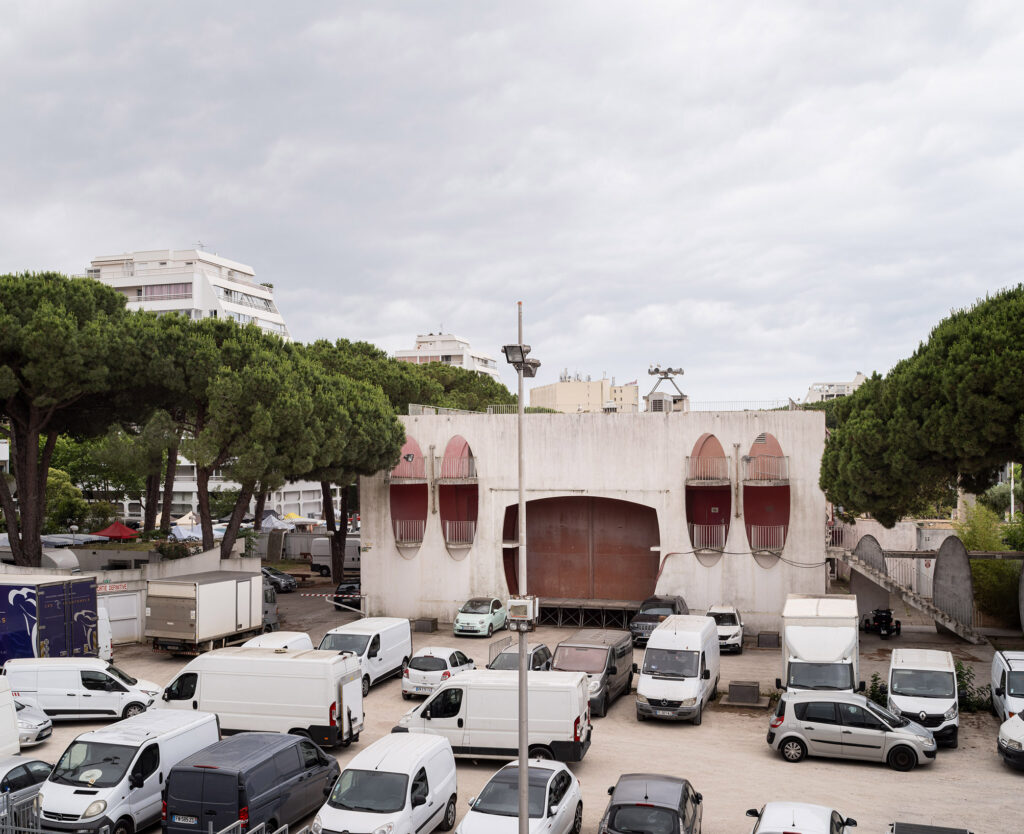
On market days, the parterre of the open-air theatre serves a a car park for the vendors’ vans and cars.
François, Michèle. Jean Balladur et la Grande-Motte: l’architecte d’une ville. Duo. Monuments historiques et objets d’art du Languedoc-Roussillon, Direction régionale des affaires culturelles, 2010, p. 41-42.
‘Exit at the dock and kill some rats. Go around the building to the left, killing the guard and his rats before flipping the switch. Another guard arrives kill him too, taking the medkits from both your victims. Enter the now open front door and kill the guard on the balcony and his friend who appears on the ground floor. Grab the shells from your second kill then shoot out the window and kill the Dobermans who jump through when you get too close.’
Tomb Raider II. The Complete Guide to the Dagger of Xian. Downloaded from http://www.the-spoiler.com on 4 August, 1999, at 15:03.

In an attempt to make it his own, Gino – it might also be Dino – has taken a can of bright pink spray paint to his hard hat and – as the paint was drying – dragged his gloved finger from top to bottom. G – or D –, I, N, O. In the dust on a demolished floor tile, someone has written 12,10. Perhaps a measurement, a quantity, a position, a date, a reference.
Subtractive writing is not uncommon. With the tip of a passer-by’s index finger ‘WASH ME’ is subtracted from the dust on a dirty car. In freshly poured concrete, a name is embedded forever with a twig. In hot and soft roofing drawings and obscenities are scratched. Styrofoam lining a brand new elevator gets impressed with names, jokes and knuckles.
In the twenty-third canto of Ariosto’s Orlando Furioso (1516), Orlando comes across the name of his love and another man, carved in the bark of a tree. He doubts. But that night, a gossiping shepherd tells him he’s seen Angelica and Medoro together. Orlando returns to the forest, and in a four-day frenzy, he uproots every tree and pollutes the rivers forever.
CXXXI
For he turf, stone, and trunk, and shoot, and lop,
Cast without cease into the beauteous source;
Till, turbid from the bottom to the top,
Never again was clear the troubled course.
At length, for lack of breath, compelled to stop,
(When he is bathed in sweat, and wasted force,
Serves not his fury more) he falls, and lies
Upon the mead, and, gazing upward, sighs.1
Ariosto, L. Orlando Furioso. Translated by William Stewart Rose, Echo Library, 2006, p. 267.

Freely adapted from interviews with residents of Sandersleben (Saxony-Anhalt). Three-act play. The first two acts take place in the present day; the third is set in the future.
From Act 2 ‘The Inhabitants’, Scene 5, ‘Living Differently’.
Characters: MR DUNST club member I, MR WINDORF amateur astronomer
Stills from text animation S. Anders Leben. Eine Handlung in Gesprächen/S. Anders Leben – Living Differently: An Act in Conversations
Stephanie Kiwitt (1972) is an artist based in Halle (Saale), Germany. Utilizing a large number of images, various perspectives and also textual elements, she is known for her insightful photography that explores spaces emblematic of contemporary phenomena. Over the past three years, she has focused on evolving habitats in rural areas, photographing traces of transformation and conducting interviews in Saxony-Anhalt, the region she moved to in 2020. From 2018 to 2020, Kiwitt was a guest lecturer at the LUCA School of Arts in Brussels.
In spring 2024 the-documents.org and Trigger co-publish a series of online articles with a focus on the meeting ground between photography and the document.

Bricks and stones of various origin (aerated concrete blocks, clinker bricks, quarry stones).
From Fortlaufend/Ongoing
Stephanie Kiwitt (1972) is an artist based in Halle (Saale), Germany. Utilizing a large number of images, various perspectives and also textual elements, she is known for her insightful photography that explores spaces emblematic of contemporary phenomena. Over the past three years, she has focused on evolving habitats in rural areas, photographing traces of transformation and conducting interviews in Saxony-Anhalt, the region she moved to in 2020. From 2018 to 2020, Kiwitt was a guest lecturer at the LUCA School of Arts in Brussels.
In spring 2024 the-documents.org and Trigger co-publish a series of online articles with a focus on the meeting ground between photography and the document.

Directed by Xie Jin, Huang Baomei (1958) is a docudrama based on the real-life experiences of the national model worker of the same name, who also plays herself in the film. Reflecting the economic priorities of the day following the launch of the Great Leap Forward—a far-reaching and ultimately devastating campaign that sought to replace the prevailing Soviet-style expert-managerial system with workers’ self-organisation and mass mobilisation—the film focuses on the challenges faced by machine operators as they strive for a technical breakthrough while working with their aging machines.
Located at No. 2866, Yangshupu Road, Shanghai No. 17 Cotton Mill, which had its origins in the Japanese-owned Yuho Spinning Company, was one of Shanghai’s best known cotton mills. The launch of China’s economic reforms opened a new era for the mill, as reflected cinematically in No. 17 Cotton Mill Shanghai Blues (1984), a British documentary that attests to the vibrant workers’ music scene blossoming within the factory walls. In 1992, the state-owned enterprise was restructured as one of the first batch of joint-stock companies in the Reform era and renamed as Longtou Company after the brand name of a fabric manufactured by the mill. Following the relocation of the mill’s original machinery to Jiangsu in 2007, work commenced to redesign the entire complex and relaunch it as the Shanghai International Fashion Center. In Jia Zhangke’s I Wish I Knew (2010), an elderly Huang Baomei is seen walking amidst the ruins that are all that remain of the cotton mill as it awaits refurbishment.
Ho Rui An is an artist and writer working in the intersections of contemporary art, cinema, performance and theory. Through lectures, essays and films, his research examines the relations between labour, technology and capital across different systems of governance in a global age.
In spring 2024 the-documents.org and Trigger co-publish a series of online articles with a focus on the meeting ground between photography and the document.

The invalidity of this official document is caused by the fact that it is produced by a machine. Unlike a photograph, the authenticity of this document relies on direct contact between hand, pen and paper.
Max Pinckers (°1988, BE) and Victoria Gonzalez-Figueras (°1988, CA) are based in Brussels, Belgium. They have been working together for the past ten years on documentary photography projects. Victoria works in the cultural field as a researcher and producer. Max is a speculative documentarian, teacher and occasional writer on photography. They are married, in love, and have a son. Victoria has consistently assisted Max in his projects as a production manager, but they have recently been making new work together as co-authors. “Double Reward” is the first such project.
In spring 2024 the-documents.org and Trigger co-publish a series of online articles with a focus on the meeting ground between photography and the document.

When discussing the sensitivities around viewing British propaganda photographs from the 1950s with Mau Mau veterans in Kenya, it became clear that it was not the graphic photographs of atrocities that would trigger the veterans emotionally, but a series of straightforward portraits of men who had pledged allegiance to the British colonial administration. These portraits were catalogued along with the men’s names and another photograph of each one of them signing a declaration of collaboration. I was advised by the representative of the veterans’ association that it would be too dangerous to share these photographs with the veterans.
22 superimposed portraits from the file CO 1066/7: Kikuyu Loyalists at The National Archives (UK) depicting Kikuyu loyalists after signing a declaration of collaboration with the British on 27 January 1954.
From the series State of Emergency, Max Pinckers et al. (2024)
Max Pinckers (°1988, BE) and Victoria Gonzalez-Figueras (°1988, CA) are based in Brussels, Belgium. They have been working together for the past ten years on documentary photography projects. Victoria works in the cultural field as a researcher and producer. Max is a speculative documentarian, teacher and occasional writer on photography. They are married, in love, and have a son. Victoria has consistently assisted Max in his projects as a production manager, but they have recently been making new work together as co-authors. “Double Reward” is the first such project.
In spring 2024 the-documents.org and Trigger co-publish a series of online articles with a focus on the meeting ground between photography and the document.

‘No consent was given for the photograph to be taken. The capture of my body in this way is a form of torture.
The photograph is evidence of the entitled authority and fundamental corruptions of the male soldiers and the occupying military forces.’
Screenshot from film chapter In Her View which engages an archival document revealing the sexual exploitation of an anonymous woman by occupying Australian soldiers fighting for the Allied forces in Lebanon in 1941. The film moves through the archival evidence to sense, trace and position her encounter as a formation of poetic testimony. The image shows extracted noise, levels, focal length and balance from the archive image to generate a 3D model of its violent points of interaction, this is without showing the image itself. A technique developed with Anabel Garcia-Kurland on human/non-human modelling in the making of the film.
Frame of Accountability, 01:00:00, Helene Kazan, 2024.
Helene Kazan is an artist, writer and educator. Her work investigates ‘risk’ as a lived condition produced through the conjoined violent effects of capitalism and conflict. This is observed in the colonial roots of international law and its material formation of the lived-built environment. In response, she uses decolonial, feminist, poetic and critical-legal approaches in her work, which explores ways of dismantling the ongoing effects of neo-colonial violence towards wider frameworks of accountability and justice.
In spring 2024 the-documents.org and Trigger co-publish a series of online articles with a focus on the meeting ground between photography and the document.

‘Dust particles flew off the box, disturbed by my opening. Adding to the sense that this archival material was vibrating under the weight of its unknown importance. Amidst the boxes of ‘Top Secret’ British governments documents, I find a map labelled ‘Syria’ 3.6.41.’
Screenshot from film chapter (Un)Touching Ground. A decolonial audio visual translation of an archival map reveals the effects of the Allied military campaign into Lebanon and Syria in 1941.
Frame of Accountability, 01:00:00, Helene Kazan, 2024.
Through film, installation, writing and public engagement Frame of Accountability investigates ‘risk’ as a lived condition, produced through the co-evolution of capitalist systems and violent conflict. The project focuses on the effects across Lebanon and Syria, with a view to understanding the wider regional and global consequences. Using poetic and critical-legal methods, the work explores ways of dismantling violence perpetrated through colonial mechanisms of governance, towards wider frameworks of accountability and justice. The work is produced in multi-part, non-linear formation.
Helene Kazan is an artist, writer and educator. Her work investigates ‘risk’ as a lived condition produced through the conjoined violent effects of capitalism and conflict. This is observed in the colonial roots of international law and its material formation of the lived-built environment. In response, she uses decolonial, feminist, poetic and critical-legal approaches in her work, which explores ways of dismantling the ongoing effects of neo-colonial violence towards wider frameworks of accountability and justice.
In spring 2024 the-documents.org and Trigger co-publish a series of online articles with a focus on the meeting ground between photography and the document.

July. Our eight-month-old son has a fever. We have a hard time getting him to drink enough. The tally marks on the back of a tortellini-box keep track of the diapers he wets and the millilitres of milk and electrolytes he’s able to hold down.
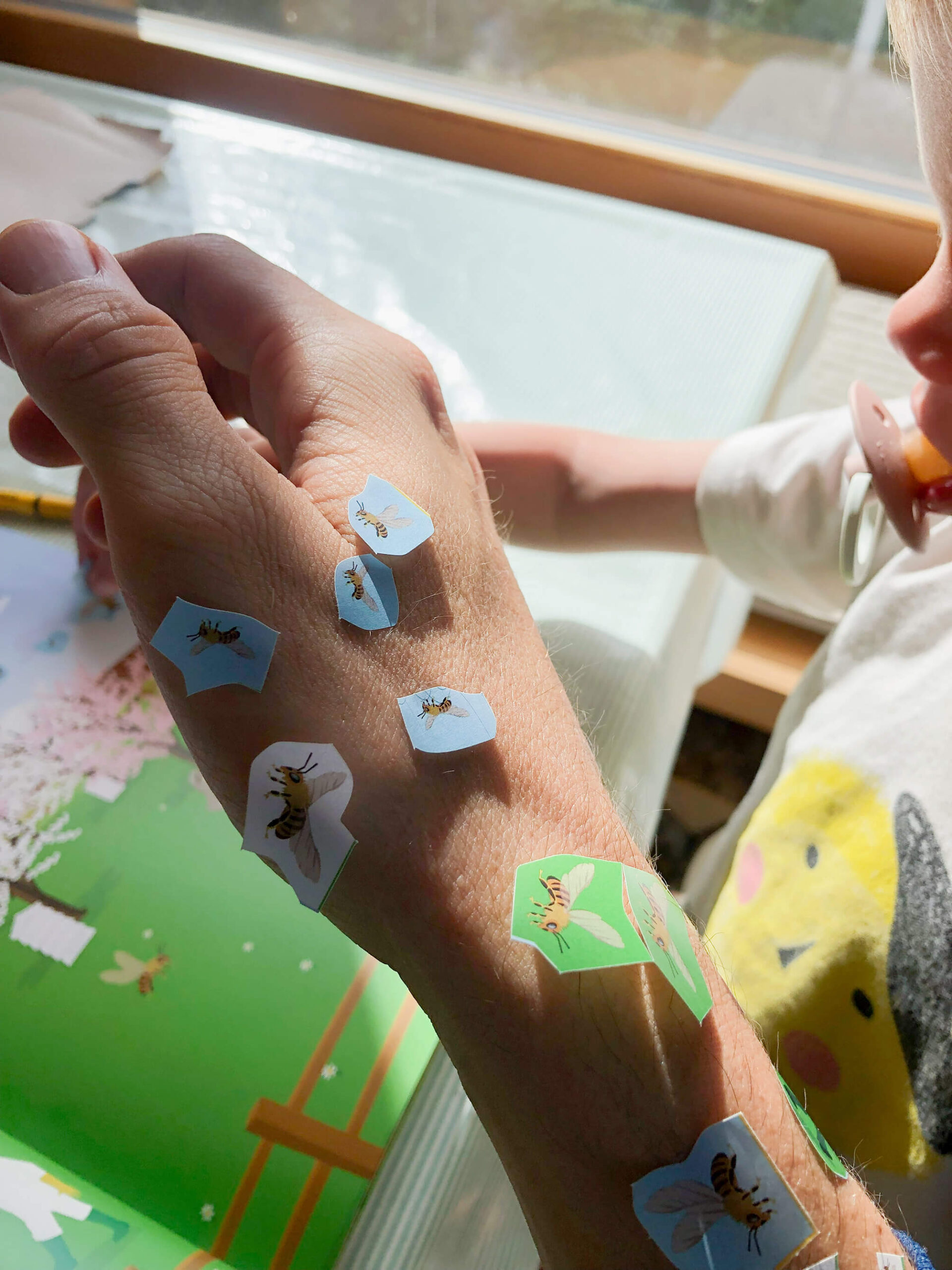
Stuck inside with worrying parents, a sticker-book about a farm is his brother’s favourite pass-time. Tired of having to go back and forth between the pastures and the sticker-filled sheets we decide to use my arm as a repository for animals that share a habitat.
Photographing the house and the clearing it stood in proved difficult. During summer, the nettles and brambles slowed down the pace. Some plants stung the elbows. The clearing only became visible when the sun fell through the opening in the canopy. On cloudy days the clearing disappeared.
‘As the order of institutions follows its course, or as huts give way to villages and then to cities and finally to cosmopolitan academies, the forests move further and further away from the center of the clearing. At the center one eventually forgets that one is dwelling in a clearing. […] Yet however wide the circle may get through the inertia of civic expansion, it presumably retains an edge of opacity where history meets the earth, where the human abode reaches its limits.’
Pogue Harrison, R. ‘The Ecology of Finitude’, in: id., Forests. Chicago, 1992, 245.

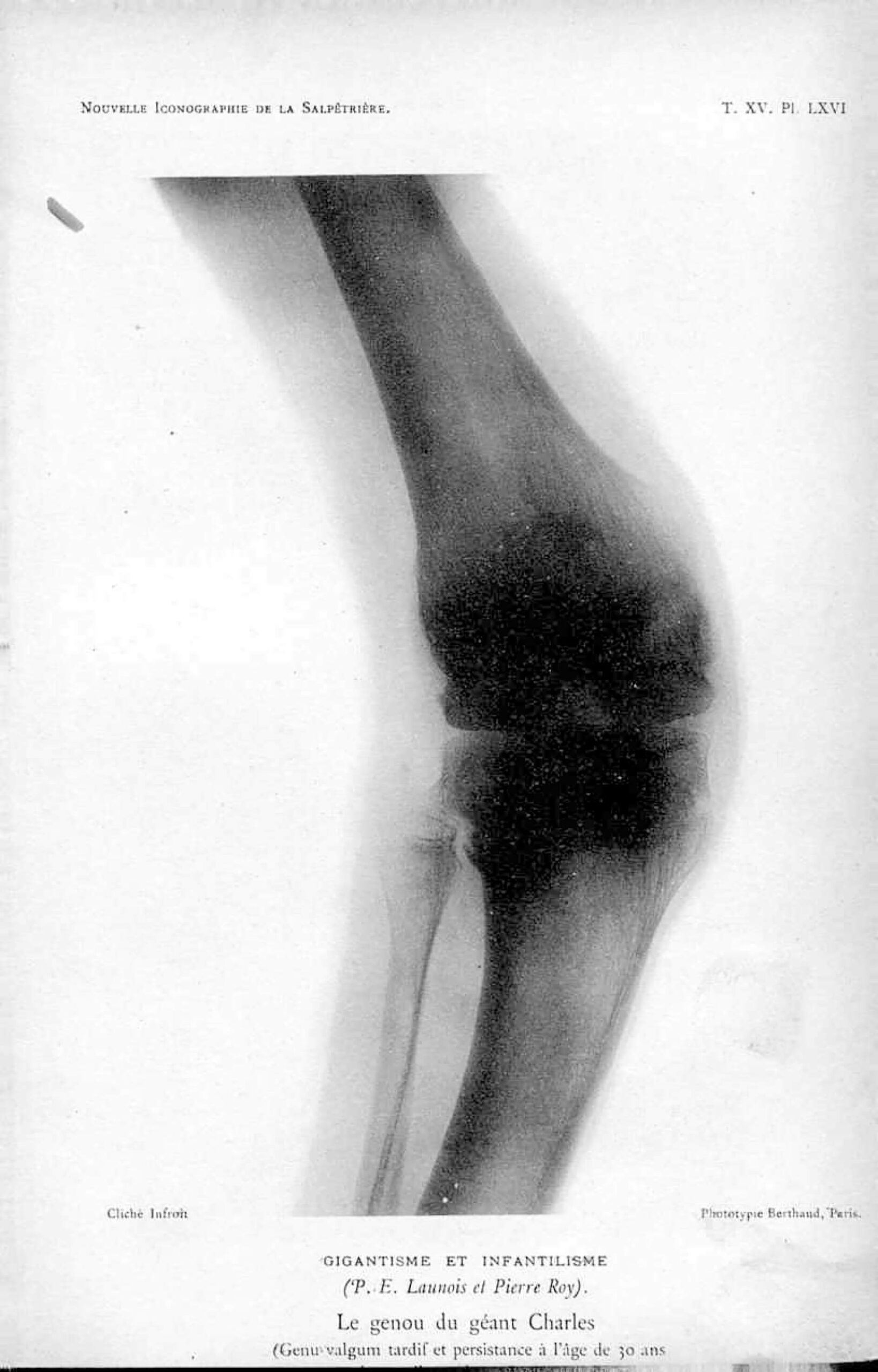
The scientific exactitude sought for in the Iconographie de la Salpêtrière and the Nouvelle Iconographie de la Salpêtrière, the (in)famous scientific publications stemming from Paris’ psychiatric hospital La Salpêtrière (1876-1918), lead to an abundance of photographic images in their pages. The photographs’ ideal: ‘Trace incontestable, incontestablement fidèle, durable, transmissible’.1 The ambition of exactitude results in cold, and often cruel depictions of patients. In the digitized version of the Sorbonne library’s copies, some photographs have left an imprint on the opposite page. The knee of Charles, ‘le géant’, adds an unwanted layer upon its measures on the opposite page, while the photograph of the knee itself loses ink.2
Didi-Huberman, G. Invention de l’hystérie. Paris: Macula, 2014, 72.
Launois, P.-E., Roy, P., ‘Gigantisme et infantilisme’, Nouvelle Iconographie de la Salpêtrière, Tome XV, 1902, 548, pl. LXVI, online: https://patrimoine.sorbonne-universite.fr/fonds/item/2613-nouvelle-iconographie-de-la-salpetriere-tome-15?offset=6

It has been snowing. A black BMW is parked on the other side of the street and is cut in half by the separation between negatives 4 and 5. Apart from a slight kink in the landscape, the negative on the right is a perfect continuation of the one on the left. The fence around the orchard, the branches of the apple tree and the power lines connect implicitly in the void between the negatives.
Based on De Cleene De Cleene, The Situation as it Is. A Photonovel in Three Movements (APE, 2022).

[13:42] Maziar: Power out at Rib now.
[13:45] Mathew: It’s windy here today, sorry!
[13:45] Maziar: Saying from the comfort of his electrified home, or…you also have no power?
[13:45] Mathew: No, I don’t. But, typically, outages in the city are shorter than in regional areas. PG&E website estimates service within two hours…Maybe you could post a business sign on Rib’s window?1
[13:52] Maziar: Yes. Though my phone is almost dead. No light. Can you send me a text for the sign? I can’t access the drive.
[13:52] Mathew: Yeah.
[13:52] Maziar: I feel reality hitting. Not so much the reality of blackouts in the U.S., but the reality of life and work…and that it is time to go home.
[13:55] Mathew: “CLOSED NO POWER For prescriptions go to Walgreens 2690 Mission OPEN UNTIL 5 PM.”
[13:55] Maziar: Thanks.
[13:56] Mathew: Yeah, maybe it’s time for you to leave for the night. I’m going to drive around to see what’s happening.
[13:59] Maziar: Okay, enjoy.
Local businesses experiencing a blackout typically post handwritten notices on their street-facing windows. These condensed notes detail acute symptoms felt at a community level, hinting at the improvisation required to maintain social harmony.
Mathew Kneebone is an artist based in San Francisco. His interdisciplinary practices takes different forms, all in relation to an interest in electricity and technology. He teaches studio and thesis writing at California College of the Arts.

During a two hour tour, H.V. (head of the science collection) guided us from the library to the observatory and back. Along the way, he touched upon various rarities: one hundred ninety-five volumes of the Encyclopédie Méthodique (according to H.V. the most complete copy left in the world), the severed summit of Mont Blanc (‘Actually de Saussure brought back a triangular piece of rock from just below the snow line near the summit’), an original copy of the publication on the infamous Lügensteine (‘These date back to the time before the hoax was unveiled’)…
In guiding us from room to room, H.V. piled oddity upon curiosity. He showed a particular interest in all things fish-related.
First published in: De Cleene, M. Reference Guide. Amsterdam: Roma Publications, 2019

The company Demuynck from Heist (B) has put the 2011 brochure of Dutch bicycle manufacturer Sparta on yumpu.com as an ePaper. According to yumpu.com, this was reportedly done on 28 September 2013. The leaflet is titled ‘Collection Overview 2011’. On pages 68 and 69, the bike is called K10, the frame says K-TEN, while a version presumably a bit older is usually for sale second-hand as K-10. The K10 is a ‘practical, compact city bike’, it is available in one unisex frame size 50 and it has an integrated cable lock. There is a loop at the back of the large tube to which the rest of the frame is mounted. This might be the end of that lock. There are optional carriers, front and rear, and there is an optional lighting kit. The recommended retail price is 299 euros.
Lars Kwakkenbos lives and works in Brussels and Ghent (B). He teaches at KASK & Conservatorium in Ghent, where he is currently working on the research project ‘On Instructing Photography’ (2023-2024), together with Michiel and Arnout De Cleene.

On 29 September 2022, I find a picture of a new Sparta K-10 on the website of cyclonewebshop.be. The bike is matt black and has a chaincase and a nice luggage rack at the front. The typical loop at the back is less noticeable in this photo. This is partly due to the colour of the bike.
Lars Kwakkenbos lives and works in Brussels and Ghent (B). He teaches at KASK & Conservatorium in Ghent, where he is currently working on the research project ‘On Instructing Photography’ (2023-2024), together with Michiel and Arnout De Cleene.

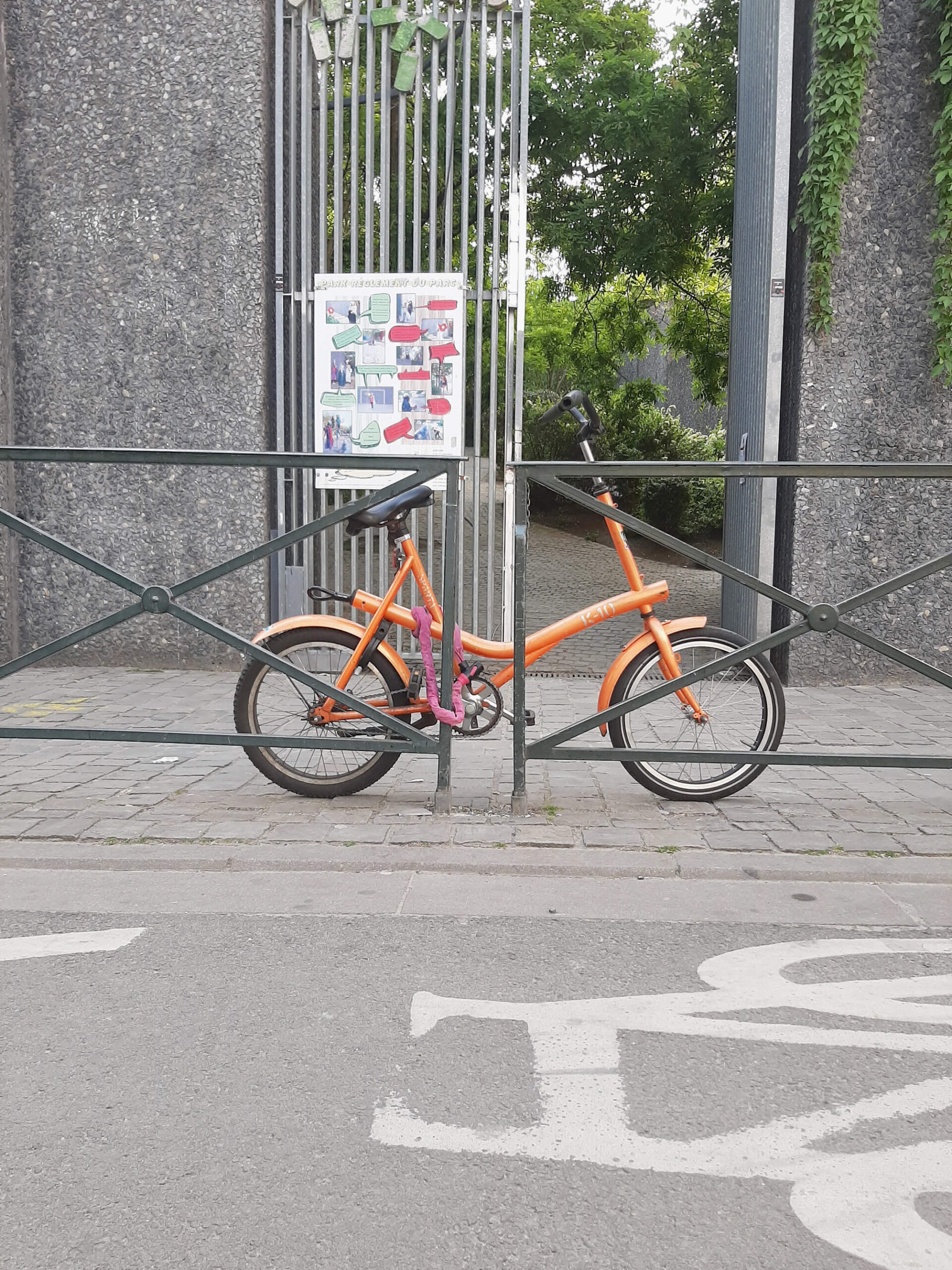
This bike regularly pops up on the streets of the Brussels neighbourhood where I live. On 4 June 2021, it stands in Rue Verte, in front of the entrance to the Reine Verte Park. The park is built on one of the steepest slopes in Brussels. That condition required a clever park design, in which you can hang out or walk from Rue Verte to Rue des Palais, up, or vice versa, down. The park is well cared for by city services.
The bike is an orange Sparta K-10. It has a remarkably low entry and high handlebars. As a result, it seems to be a comfortable bike, albeit one whose body posture while cycling is not geared to the gradient of our neighbourhood, in which it usually stands. Moreover, it has no gears and the saddle is very slanted.
Lars Kwakkenbos lives and works in Brussels and Ghent (B). He teaches at KASK & Conservatorium in Ghent, where he is currently working on the research project ‘On Instructing Photography’ (2023-2024), together with Michiel and Arnout De Cleene.
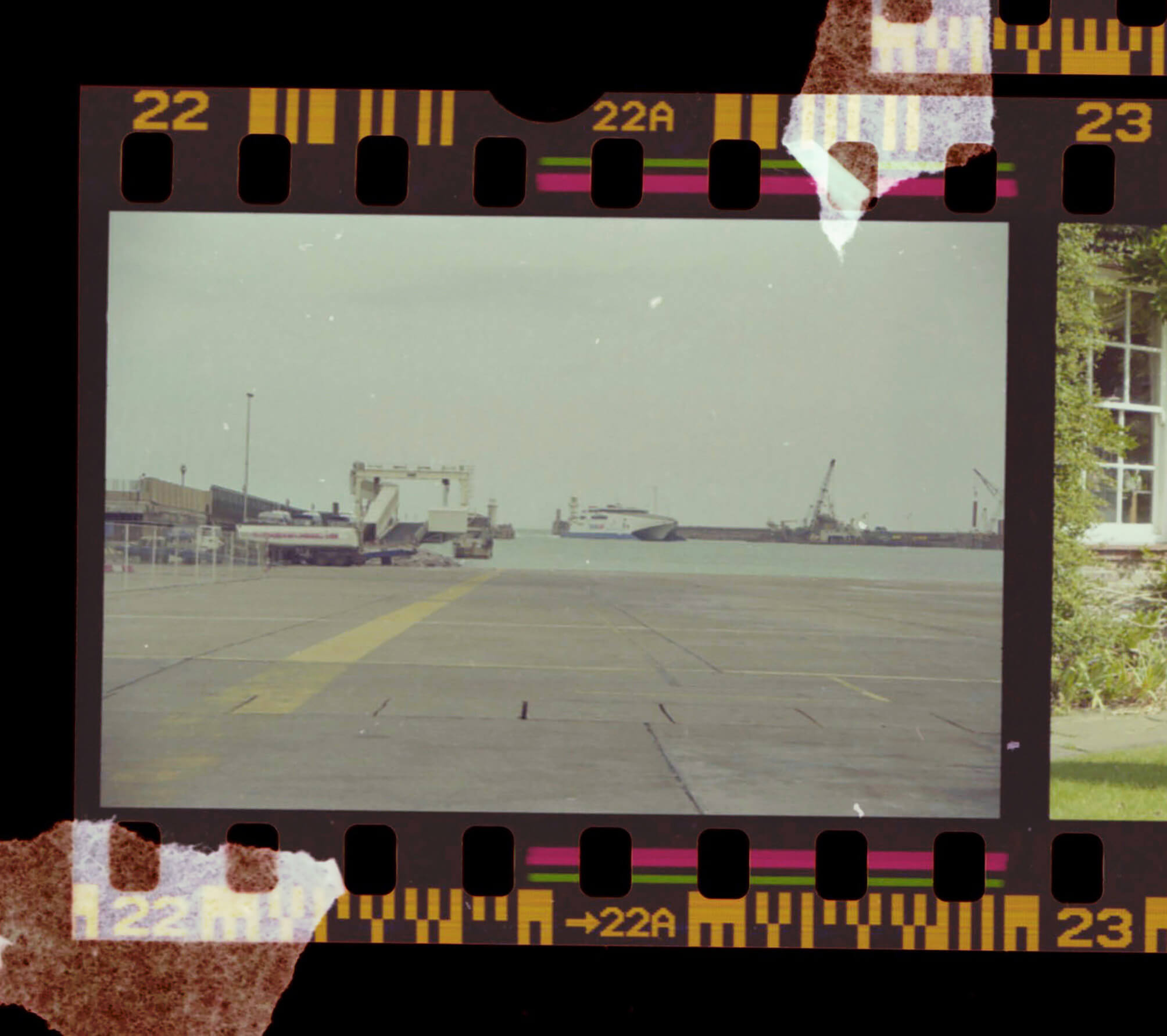
Coming back from holidays, we were waiting for the ferry to take us from Ramsgate to Ostend. We were well on time. As the ship entered the harbour, I asked my parents if I could take a photograph. It’s the first photograph I recall taking. I remember my dad telling me to wait long enough for the ship to get closer. I didn’t. I only got one try.1
It took a while before the film was developed. I couldn’t stop imagining what the photograph would look like: some picturesque waves in the foreground, the shining white ship, the red and blue text on the side, and a cloud filled sky.
Following every holiday, when we got home, the garden and our house would be photographed with the remaining exposures on the roll of film in the camera.
As we point the telescope to the sky – cloudy, and filled with chaotic bursts of rain – the dispersion of the city lights accentuates the swirling, frantic raindrops. The roof we are standing on is uneven. A puddle forms underneath the apparatus, around the right leg of the tripod and our feet. The sound of a car on a wet street, below. A kitchen light is flicked on. Temperature is low for a mid-September night, and getting lower by the minute. It seems impossible to tell the depth of field we are documenting, and at what distance from our position these fleeting constellations occur.
Excerpt from Towards Civil Dusk (De Cleene De Cleene, 2020)
Neptune in opposition [1-20] is part of ‘Documenting Objects’, a research project by Arnout De Cleene and Michiel De Cleene at KASK & Conservatorium, the school of arts of HOGENT and Howest. Their research is financed by the HOGENT Arts Research Fund. Previous research into this subject has amongst other things led to the documentary film Towards Civil Dusk and temporary public observatories at 019, Gent and Kunsthal Extra City, Antwerp.
Thanks to:
Angelo Van Daele
Arthur Haegeman
Chris De Pauw
Emi Kodama
Frédéric Thill
Gentil Van de Vijver
Guy Wauters
Hannah De Cleene
Jan Scheers
Jonas Temmerman
John Sussenbach
Kunsthal Extra City
Philippe Molet
019
Astropolis (Oostende)
Cercle Astronomique Mosan (Herbuchenne)
Koninklijk Observatorium Ukkel
Observatoire Astronomique Antoine Thomas S.J. (Namur)
Observatoire Astronomique Centre Ardenne (Grapfontaine)
Publieke Sterrenwacht van de Westkust (Koksijde)
Volkssterrenwacht Armand Pien (Gent)
Volkssterrenwacht AstroLAB IRIS (Zillebeke)
Volkssterrenwacht Beisbroek (Brugge)
Volkssterrenwacht Mira (Grimbergen)
Volkssterrenwacht Urania (Hove)

‘My backyard is oriented perfectly, I can see the entire southern sky without obstructions.
In two years, they will start building an apartment block, though, two floors high with a roof on top. The height is not a problem, but of course it does mean heat and potential turbulence. I just hope they will be well insulated.
This is what I like doing. I have never been interested in remote observations.1 In my backyard. I hear the geese flying overhead at night. An owl. The silence. I want to be near.’
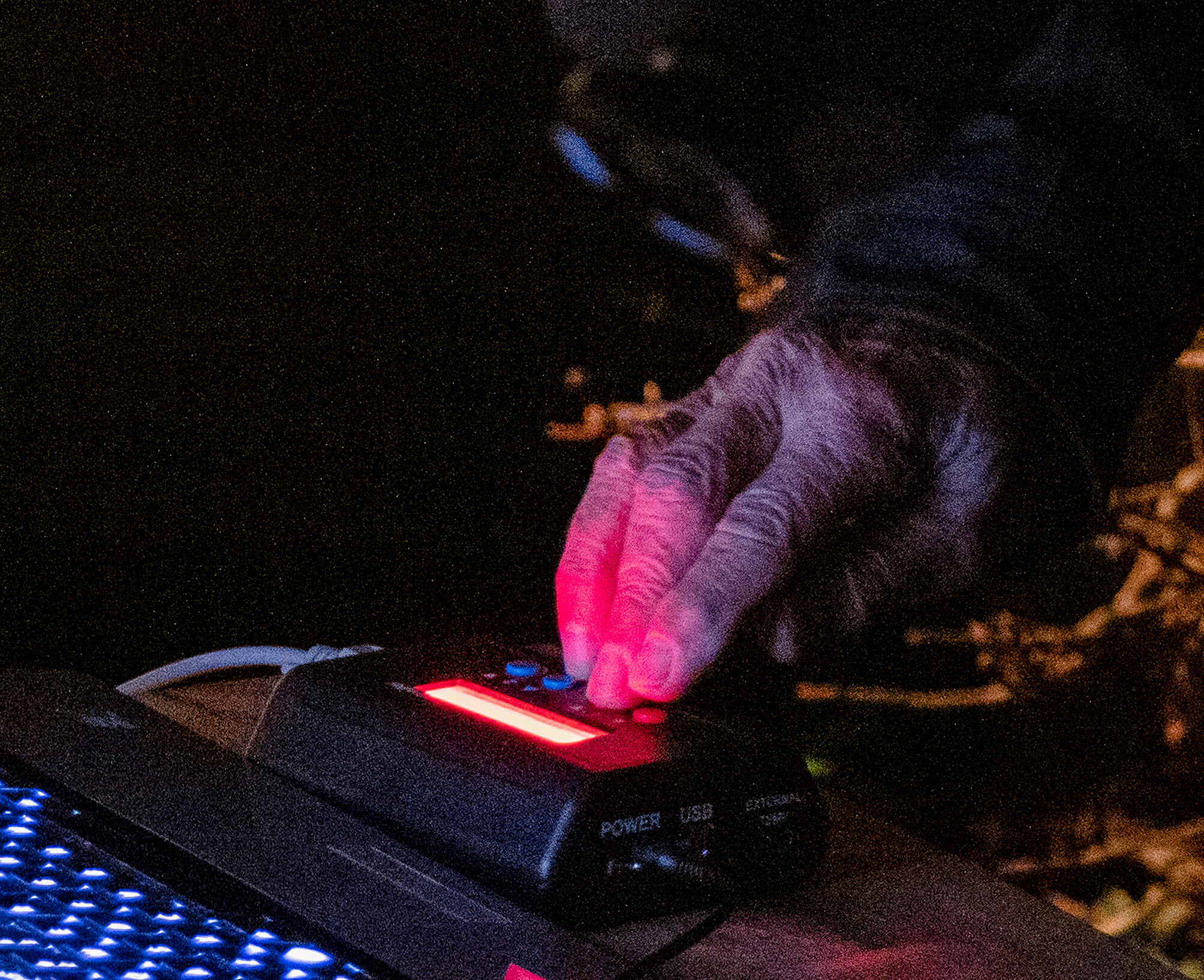
In the photograph John Sussenbach is manipulating the telescope’s focus slightly during the recording.
To make better images, astrophotographers can rent time on a ‘remote observatory’: a fully equipped observatory located in a less light-polluted region and with a more stable atmosphere than the one the average amateur astronomer lives in. A command given from a computer directs a massive telescope in Chile towards a desired spot.
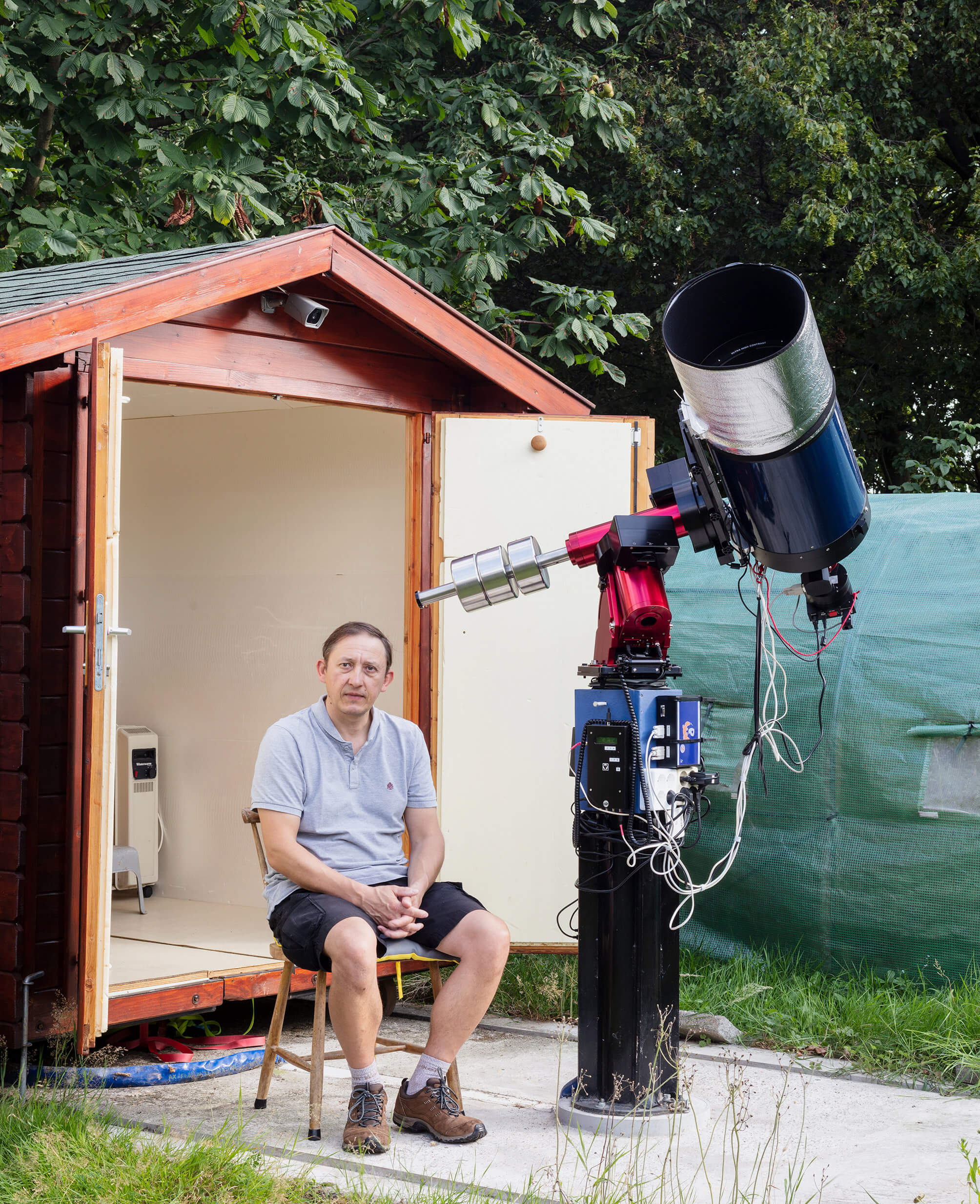
Summer 2019, between the swingset and the mesh greenhouse, astrophotographer Angelo Van Daele closes the observatory. The wheels roll smoothly across the rails embedded within a concrete slab. His former observatory is now a chicken coop. His neighbour’s trees need pruning. The camera mounted on the exterior of the shed allows him to see the instrument from inside the house.
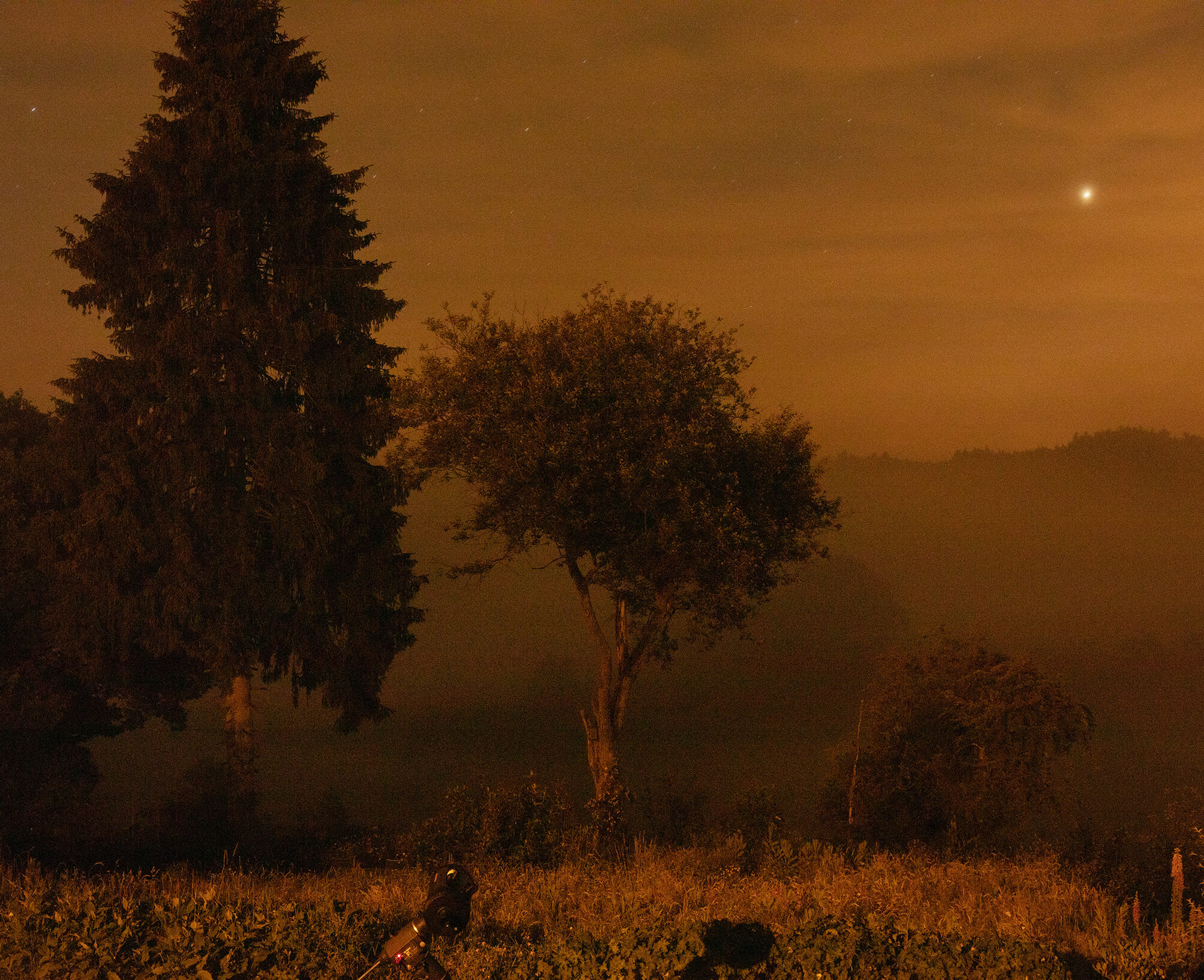
The car is parked on a gravel path, a few metres down from the small road crossing the village. It would be hopelessly stuck the next morning. While trying to capture Neptune through the rental telescope, I run back and forth between the tripod on the small lawn and the trunk several times to get other eyepieces and adapters.
I align the telescope, using three stars: Vega, Arcturus and Deneb.
I hear an animal. I look up and notice the interior light of the car has switched on.
A motorcycle around 3:14. The driver is shifting gears rapidly. I don’t see any headlights in the valley.
Fog sets in. Saturn practically disappears from sight. Jupiter appears as a blob.
I’m 380m above sea level. The highest hill in the area is barely 500m of height. Still, the fog and the settling dew, along with the nightly cold give it something strangely alpine.
The fog lifts.
I can still clearly see the ridge in the east. It should be darker.