What constitutes a ‘document’ and how does it function?
According to the Oxford English Dictionary, the etymological origin is the Latin ‘documentum’, meaning ‘lesson, proof, instance, specimen’. As a verb, it is ‘to prove or support (something) by documentary evidence’, and ‘to provide with documents’. The online version of the OED includes a draft addition, whereby a document (as a noun) is ‘a collection of data in digital form that is considered a single item and typically has a unique filename by which it can be stored, retrieved, or transmitted (as a file, a spreadsheet, or a graphic)’. The current use of the noun ‘document’ is defined as ‘something written, inscribed, etc., which furnishes evidence or information upon any subject, as a manuscript, title-deed, tomb-stone, coin, picture, etc.’ (emphasis added).
Both ‘something’ and that first ‘etc.’ leave ample room for discussion. A document doubts whether it functions as something unique, or as something reproducible. A passport is a document, but a flyer equally so. Moreover, there is a circular reasoning: to document is ‘to provide with documents’. Defining (the functioning of) a document most likely involves ideas of communication, information, evidence, inscriptions, and implies notions of objectivity and neutrality – but the document is neither reducible to one of them, nor is it equal to their sum. It is hard to pinpoint it, as it disperses into and is affected by other fields: it is intrinsically tied to the history of media and to important currents in literature, photography and art; it is linked to epistemic and power structures. However ubiquitous it is, as an often tangible thing in our environment, and as a concept, a document deranges.
the-documents.org continuously gathers documents and provides them with a short textual description, explanation,
or digression, written by multiple authors. In Paper Knowledge, Lisa Gitelman paraphrases ‘documentalist’ Suzanne Briet, stating that ‘an antelope running wild would not be a document, but an antelope taken into a zoo would be one, presumably because it would then be framed – or reframed – as an example, specimen, or instance’. The gathered files are all documents – if they weren’t before publication, they now are. That is what the-documents.org, irreversibly, does. It is a zoo turning an antelope into an ‘antelope’.
As you made your way through the collection,
the-documents.org tracked the entries you viewed.
It documented your path through the website.
As such, the time spent on the-documents.org turned
into this – a new document.
This document was compiled by ____ on 11.12.2025 11:18, printed on ____ and contains 23 documents on _ pages.
(https://the-documents.org/log/11-12-2025-6693/)
the-documents.org is a project created and edited by De Cleene De Cleene; design & development by atelier Haegeman Temmerman.
the-documents.org has been online since 23.05.2021.
- De Cleene De Cleene is Michiel De Cleene and Arnout De Cleene. Together they form a research group that focusses on novel ways of approaching the everyday, by artistic means and from a cultural and critical perspective.
www.decleenedecleene.be / info@decleenedecleene.be - This project was made possible with the support of the Flemish Government and KASK & Conservatorium, the school of arts of HOGENT and Howest. It is part of the research project Documenting Objects, financed by the HOGENT Arts Research Fund.
- Briet, S. Qu’est-ce que la documentation? Paris: Edit, 1951.
- Gitelman, L. Paper Knowledge. Toward a Media History of Documents.
Durham/ London: Duke University Press, 2014. - Oxford English Dictionary Online. Accessed on 13.05.2021.

The last couple of days have been dry. Rain is expected for the weekend. The office buckets are in place and are empty, except for some residue. Dirt, sand, a few hairs. Some particles must have come along with the drops when they made their way through the roof.

Halfway March my dad started finding empty clam shells on the banks of the Zuidlede along the pasture where he used to herd sheep. He had never seen this type of clam before. There were easily seventy of them along a hundred metre stretch of riverbank.
He brought two specimens to someone he knows in the neighbouring provincial domain. She would look into it, she said, and that she would probably pass it on to someone at the educational department.
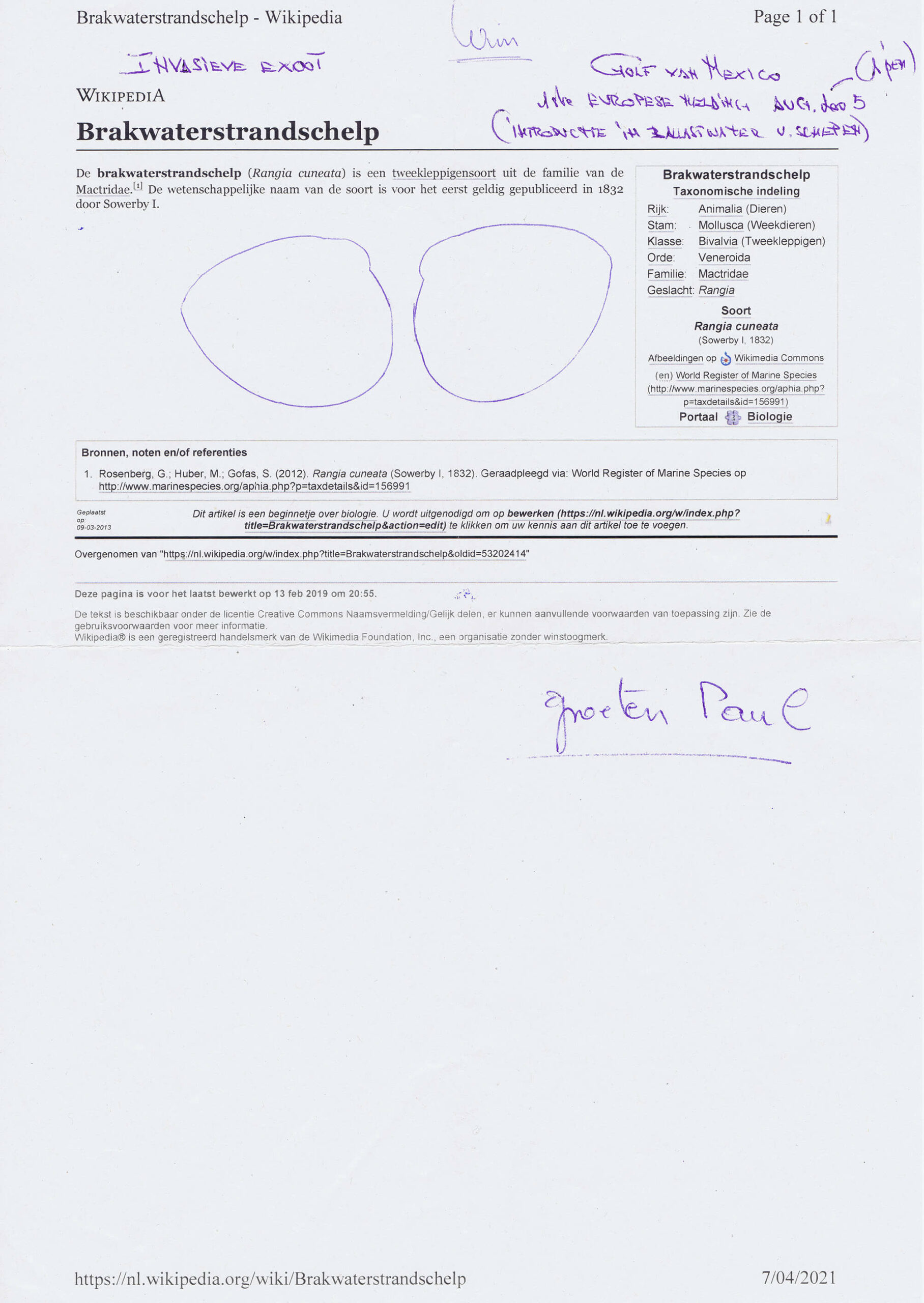
Yesterday he (my dad) received a printout of the Dutch wikipedia-page on the Brakwaterstrandschelp (Rangia Cuneata). On the page Paul (who sends his regards at the bottom of the document) traced around the scallops with a blue ballpoint pen.
My dad added in capitals – also with a blue ballpoint pen – that the Rangia Cuneata is an invasive species, native to the Gulf of Mexico. The first time it was observed in Europe was in Antwerp in August 2005, most probably they reached Europe in the ballast water tanks of large ships.
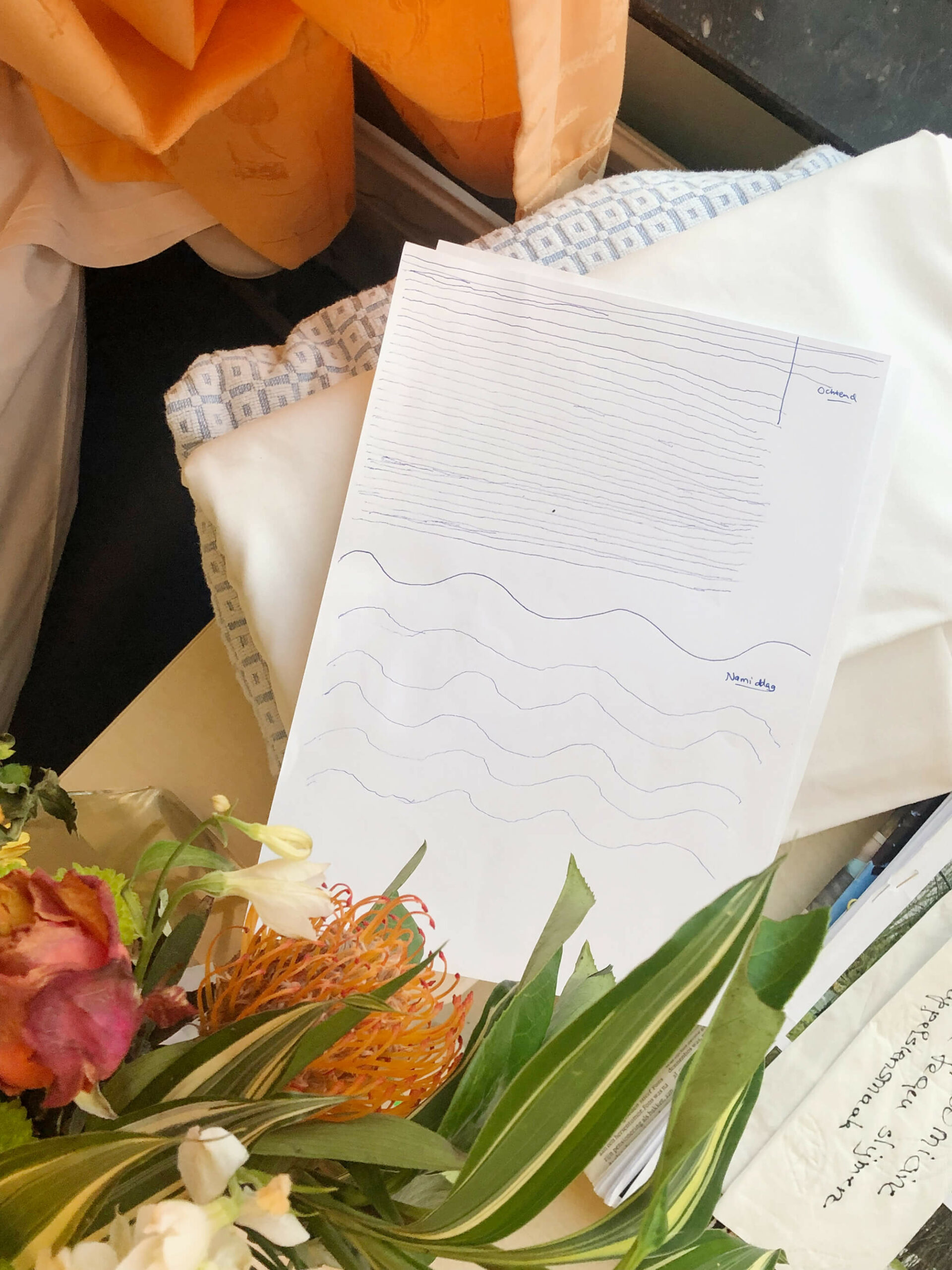
On a pile of fresh hospital sheets, near the radiator, the tangerine curtains and the black marble window sill (the window looks out over the parking lot), underneath the two-day-old bouquet of flowers and next to a pile of magazines with a handwritten note on top (about a syrup that relieves slime and tastes like oranges), lie two sheets of paper.
Earlier that day the physiotherapist had come by. Twice. Once in the morning and once in the afternoon. He had each time drawn the first line, as an example. A straight line in the morning, a curvy line in the afternoon.
With a ballpoint pen my grandfather, who is recovering from an accident, diligently copied the examples (31 in the morning, 5 in the afternoon).
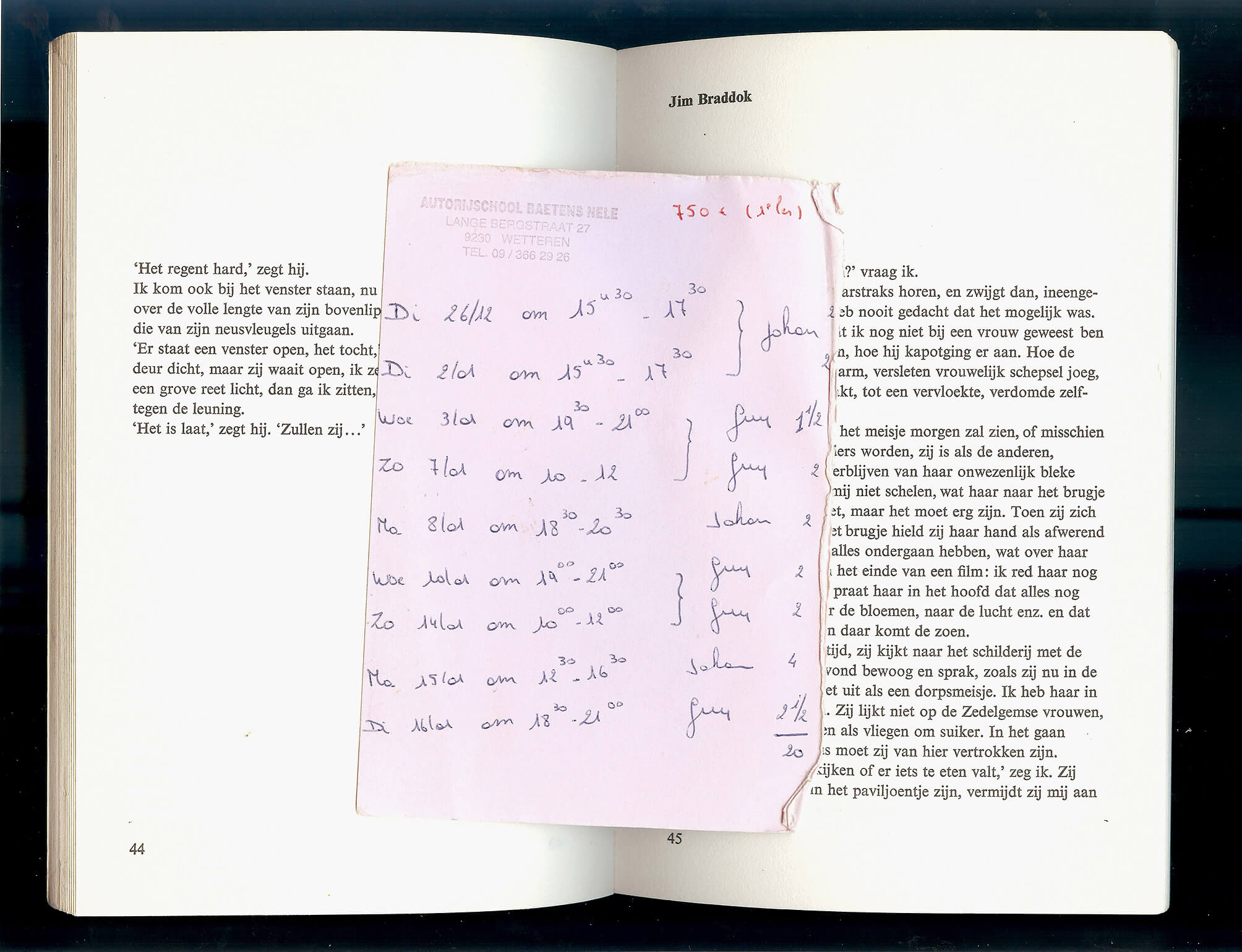
In his debut novel ‘De Metsiers’ Hugo Claus employs a multiple narrative perspective. In the copy I picked up in a thrift store, there’s a bookmarker between pages 44 and 45 where the perspective shifts from Ana to Jim Braddok. It’s pouring. The pink piece of paper lists 9 sessions at a driving school. There’s a total of 20 hours, taught alternately by Johan and Guy.
In 2000, 2006 and 2017 the twenty-sixth of December was a Tuesday. (Earlier years are improbable, since the Euro was not introduced yet.)
Claus, H. De Metsiers. Amsterdam: Uitgeverij De Bezige Bij, 1978.
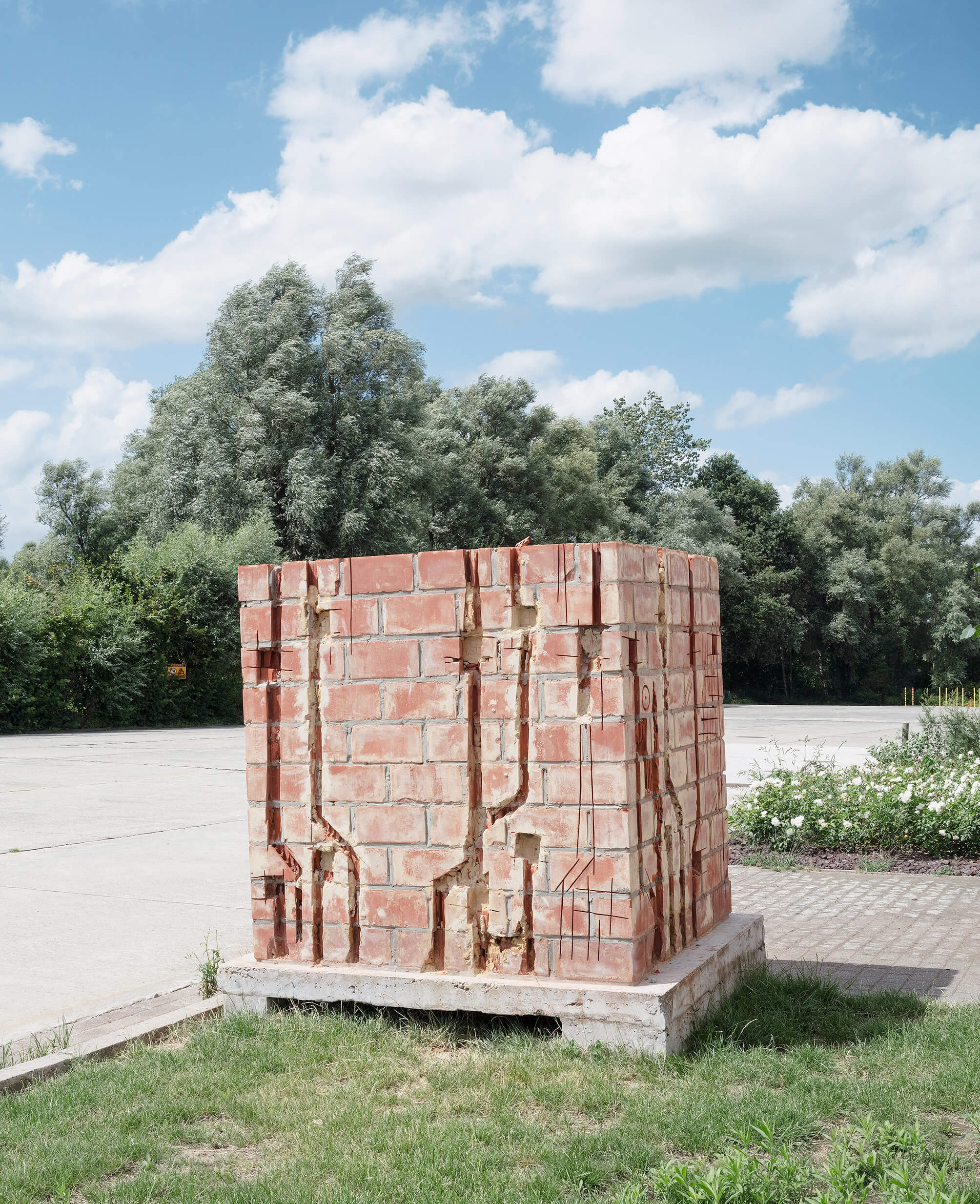
‘The masons in training pour a concrete slab and build four walls upon it in a stretcher bond. Then the block comes to our department and the students in the course Electrical installer (residential) can grind channels and drill cavities in it.’
[…]
‘It’s not always a success from the outset, but they learn quickly.’
[…]
‘Never grind horizontally, always vertically. Diagonally if there is no other way.’
[…]
‘Two fingers wide.’
[…]
‘After this it goes to the sanitary department. After the bell drilling, the demolition hammer follows and the masons make us a new block.’
Competentiecentrum VDAB, Wondelgem, July 2019.
First published in A+ Architecture in Belgium, A+ 279, Schools (August, September 2019), https://www.a-plus.be/nl/tijdschrift/schools
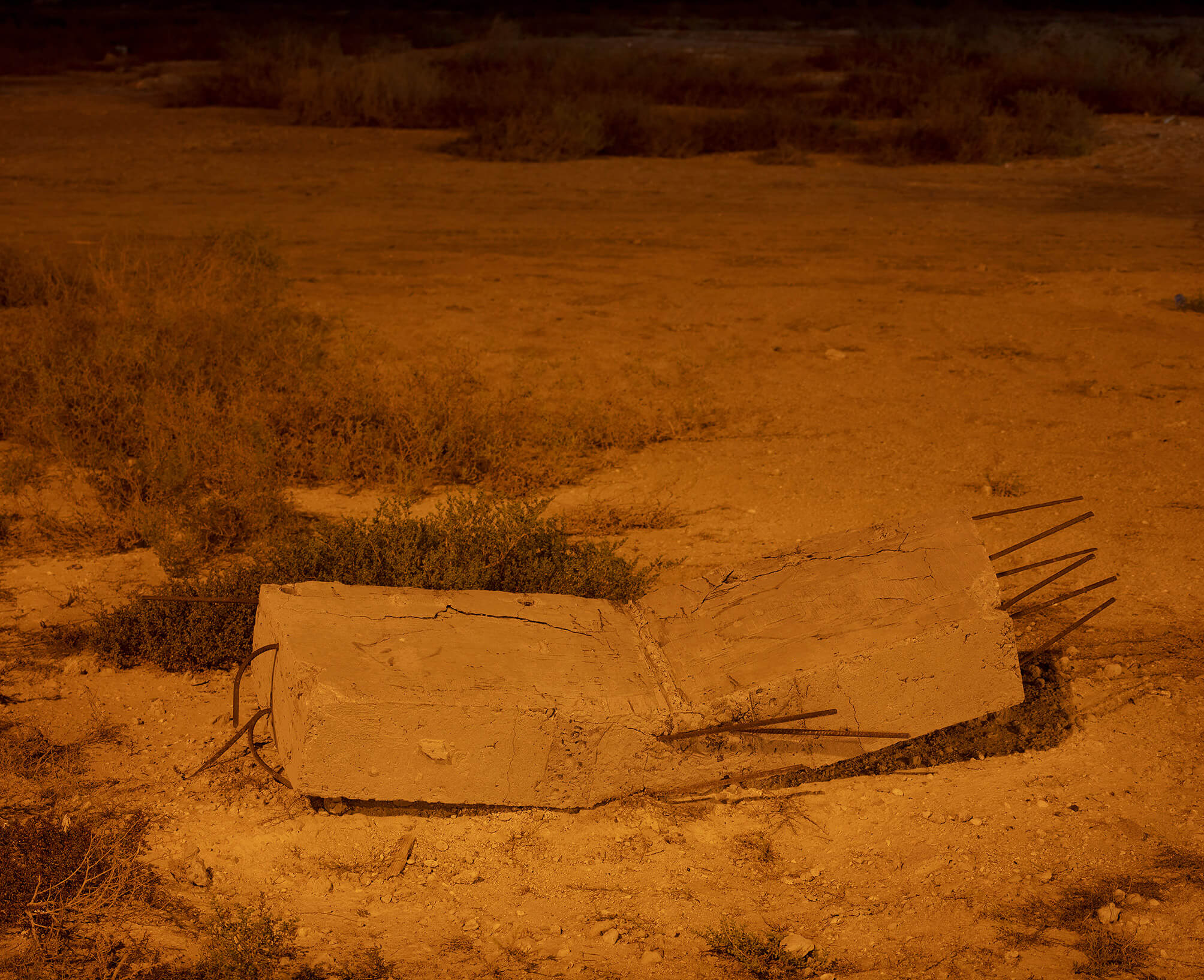
A block of concrete. Fissures are showing and rebar is sticking out from all sides. If it were still straight, the block would measure approximately 130 x 15 x 40cm.
It is lying by the side of the road, a few hundred meters from a construction site. It appears to be shaped by impact. Maybe the block plummeted to the ground from a great height. Perhaps, something heavy hit it. For all one knows, it served as a column and was exposed to an unforeseen amount of pressure, causing it to buckle.
According to Eyal Weizman ‘[a]rchitecture emerges as a documentary form, not because photographs of it circulate in the public domain but rather because it performs variations on the following three things: it registers the effect of force fields, it contains or stores these forces in material deformations, and, with the help of other mediating technologies and the forum, it transmits this information further.’1
Weizman, E. ‘Introduction’, in: Forensic Architecture. Forensis. The Architecture of Public Truth. London/Berlin: Sternberg Press, 2014.
In an attempt to make it his own, Gino – it might also be Dino – has taken a can of bright pink spray paint to his hard hat and – as the paint was drying – dragged his gloved finger from top to bottom. G – or D –, I, N, O. In the dust on a demolished floor tile, someone has written 12,10. Perhaps a measurement, a quantity, a position, a date, a reference.
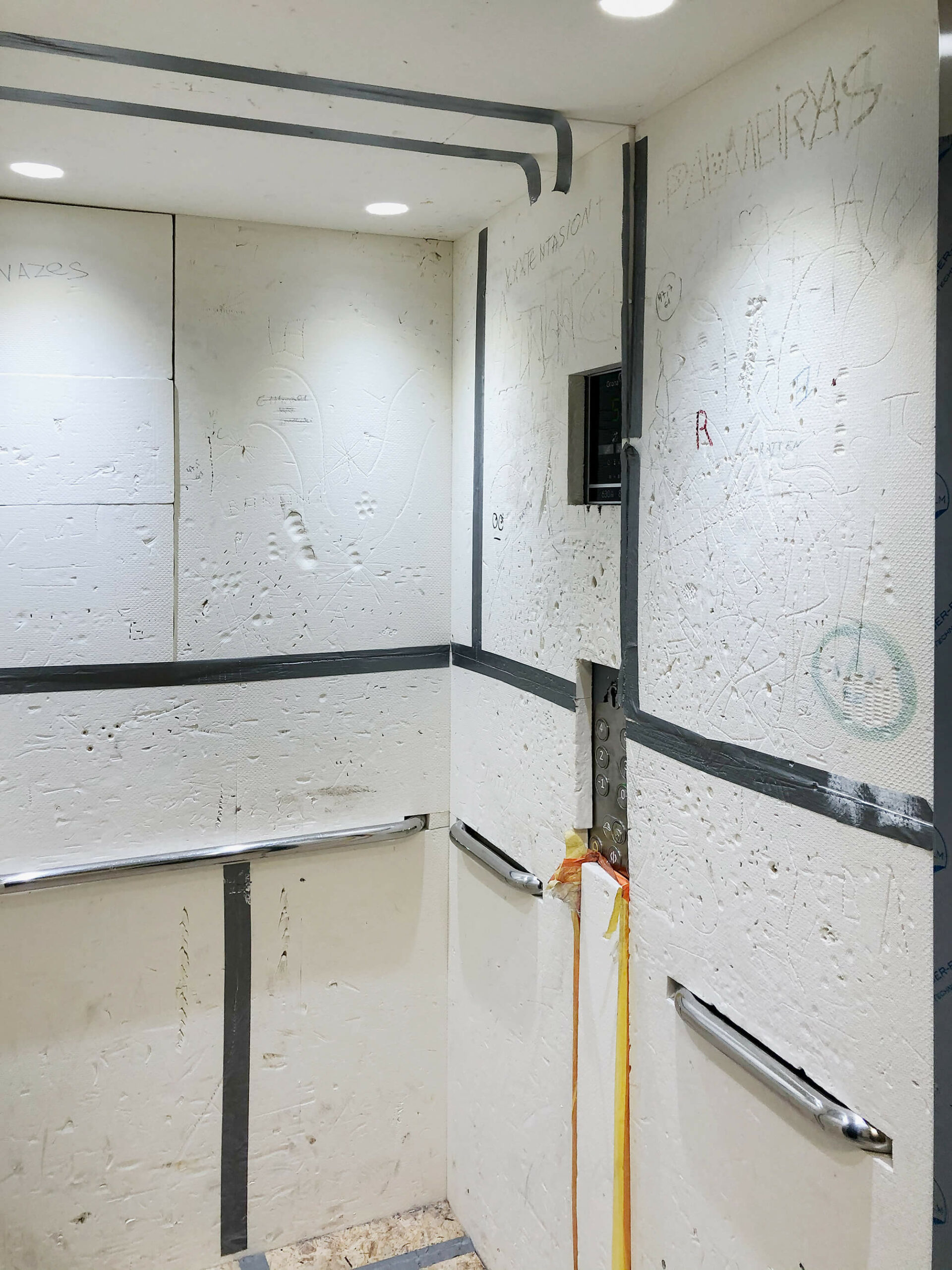
Subtractive writing is not uncommon. With the tip of a passer-by’s index finger ‘WASH ME’ is subtracted from the dust on a dirty car. In freshly poured concrete, a name is embedded forever with a twig. In hot and soft roofing drawings and obscenities are scratched. Styrofoam lining a brand new elevator gets impressed with names, jokes and knuckles.
In the twenty-third canto of Ariosto’s Orlando Furioso (1516), Orlando comes across the name of his love and another man, carved in the bark of a tree. He doubts. But that night, a gossiping shepherd tells him he’s seen Angelica and Medoro together. Orlando returns to the forest, and in a four-day frenzy, he uproots every tree and pollutes the rivers forever.
CXXXI
For he turf, stone, and trunk, and shoot, and lop,
Cast without cease into the beauteous source;
Till, turbid from the bottom to the top,
Never again was clear the troubled course.
At length, for lack of breath, compelled to stop,
(When he is bathed in sweat, and wasted force,
Serves not his fury more) he falls, and lies
Upon the mead, and, gazing upward, sighs.1
Ariosto, L. Orlando Furioso. Translated by William Stewart Rose, Echo Library, 2006, p. 267.

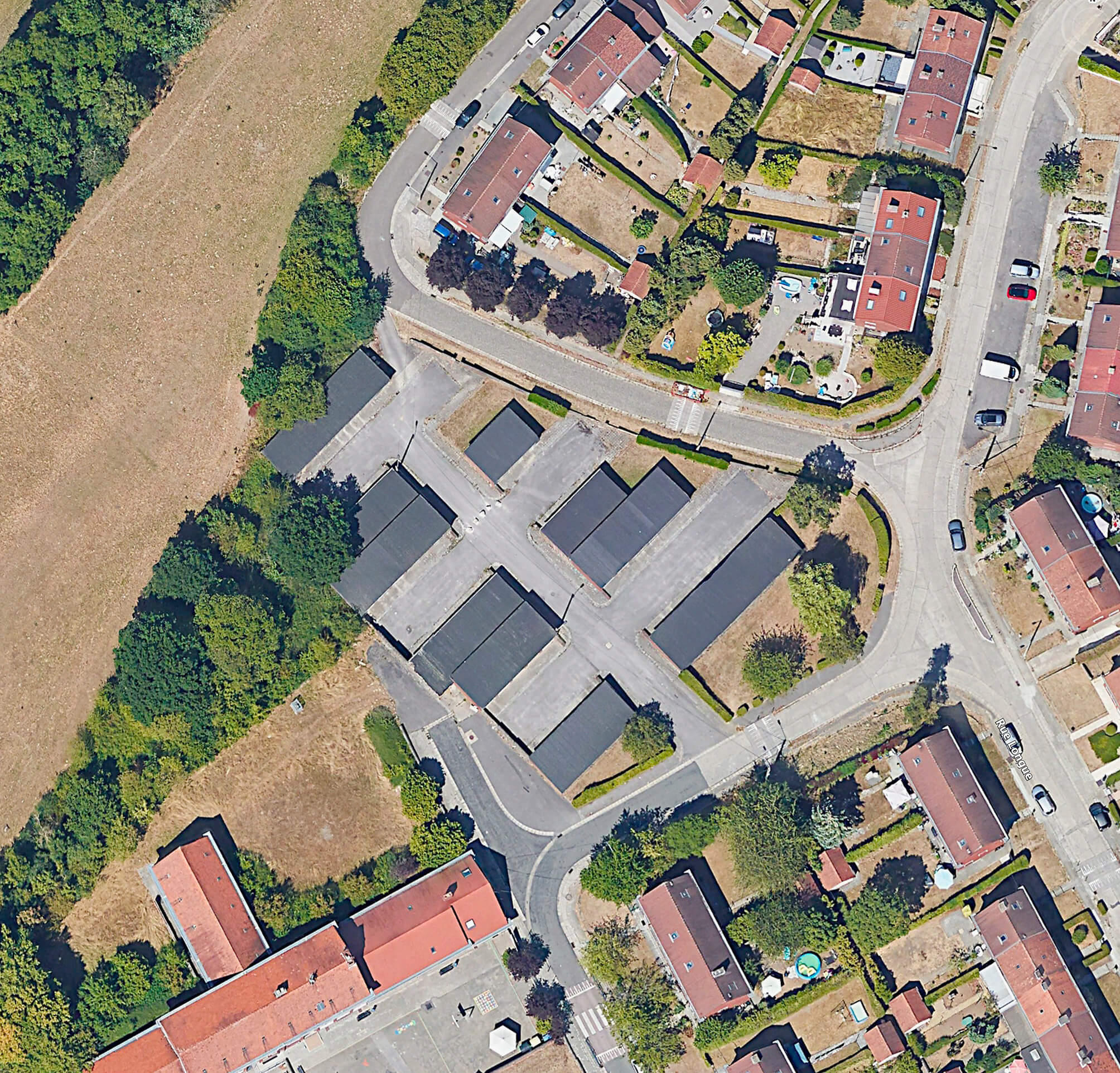
Seven very similar and rudimentary buildings take in a trapezoid plot of land in Gilly. They are located between the school on the Rue Circulaire and the houses along the Rue de l’Abbaye. The structures are built of orange brick, concrete structural elements, whitish steel gates and roofing. Every garage has its own number, hand-painted in white on the concrete lintel above each gate. In summer the roofing gets hot and soft.
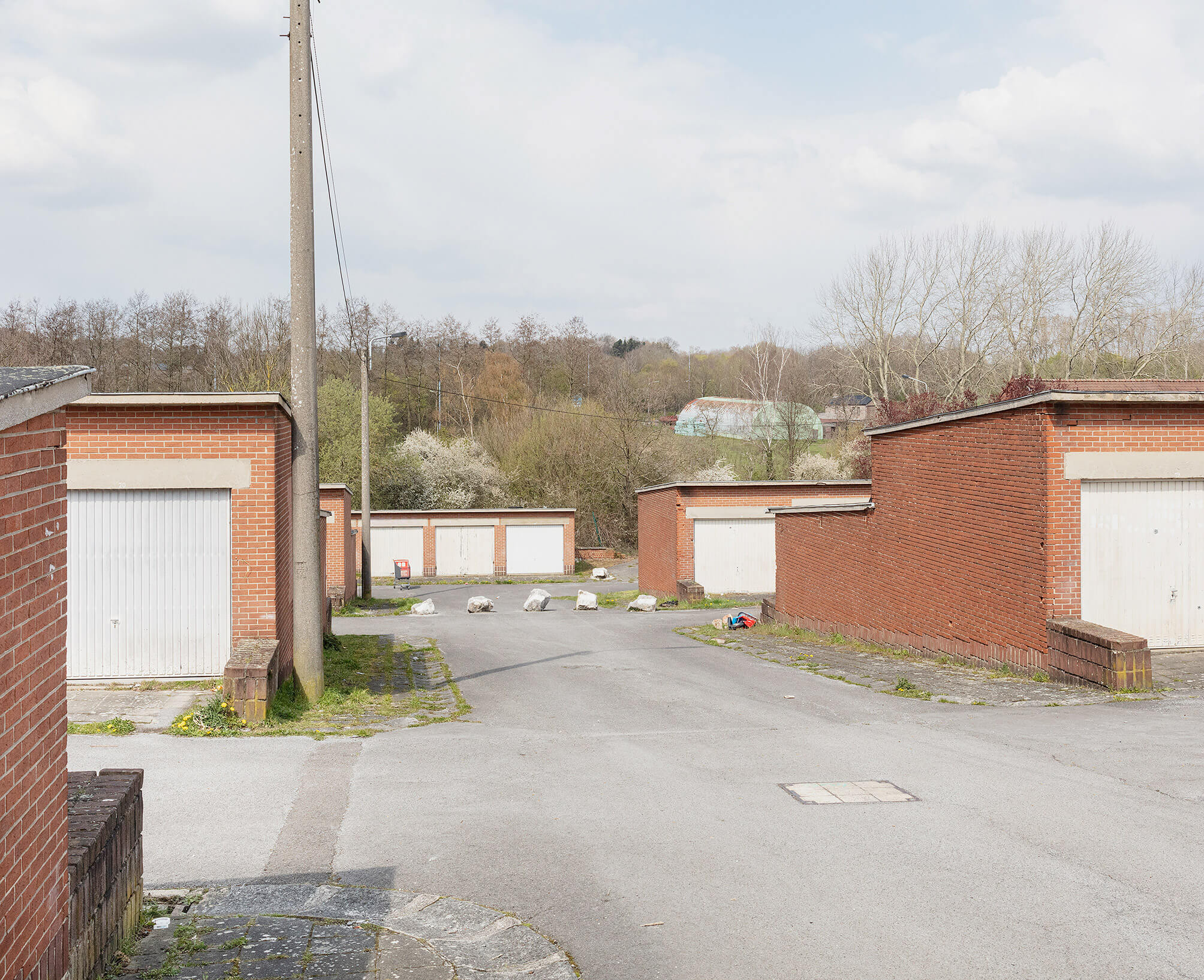
Five white boulders close off a shortcut for motorists who attempt to cut the bend in the road. The southernmost roof’s pitch runs opposite to the landscape’s slope. The lower roofline is, therefore, only about one meter above a small, triangular patch of grass which is hidden from view by a hedge. In summer, when the roofing gets hot and soft, text and drawings get pressed or carved into it.
Google Earth
In what order and by whom the various texts and drawings were carved into the soft roofing is unclear. To the right of ‘EVA’, a heart symbol and an arrow (pointing to the left), the roofing reads ‘SIMON TU ME MANQUES’.
The short sentence usually – yet hastily – translates to ‘Simon, I miss you’. However, in French the ‘you’ (tu) is the subject and has an active role, whereas the ‘I’ (me) is the direct object. In short: by his not being there, Simon actively effectuates hurt to the one who carved this text.
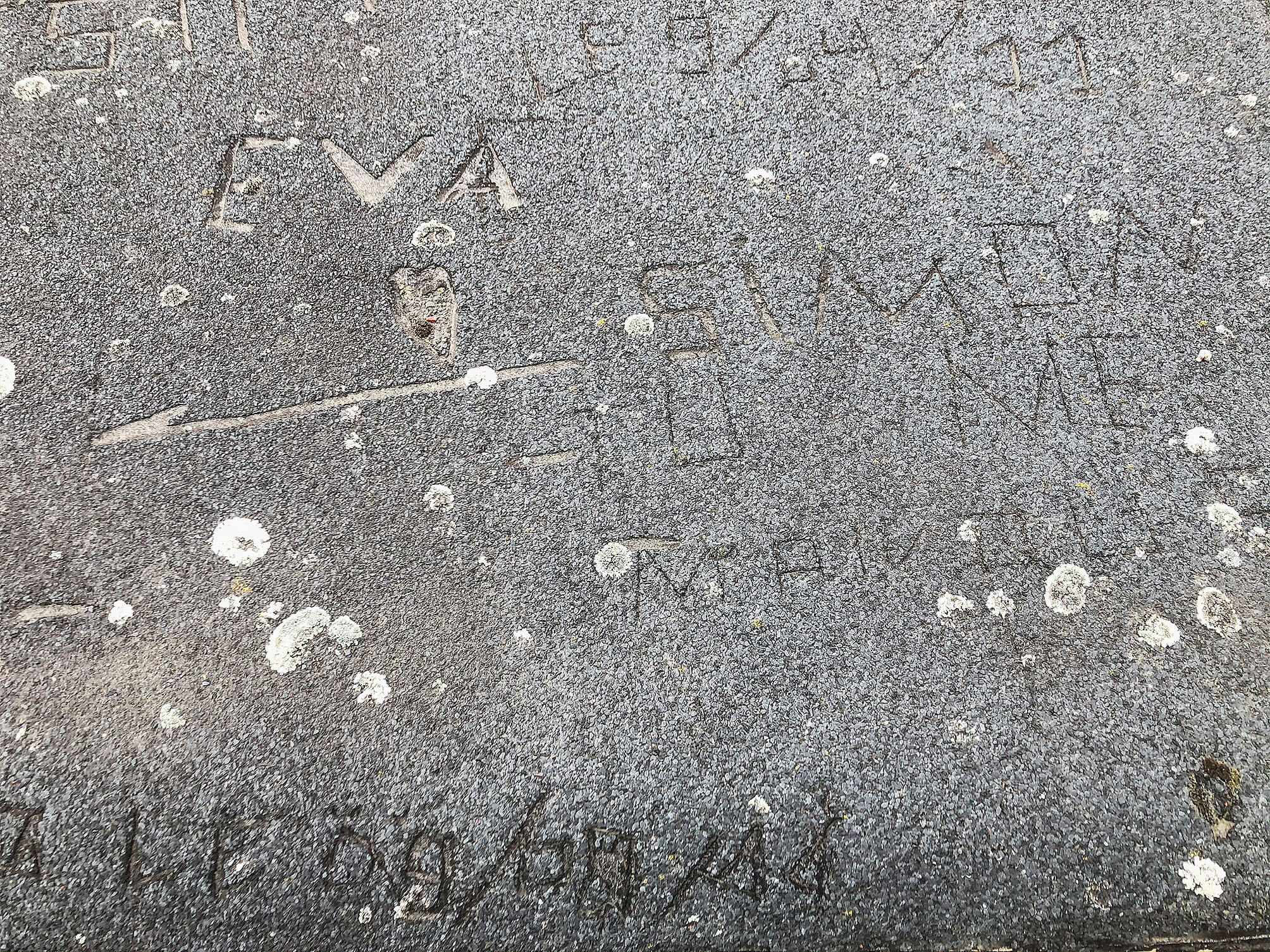
A carving that looks like a stitched-up scar (a long, slightly curved line crossed at a right angle by eleven short straight lines) is inserted into a short statement about Celine and Logan. An initial of Celine’s last name is included. At first sight it looks like a ‘D’, but the line through the middle might just as well make it a ‘B’. Maybe it was Celine D who added the line in an attempt to convince those reading the roofing that it’s actually Celine B who blows Logan.

The building is almost finished. One apartment is still up for sale, on the top floor. The contractor is finishing up. There’s a long list of comments and deficiencies that need to be addressed before the building can be handed over definitively to the owner. The elevator’s walls are protected by styrofoam to prevent squares, levels, measures, drills, air compressors, chairs, bird cages, etc. from making scratches on the brand new wooden panelling.
In 1932 Brassaï began taking photographs of graffiti scratched into walls of Parisian buildings. On his long walks he was often accompanied by the author Raymond Queneau, who lived in the same building but on a different floor. Brassaï published a small collection of the photographs in Minotaure, illustrating an article titled ‘Du mur des cavernes au mur d’usine’ [‘From cave wall to factory wall’].
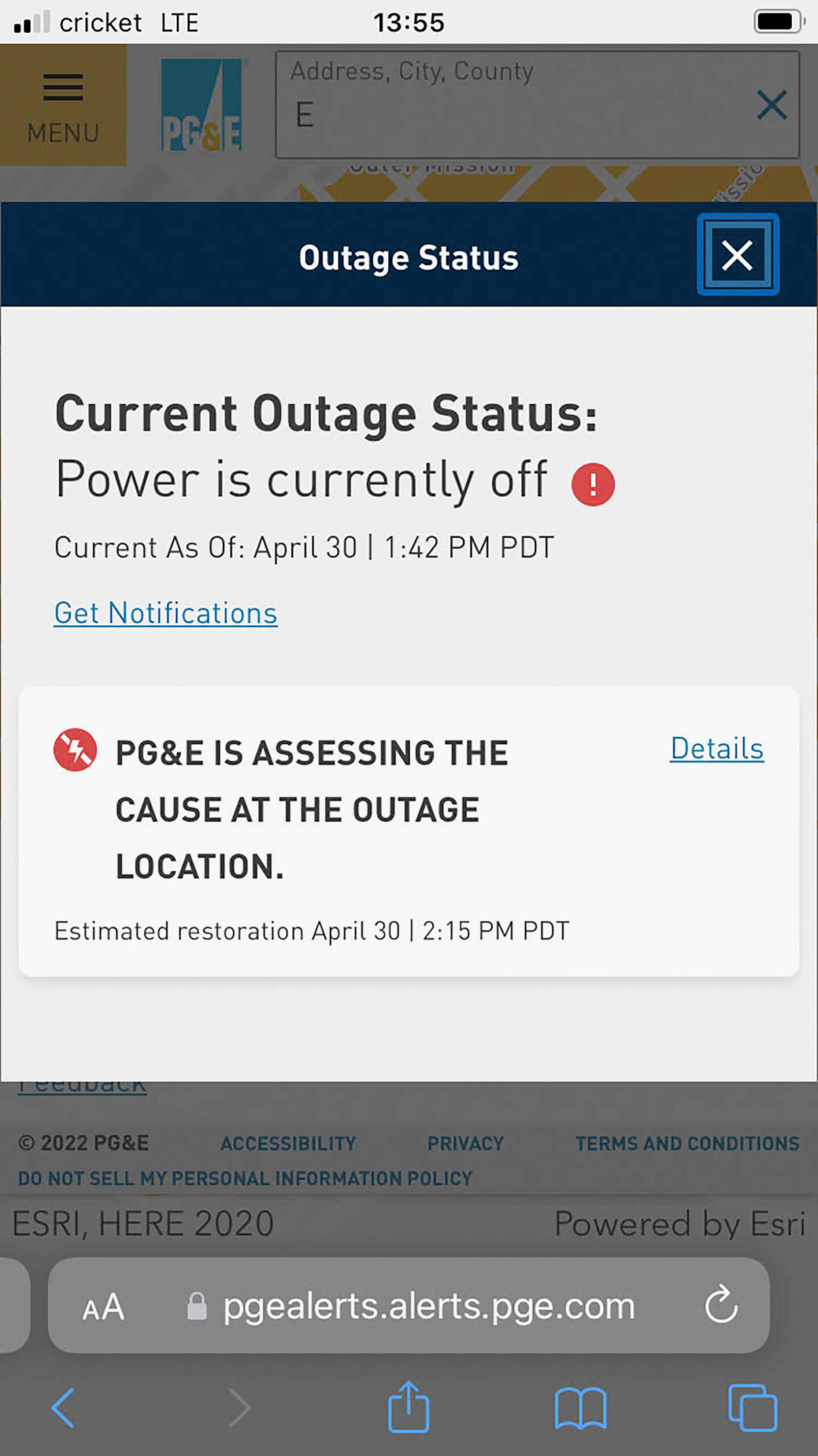
On a windy morning in April, I was on a video call with a friend, curator Maziar Afrassiabi. He listened patiently from Rotterdam as I labored over a direction for my research. It concerned a device I installed in his art space, Rib, six months prior, that monitored blackouts across California by scraping real-time data from utility companies. When a county experienced a significant blackout, it would cut Rib’s electricity in kind—causing Rib to inherit and adapt to conditions that shape Californian infrastructure. During its operation, I’d been researching the grid—learning what it is, why it fails, and how communities respond when it does.
We took a short break. Maziar, with tired eyes, stepped away for a smoke. While waiting, I watched the power lines outside my window sway limply in the breeze. In spite of its apparent lifelessness, I’ve always thought of electricity as a psychological force. My mind wandered through a cursory model of the grid, idiosyncratically cloudy and detailed.
Energy simultaneously generated and used, cascading infrastructural operations in a blink. Outlying stations burning, vaporizing, absorbing fuel, spinning vast electromagnetic turbines. Oscillating current. Neighboring transformers boosting volts to kilovolts, compensating for lost energy coursing through long-distance transmission supported by pylons peppered across Menlo Park.
Current flows into enclosed substations. Transformers, insulators, resembling a kind of industrial Watts Towers—though uninhabitable and anonymous by comparison—step voltages back down to levels safe enough for wires traversing the city. They branch out through streets via buried cables or, like the lines outside my window, are strung atop Douglas fir utility poles at roughly 30-meter intervals…curious vestigial markers. I’d read somewhere they were provisionally pitched when Samuel Morse found that telegraph signals wouldn’t transmit through the earth.
Each pole divides vertically into distinct zones, spaced apart for safety. Treacherous high-voltage wires from substations pass along the top, while safer signals—cable internet and landlines—hang nearest to the ground. The high-voltage wires enter through a barrel-shaped pole-mounted transformer. Within, submerged in oil, two tightly wound copper coils magnetically harmonize, delivering 240 and 120 volts to three exiting wires, each connected to the electrical meter attached to the building…
A blackout in my neighborhood cut my thoughts and the meeting short. The sudden silence in my apartment indicated Maziar was also in the dark. I received a text message from him and the utility company.
Mathew Kneebone is an artist based in San Francisco. His interdisciplinary practices takes different forms, all in relation to an interest in electricity and technology. He teaches studio and thesis writing at California College of the Arts.
In an attempt to make it his own, Gino – it might also be Dino – has taken a can of bright pink spray paint to his hard hat and – as the paint was drying – dragged his gloved finger from top to bottom. G – or D –, I, N, O. In the dust on a demolished floor tile, someone has written 12,10. Perhaps a measurement, a quantity, a position, a date, a reference.
Subtractive writing is not uncommon. With the tip of a passer-by’s index finger ‘WASH ME’ is subtracted from the dust on a dirty car. In freshly poured concrete, a name is embedded forever with a twig. In hot and soft roofing drawings and obscenities are scratched. Styrofoam lining a brand new elevator gets impressed with names, jokes and knuckles.
In the twenty-third canto of Ariosto’s Orlando Furioso (1516), Orlando comes across the name of his love and another man, carved in the bark of a tree. He doubts. But that night, a gossiping shepherd tells him he’s seen Angelica and Medoro together. Orlando returns to the forest, and in a four-day frenzy, he uproots every tree and pollutes the rivers forever.
CXXXI
For he turf, stone, and trunk, and shoot, and lop,
Cast without cease into the beauteous source;
Till, turbid from the bottom to the top,
Never again was clear the troubled course.
At length, for lack of breath, compelled to stop,
(When he is bathed in sweat, and wasted force,
Serves not his fury more) he falls, and lies
Upon the mead, and, gazing upward, sighs.1
Ariosto, L. Orlando Furioso. Translated by William Stewart Rose, Echo Library, 2006, p. 267.
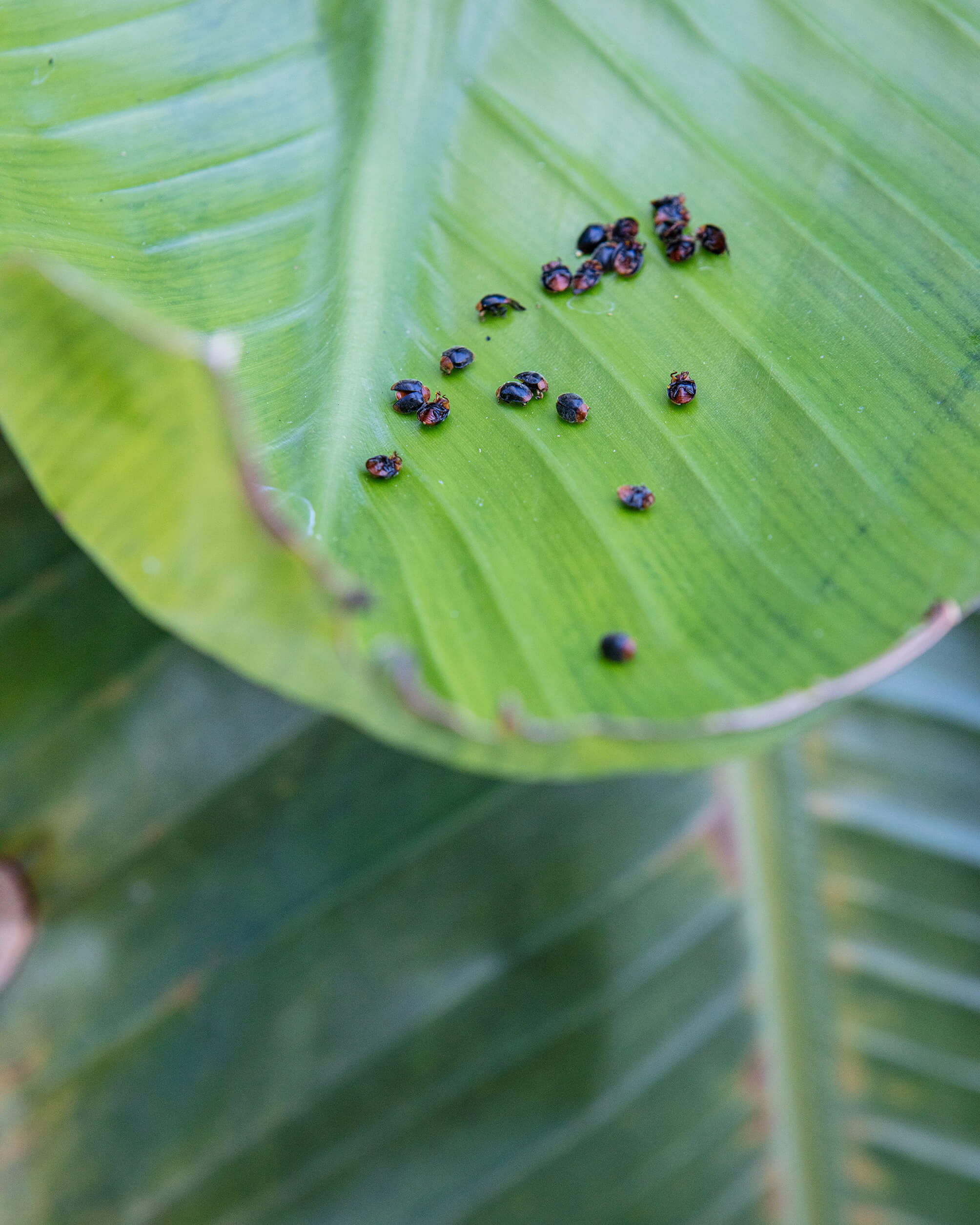
The Cryptolaemus montrouzieri is commonly known as the mealybug destroyer. This species of ladybird gets its nickname from its capacity to battle mealybugs in plantations and greenhouses.
The website waarnemingen.be that gathers observations of plants and animals in Belgium lists multiple observations in the wild of the Cryptolaemus montrouzieri. The website explains that ‘in (northern) Europe, the species is widely traded and used in greenhouses and will regularly escape from them. But this ladybird cannot survive our winters (yet?). Sightings within the Benelux must therefore be entered into the register as “escape”. However, the species is already established in the Mediterranean area.’ (our translation)
The larvae have a waxy covering that makes them look like the mealybugs they prey upon, allowing them to avoid being correctly identified by the ones they are about to devour.
In an attempt to get rid of the mealybugs on my plants, I ordered 25 adult ladybirds. They were dead on arrival.
https://waarnemingen.be/species/600135/
https://waarnemingen.be/observation/244840499/
https://en.wikipedia.org/wiki/Aggressive_mimicry
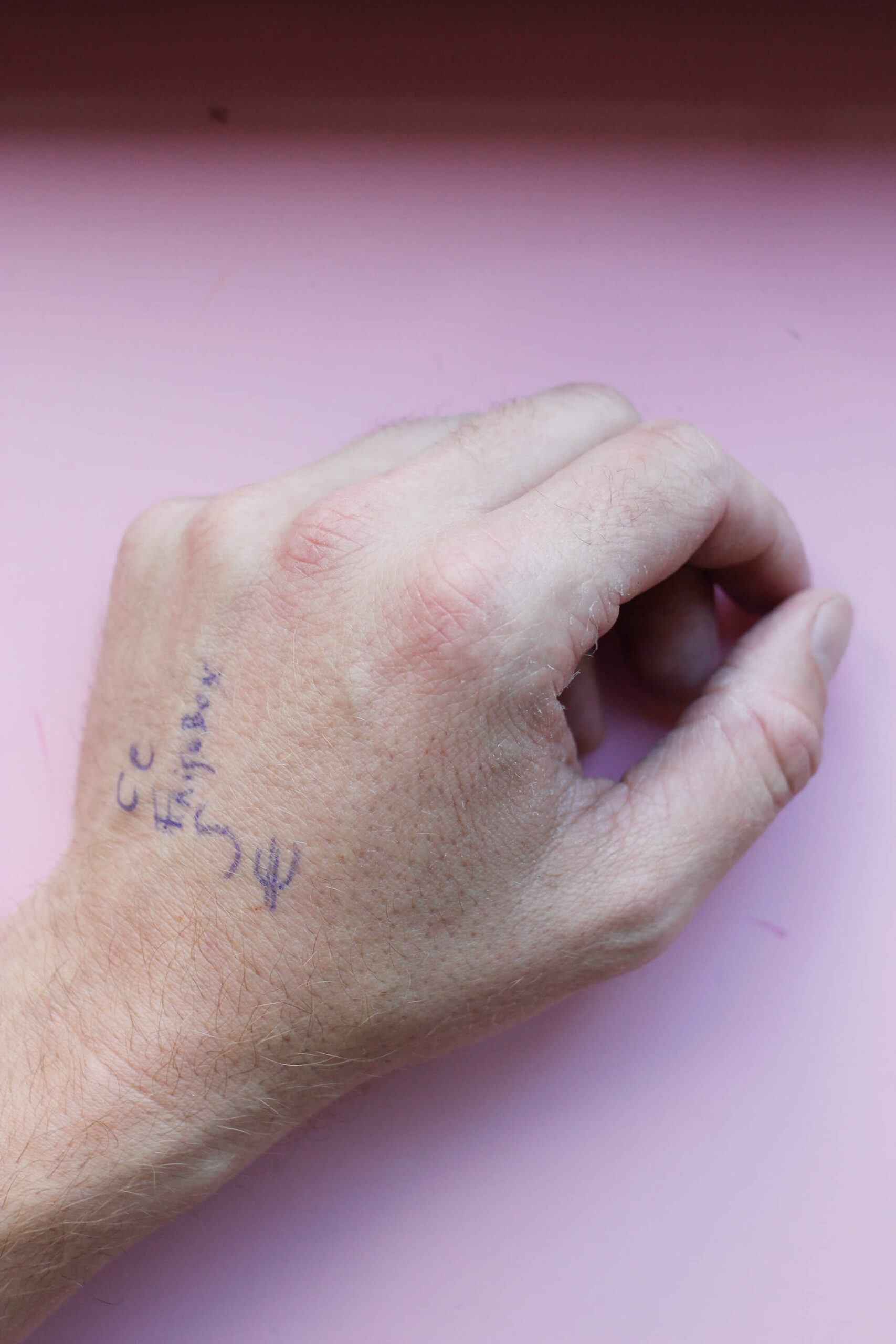
At the end of the day, riding home after work, I find a text on my hand:
C
D[…]ers
Desk
K
Communication book
‘Diapers’, I recall, and stop at the shop to buy them. Sweat, dust, and manic hand rubbing have rendered parts of the writing illegible. ‘C’ is for Carl, whose newborn I need to visit as soon as possible. Sometimes, I can’t remember what the initial stands for. I don’t have any friends with names beginning with a K (who have newborns I need to visit).
The right hand writes, the left hand serves as the canvas. The back of the right hand, folded around the pen, is blank and tells the always already written on back of the left hand, whose palm never holds a pen, what to register. Right: an author. Left: a poem, sunken into the pores.
Back home, I trace ‘Desk’ again, as not to forget to clean it tomorrow.

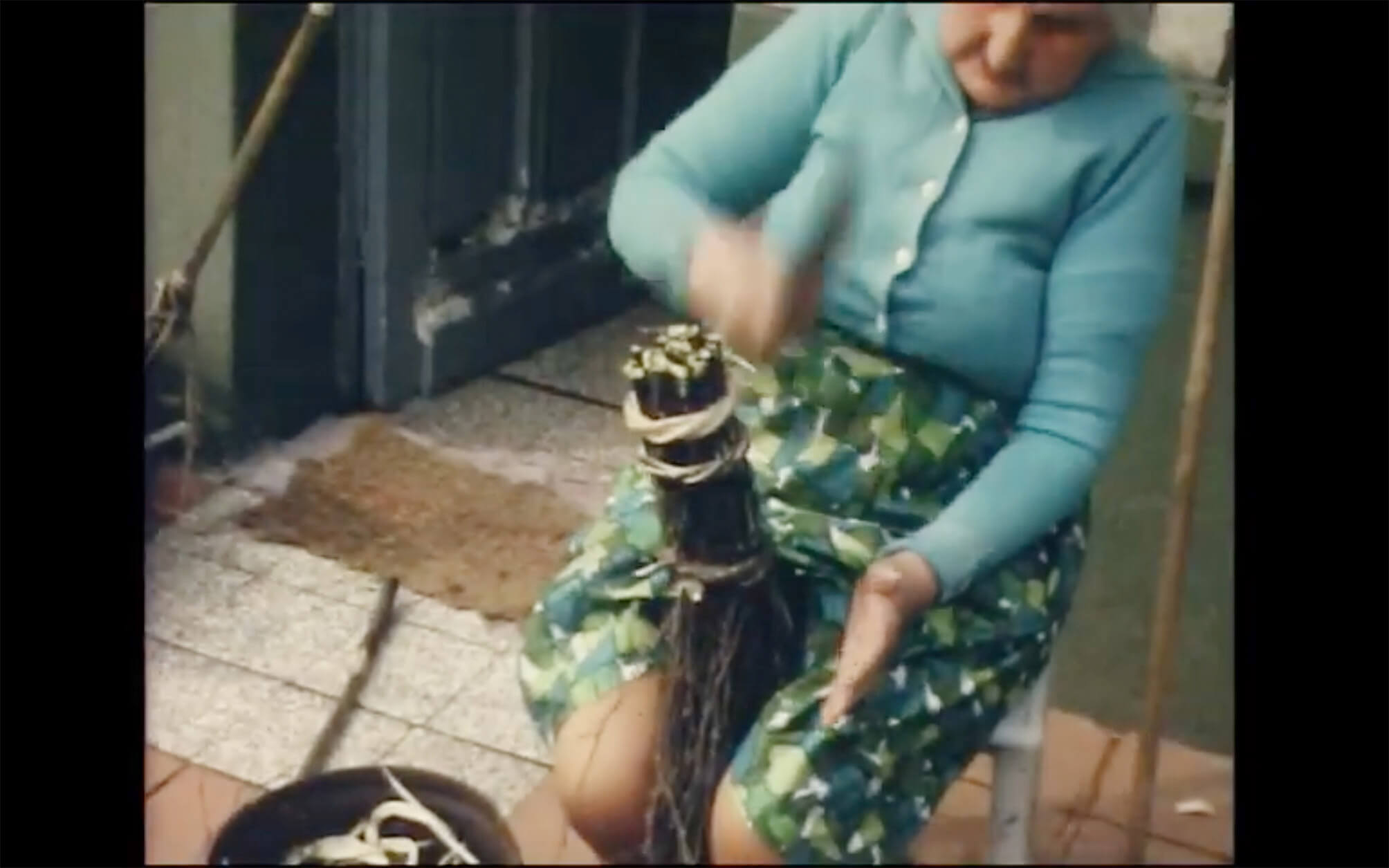
This video-still is taken from a documentary about ‘Le Coin du Balai – De Bezemhoek’, a Brussels neighborhood on the edge of the Sonian Wood. Historically, the inhabitants had the exclusive right to harvest young shoots of trees to make and sell brooms. In 1976, filmmaker Willy Biesemans captured the last broom-maker, still in possession of this vernacular knowledge.
Nowadays, the Sonian Wood is commonly understood as a place of natural beauty surrounding the city. The wood the forest produces is managed as a chain of production and sold in public auction to the best buyer. The bulk of the forest’s produce is exported abroad and eventually imported back as manufactured goods.
Clementine Vaultier’s interests, although trained as a ceramist, are in the warm surroundings of the fire rather than the production it engenders.
Biesemans, W. De Bezemhoek. 1976 (YouTube – De Bezemhoek)
It’s time to have a nap. I tilt the window over its middle axis to let the butterfly out. A breeze ruffles the drapes. Now, it sits on the glass and throws an enormous shadow on the yellow cloth.


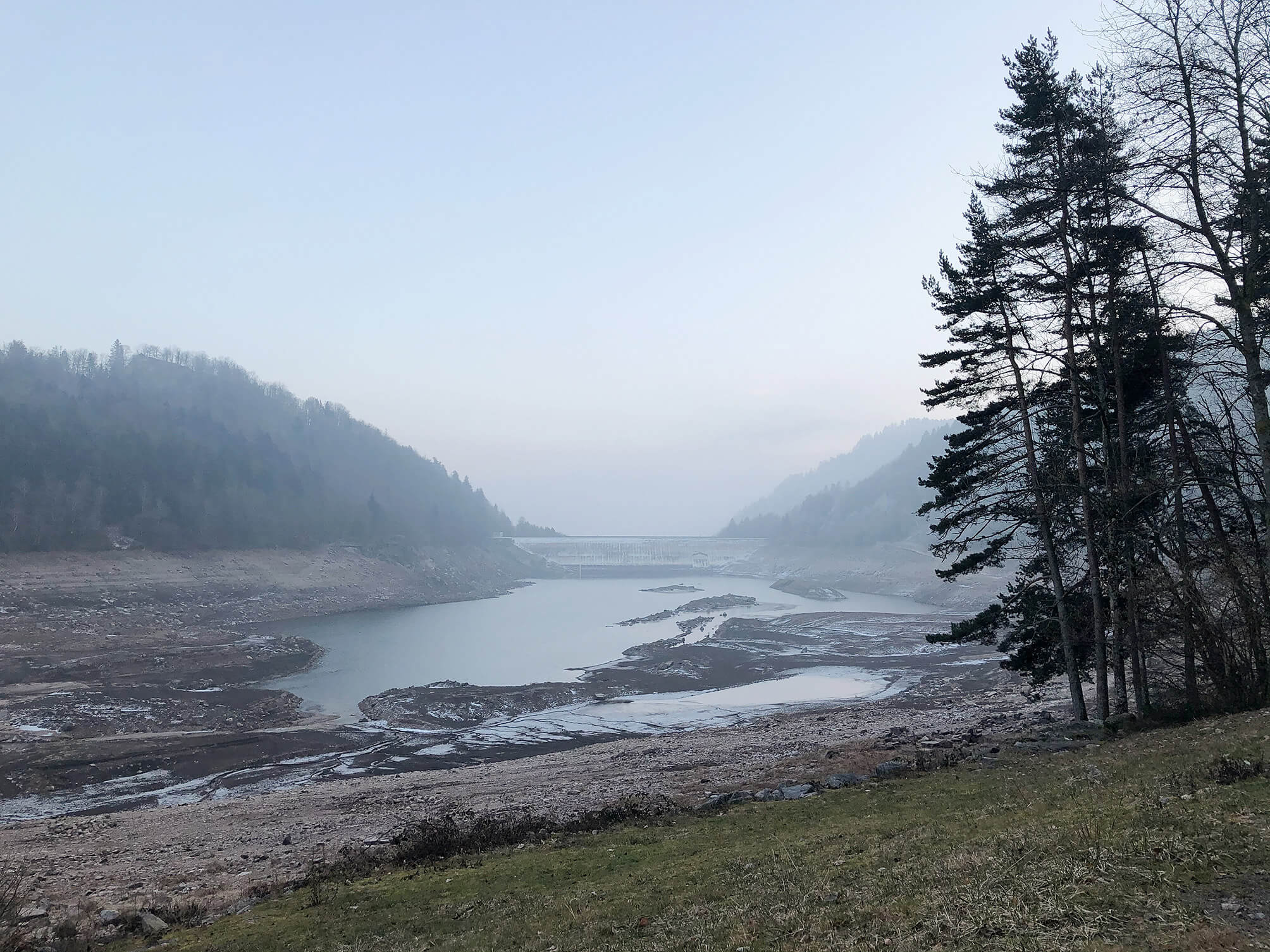
What they took for ice that slid down the dam’s slope, appears to be the reason for draining the reservoir: a fissure in the watertight layer. The dam became unreliable.
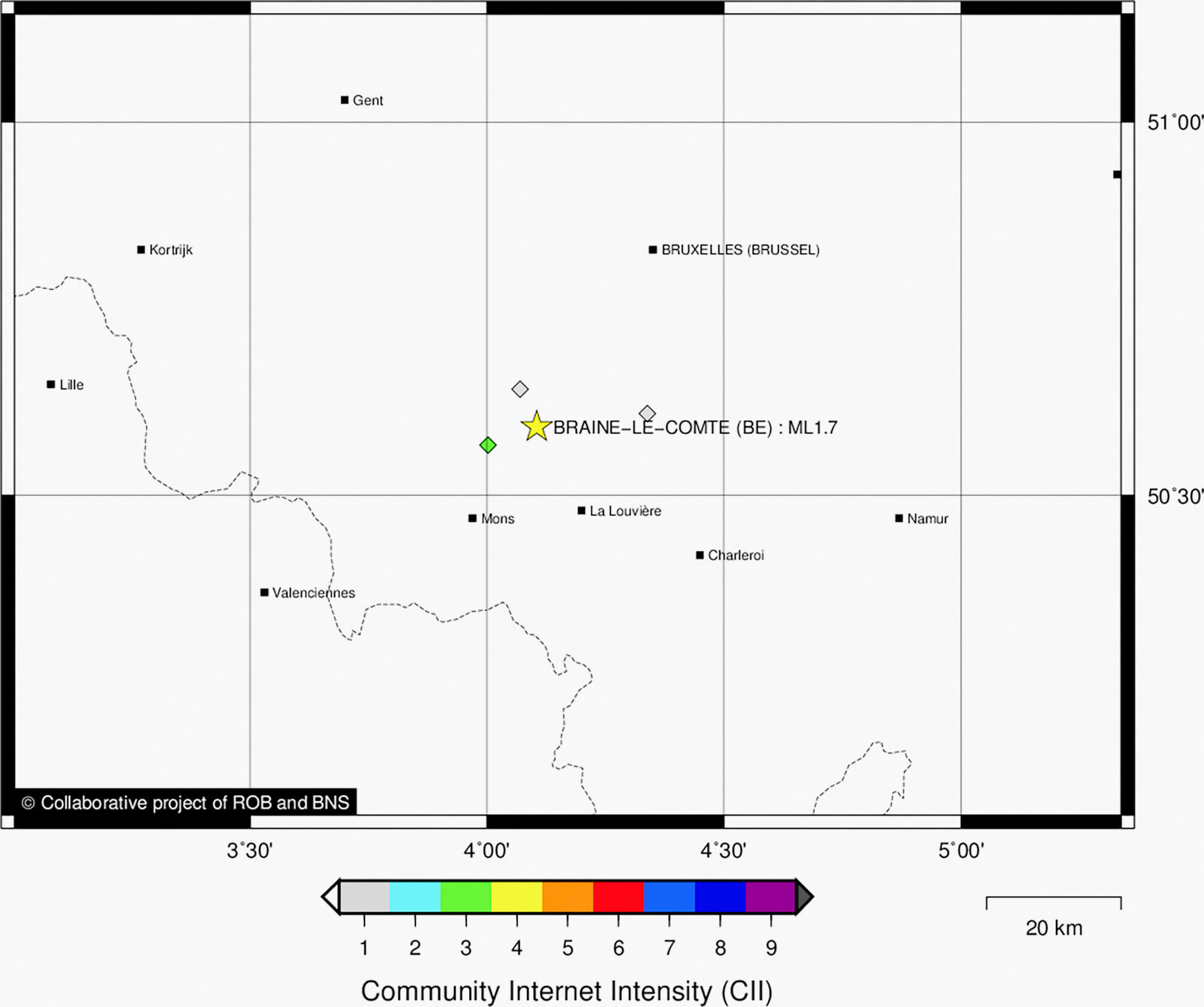
On May 6th 2020, 14h06 and 31 seconds, the Belgian Seismological Institute records an earthquake with a 1,7 magnitude in the region of Braine-Le-Compte. Three reactions from people in the neighbourhood, filed by the Institute, confirm the official seismological recordings. The Institute’s website classifies the earthquake as a ‘quarry blast’.
http://seismologie.be/nl/seismologie/aardbevingen-in-belgie/en130qj1o
United Until Tomorrow (1951) is based on the real-life events that took place at Shanghai’s Shenxin No. 9 Cotton Mill where workers led a factory-wide strike in 1948 to protest salary arrears against the background of escalating inflation. Shot at the original location of the strike, the film shows the entrance of the cotton mill transformed into a literal and ideological battlefield where workers gain class consciousness and fight to reclaim their rightful place as owners of the factory. In one climactic scene, the workers even seal the factory gate from the outside to prevent the products of their labour from being expropriated by Kuomintang forces.
Located at No. 128, Aomen Road, Shanghai, Shenxin No. 9 Cotton Mill belonged to the system of mills managed by Shenxin Textile Company, a private enterprise founded in 1915 by Wuxi-bred industrialist brothers Rong Zongjing and Rong Desheng. Following the Communist takeover of Shanghai, the cotton mill was nationalised in the 1950s and placed under the management of the Shanghai Textile Industry Bureau. With the subsequent launch of the economic reforms, the bureau was restructured into a holding company in 1998 amidst the deindustrialisation of the city. While many iconic buildings in the Shanghai Bund area today can be seen in the film, little remains of the original architecture of No. 9 Cotton Mill where the Shanghai Textile Museum is now located.
Ho Rui An is an artist and writer working in the intersections of contemporary art, cinema, performance and theory. Through lectures, essays and films, his research examines the relations between labour, technology and capital across different systems of governance in a global age.
In spring 2024 the-documents.org and Trigger co-publish a series of online articles with a focus on the meeting ground between photography and the document.

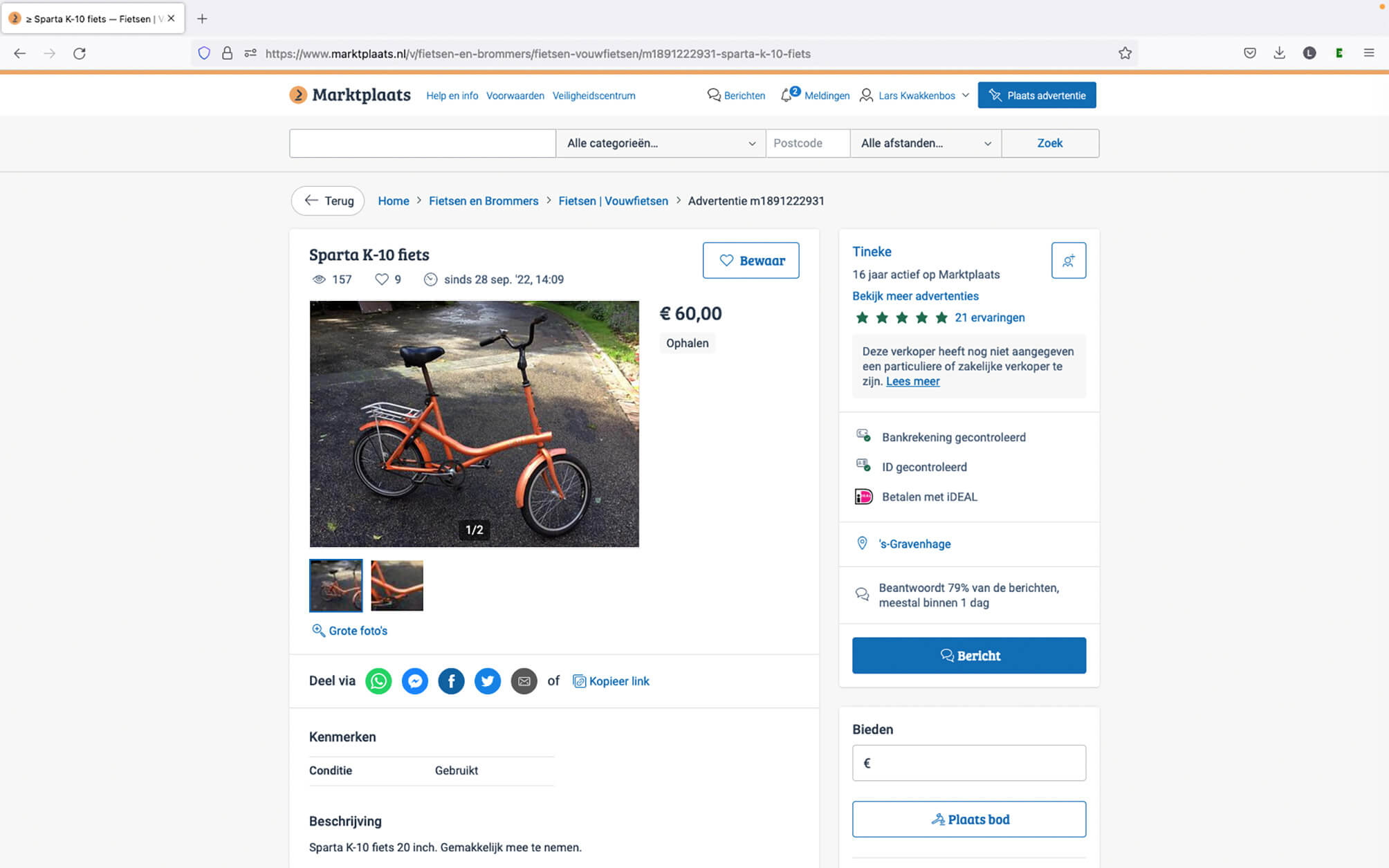
On 29 September 2022, I search the internet for the factory details of an original Sparta K-10. First I come across some second-hand K-10s. On marktplaats.nl, a Sparta K-10 is for sale for 60 euros, but anyone interested may also make an offer. The seller’s name is Tineke. She lives in The Hague and writes that the bike is ‘easy to take along’. The K-10 she is selling has no chain guard, but it does have a chrome luggage rack. This makes the bike more practical, but in my opinion also less attractive. Her bike also has a bell, but no elegant loop at the end of the long, curved tube around which the frame is built – most other K-10s do have such a loop – or has it disappeared behind the top tube of the luggage carrier? If Tineke is also the owner of the bike, she is much taller than the owner of the Brussels bike, as her saddle is a lot higher, and it is also more or less straight. Moreover, the handlebars are very high thanks to a different stem, which makes the model of the bike a bit unbalanced. I don’t know if I would have photographed the bike for sale in The Hague.
Lars Kwakkenbos lives and works in Brussels and Ghent (B). He teaches at KASK & Conservatorium in Ghent, where he is currently working on the research project ‘On Instructing Photography’ (2023-2024), together with Michiel and Arnout De Cleene.
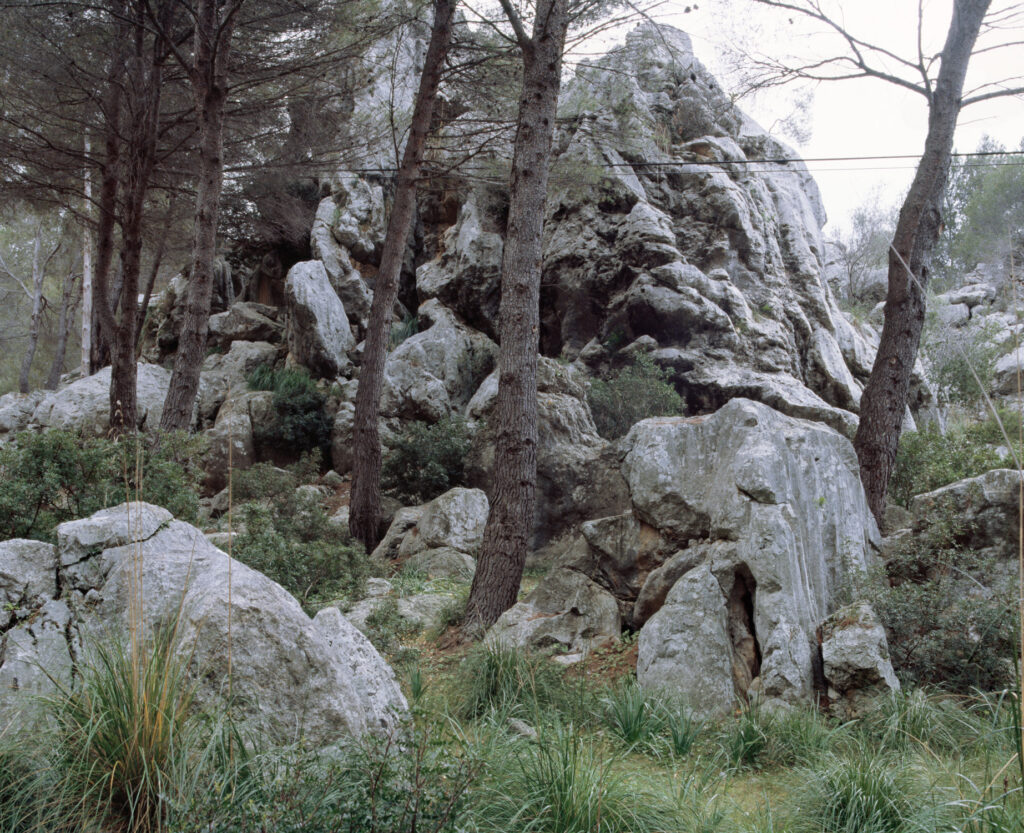
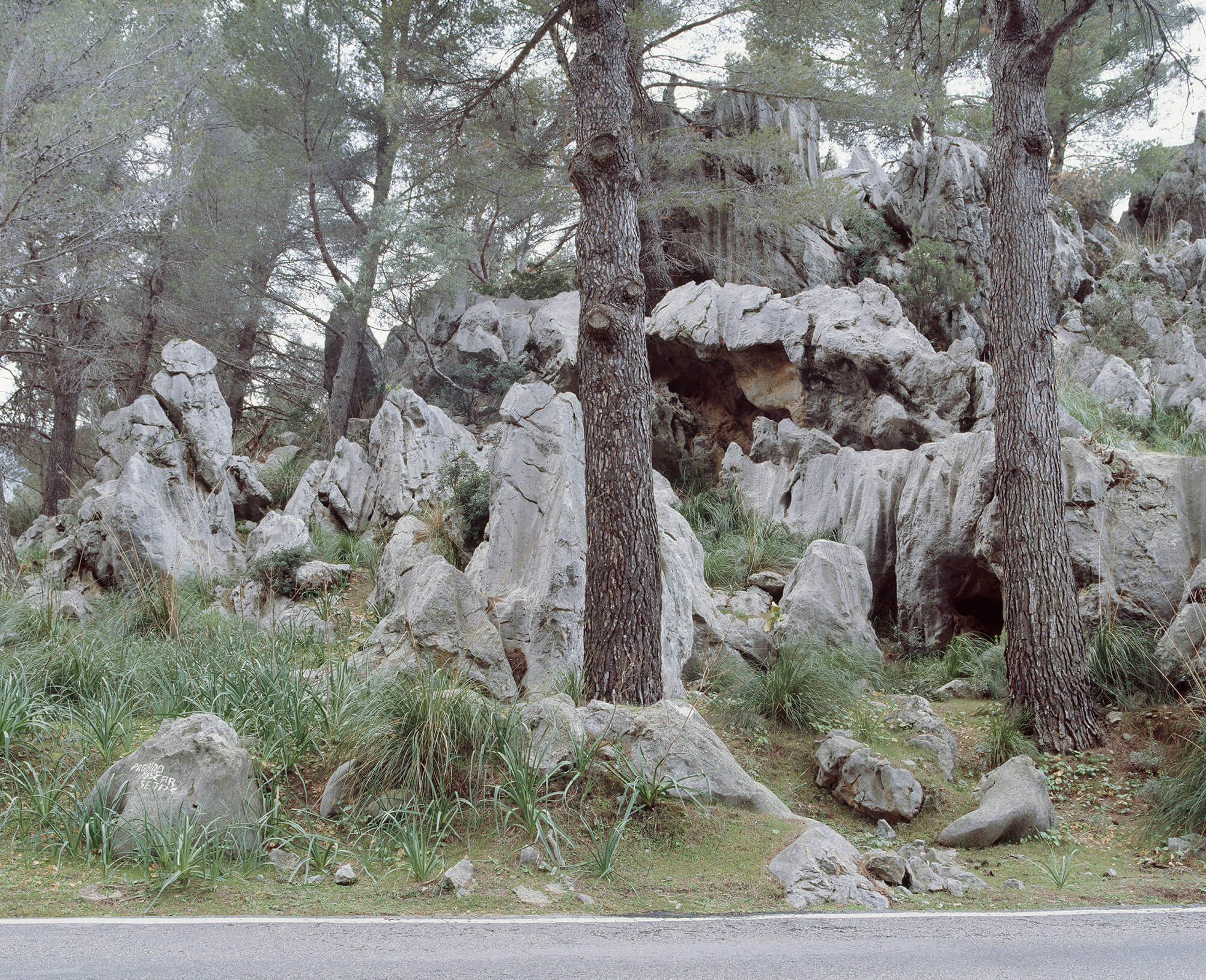
I must have driven past this rocky landscape about sixteen times, going back and forth between viewpoints and the house the parents of a friend let me stay in. On the last day, I left early for the airport, pulled into a lay-by, took my tripod and camera out of the trunk of the red Volkswagen Polo rental car and made two photographs.1 It was only when I got home, had the film developed, scanned it and was removing dust particles from the file, that I discovered the hand painted text on the rock: ‘PROIBIDO BUSCAR SETAS’.