What constitutes a ‘document’ and how does it function?
According to the Oxford English Dictionary, the etymological origin is the Latin ‘documentum’, meaning ‘lesson, proof, instance, specimen’. As a verb, it is ‘to prove or support (something) by documentary evidence’, and ‘to provide with documents’. The online version of the OED includes a draft addition, whereby a document (as a noun) is ‘a collection of data in digital form that is considered a single item and typically has a unique filename by which it can be stored, retrieved, or transmitted (as a file, a spreadsheet, or a graphic)’. The current use of the noun ‘document’ is defined as ‘something written, inscribed, etc., which furnishes evidence or information upon any subject, as a manuscript, title-deed, tomb-stone, coin, picture, etc.’ (emphasis added).
Both ‘something’ and that first ‘etc.’ leave ample room for discussion. A document doubts whether it functions as something unique, or as something reproducible. A passport is a document, but a flyer equally so. Moreover, there is a circular reasoning: to document is ‘to provide with documents’. Defining (the functioning of) a document most likely involves ideas of communication, information, evidence, inscriptions, and implies notions of objectivity and neutrality – but the document is neither reducible to one of them, nor is it equal to their sum. It is hard to pinpoint it, as it disperses into and is affected by other fields: it is intrinsically tied to the history of media and to important currents in literature, photography and art; it is linked to epistemic and power structures. However ubiquitous it is, as an often tangible thing in our environment, and as a concept, a document deranges.
the-documents.org continuously gathers documents and provides them with a short textual description, explanation,
or digression, written by multiple authors. In Paper Knowledge, Lisa Gitelman paraphrases ‘documentalist’ Suzanne Briet, stating that ‘an antelope running wild would not be a document, but an antelope taken into a zoo would be one, presumably because it would then be framed – or reframed – as an example, specimen, or instance’. The gathered files are all documents – if they weren’t before publication, they now are. That is what the-documents.org, irreversibly, does. It is a zoo turning an antelope into an ‘antelope’.
As you made your way through the collection,
the-documents.org tracked the entries you viewed.
It documented your path through the website.
As such, the time spent on the-documents.org turned
into this – a new document.
This document was compiled by ____ on 10.07.2026 08:24, printed on ____ and contains 17 documents on _ pages.
(https://the-documents.org/log/10-07-2026-6833/)
the-documents.org is a project created and edited by De Cleene De Cleene; design & development by atelier Haegeman Temmerman.
the-documents.org has been online since 23.05.2021.
- De Cleene De Cleene is Michiel De Cleene and Arnout De Cleene. Together they form a research group that focusses on novel ways of approaching the everyday, by artistic means and from a cultural and critical perspective.
www.decleenedecleene.be / info@decleenedecleene.be - This project was made possible with the support of the Flemish Government and KASK & Conservatorium, the school of arts of HOGENT and Howest. It is part of the research project Documenting Objects, financed by the HOGENT Arts Research Fund.
- Briet, S. Qu’est-ce que la documentation? Paris: Edit, 1951.
- Gitelman, L. Paper Knowledge. Toward a Media History of Documents.
Durham/ London: Duke University Press, 2014. - Oxford English Dictionary Online. Accessed on 13.05.2021.

In Zaffelare, young men who were called for military service but could not be missed at home were advised by the local doctor to swallow a small ball of aluminium foil an hour before the examination. In the X-ray, a gastric ulcer appeared. They were rejected for service. It is uncertain whether the increased incidence of gastric ulcers among young men in Zaffelare was a cause for concern.

The last couple of days have been dry. Rain is expected for the weekend. The office buckets are in place and are empty, except for some residue. Dirt, sand, a few hairs. Some particles must have come along with the drops when they made their way through the roof.

On May 7th, 1992, an anonymous photographer records the ice cellar, a stone’s throw from my parents’ house. It’s a beautiful day in spring. Quite a bit of wind, it seems. A Thursday. Surely, I am at school. Third grade kindergarten. It houses bats.
The photograph is part of an online heritage inventory, maintained by a government department. On the same day, the photographer took a photograph of the orangery, the entrance gate to the allotment, and the castle.
https://id.erfgoed.net/afbeeldingen/264680

A constant, dependable presence. With the camera focused on the North Star for an extended period, the rotation of the Earth becomes visible. Nearby, in the municipality of Wiederstedt, the geologist, poet and philosopher Friedrich von Hardenberg (better known by his pen name Novalis) spent his childhood years between 1772 and 1784. A quote of his is engraved on a stone bench in the park surrounding the chateau where he was raised: “The human being does not speak alone – the universe also speaks – everything speaks – infinite languages.”
From S. Anders Leben. Eine Handlung in Gesprächen/S. Anders Leben – Living Differently: An Act in Conversations
Stephanie Kiwitt (1972) is an artist based in Halle (Saale), Germany. Utilizing a large number of images, various perspectives and also textual elements, she is known for her insightful photography that explores spaces emblematic of contemporary phenomena. Over the past three years, she has focused on evolving habitats in rural areas, photographing traces of transformation and conducting interviews in Saxony-Anhalt, the region she moved to in 2020. From 2018 to 2020, Kiwitt was a guest lecturer at the LUCA School of Arts in Brussels.
In spring 2024 the-documents.org and Trigger co-publish a series of online articles with a focus on the meeting ground between photography and the document.

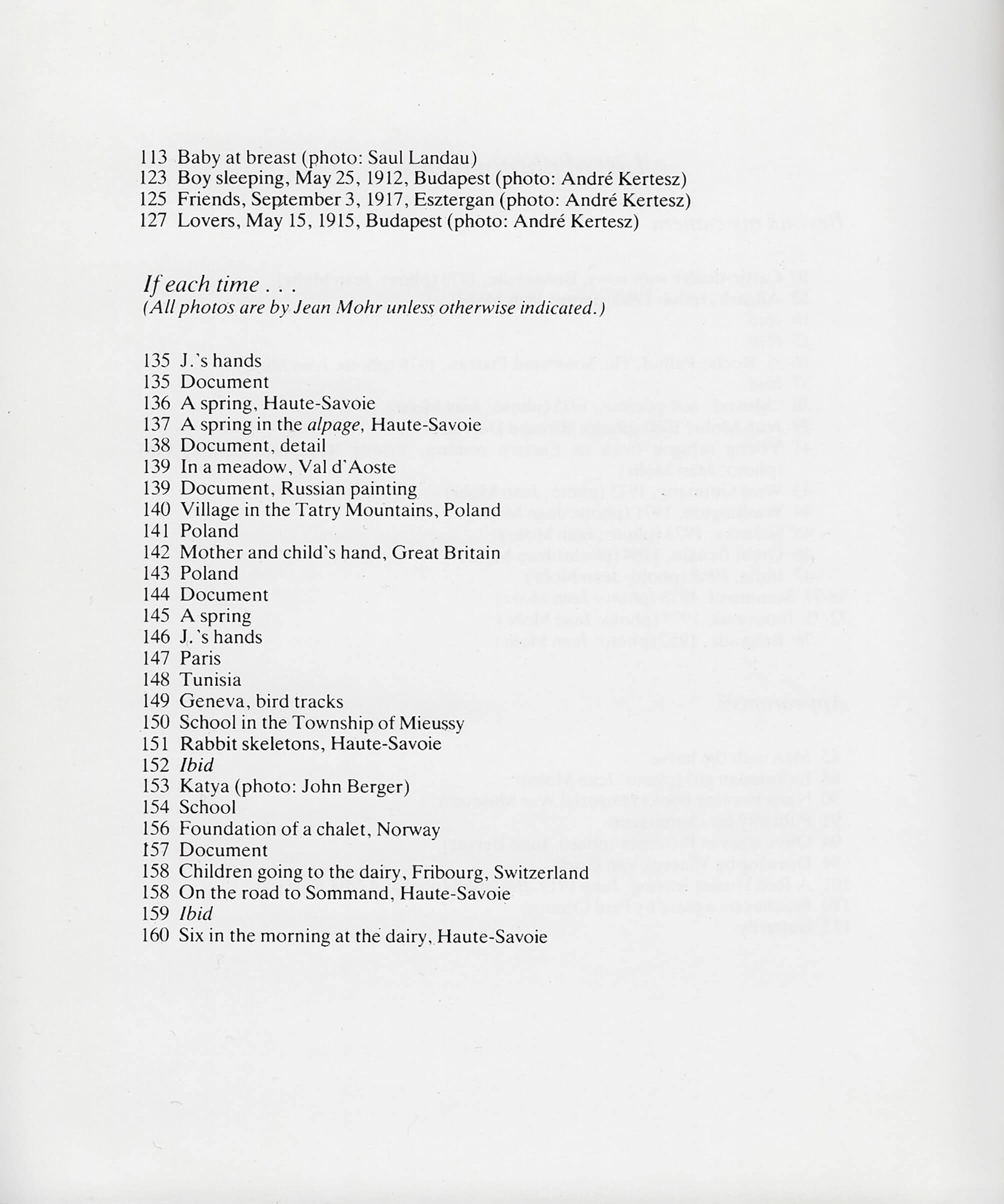
In John Berger and Jean Mohr’s groundbreaking book Another Way of Telling, the index at the end gives information on the images printed throughout the book. Most of them are Jean Mohr’s. In the section ‘If each time…’ – a wordless sequence of images which aims to develop an alternative way of telling a story – some images are referenced as ‘documents’. The information is sparse. On page 138, the index states, there is a ‘Document, detail’. It features a closeup of a knitted piece of fabric. It appears to be the same picture as seen on the first page of the section (p. 135), where it is printed beneath another image – a photo by Mohr of hands knitting. On this occasion, the image is indexed as ‘Document’.
Berger, J. & J. Mohr. Another Way of Telling. London / New York: Writers and Readers, 1982.
At a dental practice, the white Alligat®-powder is mixed with the right amount of water to get a mouldable dough that is pressed upon a patient’s teeth. After thirty seconds, the Alligat®-dough stiffens and takes on a rubber-like quality. At that point, still white, it must be removed from the patient’s mouth. Over the next few hours, the mould turns increasingly pink as the substance becomes less humid. Now, it can be used as a mould to create a positive master cast of the patient’s teeth.
Outside the dental practice, the powder’s possibilities remain to be fully explored.

First published as part of De Cleene De Cleene. ‘Amidst the Fire, I Was Not Burnt’, Trigger (Special issue: Uncertainty), 2. FOMU/Fw:Books, 25-30

In the world of National Geographic, white people overlooking a landscape are not uncommon. “The Red Shirt School of Photography” was a label used to describe National Geographic photographers who allegedly brought red clothing and props with them on assignment to put on their subjects in order to make better photographs when working with Kodachrome film, which is famous for its capability of rendering rich colors. Overlooking a landscape wearing red, the observer asserts dominance over the land. They glorify it, seeing a country that is beautiful, rich in resources, and therefore “worth taking”.
Max Pinckers (°1988, BE) and Victoria Gonzalez-Figueras (°1988, CA) are based in Brussels, Belgium. They have been working together for the past ten years on documentary photography projects. Victoria works in the cultural field as a researcher and producer. Max is a speculative documentarian, teacher and occasional writer on photography. They are married, in love, and have a son. Victoria has consistently assisted Max in his projects as a production manager, but they have recently been making new work together as co-authors. “Double Reward” is the first such project.
In spring 2024 the-documents.org and Trigger co-publish a series of online articles with a focus on the meeting ground between photography and the document.

Depending on the language one chooses, the Wikipedia entry for ‘document’ shows a different picture. The French-language page shows what appears to be a Slovenian thesis written in 1984. The caption states it is a ‘book of Czechoslovak computer science author Květoslav Šoustal about computer networks’. The image was uploaded by Kelovy, a Slovakian mushroom-picker.
The anonymous hand rests on a lemon-yellow tablecloth, on which a yellow book and a blue binded file lie. The top left corner is the most intriguing, however: the tablecloth seems to be draped over a lemon, alongside a drinking glass. The cloth, however, does not get shaped by the lemon. Nor does the shadow-side of the lemon coincide with the shadow the other documents throw on the tablecloth. A closer look seems to indicate that the lemon is in fact an image of a lemon, printed on a plastic napkin.
The Russian wikipedia shows the image of a lease agreement. The German wikipedia for ‘document’ is text only.
https://fr.wikipedia.org/wiki/Document#/media/Fichier:KVETOSLAV_SOUSTAL_BOOK.JPG, created October 3, 2006 / original in original: paper, 1984

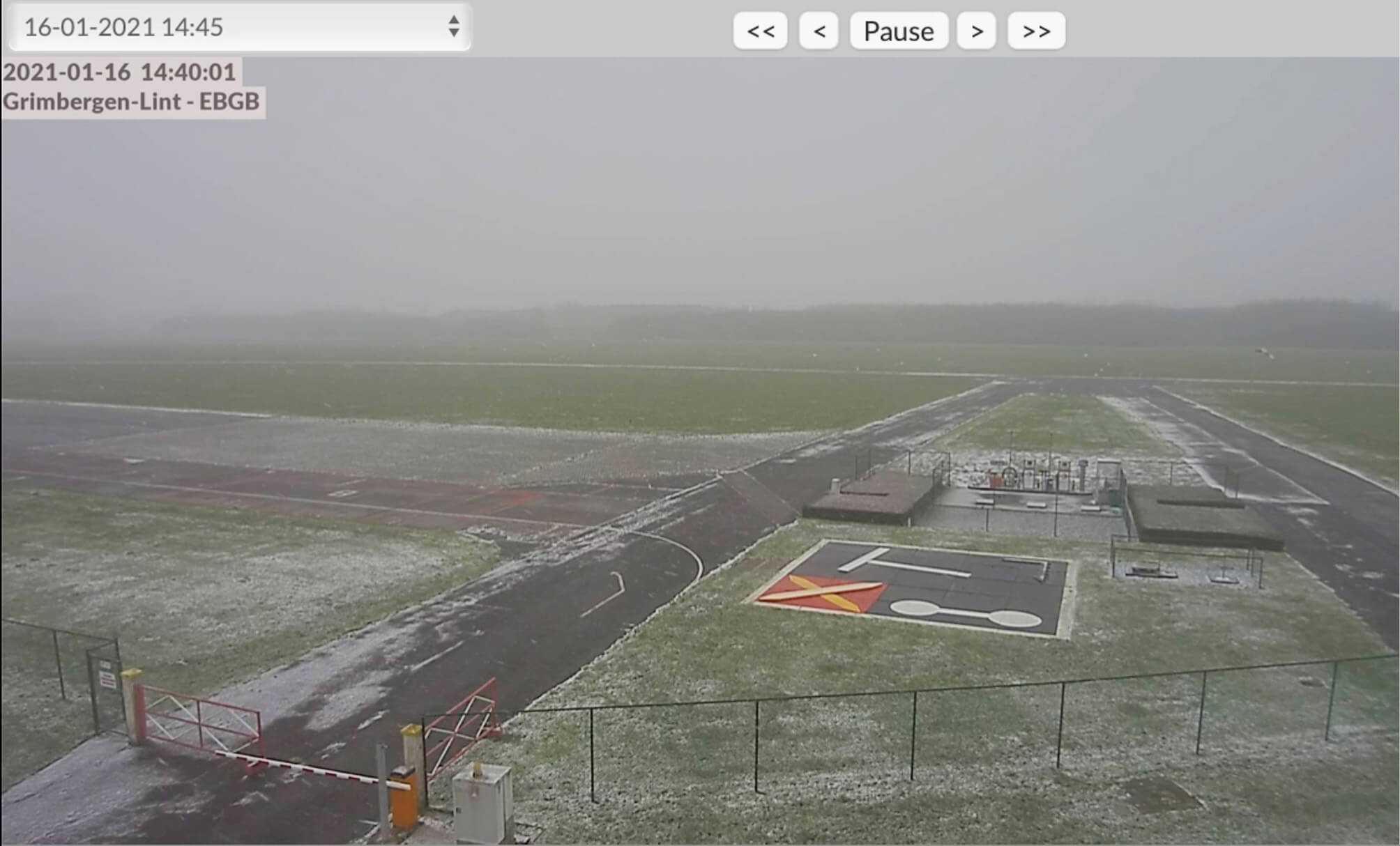
Recreational airfield at Grimbergen, webcam footage.
09:10:00The frame shows the first movement on the terrain. The gate has been opened, the barrier lowered. A black car is in the back. In the forefront, aviation signs on the ground: a yellow cross on a surface painted red; an arrow in a 90° angular shape; two circles connected by a line; a T-shaped line.
09:20:00Two men talking, each one on one side of the barrier. The man on the side of the airstrip has two dogs with him. The aviation signs have changed: the arrow is gone; the horizontal bar of the T-symbol has moved to the other side of the vertical line; one yellow line that made up the cross on the red surface is gone, leaving one yellow diagonal line.
10:09:01A small white aircraft (the two men and the dogs are gone).
10:20:01The aircraft in the same position, with what seems to be an open roof.
10:40:00Aircraft leaving the gas station where it was before.
11:10:01A white car at the gas station, where previously the aircraft was stationed; a silhouette of a man, perhaps.
11:30:01White car gone.
11:50:01Small white aircraft at the gas station; man in red jacket next to the aircraft. Not clear if it is the same aircraft seen in frame 10:09:01.
12:10:01Aircraft appears to be heading for take-off.
12:20:01Aircraft gone.
12:40:01White dots on the grass that appear to be birds.
14:10:00First precipitation: snow, visibility lessens.
14:20:00More snow, wind is stronger; someone has replaced the yellow stripe so that, again, a yellow cross is formed on the red background.
15:10:00The grass and the concrete get increasingly white. No aircrafts, vehicles or persons can be discerned. The aviation signs beneath the thin-layered snow are still visible, and unaltered.
Every so often architects ask me to photograph projects of theirs under a blanket of snow. Snow-days are rare around here. In an attempt to avoid a futile drive along roads in winter conditions, I check webcams near the project-to-be-photographed before setting out.
Webcam Grimbergen, meteobelgie.be: https://www.meteobelgie.be/waarnemingen/belgie/webcam/272/grimbergen
http://www.rvg.be
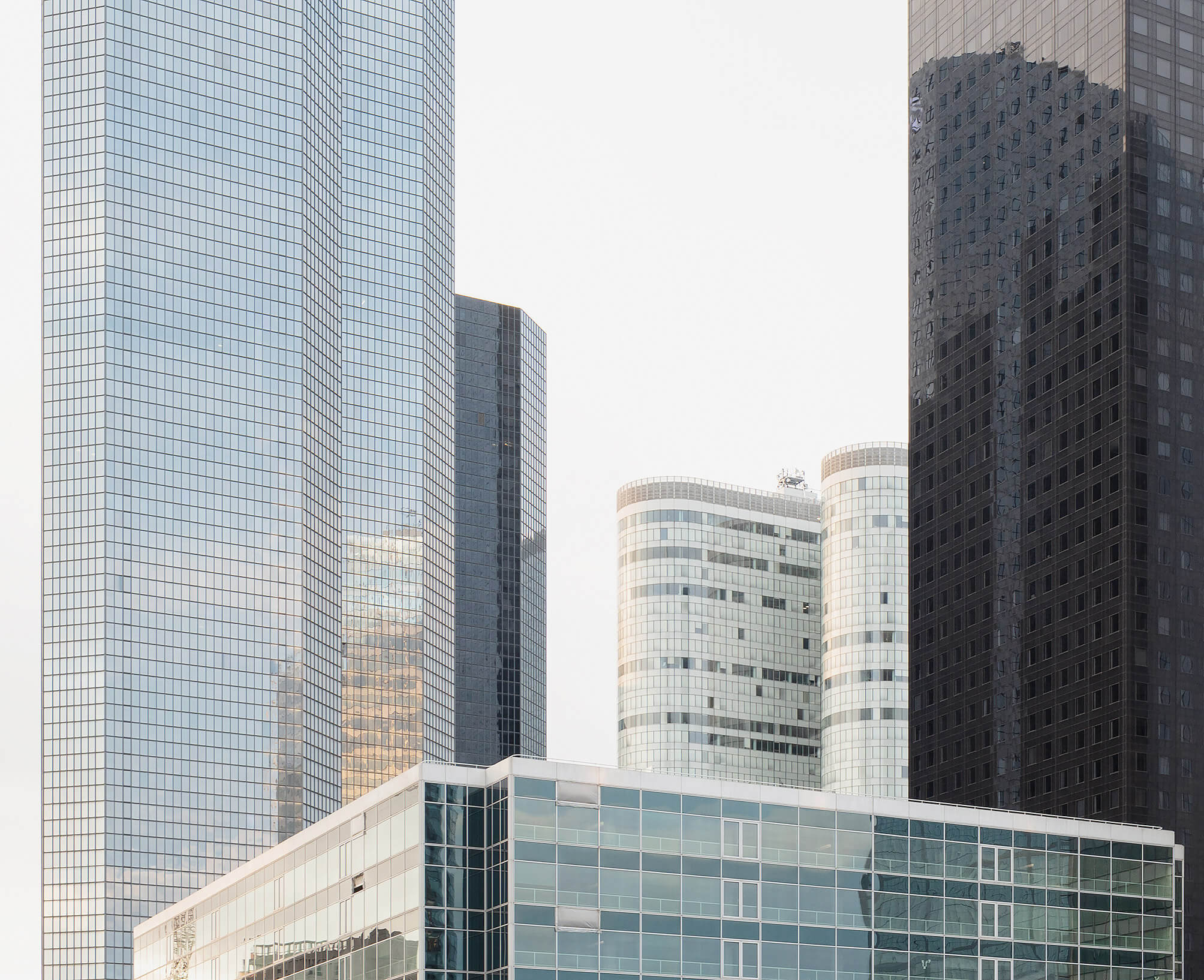
A year ago, mid-August, just before sunrise, the mostly unlit office buildings line the road that leads to the underground parking. I turn off the ignition. I’m in F36. The walls are painted pink. Looking for the exit, I take the escalator and get stuck in an empty shopping mall. The music is playing but all the shops are closed off with steel shutters. So are the exits. I’m out of place. In keeping early customers out, the mall is keeping haphazard visitors in. I’m back in the parking lot. The elevator is broken. I take the stairs and walk by a homeless man, sleeping. There’s shit on the floor. I open the door that leads out of the stairwell. It slams shut behind me. There’s no doorknob. I find myself on a dark floor between mall and parking lot. People are sleeping; some are awake. Heads turn toward me. I start walking slightly uphill towards where I think I might find an exit, or an entrance. The scale of the architecture has shifted from car (F36) and customer (the closed mall) to truck. I find myself amidst the supply-chain. It takes five minutes, maybe fifteen, maybe more to get out and see the office buildings towering over me in the first light of day.
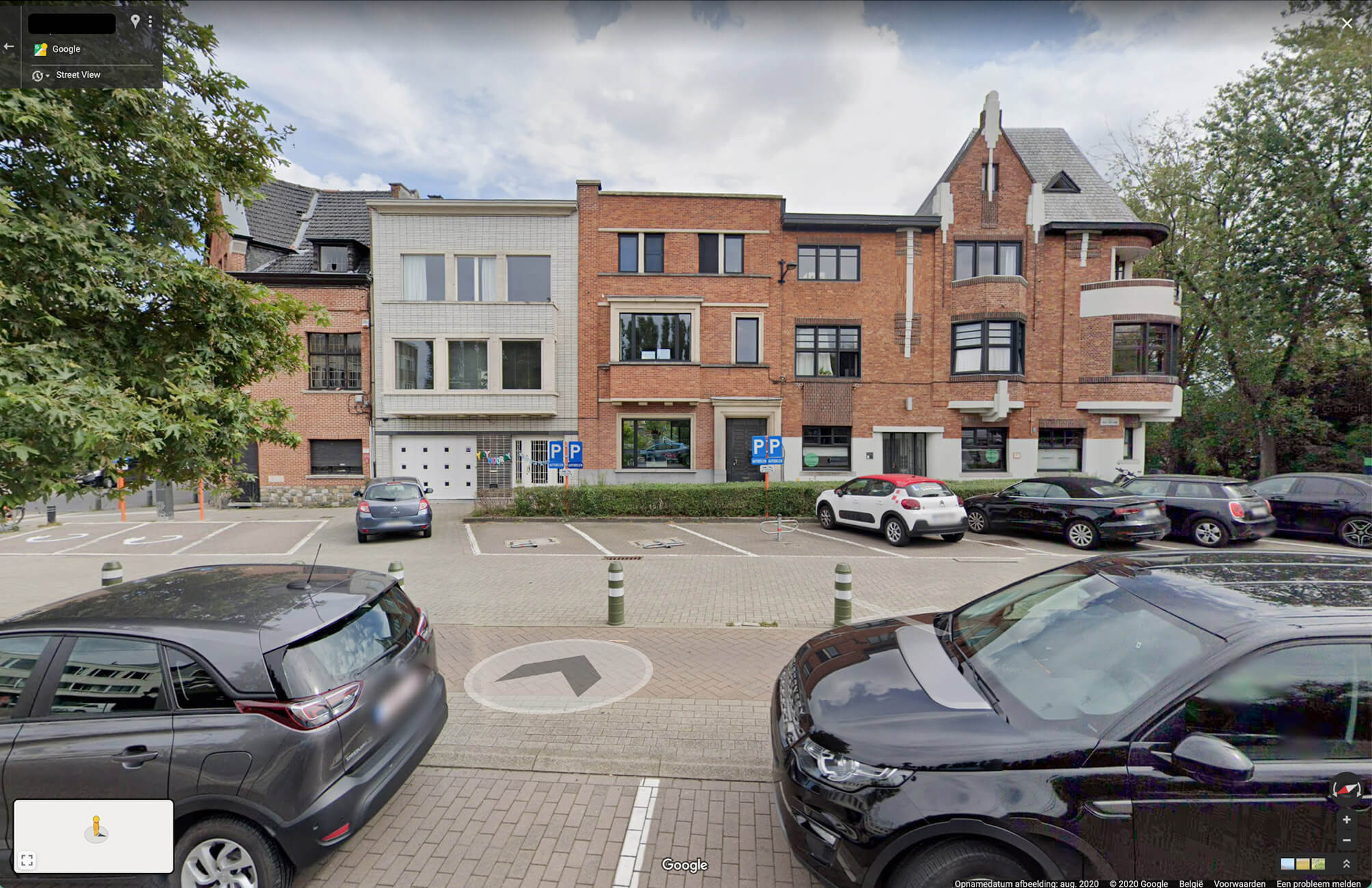
Depending on the perspective one chooses to look at the address, the house is adorned or not. The perspective from the main road is an image made in August 2020, the website (Google Maps) says. Our car is in front of the garage. It must be the end of August. We drive home from the hospital with the newborn, who doesn’t stop crying. Maybe I tightened the belts in the car seat too much. Arriving at our house, we see the slogans and decorations friends have hung at our front door. On the sill of the neighbour’s first floor window, there’s a brick that must have fallen from the second floor facade.
It’s early spring. The pool is covered with a sheet of plastic. The deciduous trees are just leafing out. A tree stump serves as a placeholder for the diving board’s foot – it was customary to take it indoors for winter – and keeps people from kicking its threaded rods sticking up from the silex tiles that line the pool.
The upper right corner of the plastic frame is missing. It’s probably where the insect – now dead, dry and yellowish – got in. The frame was left behind in the laundry room overlooking the garden, the pool and the pool house. At the time it hadn’t been used for quite a while. Half empty, the water green.
In summer, when the wind dropped, horse-flies came. You could shake them off temporarily by swimming a few meters underwater.

Bricks and stones of various origin (aerated concrete blocks, clinker bricks, quarry stones).
From Fortlaufend/Ongoing
Stephanie Kiwitt (1972) is an artist based in Halle (Saale), Germany. Utilizing a large number of images, various perspectives and also textual elements, she is known for her insightful photography that explores spaces emblematic of contemporary phenomena. Over the past three years, she has focused on evolving habitats in rural areas, photographing traces of transformation and conducting interviews in Saxony-Anhalt, the region she moved to in 2020. From 2018 to 2020, Kiwitt was a guest lecturer at the LUCA School of Arts in Brussels.
In spring 2024 the-documents.org and Trigger co-publish a series of online articles with a focus on the meeting ground between photography and the document.

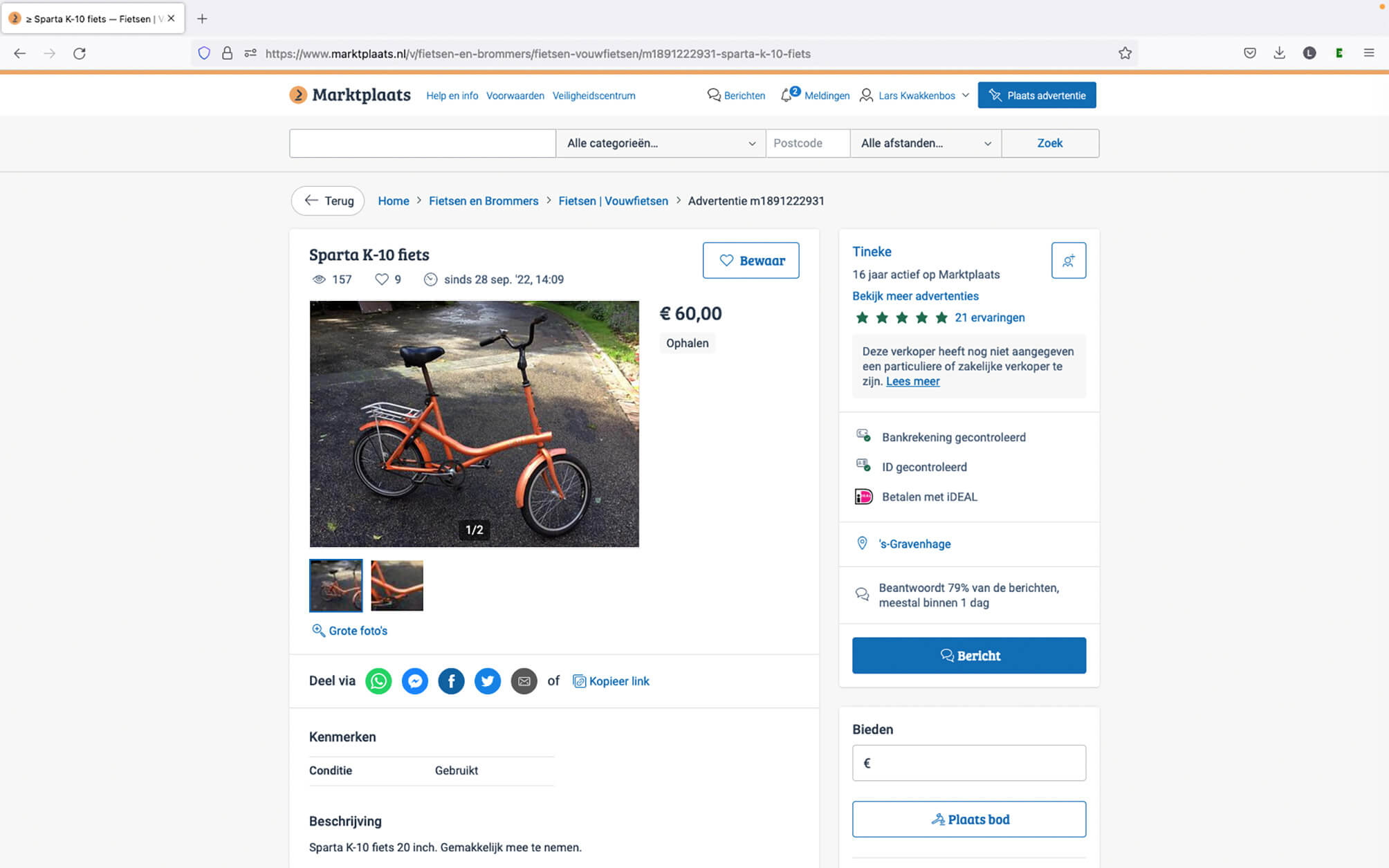
On 29 September 2022, I search the internet for the factory details of an original Sparta K-10. First I come across some second-hand K-10s. On marktplaats.nl, a Sparta K-10 is for sale for 60 euros, but anyone interested may also make an offer. The seller’s name is Tineke. She lives in The Hague and writes that the bike is ‘easy to take along’. The K-10 she is selling has no chain guard, but it does have a chrome luggage rack. This makes the bike more practical, but in my opinion also less attractive. Her bike also has a bell, but no elegant loop at the end of the long, curved tube around which the frame is built – most other K-10s do have such a loop – or has it disappeared behind the top tube of the luggage carrier? If Tineke is also the owner of the bike, she is much taller than the owner of the Brussels bike, as her saddle is a lot higher, and it is also more or less straight. Moreover, the handlebars are very high thanks to a different stem, which makes the model of the bike a bit unbalanced. I don’t know if I would have photographed the bike for sale in The Hague.
Lars Kwakkenbos lives and works in Brussels and Ghent (B). He teaches at KASK & Conservatorium in Ghent, where he is currently working on the research project ‘On Instructing Photography’ (2023-2024), together with Michiel and Arnout De Cleene.
The end of 2015. For hours, precipitation of all sorts had impeded a view of the Asian side of the city. Ships went out of sight before they reached the horizon. I can’t recall where exactly we were standing, or what we were visiting. I imagined it to be a place full of history. The Bosporus seemed agitated.
The Greek historian Herodotus wrote about Persian King Xerxes’ torn after a storm demolished the bridge he was building across the Dardanelles, at the other side of the Sea of Marmara: ‘When Xerxes heard of this, he was very angry and commanded that the Hellespont be whipped with three hundred lashes, and a pair of fetters be thrown into the sea. I have even heard that he sent branders with them to brand the Hellespont. He commanded them while they whipped to utter words outlandish and presumptuous, “Bitter water, our master thus punishes you, because you did him wrong though he had done you none. Xerxes the king will pass over you, whether you want it or not; in accordance with justice no one offers you sacrifice, for you are a turbid and briny river.”’1
Two days later, heavy snow delayed our flight back home. For hours, we were stuck inside the cabin, watching the tarmac. Passengers wanting to get out scorned the stewards. Trucks sprayed a fluid on our plane’s wings. We arrived at the family gathering just before midnight. Underneath the unlit fireworks hanging from the chandeliers, dessert was being served.
Herodotus. The Histories (A. D. Godley, trans.). Cambridge: Harvard University Press, 1920, book 7, chapter 35. Online: https://www.perseus.tufts.edu/hopper/text?doc=Perseus%3Atext%3A1999.01.0126%3Abook%3D7%3Achapter%3D35

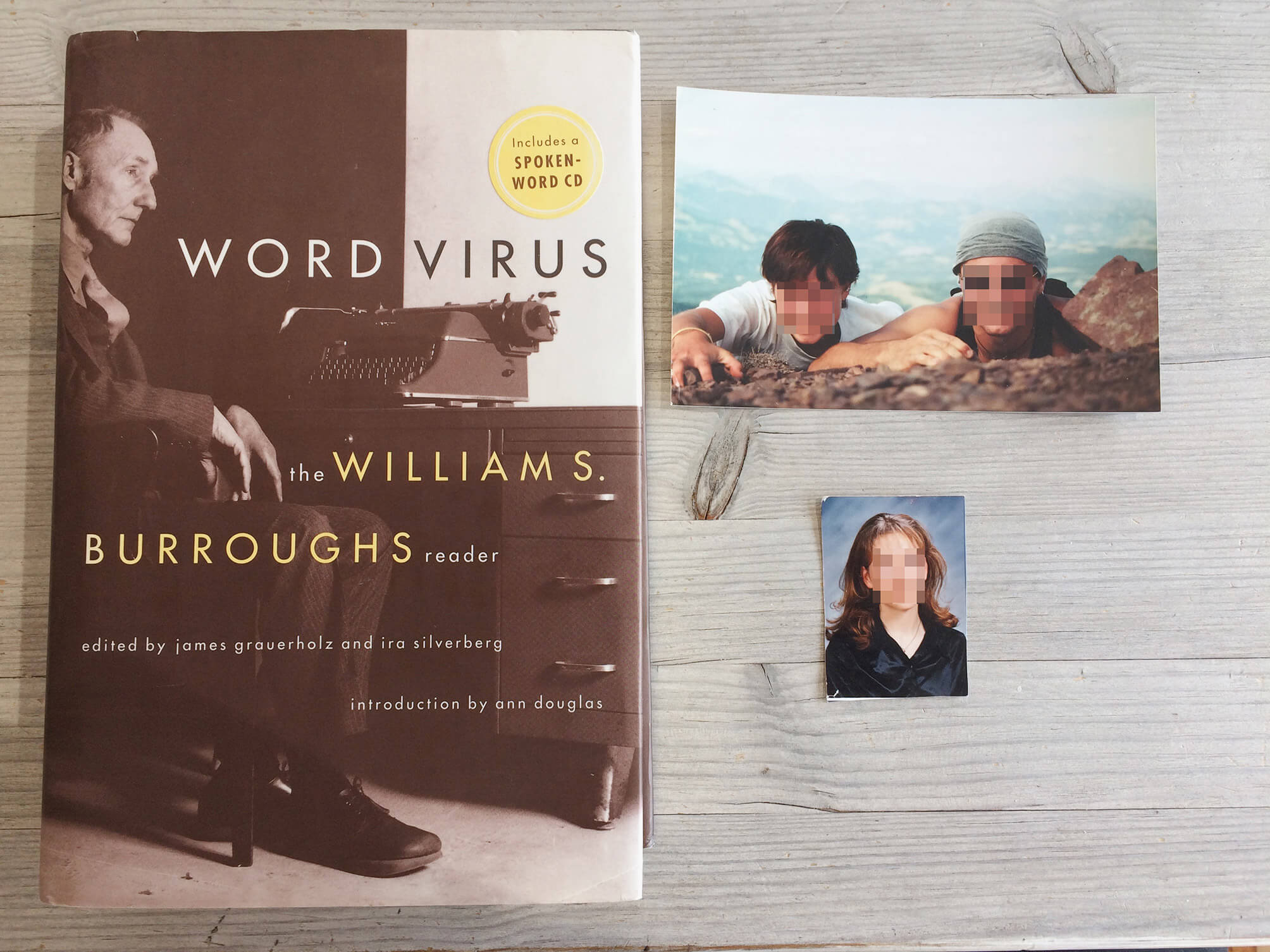
The two photographs arrived in Belgium inside a used hardback1 in spring 2016, though it is unclear how long before that time they were actually taken.2
Photograph #1 measures 151 x 100 mm and shows two young people who appear to be mountain climbing and captured while clearing a ridge. Behind the two subjects a bluish mountainous landscape is vaguely visible, suggesting a vantage point of some considerable elevation. The person on the left is wearing a white T-shirt and a bracelet, and has several earrings. The person on the right is carrying a backpack. What appears to be a black tank-top may in fact also be the straps of the pack. On their head they wear what appears to be a grey T-shirt or other garment, presumably to protect the subject from the sun; this person also has earrings and is wearing a necklace and sunglasses. The weather appears nice, both subjects are smiling and appear relaxed. The effort may well have been staged.
Photograph #2 measures (approximately) 43 x 62 mm with the left, bottom and right sides appearing to be cut, rather unevenly, with scissors. It has the typical appearance of an American high school yearbook photo and shows a young person wearing a shiny black blouse and a necklace. They have blue eyes and below-shoulder length auburn hair. The red lips appear painted. On the back of this photograph is written in a clearly legible hand:
Clay, I can’t
wait until next
year when we’re
in grade 12!3
Have a great
Summer and
call me [XXX XXXX]4
by the way, I haven’t
forgot about how big UR
The only assumptions to be made somewhat safely from these two items are that (a) the book has once belonged to ‘Clay’, and, (b) a relationship of a close, friendly, perhaps even intimate, nature has at one time existed between ‘Clay’ and the person in the second photograph (assuming also that (c) the note on the back of the second photograph was indeed written by the person in that photograph). The circumstances surrounding, and/or motivations (‘Clay’’s or any third parties’) behind the book’s ending up in a used-book shop5 must necessarily remain a matter of speculation. There are no reasons to assume that the book was gifted to ‘Clay’ by the note-writer (or by anyone else) as no dedication appears in it.6 It must also remain inconclusive whether there are either two or three different persons appearing across the two photographs, and whether any of these is in fact ‘Clay’.
Indeed, the number of questions raised by these items far exceeds the number of answers they provide. Even leaving aside the nature of the writings in the book, one cannot help but speculate as to:
— how much, if any, of the book ‘Clay’ ever read;7,8
— what happened to the CD originally included with the book;9
— why the unrelated inserted materials were not removed from the book before sale (as opposed to the CD);
— whether ‘Clay’ did in fact ring up the writer of the note over that summer;10 indeed whether the two ever did meet again, remain close during their ‘senior’ year, perhaps even stay in contact after graduating;
— the meaning of the rather cryptic final line of the note.
The book is a first edition, first printing hardback copy of Word Virus: the William S. Burroughs reader, edited by James Grauerholz and Ira Silverberg, with an introduction by Ann Douglas, published by Grove Press (New York) in 1998 (160mm x 235mm, 532pp.). On the used book aggregator webstore, the book was graded ‘Very Good’ (or, VG),* which proved a realistic assessment as it appeared (in fact, still does) largely unread with a dust jacket in equally good condition and no markings inside whatsoever. In fact, the book’s condition might well have warranted a ‘Fine’ (F) grading were it not for the only notable (yet not noted) defect, which was that the ‘Spoken Word CD’ that was originally included — as indicated by a 32mm diameter round sticker in the top right corner of the front of the dust jacket, and the glued-in envelope in the back of the book — was no longer present. This defect may well have accounted for the apparent disparity between the state and grading of the book and the low price of $4.53 (shipping not included) it was sold at, although the fact remains that this incomplete state ought to have been mentioned in the listing. Since the time of purchase, however, markings were added to the book, presumably with an additional adverse effect on its market value: appearing on the half-title page, they are in dark green crayon and of an abstract nature and were made by the current owner’s infant son.
* According to the terminology of the grading scale proposed in 1949 by AB Bookman’s Weekly and still widely, if not universally, in use in the online used book market today, albeit with some additions or modifications by individual platforms. See Wikipedia for a brief overview.
Elements of style and physical nature of the artifacts may be taken to indicate an origin roughly contemporaneous with the book.
‘[In the United States of America, the] twelfth grade is the twelfth school year after kindergarten. It is also the last year of compulsory secondary education, or high school. Students are often 17–19 years old. Twelfth graders are referred to as Seniors.’ (Wikipedia)
A 7-digit phone number, without country or area code, redacted here.
Located in the state of Nevada, no further identification of the particular shop was provided on the aggregator webstore, and it must be noted that the book was subsequently shipped from ‘Auburn’, presumably Auburn, CA.
Indeed in accordance with its ‘Very Good’ grading, which is generally understood to explicitly list any defects such as markings (including dedications) but also any missing materials.
Quality hardbacks being notably easier to read without damaging the book.
Speculations on this, and any potential subsequent extrapolations are, fortunately perhaps, further inhibited by the fact that the book presents a rather generous cross-section of writings spanning the entirety of William S. Burroughs’ famously prolific career. The inclusions span the period between 1929 and 1994. Although undertakings of this kind will inevitably meet with criticism, the consensus indeed seems to be that the editors have done an excellent job in selecting and presenting the material. Was ‘Clay’ mainly drawn by the hard-boiled straightforward prose style of the early novels; the highly experimental and provocative writings of the ‘middle period’ (traditionally labeled as rather ‘hermetic’ and ‘cold’, though they are quite often not without a haunting, perhaps even ‘poetic’ quality); or the later, one might say ‘integrated’ style which saw the earlier experiments wedded to a certain ‘return to narrative’ and, in old age, traces of a much more ‘humane’ author than ever before (if a point of critique may yet be formulated, one might indeed say that the writings from this later period (roughly 1978–1997) are somewhat favoured (quantitatively) in the Word Virus volume; as these have a (still: relatively) greater ‘readability’ than much of the older material that may indicate a decision of a commercial nature, yet there is also the fact that these texts were written in collaboration with one of the editors of Word Virus)?
Being in fact a promo sampler for the 4CD Giorno Poetry Systems compilation of William S. Burroughs material also released (by Mouth Almighty Records and Mercury Records) in 1998. See Discogs.
Nevada has three area codes (702, 725, and 775), yet quick Google searches of the 7-digit number combined with any one of those yield no easy identification. Considering the overall scarcity of information, however, it seems clear that anyone seeking to reconstruct the biographies of ‘Clay’ and/or the note-writer should take up this line of investigation.
David Depestel hesitates in trying to make something of himself; a character, a profession, a fixed mode of being, are for him concepts that already shadow forth the outlines of the skeleton, which is all that will be left of him in the end.
https://en.wikipedia.org/wiki/List_of_used_book_conditions
https://en.wikipedia.org/wiki/Twelfth_grade#United_States
https://www.discogs.com/release/673857-William-S-Burroughs-Selections-From-The-Best-Of-William-Burroughs-From-Giorno-Poetry-Systems

In the philosophy aisle of the largest used and remaindered book shop in the city — which is a regular stop on my lunchbreak walks to escape the dreariness of my office job — that particular day a set of books caught my eye. They were four copies of the same edition of a title I had never had any inclination to read. It was the near-uniformity of the four books that made them stand out. Upon closer inspection, there were two more copies of two other editions of the book on the shelf.
It was immediately apparent to me that only three minor moves were required to bring the six copies together on the shelf, and to arrange the four copies of the same edition so that the level of sun fading of their spines would make their lettering form a white to dark pink gradient. I could think of no shade of the letters that would tastefully match the very light blue of the rest of the spine, which had remained relatively uniform across the four copies.
After having moved the books, I took a photograph of them with the camera in my smartphone.
It occurred to me only afterwards that while handling the books I had not leafed through them.
Some days later, going through my photo folder, I came across the picture I had taken to document my somewhat neurotic but oddly satisfying action and noticed that the camera had been in square mode and that the photo was blurry. I have not yet gone back to take a better picture.
David Depestel hesitates in trying to make something of himself; a character, a profession, a fixed mode of being, are for him concepts that already shadow forth the outlines of the skeleton, which is all that will be left of him in the end.
