What constitutes a ‘document’ and how does it function?
According to the Oxford English Dictionary, the etymological origin is the Latin ‘documentum’, meaning ‘lesson, proof, instance, specimen’. As a verb, it is ‘to prove or support (something) by documentary evidence’, and ‘to provide with documents’. The online version of the OED includes a draft addition, whereby a document (as a noun) is ‘a collection of data in digital form that is considered a single item and typically has a unique filename by which it can be stored, retrieved, or transmitted (as a file, a spreadsheet, or a graphic)’. The current use of the noun ‘document’ is defined as ‘something written, inscribed, etc., which furnishes evidence or information upon any subject, as a manuscript, title-deed, tomb-stone, coin, picture, etc.’ (emphasis added).
Both ‘something’ and that first ‘etc.’ leave ample room for discussion. A document doubts whether it functions as something unique, or as something reproducible. A passport is a document, but a flyer equally so. Moreover, there is a circular reasoning: to document is ‘to provide with documents’. Defining (the functioning of) a document most likely involves ideas of communication, information, evidence, inscriptions, and implies notions of objectivity and neutrality – but the document is neither reducible to one of them, nor is it equal to their sum. It is hard to pinpoint it, as it disperses into and is affected by other fields: it is intrinsically tied to the history of media and to important currents in literature, photography and art; it is linked to epistemic and power structures. However ubiquitous it is, as an often tangible thing in our environment, and as a concept, a document deranges.
the-documents.org continuously gathers documents and provides them with a short textual description, explanation,
or digression, written by multiple authors. In Paper Knowledge, Lisa Gitelman paraphrases ‘documentalist’ Suzanne Briet, stating that ‘an antelope running wild would not be a document, but an antelope taken into a zoo would be one, presumably because it would then be framed – or reframed – as an example, specimen, or instance’. The gathered files are all documents – if they weren’t before publication, they now are. That is what the-documents.org, irreversibly, does. It is a zoo turning an antelope into an ‘antelope’.
As you made your way through the collection,
the-documents.org tracked the entries you viewed.
It documented your path through the website.
As such, the time spent on the-documents.org turned
into this – a new document.
This document was compiled by ____ on 07.10.2025 01:30, printed on ____ and contains 16 documents on _ pages.
(https://the-documents.org/log/06-10-2025-6669/)
the-documents.org is a project created and edited by De Cleene De Cleene; design & development by atelier Haegeman Temmerman.
the-documents.org has been online since 23.05.2021.
- De Cleene De Cleene is Michiel De Cleene and Arnout De Cleene. Together they form a research group that focusses on novel ways of approaching the everyday, by artistic means and from a cultural and critical perspective.
www.decleenedecleene.be / info@decleenedecleene.be - This project was made possible with the support of the Flemish Government and KASK & Conservatorium, the school of arts of HOGENT and Howest. It is part of the research project Documenting Objects, financed by the HOGENT Arts Research Fund.
- Briet, S. Qu’est-ce que la documentation? Paris: Edit, 1951.
- Gitelman, L. Paper Knowledge. Toward a Media History of Documents.
Durham/ London: Duke University Press, 2014. - Oxford English Dictionary Online. Accessed on 13.05.2021.

The last couple of days have been dry. Rain is expected for the weekend. The office buckets are in place and are empty, except for some residue. Dirt, sand, a few hairs. Some particles must have come along with the drops when they made their way through the roof.

In an attempt to make it his own, Gino – it might also be Dino – has taken a can of bright pink spray paint to his hard hat and – as the paint was drying – dragged his gloved finger from top to bottom. G – or D –, I, N, O. In the dust on a demolished floor tile, someone has written 12,10. Perhaps a measurement, a quantity, a position, a date, a reference.
Subtractive writing is not uncommon. With the tip of a passer-by’s index finger ‘WASH ME’ is subtracted from the dust on a dirty car. In freshly poured concrete, a name is embedded forever with a twig. In hot and soft roofing drawings and obscenities are scratched. Styrofoam lining a brand new elevator gets impressed with names, jokes and knuckles.
In the twenty-third canto of Ariosto’s Orlando Furioso (1516), Orlando comes across the name of his love and another man, carved in the bark of a tree. He doubts. But that night, a gossiping shepherd tells him he’s seen Angelica and Medoro together. Orlando returns to the forest, and in a four-day frenzy, he uproots every tree and pollutes the rivers forever.
CXXXI
For he turf, stone, and trunk, and shoot, and lop,
Cast without cease into the beauteous source;
Till, turbid from the bottom to the top,
Never again was clear the troubled course.
At length, for lack of breath, compelled to stop,
(When he is bathed in sweat, and wasted force,
Serves not his fury more) he falls, and lies
Upon the mead, and, gazing upward, sighs.1
Ariosto, L. Orlando Furioso. Translated by William Stewart Rose, Echo Library, 2006, p. 267.

A constant, dependable presence. With the camera focused on the North Star for an extended period, the rotation of the Earth becomes visible. Nearby, in the municipality of Wiederstedt, the geologist, poet and philosopher Friedrich von Hardenberg (better known by his pen name Novalis) spent his childhood years between 1772 and 1784. A quote of his is engraved on a stone bench in the park surrounding the chateau where he was raised: “The human being does not speak alone – the universe also speaks – everything speaks – infinite languages.”
From S. Anders Leben. Eine Handlung in Gesprächen/S. Anders Leben – Living Differently: An Act in Conversations
Stephanie Kiwitt (1972) is an artist based in Halle (Saale), Germany. Utilizing a large number of images, various perspectives and also textual elements, she is known for her insightful photography that explores spaces emblematic of contemporary phenomena. Over the past three years, she has focused on evolving habitats in rural areas, photographing traces of transformation and conducting interviews in Saxony-Anhalt, the region she moved to in 2020. From 2018 to 2020, Kiwitt was a guest lecturer at the LUCA School of Arts in Brussels.
In spring 2024 the-documents.org and Trigger co-publish a series of online articles with a focus on the meeting ground between photography and the document.

“… the late-Gothic St Mary’s Church in Sandersleben … was consecrated in 1519, just two years after Martin Luther published his Ninety-five Theses. After extensive renovation, part of it is still home to Sandersleben’s Protestant community. The building spans the historical period encountered throughout this region, the various stages of which continue to resonate today. Parts of the church predate the Reformation and the Peasants’ War; its tower, for instance, was initially a city tower before its subsequent role as a watchtower. The contemporary folding glass barrier inside the church is a nod to the future. Since 2013, this feature has enabled the church to host secular events, as it separates the choir from the nave. The significance of a structure or place is derived from its function. If it ceases to serve a purpose or meet a need, it loses its societal relevance. This lack of societal meaning becomes evident in its dilapidation and, ultimately, in its decay, removal or demolition. Lesser-known structures that haven’t been captured in photographs or documented can thus vanish completely, leaving no archaeological footprint, especially when replaced by new constructions. They leave no vestiges behind, not even a trace, which is usually an indicator of the presence of nothingness …”1
Sequence of images from Flächenland/Sprawling Region
Stephanie Kiwitt (1972) is an artist based in Halle (Saale), Germany. Utilizing a large number of images, various perspectives and also textual elements, she is known for her insightful photography that explores spaces emblematic of contemporary phenomena. Over the past three years, she has focused on evolving habitats in rural areas, photographing traces of transformation and conducting interviews in Saxony-Anhalt, the region she moved to in 2020. From 2018 to 2020, Kiwitt was a guest lecturer at the LUCA School of Arts in Brussels.
In spring 2024 the-documents.org and Trigger co-publish a series of online articles with a focus on the meeting ground between photography and the document.
Jonathan Everts, ‘A Long Farewell to the Present’, Flächenland (2020–22), Stephanie Kiwitt, Spector Books, Leipzig, 2023

Set in the fictitious Shanghai-based Dafeng Cotton Mill, Red Skirt Popular on the Street (1984) follows the story of an enterprising model worker as she navigates the challenges of young adult life, from workplace conflicts to choosing what clothes to wear on her days off. In the reflection of the emerging consumer consciousness of the Reform era, many of the film’s key moments happen not on the factory floor, but in the changing room where the workers seek to express themselves through their choice of dress. To this end, the film can be regarded as a document of the fashion trends being introduced into the country at the time, as best observed in the spellbinding array of colours on display as the workers leave the factory at the end of a day’s work.
The textile mill used as the setting for Dafeng Cotton Mill is Shanghai No. 1 Cotton Mill. Originally occupied by the no. 13 and 14 mills of the Japanese-owned Naigaiwata Company, the mill was formally established as the China Textile Construction Company Shanghai No. 1 Cotton Mill after the Second World War. It was located at the T-shaped intersection on Changshou Road, with the gate facing Jiaozhou Road. At that time, the area on the north side of Changshou Road extending from No. 1 Cotton Mill formed a continuous industrial zone encompassing many other factories and warehouses, all of which have since been converted into the private residences and creative parks.
Ho Rui An is an artist and writer working in the intersections of contemporary art, cinema, performance and theory. Through lectures, essays and films, his research examines the relations between labour, technology and capital across different systems of governance in a global age.
In spring 2024 the-documents.org and Trigger co-publish a series of online articles with a focus on the meeting ground between photography and the document.

A carving that looks like a stitched-up scar (a long, slightly curved line crossed at a right angle by eleven short straight lines) is inserted into a short statement about Celine and Logan. An initial of Celine’s last name is included. At first sight it looks like a ‘D’, but the line through the middle might just as well make it a ‘B’. Maybe it was Celine D who added the line in an attempt to convince those reading the roofing that it’s actually Celine B who blows Logan.

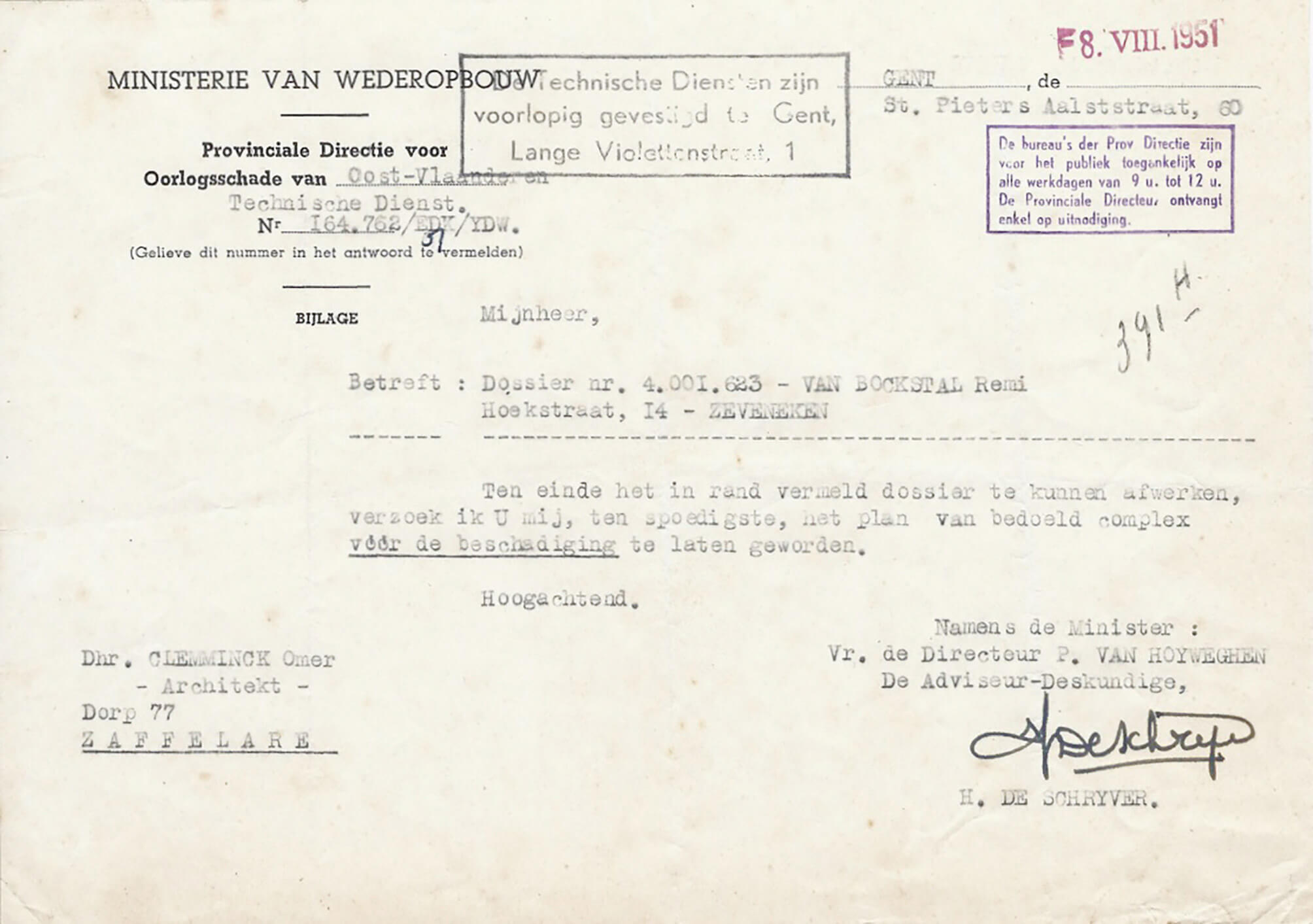
An architect in Z. receives a reminder. ‘Please send, as soon as possible, the plans of the construction before the damage.’ The reminder was sent by the Ministry of Reconstruction, in 1951. The architect’s address in Z., as mentioned in this file, is nowadays a house adjacent to Saloon Redbarn, a hall used for activities organized by a club of country and western-aficionados.
Semi-translucent paper, typoscript, stamps, handwritten notes and signature, from the archive of architect O. Clemminck, file ‘Remi Van Bockstael’
On Wednesday, May 9, 2018 at 2:23:14 PM Koh Elaine starts the thread original or original copy on the The Free Dictionary by Farlex’s forum.
‘Is “original copy” correct or should it be “original”? Thanks.’
The seventh reply to Elaine’s question is Wilmar’s on Thursday (his was preceded by towan52, georgew, NKM, Koh Elaine, Sarrriesfan, ChrisKC, Ashwin Joshi).
‘An original copy IS the original.
Folks usually call the document first created the original, but some will say original copy. If I run that original thru the copy machine, I end up with two copies (yes, I said copies) of the same thing – the original and the duplicate of it (in terms of content). This is how the term is commonly used.
If your writing or conversation depends heavily on understand the difference, I would recommend using the terms original and duplicates. There are many times when that is very important, in that the original must be retained by a particular party, and the duplicates are marked as such and distributed or stored as required depending on the document and the circumstance.
If you are just trying to make sure that you have enough copies to distribute to everyone at the company meeting this afternoon, use whatever terms trips your trigger. But, if you want to ensure that you keep custody of the original, so that you can make additional duplicates (copies) when additional people attend, then be more specific about the words you use.
OH, and, please, in the future, include some context with your question. Asking if “word” is correct doesn’t go very far in supplying a reasonably useful response.’
https://forum.thefreedictionary.com/postst182102_original-or-original-copy.aspx

Depending on the language one chooses, the Wikipedia entry for ‘document’ shows a different picture. The French-language page shows what appears to be a Slovenian thesis written in 1984. The caption states it is a ‘book of Czechoslovak computer science author Květoslav Šoustal about computer networks’. The image was uploaded by Kelovy, a Slovakian mushroom-picker.
The anonymous hand rests on a lemon-yellow tablecloth, on which a yellow book and a blue binded file lie. The top left corner is the most intriguing, however: the tablecloth seems to be draped over a lemon, alongside a drinking glass. The cloth, however, does not get shaped by the lemon. Nor does the shadow-side of the lemon coincide with the shadow the other documents throw on the tablecloth. A closer look seems to indicate that the lemon is in fact an image of a lemon, printed on a plastic napkin.
The Russian wikipedia shows the image of a lease agreement. The German wikipedia for ‘document’ is text only.
https://fr.wikipedia.org/wiki/Document#/media/Fichier:KVETOSLAV_SOUSTAL_BOOK.JPG, created October 3, 2006 / original in original: paper, 1984

In between two cities along the Belgian coast, water has run from the dunes (and the Second World War Heritage site scattered among them), underneath the coastal road and tram rails, to the beach. It has formed a small S-shaped estuary, bound to disappear due to the increasingly harsh wind coming from the coast of Britain, blowing North-easterly, and hammering down on the levee. The vibrations of the empty Ostend-bound tram passing just before the photograph was taken, had no visible impact on the estuary.

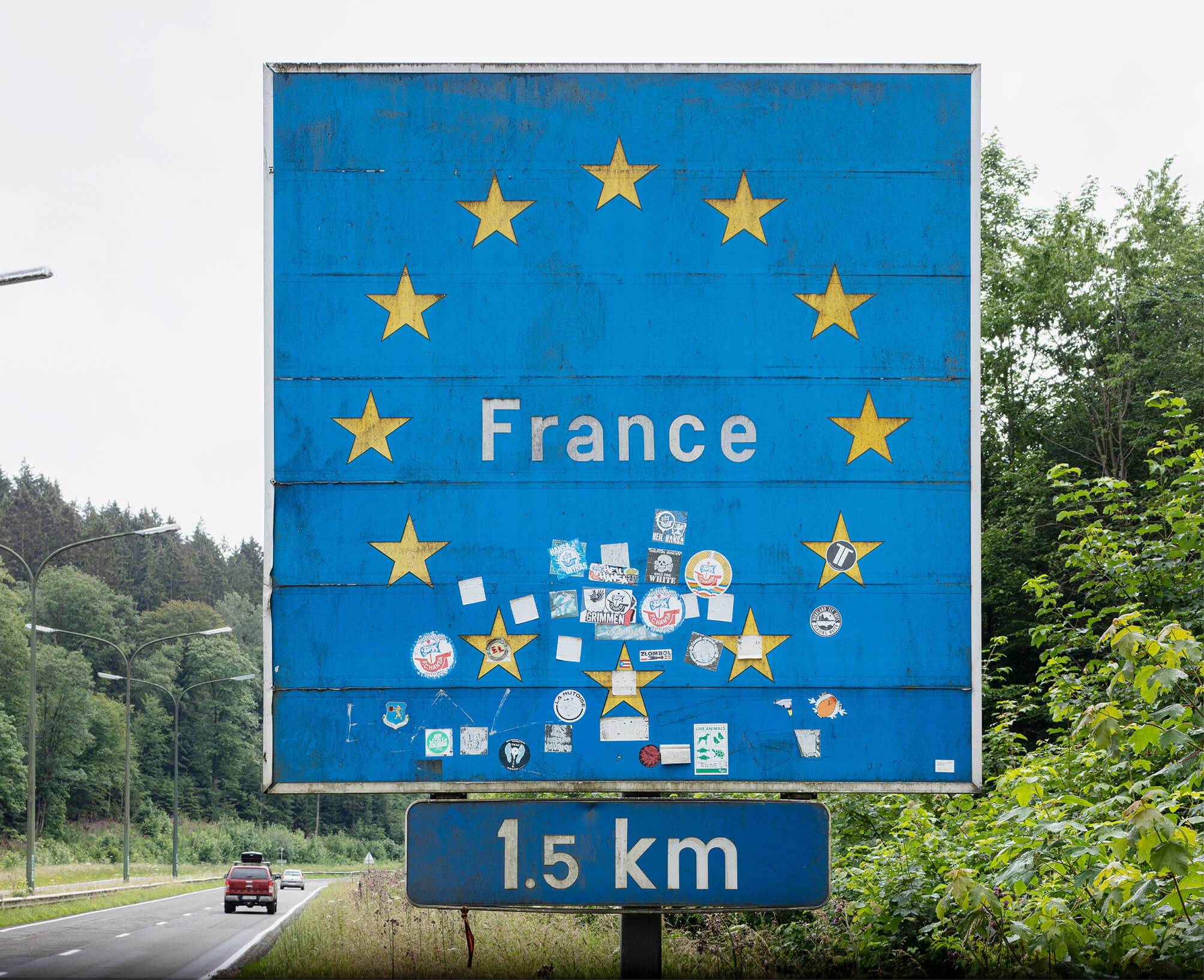
Belgium, approximately 1.5km from the French border, photograph made on 16.06.2018.
The European flag symbolises both the European Union and, more broadly, the identity and unity of Europe. It features a circle of 12 gold stars on a blue background. They stand for the ideals of unity, solidarity and harmony among the peoples of Europe. The number of stars has nothing to do with the number of member countries, though the circle is a symbol of unity.1
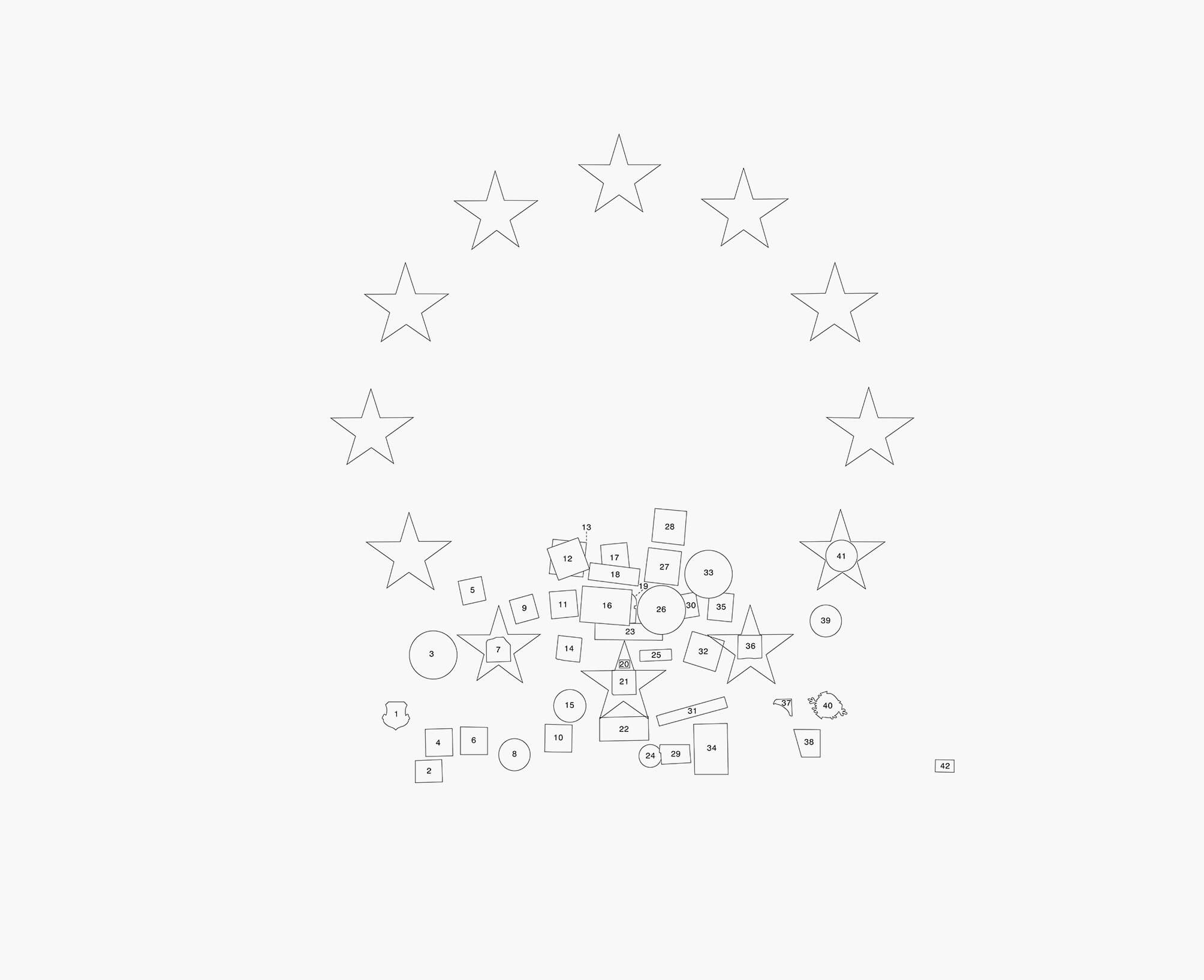
- Coat of arms of Gmina Puck, a rural district in Puck County, Pomeranian Voivodeship, in northern Poland.
- Illegible.
- F.C. Hansa, Mecklenburg, Pommern, FC Hansa Rostock is a German association football club based in the city of Rostock, Mecklenburg-Vorpommern. They have emerged as one of the most successful clubs from the former East Germany and have made several appearances in the top-flight Bundesliga. Hansa Rostock’s official anthem is “FC Hansa, wir lieben Dich total”. Hansa struggles with hooliganism, estimating up to 500 supporters to be leaning towards violence. The club’s logo consists of a red sailing ship with a blue sail showing the Rostock Griffin.
- Mon École Écologique.org is an organization for environmental conservation. On 07.01.2021 there was no website listed on this URL.
- Illegible.
- Illegible, apart from ’1962’ in the middle.
- Innocenti Bruderschaft, EL, 2018, a community of German Lambretta Innocenti riders and aficionados.
- Imag’Ink, Bretignolles Sur Mer, Tatoueur, 06 06 44 13 51, a French tattoo shop.
- Illegible.
- Hardly legible, the only word that can be made out is ‘Futbolom’: Russian for soccer.
- Kaluga on tour. Kaluga is a Russian city 150km southwest of Moscow. It is often called the cradle of space exploration thanks to the city’s most famous resident: Konstantin Tsiolkovsky.
- Hansa Ultras, F.C. Hansa. The Ultras are a group of F.C. Hansa fans (see: ‘3’).
- Illegible because ‘12’ was stuck over it.
- Illegible.
- La Hutoise is a regional student-association for higher education students from the Belgian town of Huy and its surroundings. Its aim is to bring together students from Huy in a spirit of camaraderie and to perpetuate student folklore. The logo consists of a two headed bird of prey with a cap on each head. The bird wears a scarf over one shoulder and holds a glass of beer in each paw.
- F.C. Hansa, Grimmen. The F.C. Hansa logo (see ‘3’ and ‘12’) is combined with the coat of arms of Grimmen: a griffin on a pile of 10 bricks. Grimmen is a German town in Nordvorpommern on the banks of the river Trebel.
- Illegible.
- Heil Hansa. To the left of this text the F.C. Hansa logo (see ‘3’, ‘12’ and ‘16’), on the right a logo consisting of a black bull with his tongue out and a golden crown on his head. This controversial sticker lead to several arrests in the run-up to the match between F.C. Hansa Rostock and Bayern München in February 2020. Supporters of F.C. Hansa had attached this sticker to public buildings on their way to the stadium.
- Illegible because ‘16’ was stuck over it.
- The Cuban flag.
- Illegible.
- Illegible.
- Kaluga (see ‘11’).
- De Veterinnen, a round, black sticker with a red print of a head wearing a round hat and a carnivalesque collar with a carrot for a nose. No further information found.
- Zlombol 11. Złombol is a yearly charity car rally racing event that starts in Katowice Poland. Contesters must drive a car that was built or designed during the communist era. The destination of the 2011 edition was Loch Ness.
- F.C. Hansa, Mecklenburg, Pommern, identical sticker to ‘3’, see also ‘12’, ‘16’, and ‘18’.
- Torpedo Moscow, only for white. Football club Torpedo Moscow is a Russian professional club based in Moscow, founded in 1930. Some fans of the club wave far-right symbols and banners, both during and outside of matches. Massive fan-protest ensued when the club tried to sign a black player in 2018. The player’s contract was cancelled.
- Heil Hansa. See ‘3’, ‘12’, ‘16’, ‘18’ and ‘26’.
- Illegible.
- Illegible.
- Illegible.
- Illegible.
- F.C. Hansa. Variation of ‘3’ and ‘26’ with a circle of yellow crops around the logo. See also ‘12’, ‘16’, ‘18’ and ‘28’.
- Live animals, contents: Rivne UA. These stickers are required by the International Air Transport Association for airline cargo pet travel. Rivne is a city in western Ukraine (UA) with an international airport. The sticker does not specify the transported animal but displays a dog, two birds, two fish and a turtle.
- Illegible.
- Illegible.
- Illegible.
- Illegible, apart from ‘lska’ on the bottom.
- Norrland Fly Guys, Reading Water. The sticker displays a minimal landscape with two pine trees, and a shed on a chunk of floating ice, a single four-point star shines in the sky. Norrland is the northernmost part of Sweden. No further information found. Whether the ‘fly guys’ own airplanes or are involved in fly fishing is unclear.
- This sticker displays – what appears to be – a smiling potato in front of an enlarged snow crystal. No further information found.
- Traumsucht is an artist collective from Berlin. Their website lists German rap-artists
- Illegible.
https://europa.eu/european-union/about-eu/symbols/flag_en
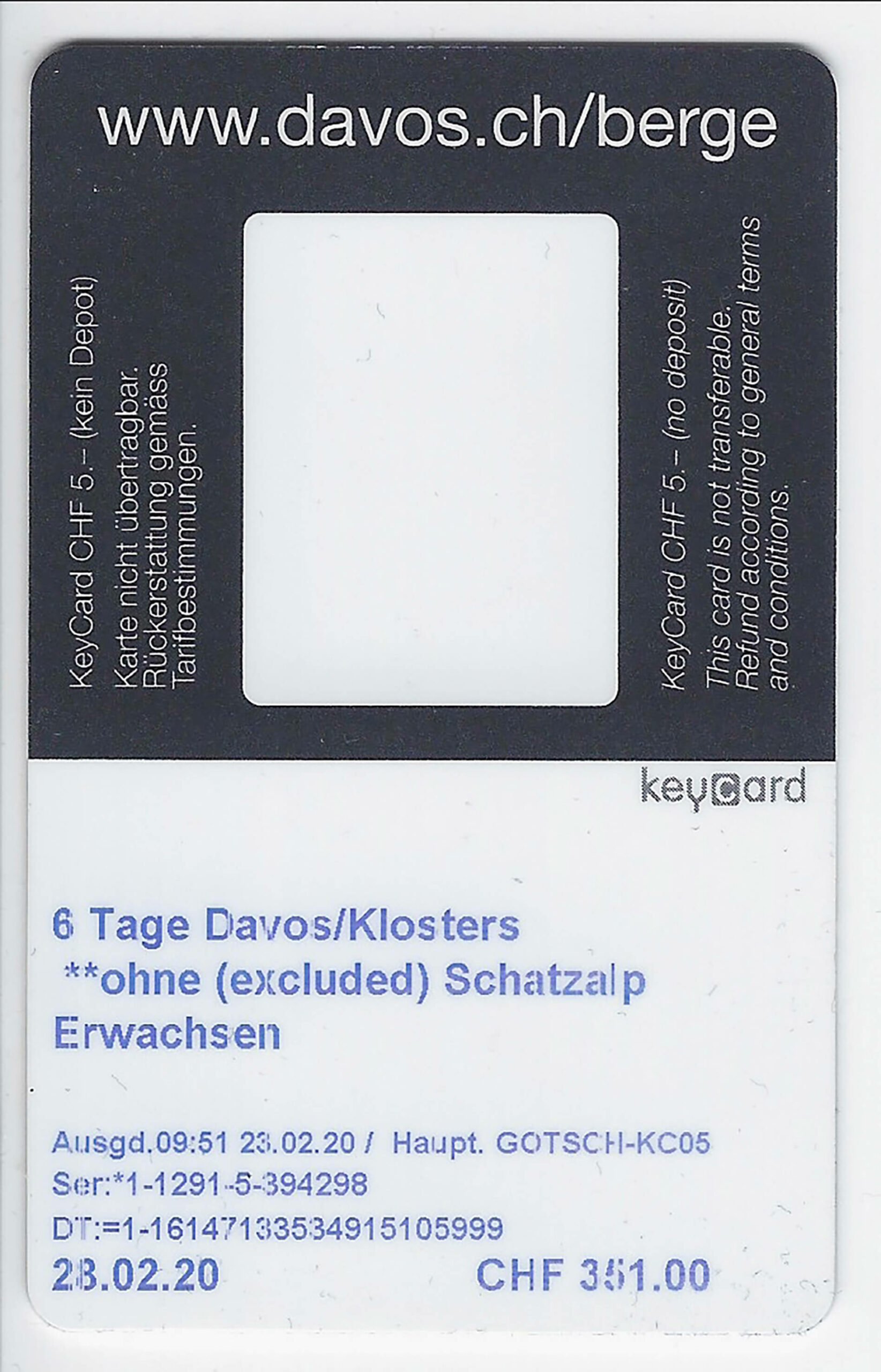
A skiing holiday with my in-laws. The ski pass does not allow you to visit Schatzalp. We buy a separate ticket and take the train up the hill to the hotel, which served as the backdrop for Thomas Mann’s Magic Mountain. The stately hotel and former sanatorium is gorgeous.
Meanwhile, a new virus is spreading. Some people are coughing. I am keeping distance while waiting in line to take the train back down to the snow-covered village.
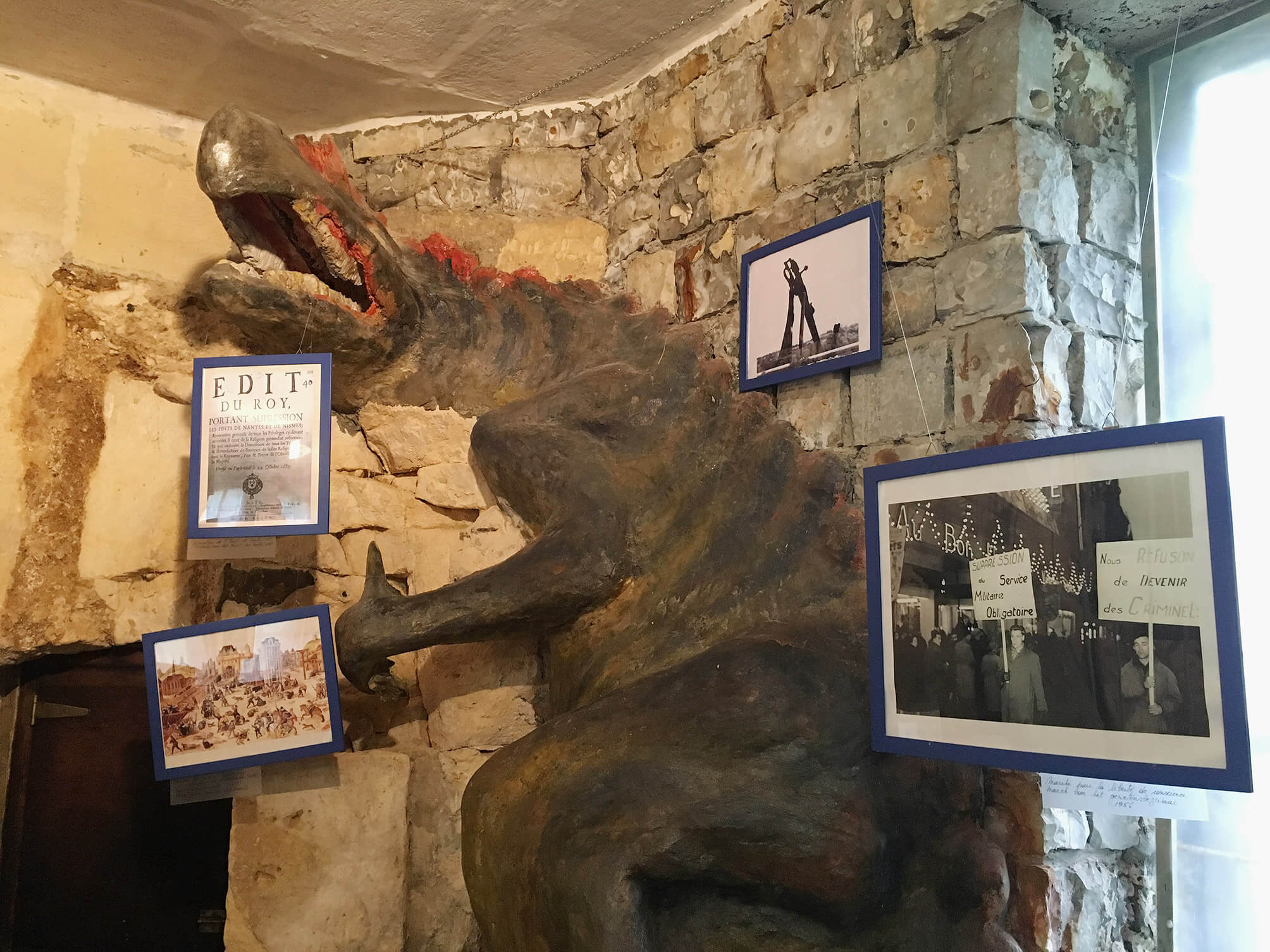
Interior of Eben-Ezer: photocopies and replicas of among other things an Edit du Roy and a photograph of a Marche pour la liberté de conscience, 1956. Handwritten labels are added beneath the blue frames. Due to limited lighting, and an interdiction to use the camera’s flash, some labels are illegible, even when zooming in on the picture. It is unclear what the bottom left replica of a painting is (it has a Brueghelian air to it) and the upper right replica of a photograph.
The walls are made of flint, harvested from quarries in the neighbourhood.
As a result of intense drainage of drinking water, an area around the Belgian city of Waver was designated as having a potential for land subsidence – the downward movement of the soil over an extended period of time. People in Waver were startled to find their town mentioned in an international study published in Science. Flemish newspaper De Standaard uncovered that the researchers had used an older study, published in 2005, which claimed that the soil in Waver had moved some five centimeters in a period of eleven years. Pictures of fissures in Waver-facades had been added to the original article.
Last year, cracks in our living room wall were covered up by placing plasterboard in front of the plastered brick wall. As such, we avoided having to paint the wall with the cracks and the marks left by the IKEA Billy bookcases.
https://science.sciencemag.org/content/sci/suppl/2020/12/29/371.6524.34.DC1/abb8549_Herrera_SM.pdf
https://www.standaard.be/cnt/dmf20210106_97889104
http://earth.esa.int/fringe2005/proceedings/papers/677_devleeschouwer.pdf

On the second to last evening before we head home, we go for dinner at Suzanne’s house. She has invited a friend, a national deputy for the region where she grew up. We eat fish and patates douces. We drink beer. The deputy’s secretaries – there are three of them – closely inspect the worn manuscript we hand them. In blue ink: proverbs of their region, written by my girlfriend’s grandfather in local Kikongo language. In red: a Dutch translation. They laugh. A month later, the deputy will become Vice-minister of Internal affairs. The proverbs get marked by fresh grease stains.

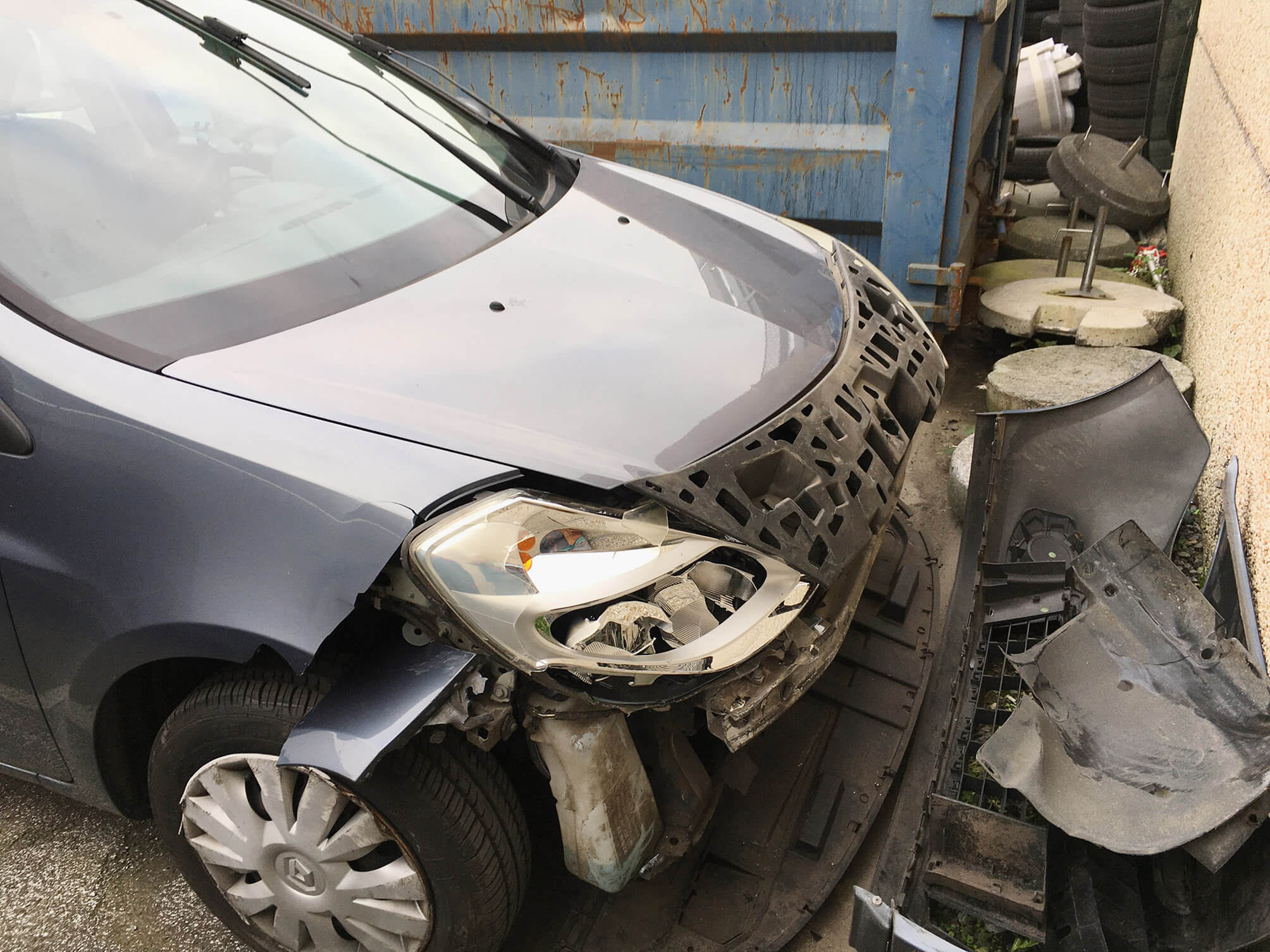
In June, 2014, a severe hailstorm hit Belgium. Warnings were broadcast. A football game between the national teams of Belgium and Tunisia was paused. The morning after, there were small dents in the hood and the roof of the car, each a square centimeter in size, some 10 centimeters separated from each other. The storm didn’t get a name.
Assessing the damage, the insurance company’s expert took the dents into account to establish the wreck’s worth.