What constitutes a ‘document’ and how does it function?
According to the Oxford English Dictionary, the etymological origin is the Latin ‘documentum’, meaning ‘lesson, proof, instance, specimen’. As a verb, it is ‘to prove or support (something) by documentary evidence’, and ‘to provide with documents’. The online version of the OED includes a draft addition, whereby a document (as a noun) is ‘a collection of data in digital form that is considered a single item and typically has a unique filename by which it can be stored, retrieved, or transmitted (as a file, a spreadsheet, or a graphic)’. The current use of the noun ‘document’ is defined as ‘something written, inscribed, etc., which furnishes evidence or information upon any subject, as a manuscript, title-deed, tomb-stone, coin, picture, etc.’ (emphasis added).
Both ‘something’ and that first ‘etc.’ leave ample room for discussion. A document doubts whether it functions as something unique, or as something reproducible. A passport is a document, but a flyer equally so. Moreover, there is a circular reasoning: to document is ‘to provide with documents’. Defining (the functioning of) a document most likely involves ideas of communication, information, evidence, inscriptions, and implies notions of objectivity and neutrality – but the document is neither reducible to one of them, nor is it equal to their sum. It is hard to pinpoint it, as it disperses into and is affected by other fields: it is intrinsically tied to the history of media and to important currents in literature, photography and art; it is linked to epistemic and power structures. However ubiquitous it is, as an often tangible thing in our environment, and as a concept, a document deranges.
the-documents.org continuously gathers documents and provides them with a short textual description, explanation,
or digression, written by multiple authors. In Paper Knowledge, Lisa Gitelman paraphrases ‘documentalist’ Suzanne Briet, stating that ‘an antelope running wild would not be a document, but an antelope taken into a zoo would be one, presumably because it would then be framed – or reframed – as an example, specimen, or instance’. The gathered files are all documents – if they weren’t before publication, they now are. That is what the-documents.org, irreversibly, does. It is a zoo turning an antelope into an ‘antelope’.
As you made your way through the collection,
the-documents.org tracked the entries you viewed.
It documented your path through the website.
As such, the time spent on the-documents.org turned
into this – a new document.
This document was compiled by ____ on 06.07.2026 13:30, printed on ____ and contains 16 documents on _ pages.
(https://the-documents.org/log/06-07-2026-6831/)
the-documents.org is a project created and edited by De Cleene De Cleene; design & development by atelier Haegeman Temmerman.
the-documents.org has been online since 23.05.2021.
- De Cleene De Cleene is Michiel De Cleene and Arnout De Cleene. Together they form a research group that focusses on novel ways of approaching the everyday, by artistic means and from a cultural and critical perspective.
www.decleenedecleene.be / info@decleenedecleene.be - This project was made possible with the support of the Flemish Government and KASK & Conservatorium, the school of arts of HOGENT and Howest. It is part of the research project Documenting Objects, financed by the HOGENT Arts Research Fund.
- Briet, S. Qu’est-ce que la documentation? Paris: Edit, 1951.
- Gitelman, L. Paper Knowledge. Toward a Media History of Documents.
Durham/ London: Duke University Press, 2014. - Oxford English Dictionary Online. Accessed on 13.05.2021.

In Zaffelare, young men who were called for military service but could not be missed at home were advised by the local doctor to swallow a small ball of aluminium foil an hour before the examination. In the X-ray, a gastric ulcer appeared. They were rejected for service. It is uncertain whether the increased incidence of gastric ulcers among young men in Zaffelare was a cause for concern.

‘Exit at the dock and kill some rats. Go around the building to the left, killing the guard and his rats before flipping the switch. Another guard arrives kill him too, taking the medkits from both your victims. Enter the now open front door and kill the guard on the balcony and his friend who appears on the ground floor. Grab the shells from your second kill then shoot out the window and kill the Dobermans who jump through when you get too close.’
Tomb Raider II. The Complete Guide to the Dagger of Xian. Downloaded from http://www.the-spoiler.com on 4 August, 1999, at 15:03.

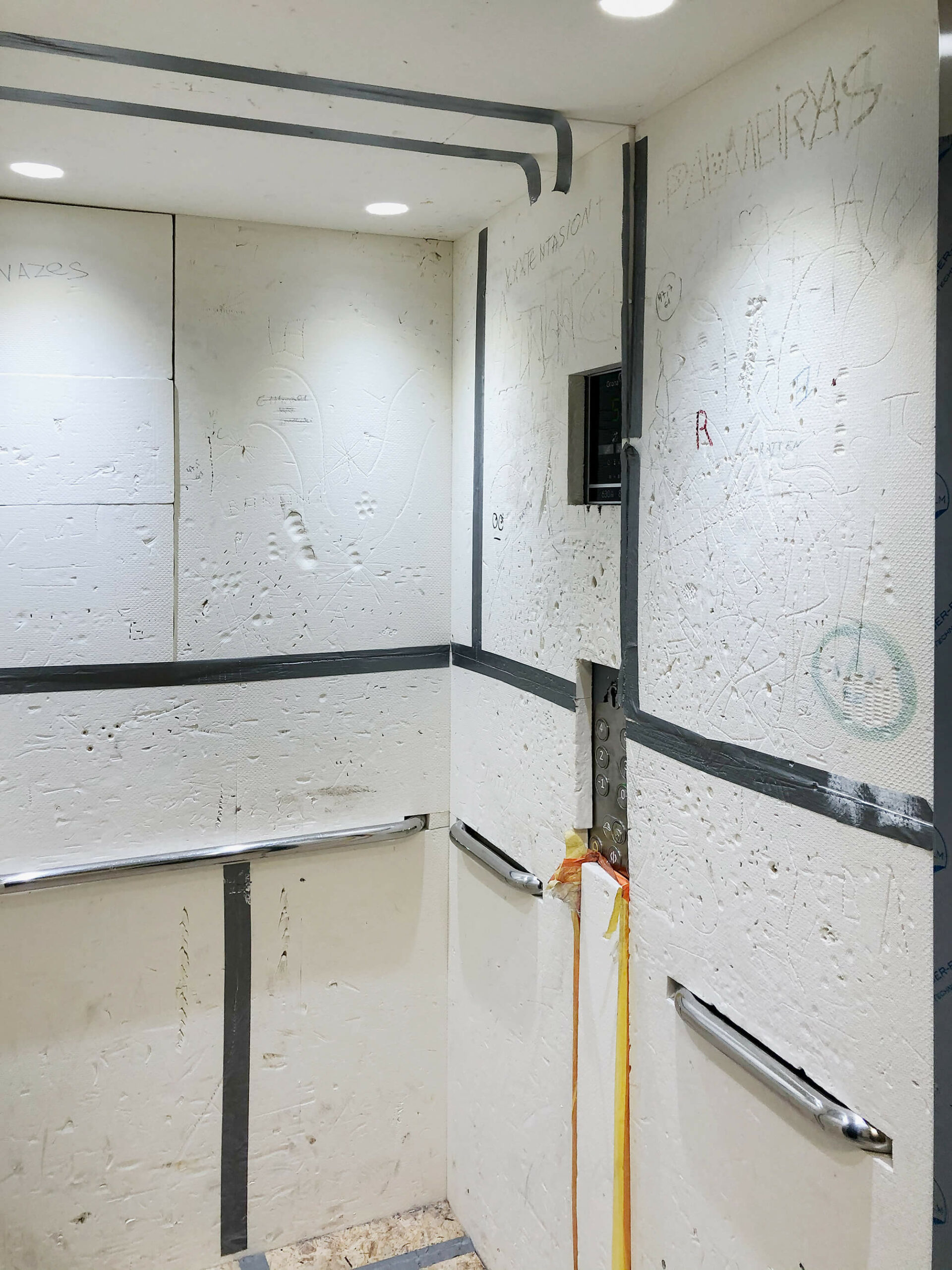
The building is almost finished. One apartment is still up for sale, on the top floor. The contractor is finishing up. There’s a long list of comments and deficiencies that need to be addressed before the building can be handed over definitively to the owner. The elevator’s walls are protected by styrofoam to prevent squares, levels, measures, drills, air compressors, chairs, bird cages, etc. from making scratches on the brand new wooden panelling.
In 1932 Brassaï began taking photographs of graffiti scratched into walls of Parisian buildings. On his long walks he was often accompanied by the author Raymond Queneau, who lived in the same building but on a different floor. Brassaï published a small collection of the photographs in Minotaure, illustrating an article titled ‘Du mur des cavernes au mur d’usine’ [‘From cave wall to factory wall’].
In an attempt to make it his own, Gino – it might also be Dino – has taken a can of bright pink spray paint to his hard hat and – as the paint was drying – dragged his gloved finger from top to bottom. G – or D –, I, N, O. In the dust on a demolished floor tile, someone has written 12,10. Perhaps a measurement, a quantity, a position, a date, a reference.
Subtractive writing is not uncommon. With the tip of a passer-by’s index finger ‘WASH ME’ is subtracted from the dust on a dirty car. In freshly poured concrete, a name is embedded forever with a twig. In hot and soft roofing drawings and obscenities are scratched. Styrofoam lining a brand new elevator gets impressed with names, jokes and knuckles.
In the twenty-third canto of Ariosto’s Orlando Furioso (1516), Orlando comes across the name of his love and another man, carved in the bark of a tree. He doubts. But that night, a gossiping shepherd tells him he’s seen Angelica and Medoro together. Orlando returns to the forest, and in a four-day frenzy, he uproots every tree and pollutes the rivers forever.
CXXXI
For he turf, stone, and trunk, and shoot, and lop,
Cast without cease into the beauteous source;
Till, turbid from the bottom to the top,
Never again was clear the troubled course.
At length, for lack of breath, compelled to stop,
(When he is bathed in sweat, and wasted force,
Serves not his fury more) he falls, and lies
Upon the mead, and, gazing upward, sighs.1
Ariosto, L. Orlando Furioso. Translated by William Stewart Rose, Echo Library, 2006, p. 267.

The building is almost finished. One apartment is still up for sale, on the top floor. The contractor is finishing up. There’s a long list of comments and deficiencies that need to be addressed before the building can be handed over definitively to the owner. The elevator’s walls are protected by styrofoam to prevent squares, levels, measures, drills, air compressors, chairs, bird cages, etc. from making scratches on the brand new wooden panelling.
In 1932 Brassaï began taking photographs of graffiti scratched into walls of Parisian buildings. On his long walks he was often accompanied by the author Raymond Queneau, who lived in the same building but on a different floor. Brassaï published a small collection of the photographs in Minotaure, illustrating an article titled ‘Du mur des cavernes au mur d’usine’ [‘From cave wall to factory wall’].
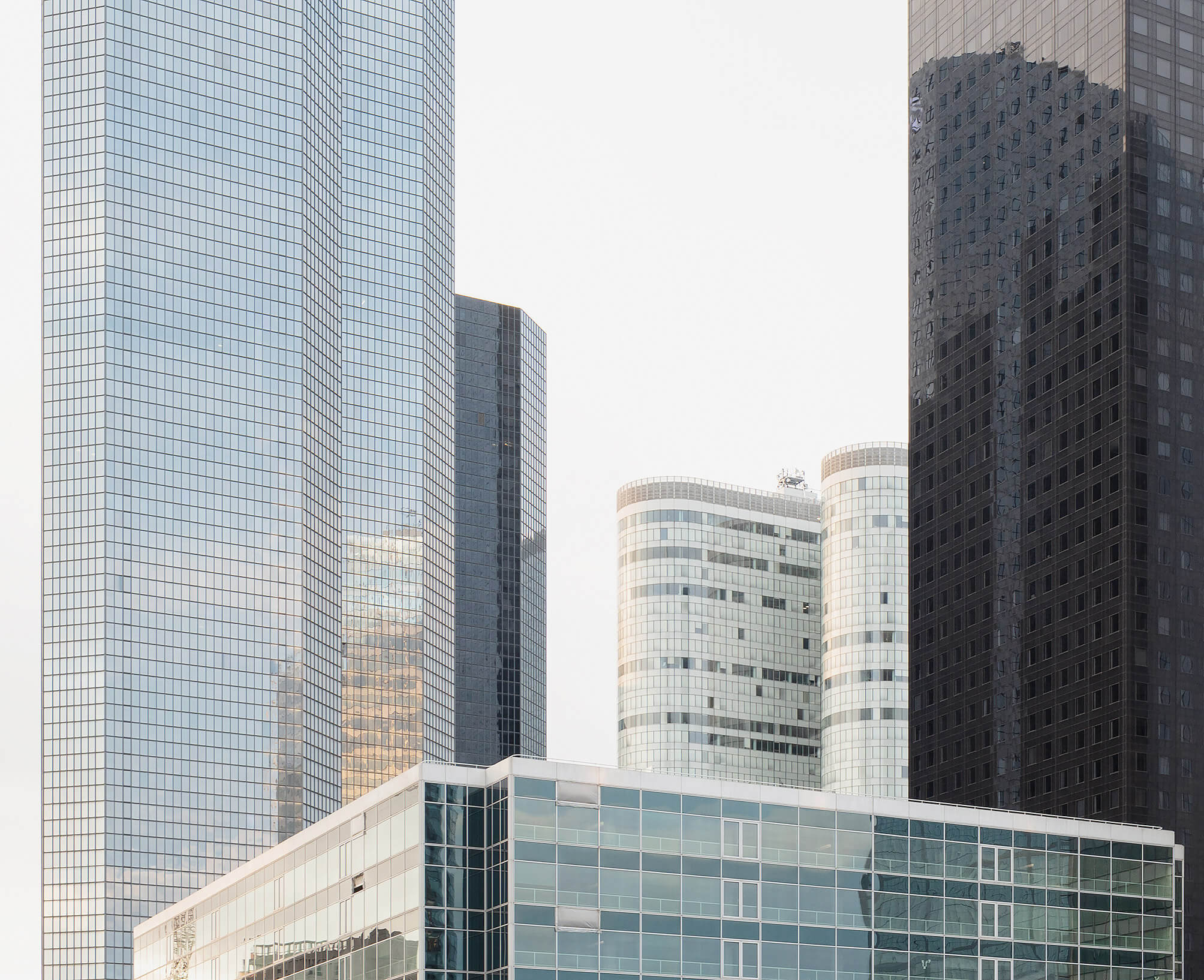
During the 1950s, as part of the communist reconstruction, a large coal/gas power plant was built close to the village of Inota, Hungary. This is the place where I grew up. It operated until about 1994. In the run-up to the final shutdown of the operation they gradually lowered its output. By this time the coal mines in the neighboring city had shut down as well due to the diminishing yield of the low-quality brown coal they had mined for the purpose of fueling the power plant. This resulted in mass unemployment and general decline in the area. The small lake in the photo is an artificial reservoir that collected all the water from the nearby streams. The substantial flow of one of those rivers powered about 11 water-driven flour mills; I know this on account of my grandmother, who would often pick up bags of flour for bread.
The ruin in the photograph once was a pumping facility that drove the water from the lake to the power plant about 3 kilometres away. In the years following the systemic change of Hungary and its celebrated evolution towards a western-type capitalism in ‘89-’90, the rules of ownership and the perception of public and private property were somewhat elusive. The lack of state control resulted in a transfer of public property to private hands on a monumental scale throughout the whole country, and – by extension – the Eastern Bloc. At the time some of the village dwellers of Inota, driven by the force of a major change and the prospect of a new, prosperous future of capitalist entrepreneurship, gathered to disassemble the water-pumping facility along the artificial lake. Slowly, day by day, under the mist of this elusive moment, they carried away carriageful after carriageful of bricks, disassembled from the facade of the building. It was perhaps a way of taking revenge, but certainly also claiming the moment’s opportunity. The bricks made their way into the walls of the new-built family homes of some of the villagers. The former water pumping facility became a sort of material reservoir for the construction of a new future. The transformation from a water reservoir to a material (and ideological) one and its subsequent exhaustion, left a ruin that has remained untouched for the last 30 years. The bricks that were difficult to reach were left in place, thus forming a curtain around the upper part of the building just above the pillars. Freed from all perimeter walls, the leftover structure appeared as a pavilion-like, open floor plan.
The cliffs at the sides of the valley on the photo served as the location for the film My Way Home (Így Jöttem, 1965) by the iconic Hungarian filmmaker Miklós Jancsó, about a 17-year-old boy who falls prisoner to the Russian army and forms a friendship with one of the foes. The film is said to display all the main themes of the director: the psychological presence of landscape, the randomness of violence and the arbitrary nature of power.
In the distance a formation of meadows can be seen in the photograph. Those meadows make up 16 acres of land that were given to my grandfather and subsequently inherited by my mother. It was a reparation for having been stripped of their wealth by the Soviet establishment in the 1950s. The worth of the land is a couple thousand euros as of today. It is part of the largest consistent nature reserve area of the EU.
While standing on the cliffs and looking south-eastward, the power plant can be seen. The orientation of the photograph is approximately north facing.
Turning southwards one can see the stone cellar, about a kilometre away, where my grandfather’s adolescent sister had spent more than a year, while two German SS officers occupied their family home. During the advancement of the Red Army, a Russian soldier, entering the cellar, attempted to take advantage of her. The soldier’s superior intervened and shot him in the head without hesitation. My parents store potatoes and apples in the cellar to keep them from rotting in the summer and freezing in the winter. It is easy to say when a potato or an apple comes from the cellar; it has an unmistakable, musty taste.
Márk Redele pursues projects that fundamentally relate to architecture and its practice but rarely look like architecture. www.markredele.com
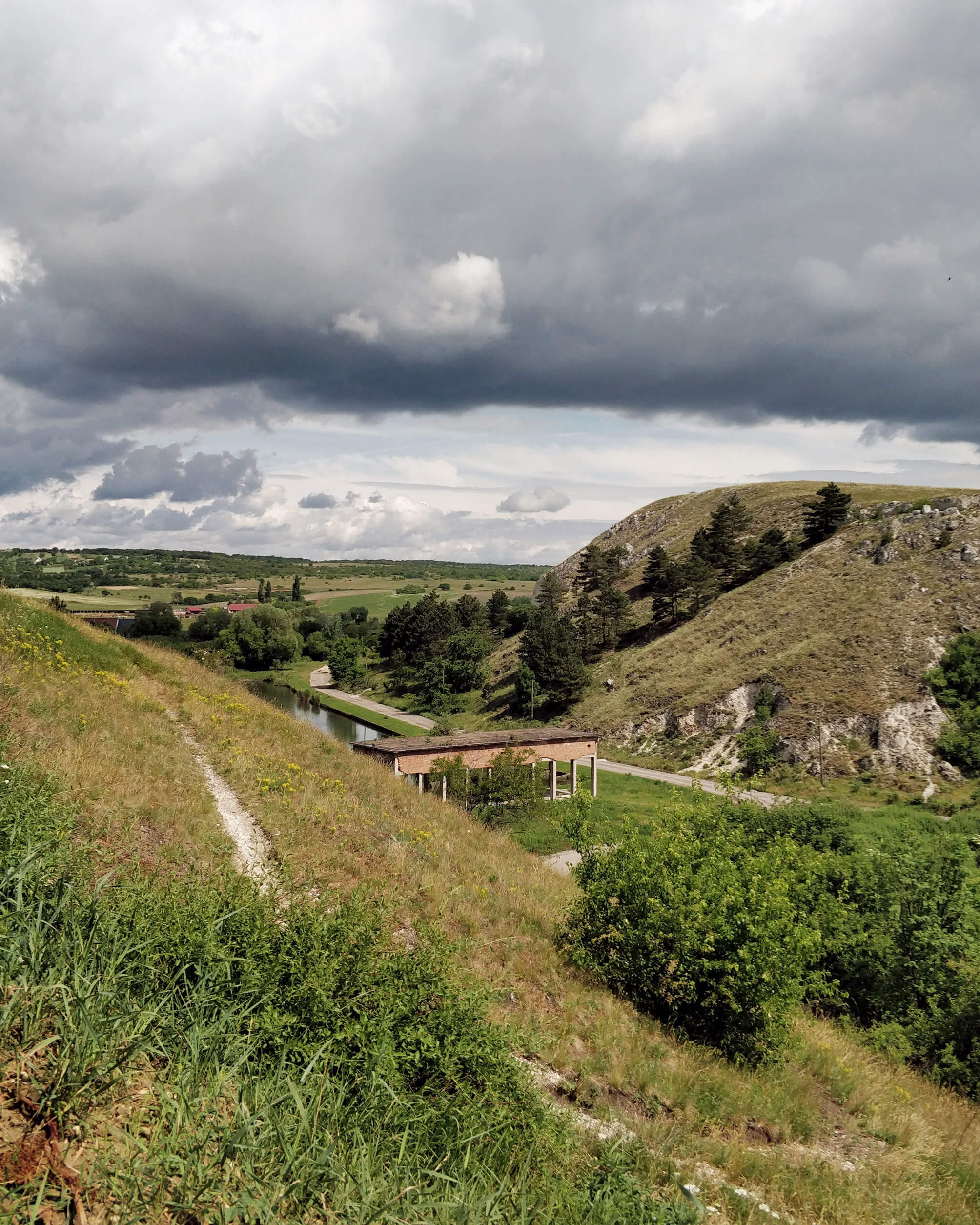
A year ago, mid-August, just before sunrise, the mostly unlit office buildings line the road that leads to the underground parking. I turn off the ignition. I’m in F36. The walls are painted pink. Looking for the exit, I take the escalator and get stuck in an empty shopping mall. The music is playing but all the shops are closed off with steel shutters. So are the exits. I’m out of place. In keeping early customers out, the mall is keeping haphazard visitors in. I’m back in the parking lot. The elevator is broken. I take the stairs and walk by a homeless man, sleeping. There’s shit on the floor. I open the door that leads out of the stairwell. It slams shut behind me. There’s no doorknob. I find myself on a dark floor between mall and parking lot. People are sleeping; some are awake. Heads turn toward me. I start walking slightly uphill towards where I think I might find an exit, or an entrance. The scale of the architecture has shifted from car (F36) and customer (the closed mall) to truck. I find myself amidst the supply-chain. It takes five minutes, maybe fifteen, maybe more to get out and see the office buildings towering over me in the first light of day.
‘You see?!’
[The man points at the waybill1 on the floor behind the glass door that closes off the abandoned and dismantled hall.]
‘It used to be here, I’m sure.’
[He looks around.]
‘I’m sure.’
[He turns towards me.]
‘Are you also here for the Leen Bakker?2 This used to be a Leen Bakker. I just looked it up on their website. They are open from 9 to 6 today.’
[He points at the waybill again.]
‘It was here. I remember well. It’s been years. But it’s here.’
[He walks away.]
‘I’ll look around.’
The waybill documents the transport of a 30m3 container filled with approximately 5000 kg of waste from this branch of Leen Bakker to a scrap processing company in nearby Ninove. They take care of scrap, both ferrous and non-ferrous metals. They also have a recognized depollution center for end-of-life vehicles.
A chain of furniture and interior stores with branches in the Netherlands, Belgium and the Caribbean part of the Kingdom of the Netherlands.

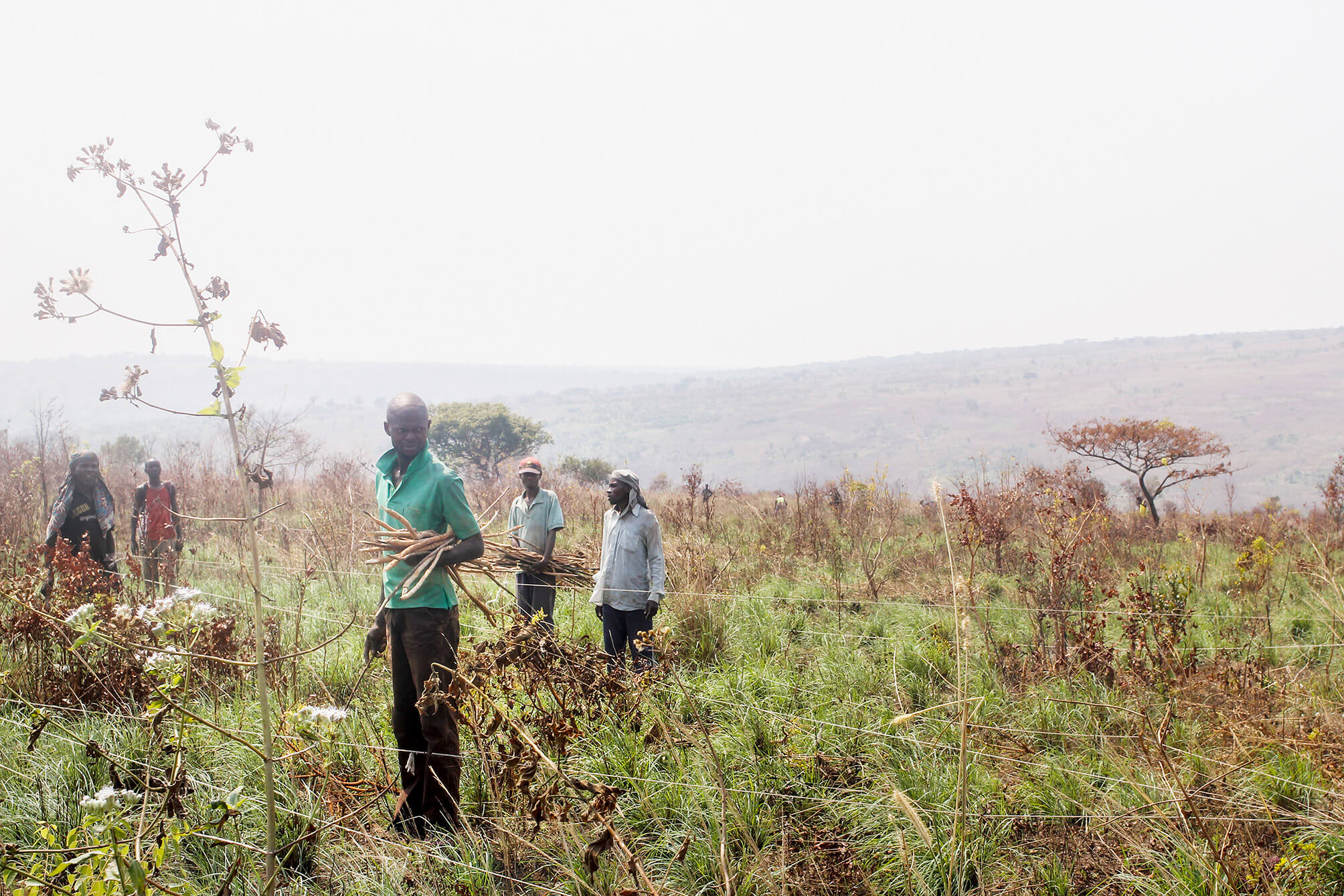
The weeds and bushes on what over the years has become savanna are being chopped to clear the ground to replant trees and reinstate the forest. During the dry season, forest fires are frequent. In between the future lots of planted trees, firebreaks are made to keep fires from spreading. Wires are used to measure the required distance between plant beds and to keep a straight line. The sun is sinking. In a bit, the workers will return home and the field will empty out. In a couple of years, the Acacias, Ebben trees, Millettia laurentii and Umbrella trees will testify to the strings.
https://www.fajalobi.org
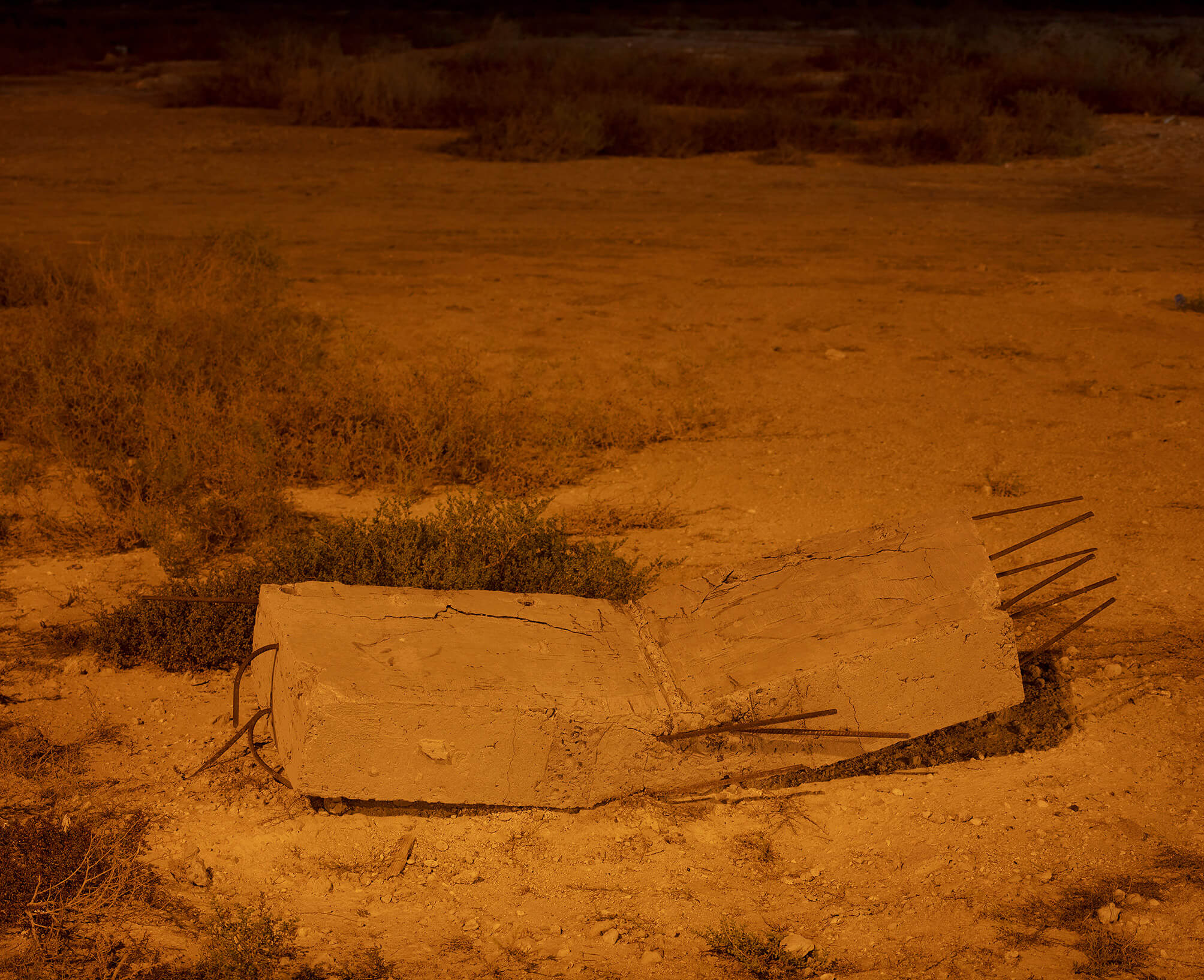
A block of concrete. Fissures are showing and rebar is sticking out from all sides. If it were still straight, the block would measure approximately 130 x 15 x 40cm.
It is lying by the side of the road, a few hundred meters from a construction site. It appears to be shaped by impact. Maybe the block plummeted to the ground from a great height. Perhaps, something heavy hit it. For all one knows, it served as a column and was exposed to an unforeseen amount of pressure, causing it to buckle.
According to Eyal Weizman ‘[a]rchitecture emerges as a documentary form, not because photographs of it circulate in the public domain but rather because it performs variations on the following three things: it registers the effect of force fields, it contains or stores these forces in material deformations, and, with the help of other mediating technologies and the forum, it transmits this information further.’1
Weizman, E. ‘Introduction’, in: Forensic Architecture. Forensis. The Architecture of Public Truth. London/Berlin: Sternberg Press, 2014.
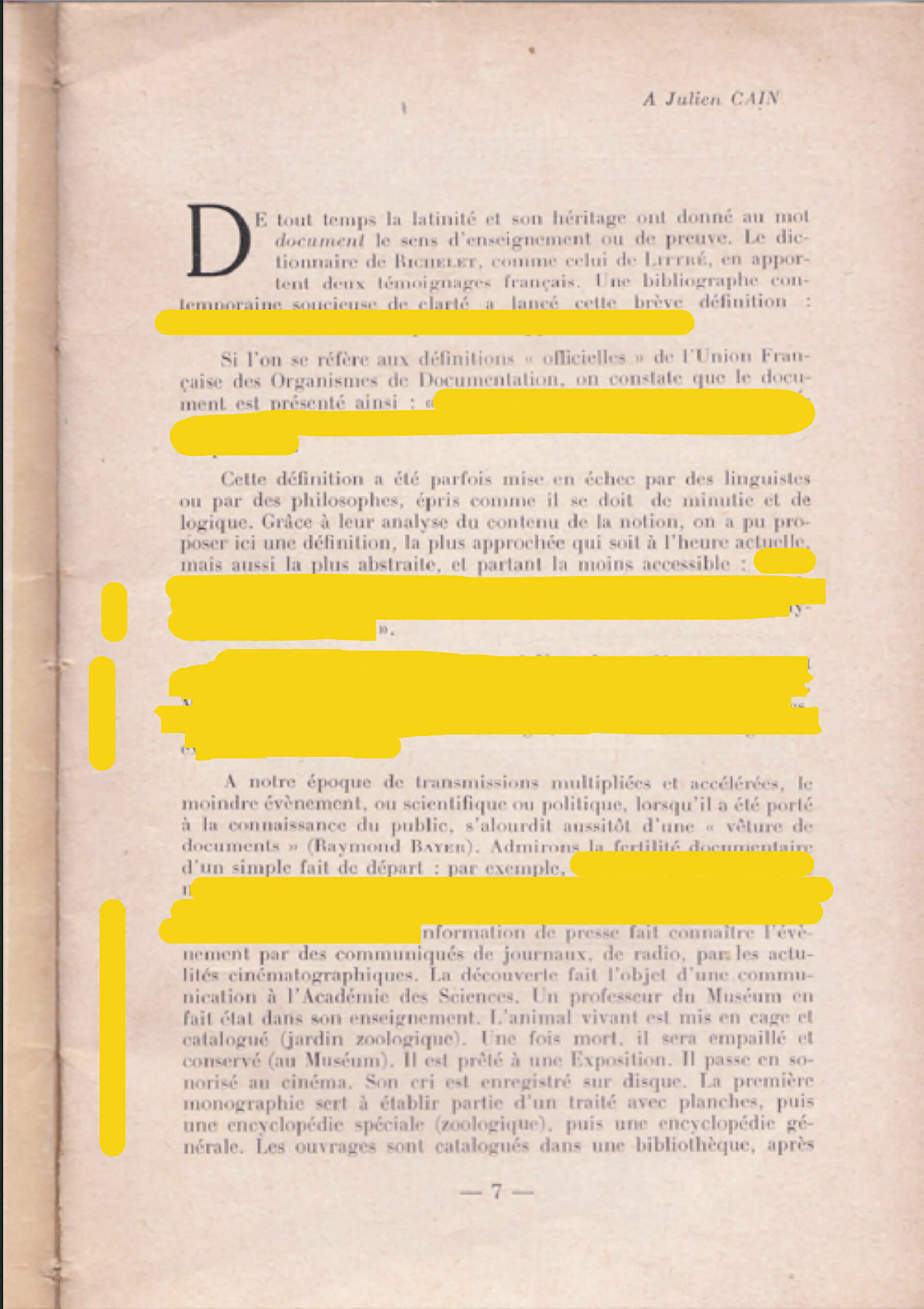
In the introduction to her book Qu’est-ce que la documentation?, French ‘documentalist’ Suzanne Briet asks what a document is. In a scrappy scan of her book I found online I am highlighting almost everything she writes. Is a star a document? Briet says it isn’t. But the catalogues and photographs of stars are. When I quickly opened the file with Apple’s ‘Preview’ application to check the above paraphrase, the highlighted sentences were illegible.
Briet is cited in Lisa Gitelman’s Paper Knowledge (2014).
Briet, S. Qu’est-ce que la documentation? Paris: Edit, 1951. Online: http://martinetl.free.fr/suzannebriet/questcequeladocumentation/briet.pdf
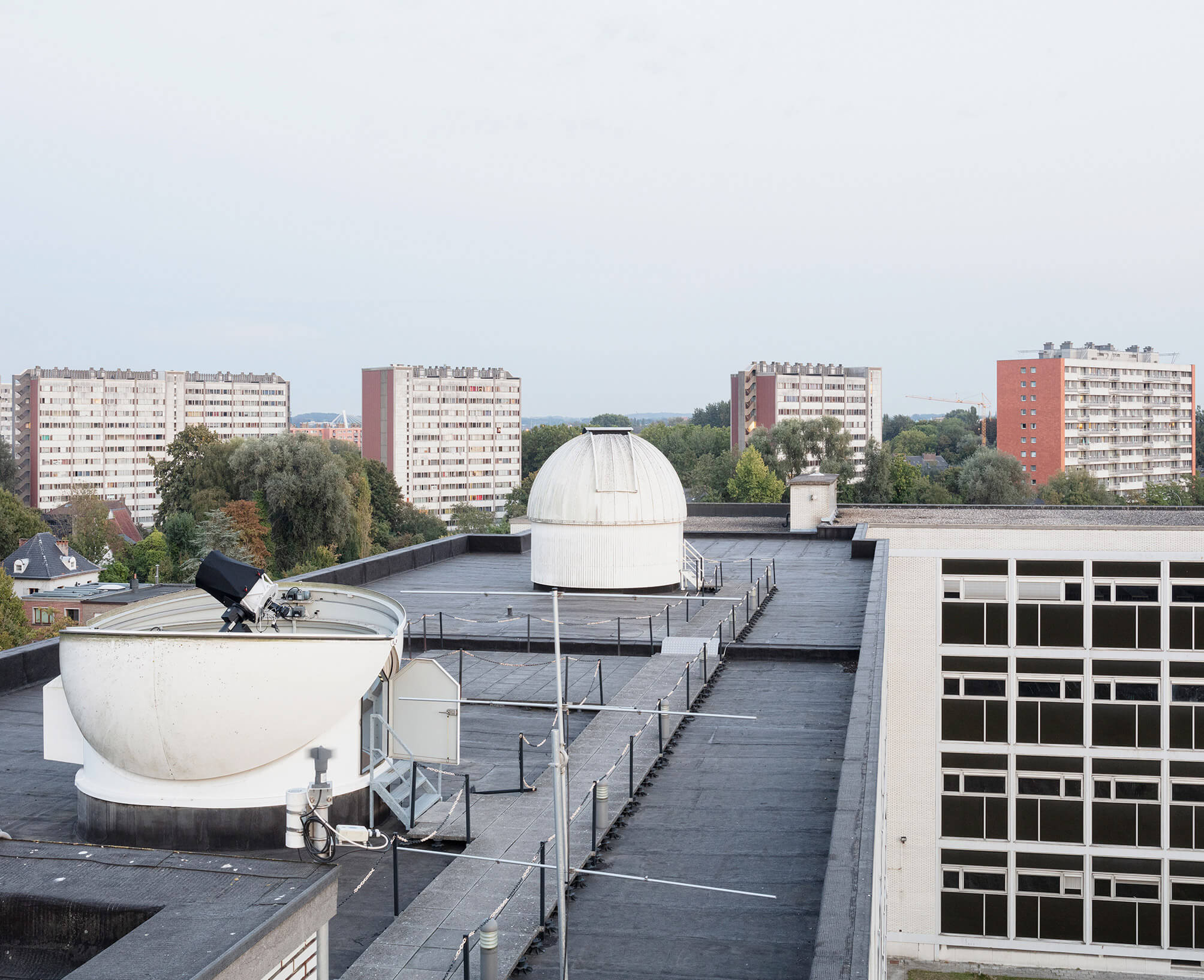
A visit to the Royal Observatory of Belgium, in Ukkel. Most of the domes are damaged and need repairing. Only a few telescopes are in use. It is difficult to find a good spot from which to film the site. When we asked the people at the Royal Meteorological Institute – the Observatory’s neighbouring institution – if we could access their building’s roof to film the observatory, the answer was ‘no’.
I (M.D.C.) remember there was a fire nearby. We couldn’t see the flames, but a tall dark plume of smoke rose above the trees lining the site. We didn’t insist any longer and ceased our attempt to access the roof, hoping we might find a good spot to film the smoke with a dome in the foreground.
Kesteloot, J. Leerboek van Cosmografie voor Middelbaar en Lager Normaal Onderwijs (derde vermeerderde uitgave). Brugge: Firma Karel Beyaert, 1948.

A seminar on spectroscopy: how, by splitting light into different, separate rays, it becomes possible to deduct the chemical composition of stars and planets far beyond our reach, as those elements have an effect on the light that reaches the spectroscope. Beautiful graphs presenting colour in schemes of black and white. From the moment the course gets into the physics of light, my mind wanders off. What approaches the observer turns blue, what elongates itself becomes red. The teacher’s leather shoes squeak as he goes back and forth between his self-made spectroscope and the desk. Redshift. Blueshift.
We meet him a couple of weeks later on the rooftop of a university building. He opens one of the half-domes. The sound of the mechanics is as obtuse as the shape it alters. A command on the computer based on coordinates: above our heads, the telescope slews slowly, only to halt at an apparently indistinct black region. From within the dome, we send ourselves an email with the photographs that we took of Neptune.
University classes will start in a couple of weeks. The city air is crisp. The roundabout below is strangely calm. On the horizon, the canopy of a southern forest delineates the sodium-lit sky.
In the introduction to her book Qu’est-ce que la documentation?, French ‘documentalist’ Suzanne Briet asks what a document is. In a scrappy scan of her book I found online I am highlighting almost everything she writes. Is a star a document? Briet says it isn’t. But the catalogues and photographs of stars are. When I quickly opened the file with Apple’s ‘Preview’ application to check the above paraphrase, the highlighted sentences were illegible.
Briet is cited in Lisa Gitelman’s Paper Knowledge (2014).
Briet, S. Qu’est-ce que la documentation? Paris: Edit, 1951. Online: http://martinetl.free.fr/suzannebriet/questcequeladocumentation/briet.pdf
It’s 21:49 on Tuesday May 4th 2021. I’m sifting through the folders of a back-up drive. When I reach Archief2A/2017/wigny donder, the subfolder contains 103 items (97 DNG-files, 1 JPEG-file and 5 PSD-files). The photographs are all very similar. They show the silhouette of the same tree and hills, the red light of the telecommunications mast on the left and the orange glow of the street’s sodium lights. The thunderstorm moves from right to left. _44A3920 is the only exposure (10 seconds) that recorded lightning bolts.
I looked up heat lightning, also known as silent lightning, summer lightning, or dry lightning, which is simply cloud-to-ground lightning that occurs very far away, with thunder that dissipates before it reaches the observer. On YouTube I watched: Top 10 Dangerous Lightning Strikes Thunder recorded on Camera (HIGH VOLTAGE!!) followed by Lightning Strikes at the 2019 U.S. Women’s Open. It’s 22:07, I am doubtful at first but become convinced I can hear thunder afar.

At the office,1 a gray and a green bucket are meticulously positioned on the floor to catch the water dripping from the ceiling.2 It has been a very wet few months.
Perpendicularly above the green bucket is the office’s smoke detector, which, when it rains, could be mistaken for a sprinkler. The gray bucket is positioned perpendicularly beneath the electric line leading to the smoke detector. The lamp doesn’t leak.
The nineteenth-century building was designed by the renowned architect Adolphe Pauli.3 The offices of my former employer were also housed in a Pauli building. Over there, it was a mop that was used to evacuate water from the recurrently flooded ground floor hallway.
the-documents.org HQ
The reason for the leaks is said to be the use of screws that cause an electrolytic reaction.
Shortly after documenting the above, the roof came down. The buckets only partly catched the plaster.

