What constitutes a ‘document’ and how does it function?
According to the Oxford English Dictionary, the etymological origin is the Latin ‘documentum’, meaning ‘lesson, proof, instance, specimen’. As a verb, it is ‘to prove or support (something) by documentary evidence’, and ‘to provide with documents’. The online version of the OED includes a draft addition, whereby a document (as a noun) is ‘a collection of data in digital form that is considered a single item and typically has a unique filename by which it can be stored, retrieved, or transmitted (as a file, a spreadsheet, or a graphic)’. The current use of the noun ‘document’ is defined as ‘something written, inscribed, etc., which furnishes evidence or information upon any subject, as a manuscript, title-deed, tomb-stone, coin, picture, etc.’ (emphasis added).
Both ‘something’ and that first ‘etc.’ leave ample room for discussion. A document doubts whether it functions as something unique, or as something reproducible. A passport is a document, but a flyer equally so. Moreover, there is a circular reasoning: to document is ‘to provide with documents’. Defining (the functioning of) a document most likely involves ideas of communication, information, evidence, inscriptions, and implies notions of objectivity and neutrality – but the document is neither reducible to one of them, nor is it equal to their sum. It is hard to pinpoint it, as it disperses into and is affected by other fields: it is intrinsically tied to the history of media and to important currents in literature, photography and art; it is linked to epistemic and power structures. However ubiquitous it is, as an often tangible thing in our environment, and as a concept, a document deranges.
the-documents.org continuously gathers documents and provides them with a short textual description, explanation,
or digression, written by multiple authors. In Paper Knowledge, Lisa Gitelman paraphrases ‘documentalist’ Suzanne Briet, stating that ‘an antelope running wild would not be a document, but an antelope taken into a zoo would be one, presumably because it would then be framed – or reframed – as an example, specimen, or instance’. The gathered files are all documents – if they weren’t before publication, they now are. That is what the-documents.org, irreversibly, does. It is a zoo turning an antelope into an ‘antelope’.
As you made your way through the collection,
the-documents.org tracked the entries you viewed.
It documented your path through the website.
As such, the time spent on the-documents.org turned
into this – a new document.
This document was compiled by ____ on 02.04.2026 11:02, printed on ____ and contains 16 documents on _ pages.
(https://the-documents.org/log/02-04-2026-6788/)
the-documents.org is a project created and edited by De Cleene De Cleene; design & development by atelier Haegeman Temmerman.
the-documents.org has been online since 23.05.2021.
- De Cleene De Cleene is Michiel De Cleene and Arnout De Cleene. Together they form a research group that focusses on novel ways of approaching the everyday, by artistic means and from a cultural and critical perspective.
www.decleenedecleene.be / info@decleenedecleene.be - This project was made possible with the support of the Flemish Government and KASK & Conservatorium, the school of arts of HOGENT and Howest. It is part of the research project Documenting Objects, financed by the HOGENT Arts Research Fund.
- Briet, S. Qu’est-ce que la documentation? Paris: Edit, 1951.
- Gitelman, L. Paper Knowledge. Toward a Media History of Documents.
Durham/ London: Duke University Press, 2014. - Oxford English Dictionary Online. Accessed on 13.05.2021.

In Zaffelare, young men who were called for military service but could not be missed at home were advised by the local doctor to swallow a small ball of aluminium foil an hour before the examination. In the X-ray, a gastric ulcer appeared. They were rejected for service. It is uncertain whether the increased incidence of gastric ulcers among young men in Zaffelare was a cause for concern.

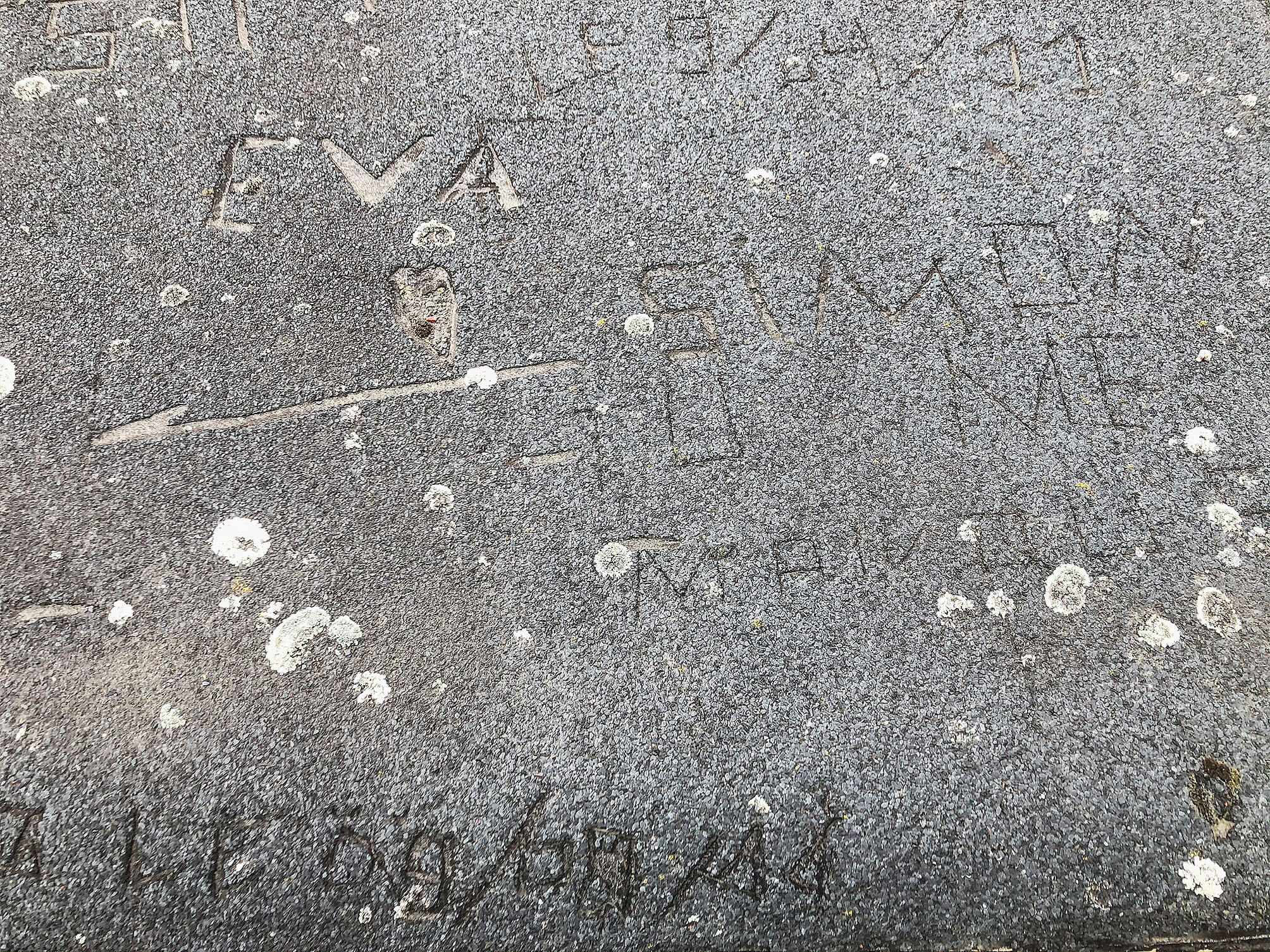
In what order and by whom the various texts and drawings were carved into the soft roofing is unclear. To the right of ‘EVA’, a heart symbol and an arrow (pointing to the left), the roofing reads ‘SIMON TU ME MANQUES’.
The short sentence usually – yet hastily – translates to ‘Simon, I miss you’. However, in French the ‘you’ (tu) is the subject and has an active role, whereas the ‘I’ (me) is the direct object. In short: by his not being there, Simon actively effectuates hurt to the one who carved this text.
In an attempt to make it his own, Gino – it might also be Dino – has taken a can of bright pink spray paint to his hard hat and – as the paint was drying – dragged his gloved finger from top to bottom. G – or D –, I, N, O. In the dust on a demolished floor tile, someone has written 12,10. Perhaps a measurement, a quantity, a position, a date, a reference.
Subtractive writing is not uncommon. With the tip of a passer-by’s index finger ‘WASH ME’ is subtracted from the dust on a dirty car. In freshly poured concrete, a name is embedded forever with a twig. In hot and soft roofing drawings and obscenities are scratched. Styrofoam lining a brand new elevator gets impressed with names, jokes and knuckles.
In the twenty-third canto of Ariosto’s Orlando Furioso (1516), Orlando comes across the name of his love and another man, carved in the bark of a tree. He doubts. But that night, a gossiping shepherd tells him he’s seen Angelica and Medoro together. Orlando returns to the forest, and in a four-day frenzy, he uproots every tree and pollutes the rivers forever.
CXXXI
For he turf, stone, and trunk, and shoot, and lop,
Cast without cease into the beauteous source;
Till, turbid from the bottom to the top,
Never again was clear the troubled course.
At length, for lack of breath, compelled to stop,
(When he is bathed in sweat, and wasted force,
Serves not his fury more) he falls, and lies
Upon the mead, and, gazing upward, sighs.1
Ariosto, L. Orlando Furioso. Translated by William Stewart Rose, Echo Library, 2006, p. 267.

On May 7th, 1992, an anonymous photographer records the ice cellar, a stone’s throw from my parents’ house. It’s a beautiful day in spring. Quite a bit of wind, it seems. A Thursday. Surely, I am at school. Third grade kindergarten. It houses bats.
The photograph is part of an online heritage inventory, maintained by a government department. On the same day, the photographer took a photograph of the orangery, the entrance gate to the allotment, and the castle.
https://id.erfgoed.net/afbeeldingen/264680

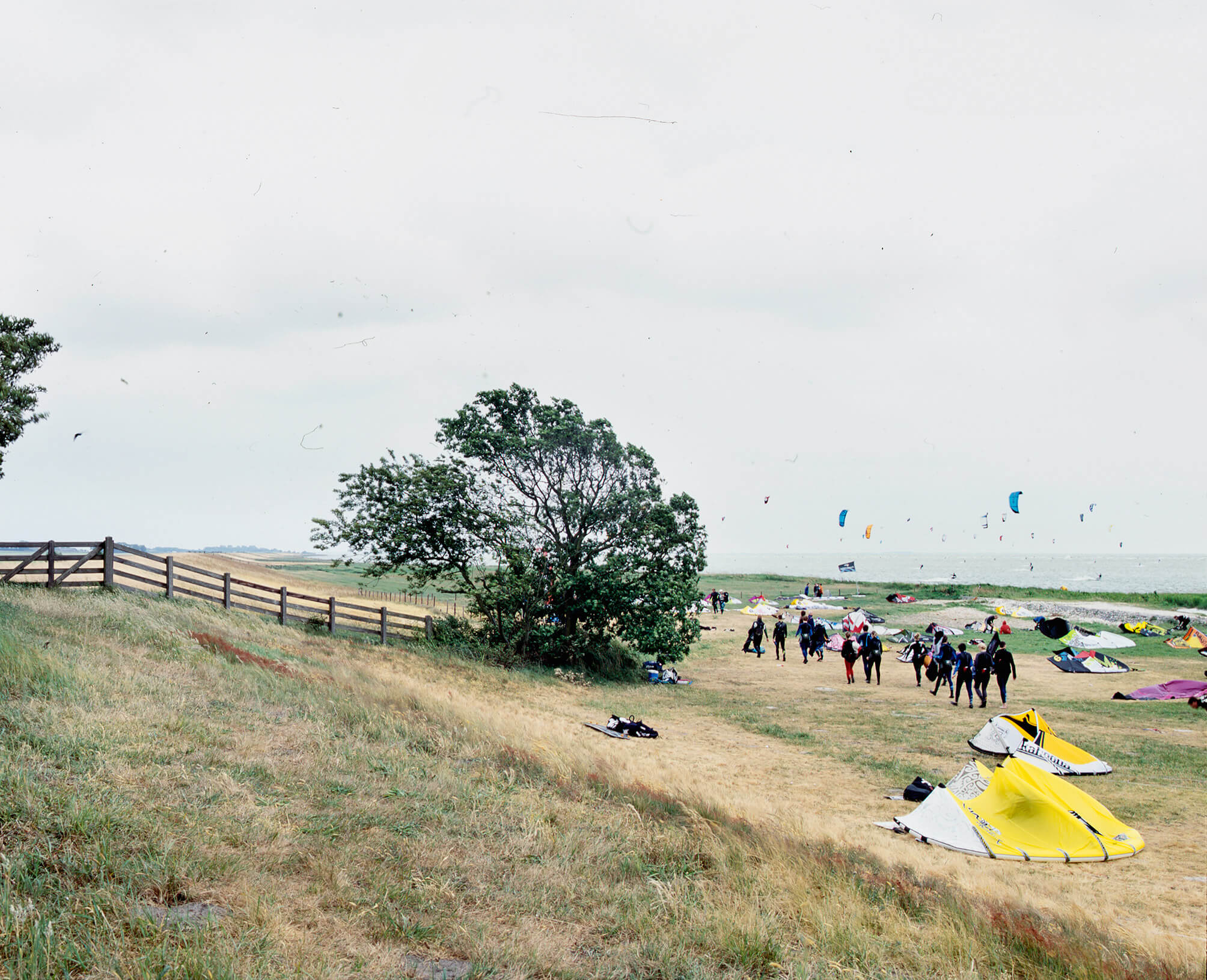
Ten years ago, in November, I drove up to Frisia – the northernmost province of The Netherlands. I was there to document the remains of air watchtowers: a network of 276 towers that were built in the fifties and sixties to warn the troops and population of possible aerial danger coming from the Soviet Union. It was very windy. The camera shook heavily. The poplars surrounding the concrete tower leaned heavily to one side.
I drove up to the seaside, a few kilometers farther. The wind was still strong when I reached the grassy dike that overlooked the kite-filled beach. I exposed the last piece of film left on the roll. Strong gusts of wind blew landwards.
Months later I didn’t bother to blow off the dust that had settled on the film before scanning it. A photograph without use, with low resolution, made for the sake of the archive’s completeness.
The dust on the film appears to be carried landwards, by the same gust of wind lifting the kites.
In between two cities along the Belgian coast, water has run from the dunes (and the Second World War Heritage site scattered among them), underneath the coastal road and tram rails, to the beach. It has formed a small S-shaped estuary, bound to disappear due to the increasingly harsh wind coming from the coast of Britain, blowing North-easterly, and hammering down on the levee. The vibrations of the empty Ostend-bound tram passing just before the photograph was taken, had no visible impact on the estuary.

A year before the crash, Swiss artist Charlotte Stuby designed a tailor-made cover for the car. The dents caused by the unfortunate hailstorm weren’t visible. The work, called Gone Fishing, was on view during an open air exhibition on the theme of the parking lot. Heavy wind had caused the temporary traffic signs on the parking lot, left there by the city services, to tip over. One hit a car and caused a scratch. It was unclear if this would be something the insurance company would accept. We attached Stuby’s cover a second time. Parking fines flew irregularly across the lot.
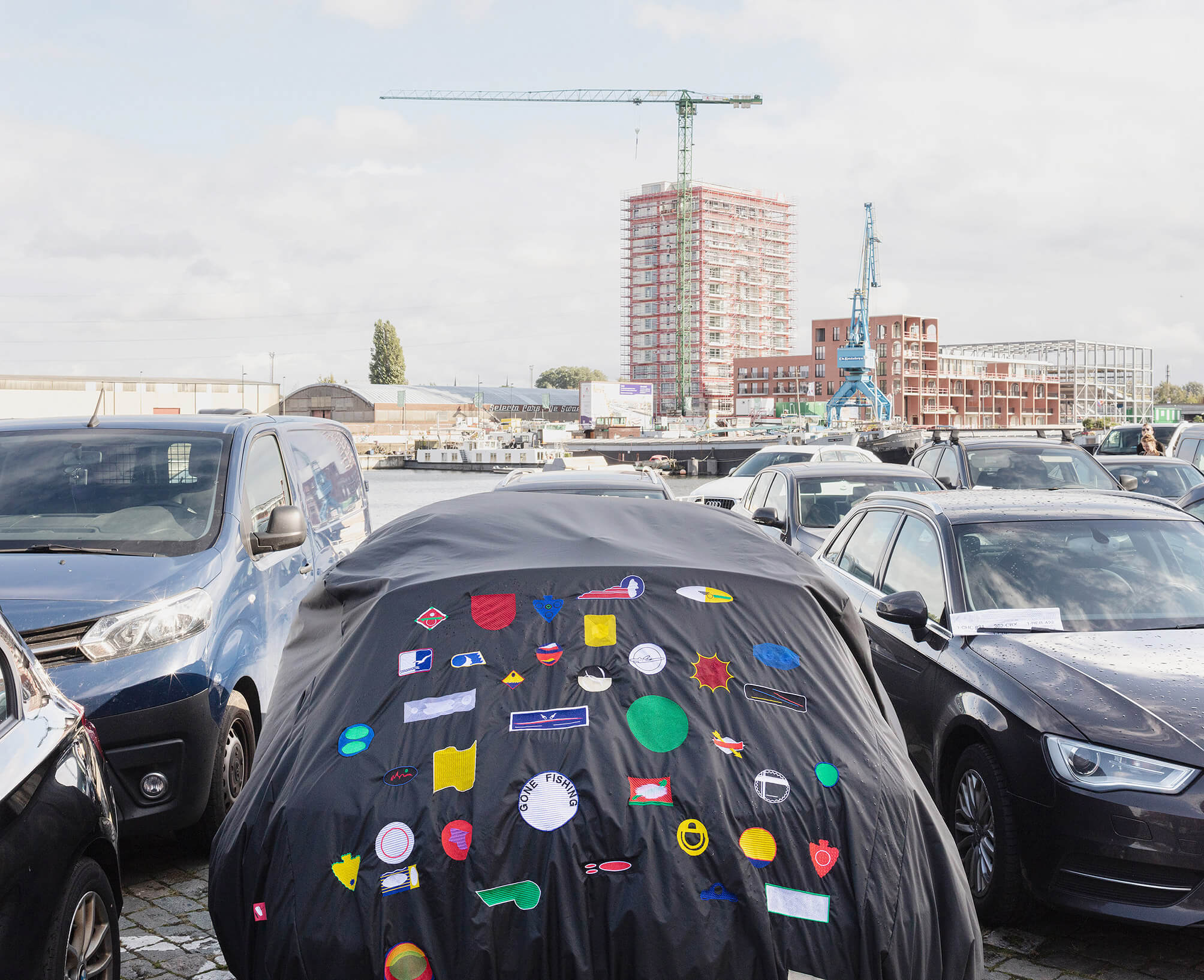
In June, 2014, a severe hailstorm hit Belgium. Warnings were broadcast. A football game between the national teams of Belgium and Tunisia was paused. The morning after, there were small dents in the hood and the roof of the car, each a square centimeter in size, some 10 centimeters separated from each other. The storm didn’t get a name.
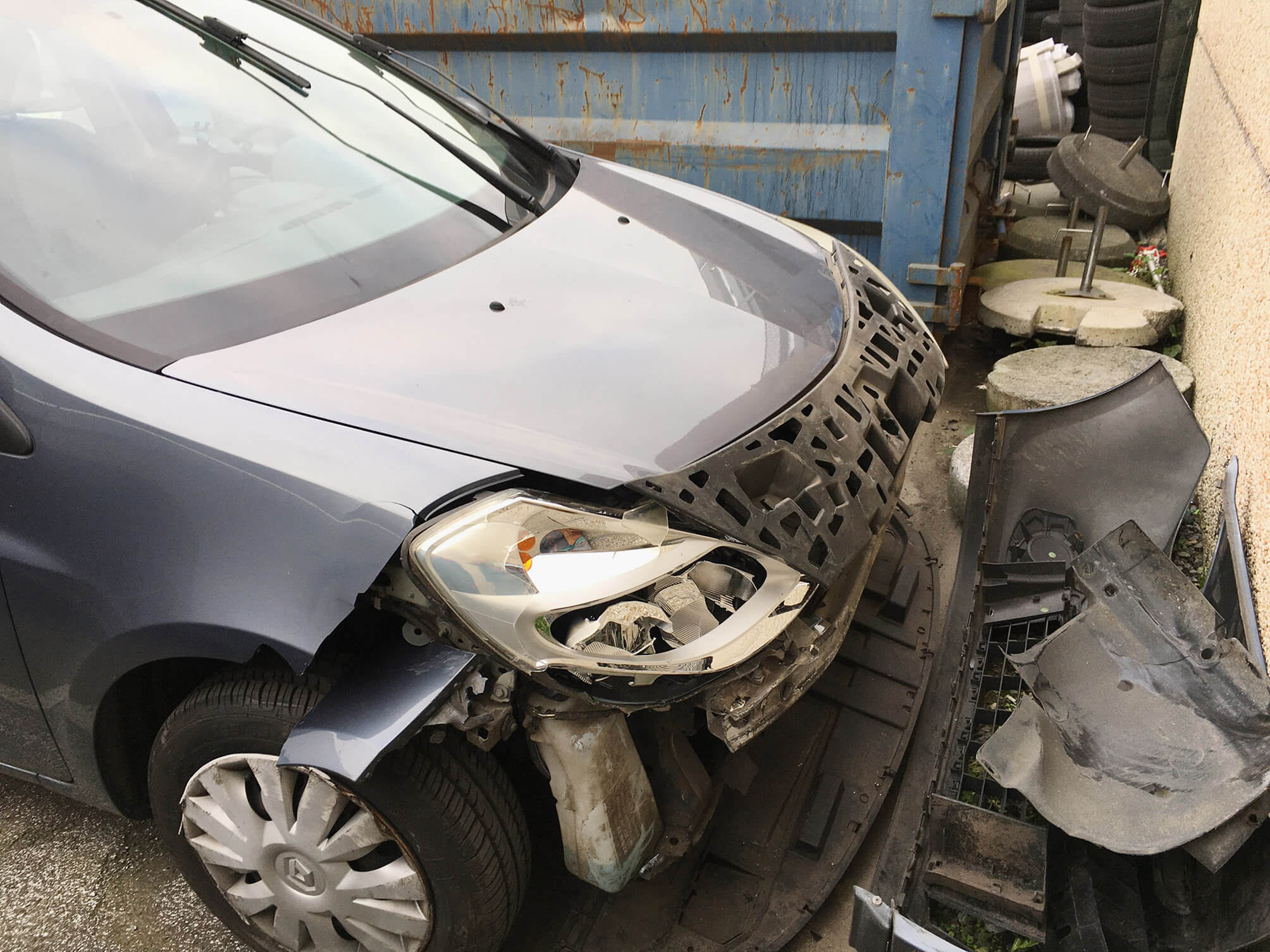
Assessing the damage, the insurance company’s expert took the dents into account to establish the wreck’s worth.
A malfunctioning of the camera leading to a double-exposed negative. The car is decisive in establishing the relationship between the superimposed photographs. In the middle of the image, we see it parked in front of the house. Slightly less visible is the same car, repeated but further away. This makes it possible to deduce that the dark outline of the house, with the roof and the chimney, is also the same house as in the other photograph. This time, the house is photographed relatively frontally (the slightly angled point of view allows to bring the shed at the back of the house in the line of sight), and from nearby. At the bottom left, the lines that make up the street help to see the continuity of the one photograph, while the electric wires at the top right aid to comprehend the other one.
The camera malfunction speculates on a future addition to the plot. The dark, outlined shed’s scale is realistic with regards to the scale of the house and itself (the shed) in the other photograph. Its position with regards to the other buildings seems logical. It imposes itself as a possible second shed for the owner to build in the next few years. In that future shed, the car, now standing in front of the house, could be comfortably parked.

‘Meunerie Duyckers & Conors, les nouveaux moulins’, better known as ‘De Nieuwe Molens’, is a flour mill established in 1897 in the north of Gent along the Verbindingskanaal. Due to increased production, the original 1897 building doubled in 1904.
Only the facade of the iconic warehouse has been preserved along with the recently renovated gasometers. The building is now part of the Tondeliersite. It has been converted into lofts and flats, and was extended with a new construction.
https://inventaris.onroerenderfgoed.be/erfgoedobjecten/18269

I drove through the neighborhood seeking evidence of the disruption using a power outage map as a compass. Winding through quiet streets, I stumbled upon a lone blue PG&E truck idling opposite a charred utility pole with fragments of wood and wire strewn across the pavement. I parked my car and walked toward the truck to ask the driver what had happened. He pointed to the top of the pole where a porcelain insulator dangled precariously from a high-voltage line. “Tracking,” he said curtly. “Is that like a short circuit?” I asked. “Kind of,” he replied before pausing. He finally elaborated, explaining that the problem arises when moisture from morning fog settles on power lines, creating a pathway for electricity to arc across components.
He then input something into a handheld device before driving away, leaving the repair for another service team to complete. I gathered the debris intending to collect the remaining components that comprise a utility pole, each having failed in one form or another. I shipped the fragments to Maziar the following week.
Mathew Kneebone is an artist based in San Francisco. His interdisciplinary practices takes different forms, all in relation to an interest in electricity and technology. He teaches studio and thesis writing at California College of the Arts.


The orthopaedic surgeon left early that morning for his shift at the hospital some twenty kilometres away. It must have been around the time Neptune was at its highest, invisible in the morning sky.
When he got back later that day, we attached a tow cable to the front of my car and the back of his.


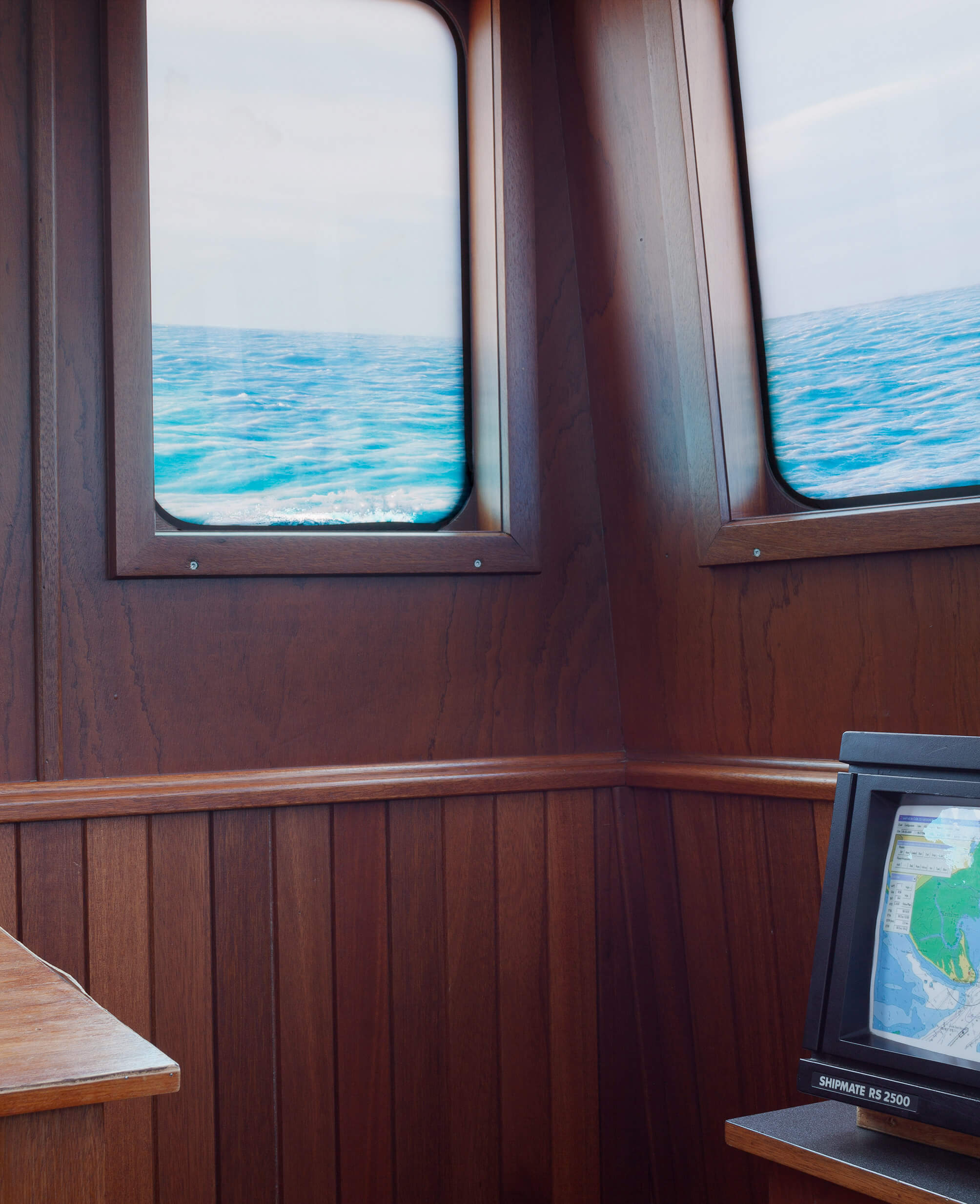
The GPS-plotter displays the ship near Keyhaven Lake, indefinitely. The sea appears calm, the horizon is level from one perspective.
In his Handboek Varende Scheepsmodellen (Handbook Sailing Ship Models) André Veenstra explains the different classes in ship model-competitions. There’s a wide variety. For static ship models the most important one is ‘truth-to-nature’. A jury compares the model to photographs of the actual ship and brings into account categories such as amount of work, degree of difficulty, scale ratio, construction execution and painting.
The most interesting class – according to Veenstra – is F 6. In this particular class, a number of participants with different boats will form a team. Together, they will perform a certain ‘act’ with a maximum duration of ten minutes. During the act, they mimic a slice of reality. Such as, for example, ‘rescuing’ and towing a ship in distress; extinguishing a fire on a tanker or oil rig, lichen and/or tow the sunken wreckage to the harbor, stage a naval battle, etc.
Page 262 shows a photograph of such a mimicked slice of reality. The caption explains: ‘Image 14.15. The Dutch demonstration in the F 6 class during the European Championship of 1975: the oil rig is set on fire by a motorboat with terrorists. The fire is extinguished and the oil rig is quickly towed to a safe harbor by tugs. The show was performed by six people and took a very creditable fourth place.’

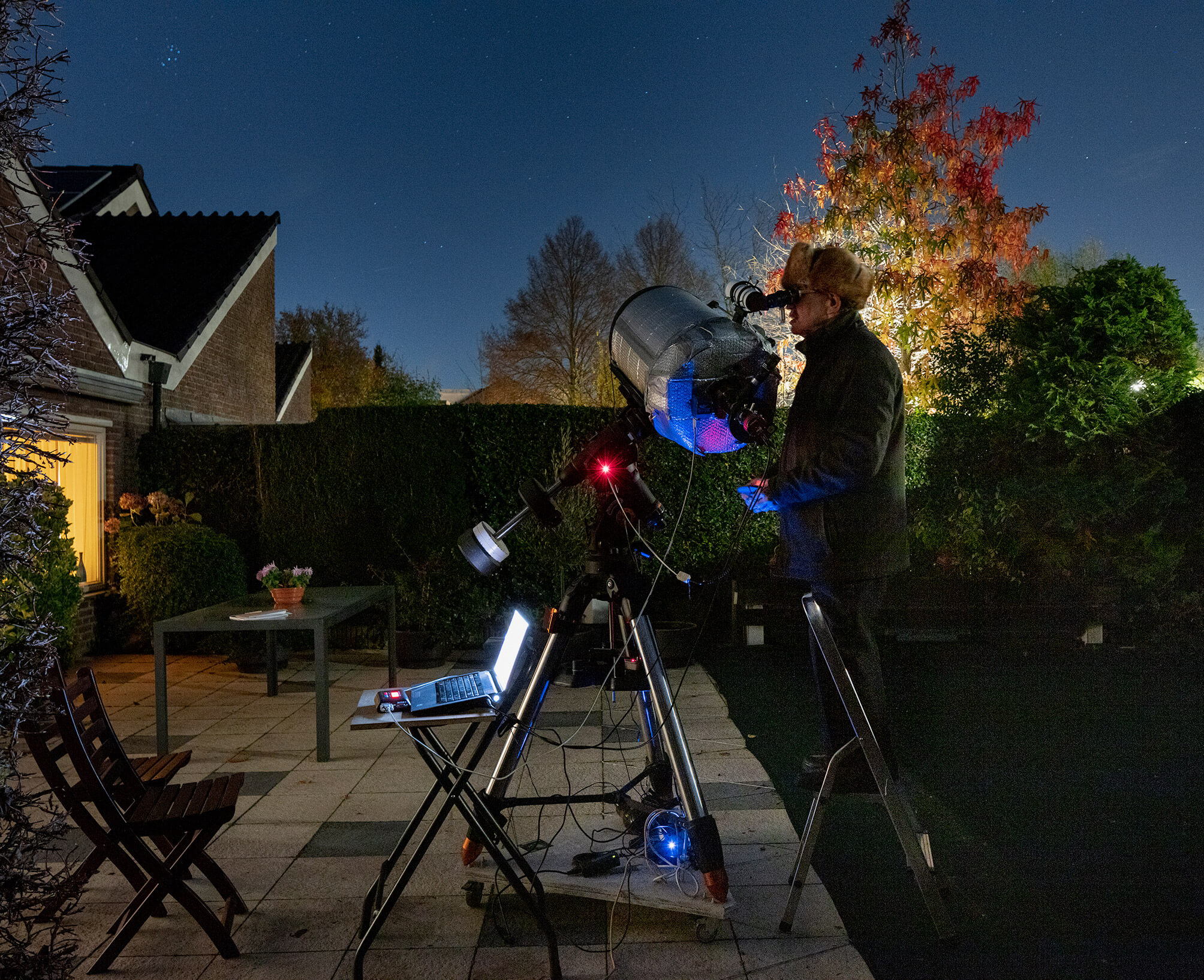
Each night a plethora of amateur-astronomers gazes into the sky. Their instruments and locations are often inferior to the means available to professionals. Yet, what they lack in terms of technology and location, darkness and mirror surface, they make up for in the collectivity of their observations. They are patient observers, spread around the globe, not bound to the strict schedules and limited availability of the large telescopes in the Atacama Desert.
When amateur astronomy became fashionable, it led to a surge of information stemming from a large group of distinct observers: seafarers, physicians, typists, masons. Theirs were valuable data, but if they were to be put to scientific use, they needed to be standardised. How to overcome the subjective element inherent in every empirical observation? The amateurs had to be instructed to recognize patterns, by means of visual examples. They had to be trained to use the right terms to describe their observations. They had to turn chaos into order. Recognize what they were looking at. A nebula. A red giant. Neptune’s faint blue-greenish colour resembling the flame of the gas stove.
Hueso, R. e.a., ‘Neptune long-lived atmospheric features in 2013-2015 from small (28-cm) to large (10-m) telescopes’, Icarus, 295, 2017, 89-109.
Lorenz, R.D. e.a. ‘Backyard spectroscopy and photometry of Titan, Uranus and Neptune’, Planetary and Space Science, 51, 2003, 113-125.
Besides the scale indicating the length in centimeters, and the marks made by using it, a folding ruler displays other marks. These are the marks found on the weber broutin www.weber-broutin.be folding ruler, from left to right:
- 2m (in a frame, between 1cm and 2cm); indicating the total length of the folding ruler.
- a hexagon, barely visible, punched into the wood (between 2cm and 3cm); unknown signification.
- LUXMA (in a frame, between 4cm and 5cm); the manufacturer of the folding ruler (different from the company who ordered the folding ruler, their (the company’s, i.c. weber-broutin’s) name is printed on the sides of the ruler, and is only readable when the ruler is folded together for at least 50% (=1m).
- III (in an oval, between 6cm and 7cm); indication of the preciseness of the scale in centimeters, with ‘I’ in roman numbers meaning the most precise, and ‘IV’ in roman numbers meaning the least precise. (It is therefore not entirely certain that the ‘III’ on weber-broutin’s folding ruler can actually be found between 6cm and 7cm.)
- D 99 (in an oval, probably between 7cm and 8cm, see argument mentioned above); unknown signification.
- 1.1.60 (in an oval, probably between 7cm and 8cm, beneath D 99), signification unknown.
