What constitutes a ‘document’ and how does it function?
According to the Oxford English Dictionary, the etymological origin is the Latin ‘documentum’, meaning ‘lesson, proof, instance, specimen’. As a verb, it is ‘to prove or support (something) by documentary evidence’, and ‘to provide with documents’. The online version of the OED includes a draft addition, whereby a document (as a noun) is ‘a collection of data in digital form that is considered a single item and typically has a unique filename by which it can be stored, retrieved, or transmitted (as a file, a spreadsheet, or a graphic)’. The current use of the noun ‘document’ is defined as ‘something written, inscribed, etc., which furnishes evidence or information upon any subject, as a manuscript, title-deed, tomb-stone, coin, picture, etc.’ (emphasis added).
Both ‘something’ and that first ‘etc.’ leave ample room for discussion. A document doubts whether it functions as something unique, or as something reproducible. A passport is a document, but a flyer equally so. Moreover, there is a circular reasoning: to document is ‘to provide with documents’. Defining (the functioning of) a document most likely involves ideas of communication, information, evidence, inscriptions, and implies notions of objectivity and neutrality – but the document is neither reducible to one of them, nor is it equal to their sum. It is hard to pinpoint it, as it disperses into and is affected by other fields: it is intrinsically tied to the history of media and to important currents in literature, photography and art; it is linked to epistemic and power structures. However ubiquitous it is, as an often tangible thing in our environment, and as a concept, a document deranges.
the-documents.org continuously gathers documents and provides them with a short textual description, explanation,
or digression, written by multiple authors. In Paper Knowledge, Lisa Gitelman paraphrases ‘documentalist’ Suzanne Briet, stating that ‘an antelope running wild would not be a document, but an antelope taken into a zoo would be one, presumably because it would then be framed – or reframed – as an example, specimen, or instance’. The gathered files are all documents – if they weren’t before publication, they now are. That is what the-documents.org, irreversibly, does. It is a zoo turning an antelope into an ‘antelope’.
As you made your way through the collection,
the-documents.org tracked the entries you viewed.
It documented your path through the website.
As such, the time spent on the-documents.org turned
into this – a new document.
This document was compiled by ____ on 01.11.2026 23:15, printed on ____ and contains 23 documents on _ pages.
(https://the-documents.org/log/01-11-2026-6939/)
the-documents.org is a project created and edited by De Cleene De Cleene; design & development by atelier Haegeman Temmerman.
the-documents.org has been online since 23.05.2021.
- De Cleene De Cleene is Michiel De Cleene and Arnout De Cleene. Together they form a research group that focusses on novel ways of approaching the everyday, by artistic means and from a cultural and critical perspective.
www.decleenedecleene.be / info@decleenedecleene.be - This project was made possible with the support of the Flemish Government and KASK & Conservatorium, the school of arts of HOGENT and Howest. It is part of the research project Documenting Objects, financed by the HOGENT Arts Research Fund.
- Briet, S. Qu’est-ce que la documentation? Paris: Edit, 1951.
- Gitelman, L. Paper Knowledge. Toward a Media History of Documents.
Durham/ London: Duke University Press, 2014. - Oxford English Dictionary Online. Accessed on 13.05.2021.

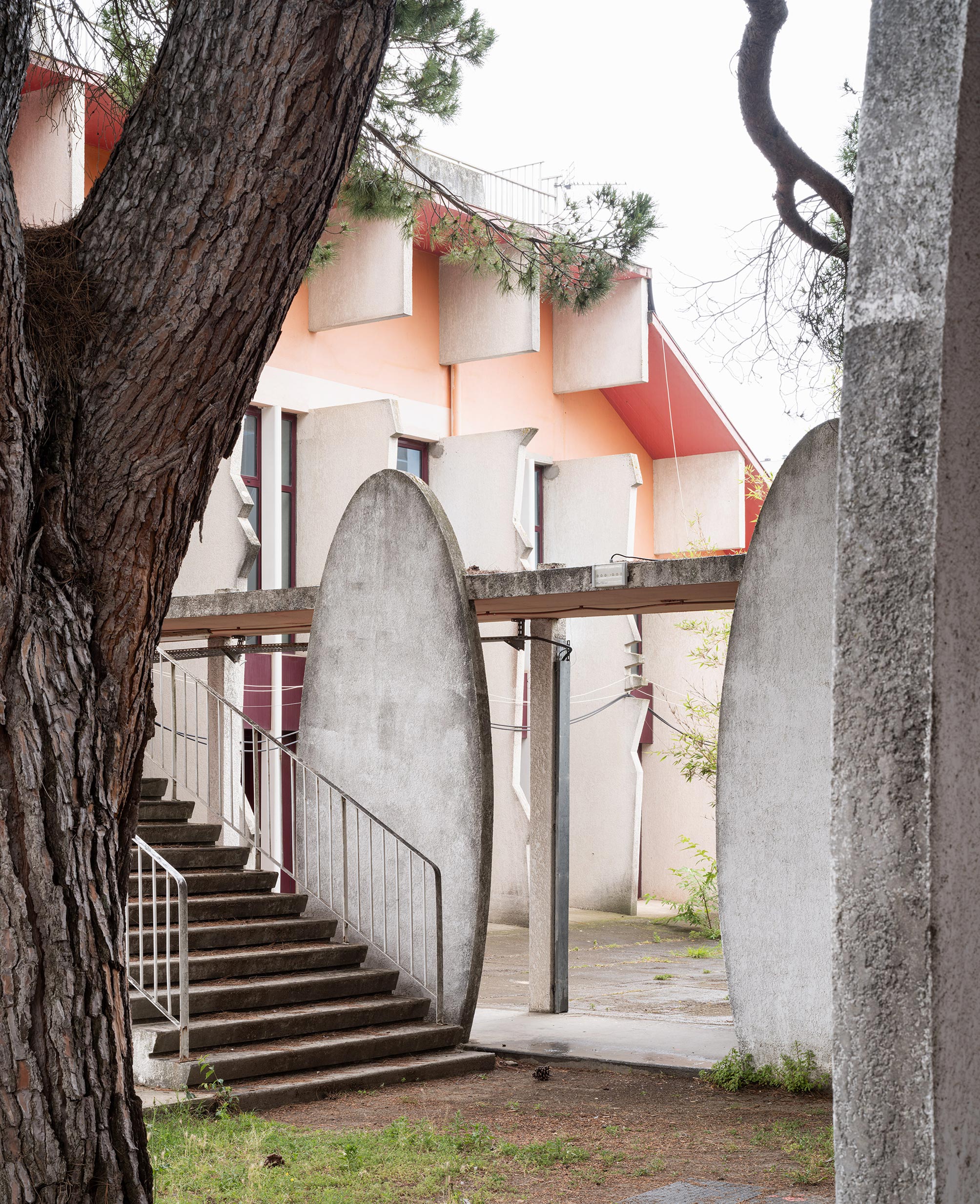
Built in 1969, the salle polyvalente1 in La Grande-Motte2 was the first venue where the residents – back when there were only 700 of them – could gather. Jean Balladur had envisioned an open-air theatre covered by a removable stretched canvas, adjacent to a single-storey multipurpose hall. The load-bearing structure, Balladur explained, consists of anthropomorphic columns sculpted by Albert Marchais: “My friend the sculptor, painter, poet and man of the theatre, Albert Marchais, devised the design for a sliding formwork that made it possible to cast the columns… they line up on either side of the hall in patterns that free them from the strict constraints of matter. This freedom is the joy of all sculpture.”3
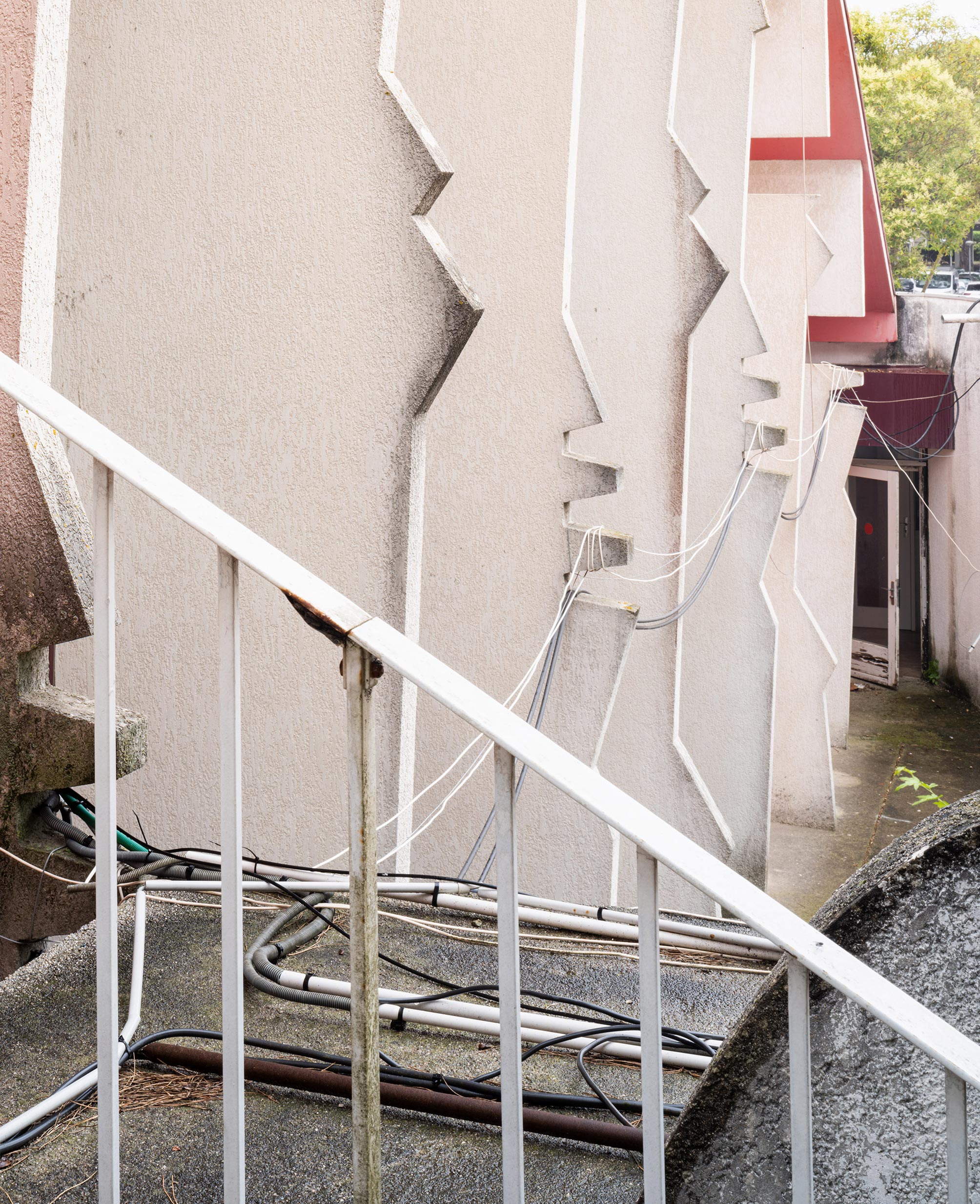
The geometric forms that make up the hands and arms of these figures are today strung with cables carrying electricity and data.
Jean Balladur was never fond of the term ‘salle polyvalente’, he preferred ‘salle commune, dédié à la fête’ – a communal hall, dedicated to parties. Since 2019 it is officially the Centre Culturel Henri Dunoyer, after a former mayor.
La Grande-Motte is a seaside resort created by the Mission Racine, the state programme for the development of the Languedoc coastline in southern France. Intended as a holiday destination for the middle class in the 1970s, it is the work of architect Jean Balladur (1924–2002), who was tasked with designing the entire urban layout and architecture of the new town. He drew inspiration from pre-Columbian pyramids and from modernist architecture in Brazil, especially the work of Oscar Niemeyer. At a time when large housing complexes were going up all over France in the form of tower blocks and slabs, Balladur’s solutions were different enough that La Grande-Motte was a success from the very beginning.
« Mon ami le sculpteur, peintre, poète, homme de théâtre, Albert Marchais, a imaginé le dessin d’un coffrage glissant qui a permis de couler les poteaux… ils s’alignent de chaque côté de la salle dans des figures qui les affranchissent des strictes contraintes de la matière. Cette liberté fait le bonheur de toute sculpture. »
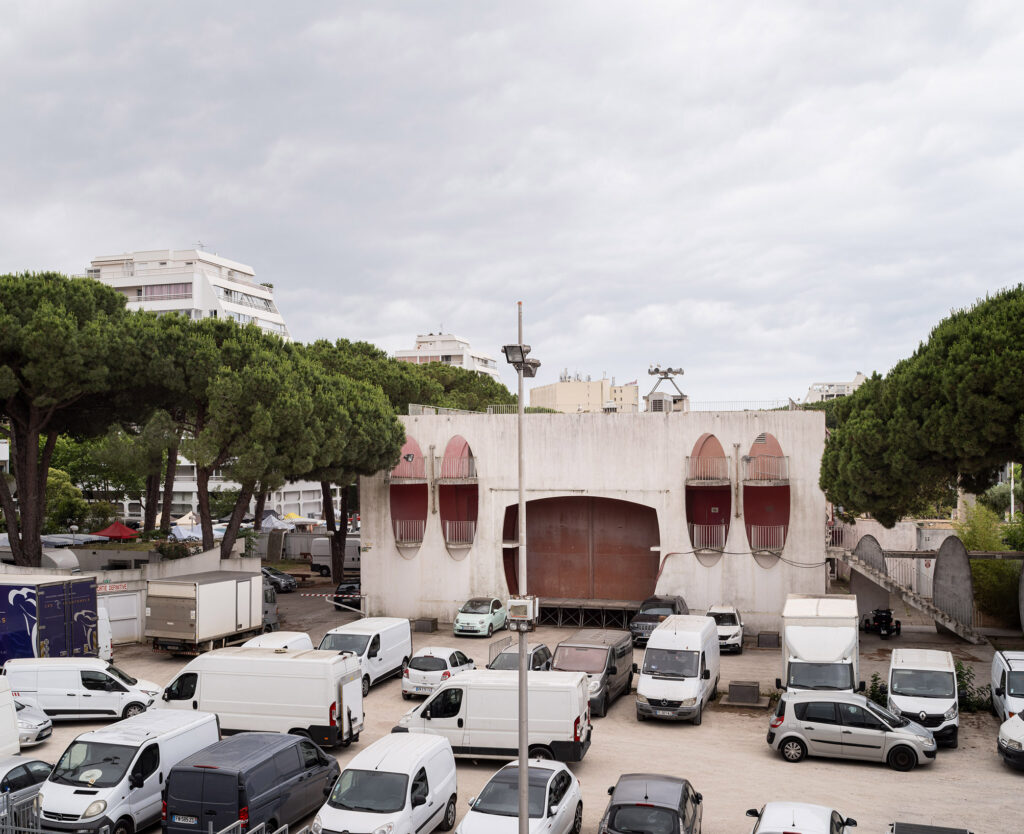
On market days, the parterre of the open-air theatre serves a a car park for the vendors’ vans and cars.
François, Michèle. Jean Balladur et la Grande-Motte: l’architecte d’une ville. Duo. Monuments historiques et objets d’art du Languedoc-Roussillon, Direction régionale des affaires culturelles, 2010, p. 41-42.
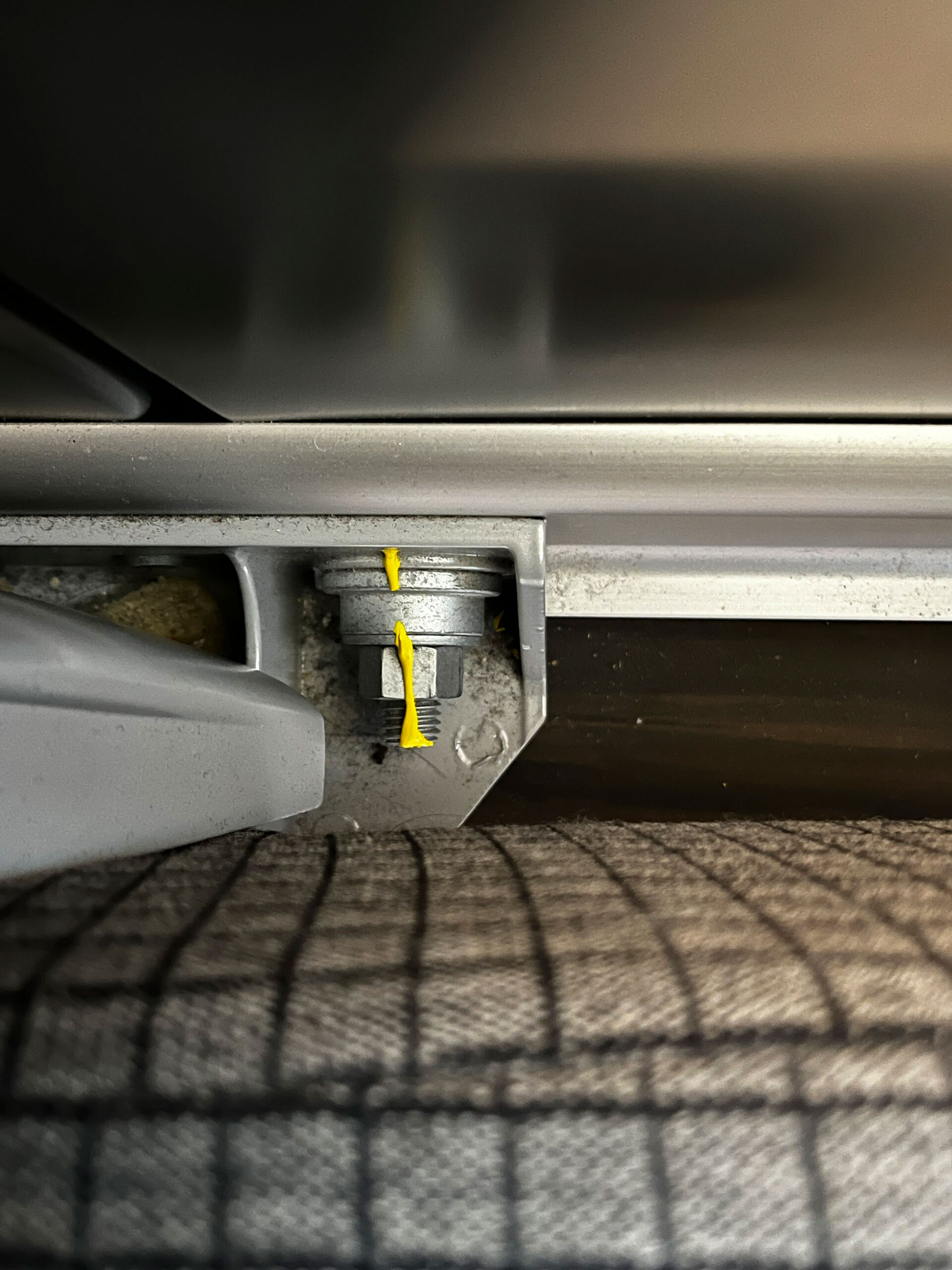
On the train between Brussels and Leuven someone appears to have spilled bright yellow mustard in a straight line onto the bolt, washer and nut that attach my seat to the structure of the carriage.
Hours later, on the train home, a similar bead. The mustard is hard and somewhat brittle1 beneath my index finger.
I search the internet for ‘lijntje verf op bout en moer’. Torque seal is a brightly colored paste applied across a tightened nut and bolt to provide a quick visual check of whether the fastener has moved or loosened due to shock, vibration or tampering. According to the same search, DIY enthusiasts often use nail polish.

Built in 1969, the salle polyvalente1 in La Grande-Motte2 was the first venue where the residents – back when there were only 700 of them – could gather. Jean Balladur had envisioned an open-air theatre covered by a removable stretched canvas, adjacent to a single-storey multipurpose hall. The load-bearing structure, Balladur explained, consists of anthropomorphic columns sculpted by Albert Marchais: “My friend the sculptor, painter, poet and man of the theatre, Albert Marchais, devised the design for a sliding formwork that made it possible to cast the columns… they line up on either side of the hall in patterns that free them from the strict constraints of matter. This freedom is the joy of all sculpture.”3
The geometric forms that make up the hands and arms of these figures are today strung with cables carrying electricity and data.
Jean Balladur was never fond of the term ‘salle polyvalente’, he preferred ‘salle commune, dédié à la fête’ – a communal hall, dedicated to parties. Since 2019 it is officially the Centre Culturel Henri Dunoyer, after a former mayor.
La Grande-Motte is a seaside resort created by the Mission Racine, the state programme for the development of the Languedoc coastline in southern France. Intended as a holiday destination for the middle class in the 1970s, it is the work of architect Jean Balladur (1924–2002), who was tasked with designing the entire urban layout and architecture of the new town. He drew inspiration from pre-Columbian pyramids and from modernist architecture in Brazil, especially the work of Oscar Niemeyer. At a time when large housing complexes were going up all over France in the form of tower blocks and slabs, Balladur’s solutions were different enough that La Grande-Motte was a success from the very beginning.
« Mon ami le sculpteur, peintre, poète, homme de théâtre, Albert Marchais, a imaginé le dessin d’un coffrage glissant qui a permis de couler les poteaux… ils s’alignent de chaque côté de la salle dans des figures qui les affranchissent des strictes contraintes de la matière. Cette liberté fait le bonheur de toute sculpture. »
On market days, the parterre of the open-air theatre serves a a car park for the vendors’ vans and cars.
François, Michèle. Jean Balladur et la Grande-Motte: l’architecte d’une ville. Duo. Monuments historiques et objets d’art du Languedoc-Roussillon, Direction régionale des affaires culturelles, 2010, p. 41-42.
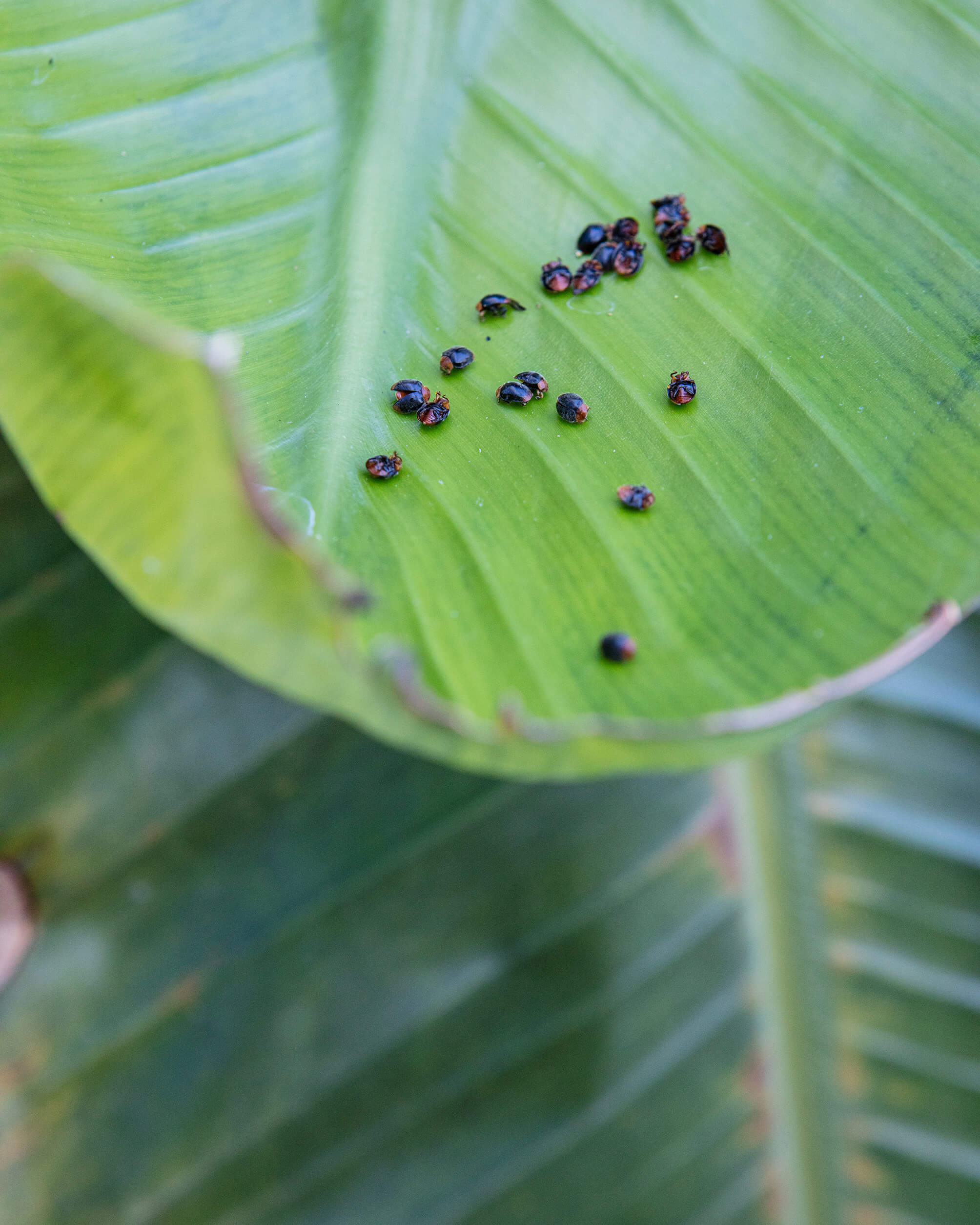
The Cryptolaemus montrouzieri is commonly known as the mealybug destroyer. This species of ladybird gets its nickname from its capacity to battle mealybugs in plantations and greenhouses.
The website waarnemingen.be that gathers observations of plants and animals in Belgium lists multiple observations in the wild of the Cryptolaemus montrouzieri. The website explains that ‘in (northern) Europe, the species is widely traded and used in greenhouses and will regularly escape from them. But this ladybird cannot survive our winters (yet?). Sightings within the Benelux must therefore be entered into the register as “escape”. However, the species is already established in the Mediterranean area.’ (our translation)
The larvae have a waxy covering that makes them look like the mealybugs they prey upon, allowing them to avoid being correctly identified by the ones they are about to devour.
In an attempt to get rid of the mealybugs on my plants, I ordered 25 adult ladybirds. They were dead on arrival.
https://waarnemingen.be/species/600135/
https://waarnemingen.be/observation/244840499/
https://en.wikipedia.org/wiki/Aggressive_mimicry
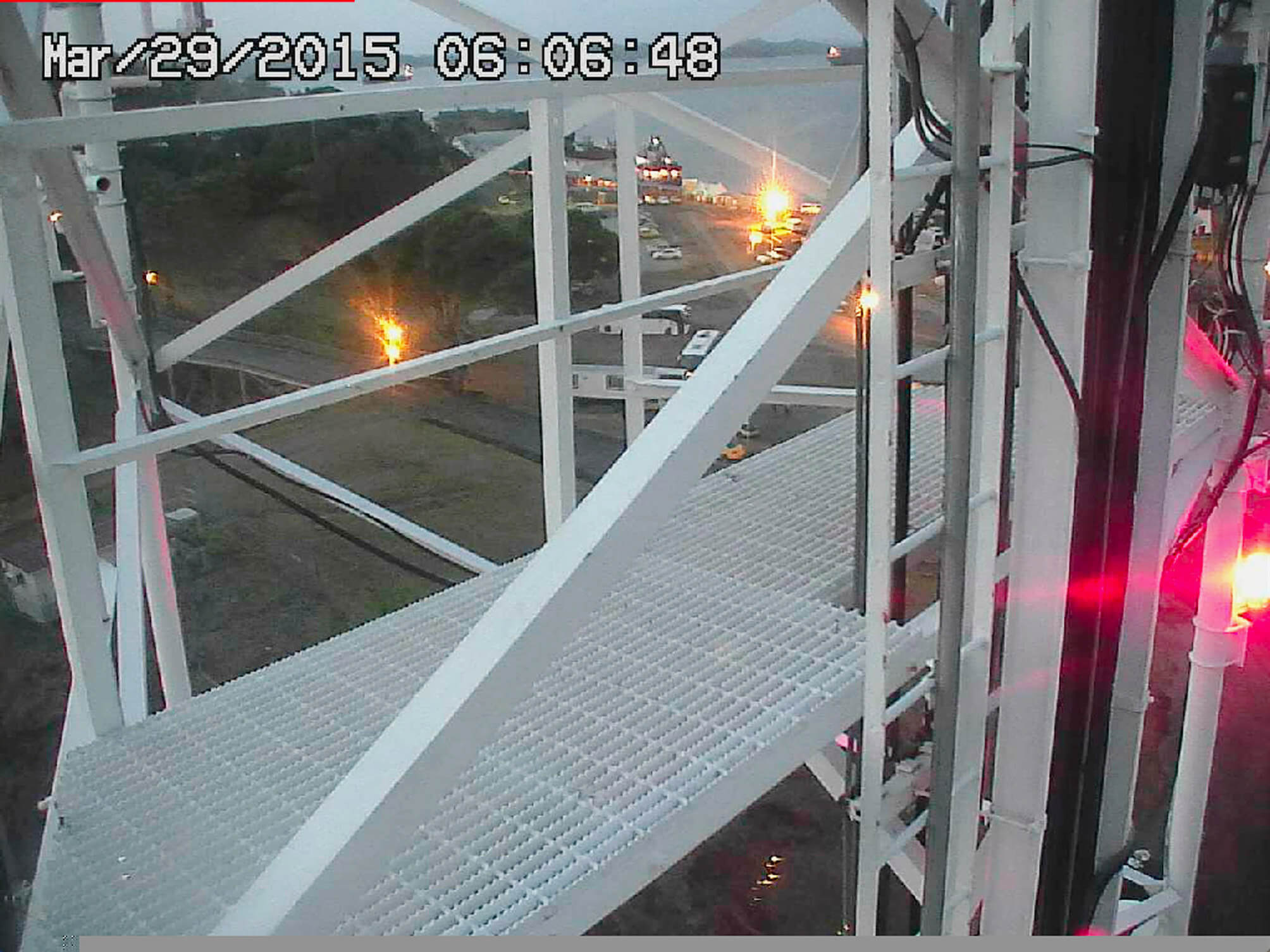
On March 23th 2015, a high pressure system above Panama Bay blew strong winds landwards. At the Gatun locks, one of the webcams overlooking the Canal neglected the traffic and briefly captured its own images. The ship’s presumed passage through the Gatun locks wasn’t recorded by this camera and the AIS-transponder did not save any data of the ship’s transit from the Pacific to the Atlantic side of the canal: the Authenticity managed to swap oceans undetected.
On February 16th 2016, the transponder still signals the ship near the port of Bahia Las Minas. The current is calm, the ship has been practically immobile for a year.
First published in: De Cleene, M. Reference Guide. Amsterdam: Roma Publications, 2019
Webcam Gatun Locks, Panama Canal, http://www.pancanal.com
In Boarhunt, close to Winchester (UK), the fort houses the Royal Armouries’ artillery collection. It contains parts of the ‘Project Babylon’ space gun, the two part bronze Dardanelles Gun and a collection of French field guns, captured in Waterloo. On the lawn to the South of the fort two neat piles of fifteen1 36” shells flank a Mallet’s Mortar. Manufactured in 1857, the mortar remains unfired up to this day.2 In 1873, its inventor – the engineer and geophysicist Robert Mallet – publishes his translation of Luigi Palmieri’s Incendio Vesuviano. Before giving a lengthy account of his take on the present state of vulcanicity, he briefly introduces the famous Italian vulcanologist’s report: ‘The following Memoir of Signor Palmieri on the eruption of Vesuvius in April of this year (1872), brief as it is, embraces two distinct subjects, viz., his narrative as an eye-witness of the actual events of the eruption as they occurred upon the cone and slopes of the mountain, and his observations as to pulses emanating from its interior, as indicated by his Seismograph, and as to the electric conditions of the overhanging cloud of smoke (so called) and ashes, as indicated by his bifilar electrometer, both established at the Observatory.’
O
O OOO
OOO OOOOOOO
In the outskirts of East of London, along Repository road in Woolwich, the only other mortar of this type is installed. This particular one fired nineteen shells on three occasions. Each time resulting in a damaged mortar.
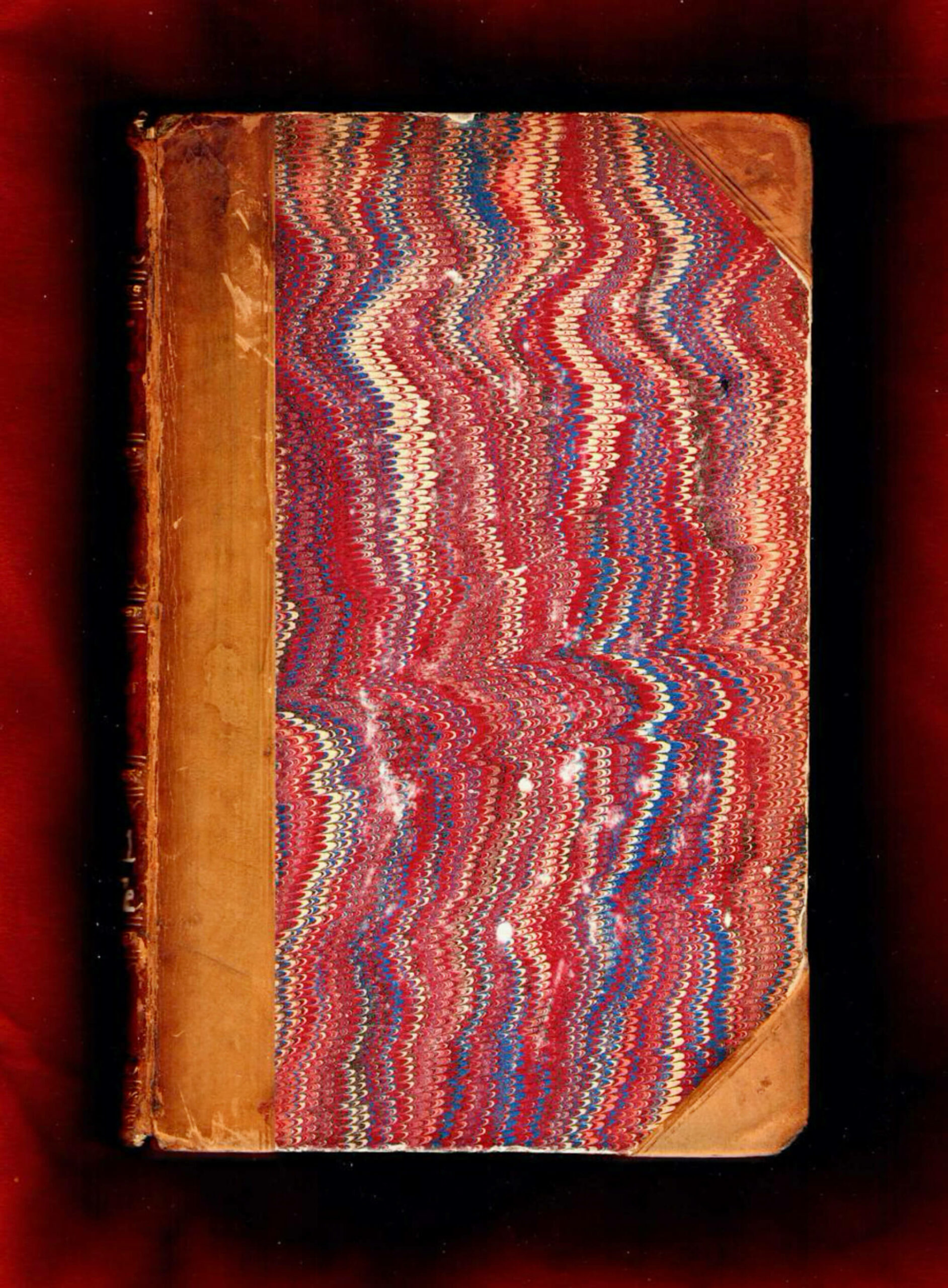
Screenshot taken from AbeBooks, where the first edition of The Eruption of Vesuvius in 1872 with Notes, and an Introductory Sketch on the Present State of Knowledge of Terrestrial Vulcanicity, the Cosmical Nature and Relations of Volcanoes and Earthquakes is listed for 1895,00 USD. https://www.abebooks.com/first-edition/Eruption-Vesuvius-1872.with-Notes-Introductory-Sketch/439314424/bd
Project Gutenberg’s The Eruption of Vesuvius in 1872, by Luigi Palmieri (translated by Mallet) can be found at: https://www.gutenberg.org/files/33483/33483-h/33483-h.htm
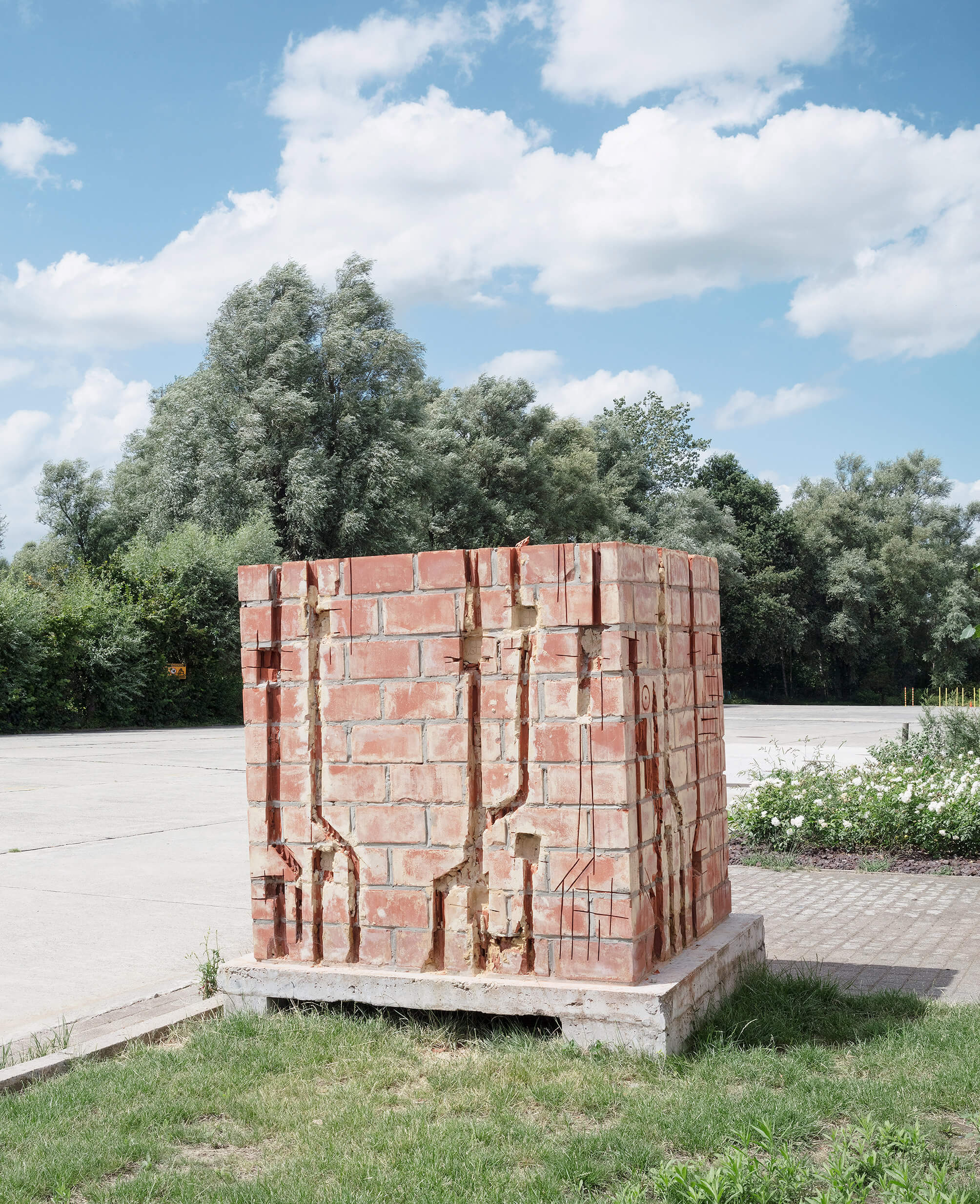
‘The masons in training pour a concrete slab and build four walls upon it in a stretcher bond. Then the block comes to our department and the students in the course Electrical installer (residential) can grind channels and drill cavities in it.’
[…]
‘It’s not always a success from the outset, but they learn quickly.’
[…]
‘Never grind horizontally, always vertically. Diagonally if there is no other way.’
[…]
‘Two fingers wide.’
[…]
‘After this it goes to the sanitary department. After the bell drilling, the demolition hammer follows and the masons make us a new block.’
Competentiecentrum VDAB, Wondelgem, July 2019.
First published in A+ Architecture in Belgium, A+ 279, Schools (August, September 2019), https://www.a-plus.be/nl/tijdschrift/schools
Freely adapted from interviews with residents of Sandersleben (Saxony-Anhalt). Three-act play. The first two acts take place in the present day; the third is set in the future.
From Act 1 ‘The Town of S’, Scene 2 ‘The Past’.
Characters: MR DUNST club member I, OLIVER club member II, ANJA young mother
Stills from text animation S. Anders Leben. Eine Handlung in Gesprächen/S. Anders Leben – Living Differently: An Act in Conversations
Stephanie Kiwitt (1972) is an artist based in Halle (Saale), Germany. Utilizing a large number of images, various perspectives and also textual elements, she is known for her insightful photography that explores spaces emblematic of contemporary phenomena. Over the past three years, she has focused on evolving habitats in rural areas, photographing traces of transformation and conducting interviews in Saxony-Anhalt, the region she moved to in 2020. From 2018 to 2020, Kiwitt was a guest lecturer at the LUCA School of Arts in Brussels.
In spring 2024 the-documents.org and Trigger co-publish a series of online articles with a focus on the meeting ground between photography and the document.

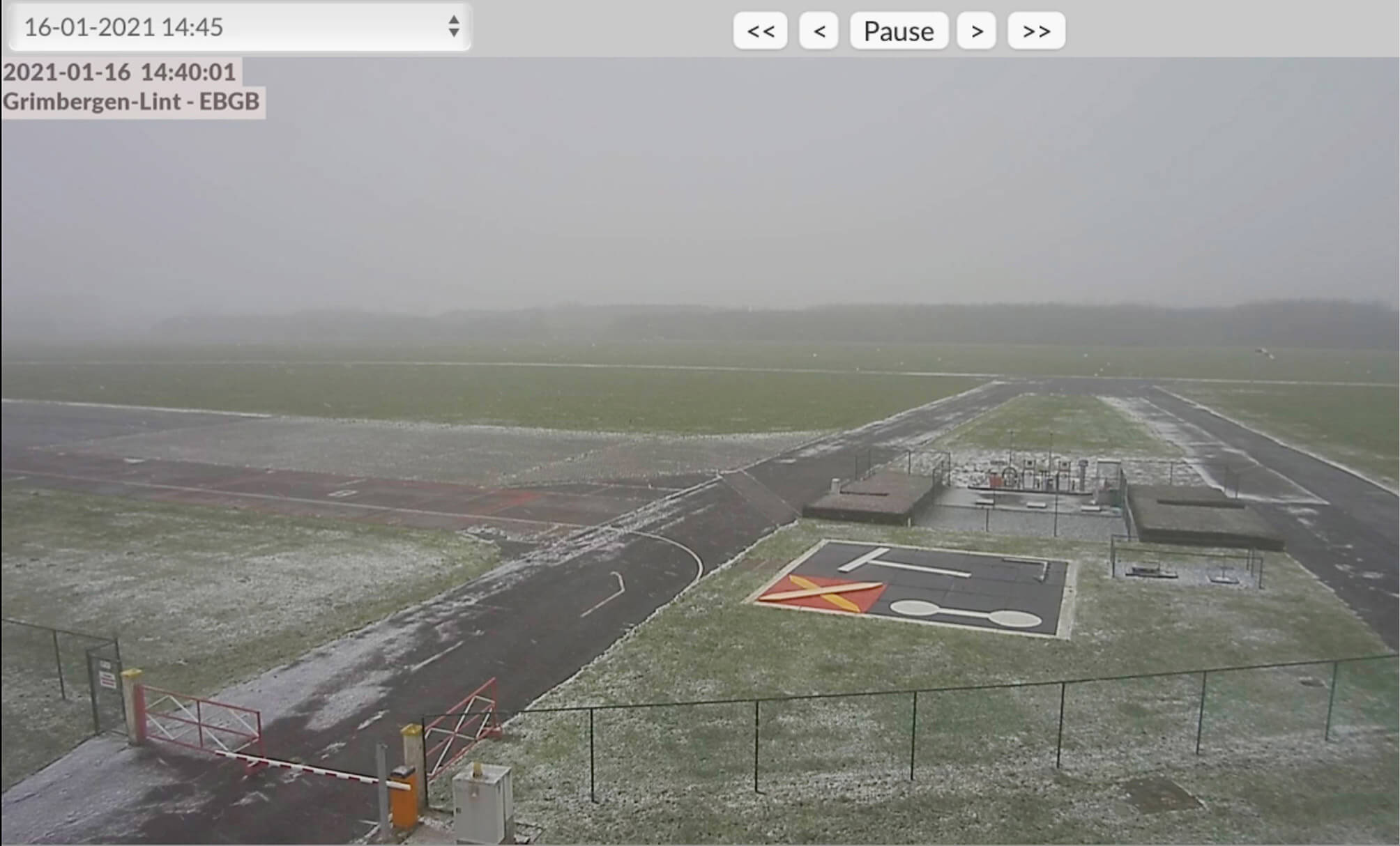
Recreational airfield at Grimbergen, webcam footage.
09:10:00The frame shows the first movement on the terrain. The gate has been opened, the barrier lowered. A black car is in the back. In the forefront, aviation signs on the ground: a yellow cross on a surface painted red; an arrow in a 90° angular shape; two circles connected by a line; a T-shaped line.
09:20:00Two men talking, each one on one side of the barrier. The man on the side of the airstrip has two dogs with him. The aviation signs have changed: the arrow is gone; the horizontal bar of the T-symbol has moved to the other side of the vertical line; one yellow line that made up the cross on the red surface is gone, leaving one yellow diagonal line.
10:09:01A small white aircraft (the two men and the dogs are gone).
10:20:01The aircraft in the same position, with what seems to be an open roof.
10:40:00Aircraft leaving the gas station where it was before.
11:10:01A white car at the gas station, where previously the aircraft was stationed; a silhouette of a man, perhaps.
11:30:01White car gone.
11:50:01Small white aircraft at the gas station; man in red jacket next to the aircraft. Not clear if it is the same aircraft seen in frame 10:09:01.
12:10:01Aircraft appears to be heading for take-off.
12:20:01Aircraft gone.
12:40:01White dots on the grass that appear to be birds.
14:10:00First precipitation: snow, visibility lessens.
14:20:00More snow, wind is stronger; someone has replaced the yellow stripe so that, again, a yellow cross is formed on the red background.
15:10:00The grass and the concrete get increasingly white. No aircrafts, vehicles or persons can be discerned. The aviation signs beneath the thin-layered snow are still visible, and unaltered.
Every so often architects ask me to photograph projects of theirs under a blanket of snow. Snow-days are rare around here. In an attempt to avoid a futile drive along roads in winter conditions, I check webcams near the project-to-be-photographed before setting out.
Webcam Grimbergen, meteobelgie.be: https://www.meteobelgie.be/waarnemingen/belgie/webcam/272/grimbergen
http://www.rvg.be
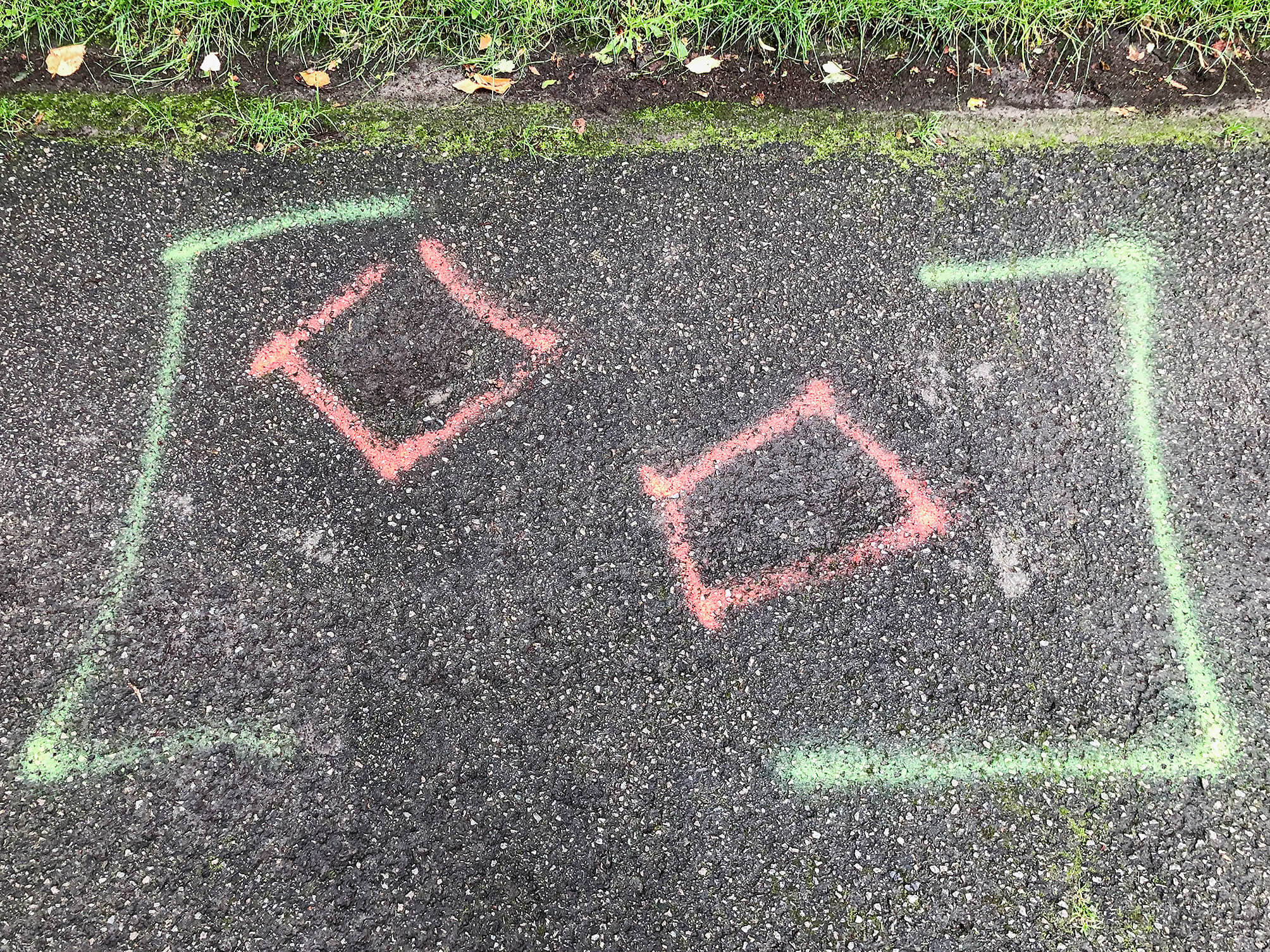
Holding two cans of spray paint, a city employee walks through a sweet chestnut grove on the graveyard. He’s looking for potholes.
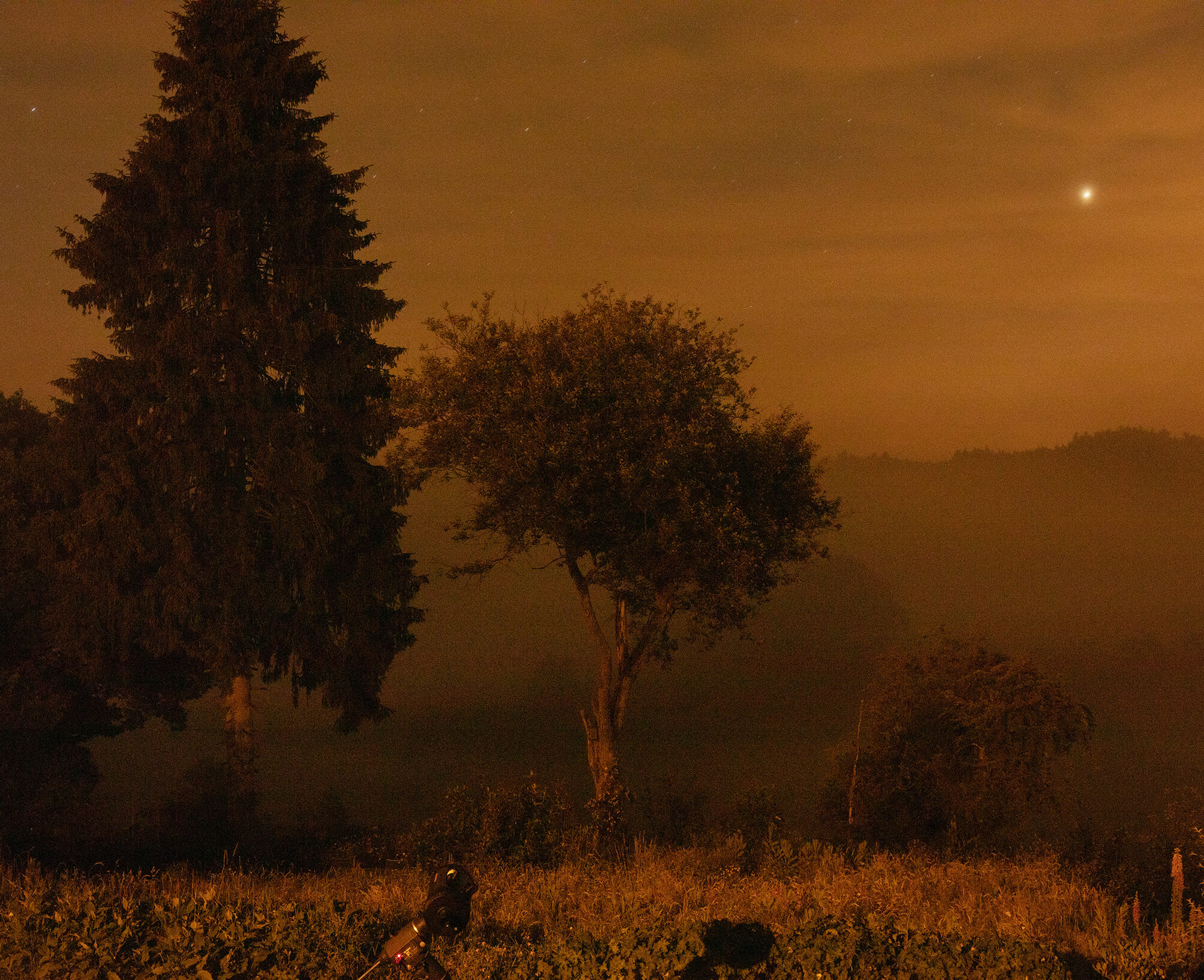
The orthopaedic surgeon left early that morning for his shift at the hospital some twenty kilometres away. It must have been around the time Neptune was at its highest, invisible in the morning sky.
When he got back later that day, we attached a tow cable to the front of my car and the back of his.


The car is parked on a gravel path, a few metres down from the small road crossing the village. It would be hopelessly stuck the next morning. While trying to capture Neptune through the rental telescope, I run back and forth between the tripod on the small lawn and the trunk several times to get other eyepieces and adapters.
I align the telescope, using three stars: Vega, Arcturus and Deneb.
I hear an animal. I look up and notice the interior light of the car has switched on.
A motorcycle around 3:14. The driver is shifting gears rapidly. I don’t see any headlights in the valley.
Fog sets in. Saturn practically disappears from sight. Jupiter appears as a blob.
I’m 380m above sea level. The highest hill in the area is barely 500m of height. Still, the fog and the settling dew, along with the nightly cold give it something strangely alpine.
The fog lifts.
I can still clearly see the ridge in the east. It should be darker.
A scene in German author and director Alexander Kluge’s Die Patriotin: a half-dome opens; the protagonist, Gabi Teichert, stares into the telescope. A montage follows: the waxing crescent moon coming into focus; a night vision of a cityscape with industrial elements; archival footage of a cityscape with skyscrapers during daytime; a giant fire; a woman giving birth aided by a midwife; raindrops falling into a puddle of water; a time-lapse video of a city at sundown; a ship floating by with, in the background, on the shore, windmills; images of tanks rolling by; close-ups of a purple-lit face of someone looking into the camera; archival footage of an air raid.1, 2
In a conversation with Ben Lerner, Kluge sees himself as someone ‘creating constellations’: ‘We deal with moving bodies. “Moving reality.” […] And this is something that you cannot present in a linear way, but in the form of constellations. “Constellation” refers to cosmic matter and gravitation. There are suns, moons, planets. There are also the dust particles, tiny particles that orbit around the sun for centuries according to physical laws. And there’s no hinge, no screw that connects them. Invisible connections.’3
Kluge, A. (dir.) Die Patriotin. München: Kairos Film, 1979. https://youtu.be/ZRuQ3SUgSSk?t=449
Kluge, A. Die Patriotin. Texte/Bilder 1-6. Frankfurt am Main: Zweitausendeins, 1979, 60-64. https://monoskop.org/images/4/49/Kluge_Alexander_Die_Patriotin.pdf
Lerner, B. & Kluge, A. The Snows of Venice. The Lerner-Kluge-container. Leipzig: Spector Books, 2018, 66.
Excerpt from Towards Civil Dusk (De Cleene De Cleene, 2020)
While calibrating their telescopes, or dealing with unforeseen, cloudy weather, amateur astronomers tend to trade the far for the not-so-far, and point their telescopes at their immediate surroundings.
Excerpt from Towards Civil Dusk (De Cleene De Cleene, 2020)

As the light of celestial objects travels through the Earth’s atmosphere, the various wavelengths that make up this light are refracted differently. This effect is called ‘dispersion’ and results in colour fringing on the edges of planetary discs: images with a sliver of blue at the top and a red one at the bottom appear.
When celestial objects are positioned close to the horizon (like Neptune when observed from Luxembourg) the images are severely affected: the path of the light through the atmosphere is longer, leading to greater dispersion.
For the same reason sunsets are red, Neptune turns from a monochromatic blue disc into a misaligned, multicoloured oval.


When the Sun, the Earth and one of the outer planets of the Solar System perfectly align, with the Earth positioned in the middle, the outer planet is said to be ‘in opposition’. It’s a moment of planetary approach and of optimal viewing conditions: the Earth and the outer planet are at their closest and brightest.
Neptune in opposition [1-20] is part of ‘Documenting Objects’, a research project by Arnout De Cleene and Michiel De Cleene at KASK & Conservatorium, the school of arts of HOGENT and Howest. Their research is financed by the HOGENT Arts Research Fund. Previous research into this subject has amongst other things led to the documentary film Towards Civil Dusk (2020) and temporary public observatories at 019, Gent and Kunsthal Extra City, Antwerp.

This stack of seaweed was offered by Henning, a farmer of the wonderful island of Laeso. This matriarchal pirate island, north of Denmark, is known for its tradition of building roofs from the seaweed growing in the surrounding salty water. Back in time, women would harvest and slowly weave the material around wooden beams from shipwrecks. This time-consuming process and technique of building shelters from what comes from the sea engaged the population in working together, building a ritual around each construction. Then those wild, yet full-of-care roofs, conserved in salt, would last for hundreds of years.
When I arrived on his land, Henning told me about how he restores those old beauties, weaving fresh seaweed around old beams and pressing the collected old material into insulation panels for new buildings. We talked about the clay of his land and how seaweed can become a material for ceramics in the process of making glazes.
Clementine Vaultier’s interests, although trained as a ceramist, are in the warm surroundings of the fire rather than the production it engenders.

The Cryptolaemus montrouzieri is commonly known as the mealybug destroyer. This species of ladybird gets its nickname from its capacity to battle mealybugs in plantations and greenhouses.
The website waarnemingen.be that gathers observations of plants and animals in Belgium lists multiple observations in the wild of the Cryptolaemus montrouzieri. The website explains that ‘in (northern) Europe, the species is widely traded and used in greenhouses and will regularly escape from them. But this ladybird cannot survive our winters (yet?). Sightings within the Benelux must therefore be entered into the register as “escape”. However, the species is already established in the Mediterranean area.’ (our translation)
The larvae have a waxy covering that makes them look like the mealybugs they prey upon, allowing them to avoid being correctly identified by the ones they are about to devour.
In an attempt to get rid of the mealybugs on my plants, I ordered 25 adult ladybirds. They were dead on arrival.
https://waarnemingen.be/species/600135/
https://waarnemingen.be/observation/244840499/
https://en.wikipedia.org/wiki/Aggressive_mimicry
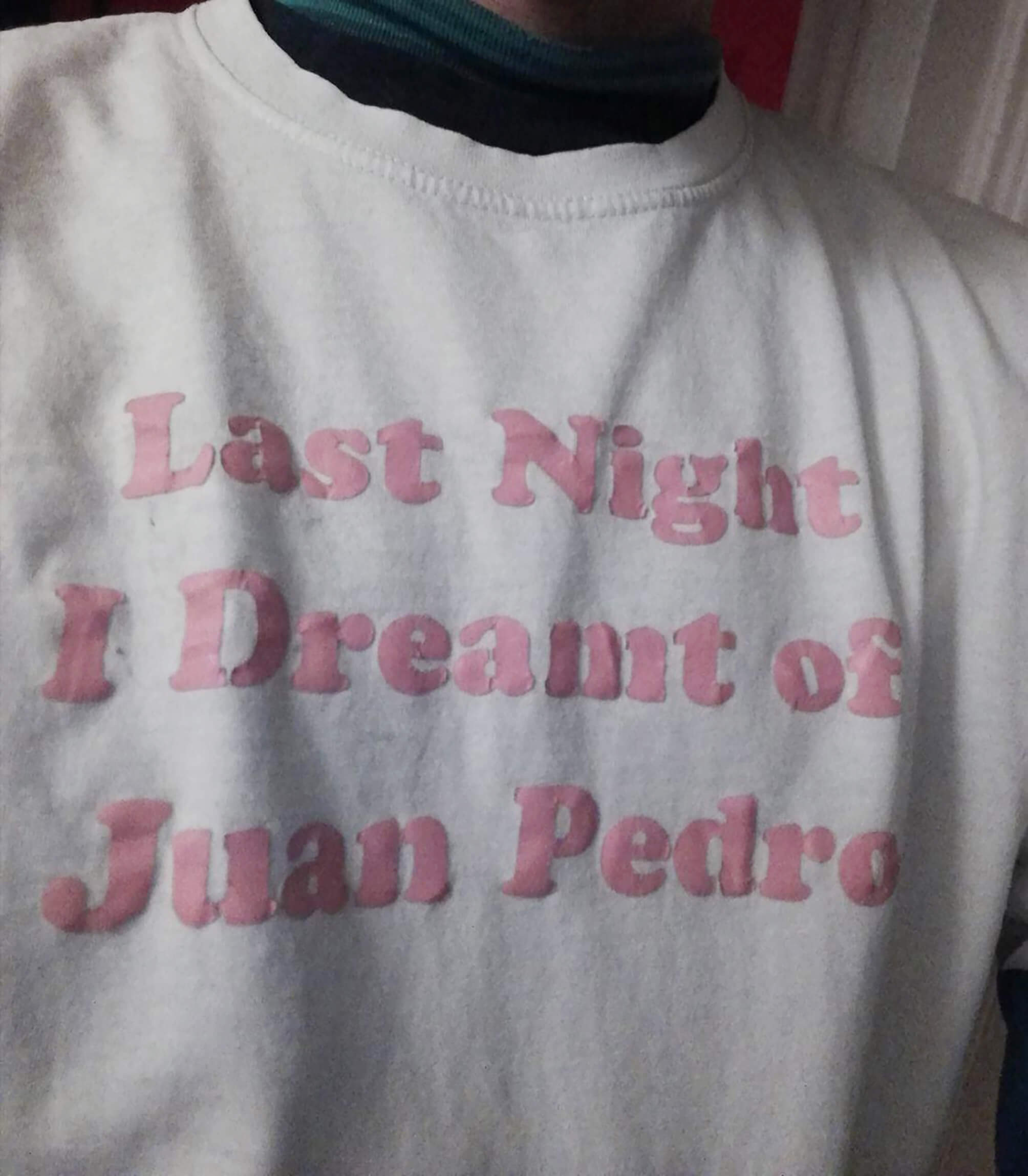
While I was sitting in the laundromat one evening waiting for my laundry to finish its cycle, La Isla Bonita by Madonna came on the radio. Competing with the rustle of seven rotating laundry machines, the song reminded me of a T-shirt that was now being washed.
The short phrase in the song’s lyrics ‘last night I dreamt of San Pedro’ would nestle itself somewhere in the back of my head and bubble up every now and again for no particular reason. I made this shirt for the occasion of Valentine’s Day in 2019 to commemorate my friendship with Jan-Pieter. I remember once mumbling the lyrics to La Isla Bonita, replacing ‘San Pedro’ for ‘Juan Pedro’, forgetting it for some time and then a while later printing it on a T-shirt.
Tjobo Kho is a graphic designer and publisher based in Amsterdam. Since 2017 part of the floating collective and publishing platform OUTLINE, and recently started his own publishing house no kiss?.
‘Submission for an art project named the-documents.org’ is a collection of 9 images1 generated by DALL·E mini2, an open-source AI model, on the basis of the prompt ‘Submission for an art project named the-documents.org’.
DALL·E mini is a freely available AI tool that generates images based on a description of the desired image (a prompt) provided by a user.
Though DALL·E mini seems to be primarily used as a source of humour within the online community – being able to create a set of images from any specific or abstract prompt – it also gives rise to more serious questions on AI ethics and copyright. As the model is trained with unfiltered data from the internet, it may reinforce societal biases, generating images that contain stereotypes against minority groups. DALL·E mini and similar, more advanced tools, are also capable of creating art ‘in the style of’ when they have sufficient data to source from (e.g. using a prompt as “Van Gogh painting the Eiffel Tower”). This leads to the legal and ethical question whether an artist should have a say in the use of his/her artwork as AI input data, and whether the artist should be able to claim rights for AI generated images based on this data.

DALL·E mini was created by Boris Dayma et al. 2021-2022, https://huggingface.co/spaces/dalle-mini/dalle-mini, to be migrated to www.craiyon.com
Ward Verwaeren is a legal counsel in the tech industry, and former IP lawyer. He tries to know more about art than the average lawyer, and more about law than the average artist.
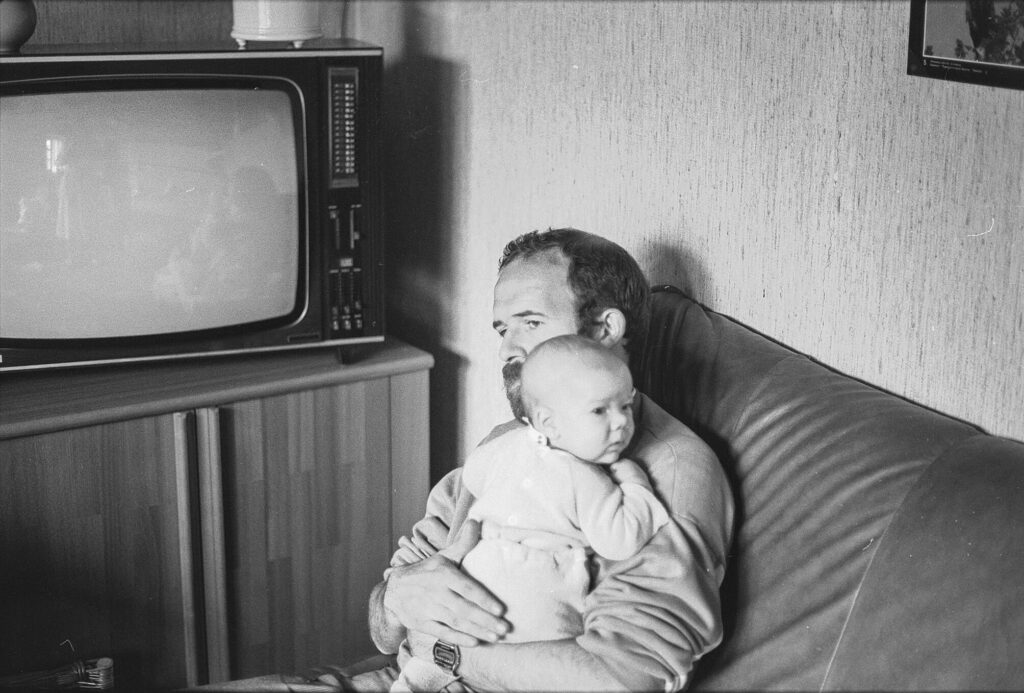
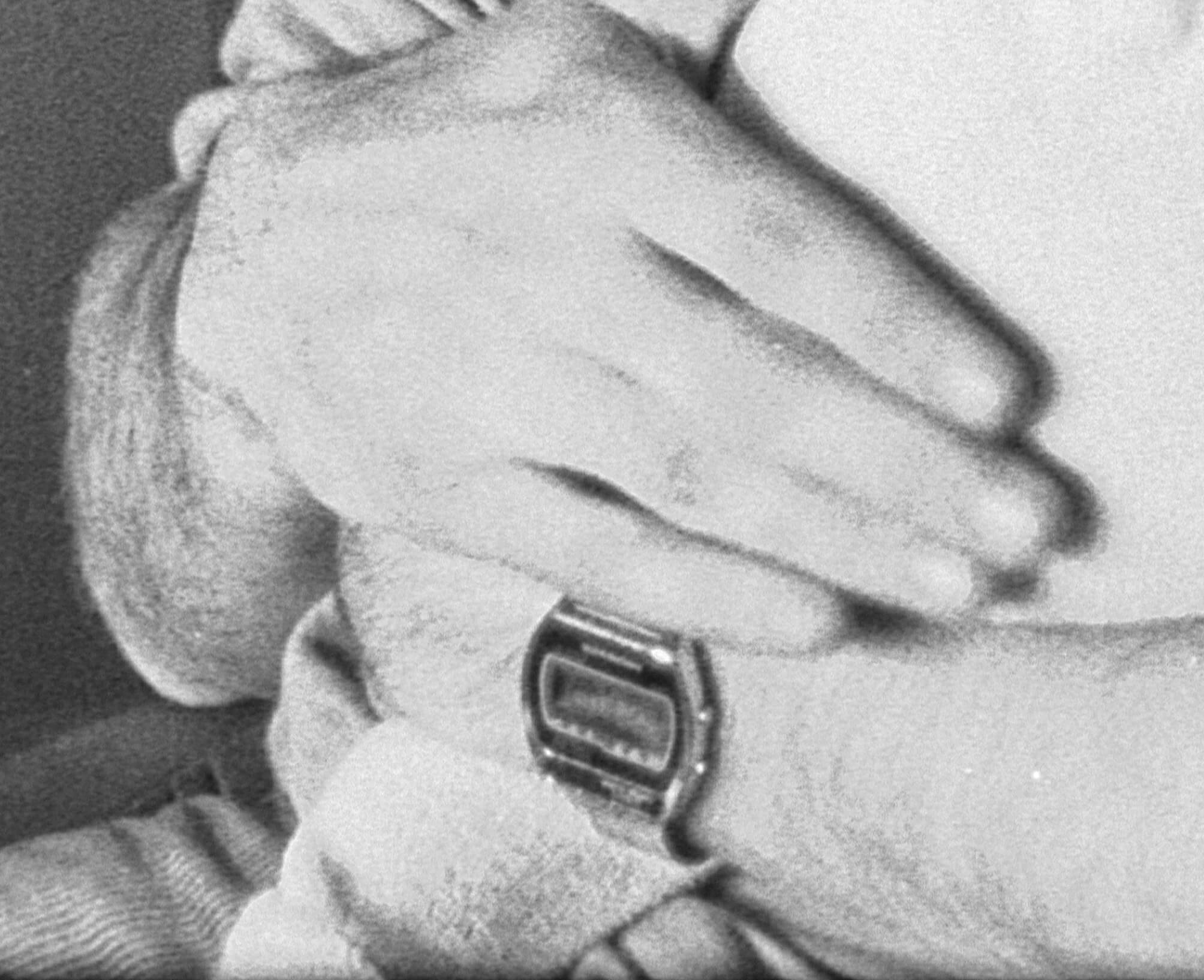
He’s wearing a digital watch. It looks like a Casio. It’s impossible to read the time, no matter whether you are studying the high-resolution scan of the negative or the negative itself, with the aid of a loupe and lightbox.
The device had a stopwatch function. When we were around eight and ten, we used to compete in trying to start and stop the stopwatch in the shortest possible interval. The smaller the gap, the closer to zero. Sometimes he would also have a try. We once managed to get it down to 00:00:00:03. Neither of us dared to press ‘reset’ and try again.
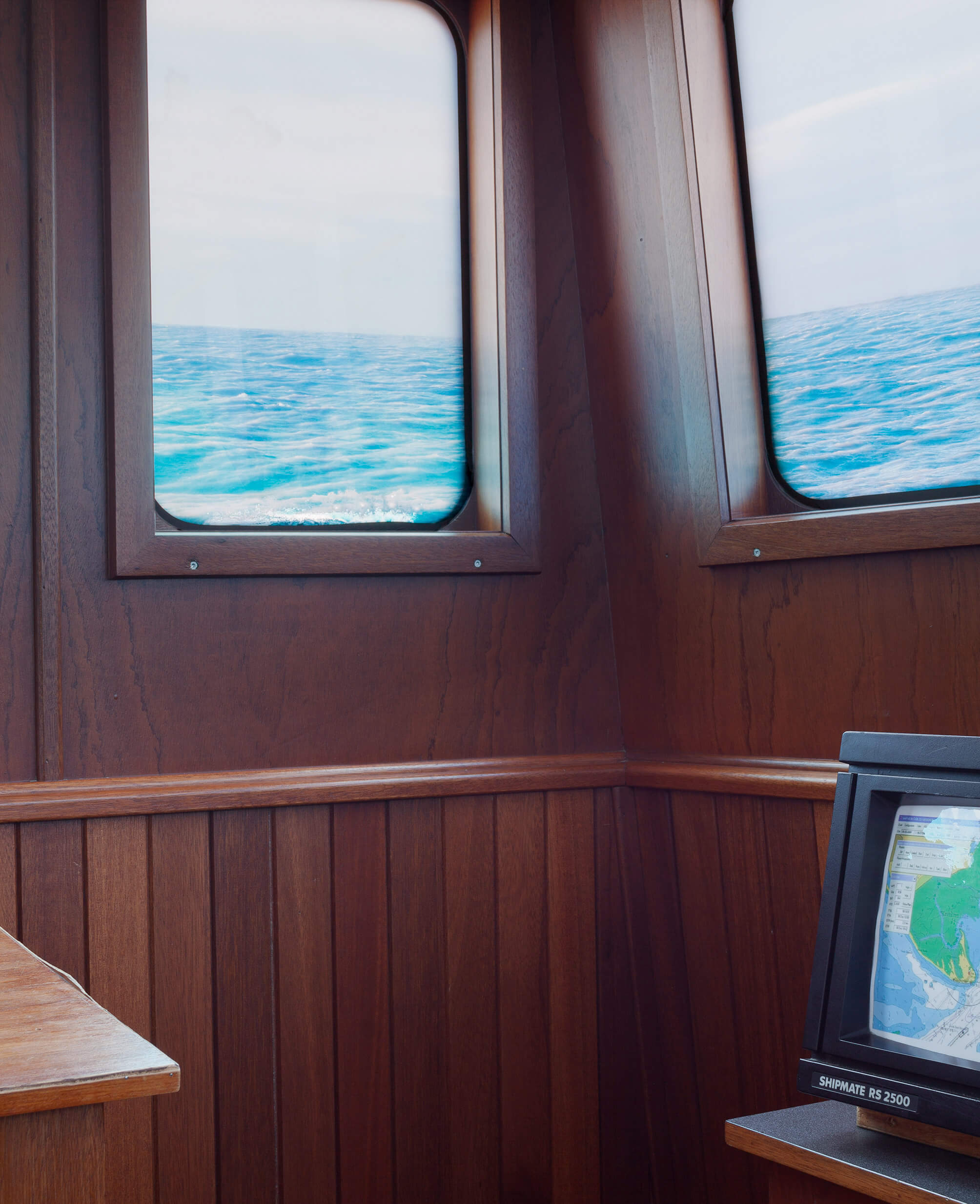
The GPS-plotter displays the ship near Keyhaven Lake, indefinitely. The sea appears calm, the horizon is level from one perspective.
_44A6588.dng
At 13:26:43 I took a photograph of a concrete building without windows in an industrial zone just south of Brussels.
_44A6590.dng
At 16:46:15 I photographed a succession of office buildings in the same industrial zone.
_44A6589.dng
I must have walked about 1 kilometer between the concrete building without windows and the section of the industrial zone with the offices. At 13:43:49, the camera, safely stored in my backpack, recorded 0.4 seconds of the 20 minutes it took me to get there.
In The Snows of Venice, Alexander Kluge wonders whether he can take the liberty to conjure up what the sky looked like on 31 December 1799, as Schiller made his way to Goethe’s house. He goes on by saying that, historically, there’s a ‘LACK OF SENSORY ATTENTION AT CRUCIAL MOMENTS’.1 There are exceptions, though, like the cameraman that was sent out to document the fireworks on New Year’s Day 2000. The camera was turned on prematurely. The batteries were used up by midnight, but ‘certain gray tones, however, filtered through the cracks of its protective case, conveyed the motion of the walking cameraman, the transportation. The incompletely shut, low-information container was documented exactly […] To this day it provides inexact testimony as to the qualities of the leather of a twenty-first century carrying case and the precise sensitivity to light and dark demonstrated by a twenty-first century recording medium.’2
Lerner, B., Kluge, A. The Snows of Venice. Leipzig: Spector Books, 2018, p. 53
Ibid.