What constitutes a ‘document’ and how does it function?
According to the Oxford English Dictionary, the etymological origin is the Latin ‘documentum’, meaning ‘lesson, proof, instance, specimen’. As a verb, it is ‘to prove or support (something) by documentary evidence’, and ‘to provide with documents’. The online version of the OED includes a draft addition, whereby a document (as a noun) is ‘a collection of data in digital form that is considered a single item and typically has a unique filename by which it can be stored, retrieved, or transmitted (as a file, a spreadsheet, or a graphic)’. The current use of the noun ‘document’ is defined as ‘something written, inscribed, etc., which furnishes evidence or information upon any subject, as a manuscript, title-deed, tomb-stone, coin, picture, etc.’ (emphasis added).
Both ‘something’ and that first ‘etc.’ leave ample room for discussion. A document doubts whether it functions as something unique, or as something reproducible. A passport is a document, but a flyer equally so. Moreover, there is a circular reasoning: to document is ‘to provide with documents’. Defining (the functioning of) a document most likely involves ideas of communication, information, evidence, inscriptions, and implies notions of objectivity and neutrality – but the document is neither reducible to one of them, nor is it equal to their sum. It is hard to pinpoint it, as it disperses into and is affected by other fields: it is intrinsically tied to the history of media and to important currents in literature, photography and art; it is linked to epistemic and power structures. However ubiquitous it is, as an often tangible thing in our environment, and as a concept, a document deranges.
the-documents.org continuously gathers documents and provides them with a short textual description, explanation,
or digression, written by multiple authors. In Paper Knowledge, Lisa Gitelman paraphrases ‘documentalist’ Suzanne Briet, stating that ‘an antelope running wild would not be a document, but an antelope taken into a zoo would be one, presumably because it would then be framed – or reframed – as an example, specimen, or instance’. The gathered files are all documents – if they weren’t before publication, they now are. That is what the-documents.org, irreversibly, does. It is a zoo turning an antelope into an ‘antelope’.
As you made your way through the collection,
the-documents.org tracked the entries you viewed.
It documented your path through the website.
As such, the time spent on the-documents.org turned
into this – a new document.
This document was compiled by ____ on 01.06.2026 06:13, printed on ____ and contains 18 documents on _ pages.
(https://the-documents.org/log/01-06-2026-6823/)
the-documents.org is a project created and edited by De Cleene De Cleene; design & development by atelier Haegeman Temmerman.
the-documents.org has been online since 23.05.2021.
- De Cleene De Cleene is Michiel De Cleene and Arnout De Cleene. Together they form a research group that focusses on novel ways of approaching the everyday, by artistic means and from a cultural and critical perspective.
www.decleenedecleene.be / info@decleenedecleene.be - This project was made possible with the support of the Flemish Government and KASK & Conservatorium, the school of arts of HOGENT and Howest. It is part of the research project Documenting Objects, financed by the HOGENT Arts Research Fund.
- Briet, S. Qu’est-ce que la documentation? Paris: Edit, 1951.
- Gitelman, L. Paper Knowledge. Toward a Media History of Documents.
Durham/ London: Duke University Press, 2014. - Oxford English Dictionary Online. Accessed on 13.05.2021.

In Zaffelare, young men who were called for military service but could not be missed at home were advised by the local doctor to swallow a small ball of aluminium foil an hour before the examination. In the X-ray, a gastric ulcer appeared. They were rejected for service. It is uncertain whether the increased incidence of gastric ulcers among young men in Zaffelare was a cause for concern.

In an attempt to make it his own, Gino – it might also be Dino – has taken a can of bright pink spray paint to his hard hat and – as the paint was drying – dragged his gloved finger from top to bottom. G – or D –, I, N, O. In the dust on a demolished floor tile, someone has written 12,10. Perhaps a measurement, a quantity, a position, a date, a reference.
Subtractive writing is not uncommon. With the tip of a passer-by’s index finger ‘WASH ME’ is subtracted from the dust on a dirty car. In freshly poured concrete, a name is embedded forever with a twig. In hot and soft roofing drawings and obscenities are scratched. Styrofoam lining a brand new elevator gets impressed with names, jokes and knuckles.
In the twenty-third canto of Ariosto’s Orlando Furioso (1516), Orlando comes across the name of his love and another man, carved in the bark of a tree. He doubts. But that night, a gossiping shepherd tells him he’s seen Angelica and Medoro together. Orlando returns to the forest, and in a four-day frenzy, he uproots every tree and pollutes the rivers forever.
CXXXI
For he turf, stone, and trunk, and shoot, and lop,
Cast without cease into the beauteous source;
Till, turbid from the bottom to the top,
Never again was clear the troubled course.
At length, for lack of breath, compelled to stop,
(When he is bathed in sweat, and wasted force,
Serves not his fury more) he falls, and lies
Upon the mead, and, gazing upward, sighs.1
Ariosto, L. Orlando Furioso. Translated by William Stewart Rose, Echo Library, 2006, p. 267.

A constant, dependable presence. With the camera focused on the North Star for an extended period, the rotation of the Earth becomes visible. Nearby, in the municipality of Wiederstedt, the geologist, poet and philosopher Friedrich von Hardenberg (better known by his pen name Novalis) spent his childhood years between 1772 and 1784. A quote of his is engraved on a stone bench in the park surrounding the chateau where he was raised: “The human being does not speak alone – the universe also speaks – everything speaks – infinite languages.”
From S. Anders Leben. Eine Handlung in Gesprächen/S. Anders Leben – Living Differently: An Act in Conversations
Stephanie Kiwitt (1972) is an artist based in Halle (Saale), Germany. Utilizing a large number of images, various perspectives and also textual elements, she is known for her insightful photography that explores spaces emblematic of contemporary phenomena. Over the past three years, she has focused on evolving habitats in rural areas, photographing traces of transformation and conducting interviews in Saxony-Anhalt, the region she moved to in 2020. From 2018 to 2020, Kiwitt was a guest lecturer at the LUCA School of Arts in Brussels.
In spring 2024 the-documents.org and Trigger co-publish a series of online articles with a focus on the meeting ground between photography and the document.

Freely adapted from interviews with residents of Sandersleben (Saxony-Anhalt). Three-act play. The first two acts take place in the present day; the third is set in the future.
From Act 1 ‘The Town of S’, Scene 2 ‘The Past’.
Characters: MR DUNST club member I, OLIVER club member II, ANJA young mother
Stills from text animation S. Anders Leben. Eine Handlung in Gesprächen/S. Anders Leben – Living Differently: An Act in Conversations
Stephanie Kiwitt (1972) is an artist based in Halle (Saale), Germany. Utilizing a large number of images, various perspectives and also textual elements, she is known for her insightful photography that explores spaces emblematic of contemporary phenomena. Over the past three years, she has focused on evolving habitats in rural areas, photographing traces of transformation and conducting interviews in Saxony-Anhalt, the region she moved to in 2020. From 2018 to 2020, Kiwitt was a guest lecturer at the LUCA School of Arts in Brussels.
In spring 2024 the-documents.org and Trigger co-publish a series of online articles with a focus on the meeting ground between photography and the document.

“… the late-Gothic St Mary’s Church in Sandersleben … was consecrated in 1519, just two years after Martin Luther published his Ninety-five Theses. After extensive renovation, part of it is still home to Sandersleben’s Protestant community. The building spans the historical period encountered throughout this region, the various stages of which continue to resonate today. Parts of the church predate the Reformation and the Peasants’ War; its tower, for instance, was initially a city tower before its subsequent role as a watchtower. The contemporary folding glass barrier inside the church is a nod to the future. Since 2013, this feature has enabled the church to host secular events, as it separates the choir from the nave. The significance of a structure or place is derived from its function. If it ceases to serve a purpose or meet a need, it loses its societal relevance. This lack of societal meaning becomes evident in its dilapidation and, ultimately, in its decay, removal or demolition. Lesser-known structures that haven’t been captured in photographs or documented can thus vanish completely, leaving no archaeological footprint, especially when replaced by new constructions. They leave no vestiges behind, not even a trace, which is usually an indicator of the presence of nothingness …”1
Sequence of images from Flächenland/Sprawling Region
Stephanie Kiwitt (1972) is an artist based in Halle (Saale), Germany. Utilizing a large number of images, various perspectives and also textual elements, she is known for her insightful photography that explores spaces emblematic of contemporary phenomena. Over the past three years, she has focused on evolving habitats in rural areas, photographing traces of transformation and conducting interviews in Saxony-Anhalt, the region she moved to in 2020. From 2018 to 2020, Kiwitt was a guest lecturer at the LUCA School of Arts in Brussels.
In spring 2024 the-documents.org and Trigger co-publish a series of online articles with a focus on the meeting ground between photography and the document.
Jonathan Everts, ‘A Long Farewell to the Present’, Flächenland (2020–22), Stephanie Kiwitt, Spector Books, Leipzig, 2023

Bricks and stones of various origin (aerated concrete blocks, clinker bricks, quarry stones).
From Fortlaufend/Ongoing
Stephanie Kiwitt (1972) is an artist based in Halle (Saale), Germany. Utilizing a large number of images, various perspectives and also textual elements, she is known for her insightful photography that explores spaces emblematic of contemporary phenomena. Over the past three years, she has focused on evolving habitats in rural areas, photographing traces of transformation and conducting interviews in Saxony-Anhalt, the region she moved to in 2020. From 2018 to 2020, Kiwitt was a guest lecturer at the LUCA School of Arts in Brussels.
In spring 2024 the-documents.org and Trigger co-publish a series of online articles with a focus on the meeting ground between photography and the document.

Set in the fictitious Shanghai-based Dafeng Cotton Mill, Red Skirt Popular on the Street (1984) follows the story of an enterprising model worker as she navigates the challenges of young adult life, from workplace conflicts to choosing what clothes to wear on her days off. In the reflection of the emerging consumer consciousness of the Reform era, many of the film’s key moments happen not on the factory floor, but in the changing room where the workers seek to express themselves through their choice of dress. To this end, the film can be regarded as a document of the fashion trends being introduced into the country at the time, as best observed in the spellbinding array of colours on display as the workers leave the factory at the end of a day’s work.
The textile mill used as the setting for Dafeng Cotton Mill is Shanghai No. 1 Cotton Mill. Originally occupied by the no. 13 and 14 mills of the Japanese-owned Naigaiwata Company, the mill was formally established as the China Textile Construction Company Shanghai No. 1 Cotton Mill after the Second World War. It was located at the T-shaped intersection on Changshou Road, with the gate facing Jiaozhou Road. At that time, the area on the north side of Changshou Road extending from No. 1 Cotton Mill formed a continuous industrial zone encompassing many other factories and warehouses, all of which have since been converted into the private residences and creative parks.
Ho Rui An is an artist and writer working in the intersections of contemporary art, cinema, performance and theory. Through lectures, essays and films, his research examines the relations between labour, technology and capital across different systems of governance in a global age.
In spring 2024 the-documents.org and Trigger co-publish a series of online articles with a focus on the meeting ground between photography and the document.

Gu Eryi’s Shanghainese opera film A Single Spark (1959) dramatises a violent confrontation between indentured labourers and their managers at the Japanese-owned Naigaiwata Company No. 7 Cotton Mill in 1925. The film’s protagonist is Yang Guiying, a peasant who moves to Shanghai to join her daughter only to find her at her last breath on the factory floor after being brutally beaten by her supervisor. The incident sparks protests among the workers at the factory, eventually resulting in one of them, Gu Zhenghong, being killed by a gunshot fired by a guard in the heat of the moment. This further escalates the unrest to a citywide scale, catalysing the May Thirtieth Movement.
The scenes of workers striking were filmed at Shenxin No. 9 Cotton Mill, also the location for another worker-themed film, United Until Tomorrow (1951). Those of Yang Guiying taking to the streets in support of anti-imperialism and patriotism were filmed at the Bund and the area surrounding Waibaidu Bridge. As for Naigaiwata Company No. 7 Cotton Mill where the events depicted in the film actually took place, the enterprise was merged with No. 5 and No. 8 Cotton Mills after the war and nationalised as Shanghai No. 2 Cotton Mill. Today, the site once occupied by the mill is a residential area where a statue of martyr Gu Zhenghong, first erected in 1959, stands before a memorial hall that was established in 2008.
Ho Rui An is an artist and writer working in the intersections of contemporary art, cinema, performance and theory. Through lectures, essays and films, his research examines the relations between labour, technology and capital across different systems of governance in a global age.
In spring 2024 the-documents.org and Trigger co-publish a series of online articles with a focus on the meeting ground between photography and the document.

Directed by Xie Jin, Huang Baomei (1958) is a docudrama based on the real-life experiences of the national model worker of the same name, who also plays herself in the film. Reflecting the economic priorities of the day following the launch of the Great Leap Forward—a far-reaching and ultimately devastating campaign that sought to replace the prevailing Soviet-style expert-managerial system with workers’ self-organisation and mass mobilisation—the film focuses on the challenges faced by machine operators as they strive for a technical breakthrough while working with their aging machines.
Located at No. 2866, Yangshupu Road, Shanghai No. 17 Cotton Mill, which had its origins in the Japanese-owned Yuho Spinning Company, was one of Shanghai’s best known cotton mills. The launch of China’s economic reforms opened a new era for the mill, as reflected cinematically in No. 17 Cotton Mill Shanghai Blues (1984), a British documentary that attests to the vibrant workers’ music scene blossoming within the factory walls. In 1992, the state-owned enterprise was restructured as one of the first batch of joint-stock companies in the Reform era and renamed as Longtou Company after the brand name of a fabric manufactured by the mill. Following the relocation of the mill’s original machinery to Jiangsu in 2007, work commenced to redesign the entire complex and relaunch it as the Shanghai International Fashion Center. In Jia Zhangke’s I Wish I Knew (2010), an elderly Huang Baomei is seen walking amidst the ruins that are all that remain of the cotton mill as it awaits refurbishment.
Ho Rui An is an artist and writer working in the intersections of contemporary art, cinema, performance and theory. Through lectures, essays and films, his research examines the relations between labour, technology and capital across different systems of governance in a global age.
In spring 2024 the-documents.org and Trigger co-publish a series of online articles with a focus on the meeting ground between photography and the document.

United Until Tomorrow (1951) is based on the real-life events that took place at Shanghai’s Shenxin No. 9 Cotton Mill where workers led a factory-wide strike in 1948 to protest salary arrears against the background of escalating inflation. Shot at the original location of the strike, the film shows the entrance of the cotton mill transformed into a literal and ideological battlefield where workers gain class consciousness and fight to reclaim their rightful place as owners of the factory. In one climactic scene, the workers even seal the factory gate from the outside to prevent the products of their labour from being expropriated by Kuomintang forces.
Located at No. 128, Aomen Road, Shanghai, Shenxin No. 9 Cotton Mill belonged to the system of mills managed by Shenxin Textile Company, a private enterprise founded in 1915 by Wuxi-bred industrialist brothers Rong Zongjing and Rong Desheng. Following the Communist takeover of Shanghai, the cotton mill was nationalised in the 1950s and placed under the management of the Shanghai Textile Industry Bureau. With the subsequent launch of the economic reforms, the bureau was restructured into a holding company in 1998 amidst the deindustrialisation of the city. While many iconic buildings in the Shanghai Bund area today can be seen in the film, little remains of the original architecture of No. 9 Cotton Mill where the Shanghai Textile Museum is now located.
Ho Rui An is an artist and writer working in the intersections of contemporary art, cinema, performance and theory. Through lectures, essays and films, his research examines the relations between labour, technology and capital across different systems of governance in a global age.
In spring 2024 the-documents.org and Trigger co-publish a series of online articles with a focus on the meeting ground between photography and the document.

A classic of Republican-era cinema, the 1926 silent film A String of Pearls follows the trials and tribulations of a middle-class Shanghai couple after a pearl necklace borrowed by the husband to please his materialistic wife is stolen. In order to pay for a replacement, the protagonist resorts to embezzling public funds and consequently ends up in prison. After working as a weaver during his sentence, he becomes a worker at Zhenhua Cotton Mill following his release. In an obvious homage to the Lumières’ seminal film, a scene in the film shows workers, including children, entering the factory to begin a day’s work.
Even though the precise location of the factory gate in the film cannot be determined, it happens that the first enterprise that attracted the investment of Rong Ruixin—a relative of cotton magnates Rong Zongjing and Rong Desheng—was called Zhenhua Cotton Mill. Established in 1905, Zhenhua Cotton Mill was not fully mechanised, which would correspond with the appearance of a hand-operated loom in the film. Today, a residential community sits on the original site of the cotton mill.
Ho Rui An is an artist and writer working in the intersections of contemporary art, cinema, performance and theory. Through lectures, essays and films, his research examines the relations between labour, technology and capital across different systems of governance in a global age.
In spring 2024 the-documents.org and Trigger co-publish a series of online articles with a focus on the meeting ground between photography and the document.

When discussing the sensitivities around viewing British propaganda photographs from the 1950s with Mau Mau veterans in Kenya, it became clear that it was not the graphic photographs of atrocities that would trigger the veterans emotionally, but a series of straightforward portraits of men who had pledged allegiance to the British colonial administration. These portraits were catalogued along with the men’s names and another photograph of each one of them signing a declaration of collaboration. I was advised by the representative of the veterans’ association that it would be too dangerous to share these photographs with the veterans.
22 superimposed portraits from the file CO 1066/7: Kikuyu Loyalists at The National Archives (UK) depicting Kikuyu loyalists after signing a declaration of collaboration with the British on 27 January 1954.
From the series State of Emergency, Max Pinckers et al. (2024)
Max Pinckers (°1988, BE) and Victoria Gonzalez-Figueras (°1988, CA) are based in Brussels, Belgium. They have been working together for the past ten years on documentary photography projects. Victoria works in the cultural field as a researcher and producer. Max is a speculative documentarian, teacher and occasional writer on photography. They are married, in love, and have a son. Victoria has consistently assisted Max in his projects as a production manager, but they have recently been making new work together as co-authors. “Double Reward” is the first such project.
In spring 2024 the-documents.org and Trigger co-publish a series of online articles with a focus on the meeting ground between photography and the document.

‘In the human design and use of weapons, natural elements are harnessed and deployed as a destructive technology. In this engineering, there is a break, fissure, and crack whereby the human and non-human entity, having been elastic, on impact becomes plastic, and forever changed from its original self.’
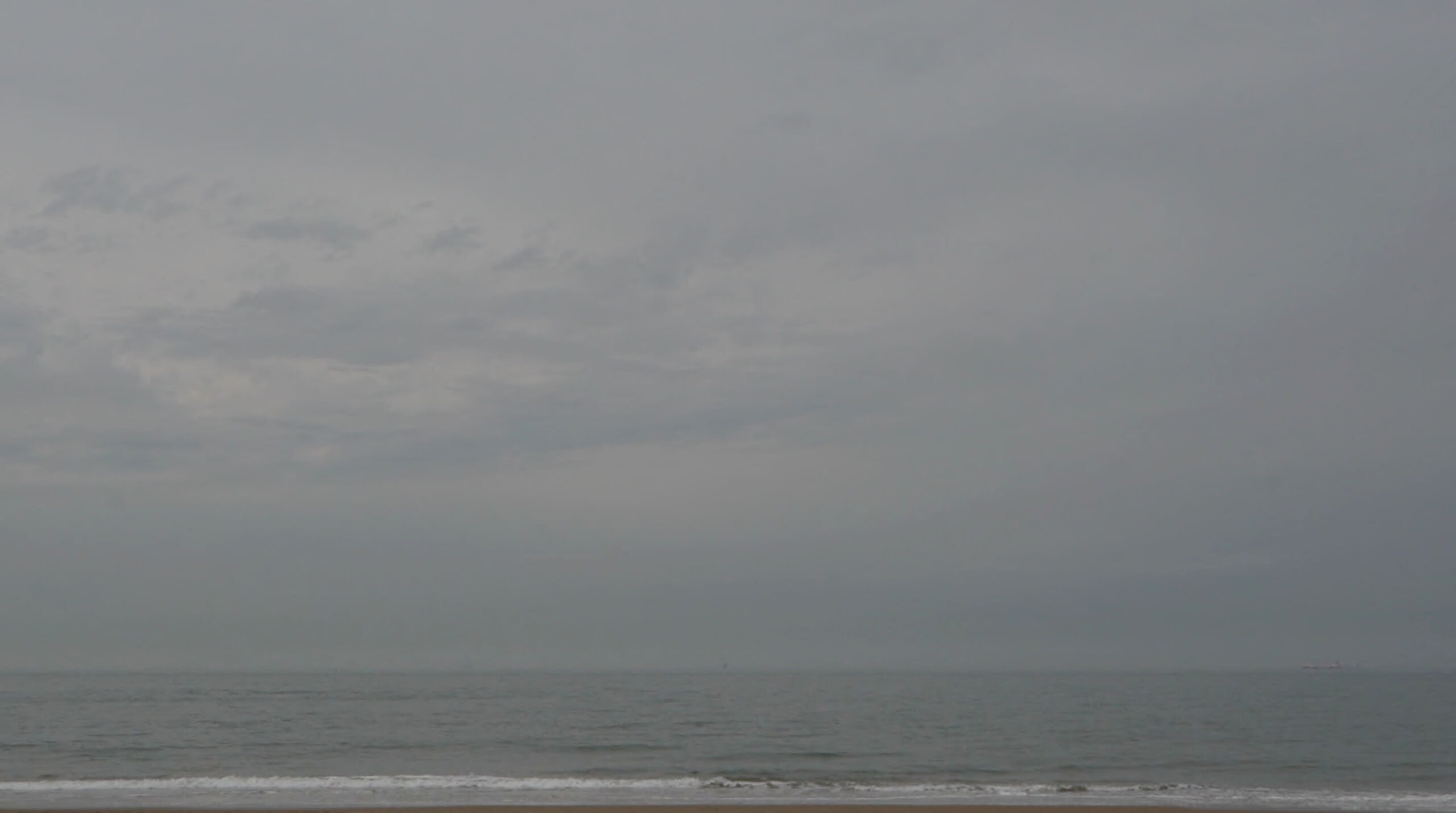
Screenshot from the film showing the calm shoreline situated close to the International Criminal Court (ICJ) in the Netherlands.
Frame of Accountability, 01:00:00, Helene Kazan, 2024.
Film chapter Beyond the Sky’s Limits narrates law as a consciousness coming to terms with its own failings: the speculative voice of a feminist, queered, decolonial international law. Unravelling this complex non-human subjectivity, it narrates the drafting of the Rules of Air Warfare in 1923. A filmic study of the legal archival document reveals how these international laws of war become corrupted by the self-interests of the strong states and colonial powers involved in their making: their ambitions fail quickly and critically.
Helene Kazan is an artist, writer and educator. Her work investigates ‘risk’ as a lived condition produced through the conjoined violent effects of capitalism and conflict. This is observed in the colonial roots of international law and its material formation of the lived-built environment. In response, she uses decolonial, feminist, poetic and critical-legal approaches in her work, which explores ways of dismantling the ongoing effects of neo-colonial violence towards wider frameworks of accountability and justice.
In spring 2024 the-documents.org and Trigger co-publish a series of online articles with a focus on the meeting ground between photography and the document.
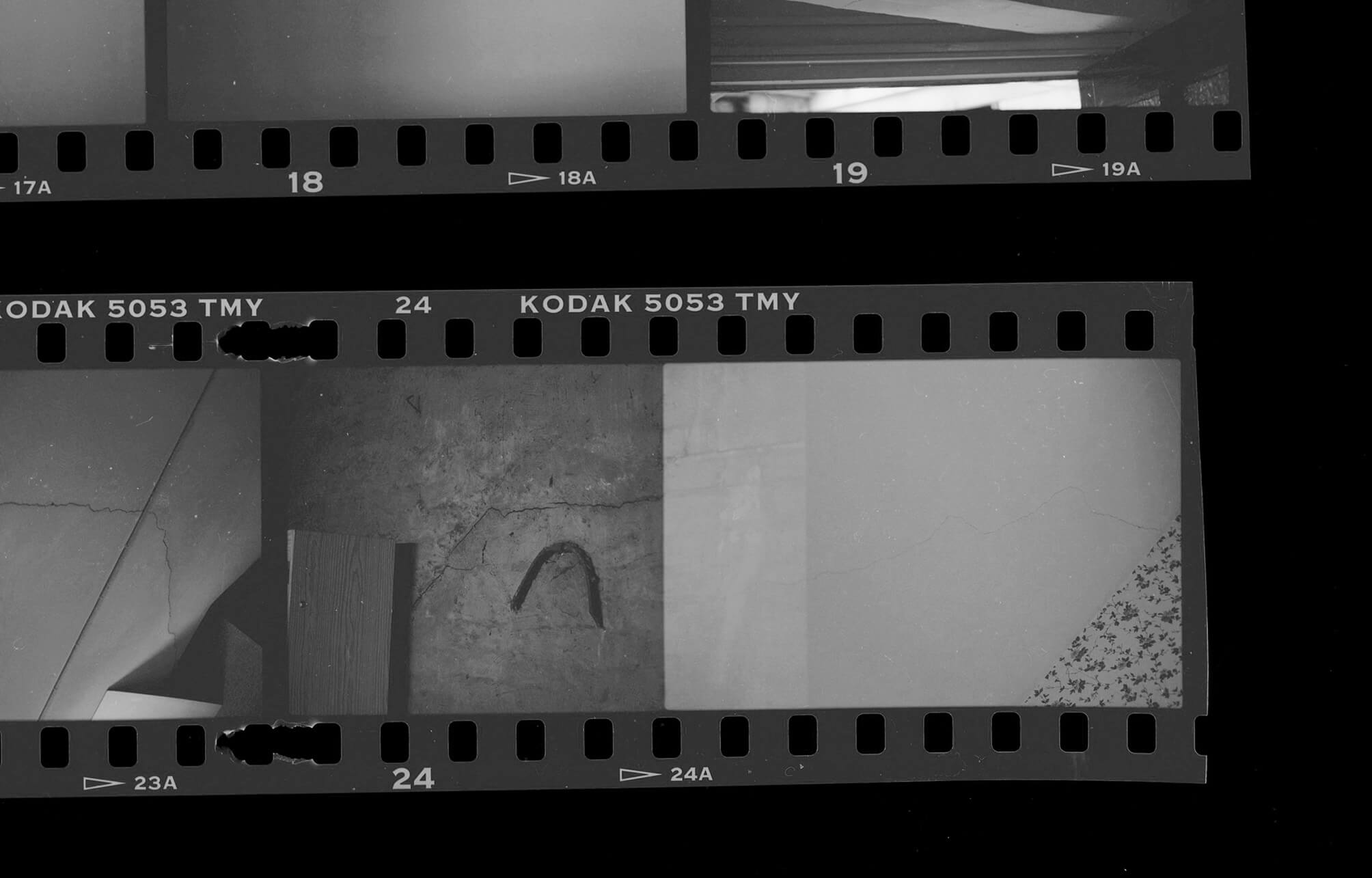
When we bought our house more than a decade ago, we were told it was listed as architectural heritage.1 The house used to be part of the Heynderyckx Foundry, in part designed by architect F. Dierkens. When submitting the planning application in the run-up to the renovation, it was therefore mandatory to include a report from the city’s heritage conservation department. They asked for plans of the proposed changes, as well as plans and photographs of the situation as it is.
The department’s advice came a few weeks later. ‘With the exception of the fireplace with its marble mantelpiece in the room at the street side on the ground floor, this building has lost many of its architectural features. The façade rendering with faux joints, the vertical pilasters with their capitals, the central curved façade finish and the joinery are elements that defined the façade and have been removed. The new design is therefore acceptable subject to the following comments:
– preservation of the marble fireplace on the ground floor.’
We replied: ‘Unfortunately, the marble mantelpiece on the ground floor is not original either. We suspect that the original fireplace disappeared along with the façade, sometime in the seventies. The mantelpiece you can see in the image is an approximation of, and a reference to, what we imagine it might once have looked like. This replica is made of sheets of MDF with a layer of Formica F3460 – Calacatta Marble.’
Formica still produces these sheets.2 They measure 3,05 x 1,3m. Similar to wallpaper, the same marble pattern appears twice on every sheet, seamlessly.


https://inventaris.onroerenderfgoed.be/erfgoedobjecten/18442
https://www.formica.com/nl-be/products/laminate/F3460

Photographing the house and the clearing it stood in proved difficult. During summer, the nettles and brambles slowed down the pace. Some plants stung the elbows. The clearing only became visible when the sun fell through the opening in the canopy. On cloudy days the clearing disappeared.
‘As the order of institutions follows its course, or as huts give way to villages and then to cities and finally to cosmopolitan academies, the forests move further and further away from the center of the clearing. At the center one eventually forgets that one is dwelling in a clearing. […] Yet however wide the circle may get through the inertia of civic expansion, it presumably retains an edge of opacity where history meets the earth, where the human abode reaches its limits.’
Pogue Harrison, R. ‘The Ecology of Finitude’, in: id., Forests. Chicago, 1992, 245.

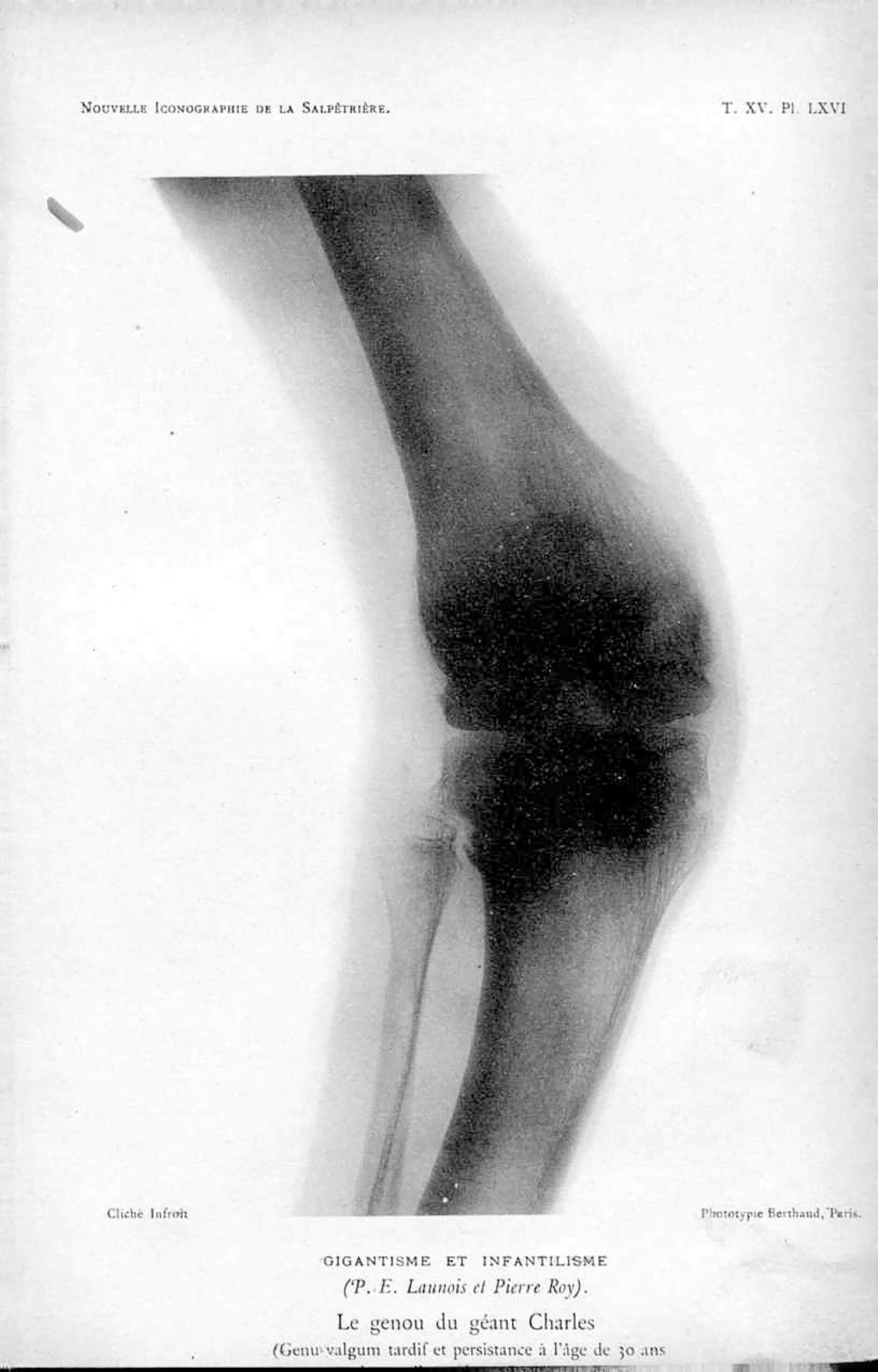
The scientific exactitude sought for in the Iconographie de la Salpêtrière and the Nouvelle Iconographie de la Salpêtrière, the (in)famous scientific publications stemming from Paris’ psychiatric hospital La Salpêtrière (1876-1918), lead to an abundance of photographic images in their pages. The photographs’ ideal: ‘Trace incontestable, incontestablement fidèle, durable, transmissible’.1 The ambition of exactitude results in cold, and often cruel depictions of patients. In the digitized version of the Sorbonne library’s copies, some photographs have left an imprint on the opposite page. The knee of Charles, ‘le géant’, adds an unwanted layer upon its measures on the opposite page, while the photograph of the knee itself loses ink.2
Didi-Huberman, G. Invention de l’hystérie. Paris: Macula, 2014, 72.
Launois, P.-E., Roy, P., ‘Gigantisme et infantilisme’, Nouvelle Iconographie de la Salpêtrière, Tome XV, 1902, 548, pl. LXVI, online: https://patrimoine.sorbonne-universite.fr/fonds/item/2613-nouvelle-iconographie-de-la-salpetriere-tome-15?offset=6

In Walter Benjamin’s The Arcades Project, Convolute Q is dedicated to the panorama. Benjamin writes: ‘Setup of the panoramas: View from a raised platform, surrounded by a balustrade, of surfaces lying round about and beneath. The painting runs along a cylindrical wall approximately a hundred meters long and twenty meters high. The principal panoramas of the great panorama painter Prévost: Paris, Toulon, Rome, Naples, Amsterdam, Tilsit, Wagram, Calais, Antwerp, London, Florence, Jerusalem, Athens. Among his pupils: Daguerre’ (Q1a, 1).
Benjamin, W. The Arcades Project (H. Eiland & K. McLaughlin, trans.). Cambridge/London: The Belknap Press of Harvard University Press, 2002, p. 528.
I drove through the neighborhood seeking evidence of the disruption using a power outage map as a compass. Winding through quiet streets, I stumbled upon a lone blue PG&E truck idling opposite a charred utility pole with fragments of wood and wire strewn across the pavement. I parked my car and walked toward the truck to ask the driver what had happened. He pointed to the top of the pole where a porcelain insulator dangled precariously from a high-voltage line. “Tracking,” he said curtly. “Is that like a short circuit?” I asked. “Kind of,” he replied before pausing. He finally elaborated, explaining that the problem arises when moisture from morning fog settles on power lines, creating a pathway for electricity to arc across components.
He then input something into a handheld device before driving away, leaving the repair for another service team to complete. I gathered the debris intending to collect the remaining components that comprise a utility pole, each having failed in one form or another. I shipped the fragments to Maziar the following week.
Mathew Kneebone is an artist based in San Francisco. His interdisciplinary practices takes different forms, all in relation to an interest in electricity and technology. He teaches studio and thesis writing at California College of the Arts.

